REVIEW 4 major objections 5 minor 1 cited by
Quantizing instruction-tuned LLMs down to low precision degrades their fairness and safety, especially outside English, and the paper proposes keeping a small sensitivity-ranked set of weights in full precision to reverse most of the damage
Reviewed by Pith at T0; open to challenge. T0 means a machine referee read the full paper against a public rubric. the ladder, T0–T4 →
T0 review · deepseek-v4-flash
2026-08-03 09:53 UTC pith:W7MXQVG6
load-bearing objection Broad multilingual study of quantization effects on fairness/safety; the mitigation's gains may just come from extra precision, and the 'consistent degradation' claim is contradicted by the paper's own tables. the 4 major comments →
Preserving Fairness and Safety in Quantized LLMs Through Critical Weight Protection
The pith
A machine-rendered reading of the paper's core claim, the machinery that carries it, and where it could break.
Core claim
The central claim is that a small, identifiable subset of weights in an aligned LLM carries much of the burden of fair and safe behavior, and that perturbing those weights during quantization is the main cause of fairness and safety collapse. The paper operationalizes this through Critical Weight Protection: it computes per-weight sensitivity as the average squared gradient of a fairness loss and a safety loss relative to a general loss, ranks weights by the sum of those scores, and preserves the top fraction in FP16. Applied to AWQ with 60% of weights kept in full precision, this keeps fairness metrics at or above full-precision levels on several benchmarks and lifts MultiJail safety in Kor
What carries the argument
Critical Weight Protection (CWP), a mixed-precision scoring pipeline. For each weight it computes FAIRSCORE = I_fair - beta*I_gen and SAFESCORE = I_safe - beta*I_gen, where I is the average squared gradient of the respective loss, i.e. a diagonal-Fisher approximation. Fairness sensitivity comes from a loss that penalizes divergence between likelihoods of stereotypical and anti-stereotypical completions on StereoSet; safety sensitivity comes from cross-entropy on harmful AdvBench prompts; general sensitivity comes from next-token cross-entropy on Wikipedia and single-turn instruction-following data. The two scores are summed, weights are ranked, the top k% are kept at FP16, and the rest are q
Load-bearing premise
The load-bearing assumption is that a weight's mean squared gradient on fairness and safety losses, estimated from 128 calibration examples, correctly identifies which weights must be preserved at FP16 to prevent the specific fairness and safety degradation that AWQ quantization would otherwise cause; if those sensitivity scores do not transfer from calibration data to the quantized model, the observed mitigation would not generalize beyond the reported setting.
What would settle it
Run the same AWQ+CWP pipeline with the ranking reversed - keep the 60% lowest-scoring weights in FP16 and quantize the top-scoring 60%; if reversed protection recovers fairness and safety as well as the original CWP does, the criticality ranking is not the causal mechanism. Alternatively, recompute FAIRSCORE and SAFESCORE on a held-out or non-English calibration set and rerun the main tables; if the protection gains disappear while uniform AWQ's degradations remain, the 128-example gradient estimates are not transferable.
If this is right
- Mixed-precision quantization guided by fairness/safety gradients offers a practical middle path: most weights still get compressed to INT4, and only a fraction need FP16, so efficiency is retained while trustworthiness is preserved.
- Non-English deployment is the higher-risk scenario: quantization degrades Korean and Arabic safety more than English, and CWP's largest measured gains are precisely there - a direct argument for language-aware trust evaluation in compressed models.
- Dynamic quantization methods appear safer as a default: FP8 and LLM.int8() stay close to full precision, whereas SmoothQuant on Gemma failed outright, so method choice matters as much as precision level.
- The mitigation is robust to hyperparameter choice: varying k from 0.6 down to 0.2 and beta from 0.5 to 1.5 causes only mild changes, and CWP beats an alternative importance-scoring baseline at every k.
- Because no retraining or alignment step is needed, CWP can be applied post-hoc to models already in deployment by re-running AWQ with the protected mask.
Where Pith is reading between the lines
- The sensitivity scores are computed from English-centric calibration sets (StereoSet, AdvBench, Wikipedia-style text), yet the biggest measured recoveries are in Korean and Arabic; whether scores computed on target-language examples would yield an even smaller or different critical set is untested.
- If the protected top-k set is truly causal, it points to a sparse 'alignment subnetwork'; a direct ablation - adding noise to the FP16-protected weights at inference - should specifically break fairness and safety while leaving perplexity nearly intact, a prediction the paper does not run.
- The paper applies CWP only to AWQ on 7-8B models; extending the same scoring to GPTQ, SmoothQuant, dynamic methods, or larger models would test whether the critical weights are a property of the model itself or of the quantization method.
- The aggregate claim that quantization 'consistently degrades' fairness and safety is shaped by catastrophic outliers such as SmoothQuant on Gemma and GPTQ on Llama SafetyBench; a stricter uncertainty-aware meta-analysis would clarify how often the effect is practically meaningful rather than merely negative in sign.
Editorial analysis
A structured set of objections, weighed in public.
Referee Report
Summary. The paper reports a systematic study of how five quantization methods (GPTQ, AWQ, SmoothQuant, FP8, LLM.int8()) affect fairness and safety of three 7–8B instruct models across several languages and benchmarks. It then proposes Critical Weight Protection (CWP): weights are ranked by a sensitivity score combining FAIRSCORE and SAFESCORE, the top k% are kept in FP16, and the remaining weights are quantized to INT4 via AWQ. The authors claim that quantization consistently degrades fairness and safety, that dynamic methods are more stable than static ones, and that CWP mitigates these degradations without sacrificing efficiency or general utility.
Significance. If the claims were fully established, the paper would be a useful contribution to responsible LLM compression: the multilingual breadth, the combination of intrinsic and extrinsic fairness metrics with safety benchmarks, and the detailed appendix tables are strengths. The paper also includes useful control experiments (SNIP-based scoring comparison in Table 7 and an inverted-score control in Appendix D) and a hyperparameter sweep in Table 6. However, the central claims are currently not established as stated: the empirical generalization about consistent degradation is contradicted by the paper's own tables, and the CWP evaluation lacks the precision-budget controls needed to attribute the gains to the sensitivity ranking rather than to the increased average bit-width.
major comments (4)
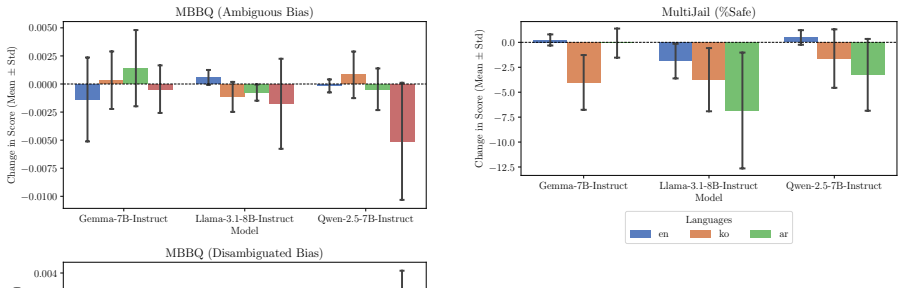
- [§5.1, Abstract; Fig. 2; Tables 1–3] The abstract and Section 5.1 state that quantization 'consistently degrades fairness and safety,' but the paper's own data contain many counterexamples. Figure 2 shows that for Qwen-2.5-7B most quantization methods have positive aggregated fairness differences, and Table 1 reports large improvements such as GPTQ StereoSet ICAT +1.873 and FP8 +1.239 for Qwen. In Table 3, Llama-3.1-8B AWQ improves Do-Not-Answer ASR (5.964 vs 6.070). The aggregate figures are also not robust: Appendix C.1 excludes SmoothQuant from the Gemma fairness aggregate as an outlier, while Figure 3 includes SmoothQuant as a catastrophic safety outlier (-12.19). The conclusion should be restated as 'quantization can degrade or sometimes improve fairness/safety, with degradation more pronounced in non-English safety evaluation,' and the aggregate analysis should be reported with and without the SmoothQuant exclusion.
- [§5.2, Tables 4–5; §3, Eq. (1)–(7)] The central claim that CWP's sensitivity ranking—rather than simply retaining more precision—drives the observed gains is not established. With the default k=0.6, AWQ-trust has average bit-width 0.6×16 + 0.4×4 = 11.2 bits per weight, about 2.8× the memory of uniform 4-bit AWQ and close to a uniform 8-bit model. Tables 4–5 compare AWQ-trust only against uniform AWQ and FP16; there is no random-selection control at the same k, no uniform 8-bit baseline, and no measurement of inference memory, latency, or throughput. The improvements over AWQ are therefore expected from the bit budget alone, and the assertion that AWQ-trust 'retains efficiency' is unsupported. Add (i) a random top-k FP16 control, (ii) a uniform 8-bit baseline matched in total bit budget, and (iii) actual memory/latency/throughput numbers.
- [§3, §4.1; Table 4] The fairness sensitivity score FAIRSCORE is computed from the intrasentence subset of StereoSet (Section 3), and Table 4's headline fairness results are measured on StereoSet SS and ICAT. This means the main evaluation is in-domain for the calibration data used to define the score. The improvements on StereoSet could partly reflect overfitting to the calibration set rather than a general protection of fairness-critical weights. The held-out results (CrowS-Pair, Jigsaw, MBBQ in Tables 4 and 16) are more persuasive, but the paper should explicitly separate calibration-set evaluation from held-out evaluation, and ideally calibrate on a different fairness dataset or report the degree of score transfer.
- [§5.1, Figures 2–3; Appendix C.1] The conclusion that 'dynamic methods demonstrate greater stability than static ones' is not supported by the aggregate analysis as presented. SmoothQuant, a static method, is among the most stable methods for Llama-3.1-8B and Qwen-2.5-7B in Tables 1–3, while its Gemma results are excluded from Figure 2 as an outlier but included in Figure 3 with a very large negative value. The comparison therefore conflates method stability with model-specific incompatibility. The authors should report aggregate scores separately with and without SmoothQuant, and quantify per-method variance across the three models rather than drawing a static-vs-dynamic distinction from the current figures.
minor comments (5)
- [§3 vs §4.1] Section 3 says the fairness sensitivity uses the 'intrasentence subset' of StereoSet, while Section 4.1 says 'we focus on the intersentence subset.' Please clarify which subset is actually used, as this affects reproducibility.
- [Table 3, Figure 3] Table 3 uses 'HExPHI' in the header while Section 4.2 writes 'HEx-PHI.' Also, Figure 3's y-axis is labeled 'Average Difference (%Safe Answers)' but the aggregated metrics include ASR (where lower is better); describe the sign transformation used in Appendix C.1.
- [§4.4, Table 1] The text says SmoothQuant is 'incompatible with Gemma-7B-Instruct,' but Table 1 still reports fairness scores for SmoothQuant on Gemma. Clarify whether the incompatibility applies only to the safety evaluation and generation tasks, or to all evaluations.
- [§5.2, Table 6] The default k=0.6 and β=1 are stated as the settings for the main experiments before the hyperparameter sweep is described. Provide a rationale for these defaults, and clarify whether the qualitative conclusions in Tables 4–5 are sensitive to k for models other than Llama-3.1-8B.
- [Appendix D] The inverted-score control is applied only to FAIRSCORE and only on Gemma-7B for fairness. Since SAFESCORE is a separate component, an analogous inverted-safety-score control would strengthen the claim that the safety results are driven by safety-critical weight selection.
Circularity Check
No significant circularity: CWP results are supported by out-of-sample benchmarks; same-benchmark overlap is neither definitional nor load-bearing.
full rationale
The paper's central degradation measurement is a direct empirical comparison of quantized models against full-precision baselines (Tables 1-3); no derived or fitted quantity is fed back into the conclusion. The mitigation method (CWP) uses squared-gradient saliency scores: FAIRSCORE and SAFESCORE are computed from small calibration losses (StereoSet for fairness, AdvBench for safety), while the reported evaluation metrics are distinct downstream quantities (SS/ICAT, CrowS-Pair, Jigsaw, MBBQ, SafetyBench, Do-Not-Answer, HEx-PHI, MultiJail, AlpacaEval). The only overlap is that FAIRSCORE is computed on a StereoSet subset (Section 3) and Table 4 also reports StereoSet; however, the ranking is a gradient magnitude, not the evaluation metric, and the method is additionally validated on several benchmarks that were not used in computing the scores. The inverted-score control in Appendix D further shows that the choice of which weights to preserve matters, not merely the act of preserving precision. Missing baselines (e.g., random-selection or equal-bit controls) and the unsupported 'retaining efficiency' claim are experimental limitations, not circular reductions. There is no load-bearing self-citation, no imported uniqueness theorem, and no ansatz hidden in a citation; the SNIP comparison is against an external baseline and the inspiration from Guo et al. is explicitly acknowledged. The paper is therefore self-contained against external benchmarks, and no step reduces to its own inputs by construction.
Axiom & Free-Parameter Ledger
free parameters (3)
- beta (β) =
1.0 (main); scanned 0.5, 1.0, 1.5
- k (top-k retained weights) =
0.6 (60%); scanned 0.2, 0.4, 0.6
- sensitivity sample size =
128
axioms (6)
- domain assumption Mean squared gradient (diagonal Fisher approximation) measures a weight's importance to a loss.
- domain assumption The absolute cross-entropy difference between stereotypical and anti-stereotypical completions captures fairness.
- domain assumption Cross-entropy on AdvBench prompts measures safety-relevant behavior.
- domain assumption Sensitivity-ranked weights are causally responsible for post-quantization fairness/safety; preserving them in FP16 protects those properties.
- domain assumption Wikipedia and Dolly next-token/instruction losses represent general capability.
- ad hoc to paper AWQ quantization of the remaining weights behaves independently of the preserved FP16 weights.
read the original abstract
Quantization is widely adopted to reduce the computational cost of large language models (LLMs); however, its implications for fairness and safety, particularly in dynamic quantization and multilingual contexts, remain underexplored. In this work, we conduct a systematic study of how static and dynamic quantization methods impact fairness and safety across benchmarks measuring intrinsic and extrinsic bias and safety alignment. For fairness, we evaluate English, French, Dutch, Spanish, and Turkish; for safety, we focus on English, Korean, and Arabic. Our findings reveal that quantization consistently degrades fairness and safety, with dynamic methods demonstrating greater stability than static ones. Moreover, fairness degradation varies across languages, while safety deterioration is especially pronounced in non-English settings. To address these risks, we introduce Critical Weight Protection, a novel technique that identifies and preserves fairness- and safety-critical weights during quantization. This approach effectively mitigates bias and safety deterioration without costly retraining or alignment, maintaining trustworthiness while retaining efficiency.
Figures



Forward citations
Cited by 1 Pith paper
-
QuantiBias: Benchmarking Quantization-Induced Bias in LLMs
Quantization leaves refusal and multiple-choice bias checks flat while open-ended stereotype endorsement remains high (~24–27% under an independent judge), a gap standard safety evaluations miss.
Reference graph
Works this paper leans on
-
[1]
Yannis Belkhiter, Giulio Zizzo, and Sergio Maffeis. 2024. https://doi.org/10.48550/ARXIV.2411.06835 Harmlevelbench: Evaluating harm-level compliance and the impact of quantization on model alignment . CoRR, abs/2411.06835
-
[2]
Daniel Borkan, Lucas Dixon, Jeffrey Sorensen, Nithum Thain, and Lucy Vasserman. 2019. https://doi.org/10.1145/3308560.3317593 Nuanced metrics for measuring unintended bias with real data for text classification . In Companion of The 2019 World Wide Web Conference, WWW 2019, San Francisco, CA, USA, May 13-17, 2019 , pages 491--500. ACM
arXiv 2019
-
[3]
Kejia Chen, Jiawen Zhang, Jiacong Hu, Yu Wang, Jian Lou, Zunlei Feng, and Mingli Song. 2025. https://proceedings.mlr.press/v267/chen25ci.html Assessing safety risks and quantization-aware safety patching for quantized large language models . In Proceedings of the 42nd International Conference on Machine Learning, volume 267 of Proceedings of Machine Learn...
2025
-
[4]
Mike Conover, Matt Hayes, Ankit Mathur, Jianwei Xie, Jun Wan, Sam Shah, Ali Ghodsi, Patrick Wendell, Matei Zaharia, and Reynold Xin. 2023. https://www.databricks.com/blog/2023/04/12/dolly-first-open-commercially-viable-instruction-tuned-llm Free dolly: Introducing the world's first truly open instruction-tuned llm
2023
-
[5]
Yue Deng, Wenxuan Zhang, Sinno Jialin Pan, and Lidong Bing. 2024. https://openreview.net/forum?id=vESNKdEMGp Multilingual jailbreak challenges in large language models . In The Twelfth International Conference on Learning Representations, ICLR 2024, Vienna, Austria, May 7-11, 2024 . OpenReview.net
2024
-
[6]
Tim Dettmers, Mike Lewis, Younes Belkada, and Luke Zettlemoyer. 2022. https://doi.org/10.48550/ARXIV.2208.07339 Llm.int8(): 8-bit matrix multiplication for transformers at scale . CoRR, abs/2208.07339
-
[7]
Thang Viet Doan, Zhibo Chu, Zichong Wang, and Wenbin Zhang. 2024. https://doi.org/10.48550/ARXIV.2407.18454 Fairness definitions in language models explained . CoRR, abs/2407.18454
-
[8]
Elias Frantar, Saleh Ashkboos, Torsten Hoefler, and Dan Alistarh. 2022. https://doi.org/10.48550/ARXIV.2210.17323 GPTQ: accurate post-training quantization for generative pre-trained transformers . CoRR, abs/2210.17323
-
[9]
Gustavo Gon c alves and Emma Strubell. 2023. https://doi.org/10.18653/V1/2023.EMNLP-MAIN.161 Understanding the effect of model compression on social bias in large language models . In Proceedings of the 2023 Conference on Empirical Methods in Natural Language Processing, EMNLP 2023, Singapore, December 6-10, 2023 , pages 2663--2675. Association for Comput...
-
[10]
Yuanbo Guo, Zhenge Jia, Jingtong Hu, and Yiyu Shi. 2024. https://doi.org/10.1007/978-3-031-72117-5\_31 Fairquantize: Achieving fairness through weight quantization for dermatological disease diagnosis . In Medical Image Computing and Computer Assisted Intervention - MICCAI 2024 - 27th International Conference, Marrakesh, Morocco, October 6-10, 2024, Proce...
-
[11]
Bartoldson, Ajay Kumar Jaiswal, Kaidi Xu, Bhavya Kailkhura, Dan Hendrycks, Dawn Song, Zhangyang Wang, and Bo Li
Junyuan Hong, Jinhao Duan, Chenhui Zhang, Zhangheng Li, Chulin Xie, Kelsey Lieberman, James Diffenderfer, Brian R. Bartoldson, Ajay Kumar Jaiswal, Kaidi Xu, Bhavya Kailkhura, Dan Hendrycks, Dawn Song, Zhangyang Wang, and Bo Li. 2024. https://openreview.net/forum?id=e3Dpq3WdMv Decoding compressed trust: Scrutinizing the trustworthiness of efficient llms un...
2024
-
[12]
Yangsibo Huang, Samyak Gupta, Mengzhou Xia, Kai Li, and Danqi Chen. 2024. https://openreview.net/forum?id=r42tSSCHPh Catastrophic jailbreak of open-source llms via exploiting generation . In The Twelfth International Conference on Learning Representations, ICLR 2024, Vienna, Austria, May 7-11, 2024 . OpenReview.net
2024
-
[13]
Christoforos Kachris. 2024. https://doi.org/10.48550/ARXIV.2401.09890 A survey on hardware accelerators for large language models . CoRR, abs/2401.09890
-
[14]
Artyom Kharinaev, Viktor Moskvoretskii, Egor Shvetsov, Kseniia Studenikina, Bykov Mikhail, and Evgeny Burnaev. 2025. https://doi.org/10.48550/ARXIV.2502.15799 Investigating the impact of quantization methods on the safety and reliability of large language models . CoRR, abs/2502.15799
-
[15]
Rabinowitz, Joel Veness, Guillaume Desjardins, Andrei A
James Kirkpatrick, Razvan Pascanu, Neil C. Rabinowitz, Joel Veness, Guillaume Desjardins, Andrei A. Rusu, Kieran Milan, John Quan, Tiago Ramalho, Agnieszka Grabska - Barwinska, Demis Hassabis, Claudia Clopath, Dharshan Kumaran, and Raia Hadsell. 2016. https://arxiv.org/abs/1612.00796 Overcoming catastrophic forgetting in neural networks . CoRR, abs/1612.00796
Pith/arXiv arXiv 2016
-
[16]
Elisabeth Kirsten, Ivan Habernal, Vedant Nanda, and Muhammad Bilal Zafar. 2025. https://doi.org/10.18653/V1/2025.NAACL-LONG.91 The impact of inference acceleration on bias of llms . In Proceedings of the 2025 Conference of the Nations of the Americas Chapter of the Association for Computational Linguistics: Human Language Technologies, NAACL 2025 - Volume...
-
[17]
Divyanshu Kumar, Anurakt Kumar, Sahil Agarwal, and Prashanth Harshangi. 2024. Fine-tuning, quantization, and llms: Navigating unintended outcomes. arXiv preprint arXiv:2404.04392
Pith/arXiv arXiv 2024
-
[18]
Jiedong Lang, Zhehao Guo, and Shuyu Huang. 2024. A comprehensive study on quantization techniques for large language models. In 2024 4th International Conference on Artificial Intelligence, Robotics, and Communication (ICAIRC), pages 224--231. IEEE
2024
-
[19]
Hashimoto
Xuechen Li, Tianyi Zhang, Yann Dubois, Rohan Taori, Ishaan Gulrajani, Carlos Guestrin, Percy Liang, and Tatsunori B. Hashimoto. 2023. Alpacaeval: An automatic evaluator of instruction-following models. https://github.com/tatsu-lab/alpaca_eval
2023
-
[20]
Ji Lin, Jiaming Tang, Haotian Tang, Shang Yang, Wei - Ming Chen, Wei - Chen Wang, Guangxuan Xiao, Xingyu Dang, Chuang Gan, and Song Han. 2024. https://proceedings.mlsys.org/paper\_files/paper/2024/hash/42a452cbafa9dd64e9ba4aa95cc1ef21-Abstract-Conference.html AWQ: activation-aware weight quantization for on-device LLM compression and acceleration . In Pro...
2024
-
[21]
Dianqing Liu, Yi Liu, Guoqing Jin, and Zhendong Mao. 2025 a . https://doi.org/10.18653/v1/2025.emnlp-main.208 Mitigating biases in language models via bias unlearning . In Proceedings of the 2025 Conference on Empirical Methods in Natural Language Processing, pages 4160--4178, Suzhou, China. Association for Computational Linguistics
-
[22]
Yutong Liu, Cairong Zhao, and Guosheng Hu. 2025 b . https://doi.org/10.48550/ARXIV.2507.17417 A comprehensive evaluation on quantization techniques for large language models . CoRR, abs/2507.17417
-
[23]
Federico Marcuzzi, Xuefei Ning, Roy Schwartz, and Iryna Gurevych. 2025. https://doi.org/10.48550/ARXIV.2508.18088 How quantization shapes bias in large language models . CoRR, abs/2508.18088
-
[24]
Forsyth, and Dan Hendrycks
Mantas Mazeika, Long Phan, Xuwang Yin, Andy Zou, Zifan Wang, Norman Mu, Elham Sakhaee, Nathaniel Li, Steven Basart, Bo Li, David A. Forsyth, and Dan Hendrycks. 2024. https://openreview.net/forum?id=f3TUipYU3U Harmbench: A standardized evaluation framework for automated red teaming and robust refusal . In Forty-first International Conference on Machine Lea...
2024
-
[25]
Oberman, Mohammad Shoeybi, Michael Y
Paulius Micikevicius, Dusan Stosic, Neil Burgess, Marius Cornea, Pradeep Dubey, Richard Grisenthwaite, Sangwon Ha, Alexander Heinecke, Patrick Judd, John Kamalu, Naveen Mellempudi, Stuart F. Oberman, Mohammad Shoeybi, Michael Y. Siu, and Hao Wu. 2022. https://doi.org/10.48550/ARXIV.2209.05433 FP8 formats for deep learning . CoRR, abs/2209.05433
-
[26]
Moin Nadeem, Anna Bethke, and Siva Reddy. 2021. https://doi.org/10.18653/V1/2021.ACL-LONG.416 Stereoset: Measuring stereotypical bias in pretrained language models . In Proceedings of the 59th Annual Meeting of the Association for Computational Linguistics and the 11th International Joint Conference on Natural Language Processing, ACL/IJCNLP 2021, (Volume...
-
[27]
Nikita Nangia, Clara Vania, Rasika Bhalerao, and Samuel R. Bowman. 2020. https://doi.org/10.18653/V1/2020.EMNLP-MAIN.154 Crows-pairs: A challenge dataset for measuring social biases in masked language models . In Proceedings of the 2020 Conference on Empirical Methods in Natural Language Processing, EMNLP 2020, Online, November 16-20, 2020 , pages 1953--1...
-
[28]
Vera Neplenbroek, Arianna Bisazza, and Raquel Fern \' a ndez. 2024. https://doi.org/10.48550/ARXIV.2406.07243 MBBQ: A dataset for cross-lingual comparison of stereotypes in generative llms . CoRR, abs/2406.07243
-
[29]
Aur \' e lie N \' e v \' e ol, Yoann Dupont, Julien Bezan c on, and Kar \" e n Fort. 2022. https://doi.org/10.18653/V1/2022.ACL-LONG.583 French crows-pairs: Extending a challenge dataset for measuring social bias in masked language models to a language other than english . In Proceedings of the 60th Annual Meeting of the Association for Computational Ling...
-
[30]
Xiangyu Qi, Yi Zeng, Tinghao Xie, Pin - Yu Chen, Ruoxi Jia, Prateek Mittal, and Peter Henderson. 2024. https://openreview.net/forum?id=hTEGyKf0dZ Fine-tuning aligned language models compromises safety, even when users do not intend to! In The Twelfth International Conference on Learning Representations, ICLR 2024, Vienna, Austria, May 7-11, 2024 . OpenReview.net
2024
-
[31]
Rafael Rafailov, Archit Sharma, Eric Mitchell, Christopher D Manning, Stefano Ermon, and Chelsea Finn. 2023. Direct preference optimization: Your language model is secretly a reward model. Advances in neural information processing systems, 36:53728--53741
2023
-
[32]
Krithika Ramesh, Arnav Chavan, Shrey Pandit, and Sunayana Sitaram. 2023. https://doi.org/10.18653/V1/2023.ACL-LONG.878 A comparative study on the impact of model compression techniques on fairness in language models . In Proceedings of the 61st Annual Meeting of the Association for Computational Linguistics (Volume 1: Long Papers), ACL 2023, Toronto, Cana...
-
[33]
Shauli Ravfogel, Yanai Elazar, Hila Gonen, Michael Twiton, and Yoav Goldberg. 2020. https://doi.org/10.18653/V1/2020.ACL-MAIN.647 Null it out: Guarding protected attributes by iterative nullspace projection . In Proceedings of the 58th Annual Meeting of the Association for Computational Linguistics, ACL 2020, Online, July 5-10, 2020 , pages 7237--7256. As...
-
[34]
Timo Schick, Sahana Udupa, and Hinrich Sch \" u tze. 2021. https://doi.org/10.1162/TACL\_A\_00434 Self-diagnosis and self-debiasing: A proposal for reducing corpus-based bias in NLP . Trans. Assoc. Comput. Linguistics, 9:1408--1424
doi:10.1162/tacl 2021
-
[35]
Gemini Team. 2023. https://doi.org/10.48550/ARXIV.2312.11805 Gemini: A family of highly capable multimodal models . CoRR, abs/2312.11805
-
[36]
Llama Team. 2024. https://doi.org/10.48550/ARXIV.2407.21783 The llama 3 herd of models . CoRR, abs/2407.21783
-
[37]
Hugo Touvron, Louis Martin, Kevin Stone, Peter Albert, Amjad Almahairi, Yasmine Babaei, Nikolay Bashlykov, Soumya Batra, Prajjwal Bhargava, Shruti Bhosale, Dan Bikel, Lukas Blecher, Cristian Canton - Ferrer, Moya Chen, Guillem Cucurull, David Esiobu, Jude Fernandes, Jeremy Fu, Wenyin Fu, and 49 others. 2023. https://doi.org/10.48550/ARXIV.2307.09288 Llama...
-
[38]
Truong, Simran Arora, Mantas Mazeika, Dan Hendrycks, Zinan Lin, Yu Cheng, Sanmi Koyejo, Dawn Song, and Bo Li
Boxin Wang, Weixin Chen, Hengzhi Pei, Chulin Xie, Mintong Kang, Chenhui Zhang, Chejian Xu, Zidi Xiong, Ritik Dutta, Rylan Schaeffer, Sang T. Truong, Simran Arora, Mantas Mazeika, Dan Hendrycks, Zinan Lin, Yu Cheng, Sanmi Koyejo, Dawn Song, and Bo Li. 2023. http://papers.nips.cc/paper\_files/paper/2023/hash/63cb9921eecf51bfad27a99b2c53dd6d-Abstract-Dataset...
2023
-
[39]
Yuxia Wang, Haonan Li, Xudong Han, Preslav Nakov, and Timothy Baldwin. 2024. https://aclanthology.org/2024.findings-eacl.61 Do-not-answer: Evaluating safeguards in llms . In Findings of the Association for Computational Linguistics: EACL 2024, St. Julian's, Malta, March 17-22, 2024 , pages 896--911. Association for Computational Linguistics
2024
-
[40]
Wikimedia Foundation . 2023. https://huggingface.co/datasets/wikimedia/wikipedia Wikipedia
2023
-
[41]
Guangxuan Xiao, Ji Lin, Micka \" e l Seznec, Hao Wu, Julien Demouth, and Song Han. 2023. https://proceedings.mlr.press/v202/xiao23c.html Smoothquant: Accurate and efficient post-training quantization for large language models . In International Conference on Machine Learning, ICML 2023, 23-29 July 2023, Honolulu, Hawaii, USA , volume 202 of Proceedings of...
2023
-
[42]
An Yang, Baosong Yang, Beichen Zhang, Binyuan Hui, Bo Zheng, Bowen Yu, Chengyuan Li, Dayiheng Liu, Fei Huang, Haoran Wei, Huan Lin, Jian Yang, Jianhong Tu, Jianwei Zhang, Jianxin Yang, Jiaxi Yang, Jingren Zhou, Junyang Lin, Kai Dang, and 22 others. 2024. https://doi.org/10.48550/ARXIV.2412.15115 Qwen2.5 technical report . CoRR, abs/2412.15115
-
[43]
Zhexin Zhang, Leqi Lei, Lindong Wu, Rui Sun, Yongkang Huang, Chong Long, Xiao Liu, Xuanyu Lei, Jie Tang, and Minlie Huang. 2024. https://doi.org/10.18653/V1/2024.ACL-LONG.830 Safetybench: Evaluating the safety of large language models . In Proceedings of the 62nd Annual Meeting of the Association for Computational Linguistics (Volume 1: Long Papers), ACL ...
-
[44]
Zico Kolter, and Matt Fredrikson
Andy Zou, Zifan Wang, J. Zico Kolter, and Matt Fredrikson. 2023. https://doi.org/10.48550/ARXIV.2307.15043 Universal and transferable adversarial attacks on aligned language models . CoRR, abs/2307.15043
-
[45]
online" 'onlinestring :=
ENTRY address archivePrefix author booktitle chapter edition editor eid eprint eprinttype howpublished institution journal key month note number organization pages publisher school series title type volume year doi pubmed url lastchecked label extra.label sort.label short.list INTEGERS output.state before.all mid.sentence after.sentence after.block STRING...
-
[46]
write newline
" write newline "" before.all 'output.state := FUNCTION n.dashify 't := "" t empty not t #1 #1 substring "-" = t #1 #2 substring "--" = not "--" * t #2 global.max substring 't := t #1 #1 substring "-" = "-" * t #2 global.max substring 't := while if t #1 #1 substring * t #2 global.max substring 't := if while FUNCTION word.in bbl.in capitalize " " * FUNCT...
discussion (0)
Sign in with ORCID, Apple, or X to comment. Anyone can read and Pith papers without signing in.