REVIEW 5 major objections 5 minor 6 references
A unified framework pools 11 public datasets to cover 713 African languages and uses hierarchical contrastive embeddings to gain +4.55 macro-F1 on closely related varieties.
Reviewed by Pith at T0; open to challenge. T0 means a machine referee read the full paper against a public rubric. the ladder, T0–T4 →
T0 review · deepseek-v4-flash
2026-08-03 09:33 UTC pith:4SDVSO4W
load-bearing objection The dataset is the real contribution; the +4.55 disambiguation gain is a self-referential result that should not be taken at face value. the 5 major comments →
AfroScope: A Framework for Studying the Linguistic Landscape of Africa
The pith
A machine-rendered reading of the paper's core claim, the machinery that carries it, and where it could break.
Core claim
On its own terms, the paper establishes AfroScope as the broadest publicly described African LID resource: 713 language labels, 19.8 million unique sentences, 9 families, 7 scripts, and 9 domains, built by standardizing labels to ISO 639-3 and attaching family and script metadata. Fine-tuning existing African LID models (AfroLID, Serengeti, Cheetah, FastText, ConLID) on AfroScope-Data improves them on both internal and external evaluations. The signature result is Mirror-Serengeti: a specialized embedding model trained with the Mirror-BERT unsupervised contrastive objective on top of Serengeti, used in a hierarchical inference scheme where low-confidence predictions are re-routed to group-sp
What carries the argument
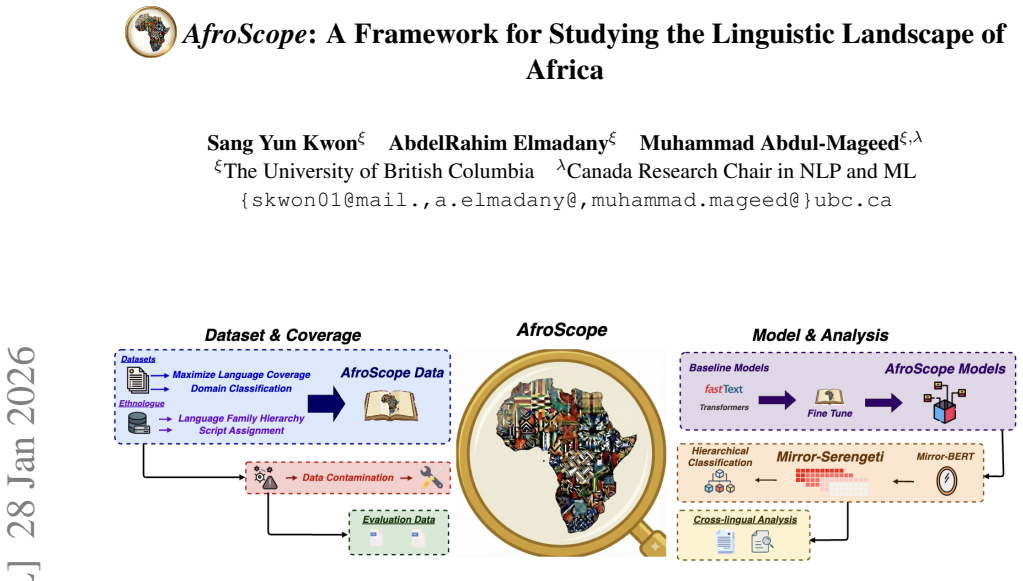
Two components carry the argument. AfroScope-Data is the pooled corpus: 11 datasets combined, deduplicated, capped per language, and split with a 4-gram contamination check so external evaluations exclude source-level leakage. Mirror-Serengeti is the disambiguation engine: an embedding model built on Serengeti (an XLM-R variant) and trained with the Mirror-BERT objective, an unsupervised contrastive loss (InfoNCE with random span masking) that pulls similar representations together and pushes unrelated ones apart. In inference, a base classifier makes a prediction; if confidence falls below a threshold, the instance is routed to a group-specific disambiguation step using the Mirror-Serengeti
Load-bearing premise
Everything rests on the inherited labels: the language IDs, family groupings, and script metadata come from the 11 constituent datasets and external catalogs without re-annotation, so if a substantial share of those labels are wrong, the reported macro-F1 numbers and transfer conclusions measure label noise rather than language identity.
What would settle it
Take a random sample of, say, 200 sentences from each of 50 languages spanning all 9 families; have fluent speakers assign ISO 639-3 codes blind and compare agreement with AfroScope-Data labels. If agreement falls well below 90%, retrain the models on the audited subset and check whether macro-F1 drops disproportionately on the confusion groups.
If this is right
- Corpus builders can now run LID over 713 African languages rather than dropping or misattributing out-of-scope text, directly reducing 'cousin' errors where an unsupported language is assigned to its closest supported relative.
- Fine-grained LID among closely related varieties is tractable via hierarchical routing: the more the base model is required to be confident before deferring, the larger the gain from specialized contrastive embeddings.
- Transfer benefits are predictable from structure: same-family and same-script donor languages help low-resource recipients in Niger-Congo and Nilo-Saharan; in Afro-Asiatic, script compatibility dominates; Austronesian shows negative interference.
- The contamination-controlled evaluation protocol shows that high external scores are not driven by train/test leakage, so the reported gains can be taken as genuine generalization to new text.
- The released dataset and models provide a shared evaluation bed for African LID across domains, scripts, and resource levels, enabling future work on code-switching, finer-grained varieties, and domain shift.
Where Pith is reading between the lines
- The reported F1 numbers inherit the labels of 11 upstream datasets and external catalogs without re-annotation; a human audit of a stratified sample of the 713 labels would reveal how much of the 'confusion' is genuine linguistic similarity versus label noise.
- Because routing relies on confidence thresholds, deployment would likely require per-group threshold calibration; the paper itself notes a few languages (e.g., ewo, kau) that decline under routing, so a learned routing policy may be needed in practice.
- The family/script transfer findings suggest a concrete design rule: for script-divergent families, transliteration or script normalization may matter more than adding more same-family data — a testable ablation would transliterate Ethiopic or Tifinagh scripts before training.
- If the framework is reliable at scale, African LID becomes a measurement instrument: the 9-domain coverage would allow longitudinal tracking of which languages actually appear in news, health, government, and web text across the continent.
Editorial analysis
A structured set of objections, weighed in public.
Referee Report
Summary. The paper introduces AfroScope, a framework for African language identification (LID), comprising AfroScope-Data (a pooled corpus claimed to cover 713 African languages across 9 families, 7 scripts, and 9 domains) and AfroScope-Models (fine-tuned FastText, ConLID, AfroLID, Serengeti, and Cheetah baselines). The main methodological contribution is a hierarchical disambiguation step, Mirror-Serengeti, which uses Mirror-BERT contrastive embeddings to resolve confusions among 29 closely related or geographically proximate languages. The authors report that this hierarchical approach improves macro-F1 by +4.55 on this confusable subset compared to the best base model. The paper also presents cross-lingual transfer and domain/script analyses, arguing that family proximity and script compatibility correlate with positive transfer for low-resource languages. The dataset and models are released online.
Significance. If the results hold, AfroScope would be a substantial resource contribution: it covers more African language labels than prior LID datasets, and the hierarchical disambiguation approach could offer a practical recipe for separating confusable language varieties. The contamination analysis and external evaluation on multiple secondary datasets are useful methodological elements, and the transfer analysis addresses an important question. However, the central quantitative claim (+4.55 macro-F1) rests on an evaluation protocol that is circular with respect to how confusion groups were selected, and the paper contains unresolved numerical inconsistencies. The dataset's label integrity is inherited from upstream web-crawled corpora without an audit, which is a known risk for African LID. These issues must be addressed before the framework's contributions can be accepted at face value.
major comments (5)
- [§6.1, §6.2, Appendix D.1, Table 5] The evaluation of the hierarchical Mirror-Serengeti method is circular. Confusion groups are constructed by taking underperforming high-resource languages (baseline F1 < 85) and their top-3 misclassifications from the base Serengeti model (§6.1, Appendix D.1). These same groups are then used both to train Mirror-Serengeti and to measure the improvement reported in Table 5. Under this protocol, any model tuned to the base model's specific error distribution will show gains on these groups, even if it does not generalize to other confusable pairs. The +4.55 headline is therefore not an estimate of generalizable improvement. To support the claim, the authors should evaluate on held-out confusion pairs (e.g., groups formed from a different seed or from an earlier model checkpoint), or use a cross-validation scheme where group construction and evaluation are disjoint.
- [§6.2, Table 5, Limitations #3] Confidence thresholds from 75% to 95% are varied and the best threshold (95%) is highlighted without any held-out selection. Table 5 shows that the optimal threshold differs across languages (e.g., kon improves most at 90%, while fub is fairly flat), so reporting the 95% value as the headline is a form of threshold overfitting on the same evaluation set used to report the gain. The paper also acknowledges degradations (ewo −0.98, kau −3.97) but provides no significance tests, confidence intervals, or multiple-seed variance. At minimum, the authors should fix thresholds using a dev split and report mean ± std over several training seeds.
- [Abstract, §1, Table 1, Table 2] The paper contains several unresolved numerical inconsistencies that directly affect the reported contributions. The abstract and §1 state 713 languages, but the first abstract in the manuscript states 640 languages; the reported hierarchical improvement is given as +1.57 in one abstract and +4.55 in the body. Additionally, Table 1 lists GlotLID as containing 30,682,541 sentences, which exceeds the final AfroScope-Data train size of 19,682,541; even accounting for deduplication, the source numbers need reconciliation. Table 1 reports a test split of 66,398 sentences, while Table 2 lists the AfroScope evaluation set as 65,503. These discrepancies undermine confidence in the headline numbers and must be corrected with a consistent, auditable accounting of dataset construction.
- [§3.1, Limitations #2] The dataset's label integrity is a load-bearing assumption. AfroScope-Data is assembled by pooling GlotLID, AfroLID, SimbaText, and eight secondary sources without re-annotating or auditing label accuracy (§3.1), and family/script metadata are taken from Ethnologue (Limitations #2). As the authors themselves cite, web-crawled African corpora contain substantial label noise (Kreutzer et al., 2022). If a nontrivial fraction of the labels are wrong or inconsistent, the reported macro-F1 numbers, the confusion analysis, and the transfer conclusions measure label noise rather than language identity. The paper should include at least a small manual audit of label accuracy (e.g., a stratified sample per source), or an agreement analysis against an independent catalog such as Glottolog, to justify the dataset as a reliable resource.
- [Appendix C, Tables C.1–C.5] The per-language results show that Cheetah achieves 100% macro-F1 for the overwhelming majority of languages—including languages where AfroLID and Serengeti score 0.00 (e.g., aaa, adq, bri). This pattern is implausible for a genuinely fine-tuned LID model and suggests an evaluation artifact, such as identical train/test label leakage, a broken prediction pipeline, or a table-generation error. Since Tables 3–4 use Cheetah as a baseline for the claim that AfroScope-Models 'outperform prior African-focused LID baselines,' this issue directly affects the validity of the baseline comparison. The authors must verify the Cheetah evaluation and replace it with correctly computed scores.
minor comments (5)
- [Throughout] The manuscript contains several typographical errors: 'Aditional' (§5), 'phenomna' (Limitations #1), 'robstness' (Limitations #3), 'recepients' (§6.3), 'geneological' (§7), 'theAfroScopeframework' (Figure 1 caption), 'we relay on' (Limitations #2), and inconsistent capitalization 'Afroscope' vs 'AfroScope' in Table 2. These should be corrected.
- [Table 5 / Table D.1] Column headers such as 'F1_0.75∆_0.75' are confusing. It would be clearer to label the columns as 'F1 at threshold 0.75' and 'Δ vs. baseline' separately, and to specify that the 'Average' row is the mean over the 29 languages.
- [§4.1, Table 1] The description of the two-stage sampling procedure is vague: it says primary sources are sampled first and secondary sources supplement languages with fewer than 100K sentences, but it does not specify how overlap between sources is resolved when the same language appears in both, or whether the caps are applied before or after deduplication. Clarifying this would help reproducibility.
- [§5, Figure 3] The grouping into low/medium/high resource levels uses thresholds at 98 and 980 sentences, but the text says the inflection point is at ~980 sentences. It should be stated explicitly that these thresholds are chosen from the observed trend on the same data, and whether the n=47, n=22, n=644 counts are based on the full 713-language set.
- [Appendix D.2, Table D.2] The Mirror-BERT training procedure is described with hyperparameters, but the training data for Mirror-Serengeti is not fully specified: does it use only the 29 confusable languages, or all 713? If only the 29, this strengthens the circularity concern; if all, the description should say so.
Circularity Check
Mirror-Serengeti is trained and evaluated on confusion groups selected from the same base model's errors, making the +4.55 gain a self-referential result rather than an independent prediction.
specific steps
-
fitted input called prediction
[§6.1, §6.2, Table 5, Appendix D.1]
"we isolate underperformers—high-resource languages with scores lower than macro-F1 85—and identify the top three most frequent misclassifications for each to form confusion groups. ... We evaluate this strategy on 29 confusable languages."
The confusion groups (14 groups, 29 languages) are constructed from the base Serengeti model's own errors on the evaluation split. Mirror-Serengeti is then trained specifically on those groups and evaluated on the same set, so the reported +4.55 macro-F1 improvement is measured on the exact data used to select the groups and train the specialized model. This is not an independent test of the hierarchical method's generalizability; it is a self-referential evaluation loop. The gain is therefore a fitted result on the selection set, not a prediction about confusable languages generally.
full rationale
The main AfroScope-Data and AfroScope-Models contributions are largely self-contained: the base models are evaluated on external benchmarks (BLOOM, FineWeb2, Mafand, MCS-350, Smol, UDHR) with contamination checks, so those results have independent support. However, the headline improvement of Mirror-Serengeti on the confusable subset is not externally validated. The paper selects the 29-language confusion set from the base Serengeti model's test-set errors, trains Mirror-Serengeti on those groups, and then reports the gain on the same groups. This is a specific, quotable evaluation loop that introduces selection bias: the method is tested only on the cases it was designed to fix, so the +4.55 figure cannot be read as evidence of general improvement on confusable language pairs. The paper itself acknowledges degradations on some languages (ewo −0.98, kau −3.97), further underscoring the lack of a robust, independent evaluation. No other significant circularity was found: the dataset aggregation, external benchmarks, and transfer analyses do not reduce to self-citation or definitional equivalences. Overall, the central dataset and baseline results are independent, but the key Mirror-Serengeti claim is partially circular due to the self-selected evaluation set, warranting a moderate score.
Axiom & Free-Parameter Ledger
free parameters (4)
- per-language training sentence cap =
100,000
- per-language test sentence cap =
100
- hierarchical routing confidence thresholds =
0.75–0.95
- resource-level thresholds =
98 and 980 sentences
axioms (5)
- domain assumption ISO 639-3 codes and Ethnologue family/script metadata used for every label are accurate and consistent.
- domain assumption The labels in the 11 constituent datasets are sufficiently clean to serve as ground truth for training and evaluation.
- domain assumption 4-gram containment is a valid contamination test.
- ad hoc to paper Confusion groups formed from base-model errors are a valid target and evaluation set for the disambiguation method.
- ad hoc to paper Model confidence is a reliable routing signal for the hierarchical step.
read the original abstract
Language Identification (LID), the task of determining the language of a given text, is a fundamental preprocessing step that shapes the reliability of downstream NLP applications. While recent work has expanded African LID, existing systems remain limited in both language coverage and fine-grained discrimination among closely related languages and varieties. We introduce AfroScope, a unified framework for African LID that includes AfroScope-Data, a dataset covering 640 languages, and AfroScope-Models, a suite of strong LID models with broad African language coverage. To address persistent confusions among closely related languages, we propose a hierarchical classification approach that leverages AfroScope-Mirror, a specialized embedding model for targeted disambiguation, improving macro-F1 by 1.57 points on the confusable subset compared to our best base model. We further analyze cross-lingual transfer and domain effects, showing how language-family structure, script compatibility, and domain coverage shape LID performance. We position African LID as an enabling technology for large-scale measurement of Africa's linguistic landscape in digital text, and release AfroScope-Data and AfroScope-Models online.
Figures


Reference graph
Works this paper leans on
-
[5]
Jessica Ojo, Zina Kamel, and David Ifeoluwa Adelani
Scaling neural machine translation to 200 lan- guages.Nature, 630(8018):841–846. Jessica Ojo, Zina Kamel, and David Ifeoluwa Adelani
-
[6]
Jessica Ojo, Kelechi Ogueji, Pontus Stenetorp, and David Ifeoluwa Adelani
Divers-bench: Evaluating language identifica- tion across domain shifts and code-switching.arXiv preprint arXiv:2509.17768. Jessica Ojo, Kelechi Ogueji, Pontus Stenetorp, and David Ifeoluwa Adelani. 2023. How good are large language models on african languages?arXiv preprint arXiv:2311.07978. Kayode Olaleye, Arturo Oncevay, Mathieu Sibue, Nom- buyiselo Zo...
arXiv 2023
-
[218]
IEEE. David M. Eberhard, Gary F. Simons, and Charles D. Fennig, editors. 2021.Ethnologue: Languages of the World, 24 edition. SIL International, Dallas, Texas. AbdelRahim Elmadany, Sang Yun Kwon, Hawau Olamide Toyin, Alcides Alcoba Incia- rte, Hanan Aldarmaki, and Muhammad Abdul- Mageed. 2025. V oice of a continent: Mapping africa’s speech technology fron...
Pith/arXiv arXiv 2021
-
[2023]
Harald Hammarström, Robert Forkel, Martin Haspel- math, and Sebastian Bank
Studying large language model general- ization with influence functions.arXiv preprint arXiv:2308.03296. Harald Hammarström, Robert Forkel, Martin Haspel- math, and Sebastian Bank. 2024. Glottolog 5.1. Ac- cessed on 2025-04-03. Bernd Heine and Derek Nurse, editors. 2000.African Languages: An Introduction. Cambridge University Press. Kedir Yassin Hussen, W...
Pith/arXiv arXiv 2024
-
[2024]
Fangyu Liu, Ivan Vuli ´c, Anna Korhonen, and Nigel Collier
Datacomp-lm: In search of the next generation of training sets for language models.Advances in Neural Information Processing Systems, 37:14200– 14282. Fangyu Liu, Ivan Vuli ´c, Anna Korhonen, and Nigel Collier. 2021. Fast, effective, and self-supervised: Transforming masked language models into univer- sal lexical and sentence encoders.arXiv preprint arXi...
Pith/arXiv arXiv 2021
-
[2025]
Armand Joulin, Edouard Grave, Piotr Bojanowski, Matthijs Douze, Hérve Jégou, and Tomas Mikolov
The state of large language models for african languages: Progress and challenges.arXiv preprint arXiv:2506.02280. Armand Joulin, Edouard Grave, Piotr Bojanowski, Matthijs Douze, Hérve Jégou, and Tomas Mikolov. 2016a. Fasttext.zip: Compressing text classification models.arXiv preprint arXiv:1612.03651. Armand Joulin, Edouard Grave, Piotr Bojanowski, and T...
Pith/arXiv arXiv 2023
discussion (0)
Sign in with ORCID, Apple, or X to comment. Anyone can read and Pith papers without signing in.