REVIEW 2 major objections 4 minor 3 cited by
This paper shows that combining randomized low-depth time-evolution circuits (TE-PAI) with classical shadow spectroscopy yields unbiased energy-gap estimators with noise resilience, validated on 20-qubit hardware.
Reviewed by Pith at T0; open to challenge. T0 means a machine referee read the full paper against a public rubric. the ladder, T0–T4 →
T0 review · deepseek-v4-flash
2026-08-03 09:23 UTC pith:Y7I46IGM
load-bearing objection Useful integration of TE-PAI and shadow spectroscopy with a clean unbiasedness theorem; the experimental evidence is suggestive but lacks null controls and error bars. the 2 major comments →
Low-Resource Quantum Energy Gap Estimation via Randomization
The pith
A machine-rendered reading of the paper's core claim, the machinery that carries it, and where it could break.
Core claim
The central discovery is that the quasiprobability gate sampling of TE-PAI and the randomized-measurement sampling of classical shadows compose into a nested unbiased estimator. Writing C for the Trotterized evolution channel and ρ for the initial state, Theorem 1 gives E[⟨Ô⟩] = ⟨⟨O|C(ρ)⟩⟩, where the expectation covers both the random circuit choice and the shadow measurement randomness. The variance bound in Theorem 2, Var ≤ Γ²((∥O∥²_sh − ∥O∥²)/(M N_s) + ∥O∥²/M), shows that the shadow contribution decays with the total shot budget M N_s, while the circuit-sampling contribution decays only with M; for q-local Pauli observables, reusing a single compiled circuit up to N_s ≈ 3^q times adds lit
What carries the argument
The load-bearing identity is the three-term quasiprobability decomposition of any Pauli rotation: R_{P,θ} = a₁(θ) I + a₂(θ) R_{P,ϕ} + a₃(θ) R_{P,π}, with carefully chosen coefficients, so a deterministic Trotter gate is replaced by sampling one of three fixed-angle gates (skip, Δ, π) and reweighting with the accumulated classical weight Γ. The nested estimator of Eq. (8) then multiplies the TE-PAI weight by the classical-shadow snapshot, giving an unbiased estimate with variance controlled by Γ². The same abstract channel decomposition applies to any quasiprobability sampling method, so the theorems are not specific to TE-PAI itself.
Load-bearing premise
The result stands on the assumption that the heuristic post-processing used to convert noisy expectation-value time series into spectral peaks does not itself bias or fabricate the observed gaps; the unbiasedness theorem applies only to the raw linear estimator.
What would settle it
Feed the full post-processing pipeline with shadow data collected from a time-independent state (no evolution, so no energy gaps exist) and check whether any peak appears near the expected gap frequency; a spurious peak would indicate the selection and cross-correlation heuristics invent spectral structure. Alternatively, vary the Ljung-Box threshold and the 10% retention cutoff and observe whether the estimated gap drifts.
If this is right
- Energy gaps can be extracted with circuit depth scaling as O(t) rather than O(t²), because TE-PAI probabilistically skips gates while preserving expectation values.
- The angle Δ gives a direct dial between shallower circuits (more noise resilience) and more measurement shots (more statistical overhead), allowing hardware-specific tuning.
- Reusing a single compiled TE-PAI circuit for up to ~3^q shadow snapshots barely inflates variance, making compilation and loading costs amortizable.
- The protocol needs no ancillas or controlled timing, placing it within reach of NISQ and early fault-tolerant devices.
- On 20-qubit transverse-Ising hardware, the randomized circuits yield a clearer spectral peak than the equivalent Trotter baseline, consistent with the shallow-depth advantage.
Where Pith is reading between the lines
- The unbiasedness theorem covers only the linear expectation estimator; the actual gap is read out through a nonlinear pipeline (standardization, Ljung-Box filtering, top-10% retention, SVD, DFT). Whether those heuristics preserve exact peak positions without selection bias is not analyzed, so the unbiasedness claim may not extend to the spectral peak itself.
- Because the estimator is unbiased for the Trotterized channel rather than the exact evolution, the total error at any finite step count still contains Trotter error; a practical protocol may need to co-optimize Δ, K, and post-processing thresholds.
- The variance bound suggests a testable allocation rule: for fixed total circuits, N_s should be set near 3^q before increasing M; hardware experiments could verify whether this maximizes peak signal-to-noise.
Editorial analysis
A structured set of objections, weighed in public.
Referee Report
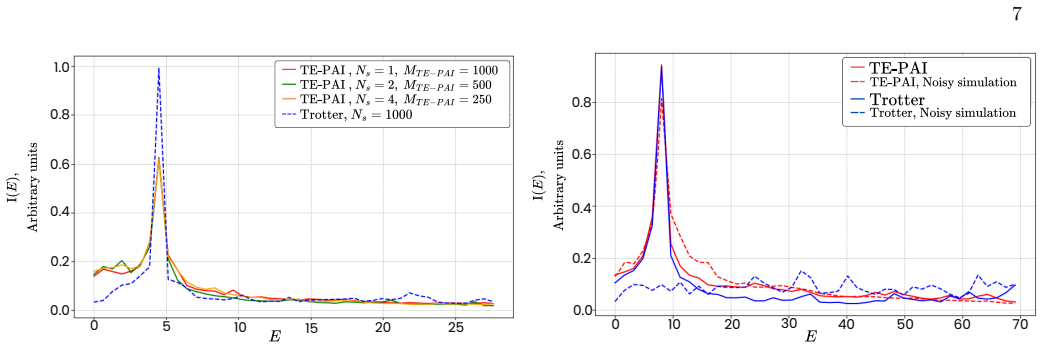
Summary. The paper proposes TE-PAI shadow spectroscopy, a hybrid quantum-classical protocol that integrates randomized time evolution via probabilistic angle interpolation (TE-PAI) with classical-shadow measurements for estimating energy gaps. The estimator in Eq. (8) is shown to be unbiased (Theorem 1) with a variance bound (Theorem 2). The protocol is benchmarked in noise-free and depolarizing-noise simulations on Heisenberg models, and on a 20-qubit transverse-field Ising model on IBM hardware, where the TE-PAI-based spectra are claimed to resolve the theoretical gap and to be more robust to gate noise than standard Trotter-based shadow spectroscopy.
Significance. If fully substantiated, the protocol is a meaningful step toward practical spectral estimation on near-term hardware: it gives a tunable trade-off between circuit depth and sampling overhead while preserving unbiasedness of the underlying expectation-value estimators, and the 20-qubit hardware demonstration is a useful scale-up over prior work. The clear asset of the paper is the clean nested estimator construction (Theorems 1 and 2) and the explicit variance analysis; the simulation code is also made available. However, the headline claim that the protocol accurately extracts energy gaps on noisy devices currently rests on an unvalidated nonlinear post-processing pipeline, so the strength of the experimental conclusion is not yet commensurate with the supporting evidence.
major comments (2)
- [Section IV A and Appendix D] The claim that the protocol 'correctly resolves' energy gaps in noisy simulation and on hardware is not yet fully supported. Theorem 1 establishes unbiasedness only for the linear expectation-value estimator in Eq. (8). The actual gap extraction uses a nonlinear, data-dependent pipeline: row standardization, Ljung-Box filtering, retention of the top 10% of signals, correlation-matrix SVD, and DFT of cross-correlations (Appendix D, steps 3-7). The paper provides no noise-only null baseline, no false-positive analysis, and no error bars in Figures 2 and 3; Section IV A explicitly states that sensitivity assessment of the Ljung-Box/top-10% thresholds is 'beyond the scope of this work.' Because rows are selected precisely for their autocorrelation, a subsequent SVD/DFT peak near the expected gap could in principle arise from selection bias even if the raw time series are noise. Please add nu
- [Appendix E, proof of Theorem 2] The proof of Theorem 2 contains an invalid inequality. The text derives E_l[Var_sh(Y_m)] = (Gamma^2/N_s)(||O||_sh^2 - E_l[<O|C_l(rho)>^2]) and then bounds this by (Gamma^2/N_s)(||O||_sh^2 - ||O||^2). This step assumes E_l[<O|C_l(rho)>^2] >= ||O||^2, but Lemma 1 and |Tr(O rho)| <= ||O|| imply the opposite inequality, E_l[<O|C_l(rho)>^2] <= ||O||^2. The final variance bound is in fact correct and can be obtained by first combining the two variance terms so that E_l[...] appears with the nonnegative coefficient (1 - 1/N_s); as written, however, the proof is not valid and should be rewritten.
minor comments (4)
- [Algorithm 1 and Section II B] The relationship between the parameter K_steps in Algorithm 1 and the product K x N_t in Section III A is unclear. Also, Algorithm 1 line 6 sets theta = -h_j delta, while Eq. (2) uses theta = 2 h_j delta; the factor of 2 and the sign convention should be reconciled, and the TE-PAI validity condition Delta in [|theta|, pi) should be checked for the largest rotation angles in the reported parameter settings.
- [Figures 1-3] The x-axis labels of Figures 1-3 appear garbled (e.g., '50 10 15 20 25' and '300 10 20 40 50 60 70 80'). Please replace with clean axis labels that show the actual energy/frequency values and units.
- [Introduction, Ref. [16]] The text says 'ref. [16] focused on the unique advantages of TE-PAI for early fault tolerant machines,' but Ref. [16] is Kim et al., 'Evidence for the utility of quantum computing before fault tolerance.' This appears to be a citation error; the intended reference is likely the TE-PAI paper (Ref. [13]).
- [Data availability] The data-availability statement provides the simulation code but not the raw IBM hardware data or the processed spectra behind Figures 2 and 3. Including the data, or at least the extracted spectral curves, would improve reproducibility and would also allow independent uncertainty assessment.
Circularity Check
No circular derivation: the combined estimator is a composition of two independently grounded unbiased-sampling identities, and the gap benchmarks are external.
full rationale
The derivation chain is not circular. Theorem 1's unbiasedness follows from two definitional identities that are independent of the target gap: classical shadow snapshots satisfy E_sh[|ρhat>] = |ρ> (Eq. 6), and quasiprobability sampling satisfies E_l[Γ_l C_l] = C (Eq. 5 and Appendix B/C). The proof in Appendix E1 applies the law of total expectation to these two identities; the energy gap never enters as an input or fitted parameter. The TE-PAI coefficients in Eq. (C1) are an explicit algebraic decomposition, and although the authors cite their own prior work (Ref. [13]) for TE-PAI, the identity is parameter-free and independently stated, so it constitutes real mathematical support rather than a circular premise. The gap extraction itself is a post-processing of time series whose frequencies are the gaps by Eq. (1); the Ljung-Box filter, top-10% retention, SVD, and DFT pipeline does not feed the expected gap into the estimator. Benchmarks compare resulting peaks against exact diagonalization (Appendix F) and the Pfeuty formula (Eq. 10), i.e., external references. The paper's admitted limitation in Section IV A — "A detailed assessment of the sensitivity to these choices is beyond the scope of this work" — is a validation/robustness concern about the nonlinear spectral post-processing, not a circularity: the heuristics could in principle introduce selection bias, but nothing in the text makes the extracted peak equal to a fitted input or to a self-citation by construction. No uniqueness theorem is imported from the authors, no ansatz is smuggled in solely via citation, and the combination of TE-PAI with shadow spectroscopy is a genuine composition of two previously published methods rather than a renaming of a known result. The paper is accordingly self-contained against external benchmarks, so the honest finding is no significant circularity.
Axiom & Free-Parameter Ledger
free parameters (6)
- Δ (TE-PAI angle) =
π/2^7 (noise-free sim), π/2^5 (noisy sim and hardware)
- Trotter steps K_steps =
650 (10-qubit sim), 300 (6-qubit noisy sim), 115 (20-qubit hardware)
- Time grid (N_t, dt) =
N_t=90, dt=0.11 (sim); N_t=80, dt=0.037 (hardware)
- Ljung-Box top-10% retention threshold =
top 10%
- Number of dominant eigenvectors c =
unspecified in text
- Shot allocation (M_TE-PAI, N_s) =
(1000,1), (500,2), (250,4) sim; (3000,1) hardware
axioms (6)
- standard math Pauli rotation channel decomposition Eq. (3) with coefficients Eq. (C1) is exact.
- standard math Classical shadow snapshot Eq. (6) is an unbiased estimator of ρ for any state.
- standard math First-order Trotter error is bounded by O(t^2/K).
- domain assumption Initial states have sufficient overlap with the target eigenstates.
- domain assumption Depolarizing noise after each gate approximates hardware noise.
- ad hoc to paper The spectral post-processing pipeline (standardization, Ljung-Box threshold, top-10% retention, SVD/DFT) preserves gap peak location and does not create artificial peaks.
read the original abstract
Estimating the energy spectra of quantum many-body systems is a fundamental task in quantum physics, with applications ranging from chemistry to condensed matter. Algorithmic shadow spectroscopy is a recent method that leverages randomized measurements on time-evolved quantum states to extract spectral information. However, implementing accurate time evolution with low-depth circuits remains a key challenge for near-term quantum hardware. In this work, we propose a hybrid quantum-classical protocol that integrates Time Evolution via Probabilistic Angle Interpolation (TE-PAI) into the shadow spectroscopy framework. TE-PAI enables the simulation of time evolution using shallow stochastic circuits while preserving unbiased estimates through quasiprobability sampling. We construct the combined estimator and derive its theoretical properties. Through numerical simulations, we demonstrate that our method accurately resolves energy gaps and exhibits enhanced robustness to gate noise compared to standard Trotter-based shadow spectroscopy. We further validate the protocol experimentally on up to 20 qubits using IBM quantum hardware. This makes TE-PAI shadow spectroscopy a promising tool for spectral analysis on noisy intermediate-scale quantum (NISQ) devices.
Figures


Forward citations
Cited by 3 Pith papers
-
Structure-Aware Variance Reduction for Unbiased Randomized Hamiltonian Simulation
Continuous TE-PAI provides an unbiased randomized protocol for Hamiltonian simulation free of Trotter error at finite circuit depth, combined with structure-aware variance reduction that achieves up to 96% sampling-co...
-
Adiabatic Error Cancellation in Berry Phase Estimation
Berry phase estimation has a universal adiabatic error-cancellation mechanism that exactly cancels O(T^{-1}) phase error via ±H evolution and suppresses residuals to O(T^{-M}) via randomization for any M.
-
Adiabatic Error Cancellation in Berry Phase Estimation
Forward–reverse evolution, Richardson extrapolation, and runtime randomization cancel the leading O(T^{-1}) adiabatic phase error in Berry phase estimation, yielding O(ε^{-3/2}) total cost (QPE) or Θ(ε^{-1/3}) coheren...
Reference graph
Works this paper leans on
-
[1]
This is the only step performed on quantum hardware; the following steps are clas- sical
Gather shadow snapshots ofρ(t n) for eacht n using Ns copies ofρ(t n). This is the only step performed on quantum hardware; the following steps are clas- sical
-
[2]
Estimate ˆSi(n) from the snapshots
-
[3]
Construct a data matrixD∈R No×Nt with entries Di,n = ˆSi(n)−µi σi andµ i,σ i are the mean and stan- dard deviation of{ ˆSi(n)}Nt n=1, respectively
-
[4]
Apply the Ljung-Box test to each row ofDto re- move signals indistinguishable from noise [32, 33]
-
[5]
, vc}corresponding to the largest eigen- values [34]
Compute the correlation matrix C=DD ⊤ ∈R No×No ,(D1) 11 and extract the topcdominant eigenvectors {v1, v2, . . . , vc}corresponding to the largest eigen- values [34]
-
[6]
Denote the resulting quantity byX kl(m), wherem now represents the frequency index
Compute the spectral cross-correlation matrix xkl(m) = Nt−m−1X n=1 vk(n+m)v l(n),(D2) and perform a discrete Fourier transform (DFT) ofx kl(m) with respect to the time lag indexm. Denote the resulting quantity byX kl(m), wherem now represents the frequency index
-
[7]
Peaks inλ(m) correspond to the energy gaps of the Hamiltonian
Compute the largest singular valueλ(m) of the ma- trixX(m). Peaks inλ(m) correspond to the energy gaps of the Hamiltonian. Appendix E: F ormal Analysis of the TE-P AI shadow Estimator Algorithm 2 shows the detailed pseudocode of the prac- tical implementation of our protocol used in the experi- ments. As discussed in the main text, this implementa- tion i...
-
[8]
M. A. Nielsen and I. L. Chuang,Quantum Computation and Quantum Information: 10th Anniversary Edition, 10th ed. (Cambridge University Press, Cambridge, UK,
-
[9]
H. H. S. Chan, R. Meister, M. L. Goh, and B. Koczor, Al- gorithmic shadow spectroscopy, PRX Quantum6, 010352 (2025)
2025
-
[10]
1 M MX m=1 Esh
Proof of Theorem 1 This modified implementation preserves the unbiased nature of the estimator. Proof.The goal is to estimate the true expectation value of an observableO, defined with respect to the original channel⟨ ⟨O|C(ρ)⟩ ⟩.Our final estimator,ˆ⟨O⟩, is the av- erage over all measurement outcomes. More specifically, leto m,s be the outcome from them-t...
-
[11]
Since theMcircuit samples are independent and iden- tically distributed, the total variance is Var[⟨ ˆO⟩] = 1 M Var[Ym]
Proof of Theorem 2 Proof.LetY m denote the estimator obtained from the m-th sampled circuit, averaged over itsN s shadow snap- shots: Ym = 1 Ns NsX s=1 om,s. Since theMcircuit samples are independent and iden- tically distributed, the total variance is Var[⟨ ˆO⟩] = 1 M Var[Ym]. We apply the Law of Total Variance toY m, conditioning on the choice of the ra...
-
[12]
and EUR QMAT ANR-17-EURE-0024 under the framework of the French Investments for the Future Pro- gram. B.K. thanks UKRI for the Future Leaders Fel- lowship Theory to Enable Practical Quantum Advantage (MR/Y015843/1) and EPSRC for funding through the project Software Enabling Early Quantum Advantage (SEEQA, EP/Y004655/1). This research was funded in part by...
-
[13]
Sachdev,Quantum Phase Transitions, 2nd ed
S. Sachdev,Quantum Phase Transitions, 2nd ed. (Cam- bridge University Press, 2011)
2011
-
[14]
The analytic expression of the coefficients in Eq
to Pauli rotations gates. The analytic expression of the coefficients in Eq. (3) is explicitly given as follows: a1(θ) = csc ∆ 2 cos θ 2 sin ∆ 2 − θ 2 , a2(θ) = csc(∆) sin(θ), a3(θ) =−sec ∆ 2 sin θ 2 sin ∆ 2 − θ 2 . (C1) Since this is quasiprobability decomposition by construc- tion, the following random map is an unbiased estimator of the ideal rotation ...
-
[15]
I. N. Levine,Quantum Chemistry, 6th ed. (Pearson Pren- tice Hall, London, 2009)
2009
-
[16]
P. A. M. Dirac, Quantum mechanics of many-electron systems, Proceedings of the Royal Society of London. Se- ries A123, 714 (1929)
1929
-
[17]
Lloyd, Universal quantum simulators, Science273, 1073 (1996)
S. Lloyd, Universal quantum simulators, Science273, 1073 (1996)
1996
-
[18]
Z. Zimbor´ as, B. Koczor, Z. Holmes, E.-M. Borrelli, A. Gily´ en, H.-Y. Huang, Z. Cai, A. Ac ´ ın, L. Aolita, L. Banchi,et al., Myths around quantum computation before full fault tolerance: What no-go theorems rule out and what they don’t, arXiv preprint arXiv:2501.05694 (2025)
Pith/arXiv arXiv 2025
-
[19]
R. Babbush, R. King, S. Boixo, W. Huggins, T. Khattar, G. H. Low, J. R. McClean, T. O’Brien, and N. C. Ru- bin, The grand challenge of quantum applications, arXiv preprint arXiv:2511.09124 (2025)
arXiv 2025
-
[20]
A. Y. Kitaev, Quantum measurements and the abelian stabilizer problem, arXiv:quant-ph/9511026 [quant-ph] (1995)
Pith/arXiv arXiv 1995
-
[21]
H.-Y. Huang, R. Kueng, and J. Preskill, Predicting many properties of a quantum system from very few measure- ments, arXiv:2002.08953 [quant-ph] (2020)
Pith/arXiv arXiv 2002
-
[22]
Jnane, J
H. Jnane, J. Steinberg, Z. Cai, H. C. Nguyen, and B. Koc- zor, Quantum error mitigated classical shadows, PRX Quantum5, 010324 (2024)
2024
-
[24]
C. Kiumi and B. Koczor, Te-pai: Exact time evolution by sampling random circuits (2024), arXiv:2410.16850 [quant-ph]
arXiv 2024
-
[25]
Koczor, J
B. Koczor, J. J. L. Morton, and S. C. Benjamin, Proba- bilistic interpolation of quantum rotation angles, Physi- cal Review Letters132, 130602 (2024)
2024
-
[26]
Koczor, Sparse probabilistic synthesis of quantum op- erations, PRX Quantum5, 040352 (2024)
B. Koczor, Sparse probabilistic synthesis of quantum op- erations, PRX Quantum5, 040352 (2024)
2024
-
[27]
Y. Kim, A. Eddins, S. Anand, K. Takagi, A. Sharma, E. Van Den Berg, A. Kandala, and K. Temme, Evidence for the utility of quantum computing before fault toler- ance, Nature618, 500 (2023)
2023
-
[28]
Gilchrist, N
A. Gilchrist, N. K. Langford, and M. A. Nielsen, Distance measures to compare real and ideal quantum processes, Physical Review A71, 062310 (2005)
2005
-
[29]
Suzuki, Fractal decomposition of exponential opera- tors with applications to many-body theories and monte carlo simulations, Physics Letters A146, 319 (1990)
M. Suzuki, Fractal decomposition of exponential opera- tors with applications to many-body theories and monte carlo simulations, Physics Letters A146, 319 (1990)
1990
-
[30]
Suzuki, General theory of fractal path integrals with applications to many-body theories and statistical physics, Journal of Mathematical Physics32, 400 (1991)
M. Suzuki, General theory of fractal path integrals with applications to many-body theories and statistical physics, Journal of Mathematical Physics32, 400 (1991)
1991
-
[32]
S. Endo, S. C. Benjamin, and Y. Li, Practical quan- tum error mitigation for near-future applications, Physi- cal Review X8, 031027 (2018)
2018
-
[33]
R. J. Baxter,Exactly solved models in statistical mechan- ics(Academic Press, 1982)
1982
-
[34]
Qiskit contributors, Qiskit sdk api reference: Quantum- Circuit.depth (2025), accessed: 2026-01-15
2025
-
[35]
Pfeuty, The one-dimensional Ising model with a trans- verse field, Annals of Physics57, 79 (1970)
P. Pfeuty, The one-dimensional Ising model with a trans- verse field, Annals of Physics57, 79 (1970)
1970
-
[36]
A. M. Childs, Y. Su, M. C. Tran, N. Wiebe, and S. Zhu, Theory of trotter error with commutator scaling, Physi- cal Review X11, 10.1103/physrevx.11.011020 (2021)
-
[37]
Temme, S
K. Temme, S. Bravyi, and J. M. Gambetta, Error mitiga- tion for short-depth quantum circuits, Physical Review Letters119, 180509 (2017)
2017
-
[38]
Jnane, J
H. Jnane, J. Steinberg, Z. Cai, H. C. Nguyen, and B. Koc- zor, Quantum error mitigated classical shadows, PRX Quantum5, 010324 (2024). 15
2024
-
[39]
B. Koczor, J. J. L. Morton, and S. C. Benjamin, Proba- bilistic interpolation of quantum rotation angles, Physi- cal Review Letters132, 10.1103/physrevlett.132.130602 (2024)
-
[40]
T. Peng, A. W. Harrow, M. Ozols, and X. Wu, Simulating large quantum circuits on a small quantum computer, Phys. Rev. Lett.125, 150504 (2020)
2020
-
[41]
K. Mitarai and K. Fujii, Constructing a virtual two-qubit gate by sampling single-qubit operations, New J. Phys. 23, 023021 (2021), (arXiv:1909.07534)
Pith/arXiv arXiv 2021
-
[42]
A. W. Harrow and A. Lowe, Optimal quantum circuit cuts with application to clustered hamiltonian simula- tion, PRX Quantum6, 010316 (2025)
2025
-
[43]
G. E. P. Box and D. A. Pierce, Distribution of resid- ual autocorrelations in autoregressive-integrated moving average time series models, Journal of the American Sta- tistical Association65, 1509 (1970)
1970
-
[44]
G. M. LJUNG and G. E. P. BOX, On a measure of lack of fit in time series models, Biometrika65, 297 (1978)
1978
-
[45]
Bronson and G
R. Bronson and G. B. Costa, Chapter 6 - eigenvalues and eigenvectors, inMatrix Methods (Fourth Edition), edited by R. Bronson and G. B. Costa (Academic Press, 2021) fourth edition ed., pp. 185–223
2021
-
[46]
Takahashi,Thermodynamics of One-Dimensional Solvable Models(Cambridge University Press, 1999)
M. Takahashi,Thermodynamics of One-Dimensional Solvable Models(Cambridge University Press, 1999)
1999
-
[47]
D. C. Mattis,The Theory of Magnetism I: Statics and Dynamics(Springer-Verlag, 1981)
1981
-
[48]
Bethe, Zur theorie der metalle, Zeitschrift f¨ ur Physik 71, 205 (1931)
H. Bethe, Zur theorie der metalle, Zeitschrift f¨ ur Physik 71, 205 (1931)
1931
-
[49]
Hulth´ en, ¨Uber das austauschproblem eines kristalls, Arkiv f¨ ur Matematik, Astronomi och Fysik26A, 1 (1938)
L. Hulth´ en, ¨Uber das austauschproblem eines kristalls, Arkiv f¨ ur Matematik, Astronomi och Fysik26A, 1 (1938)
1938
-
[50]
des Cloizeaux and J
J. des Cloizeaux and J. J. Pearson, Antiferromagnetic lin- ear chain of spin 1/2, Physical Review128, 2131 (1962)
1962
discussion (0)
Sign in with ORCID, Apple, or X to comment. Anyone can read and Pith papers without signing in.