PREFAB: PREFerence-based Affective Modeling for Low-Budget Self-Annotation
Pith reviewed 2026-05-16 12:56 UTC · model grok-4.3
The pith
PREFAB models full affective timelines from labels on only selected inflection segments using preference learning.
A machine-rendered reading of the paper's core claim, the machinery that carries it, and where it could break.
Core claim
PREFAB is a retrospective self-annotation method that employs a preference-learning model to detect relative affective changes and directs annotators to label only the selected segments, interpolating the remainder of the stimulus timeline. Grounded in the peak-end rule and ordinal emotion representations, it includes a preview mechanism for contextual cues. Evaluations indicate superior performance over baselines in capturing inflections with reduced workload and higher confidence.
What carries the argument
The preference-learning model that identifies relative affective changes from limited segment labels to enable interpolation of the full affective timeline.
If this is right
- Annotators produce complete affective timelines with reduced cognitive and temporal demands.
- Annotation quality matches or exceeds that of full continuous labeling.
- Annotators gain increased confidence in their provided labels.
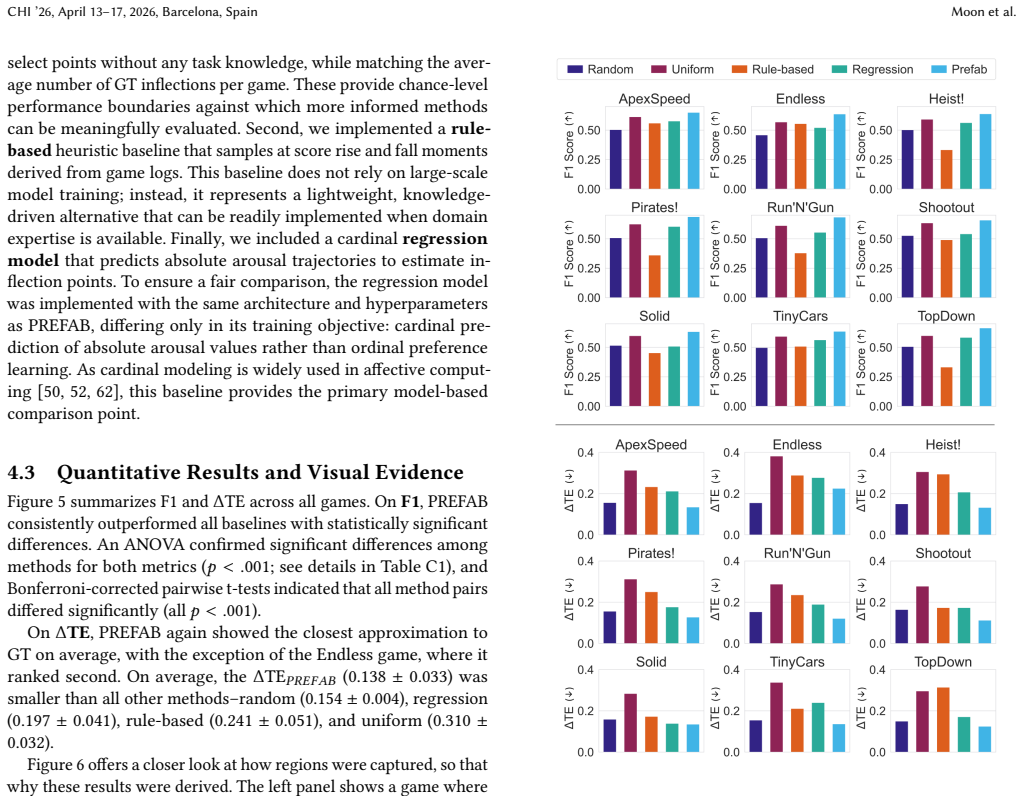
- The method outperforms standard baselines in modeling accuracy for inflections.
Where Pith is reading between the lines
- This sparse labeling strategy could generalize to other continuous labeling domains like physiological signal annotation.
- Combining PREFAB with automated detection of inflections might reduce human effort even further.
- The reliance on ordinal preferences suggests that absolute scale ratings may not always be necessary for accurate timeline reconstruction.
Load-bearing premise
The preference-learning model grounded in the peak-end rule can detect relative affective changes accurately enough from limited labels to interpolate the timeline without systematic bias.
What would settle it
A controlled comparison where the full ground-truth affective timeline is available from exhaustive labeling, and PREFAB's interpolated version shows significantly higher error rates in non-labeled segments than expected.
Figures






read the original abstract
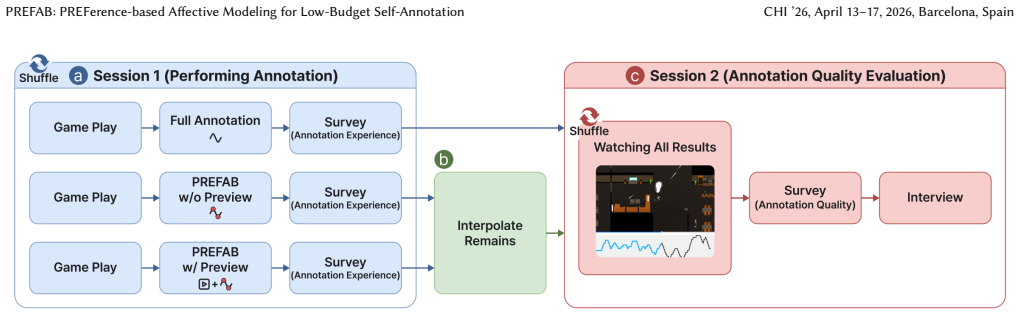
Self-annotation is the gold standard for collecting affective state labels in affective computing. Existing methods typically rely on full annotation, requiring users to continuously label affective states across entire sessions. While this process yields fine-grained data, it is time-consuming, cognitively demanding, and prone to fatigue and errors. To address these issues, we present PREFAB, a low-budget retrospective self-annotation method that targets affective inflection regions rather than full annotation. Grounded in the peak-end rule and ordinal representations of emotion, PREFAB employs a preference-learning model to detect relative affective changes, directing annotators to label only selected segments while interpolating the remainder of the stimulus. We further introduce a preview mechanism that provides brief contextual cues to assist annotation. We evaluate PREFAB through a technical performance study and a 25-participant user study. Results show that PREFAB outperforms baselines in modeling affective inflections while mitigating workload (and conditionally mitigating temporal burden). Importantly PREFAB improves annotator confidence without degrading annotation quality.
Editorial analysis
A structured set of objections, weighed in public.
Referee Report
Summary. The manuscript introduces PREFAB, a retrospective self-annotation technique for affective states that leverages the peak-end rule to identify key segments for labeling, employs a preference-learning model for interpolation of the affective timeline, and includes a preview mechanism. Through a technical performance study and a 25-participant user study, it claims to outperform baselines in modeling affective inflections, reduce workload, and improve annotator confidence without degrading quality.
Significance. If the core assumptions hold, PREFAB could enable more efficient collection of affective data in computing applications by substantially lowering annotation effort while preserving data utility, which is valuable for scaling studies in affective computing and human-computer interaction.
major comments (1)
- [Evaluation / Results] The central claim that annotation quality is preserved relies on the assumption that the preference model and interpolation from peak-end selected segments accurately reconstruct the full affective timeline. However, the reported user study compares PREFAB to baselines on workload and confidence but does not include a direct within-subject validation of the interpolated values against a complete per-frame ground truth annotation of the same stimuli. This leaves the quality preservation claim untested against potential systematic temporal biases.
minor comments (1)
- [Abstract] The abstract mentions 'outperforms baselines' and 'mitigating workload' but does not specify the exact metrics, statistical tests, or baseline definitions used in the evaluation.
Simulated Author's Rebuttal
We thank the referee for their constructive and insightful review of our manuscript. We address the single major comment below, acknowledging its validity while providing the strongest honest defense of our evaluation approach and outlining the revisions we will undertake.
read point-by-point responses
-
Referee: [Evaluation / Results] The central claim that annotation quality is preserved relies on the assumption that the preference model and interpolation from peak-end selected segments accurately reconstruct the full affective timeline. However, the reported user study compares PREFAB to baselines on workload and confidence but does not include a direct within-subject validation of the interpolated values against a complete per-frame ground truth annotation of the same stimuli. This leaves the quality preservation claim untested against potential systematic temporal biases.
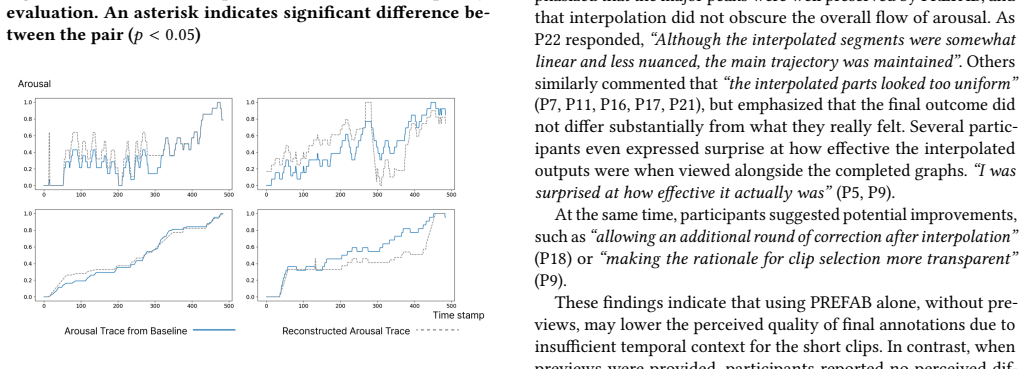
Authors: We thank the referee for highlighting this important methodological point. The technical performance study evaluates the preference-learning model's reconstruction accuracy by comparing interpolated timelines against full per-frame annotations on held-out data, providing quantitative support for the interpolation approach under the peak-end rule. The 25-participant user study was deliberately scoped to assess real-world usability (workload reduction and annotator confidence) while preserving the low-budget character of PREFAB; requiring full per-frame ground-truth annotations from the same participants would have defeated that purpose. We therefore agree that the user-study results do not furnish a direct within-subject test of reconstruction fidelity and that potential temporal biases remain unexamined in that specific setting. In the revised manuscript we will (1) clearly separate the evidence provided by the technical study from the usability findings, (2) temper the claim of “without degrading annotation quality” to reflect the available evidence, (3) add an explicit discussion of possible systematic temporal biases, and (4) list direct within-subject validation as a concrete direction for future work. These changes constitute a partial revision: the text and claims will be updated, but we cannot retroactively collect new full-annotation data for the existing user-study cohort. revision: partial
Circularity Check
No significant circularity; claims rest on external user-study validation
full rationale
The derivation applies the peak-end rule and preference learning to select segments for labeling, then interpolates the timeline. Evaluation proceeds via a technical performance study and 25-participant user study that compare PREFAB against baselines on independent metrics (workload, confidence, annotation quality). No equations reduce by construction to fitted parameters, self-definitions, or self-citation chains; the central performance claims are externally falsifiable against the study outcomes rather than tautological.
Axiom & Free-Parameter Ledger
axioms (2)
- domain assumption The peak-end rule governs how people remember and report affective experiences
- domain assumption Affective states can be represented ordinally for preference comparison
invented entities (1)
-
PREFAB method
no independent evidence
Lean theorems connected to this paper
-
IndisputableMonolith/Cost/FunctionalEquation.leanwashburn_uniqueness_aczel unclear?
unclearRelation between the paper passage and the cited Recognition theorem.
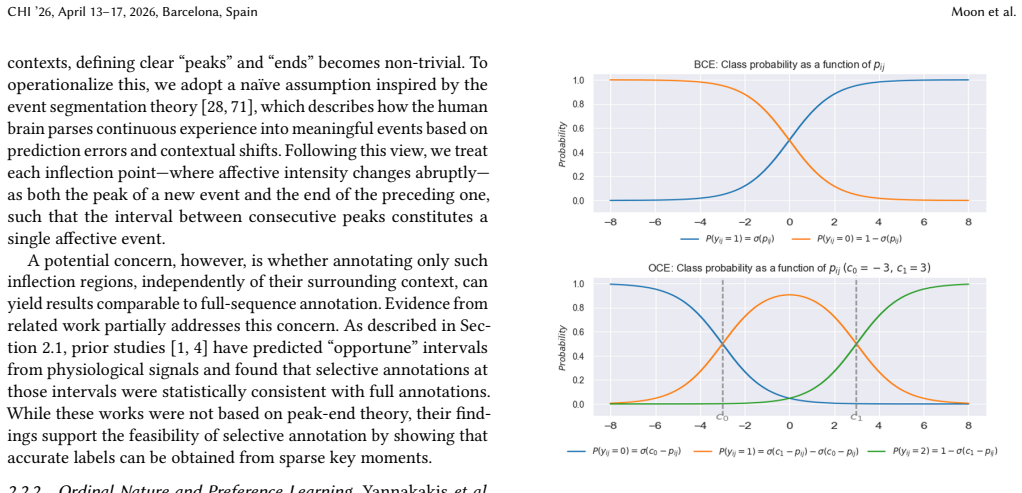
PREFAB employs a preference-learning model to detect relative affective changes... ordinal cross-entropy (OCE) loss... three-class setting: greater/equal/less
-
IndisputableMonolith/Foundation/RealityFromDistinction.leanreality_from_one_distinction unclear?
unclearRelation between the paper passage and the cited Recognition theorem.
Grounded in the peak-end rule and ordinal representations of emotion... interpolation of the remainder
What do these tags mean?
- matches
- The paper's claim is directly supported by a theorem in the formal canon.
- supports
- The theorem supports part of the paper's argument, but the paper may add assumptions or extra steps.
- extends
- The paper goes beyond the formal theorem; the theorem is a base layer rather than the whole result.
- uses
- The paper appears to rely on the theorem as machinery.
- contradicts
- The paper's claim conflicts with a theorem or certificate in the canon.
- unclear
- Pith found a possible connection, but the passage is too broad, indirect, or ambiguous to say the theorem truly supports the claim.
Reference graph
Works this paper leans on
-
[1]
Akhilesh Adithya, Snigdha Tiwari, Sougata Sen, Sandip Chakraborty, and Surjya Ghosh. 2022. OCEAN: Towards Developing an Opportunistic Continuous Emo- tion Annotation Framework. In2022 IEEE International Conference on Pervasive Computing and Communications Workshops and other Affiliated Events (PerCom Workshops). 9–12. https://doi.org/10.1109/PerComWorksho...
work page doi:10.1109/percomworkshops53856.2022.9767359 2022
-
[2]
Değer Ayata, Yusuf Yaslan, and Mustafa Kamaşak. 2016. Emotion recognition via random forest and galvanic skin response: Comparison of time based feature sets, window sizes and wavelet approaches. In2016 Medical Technologies National Congress (TIPTEKNO). 1–4. https://doi.org/10.1109/TIPTEKNO.2016.7863130
-
[3]
Brian P. Bailey and Joseph A. Konstan. 2006. On the need for attention-aware systems: Measuring effects of interruption on task performance, error rate, and affective state.Computers in Human Behavior22, 4 (2006), 685–708. https: //doi.org/10.1016/j.chb.2005.12.009 Attention aware systems
-
[4]
Swarnali Banik, Sougata Sen, Snehanshu Saha, and Surjya Ghosh. 2024. Towards Reducing Continuous Emotion Annotation Effort During Video Consumption: A Physiological Response Profiling Approach.Proc. ACM Interact. Mob. Wearable Ubiquitous Technol.8, 3, Article 91 (Sept. 2024), 32 pages. https://doi.org/10.1145/ 3678569
work page 2024
-
[5]
Virginia Braun and Victoria Clarke. 2006. Using thematic analysis in psychology.Qualitative Research in Psychology3, 2 (2006), 77–101. https://doi.org/10.1191/1478088706qp063oa arXiv:https://www.tandfonline.com/doi/pdf/10.1191/1478088706qp063oa
-
[6]
Joan E. Broderick, Joseph E. Schwartz, Gregory Vikingstad, Michelle Pribbernow, Steven Grossman, and Arthur A. Stone. 2008. The accuracy of pain and fatigue items across different reporting periods.PAIN139, 1 (2008), 146–157. https: //doi.org/10.1016/j.pain.2008.03.024
-
[7]
Joost Broekens, Anne Pronker, and Marian Neuteboom. 2010. Real time labeling of affect in music using the affectbutton. InProceedings of the 3rd International Workshop on Affective Interaction in Natural Environments(Firenze, Italy)(AFFINE ’10). Association for Computing Machinery, New York, NY, USA, 21–26. https: //doi.org/10.1145/1877826.1877833
-
[8]
Chris Burges, Tal Shaked, Erin Renshaw, Ari Lazier, Matt Deeds, Nicole Hamilton, and Greg Hullender. 2005. Learning to rank using gradient descent. InProceedings of the 22nd international conference on Machine learning(Bonn, Germany)(ICML ’05). Association for Computing Machinery, New York, NY, USA, 89–96. https: //doi.org/10.1145/1102351.1102363
-
[9]
Elizabeth Camilleri, Georgios N Yannakakis, and Antonios Liapis. 2017. Towards general models of player affect. In2017 Seventh International Conference on Affective Computing and Intelligent Interaction (ACII). IEEE, 333–339
work page 2017
-
[10]
Jingjing Chen, Xiaobin Wang, Chen Huang, Xin Hu, Xinke Shen, and Dan Zhang
-
[11]
https://doi.org/10.1038/s41597-023-02650-w
A Large Finer-grained Affective Computing EEG Dataset.Scientific Data 10, 1 (25 Oct 2023), 740. https://doi.org/10.1038/s41597-023-02650-w
-
[12]
Youjin Choi, JooYeong Kim, and Jin-Hyuk Hong. 2022. Immersion Measurement in Watching Videos Using Eye-tracking Data.IEEE Transactions on Affective Computing13, 4 (2022), 1759–1770. https://doi.org/10.1109/TAFFC.2022.3209311
-
[13]
Roddy Cowie, Ellen Douglas-Cowie, Susie Savvidou, Edelle McMahon, Martin Sawey, and Marc Schröder. 2000. Feeltrace: An instrument for recording perceived emotion in real time. InProceedings of the ISCA Workshop on Speech and Emotion, Vol. 1
work page 2000
-
[14]
Roddy Cowie, Martin Sawey, Cian Doherty, Javier Jaimovich, Cavan Fyans, and Paul Stapleton. 2013. Gtrace: General Trace Program Compatible with Emo- tionML. In2013 Humaine Association Conference on Affective Computing and Intelligent Interaction. 709–710. https://doi.org/10.1109/ACII.2013.126
-
[15]
MIHALY CSIKSZENTMIHALYI and REED LARSON. 1987. Validity and Reliability of the Experience-Sampling Method.The Journal of Nervous and Mental Disease 175, 9 (1987). https://journals.lww.com/jonmd/fulltext/1987/09000/validity_and_ reliability_of_the.4.aspx
work page 1987
-
[16]
Bridgid Finn. 2010. Ending on a high note: Adding a better end to effortful study. Journal of Experimental Psychology: Learning, Memory, and Cognition36, 6 (2010), 1548
work page 2010
-
[17]
Barbara L Fredrickson and Daniel Kahneman. 1993. Duration neglect in ret- rospective evaluations of affective episodes.Journal of personality and social psychology65, 1 (1993), 45
work page 1993
-
[18]
Siddhant Garg and Yingyu Liang. 2020. Functional regularization for representa- tion learning: A unified theoretical perspective.Advances in Neural Information Processing Systems33 (2020), 17187–17199
work page 2020
-
[19]
Jeffrey M Girard. 2014. CARMA: Software for continuous affect rating and media annotation.Journal of open research software2, 1 (2014), e5
work page 2014
-
[20]
Jeffrey M Girard and Aidan G C. Wright. 2018. DARMA: Software for dual axis rating and media annotation.Behavior research methods50 (2018), 902–909
work page 2018
-
[21]
Shalom Greene, Himanshu Thapliyal, and Allison Caban-Holt. 2016. A Survey of Affective Computing for Stress Detection: Evaluating technologies in stress detection for better health.IEEE Consumer Electronics Magazine5, 4 (2016), 44–56. https://doi.org/10.1109/MCE.2016.2590178
-
[22]
Kyeong-Soo Han, Han kyu Lee, Youngho Jeong, and Youn-Seon Jang. 2013. Improvement of viewers’ preference inference by applying the peak-end rule. In2013 International Conference on ICT Convergence (ICTC). 792–797. https: //doi.org/10.1109/ICTC.2013.6675481
-
[23]
Sepp Hochreiter and Jürgen Schmidhuber. 1997. Long Short-Term Memory. Neural Computation9, 8 (1997), 1735–1780. https://doi.org/10.1162/neco.1997.9. 8.1735
-
[24]
Alexander Hoelzemann and Kristof Van Laerhoven. 2024. A matter of annotation: an empirical study on in situ and self-recall activity annotations from wearable sensors.Frontiers in Computer Science6 (2024), 1379788
work page 2024
-
[25]
Ziniu Hu, Zhe Zhao, Xinyang Yi, Tiansheng Yao, Lichan Hong, Yizhou Sun, and Ed Chi. 2022. Improving Multi-Task Generalization via Regularizing Spurious Correlation. InAdvances in Neural Information Processing Systems, S. Koyejo, S. Mohamed, A. Agarwal, D. Belgrave, K. Cho, and A. Oh (Eds.), Vol. 35. Curran Associates, Inc., 11450–11466. https://proceeding...
work page 2022
-
[26]
Patrícia Augustin Jaques, Matheus Lehmann, and Sylvie Pesty. 2009. Evaluating the affective tactics of an emotional pedagogical agent. InProceedings of the 2009 ACM Symposium on Applied Computing(Honolulu, Hawaii)(SAC ’09). Association for Computing Machinery, New York, NY, USA, 104–109. https://doi.org/10. 1145/1529282.1529304
-
[27]
Soheil Khorram, Melvin G McInnis, and Emily Mower Provost. 2019. Jointly aligning and predicting continuous emotion annotations.IEEE Transactions on Affective Computing12, 4 (2019), 1069–1083
work page 2019
-
[28]
Gregory Koch, Richard Zemel, Ruslan Salakhutdinov, et al. 2015. Siamese neural networks for one-shot image recognition. InICML deep learning workshop, Vol. 2. Lille, 1–30
work page 2015
-
[29]
Christopher A. Kurby and Jeffrey M. Zacks. 2008. Segmentation in the perception and memory of events.Trends in Cognitive Sciences12, 2 (2008), 72–79. https: //doi.org/10.1016/j.tics.2007.11.004
-
[30]
I Lawrence and Kuei Lin. 1989. A concordance correlation coefficient to evaluate reproducibility.Biometrics(1989), 255–268. PREFAB: PREFerence-based Affective Modeling for Low-Budget Self-Annotation CHI ’26, April 13–17, 2026, Barcelona, Spain
work page 1989
-
[31]
Zongxia Li, Xiyang Wu, Hongyang Du, Fuxiao Liu, Huy Nghiem, and Guangyao Shi. 2025. A Survey of State of the Art Large Vision Language Models: Bench- mark Evaluations and Challenges. InProceedings of the IEEE/CVF Conference on Computer Vision and Pattern Recognition (CVPR) Workshops. 1587–1606
work page 2025
-
[32]
Phil Lopes, Georgios N Yannakakis, and Antonios Liapis. 2017. Ranktrace: Relative and unbounded affect annotation. In2017 Seventh International Conference on Affective Computing and Intelligent Interaction (ACII). IEEE, 158–163
work page 2017
-
[33]
Yiyue Luo, Yunzhu Li, Pratyusha Sharma, Wan Shou, Kui Wu, Michael Foshey, Beichen Li, Tomás Palacios, Antonio Torralba, and Wojciech Matusik. 2021. Learn- ing human–environment interactions using conformal tactile textiles.Nature Electronics4, 3 (2021), 193–201
work page 2021
-
[34]
Yiyue Luo, Kui Wu, Tomás Palacios, and Wojciech Matusik. 2021. KnitUI: Fab- ricating Interactive and Sensing Textiles with Machine Knitting. InProceedings of the 2021 CHI Conference on Human Factors in Computing Systems(Yokohama, Japan)(CHI ’21). Association for Computing Machinery, New York, NY, USA, Article 668, 12 pages. https://doi.org/10.1145/3411764.3445780
-
[35]
Clare Lyle, Mark Rowland, Georg Ostrovski, and Will Dabney. 2021. On the effect of auxiliary tasks on representation dynamics. InInternational Conference on Artificial Intelligence and Statistics. PMLR, 1–9
work page 2021
-
[36]
Konstantinos Makantasis, Antonios Liapis, and Georgios N. Yannakakis. 2023. The Pixels and Sounds of Emotion: General-Purpose Representations of Arousal in Games.IEEE Transactions on Affective Computing14, 1 (2023), 680–693. https: //doi.org/10.1109/TAFFC.2021.3060877
-
[37]
Soroosh Mariooryad and Carlos Busso. 2013. Analysis and Compensation of the Reaction Lag of Evaluators in Continuous Emotional Annotations. In2013 Humaine Association Conference on Affective Computing and Intelligent Interaction. 85–90. https://doi.org/10.1109/ACII.2013.21
-
[38]
Soroosh Mariooryad and Carlos Busso. 2015. Correcting Time-Continuous Emo- tional Labels by Modeling the Reaction Lag of Evaluators.IEEE Transactions on Affective Computing6, 2 (2015), 97–108. https://doi.org/10.1109/TAFFC.2014. 2334294
-
[39]
Gloria Mark, Daniela Gudith, and Ulrich Klocke. 2008. The cost of interrupted work: more speed and stress. InProceedings of the SIGCHI Conference on Human Factors in Computing Systems(Florence, Italy)(CHI ’08). Association for Comput- ing Machinery, New York, NY, USA, 107–110. https://doi.org/10.1145/1357054. 1357072
-
[40]
Héctor P. Martínez, Georgios N. Yannakakis, and John Hallam. 2014. Don’t Classify Ratings of Affect; Rank Them!IEEE Transactions on Affective Computing 5, 3 (2014), 314–326. https://doi.org/10.1109/TAFFC.2014.2352268
-
[41]
David Melhart, Antonios Liapis, and Georgios N Yannakakis. 2019. PAGAN: Video affect annotation made easy. In2019 8th international conference on affective computing and intelligent interaction (ACII). IEEE, 130–136
work page 2019
-
[42]
David Melhart, Antonios Liapis, and Georgios N Yannakakis. 2022. The arousal video game annotation (AGAIN) dataset.IEEE Transactions on Affective Computing 13, 4 (2022), 2171–2184
work page 2022
-
[43]
David Melhart, Georgios N Yannakakis, and Antonios Liapis. 2020. I feel i feel you: A theory of mind experiment in games.KI-Künstliche Intelligenz34, 1 (2020), 45–55
work page 2020
-
[44]
Metacritic. [n. d.].Metacritic. https://www.metacritic.com/game
-
[45]
Angeliki Metallinou and Shrikanth Narayanan. 2013. Annotation and processing of continuous emotional attributes: Challenges and opportunities. In2013 10th IEEE International Conference and Workshops on Automatic Face and Gesture Recognition (FG). 1–8. https://doi.org/10.1109/FG.2013.6553804
-
[46]
JaeYoung Moon, EunHye Cho, Yeabon Jo, KyungJoong Kim, and Eunsung Song
-
[47]
https://doi.org/10.1109/TG.2024.3424459
Investigating the Effect of Emotional Matching Between Game and Back- ground Music on Game Experience in a Valence–Arousal Space.IEEE Transactions on Games17, 2 (2025), 282–295. https://doi.org/10.1109/TG.2024.3424459
-
[48]
JaeYoung Moon, YouJin Choi, TaeHwa Park, JunDoo Choi, Jin-Hyuk Hong, and Kyung-Joong Kim. 2022. Diversifying dynamic difficulty adjustment agent by integrating player state models into Monte-Carlo tree search.Expert Systems with Applications205 (2022), 117677. https://doi.org/10.1016/j.eswa.2022.117677
-
[49]
Masaki Omata, Daisuke Kanuka, Xiaoyang Mao, and Atsumi Imamiya. 2012. Af- fective Doodle: a painting tool reflecting user emotion. InProceedings of the ACM Symposium on Applied Perception(Los Angeles, California)(SAP ’12). Association for Computing Machinery, New York, NY, USA, 120. https://doi.org/10.1145/ 2338676.2338702
-
[50]
Nathalie Pattyn, Xavier Neyt, David Henderickx, and Eric Soetens. 2008. Psy- chophysiological investigation of vigilance decrement: Boredom or cognitive fatigue?Physiology & Behavior93, 1 (2008), 369–378. https://doi.org/10.1016/j. physbeh.2007.09.016
work page doi:10.1016/j 2008
-
[51]
Fabian Pedregosa, Francis Bach, and Alexandre Gramfort. 2017. On the Consis- tency of Ordinal Regression Methods.Journal of Machine Learning Research18, 55 (2017), 1–35. http://jmlr.org/papers/v18/15-495.html
work page 2017
-
[52]
Guanxiong Pei, Haiying Li, Yandi Lu, Yanlei Wang, Shizhen Hua, and Taihao Li
-
[53]
Intelligent Computing3 (2024), 0076
Affective Computing: Recent Advances, Challenges, and Future Trends. Intelligent Computing3 (2024), 0076. https://doi.org/10.34133/icomputing.0076 arXiv:https://spj.science.org/doi/pdf/10.34133/icomputing.0076
-
[54]
Ethan Perez, Florian Strub, Harm de Vries, Vincent Dumoulin, and Aaron Courville. 2018. FiLM: Visual Reasoning with a General Conditioning Layer. Proceedings of the AAAI Conference on Artificial Intelligence32, 1 (Apr. 2018). https://doi.org/10.1609/aaai.v32i1.11671
-
[55]
Rosalind W. Picard. 1997.Affective computing. MIT Press, Cambridge, MA, USA
work page 1997
-
[56]
Kosmas Pinitas, Konstantinos Makantasis, Antonios Liapis, and Georgios N. Yan- nakakis. 2022. RankNEAT: outperforming stochastic gradient search in preference learning tasks. InProceedings of the Genetic and Evolutionary Computation Confer- ence(Boston, Massachusetts)(GECCO ’22). Association for Computing Machinery, New York, NY, USA, 1084–1092. https://d...
-
[57]
Dominic Potts, Miloni Gada, Aastha Gupta, Kavya Goel, Klaus Philipp Krzok, Genevieve Pate, Joseph Hartley, Mark Weston-Arnold, Jakob Aylott, Christopher Clarke, Crescent Jicol, and Christof Lutteroth. 2025. RetroSketch: A Retrospective Method for Measuring Emotions and Presence in Virtual Reality. InProceedings of the 2025 CHI Conference on Human Factors ...
-
[58]
Michael D Robinson and Gerald L Clore. 2002. Belief and feeling: evidence for an accessibility model of emotional self-report.Psychological bulletin128, 6 (2002), 934
work page 2002
-
[59]
H. Sakoe and S. Chiba. 1978. Dynamic programming algorithm optimization for spoken word recognition.IEEE Transactions on Acoustics, Speech, and Signal Processing26, 1 (1978), 43–49. https://doi.org/10.1109/TASSP.1978.1163055
-
[60]
Julian Scharbert, Katharina Utesch, Thomas Reiter, Julian ter Horst, Maarten van Zalk, Mitja D Back, and Richard Rau. 2025. If you were happy and you know it, clap your hands! Testing the peak-end rule for retrospec- tive judgments of well-being in everyday life.European Journal of Per- sonality39, 1 (2025), 55–69. https://doi.org/10.1177/0890207024123596...
-
[61]
van den Broek, Alin Albu-Schaeffer, and Friedhelm Schwenker
Karan Sharma, Claudio Castellini, Egon L. van den Broek, Alin Albu-Schaeffer, and Friedhelm Schwenker. 2019. A dataset of continuous affect annotations and physiological signals for emotion analysis.Scientific Data6, 1 (09 Oct 2019), 196. https://doi.org/10.1038/s41597-019-0209-0
-
[62]
Saul Shiffman, Arthur A Stone, and Michael R Hufford. 2008. Ecological momen- tary assessment.Annu. Rev. Clin. Psychol.4, 1 (2008), 1–32
work page 2008
-
[63]
Jianping Song, Tianran Tang, and Guosheng Hu. 2023. The duration threshold of video content observation: An experimental investigation of visual perception efficiency.Computer Science and Information Systems20, 2 (2023), 879–892
work page 2023
- [64]
-
[65]
Jianhua Tao and Tieniu Tan. 2005. Affective Computing: A Review. InAffective Computing and Intelligent Interaction, Jianhua Tao, Tieniu Tan, and Rosalind W. Picard (Eds.). Springer Berlin Heidelberg, Berlin, Heidelberg, 981–995
work page 2005
-
[66]
Ashish Vaswani, Noam Shazeer, Niki Parmar, Jakob Uszkoreit, Llion Jones, Aidan N Gomez, Łukasz Kaiser, and Illia Polosukhin. 2017. Attention is all you need.Advances in neural information processing systems30 (2017)
work page 2017
-
[67]
Pauli Virtanen, Ralf Gommers, Travis E. Oliphant, Matt Haberland, Tyler Reddy, David Cournapeau, Evgeni Burovski, Pearu Peterson, Warren Weckesser, Jonathan Bright, Stéfan J. van der Walt, Matthew Brett, Joshua Wilson, K. Jar- rod Millman, Nikolay Mayorov, Andrew R. J. Nelson, Eric Jones, Robert Kern, Eric Larson, C J Carey, İlhan Polat, Yu Feng, Eric W. ...
-
[68]
Shuo Yan, Gangyi Ding, Hongsong Li, Ningxiao Sun, Zheng Guan, Yufeng Wu, Longfei Zhang, and Tianyu Huang. 2017. Exploring Audience Response in Performing Arts with a Brain-Adaptive Digital Performance System.ACM Trans. Interact. Intell. Syst.7, 4, Article 16 (Dec. 2017), 28 pages. https://doi.org/10.1145/ 3009974
work page 2017
-
[69]
Georgios N. Yannakakis. 2009. Preference learning for affective modeling. In2009 3rd International Conference on Affective Computing and Intelligent Interaction and Workshops. 1–6. https://doi.org/10.1109/ACII.2009.5349491
-
[70]
Georgios N Yannakakis, Roddy Cowie, and Carlos Busso. 2018. The ordinal nature of emotions: An emerging approach.IEEE Transactions on Affective Computing 12, 1 (2018), 16–35
work page 2018
-
[71]
Yannakakis, Manolis Maragoudakis, and John Hallam
Georgios N. Yannakakis, Manolis Maragoudakis, and John Hallam. 2009. Prefer- ence Learning for Cognitive Modeling: A Case Study on Entertainment Prefer- ences.IEEE Transactions on Systems, Man, and Cybernetics - Part A: Systems and Humans39, 6 (2009), 1165–1175. https://doi.org/10.1109/TSMCA.2009.2028152
-
[72]
Georgios N. Yannakakis and Héctor P. Martínez. 2015. Grounding truth via ordinal annotation. In2015 International Conference on Affective Computing and Intelligent Interaction (ACII). 574–580. https://doi.org/10.1109/ACII.2015.7344627
-
[73]
Georgios N. Yannakakis and David Melhart. 2023. Affective Game Computing: A Survey.Proc. IEEE111, 10 (2023), 1423–1444. https://doi.org/10.1109/JPROC. CHI ’26, April 13–17, 2026, Barcelona, Spain Moon et al. 2023.3315689
-
[74]
Jeffrey M Zacks, Nicole K Speer, Khena M Swallow, Todd S Braver, and Jeremy R Reynolds. 2007. Event perception: a mind-brain perspective.Psychological bulletin 133, 2 (2007), 273
work page 2007
-
[75]
Emma Yann Zhang, Zhigeng Pan, and Adrian David Cheok. 2025. Emotion Recognition Using Affective Touch: A Survey.IEEE Transactions on Affective Computing(2025), 1–20. https://doi.org/10.1109/TAFFC.2025.3592197
-
[76]
Tianyi Zhang, Abdallah El Ali, Chen Wang, Alan Hanjalic, and Pablo Cesar. 2020. Rcea: Real-time, continuous emotion annotation for collecting precise mobile video ground truth labels. InProceedings of the 2020 CHI Conference on Human Factors in Computing Systems. 1–15
work page 2020
-
[77]
Zixin Zhang, Fan Qi, Shuai Li, and Changsheng Xu. 2023. AffectFAL: Fed- erated Active Affective Computing with Non-IID Data. InProceedings of the 31st ACM International Conference on Multimedia(Ottawa ON, Canada)(MM ’23). Association for Computing Machinery, New York, NY, USA, 871–882. https://doi.org/10.1145/3581783.3612442 PREFAB: PREFerence-based Affec...
discussion (0)
Sign in with ORCID, Apple, or X to comment. Anyone can read and Pith papers without signing in.