A Converse Bound via the Nussbaum-Szko{l}a Mapping for Quantum Hypothesis Testing
Pith reviewed 2026-05-21 15:23 UTC · model grok-4.3
The pith
A lower bound from the Nussbaum-Szkoła mapping unifies converse results for asymmetric quantum hypothesis testing across all regimes.
A machine-rendered reading of the paper's core claim, the machinery that carries it, and where it could break.
Core claim
The paper shows that the Nussbaum-Szkoła mapping applied to asymmetric quantum hypothesis testing produces a converse bound that holds uniformly and recovers the optimal error exponents in the large-, moderate-, and small-deviation regimes from a single expression, while also furnishing accurate approximations to the optimal finite-blocklength error trade-off curve.
What carries the argument
The Nussbaum-Szkoła mapping, which converts a pair of quantum states into a pair of classical probability distributions while preserving the quantities relevant to hypothesis testing error exponents.
Load-bearing premise
The Nussbaum-Szkoła mapping can be applied directly to the asymmetric quantum hypothesis testing problem to yield a valid unified lower bound without extra regime-specific adjustments.
What would settle it
Compute the exact optimal error-probability trade-off curve for a concrete pair of quantum states at small blocklength n and check whether the new bound lies below the true curve yet closer to it than the fidelity or information-spectrum bounds, or verify that the bound exactly reproduces the known quantum Chernoff exponent in the large-deviation limit.
Figures
read the original abstract
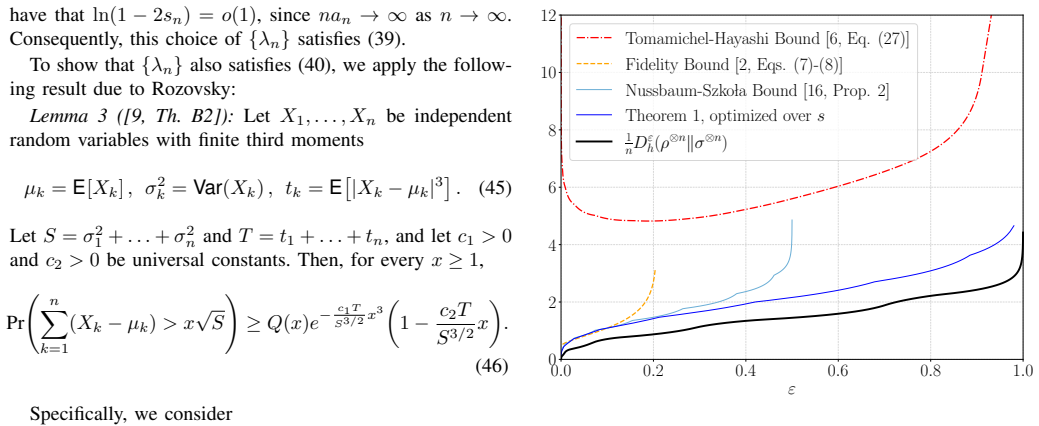
Quantum hypothesis testing concerns the discrimination between quantum states. This paper introduces a novel lower bound for asymmetric quantum hypothesis testing that is based on the Nussbaum-Szko{\l}a mapping. The lower bound provides a unified recovery of converse results across all major asymptotic regimes, including large-, moderate-, and small-deviations. Unlike existing bounds, which either rely on technically involved information-spectrum arguments or suffer from fixed prefactors and limited applicability in the non-asymptotic regime, the proposed bound arises from a single expression and enables, in some cases, the direct use of classical results. It is further demonstrated that the proposed bound provides accurate approximations to the optimal quantum error trade-off function at small blocklengths. Numerical comparisons with existing bounds, including those based on fidelity and information spectrum methods, highlight its improved tightness.
Editorial analysis
A structured set of objections, weighed in public.
Referee Report
Summary. The paper introduces a novel lower bound for asymmetric quantum hypothesis testing derived from the Nussbaum-Szkoła mapping. The bound is presented as arising from a single expression that recovers known converse results across large-deviation, moderate-deviation, and small-deviation regimes, permits direct application of classical results in some cases, and yields tighter numerical approximations to the optimal error trade-off at small blocklengths than fidelity or information-spectrum bounds.
Significance. If the unification claim holds without regime-specific looseness, the result would provide a practical, unified tool for converse bounds in quantum hypothesis testing, bridging asymptotic regimes and improving finite-blocklength estimates. The potential to leverage classical results directly would be a notable strength.
major comments (2)
- [§3] §3 (main theorem): The specialization of the single bound expression to the known tight converses (e.g., Chernoff-Stein lemma in large deviations, moderate-deviation rate functions) must be shown explicitly via parameter limits or substitutions, without auxiliary information-spectrum arguments or regime-dependent adjustments, to substantiate the 'unified recovery from one expression' claim.
- [§4] §4 (asymptotic recovery): The algebra demonstrating recovery of all three regimes should be presented in full, including any intermediate steps that might introduce looseness when the mapping is applied to quantum states rather than classical distributions.
minor comments (2)
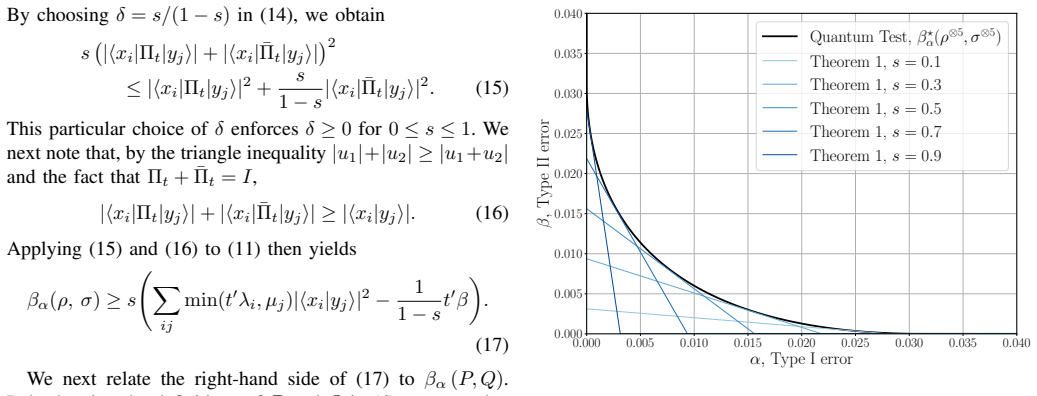
- [Numerical results] Figure 1 and Table 1: Ensure axis labels and captions explicitly state the quantum states (e.g., qubit Werner states) and blocklength values used in the numerical comparisons for reproducibility.
- [Preliminaries] Notation section: Define the precise form of the Nussbaum-Szkoła mapping when lifted to quantum hypothesis testing, including how the classical probability measures are obtained from the quantum states.
Simulated Author's Rebuttal
We thank the referee for the thorough review and constructive feedback on our manuscript. The comments highlight important aspects of our unification claim, and we address them point by point below. We have revised the manuscript to incorporate explicit derivations as requested.
read point-by-point responses
-
Referee: [§3] §3 (main theorem): The specialization of the single bound expression to the known tight converses (e.g., Chernoff-Stein lemma in large deviations, moderate-deviation rate functions) must be shown explicitly via parameter limits or substitutions, without auxiliary information-spectrum arguments or regime-dependent adjustments, to substantiate the 'unified recovery from one expression' claim.
Authors: We agree that explicit specialization is essential to substantiate the claim of recovery from a single expression. In the revised version, we add a dedicated subsection to §3 that derives the Chernoff-Stein lemma and the moderate-deviation rate function directly from the bound via parameter limits and substitutions. These derivations use only the definition of the Nussbaum-Szkoła mapping and standard limit arguments, without invoking information-spectrum methods or regime-specific adjustments. revision: yes
-
Referee: [§4] §4 (asymptotic recovery): The algebra demonstrating recovery of all three regimes should be presented in full, including any intermediate steps that might introduce looseness when the mapping is applied to quantum states rather than classical distributions.
Authors: We accept this recommendation. The revised §4 now contains the complete algebraic steps for recovering the large-, moderate-, and small-deviation regimes. We explicitly track each intermediate inequality arising from the quantum-to-classical mapping and demonstrate that any looseness is confined to the inherent properties of the bound itself rather than additional artifacts from the mapping. This expansion clarifies the tightness in each asymptotic regime. revision: yes
Circularity Check
No significant circularity; bound derived from external Nussbaum-Szkoła mapping
full rationale
The derivation applies the established Nussbaum-Szkoła mapping to asymmetric quantum hypothesis testing to obtain a single lower-bound expression. This mapping originates from prior independent classical work and is not redefined or fitted within the paper. The abstract states that the bound recovers converses across regimes directly from this expression without auxiliary information-spectrum arguments or regime-specific adjustments. No equations reduce by construction to fitted inputs, self-citations, or ansatzes imported from the authors' own prior results. The central claim remains independent of the target result and is supported by the mapping's properties plus classical results, making the paper self-contained against external benchmarks.
Axiom & Free-Parameter Ledger
Lean theorems connected to this paper
-
IndisputableMonolith/Cost/FunctionalEquation.leanwashburn_uniqueness_aczel unclear?
unclearRelation between the paper passage and the cited Recognition theorem.
Theorem 1: βα(ρ, σ) ≥ s β_{1/(1-s)}^α (P, Q) for 0 ≤ s ≤ 1
What do these tags mean?
- matches
- The paper's claim is directly supported by a theorem in the formal canon.
- supports
- The theorem supports part of the paper's argument, but the paper may add assumptions or extra steps.
- extends
- The paper goes beyond the formal theorem; the theorem is a base layer rather than the whole result.
- uses
- The paper appears to rely on the theorem as machinery.
- contradicts
- The paper's claim conflicts with a theorem or certificate in the canon.
- unclear
- Pith found a possible connection, but the passage is too broad, indirect, or ambiguous to say the theorem truly supports the claim.
Forward citations
Cited by 1 Pith paper
-
Multiple Quantum Hypothesis Testing: One-Shot Pairwise Bounds and Sharp Asymptotics
Establishes dimension-free one-shot pairwise bounds for multiple quantum hypothesis testing, resolves Audenaert-Mosonyi conjecture, and proves achievability of multiple quantum Chernoff distance for arbitrary separabl...
Reference graph
Works this paper leans on
-
[1]
The Chernoff lower bound for symmetric quantum hypothesis testing,
M. Nussbaum and A. Szkoła, “The Chernoff lower bound for symmetric quantum hypothesis testing,”The Annals of Statistics, vol. 37, no. 2, pp. 1040 – 1057, Apr. 2009
work page 2009
-
[2]
Analytical bounds for nonasymptotic asymmetric state discrimination,
J. L. Pereira, L. Banchi, and S. Pirandola, “Analytical bounds for nonasymptotic asymmetric state discrimination,”Physical Review Ap- plied, vol. 19, no. 5, p. 054030, May 2023
work page 2023
-
[3]
The proper formula for relative entropy and its asymptotics in quantum probability,
F. Hiai and D. Petz, “The proper formula for relative entropy and its asymptotics in quantum probability,”Communications in Mathematical Physics, vol. 143, no. 1, pp. 99–114, Dec. 1991
work page 1991
-
[4]
On error exponents in quantum hypothesis testing,
T. Ogawa and M. Hayashi, “On error exponents in quantum hypothesis testing,”IEEE Transactions on Information Theory, vol. 50, no. 6, pp. 1368–1372, Jun. 2004
work page 2004
-
[5]
Second-order asymptotics for quantum hypothesis testing,
K. Li, “Second-order asymptotics for quantum hypothesis testing,”The Annals of Statistics, vol. 42, no. 1, pp. 171–189, Feb. 2014
work page 2014
-
[6]
A hierarchy of information quantities for finite blocklength analysis,
M. Tomamichel and M. Hayashi, “A hierarchy of information quantities for finite blocklength analysis,”IEEE Transactions on Information Theory, vol. 59, no. 10, pp. 6719–6736, Nov. 2013
work page 2013
-
[7]
Moderate deviation analysis for classical communication over quantum channels,
C. T. Chubb, V . Y . Tan, and M. Tomamichel, “Moderate deviation analysis for classical communication over quantum channels,”Commu- nications in Mathematical Physics, vol. 355, no. 3, pp. 1283–1315, Aug. 2017
work page 2017
-
[8]
Moderate deviation analysis for classical-quantum channels and quantum hypothesis testing,
H.-C. Cheng and M.-H. Hsieh, “Moderate deviation analysis for classical-quantum channels and quantum hypothesis testing,”IEEE Transactions on Information Theory, vol. 64, no. 2, pp. 1385–1403, Feb. 2017
work page 2017
-
[9]
L. Rozovsky, “Estimate from below for large-deviation probabilities of a sum of independent random variables with finite variances,”Journal of Mathematical Sciences, vol. 109, no. 6, pp. 2192–2209, May 2002
work page 2002
-
[10]
Moderate deviations analysis of binary hypothesis testing,
I. Sason, “Moderate deviations analysis of binary hypothesis testing,” inProceedings 2012 IEEE International Symposium on Information Theory, Boston, MA, USA, Jul. 2012, pp. 821–825
work page 2012
-
[11]
Discriminating states: The quantum Chernoff bound,
K. M. R. Audenaert, J. Calsamiglia, R. Munoz-Tapia, E. Bagan, L. Masanes, A. Acin, and F. Verstraete, “Discriminating states: The quantum Chernoff bound,”Physical Review Letters, vol. 98, no. 16, p. 160501, Apr. 2007
work page 2007
-
[12]
M. Hayashi, “Error exponent in asymmetric quantum hypothesis testing and its application to classical-quantum channel coding,”Physical Review A, vol. 76, p. 062301, Dec 2007
work page 2007
-
[13]
The converse part of the theorem for quantum hoeffding bound,
H. Nagaoka, “The converse part of the theorem for quantum hoeffding bound,”arXiv: Quantum Physics, 2006
work page 2006
-
[14]
Multiple quantum hypothesis testing expressions and classical-quantum channel converse bounds,
G. Vazquez-Vilar, “Multiple quantum hypothesis testing expressions and classical-quantum channel converse bounds,” inProceedings 2016 IEEE International Symposium on Information Theory, Barcelona, Spain, Jul. 2016, pp. 2854–2857
work page 2016
-
[15]
Asymptotic estimates in information theory with non- vanishing error probabilities,
V . Y . Tan, “Asymptotic estimates in information theory with non- vanishing error probabilities,”F oundations and Trends® in Communi- cations and Information Theory, vol. 11, no. 1-2, pp. 1–184, 2014
work page 2014
-
[16]
Asymptotic error rates in quantum hypothesis testing,
K. M. R. Audenaert, M. Nussbaum, A. Szkoła, and F. Verstraete, “Asymptotic error rates in quantum hypothesis testing,”Communications in Mathematical Physics, vol. 279, no. 1, pp. 251–283, Apr. 2008
work page 2008
-
[17]
Error probability trade-off in quantum hypothesis testing via the Nussbaum–Szkoła mapping,
G. Vazquez-Vilar and J. Lizarribar-Carrillo, “Error probability trade-off in quantum hypothesis testing via the Nussbaum–Szkoła mapping,” in Proceedings International Zurich Seminar on Information and Commu- nication, Zurich, Switzerland, Mar. 2024, pp. 58–61
work page 2024
discussion (0)
Sign in with ORCID, Apple, or X to comment. Anyone can read and Pith papers without signing in.