Multiple Quantum Hypothesis Testing: One-Shot Pairwise Bounds and Sharp Asymptotics
Pith reviewed 2026-06-28 01:23 UTC · model grok-4.3
The pith
A dimension-free one-shot upper bound relates the minimum error probability in multiple quantum hypothesis testing to the sum of pairwise errors.
A machine-rendered reading of the paper's core claim, the machinery that carries it, and where it could break.
Core claim
We establish a dimension-free one-shot upper bound on the minimum probability of error in terms of the sum of pairwise errors. This resolves a conjecture of Audenaert and Mosonyi and improves the multiple quantum Chernoff bound of Li by removing its dimension-dependent prefactor. In the asymptotic many-copy regime, our bound proves the achievability of the multiple quantum Chernoff distance for arbitrary separable Hilbert spaces, thereby settling the previously open infinite-dimensional case, and further yields constant-factor sharp asymptotics for the optimal error probability. In binary quantum hypothesis testing, we prove that the minimum error probability is characterized, up to universa
What carries the argument
The dimension-free one-shot upper bound relating the multi-state minimum error probability to the sum of pairwise binary error probabilities.
If this is right
- The multiple quantum Chernoff bound holds without a dimension-dependent prefactor.
- The multiple quantum Chernoff distance is achievable in arbitrary separable Hilbert spaces, including infinite dimensions.
- Constant-factor sharp asymptotics hold for the optimal error probability in the many-copy regime.
- The optimal binary quantum error probability is within a factor of two of the optimal classical error probability for the Nussbaum-Szkoła distributions.
Where Pith is reading between the lines
- This suggests that designing good multi-state discrimination strategies can focus primarily on optimizing pairwise tests.
- The results may extend to continuous-variable quantum systems where Hilbert spaces are infinite-dimensional.
- The factor-of-two closeness between quantum and classical binary errors could motivate further comparisons with other classical-quantum relations.
Load-bearing premise
The minimum error probability for multiple states is controlled by the sum of pairwise binary error probabilities without additional dimension-dependent overhead.
What would settle it
A counterexample consisting of quantum states in some separable Hilbert space where the minimum multi-state error probability exceeds any fixed multiple of the sum of pairwise error probabilities would falsify the bound.
Figures
read the original abstract
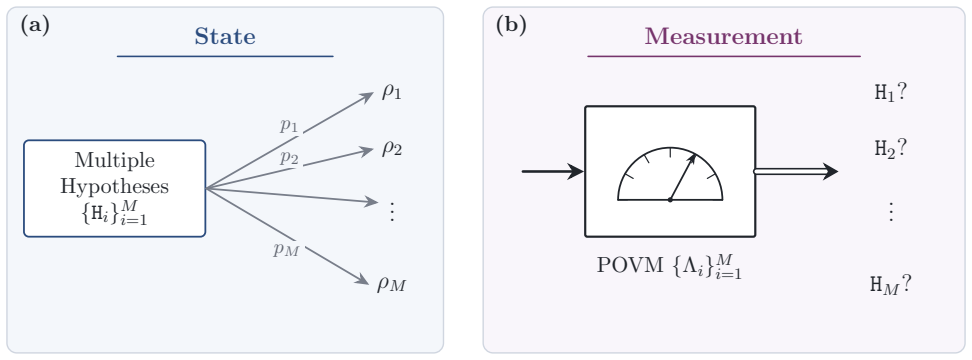
We consider Bayesian discrimination among multiple quantum states and establish a dimension-free one-shot upper bound on the minimum probability of error in terms of the sum of pairwise errors. This resolves a conjecture of Audenaert and Mosonyi [J. Math. Phys. 55 (2014)] and improves the multiple quantum Chernoff bound of Li [Ann. Statist. 44 (2016)] by removing its dimension-dependent prefactor. In the asymptotic many-copy regime, our bound proves the achievability of the multiple quantum Chernoff distance for arbitrary separable Hilbert spaces, thereby settling the previously open infinite-dimensional case, and further yields constant-factor sharp asymptotics for the optimal error probability. In binary quantum hypothesis testing, we prove that the minimum error probability is characterized, up to universal constants, by a trace harmonic-mean quantity. Consequently, the optimal binary quantum error probability is within a factor of two of the optimal classical error probability for the associated Nussbaum-Szko{\l}a distributions, complementing the lower bound of Nussbaum and Szko{\l}a [Ann. Statist. 37 (2009)].
Editorial analysis
A structured set of objections, weighed in public.
Referee Report
Summary. The paper establishes a dimension-free one-shot upper bound on the minimum probability of error for Bayesian discrimination among multiple quantum states, expressed in terms of the sum of pairwise binary error probabilities. This resolves the Audenaert-Mosonyi conjecture and improves the multiple quantum Chernoff bound by removing its dimension-dependent prefactor. In the asymptotic many-copy regime, the bound establishes achievability of the multiple quantum Chernoff distance for arbitrary separable Hilbert spaces (settling the infinite-dimensional case) and yields constant-factor sharp asymptotics. For binary hypothesis testing, the minimum error probability is characterized up to universal constants by a trace harmonic-mean quantity and lies within a factor of two of the classical error probability for the associated Nussbaum-Szkoła distributions.
Significance. If the results hold, the work is significant because it supplies explicit, dimension-free bounds that resolve a standing conjecture and extend the multiple Chernoff distance to infinite-dimensional spaces via approximation arguments that preserve the constants. The direct comparison between multi-hypothesis error and sums of binary errors, together with the trace-harmonic-mean characterization, removes the dimension-dependent overhead that limited prior bounds. These features, combined with the connection to classical Nussbaum-Szkoła distributions, strengthen the link between quantum and classical hypothesis testing and provide falsifiable predictions for the asymptotic regime.
minor comments (3)
- [§2.1, Eq. (8)] §2.1, Eq. (8): the definition of the trace harmonic mean is introduced without an immediate comparison to the classical harmonic mean; adding one sentence would clarify the factor-of-two relation claimed later.
- [§4, Theorem 12] §4, Theorem 12: the statement of the infinite-dimensional achievability result refers to 'approximation arguments' without citing the specific lemma that controls the dimension-free constant; a forward reference would help.
- [Figure 2] Figure 2: the caption does not indicate whether the plotted curves correspond to the upper or lower bound; this affects readability of the sharp-asymptotics claim.
Simulated Author's Rebuttal
We thank the referee for their positive and detailed summary of our work, as well as for recommending minor revision. No specific major comments or criticisms were raised in the report.
Circularity Check
No significant circularity; derivations are self-contained from standard quantities
full rationale
The paper establishes dimension-free bounds on multi-hypothesis error via direct comparisons to sums of pairwise binary errors and trace-harmonic-mean characterizations. These rely on explicit proofs and approximation arguments for infinite-dimensional cases, without reducing to fitted parameters, self-definitions, or load-bearing self-citations. The resolution of the Audenaert-Mosonyi conjecture and improvement over Li's bound use independent mathematical arguments (pairwise error sums, Chernoff distances) that do not collapse to the target result by construction. No steps match the enumerated circularity patterns.
Axiom & Free-Parameter Ledger
axioms (1)
- standard math Quantum states are density operators on separable Hilbert spaces and measurements are POVMs.
Reference graph
Works this paper leans on
-
[1]
Detection theory and quantum mechanics,
C. W. Helstrom, “Detection theory and quantum mechanics,”Information and Control, vol. 10, no. 3, pp. 254–291, mar 1967
1967
-
[2]
The analogue of statistical decision theory in the noncommutative probability theory,
A. S. Holevo, “The analogue of statistical decision theory in the noncommutative probability theory,”Proc. Moscow Math. Soc., vol. 26, pp. 133–149, 1972
1972
-
[3]
Remarks on optimal quantum measurements,
——, “Remarks on optimal quantum measurements,”Problems Inform. Transmission, vol. 10, no. 4, pp. 51–55, 1974. [Online]. Available: http://www.mathnet.ru/php/archive.phtml?wshow=paper&jrnid=ppi& paperid=1057&option lang=eng
1974
-
[4]
Investigations in the general theory of statistical decisions,
——, “Investigations in the general theory of statistical decisions,” inProc. Steklov Inst. Math., no. 124, 1978, pp. 1–140
1978
-
[5]
Optimum testing of multiple hypotheses in quantum detection theory,
H. P. Yuen, R. S. Kennedy, and M. Lax, “Optimum testing of multiple hypotheses in quantum detection theory,”IEEE Transactions on Information Theory, vol. 21, pp. 125–134, March 1975
1975
-
[6]
The proper formula for relative entropy and its asymptotics in quantum probability,
F. Hiai and D. Petz, “The proper formula for relative entropy and its asymptotics in quantum probability,” Communications in Mathematical Physics, vol. 143, no. 1, pp. 99–114, Dec 1991
1991
-
[7]
Strong converse and Stein’s lemma in quantum hypothesis testing,
T. Ogawa and H. Nagaoka, “Strong converse and Stein’s lemma in quantum hypothesis testing,”IEEE Trans- action on Information Theory, vol. 46, no. 7, pp. 2428–2433, 2000
2000
-
[8]
K. R. Parthasarathy,On Consistency of the Maximum Likelihood Method in Testing Multiple Quantum Hy- potheses. Birkh¨ auser Boston, 2001, pp. 361–377
2001
-
[9]
Attainment of the multiple quantum chernoff bound for certain ensembles of mixed states,
M. Nussbaum, “Attainment of the multiple quantum chernoff bound for certain ensembles of mixed states,” in Proceedings of the First International Workshop on Entangled Coherent States and Its Application to Quantum Information Science, T. S. Usuda and K. Kato, Eds. Tokyo, Japan: Tamagawa University, 2013, pp. 77–81
2013
-
[10]
Pretty simple bounds on quantum state discrimination,
A. Montanaro, “Pretty simple bounds on quantum state discrimination,” 2019
2019
-
[11]
An asymptotic error bound for testing multiple quantum hypotheses,
M. Nussbaum and A. Szko la, “An asymptotic error bound for testing multiple quantum hypotheses,”The Annals of Statistics, vol. 39, no. 6, December 2011
2011
-
[12]
Exponential error rates in multiple state discrimination on a quantum spin chain,
——, “Exponential error rates in multiple state discrimination on a quantum spin chain,”Journal of Mathe- matical Physics, vol. 51, no. 7, July 2010
2010
-
[13]
Springer Berlin Heidelberg, 2011, pp
——,Asymptotically Optimal Discrimination between Pure Quantum States. Springer Berlin Heidelberg, 2011, pp. 1–8. [Online]. Available: http://dx.doi.org/10.1007/978-3-642-18073-6 1
-
[14]
Upper bounds on the error probabilities and asymptotic error exponents in quantum multiple state discrimination,
K. M. R. Audenaert and M. Mosonyi, “Upper bounds on the error probabilities and asymptotic error exponents in quantum multiple state discrimination,”Journal of Mathematical Physics, vol. 55, no. 10, p. 102201, oct 2014. 27
2014
-
[15]
Discriminating quantum states: The multiple Chernoff distance,
K. Li, “Discriminating quantum states: The multiple Chernoff distance,”The Annals of Statistics, vol. 44, no. 4, pp. 1661 – 1679, 2016
2016
-
[16]
Simple and tighter derivation of achievability for classical communication over quantum chan- nels,
H.-C. Cheng, “Simple and tighter derivation of achievability for classical communication over quantum chan- nels,”PRX Quantum, vol. 4, no. 4, November 2023, arXiv:2208.02132 [quant-ph]
-
[17]
Quantum multiple hypothesis testing based on a sequential discarding scheme,
J. Perez-Guijarro, A. Pages-Zamora, and J. R. Fonollosa, “Quantum multiple hypothesis testing based on a sequential discarding scheme,”IEEE Access, vol. 10, pp. 13 813–13 826, 2022
2022
-
[18]
Bounds in sequential unambiguous discrimination of multiple pure quantum states,
J. P´ erez-Guijarro, A. Pag` es-Zamora, and J. R. Fonollosa, “Bounds in sequential unambiguous discrimination of multiple pure quantum states,”Quantum, vol. 9, p. 1919, 2025
1919
-
[19]
An invitation to the sample complexity of quantum hypothesis testing,
H.-C. Cheng, N. Datta, N. Liu, T. Nuradha, R. Salzmann, and M. M. Wilde, “An invitation to the sample complexity of quantum hypothesis testing,”npj Quantum Information, vol. 11, no. 1, June 2025
2025
-
[20]
A measure of asymptotic efficiency for tests of a hypothesis based on the sum of observations,
H. Chernoff, “A measure of asymptotic efficiency for tests of a hypothesis based on the sum of observations,” The Annals of Mathematical Statistics, vol. 23, no. 4, pp. 493–507, dec 1952
1952
-
[21]
Discriminating states: The quantum Chernoff bound,
K. M. R. Audenaert, J. Calsamiglia, R. Mu˜ noz-Tapia, E. Bagan, L. Masanes, A. Acin, and F. Verstraete, “Discriminating states: The quantum Chernoff bound,”Physical Review Letters, vol. 98, p. 160501, Apr 2007
2007
-
[22]
Asymptotic error rates in quantum hy- pothesis testing,
K. M. R. Audenaert, M. Nussbaum, A. Szko la, and F. Verstraete, “Asymptotic error rates in quantum hy- pothesis testing,”Communications in Mathematical Physics, vol. 279, no. 1, pp. 251–283, Feb 2008
2008
-
[23]
Quantum hypothesis testing and non-equilibrium statistical mechanics,
V. Jakˇ si´ c, Y. Ogata, C.-A. Pillet, and R. Seiringer, “Quantum hypothesis testing and non-equilibrium statistical mechanics,”Reviews in Mathematical Physics, vol. 24, no. 06, p. 1230002, jun 2012
2012
-
[24]
Jakˇ si´ c, Y
V. Jakˇ si´ c, Y. Ogata, Y. Pautrat, and C.-A. Pillet,Entropic fluctuations in quantum statistical mechanics—an introduction. Oxford University Press, May 2012, pp. 213–410
2012
-
[25]
Hiai and D
F. Hiai and D. Petz,Introduction to Matrix Analysis and Applications. Springer International Publishing, 2014
2014
-
[26]
The Chernoff lower bound for symmetric quantum hypothesis testing,
M. Nussbaum and A. Szko la, “The Chernoff lower bound for symmetric quantum hypothesis testing,”Annals of Statistics, vol. 37, no. 2, pp. 1040–1057, Apr 2009
2009
-
[27]
Query complexity of classical and quantum channel discrimination,
T. Nuradha and M. M. Wilde, “Query complexity of classical and quantum channel discrimination,”Quantum Science and Technology, vol. 10, no. 4, p. 045075, October 2025
2025
-
[28]
Correlation detection and an operational interpretation of the R´ enyi mutual information,
M. Hayashi and M. Tomamichel, “Correlation detection and an operational interpretation of the R´ enyi mutual information,”Journal of Mathematical Physics, vol. 57, no. 10, p. 102201, Oct 2016
2016
-
[29]
Generalized quantum Chernoff bound,
K. Fang and M. Hayashi, “Generalized quantum Chernoff bound,” 2025
2025
-
[30]
Error exponents of quantum state discrimination with composite correlated hypotheses,
——, “Error exponents of quantum state discrimination with composite correlated hypotheses,”IEEE Trans- actions on Information Theory, vol. 72, no. 6, pp. 4140–4165, June 2026
2026
-
[31]
Amortized channel divergence for asymptotic quantum channel discrimination,
M. M. Wilde, M. Berta, C. Hirche, and E. Kaur, “Amortized channel divergence for asymptotic quantum channel discrimination,”Letters in Mathematical Physics, vol. 110, no. 8, pp. 2277–2336, June 2020
2020
-
[32]
Quantum metrology in the finite-sample regime,
J. J. Meyer, S. Khatri, D. Stilck Fran¸ ca, J. Eisert, and P. Faist, “Quantum metrology in the finite-sample regime,”PRX Quantum, vol. 6, no. 3, August 2025
2025
-
[33]
Error exponent in asymmetric quantum hypothesis testing and its application to classical- quantum channel coding,
M. Hayashi, “Error exponent in asymmetric quantum hypothesis testing and its application to classical- quantum channel coding,”Physical Review A, vol. 76, p. 062301, Dec 2007
2007
-
[34]
Applications of position-based coding to classical communication over quantum channels,
H. Qi, Q. Wang, and M. M. Wilde, “Applications of position-based coding to classical communication over quantum channels,”Journal of Physics A: Mathematical and Theoretical, vol. 51, no. 44, p. 444002, October 2018
2018
-
[35]
Error Exponents for Quantum Packing Problems via An Operator Layer Cake Theorem
H.-C. Cheng and P.-C. Liu, “Error exponents for quantum packing problems via an operator layer cake theorem,” 2025, arXiv:2507.06232 [quant-ph]. [Online]. Available: http://arxiv.org/abs/2507.06232
work page internal anchor Pith review Pith/arXiv arXiv 2025
-
[36]
Moderate deviation analysis for classical-quantum channels and quantum hypothesis testing,
H.-C. Cheng and M.-H. Hsieh, “Moderate deviation analysis for classical-quantum channels and quantum hypothesis testing,”IEEE Transactions on Information Theory, vol. 64, no. 2, pp. 1385–1403, feb 2018
2018
-
[37]
Moderate deviation analysis for classical communication over quantum channels,
C. T. Chubb, V. Y. F. Tan, and M. Tomamichel, “Moderate deviation analysis for classical communication over quantum channels,”Communications in Mathematical Physics, vol. 355, no. 3, pp. 1283–1315, Nov 2017
2017
-
[38]
Exponential analysis for entanglement distillation,
Z. Lin, K. Li, and K. Fang, “Exponential analysis for entanglement distillation,” 2026. [Online]. Available: https://arxiv.org/abs/2601.10190
-
[39]
Strong converse for privacy amplification against quantum side infor- mation,
Y.-C. Shen, L. Gao, and H.-C. Cheng, “Strong converse for privacy amplification against quantum side infor- mation,”arXiv:2202.10263 [quant-ph], 2022
-
[40]
Error exponent and strong converse for quantum soft covering,
H.-C. Cheng and L. Gao, “Error exponent and strong converse for quantum soft covering,”IEEE Transactions on Information Theory, vol. 70, no. 5, pp. 3499–3511, May 2024
2024
-
[41]
Tight one-shot analysis for convex splitting with applications in quantum information theory,
——, “Tight one-shot analysis for convex splitting with applications in quantum information theory,”IEEE Transactions on Information Theory, vol. 71, no. 11, pp. 8573–8594, November 2025. [Online]. Available: http://dx.doi.org/10.1109/tit.2025.3612051 28
-
[42]
Joint state-channel decoupling and one-shot quantum coding theorem,
H.-C. Cheng, F. Dupuis, and L. Gao, “Joint state-channel decoupling and one-shot quantum coding theorem,”
-
[43]
Available: https://arxiv.org/abs/2409.15149
[Online]. Available: https://arxiv.org/abs/2409.15149
-
[44]
Quantum ranging with Gaussian entanglement,
Q. Zhuang, “Quantum ranging with Gaussian entanglement,”Physical Review Letters, vol. 126, no. 24, p. 240501, 2021
2021
-
[45]
Joint communication and sensing with bipartite entanglement over bosonic channels,
M.-C. Chang and M. R. Bloch, “Joint communication and sensing with bipartite entanglement over bosonic channels,” 2025
2025
-
[46]
Quantumf-divergences via Nussbaum–Szko la distributions and applications tof-divergence inequalities,
G. Androulakis and T. C. John, “Quantumf-divergences via Nussbaum–Szko la distributions and applications tof-divergence inequalities,”Reviews in Mathematical Physics, vol. 36, no. 09, September 2023
2023
-
[47]
Quantumf-divergences via Nussbaum–Szko la distributions in semifinite von Neumann algebras,
T. Anastasiadis and G. Androulakis, “Quantumf-divergences via Nussbaum–Szko la distributions in semifinite von Neumann algebras,” 2026
2026
-
[48]
Quantum union bounds for sequential projective measurements,
J. Gao, “Quantum union bounds for sequential projective measurements,”Physical Review A, vol. 92, p. 052331, Nov 2015
2015
-
[49]
Union bound for quantum information processing,
S. Khabbazi Oskouei, S. Mancini, and M. M. Wilde, “Union bound for quantum information processing,” Proceedings of the Royal Society A: Mathematical, Physical and Engineering Sciences, vol. 475, no. 2221, p. 20180612, 2019
2019
-
[50]
The quantum union bound made easy,
R. O’Donnell and R. Venkateswaran, “The quantum union bound made easy,” inSymposium on Simplicity in Algorithms (SOSA). Society for Industrial and Applied Mathematics, jan 2022, pp. 314–320
2022
-
[51]
On deviations of the sample mean,
R. R. Bahadur and R. R. Rao, “On deviations of the sample mean,”The Annals of Mathematical Statistics, vol. 31, no. 4, pp. 1015–1027, Dec 1960
1960
-
[52]
On the probabilities of large deviations for sums of independent random variables,
V. V. Petrov, “On the probabilities of large deviations for sums of independent random variables,”Theory of Probability & Its Applications, vol. 10, pp. 287–298, 1965
1965
-
[53]
Springer Berlin Heidelberg, 1975
——,Sums of Independent Random Variables. Springer Berlin Heidelberg, 1975
1975
-
[54]
Dembo and O
A. Dembo and O. Zeitouni,Large Deviations Techniques and Applications. Springer, 1998
1998
-
[55]
Quasi-entropies for finite quantum systems,
D. Petz, “Quasi-entropies for finite quantum systems,”Reports on Mathematical Physics, vol. 23, no. 1, pp. 57–65, Feb 1986
1986
-
[56]
Arimoto-R´ enyi conditional entropy and BayesianM-ary hypothesis testing,
I. Sason and S. Verdu, “Arimoto-R´ enyi conditional entropy and BayesianM-ary hypothesis testing,”IEEE Transactions on Information Theory, vol. 64, no. 1, pp. 4–25, jan 2018
2018
-
[57]
Means of positive linear operators,
F. Kubo and T. Ando, “Means of positive linear operators,”Mathematische Annalen, vol. 246, no. 3, pp. 205–224, Oct 1980
1980
-
[58]
Quasi-entropies for states of a von Neumann algebra,
D. Petz, “Quasi-entropies for states of a von Neumann algebra,”Publ. Res. Inst. Math. Sci., pp. 787–800, 1985
1985
-
[59]
Monotone metrics on matrix spaces,
——, “Monotone metrics on matrix spaces,”Linear Algebra and its Applications, vol. 244, pp. 81–96, 1996
1996
-
[60]
Monotone riemannian metrics and relative entropy on noncommutative probability spaces,
A. Lesniewski and M. B. Ruskai, “Monotone riemannian metrics and relative entropy on noncommutative probability spaces,”Journal of Mathematical Physics, vol. 40, pp. 5702–5724, 1999
1999
-
[61]
Quantumf-divergences and error correction,
F. Hiai, M. Mosonyi, D. Petz, and C. B´ eny, “Quantumf-divergences and error correction,”Reviews in Math- ematical Physics, vol. 23, no. 07, pp. 691–747, Aug 2011
2011
-
[62]
Quantumf-divergences in von Neumann algebras. i. standardf-divergences,
F. Hiai, “Quantumf-divergences in von Neumann algebras. i. standardf-divergences,”Journal of Mathemat- ical Physics, vol. 59, no. 10, September 2018
2018
-
[63]
Relative entropy of states of von Neumann algebras,
H. Araki, “Relative entropy of states of von Neumann algebras,”Publications of the Research Institute for Mathematical Sciences, vol. 11, no. 3, pp. 809–833, December 1975
1975
-
[64]
Relative entropy of states of von Neumann algebras ii,
——, “Relative entropy of states of von Neumann algebras ii,”Publications of the Research Institute for Mathematical Sciences, vol. 13, no. 1, pp. 173–192, 1977
1977
-
[65]
C ∗-algebraic generalization of relative entropy and entropy,
V. P. Belavkin and P. Staszewski, “C ∗-algebraic generalization of relative entropy and entropy,”Annales de l’I.H.P. Physique th´ eorique, vol. 37, no. 1, pp. 51–58, 1982. [Online]. Available: http://eudml.org/doc/76163
1982
-
[66]
Different quantumf-divergences and the reversibility of quantum operations,
F. Hiai and M. Mosonyi, “Different quantumf-divergences and the reversibility of quantum operations,” Reviews in Mathematical Physics, vol. 29, no. 07, p. 1750023, August 2017
2017
-
[67]
Matsumoto,A New Quantum Version off-Divergence
K. Matsumoto,A New Quantum Version off-Divergence. Singapore: Springer Singapore, 2018, pp. 229–273
2018
-
[68]
Quantumf-divergences in von Neumann algebras. ii. maximalf-divergences,
F. Hiai, “Quantumf-divergences in von Neumann algebras. ii. maximalf-divergences,”Journal of Mathemat- ical Physics, vol. 60, no. 1, January 2019
2019
-
[69]
Optimal multiple quantum statistical hypothesis testing,
V. P. Belavkin, “Optimal multiple quantum statistical hypothesis testing,”Stochastics, vol. 1, no. 1-4, pp. 315–345, 1975
1975
-
[70]
A ‘pretty good’ measurement for distinguishing quantum states,
P. Hausladen and W. K. Wootters, “A ‘pretty good’ measurement for distinguishing quantum states,”Journal of Modern Optics, vol. 41, no. 12, pp. 2385–2390, dec 1994
1994
-
[71]
Lower bounds on error exponents via a new quantum decoder,
S. Beigi and M. Tomamichel, “Lower bounds on error exponents via a new quantum decoder,”IEEE Transac- tions on Information Theory, vol. 70, no. 11, pp. 7882–7891, November 2024
2024
-
[72]
Quantum R´ enyi andf-divergences from integral representations,
C. Hirche and M. Tomamichel, “Quantum R´ enyi andf-divergences from integral representations,”Communi- cations in Mathematical Physics, vol. 405, no. 9, p. 208, 2024. 29
2024
-
[73]
Some properties and applications of the new quantumf-divergences,
S. Beigi, C. Hirche, and M. Tomamichel, “Some properties and applications of the new quantumf-divergences,” arXiv preprint arXiv:2501.03799, 2025
-
[74]
Layer cake representations for quantum divergences,
P.-C. Liu, C. Hirche, and H.-C. Cheng, “Layer cake representations for quantum divergences,” 2025, arXiv:2507.07065. [Online]. Available: http://arxiv.org/abs/2507.07065
-
[75]
Quantum state discrimination bounds for finite sample size,
K. M. R. Audenaert, M. Mosonyi, and F. Verstraete, “Quantum state discrimination bounds for finite sample size,”Journal of Mathematical Physics, vol. 53, no. 12, December 2012
2012
-
[76]
Tight relations and equivalences between smooth relative entropies,
B. Regula, L. Lami, and N. Datta, “Tight relations and equivalences between smooth relative entropies,”IEEE Transactions on Information Theory, vol. 72, no. 5, pp. 3051–3073, May 2026
2026
-
[77]
Asymptotically optimal tests for multinomial distributions,
W. Hoeffding, “Asymptotically optimal tests for multinomial distributions,”The Annals of Mathematical Statistics, vol. 36, no. 2, pp. 369–401, apr 1965
1965
-
[78]
A Hierarchy of Information Quantities for Finite Block Length Analysis of Quantum Tasks
M. Tomamichel and M. Hayashi, “A Hierarchy of Information Quantities for Finite Block Length Analysis of Quantum Tasks,”IEEE Transactions on Information Theory, vol. 59, no. 11, pp. 7693–7710, Nov. 2013, arXiv:1208.1478
work page internal anchor Pith review Pith/arXiv arXiv 2013
-
[79]
Second-order asymptotics for quantum hypothesis testing,
K. Li, “Second-order asymptotics for quantum hypothesis testing,”The Annals of Statistics, vol. 42, no. 1, pp. 171–189, Feb 2014
2014
-
[80]
A Converse Bound via the Nussbaum-Szko{\l}a Mapping for Quantum Hypothesis Testing
J. Lizarribar-Carrillo, G. V’azquez-Vilar, and T. Koch, “A converse bound via the Nussbaum–Szko la mapping for quantum hypothesis testing,” 2026, arXiv:2601.13970 [quant-ph]. [Online]. Available: https://arxiv.org/abs/2601.13970
work page internal anchor Pith review Pith/arXiv arXiv 2026
discussion (0)
Sign in with ORCID, Apple, or X to comment. Anyone can read and Pith papers without signing in.