REVIEW 3 major objections 4 minor 4 cited by
The paper derives the complete QCD×QED factorization theorem for B⁻→μ⁻ν̄(γ), and shows the photon-vetoed rate can be predicted at the percent level, including structure-dependent QED effects.
Reviewed by Pith at T0; open to challenge. T0 means a machine referee read the full paper against a public rubric. the ladder, T0–T4 →
T0 review · deepseek-v4-flash
2026-08-03 09:15 UTC pith:FDV7AIWY
load-bearing objection A technically meticulous NLP SCET×QED factorization that is likely the new reference for B−→ℓν̄, but the percent-level accuracy claim rests on an all-orders subtraction assumption checked only at one loop, and the phenomenology was missing from the copy I saw. the 3 major comments →
The Simplest B Decay, Precisely
The pith
A machine-rendered reading of the paper's core claim, the machinery that carries it, and where it could break.
Core claim
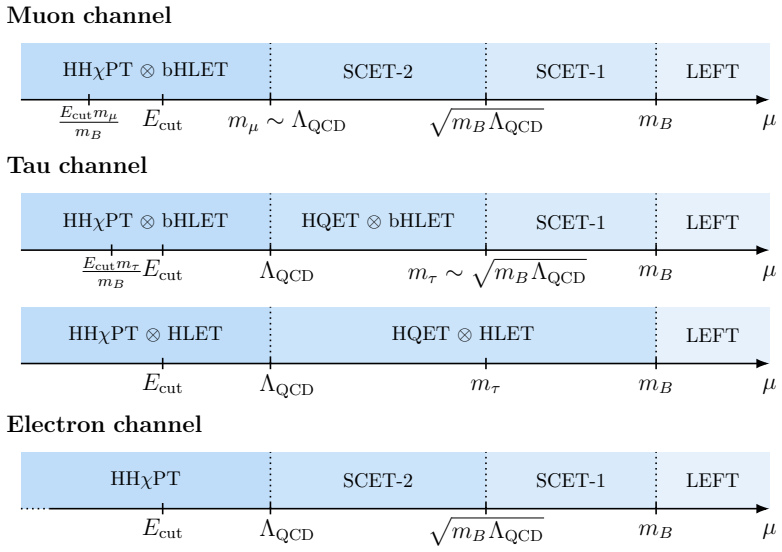
Working from the effective weak Hamiltonian below the electroweak scale, the authors match onto soft-collinear effective theory at the hard scale, then onto a second variant at the hard-collinear scale, and finally onto heavy-hadron chiral perturbation theory below the QCD confinement scale. In doing so they construct the complete next-to-leading-power operator basis, introduce a Dirac reduction scheme that preserves d-dimensional identities and avoids power-enhanced evanescent operators, and use a refactorization-based subtraction scheme to systematically handle endpoint-divergent convolution integrals. The resulting factorization formula gives the virtual B⁻→μ⁻ν̄ amplitude with the complet
What carries the argument
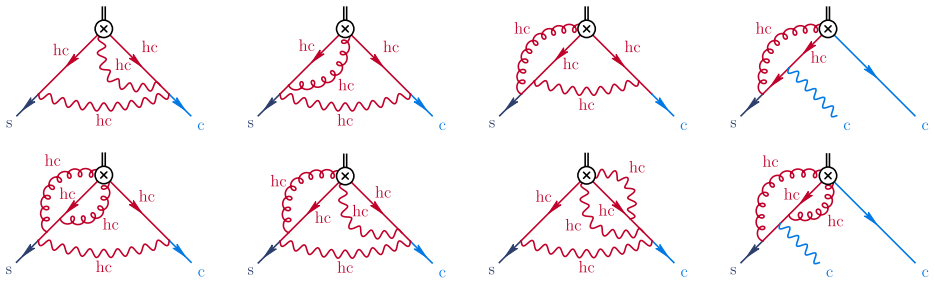
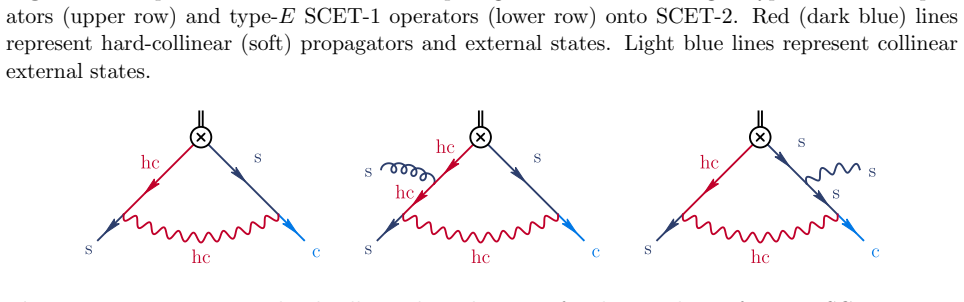
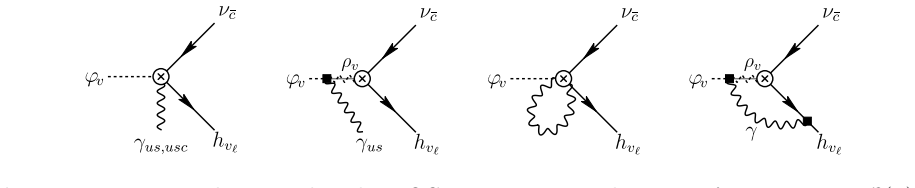
The central machinery is a sequence of effective field theories: the weak-scale effective Hamiltonian, SCET-1 (soft-collinear effective theory with hard-collinear and soft modes) at the B-meson scale, SCET-2 below the hard-collinear scale, and heavy-hadron chiral perturbation theory augmented by boosted heavy-lepton effective theory below Λ_QCD. The load-bearing identity is the refactorization-based subtraction (RBS) scheme, which rewrites endpoint-divergent convolutions of hard and jet functions as plus-distribution integrals plus a subtraction term identified with the matrix element of a θ_T operator; exact refactorization conditions guarantee the subtraction term has the required form. To
Load-bearing premise
The argument rests on identifying the subtraction that removes endpoint-divergent convolutions with the matrix element of a step-function operator, and on assuming that identification holds to all orders in perturbation theory; if it fails beyond one loop, the factorization theorem no longer systematically removes the soft region and the percent-level claim collapses.
What would settle it
Compute the two-loop corrections to the refactorization condition and to the θ_T operator matrix element; if the endpoint behavior of the product of the hard and jet functions no longer matches the subtraction, the factorization theorem fails. On the experimental side, a future photon-vetoed B→μν rate measurement at roughly 5% accuracy that disagrees with the prediction by more than the quoted uncertainty would falsify the Standard Model treatment.
If this is right
- The photon-vetoed B⁻→μ⁻ν̄ rate is known to about 1%, comparable to the expected future experimental accuracy, so the channel can deliver a clean determination of |V_ub|.
- Structure-dependent QED corrections are no longer modeled but computed within a systematic EFT expansion, making percent-level comparisons meaningful.
- The treatment of endpoint-divergent convolutions and the resummation of rapidity logarithms at next-to-leading power provides a template for other exclusive B-meson decays.
- The indirect B→B*γ→ℓνγ channel and chiral-anomaly contributions must be included in analyses of the photon-vetoed rate.
Where Pith is reading between the lines
- Editorial inference: the all-orders validity of the θ_T subtraction identification is the main structural assumption; a two-loop check would decisively test whether the factorization theorem holds at the claimed precision.
- Editorial inference: in the presence of new physics with opposite-chirality couplings, QED corrections can be enhanced by a factor of order m_B/m_ℓ, so the SM baseline derived here sharpens the new-physics reach of the channel.
- Editorial inference: the same EFT chain could be applied to the electron and tau channels, though the tau channel requires a different scale ordering and the electron channel is dominated by indirect contributions.
- Editorial inference: the percent-level SM prediction provides a target for future lattice QCD calculations of QED corrections to B-meson decays, which do not yet exist.
Editorial analysis
A structured set of objections, weighed in public.
Referee Report
Summary. The paper develops a multi-scale QCD×QED factorization framework for the leptonic decay B^- → ℓ^- ν̄_ℓ(γ), with the muon channel as the main application. The construction proceeds through a chain of effective theories: LEFT → SCET-1 → SCET-2 → HHχPT⊗bHLET. The authors build the complete next-to-leading-power (NLP) operator basis in SCET-1 (26 physical plus evanescent operators), compute the hard and jet functions at one loop, treat endpoint-divergent convolution integrals with the refactorization-based subtraction (RBS) scheme, and resum leading QCD/QED logarithms. The final RG-improved virtual amplitude is given in Eqs. (4.99), (4.113), and (4.116). The low-energy section introduces a heavy-particle effective theory and HHχPT to describe real photon emission, including the indirect B→B^*γ→ℓν̄γ contribution. The abstract claims that the resulting photon-vetoed rate is accurate at the percent level, providing a clean determination of |V_ub| and a new-physics test.
Significance. If the central claim is correct, this is a landmark calculation: the first complete treatment of QED effects to an exclusive B-meson decay at next-to-leading power, with all-orders resummation of leading logarithms. The paper is unusually explicit and internally consistent: the κ-scheme dependence cancels between the LEFT matching and the SCET-1 hard functions, the subtraction scale Λ cancels at one loop (Eq. 4.115), and the RBS refactorization is checked at one loop. The technical apparatus — the complete SCET-1 operator basis, the 'SCET-friendly' Dirac reduction scheme, and the two-scale RG evolution of the hard function H_C1 — is a substantial contribution in its own right. The relationship (4.98) that eliminates the HQET parameter F_QCD in favor of the lattice-known f_B is a sensible and testable definitional step. However, the all-orders validity of the RBS subtraction/θ_T-operator identification is assumed rather than proved, and the numerical uncertainty budget needed to support the 'percent-level' claim is not accessible in the material under review.
major comments (3)
- [§4.4 (after Eq. 4.41) and §3.6 (Eq. 3.76)] The central all-orders claim relies on an assumption that is explicitly stated but verified only at one loop: 'we assume that the identification of the subtraction term with the matrix element of the θ_T operator holds to all orders of perturbation theory.' Likewise, the exact d-dimensional refactorization conditions (3.76) are asserted to hold to all orders but are checked only through the one-loop expression (3.77). Since the RG-improved amplitude (4.99)/(4.113)/(4.116) resums logarithms to all orders, a failure of these identifications beyond one loop would leave endpoint-divergent convolutions incompletely subtracted and invalidate the factorization formula at the claimed precision. A two-loop check of (3.76) and (4.41), or a symmetry/consistency argument that excludes uncontrolled Λ-dependent terms, is needed before the all-orders statement can be accepted. This is an internal-consi
- [§6 / Abstract] The headline 'accurate at the percent level' cannot be audited from the material provided: the numerical estimates and the uncertainty budget of Section 6 are not presented in the version under review (the text breaks off in §5.2). Even granting the formal factorization theorem, the size of the residual scale dependence (4.117) — estimated as O(αα_s ln, α^2 ln^2) — and the impact of the non-perturbative inputs (F_±, ω_- and the three-particle LCDA) must be quantified to support the percent-level statement. The scale-ambiguity estimate in footnote 16 appears to claim a partial cancellation of the O(αα_s ln^2) ambiguity without a detailed demonstration; a numerical scan over μ_0, Λ, and the LCDA parameters is required.
- [§4.9, Eq. (4.110) and (4.117)] The bootstrap of the unknown O(αα_s) homogeneous two-loop anomalous dimensions from the requirement of RG invariance is an ad hoc procedure. It assumes that the residual scale dependence has the specific form (4.110) and that no other O(αα_s) terms are present. The claim that the true scale ambiguity is reduced to O(αα_s ln) rests on this bootstrap and on the structure of (4.97); a direct two-loop calculation, or at least an independent estimate of the omitted O(αα_s) terms, would be needed to make the percent-level uncertainty claim credible. Without such a check, the numerical error estimate is itself a model-dependent input.
minor comments (4)
- [Eq. (4.101)] In the expression for T_C1, the three-particle LCDA appears as 'ϕB_3g(ω,ωgµ)' — a missing comma and the μ argument are typographical errors. The same function is written with the correct arguments in Eq. (4.83).
- [§3.3, Eq. (3.48)] The definition of the SCET-friendly reduction scheme is clear, but the text would benefit from an explicit statement that the scheme choice κ=0 is used consistently in all subsequent equations; the reader must otherwise infer this from the remark below (2.5).
- [Table 1] The dagger notation is explained, but the asterisk on 'Jet function' is only explained in a footnote. Consider moving these explanations into the table caption for clarity.
- [§3.7] The notation 'eUC(μ, mB)' in (3.97) and its distinction from 'UC(μ, mB)' in (3.92) is easy to miss; a sentence emphasizing that the tilde function is the ratio of the two evolution factors would help.
Circularity Check
No circularity found; the central derivation is self-contained, and the all-orders RBS assumption is a validity risk, not a circular reduction.
full rationale
I walked the derivation chain from the LEFT operator through SCET-1 → SCET-2 → HHχPT and the final factorization formula (4.99)/(4.113)/(4.116). The non-perturbative inputs — f_B from lattice, F_±(Λ,μ) from HQET parameterizations, ϕ_B^± and ϕ_B^{3g} from LCDA definitions — are not fitted to the target B→μν rate. The hard and jet functions are computed at one loop and RG-improved; their evolution equations are derived in the paper, not imported as an unexplained black box. The relation (4.98) between f_B and the hard functions is a standard HQET matching relation used to eliminate F_QCD, not a definition that builds the final prediction into the input. The endpoint-divergent convolutions are treated by the RBS scheme, and the subtraction terms are rewritten as matrix elements of the θ_T operator; the paper explicitly verifies this identification at one loop and then states the all-orders version as an assumption: 'we assume that the identification of the subtraction term with the matrix element of the θ_T operator holds to all orders of perturbation theory' (§4.4, after (4.41)). This is an unproven premise about higher orders, and the same is true for the refactorization conditions (3.76), which are checked only at one loop. That is a genuine limitation and a target for future two-loop verification, but it is not circular: the one-loop identification is not constructed by assuming the desired final answer. The Λ- and η-dependence cancel explicitly (4.115), which is a consistency check rather than a fit. Self-citations appear (e.g., 'first derived in [24]' and references to the RBS scheme), but the relevant ingredients are rederived here; they do not reduce the central claim to the cited authors' prior work. The κ-scheme dependence cancels, and no fitted parameter is renamed as a prediction. Accordingly, I find no step where the output equals an input by construction, and the circularity score is set to 0.
Axiom & Free-Parameter Ledger
free parameters (3)
- Common resummation scale μ_0 =
1.5 GeV (default)
- RBS subtraction scale Λ (= η m_B)
- Logarithmic LCDA moment ω_-(μ_0)
axioms (6)
- ad hoc to paper The identification of RBS subtraction terms with the θ_T-operator matrix element holds to all orders of perturbation theory.
- ad hoc to paper The exact d-dimensional refactorization conditions (3.76) — J H^C_1 K = H^A_1 S^C_1 and J H^C_2 K = −H^A_2/y S^C_2 — hold to all orders.
- domain assumption SCET-1/SCET-2 mode separation and decoupling: hard-collinear, soft, and collinear fields with the stated power counting; soft×collinear interactions forbidden in SCET-2.
- domain assumption Below Λ_QCD, heavy-hadron chiral perturbation theory with a point-like (B, B*) doublet, heavy-quark spin symmetry, and Low's theorem for ultrasoft photon emission.
- standard math Dimensional regularization with the 'SCET-friendly' Dirac reduction scheme (κ=0) is a consistent evanescent-operator scheme; physical results are scheme independent.
- ad hoc to paper The unknown O(αα_s) homogeneous two-loop anomalous dimensions are fixed by bootstrapping from RG invariance.
invented entities (1)
-
θ_T-subtracted heavy-light current operator Q^A_{1,θ}
no independent evidence
read the original abstract
We derive the QCD$\times$QED factorization theorem governing the leptonic decay $B^-\to\mu^-\bar\nu_\mu(\gamma)$ at all orders in $\alpha_s$ and $\alpha$. Electromagnetic corrections to this decay probe multiple scales, which we disentangle through a sequence of effective field theories (EFTs). The resulting state-of-the-art prediction for the photon-vetoed rate includes the complete structure-dependent component and is accurate at the percent level, establishing the theoretical framework required for future high-precision measurements of this channel, which will allow for a clean determination of $|V_{ub}|$ and powerful tests of new physics. Our work presents the first complete study of QED effects to an exclusive $B$-meson decay at next-to-leading power (NLP) in the heavy-quark expansion. Important milestones are (i) the construction of the complete NLP operator basis in soft-collinear effective theory (SCET); (ii) the proposal of a "SCET-friendly" reduction scheme for the Dirac structures of four-fermion operators in dimensional regularization, which avoids power-enhanced evanescent operators; (iii) the consistent refactorization of endpoint-divergent convolution integrals and the first complete resummation of "rapidity logarithms" arising at the boundary between the contributions involving soft and hard-collinear quarks; (iv) the systematic discussion of the EFT below the scale of QCD confinement and the non-perturbative matching of SCET onto this low-energy theory; (v) the decoupling of pseudoscalar mesons in the context of heavy-hadron chiral perturbation theory, so that they can be integrated out for processes in which they do not appear as external particles. We perform a phenomenological analysis of direct and indirect contributions to the decay rate and radiation-energy spectrum, highlighting the importance of the chiral anomaly.
Figures







Forward citations
Cited by 4 Pith papers
-
Three-particle di-light-cone distribution amplitudes of the $B$-meson in heavy-quark effective theory
The authors identify eight independent three-particle DLCDAs of the B-meson, perform their complete Lorentz decomposition in definite-twist basis, obtain tree-level relations for integrals and moments from operator id...
-
QED Corrections to $B^-\to\tau^-\bar{\nu}_\tau$
The B−→τ−ν̄τ rate with real and virtual QED corrections is derived to O(α) with resummed logarithmic corrections in a two-heavy-fermion EFT: percent-level effects, mild photon-veto dependence, and a structure-dependen...
-
Hunting for new physics in $B$ meson $b \to u$ transitions: A fresh look with Belle II data
Combined Belle II analysis of b→uℓν modes favors Re(ε_μ^{2})≠0 at 2σ while yielding |V_ub|=(3.79±0.17)×10^{-3} in a global NP fit.
-
QCD-factorization amplitudes from flavour symmetries: beyond the $SU(3)$ symmetric case
A data-driven SU(3)-breaking analysis of B to PP decays yields QCD-factorization amplitudes that resemble dynamical predictions and require no enhanced annihilation terms.
Reference graph
Works this paper leans on
-
[1]
N. Davidson, T. Przedzinski and Z. Was,PHOTOS interface in C++: Technical and Physics Documentation,Comput. Phys. Commun.199(2016) 86–101, [1011.0937]
Pith/arXiv arXiv 2016
-
[2]
L. Dai, C. Kim and A. K. Leibovich,Universal lepton universality violation in exclusive processes,Phys. Rev. D105(2022) L031301, [2103.03963]
Pith/arXiv arXiv 2022
-
[3]
M. Bordone, G. Isidori and A. Pattori,On the Standard Model predictions forR K and RK∗,Eur. Phys. J. C76(2016) 440, [1605.07633]
Pith/arXiv arXiv 2016
-
[4]
G. Isidori, S. Nabeebaccus and R. Zwicky,QED corrections in B→ Kℓ +ℓ− at the double-differential level,JHEP12(2020) 104, [2009.00929]
Pith/arXiv arXiv 2020
-
[5]
G. Isidori, D. Lancierini, S. Nabeebaccus and R. Zwicky,QED in B→Kℓ +ℓ− LFU ratios: theory versus experiment, a Monte Carlo study,JHEP10(2022) 146, [2205.08635]
Pith/arXiv arXiv 2022
-
[6]
E. Baracchini and G. Isidori,Electromagnetic corrections to non-leptonic two-body B and D decays,Phys. Lett. B633(2006) 309–313, [hep-ph/0508071]
Pith/arXiv arXiv 2006
-
[7]
D. Bigi, M. Bordone, P. Gambino, U. Haisch and A. Piccione,QED effects in inclusive semi-leptonic B decays,JHEP11(2023) 163, [2309.02849]
Pith/arXiv arXiv 2023
-
[8]
N. Carrasco, V. Lubicz, G. Martinelli, C. T. Sachrajda, N. Tantalo, C. Tarantino et al., QED Corrections to Hadronic Processes in Lattice QCD,Phys. Rev. D91(2015) 074506, [1502.00257]
Pith/arXiv arXiv 2015
-
[9]
D. Giusti, V. Lubicz, G. Martinelli, C. T. Sachrajda, F. Sanfilippo, S. Simula et al., First lattice calculation of the QED corrections to leptonic decay rates,Phys. Rev. Lett. 120(2018) 072001, [1711.06537]
Pith/arXiv arXiv 2018
-
[10]
C. T. Sachrajda, M. Di Carlo, G. Martinelli, D. Giusti, V. Lubicz, F. Sanfilippo et al., Radiative corrections to semileptonic decay rates,PoSLATTICE2019(2019) 162, [1910.07342]
Pith/arXiv arXiv 2019
-
[11]
A. Desiderio et al.,First lattice calculation of radiative leptonic decay rates of pseudoscalar mesons,Phys. Rev. D103(2021) 014502, [2006.05358]
Pith/arXiv arXiv 2021
-
[12]
R. Frezzotti, M. Garofalo, V. Lubicz, G. Martinelli, C. T. Sachrajda, F. Sanfilippo et al.,Comparison of lattice QCD+QED predictions for radiative leptonic decays of light mesons with experimental data,Phys. Rev. D103(2021) 053005, [2012.02120]
Pith/arXiv arXiv 2021
-
[13]
M. Di Carlo, M. T. Hansen, A. Portelli and N. Hermansson-Truedsson,Relativistic, model-independent determination of electromagnetic finite-size effects beyond the pointlike approximation,Phys. Rev. D105(2022) 074509, [2109.05002]
Pith/arXiv arXiv 2022
-
[14]
P. Boyle et al.,Isospin-breaking corrections to light-meson leptonic decays from lattice simulations at physical quark masses,JHEP02(2023) 242, [2211.12865]. 123
Pith/arXiv arXiv 2023
-
[15]
G. Gagliardi, F. Sanfilippo, S. Simula, V. Lubicz, F. Mazzetti, G. Martinelli et al., Virtual photon emission in leptonic decays of charged pseudoscalar mesons,Phys. Rev. D105(2022) 114507, [2202.03833]
Pith/arXiv arXiv 2022
-
[16]
R. Frezzotti, N. Tantalo, G. Gagliardi, F. Sanfilippo, S. Simula, V. Lubicz et al., Lattice calculation of theD s meson radiative form factors over the full kinematical range,Phys. Rev. D108(2023) 074505, [2306.05904]
Pith/arXiv arXiv 2023
-
[17]
R. Di Palma, R. Frezzotti, G. Gagliardi, V. Lubicz, G. Martinelli, C. T. Sachrajda et al.,Kaon radiative leptonic decay rates from lattice QCD simulations at the physical point,Phys. Rev. D111(2025) 114523, [2504.08680]
Pith/arXiv arXiv 2025
-
[18]
M. Beneke, P. B¨ oer, J.-N. Toelstede and K. K. Vos,QED factorization of non-leptonic Bdecays,JHEP11(2020) 081, [2008.10615]
Pith/arXiv arXiv 2020
-
[19]
M. Beneke, P. B¨ oer, G. Finauri and K. K. Vos,QED factorization of two-body non-leptonic and semi-leptonic B to charm decays,JHEP10(2021) 223, [2107.03819]
Pith/arXiv arXiv 2021
-
[20]
M. Beneke, P. B¨ oer, J.-N. Toelstede and K. K. Vos,Light-cone distribution amplitudes of light mesons with QED effects,JHEP11(2021) 059, [2108.05589]
Pith/arXiv arXiv 2021
-
[21]
M. Beneke, P. B¨ oer, J.-N. Toelstede and K. K. Vos,Light-cone distribution amplitudes of heavy mesons with QED effects,JHEP08(2022) 020, [2204.09091]
Pith/arXiv arXiv 2022
-
[22]
M. Beneke, C. Bobeth and R. Szafron,Enhanced electromagnetic correction to the rare B-meson decayB s,d →µ +µ−,Phys. Rev. Lett.120(2018) 011801, [1708.09152]
Pith/arXiv arXiv 2018
-
[23]
M. Beneke, C. Bobeth and R. Szafron,Power-enhanced leading-logarithmic QED corrections toB q →µ +µ−,JHEP10(2019) 232, [1908.07011]
Pith/arXiv arXiv 2019
-
[24]
C. Cornella, M. K¨ onig and M. Neubert,Structure-dependent QED effects in exclusive B decays at subleading power,Phys. Rev. D108(2023) L031502, [2212.14430]
arXiv 2023
-
[25]
S. Nabeebaccus and R. Zwicky,Resolving charged hadrons in QED – gauge invariant interpolating operators,JHEP11(2022) 101, [2209.06925]
Pith/arXiv arXiv 2022
-
[26]
M. Rowe and R. Zwicky,Structure-dependent QED inB − →ℓ −ν(γ),JHEP07(2024) 249, [2404.07648]
Pith/arXiv arXiv 2024
-
[27]
D. Becirevic, B. Haas and E. Kou,Soft Photon Problem in Leptonic B-decays,Phys. Lett. B681(2009) 257–263, [0907.1845]
Pith/arXiv arXiv 2009
-
[28]
Y. G. Aditya, K. J. Healey and A. A. Petrov,FakingB s →µ +µ−,Phys. Rev. D87 (2013) 074028, [1212.4166]. [29]BaBarcollaboration, B. Aubert et al.,A search forB + →ℓ +νℓ Recoiling Against B− →D 0ℓ−¯νX,Phys. Rev. D81(2010) 051101, [0912.2453]. 124 [30]BaBarcollaboration, J. P. Lees et al.,Evidence ofB + →τ +νdecays with hadronic B tags,Phys. Rev. D88(2013) 0...
Pith/arXiv arXiv 2013
-
[37]
Y. Amhis, M. Hartmann, C. Helsens, D. Hill and O. Sumensari,Prospects forB + c → τ +ντ at FCC-ee,JHEP12(2021) 133, [2105.13330]
Pith/arXiv arXiv 2021
-
[38]
X. Zuo, M. Fedele, C. Helsens, D. Hill, S. Iguro and M. Klute,Prospects forB + c and B+ →τ +ντ at FCC-ee,Eur. Phys. J. C84(2024) 87, [2305.02998]
Pith/arXiv arXiv 2024
-
[39]
M. Beneke, G. Buchalla, M. Neubert and C. T. Sachrajda,QCD factorization for exclusive, nonleptonic B meson decays: General arguments and the case of heavy light final states,Nucl. Phys. B591(2000) 313–418, [hep-ph/0006124]
Pith/arXiv arXiv 2000
-
[40]
M. Beneke, G. Buchalla, M. Neubert and C. T. Sachrajda,QCD factorization in B→πK, ππdecays and extraction of Wolfenstein parameters,Nucl. Phys. B606 (2001) 245–321, [hep-ph/0104110]
Pith/arXiv arXiv 2001
-
[41]
M. Beneke, T. Feldmann and D. Seidel,Systematic approach to exclusiveB→V l +l−, V γdecays,Nucl. Phys. B612(2001) 25–58, [hep-ph/0106067]
Pith/arXiv arXiv 2001
-
[42]
M. Beneke and L. Vernazza,B→χ cJ Kdecays revisited,Nucl. Phys. B811(2009) 155–181, [0810.3575]
Pith/arXiv arXiv 2009
-
[43]
M. Benzke, S. J. Lee, M. Neubert and G. Paz,Factorization at Subleading Power and Irreducible Uncertainties in ¯B→X sγDecay,JHEP08(2010) 099, [1003.5012]
Pith/arXiv arXiv 2010
-
[44]
M. Benzke, S. J. Lee, M. Neubert and G. Paz,Long-Distance Dominance of the CP Asymmetry inB→X s,d +γDecays,Phys. Rev. Lett.106(2011) 141801, [1012.3167]. 125
Pith/arXiv arXiv 2011
-
[45]
M. A. Ebert, I. Moult, I. W. Stewart, F. J. Tackmann, G. Vita and H. X. Zhu, Subleading power rapidity divergences and power corrections for q T ,JHEP04(2019) 123, [1812.08189]
Pith/arXiv arXiv 2019
-
[46]
I. Moult, I. W. Stewart and G. Vita,Subleading Power Factorization with Radiative Functions,JHEP11(2019) 153, [1905.07411]
Pith/arXiv arXiv 2019
-
[47]
M. Beneke, M. Garny, R. Szafron and J. Wang,Violation of the Kluberg-Stern-Zuber theorem in SCET,JHEP09(2019) 101, [1907.05463]
Pith/arXiv arXiv 2019
-
[48]
I. Moult, I. W. Stewart, G. Vita and H. X. Zhu,The Soft Quark Sudakov,JHEP05 (2020) 089, [1910.14038]
Pith/arXiv arXiv 2020
-
[49]
M. Beneke, A. Broggio, S. Jaskiewicz and L. Vernazza,Threshold factorization of the Drell-Yan process at next-to-leading power,JHEP07(2020) 078, [1912.01585]
Pith/arXiv arXiv 2020
-
[50]
I. Moult, G. Vita and K. Yan,Subleading power resummation of rapidity logarithms: the energy-energy correlator inN= 4 SYM,JHEP07(2020) 005, [1912.02188]
Pith/arXiv arXiv 2020
-
[51]
Z. L. Liu and M. Neubert,Factorization at subleading power and endpoint-divergent convolutions inh→γγdecay,JHEP04(2020) 033, [1912.08818]
Pith/arXiv arXiv 2020
-
[52]
M. Beneke, M. Garny, S. Jaskiewicz, R. Szafron, L. Vernazza and J. Wang,Large-x resummation of off-diagonal deep-inelastic parton scattering from d-dimensional refactorization,JHEP10(2020) 196, [2008.04943]
Pith/arXiv arXiv 2020
-
[53]
Z. L. Liu, B. Mecaj, M. Neubert and X. Wang,Factorization at subleading power, Sudakov resummation, and endpoint divergences in soft-collinear effective theory,Phys. Rev. D104(2021) 014004, [2009.04456]
Pith/arXiv arXiv 2021
-
[54]
Z. L. Liu, B. Mecaj, M. Neubert and X. Wang,Factorization at subleading power and endpoint divergences inh→γγdecay. Part II. Renormalization and scale evolution, JHEP01(2021) 077, [2009.06779]
Pith/arXiv arXiv 2021
-
[55]
M. Beneke, M. Garny, S. Jaskiewicz, J. Strohm, R. Szafron, L. Vernazza et al., Next-to-leading power endpoint factorization and resummation for off-diagonal “gluon” thrust,JHEP07(2022) 144, [2205.04479]
Pith/arXiv arXiv 2022
-
[56]
G. Bell, P. B¨ oer and T. Feldmann,Muon-electron backward scattering: a prime example for endpoint singularities in SCET,JHEP09(2022) 183, [2205.06021]
Pith/arXiv arXiv 2022
-
[57]
T. Feldmann, N. Gubernari, T. Huber and N. Seitz,Contribution of the electromagnetic dipole operatorO 7 to the ¯Bs →µ +µ− decay amplitude,Phys. Rev. D 107(2023) 013007, [2211.04209]
Pith/arXiv arXiv 2023
-
[58]
Z. L. Liu, M. Neubert, M. Schnubel and X. Wang,Factorization at next-to-leading power and endpoint divergences in gg→h production,JHEP06(2023) 183, [2212.10447]. 126
Pith/arXiv arXiv 2023
-
[59]
T. Hurth and R. Szafron,Refactorisation in subleadingB→X sγ,Nucl. Phys. B991 (2023) 116200, [2301.01739]
Pith/arXiv arXiv 2023
-
[60]
G. Buchalla, A. J. Buras and M. E. Lautenbacher,Weak decays beyond leading logarithms,Rev. Mod. Phys.68(1996) 1125–1144, [hep-ph/9512380]
Pith/arXiv arXiv 1996
-
[61]
E. E. Jenkins, A. V. Manohar and P. Stoffer,Low-Energy Effective Field Theory below the Electroweak Scale: Operators and Matching,JHEP03(2018) 016, [1709.04486]
Pith/arXiv arXiv 2018
-
[62]
E. E. Jenkins, A. V. Manohar and P. Stoffer,Low-Energy Effective Field Theory below the Electroweak Scale: Anomalous Dimensions,JHEP01(2018) 084, [1711.05270]
Pith/arXiv arXiv 2018
-
[63]
Eichten and B
E. Eichten and B. R. Hill,An Effective Field Theory for the Calculation of Matrix Elements Involving Heavy Quarks,Phys. Lett. B234(1990) 511–516
1990
-
[64]
Georgi,An Effective Field Theory for Heavy Quarks at Low Energies,Phys
H. Georgi,An Effective Field Theory for Heavy Quarks at Low Energies,Phys. Lett. B 240(1990) 447–450
1990
-
[65]
Grinstein,The Static Quark Effective Theory,Nucl
B. Grinstein,The Static Quark Effective Theory,Nucl. Phys. B339(1990) 253–268
1990
-
[66]
Neubert,Heavy quark symmetry,Phys
M. Neubert,Heavy quark symmetry,Phys. Rept.245(1994) 259–396, [hep-ph/9306320]
Pith/arXiv arXiv 1994
-
[67]
C. W. Bauer, S. Fleming, D. Pirjol and I. W. Stewart,An Effective field theory for collinear and soft gluons: Heavy to light decays,Phys. Rev. D63(2001) 114020, [hep-ph/0011336]
Pith/arXiv arXiv 2001
-
[68]
C. W. Bauer, D. Pirjol and I. W. Stewart,Soft collinear factorization in effective field theory,Phys. Rev. D65(2002) 054022, [hep-ph/0109045]
Pith/arXiv arXiv 2002
-
[69]
C. W. Bauer, S. Fleming, D. Pirjol, I. Z. Rothstein and I. W. Stewart,Hard scattering factorization from effective field theory,Phys. Rev. D66(2002) 014017, [hep-ph/0202088]
Pith/arXiv arXiv 2002
-
[70]
M. Beneke, A. P. Chapovsky, M. Diehl and T. Feldmann,Soft collinear effective theory and heavy to light currents beyond leading power,Nucl. Phys. B643(2002) 431–476, [hep-ph/0206152]
Pith/arXiv arXiv 2002
-
[71]
Isgur and M
N. Isgur and M. B. Wise,Weak transition form factors between heavy mesons,Phys. Lett. B237(1990) 527–530
1990
-
[72]
A. F. Falk, H. Georgi, B. Grinstein and M. B. Wise,Heavy Meson Form-factors From QCD,Nucl. Phys. B343(1990) 1–13
1990
-
[73]
Neubert,Model independent extraction ofV cb from semileptonic decays,Phys
M. Neubert,Model independent extraction ofV cb from semileptonic decays,Phys. Lett. B264(1991) 455–461
1991
-
[74]
M. B. Wise,Chiral perturbation theory for hadrons containing a heavy quark,Phys. Rev. D45(1992) R2188. 127
1992
-
[75]
Yan, H.-Y
T.-M. Yan, H.-Y. Cheng, C.-Y. Cheung, G.-L. Lin, Y. C. Lin and H.-L. Yu,Heavy quark symmetry and chiral dynamics,Phys. Rev. D46(1992) 1148–1164
1992
-
[76]
Burdman and J
G. Burdman and J. F. Donoghue,Union of chiral and heavy quark symmetries,Phys. Lett. B280(1992) 287–291
1992
-
[77]
E. V. Shuryak,Hadrons Containing a Heavy Quark and QCD Sum Rules,Nucl. Phys. B198(1982) 83–101
1982
-
[78]
W. Dekens and P. Stoffer,Low-energy effective field theory below the electroweak scale: matching at one loop,JHEP10(2019) 197, [1908.05295]
Pith/arXiv arXiv 2019
-
[79]
W. J. Marciano and A. Sirlin,Radiative corrections toπ ℓ2 decays,Phys. Rev. Lett.71 (1993) 3629–3632
1993
-
[80]
C. W. Bauer, D. Pirjol and I. W. Stewart,Factorization and endpoint singularities in heavy to light decays,Phys. Rev. D67(2003) 071502, [hep-ph/0211069]
Pith/arXiv arXiv 2003
-
[81]
M. Beneke and T. Feldmann,Factorization of heavy to light form-factors in soft collinear effective theory,Nucl. Phys. B685(2004) 249–296, [hep-ph/0311335]
Pith/arXiv arXiv 2004
-
[82]
T. Becher, R. J. Hill and M. Neubert,Factorization inB→V γdecays,Phys. Rev. D 72(2005) 094017, [hep-ph/0503263]
Pith/arXiv arXiv 2005
-
[83]
J. Chay and C. Kim,Collinear effective theory at subleading order and its application to heavy-light currents,Phys. Rev. D65(2002) 114016, [hep-ph/0201197]
Pith/arXiv arXiv 2002
-
[84]
A. V. Manohar, T. Mehen, D. Pirjol and I. W. Stewart,Reparameterization invariance for collinear operators,Phys. Lett. B539(2002) 59–66, [hep-ph/0204229]
Pith/arXiv arXiv 2002
-
[85]
T. Becher, A. Broggio and A. Ferroglia,Introduction to Soft-Collinear Effective Theory, vol. 896. Springer, 2015, 10.1007/978-3-319-14848-9
-
[86]
R. J. Hill and M. Neubert,Spectator interactions in soft collinear effective theory, Nucl. Phys. B657(2003) 229–256, [hep-ph/0211018]
Pith/arXiv arXiv 2003
-
[87]
S. Alte, M. K¨ onig and M. Neubert,Effective Field Theory after a New-Physics Discovery,JHEP08(2018) 095, [1806.01278]
Pith/arXiv arXiv 2018
-
[88]
B. O. Lange and M. Neubert,Factorization and the soft overlap contribution to heavy to light form-factors,Nucl. Phys. B690(2004) 249–278, [hep-ph/0311345]
Pith/arXiv arXiv 2004
discussion (0)
Sign in with ORCID, Apple, or X to comment. Anyone can read and Pith papers without signing in.