REVIEW 6 major objections 4 minor 32 references
Dimension-varying control systems can be modelled on a single metric space Ω, built by identifying vectors that differ only by repeating coordinates, so trajectories may cross dimensions continuously.
Reviewed by Pith at T0; open to challenge. T0 means a machine referee read the full paper against a public rubric. the ladder, T0–T4 →
A quotient space Ω with a repetition-based metric turns dimension-varying control systems into ordinary switched systems on one common state space.
T0 review reviewed 2026-08-03 challenge →
load-bearing objection Repackages Cheng's cross-dimensional metric into control problems; coherent topology but the repetition equivalence is unvalidated and the control theorems are asserted rather than proved. the 6 major comments →
On Dimension-Varying Control Systems: A Universal State Space Approach
The pith
A machine-rendered reading of the paper's core claim, the machinery that carries it, and where it could break.
The reading
Core claim
The paper's central claim is that R^∞ = ∪ R^n, equipped with the cross-dimensional inner product ⟨x,y⟩_V = (1/t)⟨x⊗1_{t/m}, y⊗1_{t/n}⟩ and the resulting distance d_V, becomes the universal state space for dimension-varying systems after quotienting by zero-distance equivalence. The key structural fact is that each Ω_n = Ω∩R^n is homeomorphic to R^n with the Euclidean topology, so embedding a mode into Ω changes nothing locally, while globally Ω is path-connected through the intersections Ω_{m∧n}. On this space the paper defines Lipschitz switchings, common Lyapunov functions for stability, controllability along lattice chains, mode-wise observability, stabilization with or without jumps, dis
What carries the argument
The central object is the quotient space Ω = R^∞/↔, where x↔y iff x⊗1_p = y⊗1_q for some repetition factors p,q, equivalently d_V(x,y)=0. The equivalence identifies a vector with any blockwise replication of itself, so dimensions become commensurable through least common multiples. Two pieces of machinery carry the argument: the cross-dimensional projection Π^m_n = (m/t)(I_m⊗1^T_{t/m})(I_n⊗1_{t/n}), which sends a vector in R^n to its nearest point in R^m under d_V and doubles as the bridge matrix of the dimension-keeping semi-tensor product; and the lattice structure on {Ω_n} ordered by divisibility, whose sup and inf are lcm and gcd. The projection makes jumps well-defined, such as nearest-
Load-bearing premise
The load-bearing premise is that repeating a state's coordinates—turning (a,b) into (a,a,b,b)—creates the same physical state, so systems that distinguish a 2-component configuration from its 4-component replication are being modeled in an artificial space.
What would settle it
Take a concrete mechanical system with one mode in R^2 and another in R^4, with the transition energy or output depending on the actual number of coordinates—for instance, two coupled oscillators versus four identical oscillators at positions (a,a,b,b). Measure the switching cost between x=(a,b) and y=(a,a,b,b): d_V(x,y)=0, so Ω treats them as the same state, while any nonzero energy difference, distinct output, or different future trajectory would violate the equivalence and refute the metric's physical claims. Even one clean demonstration of such a distinction in a domain the paper claims to
If this is right
- A dimension-varying control system can be embedded in Ω with no modification of the local dynamics: each mode's R^{n_i} is homeomorphic to Ω_{n_i}, so local stability and controllability statements are preserved.
- Switching between modes can be treated as a jump in a single metric space; if the jump is Lipschitz, a common Lyapunov function plus sufficiently large minimum dwell time yields stability.
- Controllability can be established mode-by-mode along a lattice chain: partial controllability on the orthogonal complement of the intersection Ω_{n_i}∩Ω_{n_j} and complete controllability on the final mode suffice.
- Disturbance decoupling reduces to checking each lifted mode after projecting the disturbance into that mode's dimension; components orthogonal to the mode are harmless.
- The same construction converts dimension-varying systems into classical switching systems with Dirac impulses, so standard switched-control techniques apply.
Where Pith is reading between the lines
- If d_V is taken seriously, the framework predicts a specific testable symmetry: any physical variable replicated by an integer factor should be physically indistinguishable from the original. For mechanical systems this is rarely true—two identical masses at (a,a,b,b) generally carry different energy and dynamics than one mass at (a,b)—so the metric's domain of validity is likely signal-like or co
- The lattice structure suggests a natural extension to asynchronous or partially coupled dimension changes: subsystems could move along different sublattices, with consistency enforced only at joins, and the paper's nearest-jump and projection machinery would carry over almost unchanged.
- A quantitative extension would replace the hard equivalence d_V=0 with a tolerance: a controlled system stabilizes to within ε in Ω rather than exactly, making 'practically controllable' discontinuous switches rigorous and testable.
- The information-theoretic reading at the end—repeated coordinates carry the same entropy—points toward applications in decentralized estimation or compression, where the state is a distribution or message and replication genuinely carries no new information.
Editorial analysis
A structured set of objections, weighed in public.
Referee Report
Summary. This paper proposes a quotient space Ω=R^∞/↔ with a cross-dimensional metric d_V as a universal state space for dimension-varying control systems, where x↔y iff x⊗1_p=y⊗1_q. It proves each R^n embeds homeomorphically as Ω_n, develops a lattice of subspaces, defines Lipschitz switching and stability, and claims controllability, observability, stabilizability, disturbance decoupling, and hierarchical aggregation results in Ω. The central advertised claim is that fixed-dimension control problems can be transplanted to the dimension-varying setting without external embeddings.
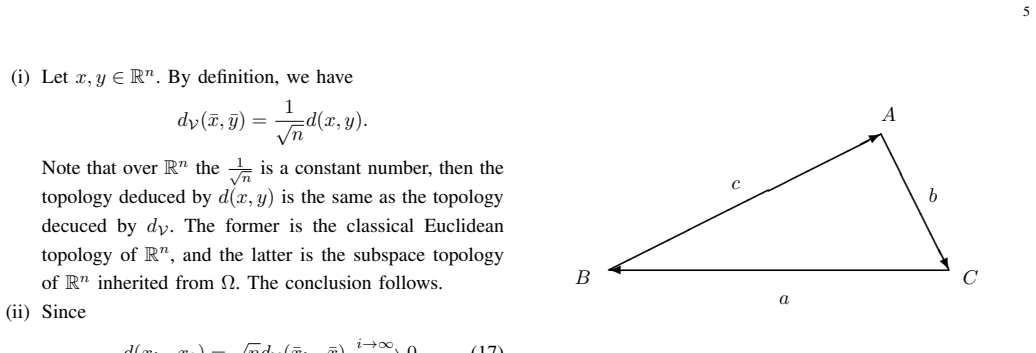
Significance. The construction is attractive and partly rigorous: d_V restricted to R^n equals (1/√n)‖·‖_2, so Theorem 3.4 gives a clean homeomorphism; the projection formula (7) and operator norm formula (24) are explicit and checkable; the triangle-geometry example (Example 3.6) is a nice sanity check. The paper also honestly flags the main modeling caveat in the conclusion. If the control theorems were proved in detail, the framework would be a useful common language for switched/dimension-varying systems. At present, however, the universal claim rests on an unvalidated equivalence relation and on several proof sketches, so the significance is prospective rather than established.
major comments (6)
- [Sec. II (Defs. 2.1–2.3), Sec. VIII] The identification x↔y iff x⊗1_p=y⊗1_q (Defs. 2.1–2.3; Lemma 4.2) makes states with repeated coordinates the same state, e.g., (a) and (a,a), or (a,b) and (a,b,a,b). The paper's conclusion explicitly concedes that the physical meaningfulness of d_V is 'the only questionable point.' This is load-bearing: every controllability, observability, and DDP theorem in §5–§6 is stated on equivalence classes. If a physical system distinguishes two synchronized agents/generators from one, the theorems describe an artificial quotient. Please add an invariance/calibration test or a precise domain restriction.
- [Sec. III.D, Theorem 3.22] The stability theorem is not proved. The proof states that for sufficiently large dwell time ‖x̄_{t_k+}‖−‖x̄_{t_{k+1}-}‖>δ_{t_k}, but this inequality is not derived from Lyapunov condition (31), and no explicit bound on ∆_m is given in terms of L, the Lyapunov decay rate, or the jump bound. Uniform boundedness of δ_{t_k} is asserted, not shown. Either provide a quantitative dwell-time theorem or state the result as a heuristic. Note also the inconsistent use of ∆_m/∆_d.
- [Sec. V.B, Prop. 5.7] The proposition uses 'partly controllable on Ω_k \ Ω_{k+1}^⊥' without defining this notion, and without formalizing the chain condition or the concatenation of controls. The proof is two sentences and only asserts the conclusion. This undefined notion is also used in Proposition 5.11. The paper needs a precise definition and a proof of the sufficiency of the chain condition.
- [Sec. V.C, Prop. 5.10] Observability of a dimension-varying system is never defined. Proposition 5.10 then asserts that the system is 'completely observable iff it is completely observable on all modes.' This equivalence is nontrivial for switched systems and is not automatic if switching provides additional information. A formal definition of observability on Ω and a proof are required.
- [Sec. VI.C, Prop. 6.2] The DDP equivalence is asserted with a projection argument that is not sufficient. The statement 'ξ−Π_{n_k}^n ξ is orthogonal to R^{n_k}, so it will not affect the states of Σ_k' ignores that the lifted state evolves in R^n (n=lcm(n_k)); an orthogonal component can alter future modes or the output after lifting. A proof using invariant distributions—or a counterexample—is needed.
- [Abstract vs. full text] The abstract promises a 'generator-removal-and-reconnection scenario in a three-machine power system' and a finite-schedule dwell-time consistency check. No such case study appears in the body; Examples 3.23 and 6.1 are low-dimensional linear examples. Either include the advertised case study or revise the abstract.
minor comments (4)
- [Notation] F∞ should be R∞; Ω_0 in Prop. 5.11 is undefined; the orientation of Π_n^m is used inconsistently (e.g., Eq. (7) vs. Example 3.23); Eq. (55) refers to 'Σ described in (55)' but should probably be (54).
- [Typos] There are numerous typos: 'beaning', 'aircreft', 'nentwork', 'subspact', 'conclusing', 'Kharithnov', 'sting theory'.
- [References] References [17] and [22] appear to be the same paper ('Stability of switched linear differential systems') with different author transcriptions; please check.
- [Example 3.23] The numerical claim ∥Π_2^4∥_V=2 is not consistent with the operator norm formula (24) and the preceding computation; please verify the projection notation and the numerical value.
Circularity Check
No significant circularity: the Ω construction is explicitly defined in the paper and the control theorems follow from those definitions; self-citations supply supporting algebra, not fitted predictions.
full rationale
The central object Ω is not imported as an unproved premise: Definitions 2.1–2.3 explicitly define x±y, ⟨x,y⟩_V, ∥x∥_V, d_V, the equivalence x↔y iff d_V(x,y)=0, and the quotient Ω=R^∞/↔. The main topological claims (Proposition 3.2, Theorem 3.4) are proved directly from this definition, e.g. d_V(x̄,ȳ)=n^{-1/2}d(x,y) on R^n, so they are consequences rather than assumptions. The control-theoretic statements (controllability Prop. 5.7, observability Prop. 5.10, stabilization Prop. 5.11, DDP Prop. 6.2) are derived inside the explicitly stated Ω-framework; they do not fit parameters to data and then relabel the fit as a prediction. The paper does rely on the author's earlier works — 'This section is based on [6], [7], [10]' and 'We refer to [6], [10] for details of all above claims' — but those citations concern parameter-free algebraic constructions (semi-tensor product, projections, operator norm formula (24)) with published proofs, and the needed definitions are restated here. The conclusion's caveat, 'The only questionable point remains is: Is the distance physically meaningful?', is an external-validity limitation about whether repetition equivalence matches physical systems, not a circular derivation. No quoted equation reduces to its own input by construction, and no self-citation is used to forbid alternative frameworks. Thus the circularity score is low.
Axiom & Free-Parameter Ledger
free parameters (3)
- DK-STP weighting factor n/t =
n/t where t = lcm(n,p)
- Projection weighting factor m/t =
m/t in Π_n^m
- Lipschitz switching constant L (or function φ) =
unspecified
axioms (5)
- domain assumption Prior cross-dimensional framework from [6], [7], [10] is correct, including inner product, projection formula (7), DK-STP properties, and operator norm formula (24).
- ad hoc to paper x↔y iff x⊗1_p = y⊗1_q captures 'same state across dimensions'; zero d_V is a meaningful state identity.
- domain assumption Every switching satisfies a Lipschitz norm bound ||x(t+)||_V ≤ L||x(t-)||_V and equation (23) holds.
- domain assumption There exists a common Lyapunov function L satisfying (31), and jump gaps δ_{t_k} are uniformly bounded.
- domain assumption Minimum dwell time Δ_m ≥ ε > 0 and dwell time can be made large enough to dominate jump increases.
invented entities (2)
-
Ω = R^∞/↔
no independent evidence
-
Cross-dimensional metric d_V and inner product ⟨·,·⟩_V
no independent evidence
Cite this review
Pith. "Pith review of On Dimension-Varying Control Systems: A Universal State Space Approach." pith.science (2026). https://pith.science/paper/2INPFSXG
@misc{pith2026260114839,
  author       = {Pith},
  title        = {Pith review of: On Dimension-Varying Control Systems: A Universal State Space Approach},
  year         = {2026},
  howpublished = {\url{https://pith.science/paper/2INPFSXG}},
  note         = {Machine review of arXiv:2601.14839}
}
abstract
This paper develops a unified framework for the analysis and design of dimension-varying control systems by constructing an intrinsic quotient state space, $\Omega$. A significant challenge in non-fixed-dimensional systems is the lack of a common metric space that enables comparison of states across dimensions without relying on arbitrary external embeddings. To address this, we propose a cross-dimensional pseudo-metric $d_{\mathcal{V}}$ on $\mathbb{R}^{\infty}$ and derive $\Omega$ by identifying zero-distance representatives. We demonstrate that $\Omega$ preserves the essential topological and metric geometry of Euclidean space, providing the necessary foundation to extend fundamental control notions to the dimension-varying case. Specifically, we establish conditions for controllability, observability and stabilizability, and we address the complexities of Lipschitz switching and disturbance decoupling within this common space. The framework is further extended to hierarchical dimension-varying networks. The practical utility of the results is illustrated through a generator-removal-and-reconnection scenario in a three-machine power system. This case study demonstrates the use of translated representatives and projection/lift benchmarks, quantifies event-wise $d_{\mathcal{V}}$-gaps, and provides a finite-schedule dwell-time consistency check to validate the system's structural transitions.
Figures




Reference graph
Works this paper leans on
-
[1]
Abbott,Set, Lattices and Boolean Algebras, Allun & Bacon, Boston, 1969
J.C. Abbott,Set, Lattices and Boolean Algebras, Allun & Bacon, Boston, 1969
1969
-
[2]
Boothby,An Introduction to Differential Manifold and Riemannian Geometry, Academic Press, Orlando, 1986
W. Boothby,An Introduction to Differential Manifold and Riemannian Geometry, Academic Press, Orlando, 1986
1986
-
[3]
Burris, H.P
S. Burris, H.P. Sankappanavar,A Course in Universal Algebra, Springer, New York, 1981
1981
-
[4]
Casarin, M
R. Casarin, M. Iacopini, X. He, et al. Bayesian markov-switching tensor regression fo time-varying networks,J. American Stat. Assoc., 119(545), 109-121, 2024
2024
-
[5]
J.C. Chan, G. Koop, R. Leon-Gonzalez, et al. Time varying dimension models,J Busin. Econ. Statis., 30(2010-523), 358-367
2010
-
[6]
Cheng,From Dimension-Free Matrix Theory to Cross-Dimensional Dynamic Systems, Elsevier, London, 2019
D. Cheng,From Dimension-Free Matrix Theory to Cross-Dimensional Dynamic Systems, Elsevier, London, 2019
2019
-
[7]
Cheng, On equivalence of matrices,Asian J
D. Cheng, On equivalence of matrices,Asian J. Mathematics, V ol. 23, No. 2, 257-348, 2019
2019
-
[8]
Cheng, Z
D. Cheng, Z. Xu, T. Shen, Equivalence-based model of dimension varying linear systems,IEEE Trans. Autom. Control, V ol. 65, No. 12, 5444-5449, 2020
2020
-
[9]
Cheng, Z
D. Cheng, Z. Ji,Lecture Notes in Semi-Tensor Product of Matrices, Vol. 4, Finite and Dimension-Free Dynamic Systems, Science Press, Beijing, 2023 (in Chinese)
2023
-
[10]
D. Cheng, Cross-dimensional mathematics–A foun- dation for semi-tensor prodact/semi-tensor addition, htti//engine.scichina.com/doi/10.1007/s11425-024-2528-4
-
[11]
X. Feng, J. Liu, F.C. Lee, Impedance specifications for stable DC distributed power systems,IEEE Trans. Power Electr., 17(2) 157-162, 2002
2002
-
[12]
Giordano, Passivity preserving energy-aware design for multi- dimensional switched systems: Application to open multi-robot systems, Automatica, 181(2025), 112496
P.R. Giordano, Passivity preserving energy-aware design for multi- dimensional switched systems: Application to open multi-robot systems, Automatica, 181(2025), 112496
2025
-
[13]
Hespanha, A.Sl Morse, Switching between stabilizing controllers, Automatica, 38(11), 1905-1917, 2002
J.P. Hespanha, A.Sl Morse, Switching between stabilizing controllers, Automatica, 38(11), 1905-1917, 2002
1905
-
[14]
Hungerford,Algebra, Springer-Verlag, New York, 1974
T.W. Hungerford,Algebra, Springer-Verlag, New York, 1974
1974
-
[15]
Isidori,Nonlinear Control Systems, 3rd Ed., Springer-Verlag, London, 1995
A. Isidori,Nonlinear Control Systems, 3rd Ed., Springer-Verlag, London, 1995
1995
-
[16]
P. Jiao, Y . Hao, J. Bin, Modeling and control of spacecraft formation based on impulsive switching with variable dimensions,Comput. Simul., V ol. 31, No. 6, 2014, 124-128
2014
-
[17]
Jonathan, M
C. Jonathan, M. Maldonado, P. Rapisarda, et al. Stability of switched linear differential systes,IEEE Trans. Aut. Contr., 59(8), 2038-2051, 2014
2038
-
[18]
Kaku,Introduction to Supersting and M-Theory, 2nd Ed., Springer- Verlag, New York, 1999
M. Kaku,Introduction to Supersting and M-Theory, 2nd Ed., Springer- Verlag, New York, 1999
1999
-
[19]
Kelley,General Topology, Springer-Verlag, New York, 1955
J.L. Kelley,General Topology, Springer-Verlag, New York, 1955
1955
-
[20]
Kelley, I
J.L. Kelley, I. Namioka,Linear Topological Spaces, Springer-Verlag, New York, 1963
1963
-
[21]
Machowski, J.W
J. Machowski, J.W. Bialek, J.R. Bumby,Power System Dynamics and Stability, John Wiley and Sons, Inc., Chichester, 1997
1997
-
[22]
Myo-Maldonado, P
J.C. Myo-Maldonado, P. Rapisarda, P. Rocha, Stability of switched linear differential systems,IEEE Trans. Aut. Contr., 59(8), 2038-2051, 2014
2038
-
[23]
Minnichelli, J.J
R.J. Minnichelli, J.J. Anagnost, C.A. Desoer, An elementary proof of Kharitonov’s theorem with extensions,IEEE Trans. Aut. Contr., 34(9), 995-998, 1989
1989
-
[24]
Pakniyat, P.E
A. Pakniyat, P.E. Caies, Hybrid optimal control of an electric vehicle with a dual-planetary transmissions,Nonlinear Systems, V ol. 25, 263- 282,2017
2017
-
[25]
Restrepo, C
E. Restrepo, C. Secchi, P.R. Giordano, Passivity preserving energy-aware design for multi-dimensional switched systems,Automatica, 181(2025) 112496
2025
-
[26]
Song, D.F
T. Song, D.F. Li, Hybrid time-varying frequency response function estimates using multiple sets of basis functions,IEEE Trans. Instrum. Meas., 66(2), 263-279, 2017
2017
-
[27]
Taylor, D.C
A.E. Taylor, D.C. Lay,Introduction to Functional Analysis, John Wiley & Sons, New York, 1980
1980
-
[28]
Temporelli, M
R. Temporelli, M. Boisvert, B. Micheau, Accurate clutch slip controllers during vehicle steady and acceleration states,IEEE/ASME Trans. Mecha- tronics, 23(5), 2078-2089, 2018
2078
-
[29]
Verriest, Multi-mode multi-dimensional systems,Proc
E.I. Verriest, Multi-mode multi-dimensional systems,Proc. 17th Int. Symp. Math. Theory Network Sys., 1268-1274, 2006
2006
-
[30]
Verriest, Canonical forms for pseudo-continuous multi-mode multi- dimensional systems (M 3D) with conservation laws, inMathemamati- cal System Theory, 449-469, CreateSpace, 2013
E.I. Verriest, Canonical forms for pseudo-continuous multi-mode multi- dimensional systems (M 3D) with conservation laws, inMathemamati- cal System Theory, 449-469, CreateSpace, 2013
2013
-
[31]
M. Xue, Y . Tang, W. Ren, et al. Stability of mult-dimensional switched systems with application to opem multi-agent systems,Automatica, 146(2022), 110644
2022
-
[32]
H. Yang, B. Jiang, V . Cocquempot,Stabilization of Switched Nonlinear Systems with Unstable Modes, Chapter 4. Switched Nonlinear Systems with Varying states, Springer, Switzerland, 2014
2014
This paper was first reviewed by deepseek-v4-flash on August 3, 2026.
discussion (0)
Sign in with ORCID, Apple, or X to comment. Anyone can read and Pith papers without signing in.