The early r-process nucleosynthesis scenarios
Pith reviewed 2026-05-16 12:07 UTC · model grok-4.3
The pith
The magnetorotational r-process scenario best accounts for elements below the third peak while the common envelope jets supernova scenario explains the third peak in the early Universe.
A machine-rendered reading of the paper's core claim, the machinery that carries it, and where it could break.
Core claim
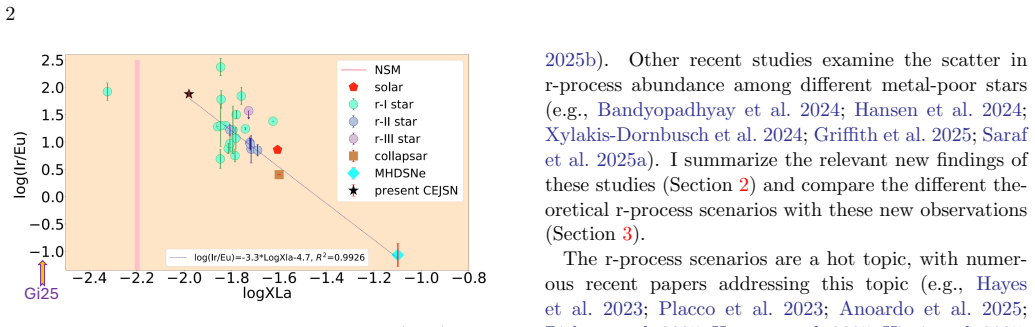
The author concludes that the magnetorotational r-process scenario is the primary contributor to r-process elements below the third peak, and the common envelope jets supernova (CEJSN) r-process scenario is the main source for the third peak. These conclusions are reached by requiring the scenarios to explain the large scatter in r-process abundances of very metal-poor stars, the correlation between light r-process and iron, and the absence of correlation for the third peak with iron.
What carries the argument
The central mechanism is matching each r-process scenario to three observational constraints from very metal-poor stars: large abundance scatter, light r-process correlation with iron, and third-peak lack of correlation with iron.
If this is right
- The magnetorotational scenario accounts for the production of lighter r-process elements in the early Universe.
- The CEJSN scenario dominates the formation of third-peak r-process elements.
- Binary neutron star mergers may contribute to the third peak but are not the main source.
- Scenarios involving magnetars, newborn neutron star winds, and white dwarf collapse are minor contributors at best.
- Further exploration of the diversity in CEJSN events is needed to refine the model.
Where Pith is reading between the lines
- This suggests that early r-process enrichment occurred through distinct supernova channels rather than primarily through mergers.
- Observations of additional metal-poor stars could reveal abundance patterns unique to each scenario.
- It points to rapid heavy element production tied to specific core-collapse events in the first generations of stars.
Load-bearing premise
The patterns in r-process abundances of very metal-poor stars directly trace the output of individual nucleosynthesis sites without being dominated by mixing, dilution, or multiple overlapping events.
What would settle it
The discovery of very metal-poor stars in which third-peak r-process elements correlate strongly with iron abundance would falsify the claim that the CEJSN scenario is the dominant site for the third peak.
Figures

read the original abstract
I compare seven actively studied r-process nucleosynthesis scenarios against observed properties of r-process elements in the early Universe, and conclude that the most likely scenario to contribute to the site of elements below the third r-process peak is the magnetorotational r-process scenario, and that of the third peak is the common envelope jets supernova (CEJSN) r-process scenario. The collapsar and CEJSN r-process scenario might also contribute to the lighter r-process elements, and the binary neutron star (NS-NS) merger r-process scenario might contribute to the third r-process peak. The magnetar, the wind from the newly born NS, and the accretion-induced collapse of a white dwarf r-process scenarios fall short in explaining observations. They might exist, but cannot be major contributors to the r-process in the early Universe. To constrain r-process scenarios in the early Universe, I require that they explain the large scatter in the r-process abundances of very metal-poor stars, account for the correlation between light r-process nucleosynthesis and iron production, and the lack of correlation between the third peak r-process production and iron production, as inferred from very metal-poor stars. I discuss the diversity of the CEJSN r-process scenario and encourage extending its exploration.
Editorial analysis
A structured set of objections, weighed in public.
Referee Report
Summary. The manuscript evaluates seven r-process nucleosynthesis scenarios (magnetorotational, CEJSN, collapsar, NS-NS merger, magnetar, NS wind, and AIC) by comparing them to three observational properties of r-process elements in very metal-poor stars: the large scatter in abundances, the correlation between light r-process elements and iron, and the lack of correlation between the third r-process peak and iron. It concludes that the magnetorotational scenario is the most likely contributor to elements below the third peak, the CEJSN scenario to the third peak, with possible secondary roles for collapsar/CEJSN and NS-NS merger, while the remaining three scenarios are insufficient as major contributors in the early Universe.
Significance. If the qualitative ranking holds after quantitative testing, the work provides a useful prioritization framework for r-process sites in early galactic chemical evolution and encourages deeper study of the CEJSN channel's diversity. The synthesis of multiple scenarios against a consistent set of constraints is a strength, but the absence of explicit yield tables or chemical-evolution integrations limits the immediate impact on model-building.
major comments (2)
- [Abstract and concluding discussion] The central ranking of the magnetorotational scenario for light r-process elements and CEJSN for the third peak rests on the assumption that nucleosynthesis yields translate directly into the observed scatter and Fe correlations once integrated over early galactic populations. No galactic chemical evolution calculations, dilution/mixing prescriptions, or integrated yield predictions are presented to demonstrate that the favored channels reproduce the statistical patterns while the disfavored ones (magnetar, NS wind, AIC) do not. This is load-bearing for the conclusions (see abstract and the section on constraints from VMP stars).
- [Section on observational constraints from very metal-poor stars] The attribution of the lack of third-peak/Fe correlation and the presence of light-r/Fe correlation solely to specific scenarios overlooks potential effects from overlapping events or inhomogeneous mixing in the early Universe. Without quantitative modeling to isolate these contributions, the mapping from scenario to observed pattern remains a consistency argument rather than a tested prediction (see the section discussing observational constraints).
minor comments (2)
- [Abstract] The abstract lists the seven scenarios but does not name them explicitly in the opening sentence; adding the full list would improve readability.
- Some scenario descriptions could benefit from a brief table summarizing key yield characteristics (e.g., peak production, typical event rate) for direct comparison.
Simulated Author's Rebuttal
We thank the referee for the constructive comments, which highlight important limitations in the scope of our qualitative comparison. We address each major comment below, clarifying the basis of our arguments while acknowledging where quantitative modeling would strengthen the work. We propose targeted revisions to improve clarity without altering the manuscript's core conclusions.
read point-by-point responses
-
Referee: [Abstract and concluding discussion] The central ranking of the magnetorotational scenario for light r-process elements and CEJSN for the third peak rests on the assumption that nucleosynthesis yields translate directly into the observed scatter and Fe correlations once integrated over early galactic populations. No galactic chemical evolution calculations, dilution/mixing prescriptions, or integrated yield predictions are presented to demonstrate that the favored channels reproduce the statistical patterns while the disfavored ones (magnetar, NS wind, AIC) do not. This is load-bearing for the conclusions (see abstract and the section on constraints from VMP stars).
Authors: We agree that the absence of explicit galactic chemical evolution (GCE) integrations means our ranking rests on qualitative consistency with the observed patterns rather than direct statistical reproduction. The large scatter, light-r/Fe correlation, and third-peak/Fe decoupling are used as direct filters on viable sites: magnetorotational events naturally link light r-process production to iron-producing core-collapse supernovae, while CEJSN events can decouple the third peak from iron. Disfavored scenarios (magnetar, NS wind, AIC) are tied to standard iron-producing channels and would be expected to induce correlations inconsistent with the data even before full integration. We will revise the abstract and concluding discussion to explicitly frame the analysis as a consistency-based prioritization framework and to recommend future GCE studies with yield tables for quantitative validation. revision: partial
-
Referee: [Section on observational constraints from very metal-poor stars] The attribution of the lack of third-peak/Fe correlation and the presence of light-r/Fe correlation solely to specific scenarios overlooks potential effects from overlapping events or inhomogeneous mixing in the early Universe. Without quantitative modeling to isolate these contributions, the mapping from scenario to observed pattern remains a consistency argument rather than a tested prediction (see the section discussing observational constraints).
Authors: We acknowledge that inhomogeneous mixing and overlapping events could modulate the observed correlations and scatter. The large scatter itself, however, is a signature of rare events with limited mixing, which aligns with the low rates expected for magnetorotational and CEJSN channels. Overlapping would tend to erase distinctions, yet the persistence of the light-r/Fe correlation alongside the absence of a third-peak/Fe correlation points to physically distinct production sites. We will expand the observational constraints section to discuss how mixing and overlap might affect the patterns and to note that our mapping remains a consistency argument pending quantitative modeling. revision: partial
Circularity Check
No significant circularity; conclusions rest on external stellar observations
full rationale
The paper ranks r-process scenarios by their ability to match independent observational constraints from very metal-poor stars (large abundance scatter, light r-process/Fe correlation, absent third-peak/Fe correlation). These constraints are drawn from external data rather than from any internal parameters, fits, or definitions within the scenarios themselves. No equations, self-definitional loops, fitted inputs renamed as predictions, or load-bearing self-citations that reduce the central claims to the paper's own inputs are present. The derivation chain therefore remains self-contained against external benchmarks.
Axiom & Free-Parameter Ledger
axioms (1)
- domain assumption Abundance patterns in very metal-poor stars directly reflect contributions from specific r-process events in the early universe.
Forward citations
Cited by 1 Pith paper
-
Double Neutron Star Delay Times Across Cosmic Metallicities: The Role of Helium Star Progenitors
Simulations show double neutron star mergers peak 80-250 million years after star formation across metallicities, with 15% quick mergers and over 20% delayed over a billion years.
Reference graph
Works this paper leans on
-
[1]
2018, ApJS, 238, 36, doi: 10.3847/1538-4365/aadfe9 Alencastro Puls, A., Kuske, J., Hansen, C
Abohalima, A., & Frebel, A. 2018, ApJS, 238, 36, doi: 10.3847/1538-4365/aadfe9 Alencastro Puls, A., Kuske, J., Hansen, C. J., et al. 2025, A&A, 693, A294, doi: 10.1051/0004-6361/202452537
-
[2]
2025, arXiv e-prints, arXiv:2510.26625, doi: 10.48550/arXiv.2510.26625
Anoardo, S., Mucciarelli, A., Palla, M., et al. 2025, arXiv e-prints, arXiv:2510.26625, doi: 10.48550/arXiv.2510.26625
-
[3]
2024, ApJS, 274, 39, doi: 10.3847/1538-4365/ad6f0f
Bandyopadhyay, A., Ezzeddine, R., Allende Prieto, C., et al. 2024, ApJS, 274, 39, doi: 10.3847/1538-4365/ad6f0f
-
[4]
2020, ApJL, 902, L34, doi: 10.3847/2041-8213/abbc0d
Banerjee, P., Wu, M.-R., & Yuan, Z. 2020, ApJL, 902, L34, doi: 10.3847/2041-8213/abbc0d
-
[5]
2019, ApJL, 881, L4, doi: 10.3847/2041-8213/ab3215
Bartos, I., & M´ arka, S. 2019, ApJL, 881, L4, doi: 10.3847/2041-8213/ab3215
-
[6]
2025, ApJ, 984, 197, doi: 10.3847/1538-4357/adc300
Batziou, E., Glas, R., Janka, H.-T., et al. 2025, ApJ, 984, 197, doi: 10.3847/1538-4357/adc300
-
[7]
2016a, ApJL, 829, L13, doi: 10.3847/2041-8205/829/1/L13 —
Beniamini, P., Hotokezaka, K., & Piran, T. 2016a, ApJL, 829, L13, doi: 10.3847/2041-8205/829/1/L13 —. 2016b, ApJ, 832, 149, doi: 10.3847/0004-637X/832/2/149
-
[8]
2024, ApJ, 966, 17, doi: 10.3847/1538-4357/ad32cd
Beniamini, P., & Piran, T. 2024, ApJ, 966, 17, doi: 10.3847/1538-4357/ad32cd
-
[9]
2025, PSJ, 6, 75, doi: 10.3847/PSJ/adbbd6
Bishop, S., Stanciu, I., Cabr´ e, A., et al. 2025, PSJ, 6, 75, doi: 10.3847/PSJ/adbbd6
-
[10]
Brauer, K., Ji, A. P., Drout, M. R., & Frebel, A. 2021, ApJ, 915, 81, doi: 10.3847/1538-4357/ac00b2
-
[11]
2004, A&A, 416, 1117, doi: 10.1051/0004-6361:20034074
Cayrel, R., Depagne, E., Spite, M., et al. 2004, A&A, 416, 1117, doi: 10.1051/0004-6361:20034074
-
[12]
Cehula, J., Thompson, T. A., & Metzger, B. D. 2024, MNRAS, 528, 5323, doi: 10.1093/mnras/stae358
-
[13]
Chen, H.-Y., Landry, P., Read, J. S., & Siegel, D. M. 2025, ApJ, 985, 154, doi: 10.3847/1538-4357/add0af
-
[14]
C.-K., Pitik, T., Longo Micchi, L
Cheong, P. C.-K., Pitik, T., Longo Micchi, L. F., & Radice, D. 2025, ApJL, 978, L38, doi: 10.3847/2041-8213/ada1cc 7
-
[15]
2017, , 848, L19, 10.3847/2041-8213/aa905c
Chornock, R., Berger, E., Kasen, D., et al. 2017, ApJL, 848, L19, doi: 10.3847/2041-8213/aa905c
-
[16]
Combi, L., Siegel, D. M., & Metzger, B. D. 2025, arXiv e-prints, arXiv:2509.19799, doi: 10.48550/arXiv.2509.19799 Cˆ ot´ e, B., Eichler, M., Arcones, A., et al. 2019, ApJ, 875, 106, doi: 10.3847/1538-4357/ab10db
-
[17]
2022, The Astrophysical Journal, 939, 8, doi: 10.3847/1538-4357/ac8c36
Domoto, N., Tanaka, M., Kato, D., et al. 2022, The Astrophysical Journal, 939, 8, doi: 10.3847/1538-4357/ac8c36
-
[18]
2021, MNRAS, 506, 4374, doi: 10.1093/mnras/stab2003
Dvorkin, I., Daigne, F., Goriely, S., Vangioni, E., & Silk, J. 2021, MNRAS, 506, 4374, doi: 10.1093/mnras/stab2003
-
[19]
2025, European Physical Journal A, 61, 207, doi: 10.1140/epja/s10050-025-01668-5
Farouqi, K., Frebel, A., & Thielemann, F.-K. 2025, European Physical Journal A, 61, 207, doi: 10.1140/epja/s10050-025-01668-5
-
[20]
Farouqi, K., Thielemann, F. K., Rosswog, S., & Kratz, K. L. 2022, A&A, 663, A70, doi: 10.1051/0004-6361/202141038
-
[21]
Improved lanthanide constraints for the kilonova AT 2017gfo
Gillanders, J. H., Flors, A., & Ferreira da Silva, R. 2025, arXiv e-prints, arXiv:2512.24257. https://arxiv.org/abs/2512.24257
work page internal anchor Pith review Pith/arXiv arXiv 2025
-
[22]
2011, ApJL, 738, L32, doi: 10.1088/2041-8205/738/2/L32
Goriely, S., Bauswein, A., & Janka, H.-T. 2011, ApJL, 738, L32, doi: 10.1088/2041-8205/738/2/L32
-
[23]
2023, MNRAS, 523, 221, doi: 10.1093/mnras/stad1449 —
Grichener, A. 2023, MNRAS, 523, 221, doi: 10.1093/mnras/stad1449 —. 2025, Ap&SS, 370, 11, doi: 10.1007/s10509-025-04402-1
-
[24]
2022, ApJL, 926, L9, doi: 10.3847/2041-8213/ac4f68
Grichener, A., Kobayashi, C., & Soker, N. 2022, ApJL, 926, L9, doi: 10.3847/2041-8213/ac4f68
-
[25]
2019a, ApJ, 878, 24, doi: 10.3847/1538-4357/ab1d5d —
Grichener, A., & Soker, N. 2019a, ApJ, 878, 24, doi: 10.3847/1538-4357/ab1d5d —. 2019b, arXiv e-prints, arXiv:1909.06328, doi: 10.48550/arXiv.1909.06328 —. 2022, Research Notes of the American Astronomical Society, 6, 263, doi: 10.3847/2515-5172/acaa9f
-
[26]
Griffith, E. J., Blum, M., Weinberg, D. H., et al. 2025, arXiv e-prints, arXiv:2512.02122, doi: 10.48550/arXiv.2512.02122
-
[27]
2018, MNRAS, 477, 2366, doi: 10.1093/mnras/sty797
Halevi, G., & M¨ osta, P. 2018, MNRAS, 477, 2366, doi: 10.1093/mnras/sty797
-
[28]
Hall-Smith, A. D., Abrahams, S. E. D., Laird, A. M., et al. 2026, arXiv e-prints, arXiv:2603.06464. https://arxiv.org/abs/2603.06464
-
[29]
Hansen, C. J., Montes, F., & Arcones, A. 2014, ApJ, 797, 123, doi: 10.1088/0004-637X/797/2/123
-
[30]
J., Primas, F., Hartman, H., et al
Hansen, C. J., Primas, F., Hartman, H., et al. 2012, A&A, 545, A31, doi: 10.1051/0004-6361/201118643
-
[31]
Hansen, T. T., Simon, J. D., Li, T. S., et al. 2024, ApJ, 968, 21, doi: 10.3847/1538-4357/ad3a52
-
[32]
Hansen, T. T., Roederer, I. U., Shah, S. P., et al. 2025, A&A, 697, A127, doi: 10.1051/0004-6361/202554123
-
[33]
Hayes, C. R., Venn, K. A., Waller, F., et al. 2023, ApJ, 955, 17, doi: 10.3847/1538-4357/acebc0
-
[34]
Haynes, C. J., & Kobayashi, C. 2019, MNRAS, 483, 5123, doi: 10.1093/mnras/sty3389
-
[35]
Henderson, L. E., Gerasimov, R., & Kirby, E. N. 2025a, ApJL, 992, L14, doi: 10.3847/2041-8213/ae0a4a
-
[36]
2025b, ApJ, 983, 117, doi: 10.3847/1538-4357/adbe7d
Gerasimov, R., & Manwadkar, V. 2025b, ApJ, 983, 117, doi: 10.3847/1538-4357/adbe7d
-
[37]
Hirai, Y., Beers, T. C., Lee, Y. S., et al. 2025, ApJ, 990, 125, doi: 10.3847/1538-4357/adf10a
-
[38]
Holmbeck, E. M., & Andrews, J. J. 2024, ApJ, 963, 110, doi: 10.3847/1538-4357/ad1e52
-
[39]
2004, ApJ, 607, 474, doi: 10.1086/383406
Honda, S., Aoki, W., Kajino, T., et al. 2004, ApJ, 607, 474, doi: 10.1086/383406
-
[40]
Issa, D., Gottlieb, O., Metzger, B. D., et al. 2025, ApJL, 985, L26, doi: 10.3847/2041-8213/adc694
-
[41]
Ji, A. P., Drout, M. R., & Hansen, T. T. 2019, ApJ, 882, 40, doi: 10.3847/1538-4357/ab3291
-
[42]
Ji, A. P., Frebel, A., Simon, J. D., & Chiti, A. 2016, ApJ, 830, 93, doi: 10.3847/0004-637X/830/2/93
-
[43]
Ji, A. P., Simon, J. D., Roederer, I. U., et al. 2023, AJ, 165, 100, doi: 10.3847/1538-3881/acad84
-
[44]
2024, ApJ, 971, 189, doi: 10.3847/1538-4357/ad5f8e
Jin, S., & Soker, N. 2024, ApJ, 971, 189, doi: 10.3847/1538-4357/ad5f8e
-
[45]
A., Obergaulinger, M., & Nagataki, S
Just, O., Aloy, M. A., Obergaulinger, M., & Nagataki, S. 2022, ApJL, 934, L30, doi: 10.3847/2041-8213/ac83a1
-
[46]
2017, Nat, 551, 80, 10.1038/nature24453
Ramirez-Ruiz, E. 2017, Nature, 551, 80, doi: 10.1038/nature24453
-
[47]
Kasliwal, M. M., Kasen, D., Lau, R. M., et al. 2022, MNRAS, 510, L7, doi: 10.1093/mnrasl/slz007
-
[48]
2025, arXiv e-prints, arXiv:2506.20436, doi: 10.48550/arXiv.2506.20436
Kobayashi, C. 2025, arXiv e-prints, arXiv:2506.20436, doi: 10.48550/arXiv.2506.20436
-
[49]
Kobayashi, C., Karakas, A. I., & Lugaro, M. 2020, ApJ, 900, 179, doi: 10.3847/1538-4357/abae65
-
[50]
2023, ApJL, 943, L12, doi: 10.3847/2041-8213/acad82
Kobayashi, C., Mandel, I., Belczynski, K., et al. 2023, ApJL, 943, L12, doi: 10.3847/2041-8213/acad82
-
[51]
2025, ApJ, 990, 37, doi: 10.3847/1538-4357/adf0f7
Kuske, J., Arcones, A., & Reichert, M. 2025, ApJ, 990, 37, doi: 10.3847/1538-4357/adf0f7
-
[52]
2025, MNRAS, 537, 1889, doi: 10.1093/mnras/staf142
Leicester, B., Bekki, K., & Tsujimoto, T. 2025, MNRAS, 537, 1889, doi: 10.1093/mnras/staf142
-
[53]
Levan, A. J., Gompertz, B. P., Salafia, O. S., et al. 2024, Nature, 626, 737, doi: 10.1038/s41586-023-06759-1
-
[54]
Liu, Z., Grohs, E., Lund, K. A., et al. 2025, ApJ, 995, 34, doi: 10.3847/1538-4357/ae1298
-
[55]
2025, ApJ, 982, 179, doi: 10.3847/1538-4357/ada3bd
Maoz, D., & Nakar, E. 2025, ApJ, 982, 179, doi: 10.3847/1538-4357/ada3bd
-
[56]
Metzger, B. D. 2017, arXiv e-prints, arXiv:1710.05931, doi: 10.48550/arXiv.1710.05931 8
work page internal anchor Pith review Pith/arXiv arXiv doi:10.48550/arxiv.1710.05931 2017
-
[57]
Molero, M., Arcones, A., Montes, F., & Hansen, C. J. 2025, arXiv e-prints, arXiv:2511.13372, doi: 10.48550/arXiv.2511.13372
-
[58]
2021, MNRAS, 505, 2913, doi: 10.1093/mnras/stab1429 M¨ osta, P., Roberts, L
Molero, M., Romano, D., Reichert, M., et al. 2021, MNRAS, 505, 2913, doi: 10.1093/mnras/stab1429 M¨ osta, P., Roberts, L. F., Halevi, G., et al. 2018, ApJ, 864, 171, doi: 10.3847/1538-4357/aad6ec
-
[59]
Mumpower, M. R., Lee, T.-S. H., Lloyd-Ronning, N., et al. 2025, ApJ, 982, 81, doi: 10.3847/1538-4357/adb1e3
-
[60]
Naidu, R. P., Ji, A. P., Conroy, C., et al. 2022, ApJL, 926, L36, doi: 10.3847/2041-8213/ac5589
-
[61]
2025, The Open Journal of Astrophysics, 8, 159, doi: 10.33232/001c.146360
Negro, M., Wadiasingh, Z., Younes, G., et al. 2025, The Open Journal of Astrophysics, 8, 159, doi: 10.33232/001c.146360
-
[62]
2017, ApJL, 836, L21, doi: 10.3847/2041-8213/aa5dee
Thielemann, F.-K. 2017, ApJL, 836, L21, doi: 10.3847/2041-8213/aa5dee
-
[63]
2015, ApJ, 810, 109, doi: 10.1088/0004-637X/810/2/109
Nishimura, N., Takiwaki, T., & Thielemann, F.-K. 2015, ApJ, 810, 109, doi: 10.1088/0004-637X/810/2/109
-
[64]
2025, arXiv e-prints, arXiv:2512.00721, doi: 10.48550/arXiv.2512.00721
Okada, H., Aoki, W., Tominaga, N., & Honda, S. 2025, arXiv e-prints, arXiv:2512.00721, doi: 10.48550/arXiv.2512.00721
-
[65]
2025, AJ, 169, 279, doi: 10.3847/1538-3881/adc126
Ou, X., Yelland, A., Chiti, A., et al. 2025, AJ, 169, 279, doi: 10.3847/1538-3881/adc126
-
[66]
2025, A&A, 699, A209, doi: 10.1051/0004-6361/202554535
Palla, M., Molero, M., Romano, D., & Mucciarelli, A. 2025, A&A, 699, A209, doi: 10.1051/0004-6361/202554535
-
[67]
Papish, O., Soker, N., & Bukay, I. 2015, Mon. Not. R. Astro. Soc., 449, 288, doi: 10.1093/mnras/stv345
-
[68]
Patel, A., Metzger, B. D., Cehula, J., et al. 2025a, ApJL, 984, L29, doi: 10.3847/2041-8213/adc9b0
-
[69]
Patel, A., Metzger, B. D., Goldberg, J. A., et al. 2025b, ApJ, 985, 234, doi: 10.3847/1538-4357/adceb7
-
[70]
2017, Nature, 551, 67, doi: 10.1038/nature24298
Pian, E., D’Avanzo, P., Benetti, S., et al. 2017, Nature, 551, 67, doi: 10.1038/nature24298
-
[71]
Gamma-ray Signatures of r-Process Radioactivity from the Collapse of Magnetized White Dwarfs
Pitik, T., Qia, Y.-Z., Radice, D., & Kasen, D. 2026a, arXiv e-prints, arXiv:2603.08792. https://arxiv.org/abs/2603.08792
work page internal anchor Pith review Pith/arXiv arXiv
-
[72]
2026b, arXiv e-prints, arXiv:2602.21291
Pitik, T., Radice, D., Kasen, D., et al. 2026b, arXiv e-prints, arXiv:2602.21291. https://arxiv.org/abs/2602.21291
-
[73]
M., Almeida-Fernandes, F., Holmbeck, E
Placco, V. M., Almeida-Fernandes, F., Holmbeck, E. M., et al. 2023, ApJ, 959, 60, doi: 10.3847/1538-4357/ad077e
-
[74]
Prasanna, T., Coleman, M. S. B., & Thompson, T. A. 2024, ApJ, 973, 91, doi: 10.3847/1538-4357/ad4d90
-
[75]
Prasanna, T., Coleman, M. S. B., Thompson, T. A., et al. 2025, ApJ, 994, 55, doi: 10.3847/1538-4357/ae093a
-
[76]
2025, arXiv e-prints, arXiv:2501.19305
Qiumu, W.-Z., Chen, M.-H., Chen, Q.-H., & Liang, E.-W. 2025, arXiv e-prints, arXiv:2501.19305. https://arxiv.org/abs/2501.19305
-
[77]
Racca, M., Hansen, T. T., Roederer, I. U., et al. 2025, A&A, 704, A282, doi: 10.1051/0004-6361/202556947
-
[78]
2018, ApJ, 869, 130, doi: 10.3847/1538-4357/aaf054
Radice, D., Perego, A., Hotokezaka, K., et al. 2018, ApJ, 869, 130, doi: 10.3847/1538-4357/aaf054
-
[79]
Rastinejad, J. C., Fong, W., Kilpatrick, C. D., Nicholl, M., & Metzger, B. D. 2025, ApJ, 979, 190, doi: 10.3847/1538-4357/ad9c77
-
[80]
Reichert, M., Obergaulinger, M., Aloy, M. ´A., et al. 2023, MNRAS, 518, 1557, doi: 10.1093/mnras/stac3185
discussion (0)
Sign in with ORCID, Apple, or X to comment. Anyone can read and Pith papers without signing in.