Improved lanthanide constraints for the kilonova AT 2017gfo
Pith reviewed 2026-05-16 19:11 UTC · model grok-4.3
The pith
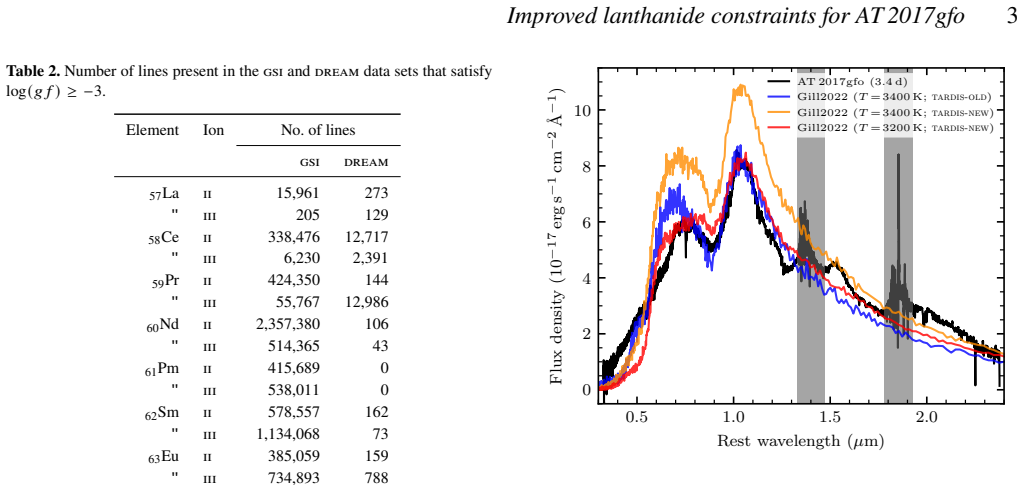
Improved lanthanide line lists require a twenty times lower mass fraction to fit the spectrum of kilonova AT 2017gfo.
A machine-rendered reading of the paper's core claim, the machinery that carries it, and where it could break.
Core claim
Incorporating updated and more complete lanthanide line lists into TARDIS modeling of the photospheric spectrum of AT 2017gfo at 3.4 days demonstrates that the data can be reproduced with a lanthanide mass fraction X_ln approximately equal to 2.5 times 10 to the minus 3, a value twenty times lower than previously claimed. This result follows from the improved estimation of the total contribution of lanthanides to the observed opacity.
What carries the argument
The TARDIS radiative transfer code combined with expanded lanthanide atomic line lists, which provide a more accurate total opacity calculation for these elements in the ejecta.
Load-bearing premise
That the TARDIS models with the new lanthanide lines fully capture the dominant opacity without large systematic errors from omitted lines of other elements or from the assumed ejecta structure.
What would settle it
Independent modeling of the same spectrum with complete atomic data for additional r-process elements that still requires a lanthanide fraction near 5 percent to achieve a fit would falsify the low value.
Figures


read the original abstract
Spectroscopic observations of the kilonova AT 2017gfo provide a unique opportunity to identify signatures from individual heavy elements freshly synthesised via the r-process, the nucleosynthetic channel responsible for producing $\sim$half of all trans-iron-group elements. Limitations in the available atomic data have historically hampered comprehensive line identification studies; however, renewed interest has led to the generation of improved (more complete and accurately calibrated) line lists for r-process species. Here we demonstrate the utility of such data, by exploiting newly generated line lists for the lanthanides to model the photospheric-phase 3.4d X-shooter spectrum of AT 2017gfo with the radiative transfer tool TARDIS. We find the data can only be reproduced by invoking a substantially diminished lanthanide mass fraction ($X_{\textsc{ln}}$) than that proposed by previous studies. Specifically, our model necessitates $X_{\textsc{ln}} \approx 2.5 \times 10^{-3}$ in the line-forming region, a value $20 \times$ lower than previously claimed. This substantial reduction in $X_{\textsc{ln}}$ is driven by our inclusion of much more complete lanthanide line information that enables better estimation of their total contribution to the observations. We encourage future modelling works to exploit all atomic data advances, and also encourage continued efforts to generate the necessary data for the remaining r-process species of interest.
Editorial analysis
A structured set of objections, weighed in public.
Referee Report
Summary. The paper models the photospheric-phase 3.4 d X-shooter spectrum of kilonova AT 2017gfo using the TARDIS radiative transfer code together with newly generated lanthanide line lists. It reports that the spectrum can be reproduced only with a lanthanide mass fraction X_ln ≈ 2.5 × 10^{-3} in the line-forming region, a value stated to be 20× lower than previous claims, and attributes the reduction to the more complete opacity contribution captured by the updated atomic data.
Significance. If the central result holds after robustness checks, the work would revise downward the lanthanide abundance required to explain AT 2017gfo spectra, tightening constraints on r-process yields in neutron-star mergers. Credit is due for incorporating recent atomic-data advances into a standard radiative-transfer framework and for producing a concrete, observationally testable abundance value.
major comments (2)
- [Modeling description (abstract and §3)] The headline claim (X_ln ≈ 2.5 × 10^{-3}, 20× lower) is obtained by varying only the lanthanide mass fraction inside a single fixed 1D TARDIS model. No explicit tests are shown that vary the density power-law index or the velocity coordinate of the photosphere; because the new line lists increase total opacity and therefore shift the τ=1 surface, even modest changes in the adopted ejecta structure can alter the X_ln needed to match observed line depths by a large factor.
- [Results and discussion] The paper states that the spectrum 'can only be reproduced' with the lower X_ln once the new line lists are included, yet no direct side-by-side comparison is presented of the same density/velocity structure run with the old versus new lanthanide data. Without that differential test it remains unclear how much of the factor-of-20 reduction is genuinely due to the improved atomic data versus differences in the underlying ejecta model.
minor comments (2)
- [Abstract] The notation X_ln (or X_{ln}) should be defined explicitly on first use and the precise radial region over which it is assumed constant should be stated.
- [Figures and methods] Figure captions (or the methods section) should list the exact density power-law index, photospheric velocity, and temperature structure adopted for the fiducial model so that the result can be reproduced.
Simulated Author's Rebuttal
We thank the referee for their detailed and constructive report. We address each major comment below and will revise the manuscript accordingly to strengthen the presentation of our results.
read point-by-point responses
-
Referee: [Modeling description (abstract and §3)] The headline claim (X_ln ≈ 2.5 × 10^{-3}, 20× lower) is obtained by varying only the lanthanide mass fraction inside a single fixed 1D TARDIS model. No explicit tests are shown that vary the density power-law index or the velocity coordinate of the photosphere; because the new line lists increase total opacity and therefore shift the τ=1 surface, even modest changes in the adopted ejecta structure can alter the X_ln needed to match observed line depths by a large factor.
Authors: We acknowledge that our primary models hold the ejecta density profile and photospheric velocity fixed while varying only X_ln. The referee correctly notes that increased opacity from the new line lists will shift the τ=1 surface, and that modest changes to the underlying structure could affect the precise X_ln required. To address this, we will add a new subsection in the revised manuscript presenting additional TARDIS runs that vary the density power-law index (e.g., ±0.5 around the fiducial value) and the photospheric velocity coordinate. These tests will demonstrate that the factor-of-20 reduction in X_ln remains robust within the range of structures consistent with the observed spectrum, thereby isolating the dominant role of the improved atomic data. revision: yes
-
Referee: [Results and discussion] The paper states that the spectrum 'can only be reproduced' with the lower X_ln once the new line lists are included, yet no direct side-by-side comparison is presented of the same density/velocity structure run with the old versus new lanthanide data. Without that differential test it remains unclear how much of the factor-of-20 reduction is genuinely due to the improved atomic data versus differences in the underlying ejecta model.
Authors: We agree that an explicit differential test with identical ejecta parameters is necessary to quantify the contribution of the new line lists. In the submitted manuscript the model was optimized using the updated data, so a direct old-versus-new comparison under the same density and velocity structure was not shown. We will add this comparison to the revised version, including a figure that overlays the synthetic spectra obtained with the previous lanthanide line lists (under the same TARDIS configuration) against those with the new lists. This will clearly illustrate the increase in total opacity and the consequent reduction in required X_ln attributable to the atomic-data improvement. revision: yes
Circularity Check
Fitted lanthanide mass fraction presented as model necessity
specific steps
-
fitted input called prediction
[Abstract]
"our model necessitates X_ln ≈ 2.5 × 10^{-3} in the line-forming region, a value 20 × lower than previously claimed."
The X_ln value is determined by varying the lanthanide mass fraction inside the TARDIS radiative-transfer calculation until the synthetic spectrum reproduces the observed features. The reported 'necessitated' abundance is therefore the tuned parameter that matches the data rather than a quantity derived independently of the fit.
full rationale
The paper's central claim is obtained by adjusting X_ln in a TARDIS model until the synthetic spectrum matches the observed 3.4 d data. The reported value is therefore the fitted parameter that reproduces the line depths once the new line lists are included; it is not an independent prediction or first-principles derivation. The new atomic data supply an independent input, but the headline abundance constraint reduces directly to the fit. No self-citation load-bearing or definitional circularity is present in the provided text.
Axiom & Free-Parameter Ledger
free parameters (1)
- X_ln =
2.5e-3
axioms (1)
- domain assumption TARDIS assumptions for photospheric-phase radiative transfer (density profile, velocity field, and level populations)
Forward citations
Cited by 3 Pith papers
-
Strontium and helium in the kilonova AT2017gfo: Origin of the 1{\mu}m feature constrained via NLTE calculations
NLTE calculations indicate strontium is required to explain the onset of the 1μm feature at early times in AT2017gfo, while helium can dominate at later epochs with plausible masses.
-
Exploring the diversity of kilonovae with 3D radiative transfer I. The polar direction
Dynamical ejecta from neutron star mergers reproduce key spectral properties of AT2017gfo in polar views, with features from Sr II, La III and other ions appearing at earlier times than observed.
-
The early r-process nucleosynthesis scenarios
Magnetorotational r-process best explains lighter elements and CEJSN explains the third peak based on scatter and iron correlations in early metal-poor stars.
Reference graph
Works this paper leans on
-
[1]
2017, The Astrophysical Journal Letters, 848, L12, doi:10.3847/2041-8213/aa91c9
Abbott B. P., et al., 2017, @doi [ ] 10.3847/2041-8213/aa91c9 , http://adsabs.harvard.edu/abs/2017ApJ...848L..12A 848, L12
-
[2]
Bauswein A., Goriely S., Janka H. T., 2013, @doi [ ] 10.1088/0004-637X/773/1/78 , https://ui.adsabs.harvard.edu/abs/2013ApJ...773...78B 773, 78
-
[3]
Bi \'e mont E., Palmeri P., Quinet P., 1999, @doi [ ] 10.1023/A:1017049314691 , https://ui.adsabs.harvard.edu/abs/1999Ap&SS.269..635B 269, 635
-
[4]
Dere K. P., Landi E., Mason H. E., Monsignori Fossi B. C., Young P. R., 1997, @doi [ ] 10.1051/aas:1997368 , https://ui.adsabs.harvard.edu/abs/1997A&AS..125..149D 125, 149
-
[5]
Dere K. P., Del Zanna G., Young P. R., Landi E., Sutherland R. S., 2019, @doi [ ] 10.3847/1538-4365/ab05cf , https://ui.adsabs.harvard.edu/abs/2019ApJS..241...22D 241, 22
-
[6]
Domoto N., Tanaka M., Wanajo S., Kawaguchi K., 2021, @doi [ ] 10.3847/1538-4357/abf358 , https://ui.adsabs.harvard.edu/abs/2021ApJ...913...26D 913, 26
-
[7]
Domoto N., Tanaka M., Kato D., Kawaguchi K., Hotokezaka K., Wanajo S., 2022, @doi [ ] 10.3847/1538-4357/ac8c36 , https://ui.adsabs.harvard.edu/abs/2022ApJ...939....8D 939, 8
-
[8]
Dougan D. J., McElroy N. E., Ballance C. P., Ramsbottom C. A., 2025, @doi [ ] 10.1093/mnras/staf1013 , https://ui.adsabs.harvard.edu/abs/2025MNRAS.541..367D 541, 367
-
[9]
Dunleavy N. L., Ballance C. P., Ramsbottom C. A., Johnson C. A., Loch S. D., Ennis D. A., 2022, @doi [Journal of Physics B Atomic Molecular Physics] 10.1088/1361-6455/ac8089 , https://ui.adsabs.harvard.edu/abs/2022JPhB...55q5002D 55, 175002
-
[10]
N., 1989, @doi [ ] 10.1038/340126a0 , https://ui.adsabs.harvard.edu/abs/1989Natur.340..126E 340, 126
Eichler D., Livio M., Piran T., Schramm D. N., 1989, @doi [ ] 10.1038/340126a0 , https://ui.adsabs.harvard.edu/abs/1989Natur.340..126E 340, 126
-
[11]
Fl \"o rs A., et al., 2023, @doi [ ] 10.1093/mnras/stad2053 , https://ui.adsabs.harvard.edu/abs/2023MNRAS.524.3083F 524, 3083
-
[12]
Fl \"o rs A., Ferreira da Silva R., Marques J. P., Sampaio J. M., Mart \' nez-Pinedo G., 2025, @doi [arXiv e-prints] 10.48550/arXiv.2507.07785 , https://ui.adsabs.harvard.edu/abs/2025arXiv250707785F p. arXiv:2507.07785
-
[13]
K., 1999, @doi [ ] 10.1086/312343 , https://ui.adsabs.harvard.edu/abs/1999ApJ...525L.121F 525, L121
Freiburghaus C., Rosswog S., Thielemann F. K., 1999, @doi [ ] 10.1086/312343 , https://ui.adsabs.harvard.edu/abs/1999ApJ...525L.121F 525, L121
-
[14]
Gillanders J. H., McCann M., Sim S. A., Smartt S. J., Ballance C. P., 2021, @doi [ ] 10.1093/mnras/stab1861 , https://ui.adsabs.harvard.edu/abs/2021MNRAS.506.3560G 506, 3560
-
[15]
Gillanders J. H., Smartt S. J., Sim S. A., Bauswein A., Goriely S., 2022, @doi [ ] 10.1093/mnras/stac1258 , https://ui.adsabs.harvard.edu/abs/2022MNRAS.515..631G 515, 631
-
[16]
Gillanders J. H., Sim S. A., Smartt S. J., Goriely S., Bauswein A., 2024, @doi [ ] 10.1093/mnras/stad3688 , https://ui.adsabs.harvard.edu/abs/2024MNRAS.529.2918G 529, 2918
-
[17]
Goriely S., 1999, , https://ui.adsabs.harvard.edu/abs/1999A&A...342..881G 342, 881
work page 1999
-
[18]
Goriely S., Bauswein A., Janka H.-T., 2011, @doi [ ] 10.1088/2041-8205/738/2/L32 , https://ui.adsabs.harvard.edu/abs/2011ApJ...738L..32G 738, L32
-
[19]
Goriely S., Sida J. L., Lema \^ tre J. F., Panebianco S., Dubray N., Hilaire S., Bauswein A., Janka H. T., 2013, @doi [ ] 10.1103/PhysRevLett.111.242502 , https://ui.adsabs.harvard.edu/abs/2013PhRvL.111x2502G 111, 242502
-
[20]
Goriely S., Bauswein A., Just O., Pllumbi E., Janka H. T., 2015, @doi [ ] 10.1093/mnras/stv1526 , https://ui.adsabs.harvard.edu/abs/2015MNRAS.452.3894G 452, 3894
-
[21]
Gu M. F., 2008, @doi [Canadian Journal of Physics] 10.1139/p07-197 , https://ui.adsabs.harvard.edu/abs/2008CaJPh..86..675G 86, 675
-
[22]
Hjorth J., et al., 2017, @doi [ ] 10.3847/2041-8213/aa9110 , https://ui.adsabs.harvard.edu/abs/2017ApJ...848L..31H 848, L31
-
[23]
Hotokezaka K., Tanaka M., Kato D., Gaigalas G., 2023, @doi [ ] 10.1093/mnrasl/slad128 , https://ui.adsabs.harvard.edu/abs/2023MNRAS.526L.155H 526, L155
-
[24]
Just O., Bauswein A., Ardevol Pulpillo R., Goriely S., Janka H. T., 2015, @doi [ ] 10.1093/mnras/stv009 , https://ui.adsabs.harvard.edu/abs/2015MNRAS.448..541J 448, 541
-
[25]
Kato D., Tanaka M., Gaigalas G., Kitovien \. e L., Rynkun P., 2024, @doi [ ] 10.1093/mnras/stae2504 , https://ui.adsabs.harvard.edu/abs/2024MNRAS.535.2670K 535, 2670
-
[26]
Kerzendorf W. E., Sim S. A., 2014, @doi [ ] 10.1093/mnras/stu055 , http://adsabs.harvard.edu/abs/2014MNRAS.440..387K 440, 387
-
[27]
Korobkin O., Rosswog S., Arcones A., Winteler C., 2012, @doi [ ] 10.1111/j.1365-2966.2012.21859.x , https://ui.adsabs.harvard.edu/abs/2012MNRAS.426.1940K 426, 1940
-
[28]
L., 2018, in Workshop on Astrophysical Opacities
Kurucz R. L., 2018, in Workshop on Astrophysical Opacities. p. 47
work page 2018
-
[29]
Kurucz R., Bell B., 1995, Robert Kurucz CD-ROM, https://ui.adsabs.harvard.edu/abs/1995KurCD..23.....K 23
work page 1995
-
[30]
Lattimer J. M., Schramm D. N., 1974, @doi [ ] 10.1086/181612 , https://ui.adsabs.harvard.edu/abs/1974ApJ...192L.145L 192, L145
-
[31]
Li L.-X., Paczy \'n ski B., 1998, @doi [ ] 10.1086/311680 , http://adsabs.harvard.edu/abs/1998ApJ...507L..59L 507, L59
-
[32]
McCann M., Bromley S., Loch S. D., Ballance C. P., 2022, @doi [ ] 10.1093/mnras/stab3285 , https://ui.adsabs.harvard.edu/abs/2022MNRAS.509.4723M 509, 4723
-
[33]
McCann M., Ballance C. P., Loch S. D., Ennis D. A., 2024, @doi [Journal of Physics B Atomic Molecular Physics] 10.1088/1361-6455/ad7cad , https://ui.adsabs.harvard.edu/abs/2024JPhB...57w5202M 57, 235202
-
[34]
McCann M., Ballance C. P., McNeill F., Sim S. A., Ramsbottom C. A., 2025, @doi [ ] 10.1093/mnras/staf866 , https://ui.adsabs.harvard.edu/abs/2025MNRAS.540.2923M 540, 2923
-
[35]
Metzger B. D., 2019, @doi [Living Reviews in Relativity] 10.1007/s41114-019-0024-0 , https://ui.adsabs.harvard.edu/abs/2019LRR....23....1M 23, 1
-
[36]
G., Vernon I., Goldstein M., Benson A
Metzger B. D., et al., 2010, @doi [ ] 10.1111/j.1365-2966.2010.16864.x , http://adsabs.harvard.edu/abs/2010MNRAS.406.2650M 406, 2650
-
[37]
Mulholland L. P., McElroy N. E., McNeill F. L., Sim S. A., Ballance C. P., Ramsbottom C. A., 2024a, @doi [ ] 10.1093/mnras/stae1615 , https://ui.adsabs.harvard.edu/abs/2024MNRAS.532.2289M 532, 2289
-
[38]
Mulholland L. P., McNeill F., Sim S. A., Ballance C. P., Ramsbottom C. A., 2024b, @doi [ ] 10.1093/mnras/stae2331 , https://ui.adsabs.harvard.edu/abs/2024MNRAS.534.3423M 534, 3423
-
[39]
Mulholland L. P., Ramsbottom C. A., Ballance C. P., Sneppen A., Sim S. A., 2025, @doi [arXiv e-prints] 10.48550/arXiv.2510.17357 , https://ui.adsabs.harvard.edu/abs/2025arXiv251017357M p. arXiv:2510.17357
-
[40]
a ppeli R., Arcones A., Liebend \
Perego A., Rosswog S., Cabez \'o n R. M., Korobkin O., K \"a ppeli R., Arcones A., Liebend \"o rfer M., 2014, @doi [ ] 10.1093/mnras/stu1352 , https://ui.adsabs.harvard.edu/abs/2014MNRAS.443.3134P 443, 3134
-
[41]
Perego A., et al., 2022, @doi [ ] 10.3847/1538-4357/ac3751 , https://ui.adsabs.harvard.edu/abs/2022ApJ...925...22P 925, 22
-
[42]
Pian E., et al., 2017, @doi [ ] 10.1038/nature24298 , https://ui.adsabs.harvard.edu/abs/2017Natur.551...67P 551, 67
-
[43]
Pognan Q., Grumer J., Jerkstrand A., Wanajo S., 2023, @doi [ ] 10.1093/mnras/stad3106 , https://ui.adsabs.harvard.edu/abs/2023MNRAS.526.5220P 526, 5220
-
[44]
Prantzos N., Abia C., Cristallo S., Limongi M., Chieffi A., 2020, @doi [ ] 10.1093/mnras/stz3154 , https://ui.adsabs.harvard.edu/abs/2020MNRAS.491.1832P 491, 1832
-
[45]
Quinet P., Palmeri P., 2020, @doi [Atoms] 10.3390/atoms8020018 , https://ui.adsabs.harvard.edu/abs/2020Atoms...8...18Q 8, 18
-
[46]
Rosswog S., Liebend \"o rfer M., Thielemann F. K., Davies M. B., Benz W., Piran T., 1999, , https://ui.adsabs.harvard.edu/abs/1999A&A...341..499R 341, 499
work page 1999
-
[47]
Shingles L. J., et al., 2023, @doi [ ] 10.3847/2041-8213/acf29a , https://ui.adsabs.harvard.edu/abs/2023ApJ...954L..41S 954, L41
-
[48]
Smartt S. J., et al., 2017, @doi [ ] 10.1038/nature24303 , https://ui.adsabs.harvard.edu/abs/2017Natur.551...75S 551, 75
-
[49]
Smyth R. T., Ballance C. P., Ramsbottom C. A., Johnson C. A., Ennis D. A., Loch S. D., 2018, @doi [ ] 10.1103/PhysRevA.97.052705 , https://ui.adsabs.harvard.edu/abs/2018PhRvA..97e2705S 97, 052705
-
[50]
Sneppen A., Watson D., 2023, @doi [ ] 10.1051/0004-6361/202346421 , https://ui.adsabs.harvard.edu/abs/2023A&A...675A.194S 675, A194
-
[51]
N., 1982, , http://adsabs.harvard.edu/abs/1982ApL....22..143S 22, 143
Symbalisty E., Schramm D. N., 1982, , http://adsabs.harvard.edu/abs/1982ApL....22..143S 22, 143
work page 1982
-
[52]
Tanaka M., Kato D., Gaigalas G., Kawaguchi K., 2020, @doi [ ] 10.1093/mnras/staa1576 , https://ui.adsabs.harvard.edu/abs/2020MNRAS.496.1369T 496, 1369
-
[53]
J., Haggard D., Ford N., Drout M
Vieira N., Ruan J. J., Haggard D., Ford N., Drout M. R., Fern \'a ndez R., Badnell N. R., 2023, @doi [ ] 10.3847/1538-4357/acae72 , https://ui.adsabs.harvard.edu/abs/2023ApJ...944..123V 944, 123
-
[54]
Vieira N., Ruan J. J., Haggard D., Ford N. M., Drout M. R., Fern \'a ndez R., 2024, @doi [ ] 10.3847/1538-4357/ad1193 , https://ui.adsabs.harvard.edu/abs/2024ApJ...962...33V 962, 33
-
[55]
Vogl C., Sim S. A., Noebauer U. M., Kerzendorf W. E., Hillebrandt W., 2019, @doi [ ] 10.1051/0004-6361/201833701 , https://ui.adsabs.harvard.edu/abs/2019A&A...621A..29V 621, A29
-
[56]
Wanajo S., Sekiguchi Y., Nishimura N., Kiuchi K., Kyutoku K., Shibata M., 2014, @doi [ ] 10.1088/2041-8205/789/2/L39 , https://ui.adsabs.harvard.edu/abs/2014ApJ...789L..39W 789, L39
-
[57]
Watson D., et al., 2019, @doi [ ] 10.1038/s41586-019-1676-3 , https://ui.adsabs.harvard.edu/abs/2019Natur.574..497W 574, 497
-
[58]
" write newline "" before.all 'output.state := FUNCTION fin.entry write newline FUNCTION new.block output.state before.all = 'skip after.block 'output.state := if FUNCTION new.sentence output.state after.block = 'skip output.state before.all = 'skip after.sentence 'output.state := if if FUNCTION not #0 #1 if FUNCTION and 'skip pop #0 if FUNCTION or pop #1...
discussion (0)
Sign in with ORCID, Apple, or X to comment. Anyone can read and Pith papers without signing in.