REVIEW 4 major objections 4 minor 3 cited by
LuxRemix: Lighting Decomposition and Remixing for Indoor Scenes
T0 review · 4 major / 4 minor · reviewed 2026-08-03 · deepseek-v4-flash
Pith's one-line read LuxRemix claims that a single multi-view capture of an indoor scene can be decomposed into an ambient layer plus one layer per light source, harmonized across views, and re-rendered interactively from any viewpoint.
desk verdict Real contribution with honest limitations, but the load-bearing additive decomposition in Eq. (1) is never directly verified and real-world evidence is qualitative; still worth serious review. read the letter →
The pith
A machine-rendered reading of the paper's core claim, the machinery that carries it, and where it could break.
The reading
What carries the argument
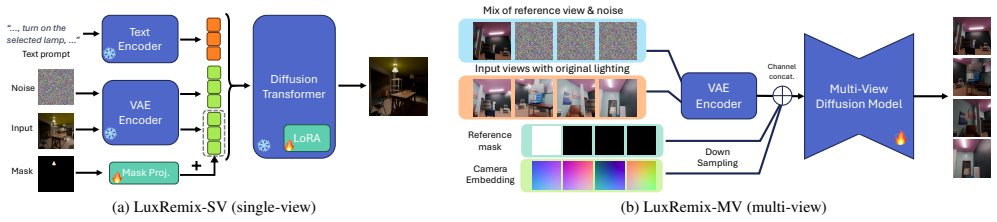
The load-bearing identity is Eq. (1): I_input = tonemap(I_ambient + sum_i c_i * I_i), which asserts that the observed image is a tone-mapped linear sum of an ambient pass and per-light one-light-at-a-time (OLAT) passes. Carrying the argument is a three-stage pipeline: (1) a LoRA-fine-tuned diffusion transformer conditioned on light-fixture masks, with multi-exposure outputs merged into HDR OLAT images; (2) a multi-view harmonization U-Net that takes geometric ray (Plücker) embeddings, reference masks, and sparse decomposed views and propagates the decomposition to every view; (3) a 3D Gaussian splatting model whose per-Gaussian per-light HDR RGB coefficients are linearly blended at render ti
What would settle it
Capture a real room twice: once under normal multi-light conditions and once with each physical light switched on alone (controlled OLAT). Compare the model's predicted per-light layers to the actual OLAT photographs. If per-pixel error on a typical room with indirect color bouncing is comparable to or worse than the spread between different random seeds shown in Fig. 14, the additive factorization—and the harmonization and 3DGS stages that inherit it—is not holding in the regime the paper claims.
Extended reading notes
Core claim
The central discovery is that per-light editing can be lifted from single images to full 3D scenes by treating lighting decomposition as an additive, view-consistent problem. Concretely, the method fine-tunes a text-guided image-editing diffusion model to produce one-light-at-a-time (OLAT) images — a scene lit only by a selected source — and ambient images, given the input photo and a mask of the light fixture. A multi-view harmonization stage propagates those sparse decompositions across all captured viewpoints using geometric ray embeddings, and a relightable 3D Gaussian splatting representation stores per-light HDR color coefficients per Gaussian, so rendering the scene under a new lighti
Load-bearing premise
That a real indoor photograph is well approximated as a tone-mapped linear sum of an ambient layer plus one layer per light source, learned from procedurally generated static rooms whose fixtures are largely cone-shaped.
Editorial extensions
If this is right
- A single casual multi-view capture suffices to edit individual light sources; no controlled OLAT photography rig is required.
- Edits made in one view propagate to all views and to novel viewpoints, because the per-light coefficients live in a shared 3D representation.
- Because final rendering is a linear blend of per-light passes, on/off, intensity, and chromaticity controls respond instantly and can be animated.
- The 12,000-scene synthetic dataset with ground-truth per-light decompositions provides a training signal that lets the diffusion prior specialize to light editing while retaining real-world generalization via its pretrained base.
Reading between the lines
- If the additive decomposition holds for real rooms, the per-light 3DGS coefficients become physically meaningful radiance layers; one could then support material edits or light-position changes by recombining them, though the paper does not attempt this.
- The model's known bias toward conical light spreads (stated in Sec. 5 and Fig. 14) predicts a concrete failure mode: fixtures with wide or asymmetric photometry, or strong color bleeding from interreflections, should push decomposition error well above the synthetic benchmark numbers.
- An immediate testable extension is temporal consistency: since harmonization runs per lighting condition, applying it to video frames with a shared reference view should yield flicker-free per-light edits, but the paper does not validate dynamic scenes.
- Given the seed-dependent OLAT outputs noted in Fig. 14, a practical robustness test is to run the decomposition several times and check whether user edits remain stable across seeds; the paper does not quantify this.
Editorial analysis
A structured set of objections, weighed in public.
Referee Report
Summary. LuxRemix proposes a three-stage pipeline for interactive per-light editing of indoor scenes from a casual multi-view capture. A single-image diffusion model (LuxRemix-SV) decomposes an input image into ambient and one-light-at-a-time (OLAT) passes according to Eq. (1); a multi-view diffusion harmonization model (LuxRemix-MV) propagates these passes across views; and the decomposed per-light images are encoded as per-Gaussian RGB coefficients in a 3D Gaussian splatting representation, allowing real-time recombination. The models are trained on a large procedurally generated synthetic indoor dataset with ground-truth OLAT renders, and quantitative evaluation is performed on 30 held-out synthetic scenes, with real-world results shown qualitatively. The central claim is that the method factorizes complex indoor illumination into individually controllable light sources and enables view-consistent relighting in real time.
Significance. If the claims hold, this is a useful step toward practical relighting of casually captured indoor scenes: it combines generative single-image decomposition with multi-view consistency and a real-time 3D representation, and it releases/large-scale synthetic training data with ground-truth per-light passes. The paper also ships qualitative interactive results and ablated comparisons that make the contributions easy to inspect. The main value is the demonstration that per-light control can be obtained without controlled multi-light capture, which would be a genuinely useful capability for virtual production and scene editing. However, the current evidence is primarily synthetic, and the load-bearing additive-decomposition identity is not directly evaluated, so the significance is conditional on closing that gap.
major comments (4)
- [Eq. (1), Section 3.2, Table 1] The paper never directly verifies the additive composition identity in Eq. (1). Table 1 scores each predicted OLAT/ambient pass against its own ground truth after per-channel color rescaling, but a set of individually accurate passes can still violate the sum-to-input identity. The only composition loss, Eq. (3), appears in the 3DGS stage and can absorb residual inconsistency via the learnable per-light weights w_m and per-Gaussian coefficients. Since on/off and intensity editing requires the decomposition to satisfy Eq. (1) with correct per-light scales, the paper should report, on the held-out synthetic scenes, the error of T(I_ambient + sum c_i I_i) versus I_input, with c_i estimated in the same way as at inference, and the per-light scale estimation error. This is a testable and essential check that the current evaluation omits.
- [Section 4, Section 5, Figs. 11–13] The abstract states that the method is evaluated on both synthetic and real-world datasets, but all quantitative numbers in Tables 1–2 are synthetic-only; real-world evidence is qualitative. Given that the method is trained entirely on procedural synthetic scenes, and Section 5 acknowledges a light-cone bias and limited light-source diversity, the real-world generalization claim is currently unsupported by quantitative evidence. I am not requiring a full real-world benchmark, but the paper should either add a quantitative real-world proxy (e.g., controlled real captures, or a real-world consistency metric for the 3DGS stage) or explicitly scope the central claim to synthetic-like lighting conditions in the abstract and introduction.
- [Section 3.3, Table 2] The multi-view harmonization stage is evaluated only against internal ablations (LuxRemix-SV per-view and LuxRemix-MV-Edit) on synthetic scenes. This is sufficient to show the value of multi-view context within the proposed system, but it does not support the abstract's claim of quantitative comparison to state-of-the-art techniques for the multi-view task. I ask the authors to either add an external baseline that can be adapted to per-light multi-view propagation, or to temper the abstract's wording so the SOTA comparison refers specifically to the single-image stage.
- [Section 3.4 vs Supplementary Section 7.3] There is a direct contradiction about the 3DGS optimization. Section 3.4 says that after pretraining, the authors 'freeze all geometric and appearance parameters' and then optimize only per-light RGB coefficients. Supplementary Section 7.3 Stage 2, step 1 says they 'jointly optimize the per-light RGB parameters L alongside the shared geometry parameters' for 4,000 iterations before freezing geometry for 2,000 iterations. This distinction matters because allowing geometry to adapt can mask errors in the per-light decomposition. Please state which protocol was actually used and report results for the frozen-geometry version, since that is the protocol that matches the claimed representation.
minor comments (4)
- [Section 3.1 / Supplementary Section 6] The dataset sizes are inconsistent: the main text says 12,000 scenes, the supplement says 12,400 synthetic rooms and 49,600 equirectangular views, and Table 3 compares 20,000 perspective images against 1,000 equirectangular images. Please reconcile these numbers.
- [Table 1 / Figure 8] LightLab is shown in qualitative comparisons but is absent from Table 1. If LightLab's public checkpoint or dataset can be run on the synthetic test set, it should be included; otherwise the omission should be explained.
- [Throughout] Minor wording: 'the OLAT images are determined up to scale' (Section 3.2) is followed by a discussion of brightness levels, but the mechanism for estimating c_i during single-image inference is not described. Clarify whether c_i are predicted, optimized, or absorbed by the later 3DGS stage.
- [Figure 14] The seed-dependence failure case is important; consider reporting a small quantitative seed-variance study for the single-image decomposition on the synthetic test set, since the current qualitative example suggests non-trivial variance.
Circularity Check
No significant circularity: the method is trained and evaluated against independent synthetic ground-truth OLAT decompositions, and the 3DGS fitting stage is representation encoding rather than a circular prediction.
full rationale
The load-bearing derivation chain is supervised and not circular. Eq. (1) is a linear additive forward model imposed on the data; the single-image model is trained with LoRA on synthetic OLAT decompositions rendered by Cycles and evaluated on 30 held-out synthetic scenes with ground-truth per-light images (Section 4). The multi-view harmonization model is likewise fine-tuned on synthetic per-view ground truth and compared against per-view and mask-guided ablations (Table 2). The 3DGS stage fits per-light RGB coefficients to the already-decomposed multi-view images; the composition loss Lcomp is a training objective that encodes the input into the representation, not a validation claim that the decomposition was correct. No prediction in the paper is obtained by fitting the quantity it claims to predict: per-image channel rescaling in Table 1 is a standard scale-invariance correction for OLAT outputs, not a fitted input used as evidence. Self-citations (e.g., DiffusionRenderer [51], UniRelight [35]) appear in related work and are not load-bearing premises; no uniqueness theorem or ansatz is imported from the authors' prior work. The concern that Eq. (1)'s additive identity is not directly verified on output passes is an evaluation gap or correctness risk, not circularity: the model is trained against ground-truth OLAT passes, and the decomposition is not defined as 'whatever sums to the input.'
Assumptions & free parameters
free parameters (6)
- per-image OLAT scale factors c_i =
fitted per scene at recomposition time
- channel-wise rescaling in evaluation =
optimal per-channel scale on each test output
- per-Gaussian per-light RGB coefficients L (M x 3) =
optimized in Stage 2 (4000+2000 iterations)
- tone-map parameters gamma, beta in L_comp =
learnable
- brightness prompt levels (EV0, EV-2, EV-4) =
EV0 / EV-2 / EV-4
- learnable per-light recombination weights w_m =
learned in 3DGS stage
assumptions (5)
- domain assumption Additive per-light decomposition (Eq. 1): the tone-mapped image equals tone-mapped sum of ambient and OLAT passes.
- domain assumption Synthetic-to-real transfer: models trained on 12,000 Infinigen-lit SceneScript rooms generalize to real indoor scenes through the diffusion prior.
- domain assumption Multi-view harmonization can propagate per-light decompositions using a Plücker-ray-conditioned diffusion U-Net (SEVA/SimVS style).
- domain assumption Linear blending of per-light 3DGS renderings reproduces plausible relighting.
- standard math Differentiable rasterization, LoRA fine-tuning, and standard tone-mapping/HDR fusion (Debevec-Malik) behave as in the cited literature.
Cite this review
Pith. "Pith review of LuxRemix: Lighting Decomposition and Remixing for Indoor Scenes." pith.science (2026). https://pith.science/paper/VETU3Q2V
@misc{pith2026260115283,
  author       = {Pith},
  title        = {Pith review of: LuxRemix: Lighting Decomposition and Remixing for Indoor Scenes},
  year         = {2026},
  howpublished = {\url{https://pith.science/paper/VETU3Q2V}},
  note         = {Machine review of arXiv:2601.15283}
}
read the original abstract
We present a novel approach for interactive light editing in indoor scenes from a single multi-view scene capture. Our method leverages a generative image-based light decomposition model that factorizes complex indoor scene illumination into its constituent light sources. This factorization enables independent manipulation of individual light sources, specifically allowing control over their state (on/off), chromaticity, and intensity. We further introduce multi-view lighting harmonization to ensure consistent propagation of the lighting decomposition across all scene views. This is integrated into a relightable 3D Gaussian splatting representation, providing real-time interactive control over the individual light sources. Our results demonstrate highly photorealistic lighting decomposition and relighting outcomes across diverse indoor scenes. We evaluate our method on both synthetic and real-world datasets and provide a quantitative and qualitative comparison to state-of-the-art techniques. For video results and interactive demos, see https://luxremix.github.io.
Figures


Figures from the paper (11 more)




Forward citations
Cited by 3 Pith papers
-
Do Image Editing Models Understand Lighting?
New 3DLP benchmark with real-world 1K HDR pairs shows state-of-the-art image editing models vary in physical lighting consistency, with best models close to reality but error-prone in low-light regions.
-
Decoupled Illumination Priors for Spatially Controllable Multi-View Indoor Scene Relighting
Lume-Palette decouples multi-view indoor relighting into diffusion-based distillation of canonical illumination palettes and casting under receiver-centric 3D lighting maps with asymmetric multi-view conditioning.
-
LightCrafter: PBR-Conditioned Video Diffusion Refinement for Controllable and Consistent Relighting
Video relighting as diffusion refinement of a target-lit PBR proxy, trained on artifact-matched synthetic pairs and real unpaired videos, beats prior SOTA on real and synthetic benchmarks.
Reference graph
Works this paper leans on
-
[1]
Barron, Jia-Bin Huang, Pratul P
Hadi Alzayer, Philipp Henzler, Jonathan T. Barron, Jia-Bin Huang, Pratul P. Srinivasan, and Dor Verbin. Generative multiview relighting for 3D reconstruction under extreme illumination variation. InCVPR, 2025. 2, 3
2025
-
[2]
SceneScript: Reconstructing scenes with an autoregressive structured language model
Armen Avetisyan, Christopher Xie, Henry Howard-Jenkins, Tsun-Yi Yang, Samir Aroudj, Suvam Patra, Fuyang Zhang, Duncan Frost, Luke Holland, Campbell Orme, Jakob Engel, Edward Miller, Richard Newcombe, and Vasileios Balntas. SceneScript: Reconstructing scenes with an autoregressive structured language model. InECCV, 2024. 4, 13
2024
-
[3]
GaRe: Relightable 3D Gaussian splatting for outdoor scenes from unconstrained photo collections
Haiyang Bai, Jiaqi Zhu, Songru Jiang, Wei Huang, Tao Lu, Yuanqi Li, Jie Guo, Runze Fu, Yanwen Guo, and Lijun Chen. GaRe: Relightable 3D Gaussian splatting for outdoor scenes from unconstrained photo collections. InICCV, 2025. 3, 4
2025
-
[4]
Barron, Ben Mildenhall, Dor Verbin, Pratul P
Jonathan T. Barron, Ben Mildenhall, Dor Verbin, Pratul P. Srinivasan, and Peter Hedman. Zip-NeRF: Anti-aliased grid- based neural radiance fields. InICCV, 2023. 6
2023
-
[5]
Anand Bhattad, James Soole, and D.A. Forsyth. StyLitGAN: Image-based relighting via latent control. InCVPR, 2024. 3
2024
-
[6]
Deep reflectance volumes: Relightable reconstructions from multi-view photometric images
Sai Bi, Zexiang Xu, Kalyan Sunkavalli, Miloˇs Haˇsan, Yan- nick Hold-Geoffroy, David Kriegman, and Ravi Ramamoor- thi. Deep reflectance volumes: Relightable reconstructions from multi-view photometric images. InECCV, 2020. 2, 3
2020
-
[7]
GS3: Efficient relighting with triple Gaussian splatting
Zoubin Bi, Yixin Zeng, Chong Zeng, Fan Pei, Xiang Feng, Kun Zhou, and Hongzhi Wu. GS3: Efficient relighting with triple Gaussian splatting. InSIGGRAPH Asia, 2024. 3
2024
-
[8]
FLUX.1 Kontext: Flow matching for in-context image generation and editing in latent space
Black Forest Labs. FLUX.1 Kontext: Flow matching for in-context image generation and editing in latent space. arXiv:2506.15742, 2025. 7, 14, 16, 19
arXiv 2025
Show all 108 references
-
[9]
Blender Foundation, 2025
Blender Online Community.Blender – a 3D modelling and rendering package. Blender Foundation, 2025. 4, 13
2025
-
[10]
Barron, and Hendrik P.A
Mark Boss, Varun Jampani, Raphael Braun, Ce Liu, Jonathan T. Barron, and Hendrik P.A. Lensch. Neural-PIL: Neural pre-integrated lighting for reflectance decomposition. InNeurIPS, 2021. 2, 3
2021
-
[11]
Barron, Hendrik P
Mark Boss, Andreas Engelhardt, Abhishek Kar, Yuanzhen Li, Deqing Sun, Jonathan T. Barron, Hendrik P. A. Lensch, and Varun Jampani. SAMURAI: Shape and material from unconstrained real-world arbitrary image collections. In NeurIPS, 2022. 3
2022
-
[12]
User- assisted image compositing for photographic lighting.ACM Trans
Ivaylo Boyadzhiev, Sylvain Paris, and Kavita Bala. User- assisted image compositing for photographic lighting.ACM Trans. Graph., 32(4):36:1–12, 2013. 3
2013
-
[13]
Intrinsic image decomposi- tion via ordinal shading.ACM Trans
Chris Careaga and Ya˘gız Aksoy. Intrinsic image decomposi- tion via ordinal shading.ACM Trans. Graph., 43(1):12:1–24,
-
[14]
Physically controllable relighting of photographs
Chris Careaga and Yagiz Aksoy. Physically controllable relighting of photographs. InSIGGRAPH, 2025. 3
2025
-
[15]
SynthLight: Portrait relighting with diffusion model by learning to re- render synthetic faces
Sumit Chaturvedi, Mengwei Ren, Yannick Hold-Geoffroy, Jingyuan Liu, Julie Dorsey, and Zhixin Shu. SynthLight: Portrait relighting with diffusion model by learning to re- render synthetic faces. InCVPR, 2025. 2, 3
2025
-
[16]
GI-GS: Global illumination decomposition on Gaussian splatting for inverse rendering
Hongze Chen, Zehong Lin, and Jun Zhang. GI-GS: Global illumination decomposition on Gaussian splatting for inverse rendering. InICLR, 2025. 3
2025
-
[17]
IBL- NeRF: Image-based lighting formulation of neural radiance fields.Comput
Changwoon Choi, Juhyeon Kim, and Young Min Kim. IBL- NeRF: Image-based lighting formulation of neural radiance fields.Comput. Graph. Forum, 42(7):e14929, 2023. 3
2023
-
[18]
MAIR++: Improving multi-view attention inverse rendering with implicit lighting representation.IEEE Trans
JunYong Choi, SeokYeong Lee, Haesol Park, Seung-Won Jung, Ig-Jae Kim, and Junghyun Cho. MAIR++: Improving multi-view attention inverse rendering with implicit lighting representation.IEEE Trans. Pattern Anal. Mach. Intell., 47 (6):5076–5093, 2025. 3
2025
-
[19]
ScribbleLight: Single image indoor relighting with scribbles
Jun Myeong Choi, Annie Wang, Pieter Peers, Anand Bhat- tad, and Roni Sengupta. ScribbleLight: Single image indoor relighting with scribbles. InCVPR, 2025. 3, 7, 8
2025
-
[20]
Debevec and Jitendra Malik
Paul E. Debevec and Jitendra Malik. Recovering high dy- namic range radiance maps from photographs. InSIG- GRAPH, pages 369–378, 1997. 6, 14
1997
-
[21]
Physics-based indirect illumination for inverse render- ing
Youming Deng, Xueting Li, Sifei Liu, and Ming-Hsuan Yang. Physics-based indirect illumination for inverse render- ing. In3DV, 2024. 3
2024
-
[22]
GS-ID: Illumina- tion decomposition on Gaussian splatting via diffusion prior and parametric light source optimization
Kang Du, Zhihao Liang, and Zeyu Wang. GS-ID: Illumina- tion decomposition on Gaussian splatting via diffusion prior and parametric light source optimization. InICCV, 2025. 3
2025
-
[23]
Multiview intrinsic images of outdoors scenes with an application to relighting
Sylvain Duch ˆene, Clement Riant, Gaurav Chaurasia, Jorge Lopez Moreno, Pierre-Yves Laffont, Stefan Popov, Adrien Bousseau, and George Drettakis. Multiview intrinsic images of outdoors scenes with an application to relighting. ACM Trans. Graph., 34(5):164:1–16, 2015. 3
2015
-
[24]
Deep neural models for illumination estimation and relight- ing: A survey.Comput
Farshad Einabadi, Jean-Yves Guillemaut, and Adrian Hilton. Deep neural models for illumination estimation and relight- ing: A survey.Comput. Graph. Forum, 40(6):315–331, 2021. 3
2021
-
[25]
Barron, Hendrik P
Andreas Engelhardt, Amit Raj, Mark Boss, Yunzhi Zhang, Abhishek Kar, Yuanzhen Li, Deqing Sun, Ricardo Martin Brualla, Jonathan T. Barron, Hendrik P. A. Lensch, and Varun Jampani. SHINOBI: Shape and illumination using neural object decomposition via BRDF optimization in-the- wi...
2024
-
[26]
RNG: Relightable neural Gaussians
Jiahui Fan, Fujun Luan, Jian Yang, Miloˇs Haˇsan, and Beibei Wang. RNG: Relightable neural Gaussians. InCVPR, 2025. 3
2025
-
[27]
VMINer: Versatile multi-view inverse rendering with near- and far- field light sources
Fan Fei, Jiajun Tang, Ping Tan, and Boxin Shi. VMINer: Versatile multi-view inverse rendering with near- and far- field light sources. InCVPR, 2024. 3 9
2024
-
[28]
Relightable 3D Gaussians: Realistic point cloud relighting with BRDF decomposition and ray tracing
Jian Gao, Chun Gu, Youtian Lin, Hao Zhu, Xun Cao, Li Zhang, and Yao Yao. Relightable 3D Gaussians: Realistic point cloud relighting with BRDF decomposition and ray tracing. InECCV, 2024. 3
2024
-
[29]
Barron, and Ben Poole
Ruiqi Gao, Aleksander Holynski, Philipp Henzler, Arthur Brussee, Ricardo Martin-Brualla, Pratul Srinivasan, Jonathan T. Barron, and Ben Poole. CAT3D: Create any- thing in 3D with multi-view diffusion models. InNeurIPS,
-
[30]
A survey on intrinsic images: Delving deep into Lambert and beyond.Int
Elena Garces, Carlos Rodriguez-Pardo, Dan Casas, and Jorge Lopez-Moreno. A survey on intrinsic images: Delving deep into Lambert and beyond.Int. J. Comput. Vis., 130: 836–868, 2022. 2
2022
-
[31]
OutCast: Outdoor single-image relighting with cast shadows.Comput
David Griffiths, Tobias Ritschel, and Julien Philip. OutCast: Outdoor single-image relighting with cast shadows.Comput. Graph. Forum, 41(2):179–193, 2022. 3
2022
-
[32]
IRGS: Inter-reflective Gaussian splatting with 2D Gaussian ray tracing
Chun Gu, Xiaofei Wei, Zixuan Zeng, Yuxuan Yao, and Li Zhang. IRGS: Inter-reflective Gaussian splatting with 2D Gaussian ray tracing. InCVPR, 2025. 3
2025
-
[33]
Efros, Aleksander Holynski, and Angjoo Kanazawa
Ayaan Haque, Matthew Tancik, Alexei A. Efros, Aleksander Holynski, and Angjoo Kanazawa. Instruct-NeRF2NeRF: Editing 3D scenes with instructions. InICCV, 2023. 7
2023
-
[34]
Shape, light, and material decomposition from images using Monte Carlo rendering and denoising
Jon Hasselgren, Nikolai Hofmann, and Jacob Munkberg. Shape, light, and material decomposition from images using Monte Carlo rendering and denoising. InNeurIPS, 2022. 3
2022
-
[35]
UniRelight: Learning joint decomposition and synthesis for video re- lighting
Kai He, Ruofan Liang, Jacob Munkberg, Jon Hasselgren, Nandita Vijaykumar, Alexander Keller, Sanja Fidler, Igor Gilitschenski, Zan Gojcic, and Zian Wang. UniRelight: Learning joint decomposition and synthesis for video re- lighting. InNeurIPS, 2025. 3
2025
-
[36]
Real-time global illumination for dynamic 3D Gaussian scenes
Chenxiao Hu, Meng Gai, Guoping Wang, and Sheng Li. Real-time global illumination for dynamic 3D Gaussian scenes. arXiv:2503.17897, 2025. 4
2025 arXiv
-
[37]
Hu, Yelong Shen, Phillip Wallis, Zeyuan Allen- Zhu, Yuanzhi Li, Shean Wang, Lu Wang, and Weizhu Chen
Edward J. Hu, Yelong Shen, Phillip Wallis, Zeyuan Allen- Zhu, Yuanzhi Li, Shean Wang, Lu Wang, and Weizhu Chen. LoRA: Low-rank adaptation of large language models. In ICLR, 2022. 5, 14
2022
-
[38]
In-context LoRA for diffusion transformers
Lianghua Huang, Wei Wang, Zhi-Fan Wu, Yupeng Shi, Huanzhang Dou, Chen Liang, Yutong Feng, Yu Liu, and Jingren Zhou. In-context LoRA for diffusion transformers. arXiv:2410.23775, 2024. 7
2024 arXiv
-
[39]
GaussianShader: 3D Gaussian splatting with shading functions for reflective surfaces
Yingwenqi Jiang, Jiadong Tu, Yuan Liu, Xifeng Gao, Xiaox- iao Long, Wenping Wang, and Yuexin Ma. GaussianShader: 3D Gaussian splatting with shading functions for reflective surfaces. InCVPR, 2024. 3
2024
-
[40]
Neural gaffer: Relighting any object via diffusion
Haian Jin, Yuan Li, Fujun Luan, Yuanbo Xiangli, Sai Bi, Kai Zhang, Zexiang Xu, Jin Sun, and Noah Snavely. Neural gaffer: Relighting any object via diffusion. InNeurIPS, 2024. 2, 3
2024
-
[41]
3D Gaussian splatting for real-time radiance field rendering.ACM Trans
Bernhard Kerbl, Georgios Kopanas, Thomas Leimk ¨uhler, and George Drettakis. 3D Gaussian splatting for real-time radiance field rendering.ACM Trans. Graph., 42(4):139:1– 14, 2023. 3, 6, 15
2023
-
[42]
SwitchLight: Co-design of physics- driven architecture and pre-training framework for human portrait relighting
Hoon Kim, Minje Jang, Wonjun Yoon, Jisoo Lee, Donghyun Na, and Sanghyun Woo. SwitchLight: Co-design of physics- driven architecture and pre-training framework for human portrait relighting. InCVPR, 2024. 3
2024
-
[43]
Kingma and Jimmy Ba
Diederik P. Kingma and Jimmy Ba. Adam: A method for stochastic optimization. InICLR, 2015. 15
2015
-
[44]
Jeremy Klotz and Shree K. Nayar. Minimal sensing for orienting a solar panel.Solar Energy, 300:113833, 2025. 4
2025
-
[45]
LightIt: Illumination modeling and control for diffusion models
Peter Kocsis, Julien Philip, Kalyan Sunkavalli, Matthias Nießner, and Yannick Hold-Geoffroy. LightIt: Illumination modeling and control for diffusion models. InCVPR, 2024. 3
2024
-
[46]
In- trinsic image diffusion for single-view material estimation
Peter Kocsis, Vincent Sitzmann, and Matthias Nießner. In- trinsic image diffusion for single-view material estimation. InCVPR, 2024. 3
2024
-
[47]
Inverse ren- dering for complex indoor scenes: Shape, spatially-varying lighting and SVBRDF from a single image
Zhengqin Li, Mohammad Shafiei, Ravi Ramamoorthi, Kalyan Sunkavalli, and Manmohan Chandraker. Inverse ren- dering for complex indoor scenes: Shape, spatially-varying lighting and SVBRDF from a single image. InCVPR, 2020. 3
2020
-
[48]
Physically-based editing of indoor scene lighting from a single image
Zhengqin Li, Jia Shi, Sai Bi, Rui Zhu, Kalyan Sunkavalli, Miloˇs Haˇsan, Zexiang Xu, Ravi Ramamoorthi, and Manmo- han Chandraker. Physically-based editing of indoor scene lighting from a single image. InECCV, 2022. 3
2022
-
[49]
Multi-view inverse rendering for large-scale real- world indoor scenes
Zhen Li, Lingli Wang, Mofang Cheng, Cihui Pan, and Jiaqi Yang. Multi-view inverse rendering for large-scale real- world indoor scenes. InCVPR, 2023. 3
2023
-
[50]
Marshall, Yufeng Ren, Richard Newcombe, and Zhao Dong
Zhengqin Li, Dilin Wang, Ka Chen, Zhaoyang Lv, Thu Nguyen-Phuoc, Milim Lee, Jia-Bin Huang, Lei Xiao, Cheng Zhang, Yufeng Zhu, Carl S. Marshall, Yufeng Ren, Richard Newcombe, and Zhao Dong. LIRM: Large inverse rendering model for progressive reconstruction of shape, materials a...
2025
-
[51]
Diffu- sionRenderer: Neural inverse and forward rendering with video diffusion models
Ruofan Liang, Zan Gojcic, Huan Ling, Jacob Munkberg, Jon Hasselgren, Zhi-Hao Lin, Jun Gao, Alexander Keller, Nandita Vijaykumar, Sanja Fidler, and Zian Wang. Diffu- sionRenderer: Neural inverse and forward rendering with video diffusion models. InCVPR, 2025. 2, 3
2025
-
[52]
GS-IR: 3D Gaussian splatting for inverse rendering
Zhihao Liang, Qi Zhang, Ying Feng, Ying Shan, and Kui Jia. GS-IR: 3D Gaussian splatting for inverse rendering. In CVPR, 2024. 3
2024
-
[53]
GUS-IR: Gaussian splatting with unified shading for inverse rendering.IEEE Trans
Zhihao Liang, Hongdong Li, Kui Jia, Kailing Guo, and Qi Zhang. GUS-IR: Gaussian splatting with unified shading for inverse rendering.IEEE Trans. Pattern Anal. Mach. Intell., 47(10):8364–8378, 2025. 3
2025
-
[54]
IRIS: Inverse ren- dering of indoor scenes from low dynamic range images
Zhi-Hao Lin, Jia-Bin Huang, Zhengqin Li, Zhao Dong, Christian Richardt, Tuotuo Li, Michael Zollh¨ofer, Johannes Kopf, Shenlong Wang, and Changil Kim. IRIS: Inverse ren- dering of indoor scenes from low dynamic range images. In CVPR, 2025. 2, 3
2025
-
[55]
LightSwitch: Multi-view relighting with material- guided diffusion
Yehonathan Litman, Fernando De la Torre, and Shubham Tulsiani. LightSwitch: Multi-view relighting with material- guided diffusion. InICCV, 2025. 2, 3
2025
-
[56]
BiGS: Bidirectional Gaussian primitives for relightable 3D Gaussian splatting
Zhenyuan Liu, Yu Guo, Xinyuan Li, Bernd Bickel, and Ran Zhang. BiGS: Bidirectional Gaussian primitives for relightable 3D Gaussian splatting. In3DV, 2025. 3
2025
-
[57]
Jundan Luo, Duygu Ceylan, Jae Shin Yoon, Nanxuan Zhao, Julien Philip, Anna Fr¨uhst¨uck, Wenbin Li, Christian Richardt, and Tuanfeng Y . Wang. IntrinsicDiffusion: Joint intrinsic layers from latent diffusion models. InSIGGRAPH,
-
[58]
LightLab: Controlling light sources in images with diffusion models
Nadav Magar, Amir Hertz, Eric Tabellion, Yael Pritch, Alex Rav-Acha, Ariel Shamir, and Yedid Hoshen. LightLab: Controlling light sources in images with diffusion models. InSIGGRAPH, 2025. 2, 3, 8
2025
-
[59]
Ricardo Martin-Brualla, Noha Radwan, Mehdi S. M. Saj- jadi, Jonathan T. Barron, Alexey Dosovitskiy, and Daniel Duckworth. NeRF in the wild: Neural radiance fields for unconstrained photo collections. InCVPR, 2021. 3, 7
2021
-
[60]
Yiqun Mei, Yu Zeng, He Zhang, Zhixin Shu, Xuaner Zhang, Sai Bi, Jianming Zhang, HyunJoon Jung, and Vishal M. Patel. Holo-relighting: Controllable volumetric portrait re- lighting from a single image. InCVPR, 2024. 3
2024
-
[61]
Patel, and Paul Debevec
Yiqun Mei, Mingming He, Li Ma, Julien Philip, Wenqi Xian, David M George, Xueming Yu, Gabriel Dedic, Ahmet Lev- ent Tas ¸el, Ning Yu, Vishal M. Patel, and Paul Debevec. Lux post facto: Learning portrait performance relighting with conditional video diffusion and a hybrid datas...
-
[62]
Real-time global illumination decomposition of videos.ACM Trans
Abhimitra Meka, Mohammad Shafiei, Michael Zollh ¨ofer, Christian Richardt, and Christian Theobalt. Real-time global illumination decomposition of videos.ACM Trans. Graph., 40(3):22:1–16, 2021. 3
2021
-
[63]
Prodigy: An expeditiously adaptive parameter-free learner
Konstantin Mishchenko and Aaron Defazio. Prodigy: An expeditiously adaptive parameter-free learner. InICML,
-
[64]
Extracting triangular 3D models, materials, and lighting from images
Jacob Munkberg, Jon Hasselgren, Tianchang Shen, Jun Gao, Wenzheng Chen, Alex Evans, Thomas M¨uller, and Sanja Fi- dler. Extracting triangular 3D models, materials, and lighting from images. InCVPR, 2022. 3
2022
-
[65]
Material and Lighting Reconstruction for Complex Indoor Scenes with Texture-space Differentiable Rendering
Merlin Nimier-David, Zhao Dong, Wenzel Jakob, and An- ton Kaplanyan. Material and Lighting Reconstruction for Complex Indoor Scenes with Texture-space Differentiable Rendering. InEurographics Symposium on Rendering, 2021. 2, 3
2021
-
[66]
Total relighting: Learning to relight portraits for background replacement.ACM Trans
Rohit Pandey, Sergio Orts-Escolano, Chloe LeGendre, Chris- tian Haene, Sofien Bouaziz, Christoph Rhemann, Paul De- bevec, and Sean Fanello. Total relighting: Learning to relight portraits for background replacement.ACM Trans. Graph., 40(4), 2021. 3
2021
-
[67]
Efros, and George Drettakis
Julien Philip, Micha ¨el Gharbi, Tinghui Zhou, Alexei A. Efros, and George Drettakis. Multi-view relighting using a geometry-aware network.ACM Trans. Graph., 38(4):78:1– 14, 2019. 2, 3
2019
-
[68]
Free-viewpoint indoor neural relighting from multi-view stereo.ACM Trans
Julien Philip, S´ebastien Morgenthaler, Micha¨el Gharbi, and George Drettakis. Free-viewpoint indoor neural relighting from multi-view stereo.ACM Trans. Graph., 40(5):194:1– 18, 2021. 3
2021
-
[69]
A diffusion ap- proach to radiance field relighting using multi-illumination synthesis.Comput
Yohan Poirier-Ginter, Alban Gauthier, Julien Philip, Jean- Franc ¸ois Lalonde, and George Drettakis. A diffusion ap- proach to radiance field relighting using multi-illumination synthesis.Comput. Graph. Forum, 43(4):e15147, 2024. 3
2024
-
[70]
Poly Haven: The public 3D asset library
Poly Haven. Poly Haven: The public 3D asset library. https://polyhaven.com/, 2025. 4
2025
-
[71]
Infinigen indoors: Photorealistic indoor scenes using procedural generation
Alexander Raistrick, Lingjie Mei, Karhan Kayan, David Yan, Yiming Zuo, Beining Han, Hongyu Wen, Meenal Parakh, Stamatis Alexandropoulos, Lahav Lipson, Zeyu Ma, and Jia Deng. Infinigen indoors: Photorealistic indoor scenes using procedural generation. InCVPR, 2024. 4, 13
2024
-
[72]
Lite2Relight: 3D-aware single image portrait relighting
Pramod Rao, Gereon Fox, Abhimitra Meka, Mallikarjun B R, Fangneng Zhan, Tim Weyrich, Bernd Bickel, Hanspeter Pfister, Wojciech Matusik, Mohamed Elgharib, and Christian Theobalt. Lite2Relight: 3D-aware single image portrait relighting. InSIGGRAPH, 2024. 3
2024
-
[73]
Relightful harmonization: Lighting-aware portrait background replacement
Mengwei Ren, Wei Xiong, Jae Shin Yoon, Zhixin Shu, Jianming Zhang, HyunJoon Jung, Guido Gerig, and He Zhang. Relightful harmonization: Lighting-aware portrait background replacement. InCVPR, 2024. 3
2024
-
[74]
High-resolution image synthesis with latent diffusion models
Robin Rombach, Andreas Blattmann, Dominik Lorenz, Patrick Esser, and Bj ¨orn Ommer. High-resolution image synthesis with latent diffusion models. InCVPR, 2022. 7
2022
-
[75]
Relightable Gaussian codec avatars
Shunsuke Saito, Gabriel Schwartz, Tomas Simon, Junxuan Li, and Giljoo Nam. Relightable Gaussian codec avatars. In CVPR, 2024. 4
2024
-
[76]
BecomingLit: Relightable Gaussian avatars with hybrid neural shading
Jonathan Schmidt, Simon Giebenhain, and Matthias Niess- ner. BecomingLit: Relightable Gaussian avatars with hybrid neural shading. InNeurIPS, 2025. 4
2025
-
[77]
GIR: 3D Gaussian inverse rendering for relightable scene factorization.IEEE Trans
Yahao Shi, Yanmin Wu, Chenming Wu, Xing Liu, Chen Zhao, Haocheng Feng, Jian Zhang, Bin Zhou, Errui Ding, and Jingdong Wang. GIR: 3D Gaussian inverse rendering for relightable scene factorization.IEEE Trans. Pattern Anal. Mach. Intell., 2025. 3
2025
-
[78]
Ouroboros: Single-step diffusion models for cycle-consistent forward and inverse rendering
Shanlin Sun, Yifan Wang, Hanwen Zhang, Yifeng Xiong, Qin Ren, Ruogu Fang, Xiaohui Xie, and Chenyu You. Ouroboros: Single-step diffusion models for cycle-consistent forward and inverse rendering. InICCV, 2025. 2
2025
-
[79]
Barron, Aleksander Holynski, Ravi Ramamoorthi, and Pratul P
Alex Trevithick, Roni Paiss, Philipp Henzler, Dor Verbin, Rundi Wu, Hadi Alzayer, Ruiqi Gao, Ben Poole, Jonathan T. Barron, Aleksander Holynski, Ravi Ramamoorthi, and Pratul P. Srinivasan. SimVS: Simulating world inconsis- tencies for robust view synthesis. InCVPR, 2025. 3, 5
2025
-
[80]
Wang, Simon S
Junying Wang, Jingyuan Liu, Xin Sun, Krishna Kumar Singh, Zhixin Shu, He Zhang, Jimei Yang, Nanxuan Zhao, Tuanfeng Y . Wang, Simon S. Chen, Ulrich Neumann, and Jae Shin Yoon. Comprehensive relighting: Generalizable and consistent monocular human relighting and harmonization. I...
2025
-
[81]
Relightable full-body Gaussian codec avatars
Shaofei Wang, Tomas Simon, Igor Santesteban, Timur Bagautdinov, Junxuan Li, Vasu Agrawal, Fabian Prada, Shoou-I Yu, Pace Nalbone, Matt Gramlich, Roman Lubach- ersky, Chenglei Wu, Javier Romero, Jason Saragih, Michael Zollhoefer, Andreas Geiger, Siyu Tang, and Shunsuke Saito. R...
2025
-
[82]
Qwen-image technical report
Chenfei Wu, Jiahao Li, Jingren Zhou, Junyang Lin, Kaiyuan Gao, Kun Yan, Sheng ming Yin, Shuai Bai, Xiao Xu, Yilei Chen, Yuxiang Chen, Zecheng Tang, Zekai Zhang, Zhengyi Wang, An Yang, Bowen Yu, Chen Cheng, Dayiheng Liu, De- qing Li, Hang Zhang, Hao Meng, Hu Wei, Jingyuan Ni, K...
2025 arXiv
-
[83]
Yaldiz, Yinhao Zhu, Hong Cai, Janarbek Matai, Fatih Porikli, Tzu-Mao Li, Manmohan 11 Chandraker, and Ravi Ramamoorthi
Liwen Wu, Rui Zhu, Mustafa B. Yaldiz, Yinhao Zhu, Hong Cai, Janarbek Matai, Fatih Porikli, Tzu-Mao Li, Manmohan 11 Chandraker, and Ravi Ramamoorthi. Factorized inverse path tracing for efficient and accurate material-lighting estimation. InICCV, 2023. 2, 3
2023
-
[84]
LumiNet: Latent intrinsics meets dif- fusion models for indoor scene relighting
Xiaoyan Xing, Konrad Groh, Sezer Karagolu, Theo Gevers, and Anand Bhattad. LumiNet: Latent intrinsics meets dif- fusion models for indoor scene relighting. InCVPR, 2025. 3
2025
-
[85]
Splatfacto-W: A nerfstudio implementation of Gaus- sian splatting for unconstrained photo collections
Congrong Xu, Justin Kerr, and Angjoo Kanazawa. Splatfacto-W: A nerfstudio implementation of Gaus- sian splatting for unconstrained photo collections. arXiv:2407.12306, 2024. 7
2024 arXiv
-
[86]
VR-NeRF: High-fidelity virtualized walkable spaces
Linning Xu, Vasu Agrawal, William Laney, Tony Garcia, Aayush Bansal, Changil Kim, Samuel Rota Bul`o, Lorenzo Porzi, Peter Kontschieder, Aljaˇz Boˇziˇc, Dahua Lin, Michael Zollh¨ofer, and Christian Richardt. VR-NeRF: High-fidelity virtualized walkable spaces. InSIGGRAPH Asia, 2...
2023
-
[87]
GeoSplatting: Towards geometry guided Gaus- sian splatting for physically-based inverse rendering
Kai Ye, Chong Gao, Guanbin Li, Wenzheng Chen, and Bao- quan Chen. GeoSplatting: Towards geometry guided Gaus- sian splatting for physically-based inverse rendering. In ICCV, 2025. 3
2025
-
[88]
gsplat: An open-source library for Gaussian splatting.Journal of Ma- chine Learning Research, 26(34):1–17, 2025
Vickie Ye, Ruilong Li, Justin Kerr, Matias Turkulainen, Brent Yi, Zhuoyang Pan, Otto Seiskari, Jianbo Ye, Jeffrey Hu, Matthew Tancik, and Angjoo Kanazawa. gsplat: An open-source library for Gaussian splatting.Journal of Ma- chine Learning Research, 26(34):1–17, 2025. 6, 15
2025
-
[89]
Ye Yu, Abhimitra Meka, Mohamed Elgharib, Hans-Peter Seidel, Christian Theobalt, and William A. P. Smith. Self- supervised outdoor scene relighting. InECCV, 2020. 3
2020
-
[90]
DiLightNet: Fine-grained lighting control for diffusion-based image generation
Chong Zeng, Yue Dong, Pieter Peers, Youkang Kong, Hongzhi Wu, and Xin Tong. DiLightNet: Fine-grained lighting control for diffusion-based image generation. In SIGGRAPH, 2024. 2, 3
2024
-
[91]
Lumen: Consistent video relighting and harmo- nious background replacement with video generative models
Jianshu Zeng, Yuxuan Liu, Yutong Feng, Chenxuan Miao, Zixiang Gao, Jiwang Qu, Jianzhang Zhang, Bin Wang, and Kun Yuan. Lumen: Consistent video relighting and harmo- nious background replacement with video generative models. arXiv:2508.12945, 2025. 3
2025 arXiv
-
[92]
RGB↔X: Image decomposition and synthesis using material- and lighting-aware diffusion models
Zheng Zeng, Valentin Deschaintre, Iliyan Georgiev, Yannick Hold-Geoffroy, Yiwei Hu, Fujun Luan, Ling-Qi Yan, and Miloˇs Haˇsan. RGB↔X: Image decomposition and synthesis using material- and lighting-aware diffusion models. In SIGGRAPH, 2024. 2
2024
-
[93]
Neural video portrait relighting in real-time via consistency modeling
Longwen Zhang, Qixuan Zhang, Minye Wu, Jingyi Yu, and Lan Xu. Neural video portrait relighting in real-time via consistency modeling. InICCV, 2021. 3
2021
-
[94]
PRTGaussian: Efficient relighting using 3D Gaus- sians with precomputed radiance transfer
Libo Zhang, Yuxuan Han, Wenbin Lin, Jingwang Ling, and Feng Xu. PRTGaussian: Efficient relighting using 3D Gaus- sians with precomputed radiance transfer. InAsia Pacific Signal and Information Processing Association Annual Sum- mit and Conference (APSIPA ASC), 2024. 3
2024
-
[95]
Scaling in-the-wild training for diffusion-based illumination harmo- nization and editing by imposing consistent light transport
Lvmin Zhang, Anyi Rao, and Maneesh Agrawala. Scaling in-the-wild training for diffusion-based illumination harmo- nization and editing by imposing consistent light transport. InICLR, 2025. 2, 3
2025
-
[96]
Efros, Eli Shecht- man, and Oliver Wang
Richard Zhang, Phillip Isola, Alexei A. Efros, Eli Shecht- man, and Oliver Wang. The unreasonable effectiveness of deep features as a perceptual metric. InCVPR, 2018. 7
2018
-
[97]
Srinivasan, Dor Verbin, Keunhong Park, Ricardo Martin Brualla, and Philipp Henzler
Xiaoming Zhao, Pratul P. Srinivasan, Dor Verbin, Keunhong Park, Ricardo Martin Brualla, and Philipp Henzler. IllumiN- eRF: 3D relighting without inverse rendering. InNeurIPS,
-
[98]
Stable virtual camera: Gen- erative view synthesis with diffusion models
Jinghao (Jensen) Zhou, Hang Gao, Vikram V oleti, Aaryaman Vasishta, Chun-Han Yao, Mark Boss, Philip Torr, Christian Rupprecht, and Varun Jampani. Stable virtual camera: Gen- erative view synthesis with diffusion models. InICCV, 2025. 3, 5, 15
2025
-
[99]
Light-a- video: Training-free video relighting via progressive light fusion
Yujie Zhou, Jiazi Bu, Pengyang Ling, Pan Zhang, Tong Wu, Qidong Huang, Jinsong Li, Xiaoyi Dong, Yuhang Zang, Yuhang Cao, Anyi Rao, Jiaqi Wang, and Li Niu. Light-a- video: Training-free video relighting via progressive light fusion. InICCV, 2025. 3
2025
-
[100]
RTR-GS: 3D Gaussian splatting for inverse render- ing with radiance transfer and reflection
Yongyang Zhou, Fang-Lue Zhang, Zichen Wang, and Lei Zhang. RTR-GS: 3D Gaussian splatting for inverse render- ing with radiance transfer and reflection. InACM Multime- dia, 2025. 3
2025
-
[101]
I 2-SDF: Intrinsic indoor scene reconstruction and editing via raytracing in neural SDFs
Jingsen Zhu, Yuchi Huo, Qi Ye, Fujun Luan, Jifan Li, Dian- bing Xi, Lisha Wang, Rui Tang, Wei Hua, Hujun Bao, and Rui Wang. I 2-SDF: Intrinsic indoor scene reconstruction and editing via raytracing in neural SDFs. InCVPR, 2023. 3
2023
-
[102]
IRISformer: Dense vision trans- formers for single-image inverse rendering in indoor scenes
Rui Zhu, Zhengqin Li, Janarbek Matai, Fatih Porikli, and Manmohan Chandraker. IRISformer: Dense vision trans- formers for single-image inverse rendering in indoor scenes. InCVPR, 2022. 3 12 LuxRemix: Lighting Decomposition and Remixing for Indoor Scenes Supplementary Material ...
2022
-
[103]
… , t u r n o n t h e selected lamp, …
Data Here we provide additional information for how we created the training data for LuxRemix. We render scenes from Avetisyan et al.[2] with procedurally generated light sources using Infinigen [71] into many one-light-at-a-time (OLAT) equirectangular images. We choose equire...
-
[104]
{trigger word: LTOFF}. Only turn off the selected {light type}, according to the selection mask. Keep the remain- ing light sources unchanged
Models 7.1. Single-image Light Editing – LuxRemix-SV Our single-image editing model builds upon a pretrained text-based image editing diffusion transformer (DiT) with an architecture similar to FLUX.1 Kontext [8]. Because full- parameter fine-tuning is prohibitively expensive,...
-
[105]
This step refines the pretrained Gaussians’ ge- ometry and appearance to better align with the light- decomposed multi-view images
Joint Optimization:We jointly optimize the per-light RGB parameters L alongside the shared geometry pa- rameters. This step refines the pretrained Gaussians’ ge- ometry and appearance to better align with the light- decomposed multi-view images. We train the Gaussians in this ...
-
[106]
Light Fitting (Frozen Geometry):To prevent the model from explaining lighting residuals by altering geometry, we freeze all geometric parameters and focus solely on optimizing L to fit the light-decomposed images for the remaining 2,000 iterations. Training Objectives.The opti...
-
[107]
We apply this loss every 100 optimization iterations after the initial 4,000 iterations
(4) This encourages local consistency in light reflectance, help- ing to reduce sparkling artifacts during relighting. We apply this loss every 100 optimization iterations after the initial 4,000 iterations. The final objective is the weighted sum of three losses: L=L olat +λ ...
-
[108]
Single-Image Lighting Editing We show additional editing results in Figures 11 and 12
Additional Results and Comparisons 8.1. Single-Image Lighting Editing We show additional editing results in Figures 11 and 12. In Figure 11, we show results of switching lights off and on, with various light colors. The baseline comparisons to FLUX.1 Kontext [ 8], Qwen-Image [...
Reviewed August 3, 2026 · model on record in the stance chip above.
Discussion (0). Continue with ORCID to comment.