REVIEW 3 major objections 6 minor 1 cited by
Decoupling exploration from goal-reaching lets a depth-guided drone find never-seen objects in unknown rooms without maps or external pose.
Reviewed by Pith at T0; open to challenge. T0 means a machine referee read the full paper against a public rubric. the ladder, T0–T4 →
T0 review · deepseek-v4-flash
2026-08-03 08:49 UTC pith:6IKXV6NW
load-bearing objection A credible dual-policy aerial ObjectNav system whose iTHOR results rest on an undisclosed bounding-box source; the IsaacSim evaluation is the more honest evidence. the 3 major comments →
AION: Aerial Indoor Object-Goal Navigation Using Dual-Policy Reinforcement Learning
The pith
A machine-rendered reading of the paper's core claim, the machinery that carries it, and where it could break.
Core claim
The central discovery is that 3D ObjectNav can be handled end-to-end by an aerial agent that never builds a global map and never estimates its own pose. The agent runs two learned policies: an exploration policy that seeks the largest far-away depth region (open space) while reading a projected 2D laser-scan-like obstacle distribution, and a goal-reaching policy that is activated once the target is visually detected. The goal-reaching policy fuses RGB patches, depth, a semantic similarity map between image regions and the target label, and a bounding-box feature to approach and declare success. The authors show that this decomposition, together with depth-based spatial perception, yields hig
What carries the argument
The central mechanism is a two-policy architecture with a mode switch triggered by target detection. Exploration uses a depth ROI feature (normalized offset and mean depth of the largest connected far-depth region) plus a 2D laser-scan-like distance feature obtained by projecting depth onto the current altitude plane. Goal-reaching uses a six-number bounding-box feature (center coordinates, width, height, relative area, altitude) together with patch-level semantic similarity between RGB patches and the target label. The bounding-box feature carries most of the performance; the ablation shows that removing it collapses success from 88.7% to 14.0% on seen classes.
Load-bearing premise
The gains rest on the six-number bounding-box feature, whose source is left ambiguous (simulator ground truth or a real detector); if the simulator supplies it at evaluation time, the policy is homing to an oracle rather than demonstrating end-to-end vision-based ObjectNav.
What would settle it
Replace the bounding-box feature source with outputs of a detector whose training set contains none of the benchmark rooms. If success drops from 88.7% toward the 14.0% seen in the no-f_bbox ablation, the reported navigation gains are attributable to oracle bounding boxes, not learned perception.
If this is right
- Aerial ObjectNav in 3D is feasible without global maps or external localization, using only RGB-D images, altitude, and a target label.
- Zero-shot generalization to unseen object classes is achievable with vision-language grounding plus depth cues.
- Separating exploration and goal-reaching into specialized policies improves success and safety over monolithic baselines.
- The depth-projection collision feature transfers to realistic drone dynamics, keeping collision rates low in a physics-based simulator.
- A dedicated exploration policy is necessary in larger multi-room scenes; the goal-reaching policy alone explores poorly.
Where Pith is reading between the lines
- If the bounding-box feature comes from simulator ground truth during evaluation, the reported success rates likely overstate what an end-to-end vision system would achieve in the real world; the paper's own failure analysis names detection quality as a primary failure source.
- The dual-policy decomposition and the depth-ROI exploration reward are not aerial-specific and could transfer to ground robots or underwater vehicles with appropriate action spaces.
- A testable extension is to train the goal-reaching policy to operate purely from detector outputs (no simulator boxes) and measure the drop relative to the oracle-box results; that drop would quantify the real-world gap.
- The success criteria (bounding-box center in the central 80%, distance below 1.5 m, and a Done action) entangle the metric with the bounding-box channel, so a metric requiring physical contact or independent verification would be harder to satisfy.
Editorial analysis
A structured set of objections, weighed in public.
Referee Report
Summary. The paper proposes AION, a dual-policy reinforcement learning framework for indoor aerial Object-Goal Navigation. One policy (AION-e) explores unknown environments using a depth-derived region-of-interest and a laser-scan-like obstacle feature; the other (AION-g) approaches a detected target using CLIP semantic similarity, DINOv2 RGB features, depth features, and a bounding-box feature. The system is trained in AI2-THOR/ProcTHOR and evaluated in AI2-THOR and IsaacSim with PX4 dynamics, reporting state-of-the-art success rates on iTHOR (e.g., 88.7%/95.0% seen/unseen SR on the 18/4 split) and low collision rates, plus real-time drone experiments in three houses. The main claims are that AION achieves superior navigation efficiency, exploration coverage, and safety compared with baselines, and that it transfers to realistic drone dynamics.
Significance. If the reported results hold, the paper would make a useful contribution: it demonstrates end-to-end, mapless, localization-free aerial ObjectNav with 3D actions and zero-shot generalization to unseen object classes, and it evaluates under realistic PX4-driven dynamics in IsaacSim, which is rare in this literature. The dual-policy separation—training exploration on ProcTHOR and goal-reaching on iTHOR—is a sensible design, and the ablations are internally consistent: removing depth hurts both SR and SPL, removing the collision penalty raises CR from ~5 to ~26–34, and removing each input feature degrades performance. These ablations support the qualitative importance of the proposed components. However, the central iTHOR result is dominated by the bounding-box feature f_bbox, whose source is not disclosed, and the statistical evidence for the claimed improvements is weak (no error bars, very few episodes in IsaacSim). The paper ships no code or checkpoints, so the key ambiguity is not independently resolvable.
major comments (3)
- [Sec. III-D, Eq. (11), and Table III] The source of f_bbox is never fixed. Eq. (11) defines f_bbox = [cx, cy, w, h, Sbbox/Sall, H], and Sec. III-D states it is 'obtained either from the AI2THOR simulator or existing object detection algorithms.' The ablation in Table III shows that removing f_bbox collapses seen SR from 88.7% to 14.0% on the 18/4 split. Since the success criterion in Sec. III-A uses the bounding-box center in the central 80% of the image, distance < 1.5 m, and a Done action, using simulator ground-truth boxes at evaluation would reduce the task to oracle-box homing and invalidate the paper's headline claim of 'end-to-end vision-based' zero-shot ObjectNav. If a real detector was used, the paper must specify which detector, its operating point, and how its detection quality affects the reported numbers, especially because Sec. V-C identifies detector failures as a primary cause of failure. This is load-bearing
- [Table II and Sec. IV-C] No statistical uncertainty is reported for the iTHOR results. The text says each room type is tested for 150 episodes, but no standard deviations, confidence intervals, or numbers of training seeds are given. A 7.5% SR difference over MJO (88.7 vs. 81.2) may be meaningful with 600 episodes per split, but single-run RL evaluations are sensitive to seed and evaluation episodes. The paper should report mean and std over at least three seeds, or clearly state that only one training run was used. Without this, the 'superior performance across comprehensive evaluation metrics' claim is not yet supported.
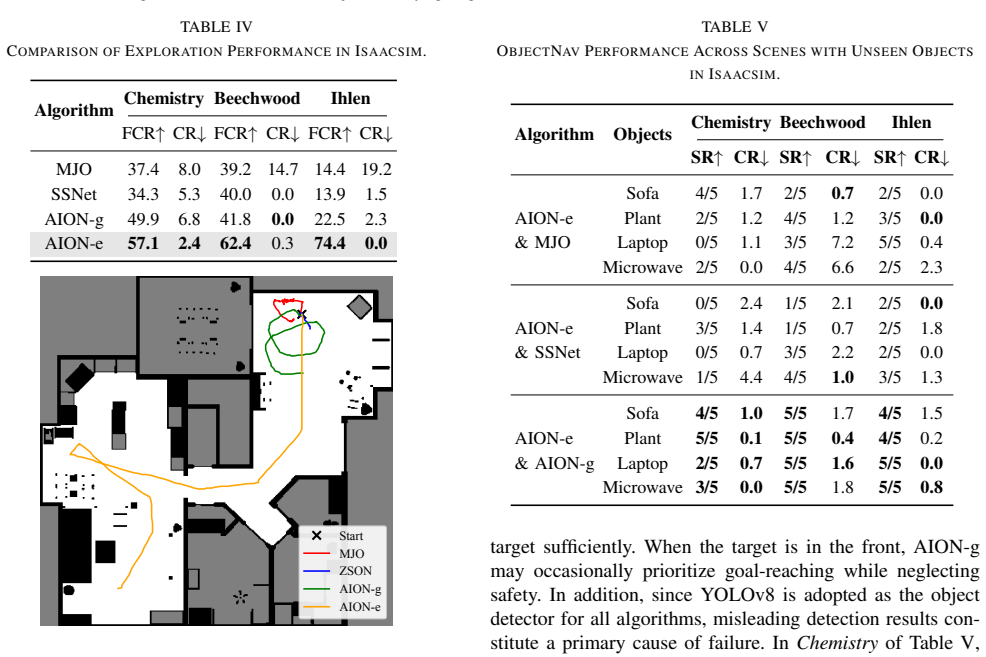
- [Table V and Sec. V-B] The IsaacSim dual-policy evaluation uses only 5 episodes per scene-object condition. Consequently each SR value is a multiple of 20% (0/5, 1/5, ..., 5/5), and differences such as 4/5 vs. 2/5 are not statistically meaningful. The conclusion that 'dual-policy AION consistently attains the highest SR across all scenes' is not supported by samples of this size. Please report per-episode results, confidence intervals, or a larger number of episodes, and ideally metrics such as success weighted by path length and collision counts per episode.
minor comments (6)
- [Eq. (14)] The expression R_forward = min(max(..., -0.2), 0.2) has a redundant outer min; presumably a clip to [-0.2, 0.2] was intended. Please clarify.
- [Eq. (16)] When ρ_min ≤ ρ_thr, the formula 1 - e^{2(ρ_thr - ρ_min)} is negative (e.g., near -0.9 at ρ_min = 0), so it is a penalty, not a 'reward.' If this is intentional, rename it 'safety penalty' or explain the sign.
- [Eq. (13) and surrounding text] The sentence 'R_c = −0.1 are the step and collision penalty, respectively' is ambiguous. The notation suggests γ is the step penalty and R_c is the collision penalty; please rewrite.
- [Fig. 6] The legend includes 'ZSON,' but this baseline acronym is not defined in the text; presumably it refers to SSNet or another method. Please align the caption with the table entries.
- [Sec. IV-A] The text says 'Each room type is tested for 150 episodes.' Please clarify whether this number is per room type per split (seen/unseen), and whether Table II aggregates over room types or reports a per-room-type average.
- [General] The project URL is given, but no code or checkpoints are described. Given the ambiguity in f_bbox, providing the evaluation code or at least a precise description of the perception pipeline would be essential for reproducibility.
Circularity Check
iTHOR flagship SR reduces to homing to the supplied f_bbox if simulator boxes are used; the paper never disambiguates, so the central vision-based claim is partially circular.
specific steps
-
self definitional
[Sec. III-A (success criteria); Sec. III-D Eq. (11); Table III]
"The task is considered successful when 1) the bounding box center lies in the central 80% of the image; 2) the distance to the goal is less than 1.5m; 3) the agent chooses Done. ... The bounding box of the target object is obtained either from the AI2THOR simulator or existing object detection algorithms. ... the feature f_bbox contains specific geometric cues of detected objects, defined as fbbox = [cx, cy, w, h, Sbbox/Sall, H] (11)"
If the iTHOR branch uses the AI2THOR simulator, Eq. (11) feeds the agent the target bbox center/size, while success is defined by the same bbox center in central 80% and distance <1.5m; Eqs. (9),(12) reward homing to that supplied box. Table III shows removing f_bbox drops seen SR from 88.7% to 14.0%, so almost all Table II performance flows through this channel. The paper never states which f_bbox source is used at evaluation, so the flagship 'end-to-end vision-based zero-shot ObjectNav' result is, in the explicitly allowed simulator branch, success-at-homing-to-the-input rather than vision-based object discovery.
full rationale
No self-citation load-bearing, uniqueness-import, or ansatz-smuggling patterns appear; the paper's claims are empirical RL benchmark results, not a theoretical derivation. The only substantive circularity-adjacent issue is the f_bbox source ambiguity. Eq. (11)'s feature is the same quantity as the success criterion (bbox center and proximity), and the ablation attributes almost all iTHOR success to this feature; if the simulator was the source, the flagship result is self-definitional by construction. If a real detector was used, the result is instead bounded by detector quality, which the paper itself notes (Sec. V-C: 'misleading detection results constitute a primary cause of failure'). Because the paper explicitly permits both sources and provides no code/checkpoints to disambiguate, the central vision-based claim is partially circular. The IsaacSim experiments with YOLOv8 provide independent content but are limited to 5 episodes per condition, weakening but not circularizing the evidence. Overall score 5: partial circularity confined to the iTHOR evaluation pipeline.
Axiom & Free-Parameter Ledger
free parameters (5)
- Goal-reaching reward weights =
R_suc=+5; R_c=-0.1; gamma=-0.02; R_bbox capped at 0.1
- Exploration reward weights and thresholds =
gamma=-0.01; R_dir=-0.75*d with d_thr=0.3; 2x weighting on d_y; rho_thr=1/3; R_forward clamped to ±0.2
- Success criteria thresholds =
bbox center in central 80% of image; distance < 1.5 m; Done action
- Depth-ROI percentile and sector count N =
unspecified (upper percentile; N not given)
- IsaacSim action mapping =
forward 0.8 m/s; vertical ±0.15 m/s; turn ±25 deg/s; each action held 0.5 s
axioms (6)
- standard math Known camera intrinsics K and constant body-to-camera transform T_c^b; horizontal slice filter at -d<=y_b<=d approximates the altitude plane
- domain assumption Altitude H (and attitude for the depth projection) is available without 'external localization'
- domain assumption CLIP patch-text cosine similarity provides usable zero-shot grounding for unseen classes
- domain assumption High depth values indicate navigable space worth exploring (FrontierNet-inspired heuristic)
- domain assumption AI2-THOR-trained policies transfer to IsaacSim/PX4 without adaptation
- domain assumption YOLOv8 detections are reliable enough for the ObjectNav loop
read the original abstract
Object-Goal Navigation (ObjectNav) requires an agent to autonomously explore an unknown environment and navigate toward target objects specified by a semantic label. While prior work has primarily studied zero-shot ObjectNav under 2D locomotion, extending it to aerial platforms with 3D locomotion capability remains underexplored. Aerial robots offer superior maneuverability and search efficiency, but also introduce new challenges in spatial perception, dynamic control, and safety assurance. In this paper, we propose AION for vision-based aerial ObjectNav without relying on external localization or global maps. AION is an end-to-end dual-policy reinforcement learning (RL) framework that decouples exploration and goal-reaching behaviors into two specialized policies. We evaluate AION on the AI2-THOR benchmark and further assess its real-time performance in IsaacSim using high-fidelity drone models. Experimental results show that AION achieves superior performance across comprehensive evaluation metrics in exploration, navigation efficiency, and safety. The project is available at https://github.com/Zichen-Yan/AION.
Figures


Forward citations
Cited by 1 Pith paper
-
Vision-Language Navigation for Aerial Robots: Towards the Era of Large Language Models
This survey organizes aerial vision-language navigation methods into five architectural categories, critically reviews evaluation infrastructure, and synthesizes seven open problems for LLM/VLM integration.
Reference graph
Works this paper leans on
-
[1]
Navigating to objects in the real world,
T. Gervet, S. Chintala, D. Batra, J. Malik, and D. S. Chaplot, “Navigating to objects in the real world,”Science Robotics, vol. 8, no. 79, p. eadf6991, 2023
2023
-
[2]
M. Zhang, Y . Du, C. Wu, J. Zhou, Z. Qi, J. Ma, and B. Zhou, “Apex- nav: An adaptive exploration strategy for zero-shot object navigation with target-centric semantic fusion,”arXiv preprint arXiv:2504.14478, 2025
Pith/arXiv arXiv 2025
-
[3]
Esc: Exploration with soft commonsense constraints for zero-shot object navigation,
K. Zhou, K. Zheng, C. Pryor, Y . Shen, H. Jin, L. Getoor, and X. E. Wang, “Esc: Exploration with soft commonsense constraints for zero-shot object navigation,” inInternational Conference on Machine Learning, 2023, pp. 42 829–42 842
2023
-
[4]
L3mvn: Leveraging large language models for visual target navigation,
B. Yu, H. Kasaei, and M. Cao, “L3mvn: Leveraging large language models for visual target navigation,” in2023 IEEE/RSJ International Conference on Intelligent Robots and Systems (IROS), 2023, pp. 3554– 3560
2023
-
[5]
Learning hierarchical relationships for object-goal navigation,
A. Pal, Y . Qiu, and H. Christensen, “Learning hierarchical relationships for object-goal navigation,” inConference on Robot Learning, 2021, pp. 517–528
2021
-
[6]
Visual semantic navigation using scene priors,
W. Yang, X. Wang, A. Farhadi, A. Gupta, and R. Mottaghi, “Visual semantic navigation using scene priors,”arXiv preprint arXiv:1810.06543, 2018
Pith/arXiv arXiv 2018
-
[7]
Zero-shot object goal visual navigation,
Q. Zhao, L. Zhang, B. He, H. Qiao, and Z. Liu, “Zero-shot object goal visual navigation,” in2023 IEEE International Conference on Robotics and Automation (ICRA), 2023, pp. 2025–2031
2023
-
[8]
Learning to learn how to learn: Self-adaptive visual navigation using meta-learning,
M. Wortsman, K. Ehsani, M. Rastegari, A. Farhadi, and R. Mottaghi, “Learning to learn how to learn: Self-adaptive visual navigation using meta-learning,” inProceedings of the IEEE/CVF conference on computer vision and pattern recognition, 2019, pp. 6750–6759
2019
-
[9]
Tdanet: Target-directed attention network for object-goal visual navigation with zero-shot ability,
S. Lian and F. Zhang, “Tdanet: Target-directed attention network for object-goal visual navigation with zero-shot ability,”IEEE Robotics and Automation Letters, 2024
2024
-
[10]
Habitat 3.0: A co-habitat for humans, avatars, and robots,
X. Puig, E. Undersander, A. Szot, M. D. Cote, T. Yang, R. Partsey, R. Desai, A. Clegg, M. Hlavac, S. Y . Min, V . V ondrus, T. Gervet, V . Berges, J. M. Turner, O. Maksymets, Z. Kira, M. Kalakrishnan, J. Malik, D. S. Chaplot, U. Jain, D. Batra, A. Rai, and R. Mottaghi, “Habitat 3.0: A co-habitat for humans, avatars, and robots,” inThe Twelfth Internationa...
2024
-
[11]
Ai2-thor: An inter- active 3d environment for visual ai,
E. Kolve, R. Mottaghi, W. Han, E. VanderBilt, L. Weihs, A. Herrasti, M. Deitke, K. Ehsani, D. Gordon, Y . Zhu,et al., “Ai2-thor: An inter- active 3d environment for visual ai,”arXiv preprint arXiv:1712.05474, 2017
Pith/arXiv arXiv 2017
-
[12]
Stubborn: A strong baseline for indoor object navigation,
H. Luo, A. Yue, Z.-W. Hong, and P. Agrawal, “Stubborn: A strong baseline for indoor object navigation,” in2022 IEEE/RSJ International Conference on Intelligent Robots and Systems (IROS), 2022, pp. 3287– 3293
2022
-
[13]
Vlfm: Vision- language frontier maps for zero-shot semantic navigation,
N. Yokoyama, S. Ha, D. Batra, J. Wang, and B. Bucher, “Vlfm: Vision- language frontier maps for zero-shot semantic navigation,” in2024 IEEE International Conference on Robotics and Automation (ICRA), 2024, pp. 42–48
2024
-
[14]
Object goal navigation using goal-oriented semantic exploration,
D. S. Chaplot, D. P. Gandhi, A. Gupta, and R. R. Salakhutdinov, “Object goal navigation using goal-oriented semantic exploration,” Advances in Neural Information Processing Systems, vol. 33, pp. 4247–4258, 2020
2020
-
[15]
Bridging zero-shot object navigation and foundation models through pixel-guided navigation skill,
W. Cai, S. Huang, G. Cheng, Y . Long, P. Gao, C. Sun, and H. Dong, “Bridging zero-shot object navigation and foundation models through pixel-guided navigation skill,” in2024 IEEE International Conference on Robotics and Automation (ICRA), 2024, pp. 5228–5234
2024
-
[16]
Logoplanner: Localization grounded navigation policy with metric-aware visual geometry,
J. Peng, W. Cai, Y . Yang, T. Wang, Y . Shen, and J. Pang, “Logoplanner: Localization grounded navigation policy with metric-aware visual geometry,”arXiv preprint arXiv:2512.19629, 2025
arXiv 2025
-
[17]
Prioritized semantic learning for zero-shot instance navigation,
X. Sun, L. Liu, H. Zhi, R. Qiu, and J. Liang, “Prioritized semantic learning for zero-shot instance navigation,” inEuropean Conference on Computer Vision, 2024, pp. 161–178
2024
-
[18]
Object-goal visual navigation via effective exploration of relations among historical navigation states,
H. Du, L. Li, Z. Huang, and X. Yu, “Object-goal visual navigation via effective exploration of relations among historical navigation states,” inProceedings of the IEEE/CVF Conference on Computer Vision and Pattern Recognition, 2023, pp. 2563–2573
2023
-
[19]
Learning transferable visual models from natural language supervision,
A. Radford, J. W. Kim, C. Hallacy, A. Ramesh, G. Goh, S. Agarwal, G. Sastry, A. Askell, P. Mishkin, J. Clark,et al., “Learning transferable visual models from natural language supervision,” inInternational conference on machine learning, 2021, pp. 8748–8763
2021
-
[20]
Blip-2: Bootstrapping language- image pre-training with frozen image encoders and large language models,
J. Li, D. Li, S. Savarese, and S. Hoi, “Blip-2: Bootstrapping language- image pre-training with frozen image encoders and large language models,” inInternational conference on machine learning. PMLR, 2023, pp. 19 730–19 742
2023
-
[21]
Search for or navigate to? dual adaptive thinking for object navigation,
R. Dang, L. Wang, Z. He, S. Su, J. Tang, C. Liu, and Q. Chen, “Search for or navigate to? dual adaptive thinking for object navigation,” in Proceedings of the IEEE/CVF International Conference on Computer Vision, 2023, pp. 8250–8259
2023
-
[22]
Citynav: A large-scale dataset for real-world aerial navigation,
J. Lee, T. Miyanishi, S. Kurita, K. Sakamoto, D. Azuma, Y . Matsuo, and N. Inoue, “Citynav: A large-scale dataset for real-world aerial navigation,” inProceedings of the IEEE/CVF International Conference on Computer Vision, 2025, pp. 5912–5922
2025
-
[23]
Uav-on: A benchmark for open-world object goal naviga- tion with aerial agents,
J. Xiao, Y . Sun, Y . Shao, B. Gan, R. Liu, Y . Wu, W. Guan, and X. Deng, “Uav-on: A benchmark for open-world object goal naviga- tion with aerial agents,” inProceedings of the 33rd ACM International Conference on Multimedia, 2025, pp. 13 023–13 029
2025
-
[24]
Aeri- alvln: Vision-and-language navigation for uavs,
S. Liu, H. Zhang, Y . Qi, P. Wang, Y . Zhang, and Q. Wu, “Aeri- alvln: Vision-and-language navigation for uavs,” inProceedings of the IEEE/CVF International Conference on Computer Vision, 2023, pp. 15 384–15 394
2023
-
[25]
Uav-flow colosseo: A real-world benchmark for flying-on-a-word uav imitation learning,
X. Wang, D. Yang, Y . Liao, W. Zheng, B. Dai, H. Li, S. Liu,et al., “Uav-flow colosseo: A real-world benchmark for flying-on-a-word uav imitation learning,”arXiv preprint arXiv:2505.15725, 2025
Pith/arXiv arXiv 2025
-
[26]
Indooruav: Bench- marking vision-language uav navigation in continuous indoor environ- ments,
X. Liu, Y . Liu, H. Qiu, Y . Qirong, and Z. Lian, “Indooruav: Bench- marking vision-language uav navigation in continuous indoor environ- ments,”arXiv preprint arXiv:2512.19024, 2025
arXiv 2025
-
[27]
Visual language maps for robot navigation,
C. Huang, O. Mees, A. Zeng, and W. Burgard, “Visual language maps for robot navigation,” inIEEE International Conference on Robotics and Automation, ICRA 2023, London, UK, May 29 - June 2, 2023. IEEE, 2023, pp. 10 608–10 615
2023
-
[28]
Dinov2: Learning robust visual features without supervision,
M. Oquab, T. Darcet, T. Moutakanni, H. V o, M. Szafraniec, V . Khali- dov, P. Fernandez, D. Haziza, F. Massa, A. El-Nouby,et al., “Dinov2: Learning robust visual features without supervision,”arXiv preprint arXiv:2304.07193, 2023
Pith/arXiv arXiv 2023
-
[29]
You only look once: Unified, real-time object detection,
J. Redmon, S. Divvala, R. Girshick, and A. Farhadi, “You only look once: Unified, real-time object detection,” inProceedings of the IEEE conference on computer vision and pattern recognition, 2016, pp. 779– 788
2016
-
[30]
Frontiernet: Learning visual cues to explore,
B. Sun, H. Chen, S. Leutenegger, C. Cadena, M. Pollefeys, and H. Blum, “Frontiernet: Learning visual cues to explore,”IEEE Robotics and Automation Letters, 2025
2025
-
[31]
Asynchronous methods for deep rein- forcement learning,
V . Mnih, A. P. Badia, M. Mirza, A. Graves, T. Lillicrap, T. Harley, D. Silver, and K. Kavukcuoglu, “Asynchronous methods for deep rein- forcement learning,” inInternational conference on machine learning, 2016, pp. 1928–1937
2016
-
[32]
ProcTHOR: Large-Scale Embodied AI Using Procedural Generation,
M. Deitke, E. VanderBilt, A. Herrasti, L. Weihs, J. Salvador, K. Ehsani, W. Han, E. Kolve, A. Farhadi, A. Kembhavi, and R. Mottaghi, “ProcTHOR: Large-Scale Embodied AI Using Procedural Generation,” inNeurIPS, 2022, outstanding Paper Award
2022
-
[33]
Glove: Global vectors for word representation,
J. Pennington, R. Socher, and C. D. Manning, “Glove: Global vectors for word representation,” inProceedings of the 2014 conference on empirical methods in natural language processing (EMNLP), 2014, pp. 1532–1543
2014
-
[34]
Isaac Sim
NVIDIA, “Isaac Sim.” [Online]. Available: https://github.com/ isaac-sim/IsaacSim
-
[35]
Pegasus simulator: An isaac sim framework for multiple aerial vehicles simulation,
M. Jacinto, J. Pinto, J. Patrikar, J. Keller, R. Cunha, S. Scherer, and A. Pascoal, “Pegasus simulator: An isaac sim framework for multiple aerial vehicles simulation,” in2024 International Conference on Unmanned Aircraft Systems (ICUAS), 2024, pp. 917–922
2024
-
[36]
Behavior-1k: A benchmark for embodied ai with 1,000 everyday activities and realistic simulation,
C. Li, R. Zhang, J. Wong, C. Gokmen, S. Srivastava, R. Mart ´ın-Mart´ın, C. Wang, G. Levine, M. Lingelbach, J. Sun,et al., “Behavior-1k: A benchmark for embodied ai with 1,000 everyday activities and realistic simulation,” inConference on Robot Learning, 2023, pp. 80–93
2023
discussion (0)
Sign in with ORCID, Apple, or X to comment. Anyone can read and Pith papers without signing in.