REVIEW 5 major objections 5 minor 1 cited by
Replacing the bounded Uniform proposal with a Tailed-Uniform proposal—Uniform in the core with smooth Gaussian tails—eliminates the sharp discontinuities that cause neural posterior estimators to fail when posteriors intersect or extend bey
Reviewed by Pith at T0; open to challenge. T0 means a machine referee read the full paper against a public rubric. the ladder, T0–T4 →
T0 review · deepseek-v4-flash
2026-08-03 08:26 UTC pith:M4RHSYBZ
load-bearing objection Tailed-Uniform proposal is a sensible idea, but the loss equation and toy prior are wrong as written, so the empirical claims are currently unsupported. the 5 major comments →
Learning at the Edge: Tailed-Uniform Sampling for Robust Simulation-Based Inference
The pith
A machine-rendered reading of the paper's core claim, the machinery that carries it, and where it could break.
Core claim
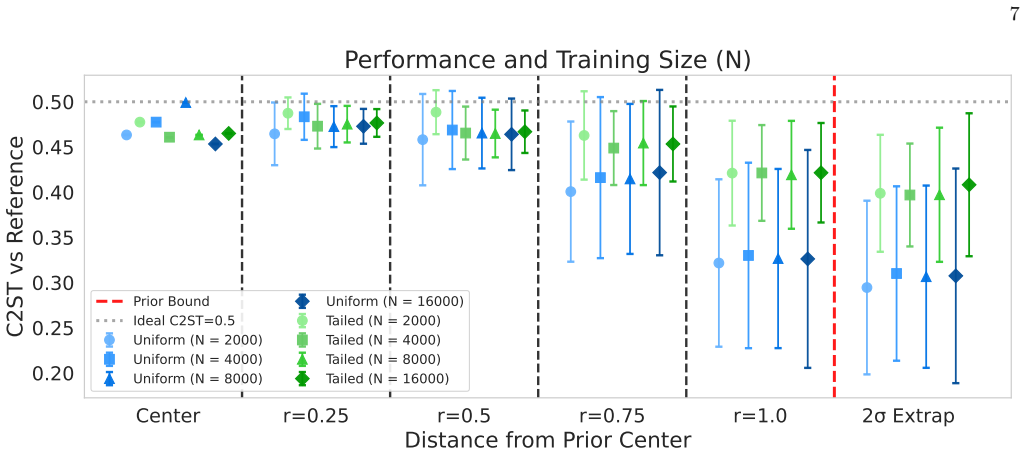
The paper's central claim is that the sharp boundary of the Uniform proposal is a structural, not statistical, obstacle for neural posterior estimation. Because the proposal density drops to zero discontinuously at the boundary, density estimators lack gradient information to learn the correct transition, so learned posteriors leak or smear near the edge. The Tailed-Uniform proposal replaces that step with Gaussian tails—matched in density at the cut points and continuously differentiable—giving the network smooth support. In experiments, Tailed-Uniform-trained models outperform Uniform-trained models near boundaries and in extrapolation, across training set sizes from 2,000 to 16,000 and di
What carries the argument
The central object is the Tailed-Uniform proposal distribution, a piecewise density that is Uniform on the hypercube [a,b] and Gaussian (with standard deviation σ) beyond each face, normalized so that the density is continuous at the faces. In d dimensions it is the product of independent univariate Tailed-Uniform marginals. The smooth tails provide nonzero training support and gradient signal outside the prior box, which is what lets neural conditional density estimators learn a posterior that is well calibrated at and beyond the boundary. The tunable parameter σ (recommended as 10–40% of the box width per dimension) controls the trade-off between boundary smoothing and dilution of samples
Load-bearing premise
The results depend on the neural posterior estimator's training loss actually correcting for the difference between the proposal distribution and the assumed prior; if that correction is missing or mis-specified, the learned posterior is the posterior under the proposal, and the reported comparison to the analytic/MCMC reference does not measure what the paper claims.
What would settle it
Train both models on the Gaussian linear task and evaluate the posterior at a test point deep in the interior (θ=(0,0)): if the Tailed-Uniform posterior has materially lower C2ST against the analytic Gaussian than the Uniform posterior does, then the tails are hurting interior accuracy, contradicting the claim that the method maintains consistent posterior quality across the whole space.
If this is right
- Simulation-based inference pipelines can adopt Tailed-Uniform as a drop-in replacement for the Uniform proposal, requiring only a tail-width hyperparameter, with robust behavior for α between 0.1 and 0.4.
- Public simulation campaigns that pre-generate training data inside a fixed box become more reusable because a Tailed-Uniform-trained emulator retains accuracy when the posterior of a later analysis approaches or crosses the original box boundary.
- Accurate posterior estimation near boundaries requires fewer simulations with Tailed-Uniform: a 2,000-sample Tailed-Uniform model outperforms a 16,000-sample Uniform model on the toy task, so the method can cut simulation costs.
- In higher-dimensional parameter spaces, where the boundary shell dominates volume, Tailed-Uniform's advantage is larger, not smaller, up to at least d=16.
- The mechanism is architecture-invariant in principle, so the same proposal should benefit neural likelihood and neural ratio estimators, not just neural posterior estimation.
Where Pith is reading between the lines
- Because the tails are Gaussian, Tailed-Uniform effectively places an implicit shrinkage prior on the parameter; this suggests that the improvement may come partly from regularization rather than purely from boundary smoothness, which could be tested by comparing against other smooth proposals such as truncated-Laplace tails or a Beta proposal.
- The optimal tail width likely depends on dimension and on how far the posterior extends beyond the boundary; a dimension-dependent tuning rule (e.g., scaling σ with the boundary-shell probability) could extend the method's usefulness beyond d=16, where the paper itself notes that interior dilution may dominate.
- The paper's concentration on C2ST at fixed test points could be complemented by a coverage test (e.g., how often the 68% credible region contains the true parameter) to see whether the improved distributional closeness translates into better calibration for downstream scientific claims.
- The method's benefit for emulators trained on fixed simulation grids suggests that inverse problems for expensive simulators could pre-sample a small fraction of tails in a one-time simulation design, a simple extension that does not require changing the simulator code.
Editorial analysis
A structured set of objections, weighed in public.
Referee Report
Summary. The manuscript proposes a new training proposal for simulation-based inference, the Tailed-Uniform distribution: a Uniform core augmented with smooth Gaussian tails beyond the prior box. The motivation is that the sharp boundary of a bounded Uniform proposal is hard for normalizing-flow posterior estimators to learn, especially when posteriors extend to or beyond the boundary. The method is applied to a 2D Gaussian linear toy task and to cosmological parameter inference from the matter power spectrum, with sensitivity studies over tail width, training set size, and dimensionality. The paper claims that Tailed-Uniform-trained NPE models outperform Uniform-trained ones near boundaries and that the advantage grows with dimension. Public code is provided.
Significance. If the empirical claims hold, this is a simple, low-cost, drop-in modification to NPE training for bounded parameter spaces, relevant to large simulation campaigns and to high-dimensional astrophysical inference. The paper has several commendable features: the proposal density is explicitly normalized; tail width, training budget, and dimensionality are scanned; a realistic cosmology benchmark is included; and the code is publicly available. However, the manuscript as written has load-bearing problems: the proposal-correction loss in Eq. (3) is not correct as printed; the toy example's assumed prior and analytic reference are inconsistent; a crucial expanded-Uniform control is missing; and quantitative reports contain conflicts. These issues must be resolved before the central claim is supported.
major comments (5)
- [§2.1, Eq. (3)] The printed NPE loss places the ratio P(θ)/P̃(θ) inside the logarithm. Since the expectation is over θ sampled from P̃, log[P(θ)/P̃(θ)] is an additive constant independent of the network weights, so its gradient is zero. Minimizing this loss drives q_w(θ|x) to P̃(θ|x), not to the target posterior P(θ|x). The correct proposal-corrected loss has the ratio outside the log: -E[(P(θ)/P̃(θ)) log q_w(θ|x)]. If the implementation follows Eq. (3), all C2ST comparisons in §§3–4 measure distance to the wrong posterior; if the implementation is correct, the equation must be fixed. This is central to the paper's validity.
- [§3.1] The toy problem is internally inconsistent. The model definition states a standard Gaussian prior N(0,I_2), and the analytic reference posterior is N(x/2, I_2/2), which is the conjugate posterior for that prior. But the training section then says the assumed prior for both proposals is N(0, 0.2^2). With that prior, the conjugate posterior is approximately N(x/26, 0.038 I_2), not N(x/2, I_2/2). The C2ST comparisons are therefore made against a reference posterior that the training objective does not target. The toy experiment must be rerun with a consistent prior and reference, or the analytic posterior must be recomputed.
- [§3.3.3] The text claims that 'Tailed-Uniform outperforms expanding the boundaries of a Uniform proposal at a reasonable number of dimensions,' but no expanded-Uniform baseline appears in any figure or table. Without that control, the observed improvements could be due simply to additional support outside the prior box rather than to the smoothness of the Gaussian tails. An expanded Uniform proposal, ideally matched in tail mass or effective support, is necessary to separate the two mechanisms. The same concern applies to the cosmological experiment in §4.
- [§4.2.1, Table 2] The single-point cosmology results are reported inconsistently. The text states Uniform C2ST = 0.395, Tailed-Uniform C2ST = 0.452, and a 14% improvement, while Table 2 lists Uniform C2ST = 0.259, Tailed-Uniform C2ST = 0.405, and a +56% improvement. These are materially different numbers and cannot both describe the same run. The authors must reconcile the text and table and state which result is the one used to support the claim.
- [§3.2, Figs. 3–4, Tables 1–2] The paper interprets C2ST values below 0.5 as 'poor' and values closer to 0.5 as 'good.' In a balanced two-sample classification test, accuracy below 0.5 means the classifier is worse than random; the standard C2ST metric is bounded below by 0.5 (or symmetrized as |accuracy − 0.5|). Scores such as 0.329 are not on the same interpretable scale as 0.417 in the way the paper assumes. The quantitative ordering of methods may be affected by classifier variance or label misalignment. Please report a properly bounded C2ST accuracy/error and use it consistently.
minor comments (5)
- [§2.1, Eq. (2)] The loss is described as maximizing the joint likelihood, but Eq. (2) is an expectation of a conditional log-density. Please clarify the relationship to the joint likelihood or rephrase.
- [§3.3.3 vs. §5] The tail-allocation numbers conflict: §3.3.3 says the tail fraction rises from 36% at d=2 to 97% at d=16, while §5 says from 24% at d=2 to 86% at d=16. These values need to be reconciled.
- [§4.1] The cosmological experiment does not state the number of training simulations N or the assumed prior used during NPE training. These are needed for reproducibility and for interpreting the comparison.
- [Tables 1–2] The 'C2ST Improvement' percentages are computed as raw score ratios. Since the meaningful quantity is distance from 0.5, the improvement should be reported on that scale (e.g., reduction in |C2ST − 0.5|).
- [Figures 3, 9–11] Figure labels contain typos such as 'T ailedUniform' and '2 Extrap'; the latter x-axis label is unclear. Please clean up labels and ensure color-bar scales are identical across panels that are compared.
Circularity Check
No significant circularity: the Tailed-Uniform proposal is independently normalized and its improvement is empirical; the only self-citation is a non-load-bearing pipeline reference, though Eq. (3) raises a correctness concern that is not itself a circular step.
full rationale
The Tailed-Uniform construction is not circular: Eqs. (4)-(6) define the density purely by normalization and continuity conditions, with no dependence on the benchmark posteriors being predicted. The tail width is scanned in Sec. 3.3.1 rather than fit to the test targets, and the C2ST validations use analytic/MCMC reference posteriors that are external to the training pipeline. The only author self-citation is Ho et al. (2024) for the LtU-ILI implementation framework; it is a pipeline tool, not a load-bearing theoretical premise, so it does not raise the circularity score. One caveat, flagged as a correctness issue rather than a circularity step: in Eq. (3) the ratio P(θ)/P̃(θ) is written inside the logarithm, so it is independent of the network weights and cancels from the gradient; as printed, the loss drives q_w toward the proposal-conditional posterior P̃(θ|x), not the assumed-prior posterior P(θ|x). This would make the §3-§4 C2ST references measure a different target, but it applies symmetrically to both Uniform and Tailed-Uniform and does not turn the method's empirical comparison into a restatement of its inputs. Overall: no circular derivation; score 1 solely for the minor non-load-bearing self-citation and the internal-consistency caveat.
Axiom & Free-Parameter Ledger
free parameters (2)
- Tail width fraction α =
α ∈ {0.01, 0.05, 0.1, 0.2, 0.4} in the toy; recommended 0.1–0.4
- Assumed prior standard deviation in the toy =
text says 0.2, analytic reference implies 1.0
axioms (5)
- domain assumption Neural posterior estimation minimizes a loss whose optimum is the posterior under the assumed prior when the proposal differs from the prior.
- domain assumption Sharp truncation of the proposal density is the root cause of boundary errors in NPE.
- standard math The Gaussian linear toy's analytic posterior is N(x/2, I/2).
- domain assumption The matter power spectrum observable is well modeled by syren-new theory plus Gaussian cosmic-variance noise.
- domain assumption The MCMC chains used as ground truth have converged.
read the original abstract
We introduce the Tailed-Uniform proposal distribution for generating training simulations in simulation-based inference. Instead of sampling parameters uniformly within bounded regions, we extend the distribution beyond prior boundaries with smooth Gaussian tails. This eliminates sharp transitions that cause neural posterior estimators to fail when the posterior distribution intersects or extends beyond the prior bounds. We show these benefits on a toy problem and cosmological parameter inference from the matter power spectrum. Such an advantage grows in high dimensions, where boundaries dominate parameter space volume. All code is publicly available on Github at https://github.com/chaipattira/tailed-uniform-sbi.
Figures




Forward citations
Cited by 1 Pith paper
-
Dark Energy Survey Year 3 results: optimized $w$CDM simulation-based inference with weak lensing map-level hybrid statistics
DES Y3 weak lensing analysis with hybrid map-level statistics and simulation-based inference yields S8 = 0.808 ± 0.017, Ωm = 0.325 ± 0.024, and w < -0.766, improving the figure of merit by 60% over prior state-of-the-art.
Reference graph
Works this paper leans on
-
[1]
Planck 2018 results-vi
Nabila Aghanim, Yashar Akrami, Mark Ashdown, Jonathan Aumont, Carlo Baccigalupi, Mario Ballardini, Anthony J Banday, RB Barreiro, Nicola Bartolo, S Basak, et al. Planck 2018 results-vi. cosmological parameters.Astronomy & Astrophysics, 641:A6,
2018
-
[10]
George Papamakarios, Theo Pavlakou, and Iain Murray
URLhttps://arxiv.org/abs/1605.06376. George Papamakarios, Theo Pavlakou, and Iain Murray. Masked autoregressive flow for density estimation,
-
[11]
URL https://arxiv.org/abs/1705.07057. JA Peacock and SJ Dodds. Non-linear evolution of cosmological power spectra.Monthly Notices of the Royal Astronomical Society, 280(3):L19–L26,
-
[1970]
Matthew Ho, Deaglan J Bartlett, Nicolas Chartier, Carolina Cuesta-Lazaro, Simon Ding, Axel Lapel, Pablo Lemos, Christopher C Lovell, T Lucas Makinen, Chirag Modi, et al. Ltu-ili: An all-in-one framework for implicit inference in astrophysics and cosmology.arXiv preprint arXiv:2402.05137,
-
[2013]
ISSN 1538-3873. doi:10.1086/670067. URL http://dx.doi.org/10.1086/670067. Andrew Gelman and Donald B Rubin. Inference from iterative simulation using multiple sequences.Statistical science, 7(4): 457–472,
-
[2015]
URLhttps://arxiv.org/abs/1502.03509. David S. Greenberg, Marcel Nonnenmacher, and Jakob H. Macke. Automatic posterior transformation for likelihood-free inference,
-
[2017]
Jan-Matthis Lueckmann, Jan Boelts, David S
URLhttps://arxiv.org/abs/1711.01861. Jan-Matthis Lueckmann, Jan Boelts, David S. Greenberg, Pedro J. Gon¸ calves, and Jakob H. Macke. Benchmarking simulation-based inference,
-
[2018]
Jan-Matthis Lueckmann, Pedro J
URL https://arxiv.org/abs/1610.06545. Jan-Matthis Lueckmann, Pedro J. Goncalves, Giacomo Bassetto, Kaan ¨Ocal, Marcel Nonnenmacher, and Jakob H. Macke. Flexible statistical inference for mechanistic models of neural dynamics,
-
[2019]
URLhttps://arxiv.org/abs/1905.07488. W Keith Hastings. Monte carlo sampling methods using markov chains and their applications
Pith/arXiv arXiv 1905
-
[2020]
ISSN 1091-6490. doi:10.1073/pnas.1912789117. URL http://dx.doi.org/10.1073/pnas.1912789117. Scott Dodelson and Fabian Schmidt.Modern cosmology. Academic press,
-
[2021]
Michael D McKay, Richard J Beckman, and William J Conover
URL https://arxiv.org/abs/2101.04653. Michael D McKay, Richard J Beckman, and William J Conover. A comparison of three methods for selecting values of input variables in the analysis of output from a computer code. Technometrics, 42(1):55–61,
-
[2025]
doi:10.1051/0004-6361/202452854
ISSN 1432-0746. doi:10.1051/0004-6361/202452854. URL http://dx.doi.org/10.1051/0004-6361/202452854. Francisco Villaescusa-Navarro, Shy Genel, Daniel Angl´ es-Alc´ azar, Lucia A Perez, Pablo Villanueva-Domingo, Digvijay Wadekar, Helen Shao, Faizan G Mohammad, Sultan Hassan, Emily Moser, et al. The camels project: public data release.The Astrophysical Journ...
discussion (0)
Sign in with ORCID, Apple, or X to comment. Anyone can read and Pith papers without signing in.