Holographic timelike entanglement and subregion complexity with scalar hair
Pith reviewed 2026-05-16 10:58 UTC · model grok-4.3
The pith
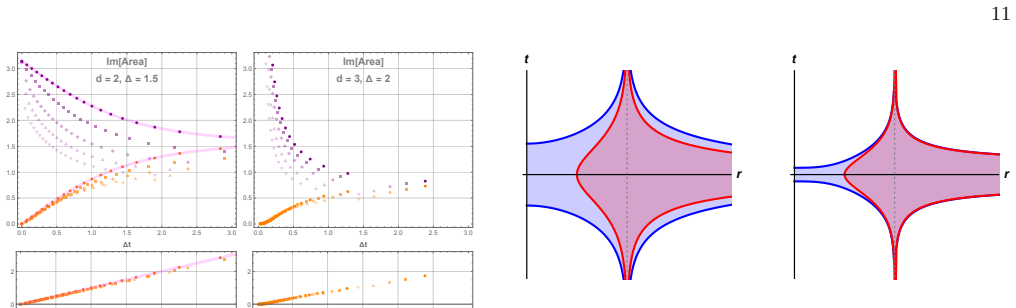
Scalar hair in AdS black holes breaks the time-interval invariance of the imaginary part of holographic timelike entanglement entropy.
A machine-rendered reading of the paper's core claim, the machinery that carries it, and where it could break.
Core claim
A relevant scalar deformation of the boundary CFT produces a hairy AdS black hole whose extremal surfaces for timelike subsystems yield an imaginary HTEE that varies nontrivially with Δt. This breaks the invariance present in undeformed geometries. Analytic continuation of CFT temporal entropy fails to match the holographic values. Within the complexity=volume prescription the timelike subregion complexity stays real, and its UV-finite piece for the BTZ black hole is contributed solely by the interior region.
What carries the argument
The prescription that merges spacelike and timelike surfaces at the interior to form an extremal surface homologous to a boundary timelike interval of duration Δt.
If this is right
- The imaginary component of HTEE acquires a nontrivial dependence on Δt once scalar hair is introduced.
- Analytic continuation from CFT temporal entanglement entropy no longer reproduces the holographic HTEE under boundary deformation.
- Timelike subregion complexity remains real-valued for the deformed geometries.
- In the BTZ case the entire UV-finite contribution to subregion complexity comes from the interior region.
Where Pith is reading between the lines
- The same interior-only finite term may appear for other black-hole solutions with scalar hair in higher dimensions.
- Similar Δt dependence could appear in other holographic quantities that probe the interior when relevant deformations are added.
- Direct comparison between HTEE and complexity results in d=3 could reveal how the interior contribution scales with dimension.
Load-bearing premise
Merging spacelike and timelike surfaces at the interior still produces a valid extremal surface when scalar hair is present.
What would settle it
A numerical evaluation of the extremal surface for a fixed nonzero scalar-hair parameter and small nonzero Δt that yields a Δt-independent imaginary HTEE would falsify the central claim.
Figures




read the original abstract
We investigate the holographic timelike entanglement entropy (HTEE) and timelike subregion complexity of a thermal CFT$_d$ deformed by a relevant scalar operator $\phi_0$, dual to a hairy black hole in AdS$_{d+1}$. We employ the prescription of merging spacelike and timelike surfaces at the interior, constructing an extremal surface homologous to a boundary timelike subsystem with a time interval $\Delta t$. Consequently, this deformation breaks the invariance of the imaginary component of HTEE observed in pure AdS$_3$ and BTZ geometry, introducing a nontrivial dependence on $\Delta t$. At small $\Delta t$, we derive analytical expressions that are in agreement with numerical results, and observe partial consistency with analytic continuation to temporal or spacelike entanglement entropy at the level of the near-boundary expansion. However, analytic continuation of CFT temporal entanglement entropy fails to reproduce the HTEE calculations under boundary deformation, even in $d=2$. Furthermore, we extend the numerical calculations to higher dimensions ($d=3$). In addition, we study holographic timelike subregion complexity within the complexity=volume conjecture and find that it remains real-valued, providing a complementary geometric probe of the black hole interior. In particular, for the BTZ black hole, we analytically show that the UV-finite term of the subregion complexity receives its entire contribution from the interior region alone.
Editorial analysis
A structured set of objections, weighed in public.
Referee Report
Summary. The manuscript investigates holographic timelike entanglement entropy (HTEE) and timelike subregion complexity for a thermal CFT_d deformed by a relevant scalar operator, dual to a hairy black hole in AdS_{d+1}. Employing a prescription that merges spacelike and timelike extremal surfaces at an interior point to construct a surface homologous to a boundary timelike interval of duration Δt, the authors find that the scalar deformation breaks the Δt-invariance of the imaginary part of HTEE observed in pure AdS3 and BTZ geometries, leading to a nontrivial Δt dependence. Analytical expressions at small Δt agree with numerical results, though analytic continuation of CFT temporal entanglement entropy does not reproduce the HTEE results even in d=2. The study extends to d=3 and examines holographic timelike subregion complexity via the complexity=volume conjecture, showing it remains real-valued, with the UV-finite term for the BTZ case receiving its entire contribution from the interior region.
Significance. If the central construction is valid, this work provides a concrete example of how relevant deformations affect timelike entanglement measures and offers a geometric probe of the black hole interior through subregion complexity. The analytic demonstration for BTZ that the UV-finite complexity comes solely from the interior is a notable result, as is the agreement between small-Δt analytics and numerics. These findings could inform studies of entanglement in non-conformal theories and the role of interior geometry in holographic complexity.
major comments (2)
- [Construction of extremal surfaces (method section)] The headline results on the nontrivial Δt dependence of Im(HTEE) and the interior-only contribution to UV-finite complexity rely on the merged spacelike-timelike surface remaining extremal in the presence of scalar hair. The manuscript states that it employs the merging prescription but does not provide an explicit verification that the first variation of the area functional (including the scalar field contribution) vanishes at the junction point on the deformed metric. This check is necessary to confirm the surface is indeed extremal after backreaction.
- [BTZ subregion complexity calculation] For the BTZ analytic result, the claim that the UV-finite term of the subregion complexity receives its entire contribution from the interior region alone should be supported by showing the explicit cancellation or vanishing of any boundary contributions in the regularized volume integral.
minor comments (2)
- [Abstract] The abstract states 'partial consistency with analytic continuation... at the level of the near-boundary expansion' without specifying which expansion terms agree or disagree; adding this detail would improve clarity.
- [Numerical results section] In the numerical results for d=3, including quantitative error bars or convergence tests for the agreement between small-Δt analytics and numerics would strengthen the presentation.
Simulated Author's Rebuttal
We thank the referee for their careful reading and constructive comments on our manuscript. We address each major comment below and will incorporate the requested clarifications and explicit calculations in the revised version.
read point-by-point responses
-
Referee: [Construction of extremal surfaces (method section)] The headline results on the nontrivial Δt dependence of Im(HTEE) and the interior-only contribution to UV-finite complexity rely on the merged spacelike-timelike surface remaining extremal in the presence of scalar hair. The manuscript states that it employs the merging prescription but does not provide an explicit verification that the first variation of the area functional (including the scalar field contribution) vanishes at the junction point on the deformed metric. This check is necessary to confirm the surface is indeed extremal after backreaction.
Authors: We agree that an explicit verification strengthens the construction. In the revised manuscript we will add a dedicated paragraph in the methods section computing the first variation of the area functional (including the scalar-field contribution) and showing that it vanishes at the junction point for the backreacted hairy metric. This confirms that the merged surface remains extremal. revision: yes
-
Referee: [BTZ subregion complexity calculation] For the BTZ analytic result, the claim that the UV-finite term of the subregion complexity receives its entire contribution from the interior region alone should be supported by showing the explicit cancellation or vanishing of any boundary contributions in the regularized volume integral.
Authors: We thank the referee for this suggestion. In the revised version we will present the explicit regularized volume integral for the BTZ case, including the boundary terms, and demonstrate their cancellation, thereby confirming that the UV-finite contribution originates entirely from the interior region. revision: yes
Circularity Check
No circularity: standard holographic extremal-surface and volume calculations on deformed metric
full rationale
The derivation constructs extremal surfaces by merging spacelike and timelike segments homologous to a timelike boundary interval, then evaluates the area functional and volume on the hairy black-hole metric. The resulting nontrivial Δt dependence of Im(HTEE) and the interior-only UV-finite complexity term follow directly from integrating the corrected metric and scalar profile; they are not obtained by fitting parameters to the target observables or by renaming prior results. Analytic-continuation comparisons are performed as consistency checks rather than as inputs. No load-bearing self-citation, self-definitional step, or ansatz smuggling is present in the reported chain.
Axiom & Free-Parameter Ledger
free parameters (1)
- scalar vev φ0
axioms (2)
- domain assumption AdS/CFT correspondence holds for the deformed thermal state
- ad hoc to paper Merged spacelike-timelike extremal surface prescription is valid
Lean theorems connected to this paper
-
IndisputableMonolith/Foundation/RealityFromDistinction.leanreality_from_one_distinction unclear?
unclearRelation between the paper passage and the cited Recognition theorem.
We employ the prescription of merging spacelike and timelike surfaces at the interior, constructing an extremal surface homologous to a boundary timelike subsystem with a time interval Δt.
-
IndisputableMonolith/Cost/FunctionalEquation.leanwashburn_uniqueness_aczel unclear?
unclearRelation between the paper passage and the cited Recognition theorem.
A(γT) = V_{d-2} L^{d-1} ∫ dr/r^{d-1} sqrt(-f e^{-χ} t'^2 + 1/f)
What do these tags mean?
- matches
- The paper's claim is directly supported by a theorem in the formal canon.
- supports
- The theorem supports part of the paper's argument, but the paper may add assumptions or extra steps.
- extends
- The paper goes beyond the formal theorem; the theorem is a base layer rather than the whole result.
- uses
- The paper appears to rely on the theorem as machinery.
- contradicts
- The paper's claim conflicts with a theorem or certificate in the canon.
- unclear
- Pith found a possible connection, but the passage is too broad, indirect, or ambiguous to say the theorem truly supports the claim.
Forward citations
Cited by 1 Pith paper
-
Holographic complexity of conformal fields in global de Sitter spacetime
Holographic complexity of CFTs in global dS_d is computed via volume and action prescriptions in AdS foliation and brane setups, then compared to results from static and Poincare patches.
Reference graph
Works this paper leans on
-
[1]
In the numerical calculations, we chooseL= 1
These will give us two different boundary condi- tions for the scalar field. In the numerical calculations, we chooseL= 1. The relation betweenr 0 and ∆tfor various value of ˜ϕ0 =T −d+∆ϕ0 can be seen in figure 3, which recovers the analytical solution ford= 2 andϕ(r) = 0. The deformation parameter ˜ϕ0 modifies the relation between r0 and ∆tfor hairy black...
-
[2]
− ϕ2 0 √πΓ( 1 4) 16Γ( 3
-
[3]
, and A−(γT ) Vd−2Ld−1 ≈ i r0 2√πΓ( 3 4) Γ( 1
r0 (38) + ϕ2 0 4r⋆ r2 0 +. . . , and A−(γT ) Vd−2Ld−1 ≈ i r0 2√πΓ( 3 4) Γ( 1
-
[4]
− iϕ2 0 √πΓ( 1 4) 16Γ( 3
-
[5]
r0 + iϕ2 0 4r⋆ r2 0 +. . . .(39) Finally, for (d,∆) = (3,1.5), the area functional with the first-order correction can be evaluated as follows: A+(γT ) Vd−2Ld−1 ≈2 ε − 2√πΓ( 3 4) r0Γ( 1
-
[6]
, (40) and A−(γT ) Vd−2Ld−1 ≈ i r0 2√πΓ( 3 4) Γ( 1
+ 3ϕ2 0 8 r2 0 ln r0 r⋆ √ 2 +. . . , (40) and A−(γT ) Vd−2Ld−1 ≈ i r0 2√πΓ( 3 4) Γ( 1
-
[7]
+ 3iϕ2 0 8 r2 0 ln r0 r⋆ √ 2 +. . . . (41) 9 In this case, the leading∼ i r0 behavior gets corrected by ∼r 2 0 lnr 0 when the scalar field is turned on at ∆t≪1. We find an agreement between numerical results and an- alytical calculations for bothd= 2 andd= 3 in small ∆tlimit. When the scalar field is turned off, all expres- sions reduce to those obtained ...
-
[8]
− ϕ2 0 4 r0 √πΓ( 1 4) 4Γ( 3
-
[9]
,(49) for ∆ = 2, and A(γτE) V1L2 =2 ε − 2√πΓ( 3 4) r0Γ( 1
+. . . ,(49) for ∆ = 2, and A(γτE) V1L2 =2 ε − 2√πΓ( 3 4) r0Γ( 1
-
[10]
− 3ϕ2 0 4 πr2 0 8 +. . . ,(50) for ∆ = 1.5. Here, we find similarr 0 scaling behavior between temporal entanglement entropy and HTEE in (d,∆) = (3,2) for the term that does not depends onr ⋆, while the∼r 2 0 term in the (d,∆) = (3,1.5) case can be obtained from taking the reverse analytic continuation r0 → −ir0 on Eq. (38). We therefore remarkably find th...
-
[11]
A. Frenkel, S. A. Hartnoll, J. Kruthoff, and Z. D. Shi, Holographic flows from cft to the kasner universe, Journal of High Energy Physics2020, 10.1007/jhep08(2020)003 (2020)
-
[12]
R.-G. Cai, L. Li, and R.-Q. Yang, No inner-horizon the- orem for black holes with charged scalar hairs, Journal of High Energy Physics2021, 10.1007/jhep03(2021)263 (2021)
-
[13]
D. Are´ an, H.-S. Jeong, J. F. Pedraza, and L.-C. Qu, Kasner interiors from analytic hairy black holes, Journal of High Energy Physics2024, 10.1007/jhep11(2024)138 (2024)
-
[14]
E. C´ aceres,´Angel J. Murcia, A. K. Patra, and J. F. Pe- draza, Kasner eons with matter: holographic excursions to the black hole singularity (2024), arXiv:2408.14535 [hep-th]
- [15]
- [16]
-
[17]
J. Carballo, A. K. Patra, and J. F. Pedraza, Diving in- side holographic metals, Journal of High Energy Physics 2025, 10.1007/jhep05(2025)072 (2025)
- [18]
- [19]
-
[20]
H. L. Prihadi, R. R. Firdaus, F. Khairunnisa, D. Dwipu- tra, and F. P. Zen, Stationary solution to charged hairy black hole in ads4: Kasner interior, rotating shock waves, and fast scrambling, The European Physical Journal C 85, 10.1140/epjc/s10052-025-14979-0 (2025)
-
[21]
J. Maldacena, The large-n limit of superconformal field theories and supergravity, International Journal of The- oretical Physics38, 1113–1133 (1999)
work page 1999
-
[22]
Bulk and Transhorizon Measurements in AdS/CFT
I. Heemskerk, D. Marolf, J. Polchinski, and J. Sully, Bulk and transhorizon measurements in AdS/CFT, Journal of High Energy Physics2012, 165 (2012), arXiv:1201.3664 [hep-th]
work page internal anchor Pith review Pith/arXiv arXiv 2012
-
[23]
T. Hartman and J. Maldacena, Time evolution of en- tanglement entropy from black hole interiors, Journal of High Energy Physics2013, 10.1007/jhep05(2013)014 (2013)
- [24]
- [25]
- [26]
-
[27]
V. E. Hubeny, M. Rangamani, and T. Takayanagi, A covariant holographic entanglement entropy proposal, Journal of High Energy Physics2007, 062–062 (2007)
work page 2007
-
[28]
R. Horodecki, P. Horodecki, M. Horodecki, and K. Horodecki, Quantum entanglement, Reviews of Mod- ern Physics81, 865–942 (2009)
work page 2009
- [29]
-
[30]
K. Doi, J. Harper, A. Mollabashi, T. Takayanagi, and Y. Taki, Timelike entanglement entropy, Journal of High Energy Physics2023, 10.1007/jhep05(2023)052 (2023)
-
[31]
K. Doi, J. Harper, A. Mollabashi, T. Takayanagi, and Y. Taki, Pseudoentropy in dS/CFT and timelike entan- glement entropy, Phys. Rev. Lett.130, 031601 (2023)
work page 2023
-
[32]
M. Afrasiar, J. K. Basak, and D. Giataganas, Time- like entanglement entropy and phase transitions in non- conformal theories, Journal of High Energy Physics 2024, 10.1007/JHEP07(2024)243 (2024)
-
[33]
M. Afrasiar, J. K. Basak, and D. Giataganas, Holo- graphic timelike entanglement entropy in non-relativistic theories, Journal of High Energy Physics2025, 10.1007/JHEP05(2025)205 (2025)
-
[34]
M. P. Heller, F. Ori, and A. Serantes, Geometric interpre- tation of timelike entanglement entropy, Physical Review Letters134, 10.1103/physrevlett.134.131601 (2025)
-
[35]
M. P. Heller, F. Ori, and A. Serantes, Temporal entangle- ment from holographic entanglement entropy, Phys. Rev. X15, 041022 (2025)
work page 2025
-
[36]
Alishahiha, Timelike holographic complexity (2025), arXiv:2510.25700 [hep-th]
M. Alishahiha, Timelike holographic complexity (2025), arXiv:2510.25700 [hep-th]
-
[37]
S. S. Jena and S. Mahapatra, A note on the holographic time-like entanglement entropy in lif- shitz theory, Journal of High Energy Physics2025, 18 10.1007/JHEP01(2025)055 (2025)
-
[38]
M. Afrasiar, J. K. Basak, and K.-Y. Kim, Aspects of holographic timelike entanglement entropy in black hole backgrounds (2025), arXiv:2512.21327 [hep-th]
- [39]
-
[40]
D. Basu and V. Raj, Reflected entropy and timelike entanglement in T t-deformed cft 2s, Phys. Rev. D110, 046009 (2024)
work page 2024
- [41]
- [42]
-
[43]
T. Kawamoto, R. Maeda, N. Nakamura, and T. Takayanagi, Traversable ads wormhole via non- local double trace or janus deformation, Journal of High Energy Physics2025, 10.1007/jhep04(2025)086 (2025)
- [44]
-
[45]
Z. Li, Z.-Q. Xiao, and R.-Q. Yang, On holographic time-like entanglement entropy, Journal of High Energy Physics2023, 10.1007/jhep04(2023)004 (2023)
-
[46]
X. Jiang, P. Wang, H. Wu, and H. Yang, Timelike en- tanglement entropy in ds 3/cft2, Journal of High Energy Physics2023, 10.1007/JHEP08(2023)216 (2023)
-
[47]
C.-S. Chu and H. Parihar, Time-like entanglement en- tropy in ads/bcft, Journal of High Energy Physics2023, 10.1007/JHEP06(2023)173 (2023)
-
[48]
S. Grieninger, K. Ikeda, and D. E. Kharzeev, Tempo- ral entanglement entropy as a probe of renormaliza- tion group flow, Journal of High Energy Physics2024, 10.1007/JHEP05(2024)030 (2024)
-
[49]
K. Narayan and H. K. Saini, Notes on time entanglement and pseudo-entropy, European Physical Journal C84, 499 (2024)
work page 2024
-
[50]
P.-Z. He and H.-Q. Zhang, Holographic timelike entan- glement entropy from rindler method, Chinese Physics C 48, 115113 (2024)
work page 2024
-
[51]
B. Liu, H. Chen, and B. Lian, Entanglement entropy of free fermions in timelike slices, Phys. Rev. B110, 144306 (2024)
work page 2024
-
[52]
C. Nunez and D. Roychowdhury, Timelike entanglement entropy: A top-down approach, Phys. Rev. D112, 026030 (2025)
work page 2025
-
[53]
J. Xu and W. Guo, Imaginary part of timelike entan- glement entropy, Journal of High Energy Physics2025, 10.1007/JHEP02(2025)094 (2025)
-
[54]
W.-z. Guo, S. He, and Y.-X. Zhang, Relation between time- and spacelike entanglement entropy, Phys. Rev. D 112, 086020 (2025)
work page 2025
-
[55]
C.-S. Chu and H. Parihar, Timelike entanglement en- tropy with gravitational anomalies, Journal of High En- ergy Physics2025, 10.1007/JHEP08(2025)038 (2025)
-
[56]
D. Giataganas, Timelike entanglement entropy and renormalization group flow irreversibility (2025), arXiv:2512.16499 [hep-th]
-
[57]
E. C´ aceres, A. Kundu, A. K. Patra, and S. Shashi, Trans- ir flows to black hole singularities, Physical Review D (2022)
work page 2022
-
[58]
E. C´ aceres, A. K. Patra, and J. F. Pedraza, Shock waves, black hole interiors and holographic rg flows, Journal of High Energy Physics2024, 10.1007/jhep07(2024)052 (2024)
-
[59]
S. A. Hartnoll, C. P. Herzog, and G. T. Horowitz, Holo- graphic superconductors, Journal of High Energy Physics 2008, 015–015 (2008)
work page 2008
-
[60]
S. Hartnoll, G. Horowitz, J. Kruthoff, and J. Santos, Div- ing into a holographic superconductor, SciPost Physics 10, 10.21468/scipostphys.10.1.009 (2021)
-
[61]
R.-G. Cai, S. He, L. Li, and Y.-L. Zhang, Holo- graphic entanglement entropy in p-wave superconductor phase transition, Journal of High Energy Physics2012, 10.1007/jhep07(2012)027 (2012)
-
[62]
R.-G. Cai, S. He, L. Li, and Y.-L. Zhang, Holographic entanglement entropy in insulator/superconductor transition, Journal of High Energy Physics2012, 10.1007/jhep07(2012)088 (2012)
-
[63]
T. Albash and C. V. Johnson, Holographic studies of en- tanglement entropy in superconductors, Journal of High Energy Physics2012, 10.1007/jhep05(2012)079 (2012)
-
[64]
A. M. Garc´ ıa-Garc´ ıa and A. Romero-Berm´ udez, Con- ductivity and entanglement entropy of high dimensional holographic superconductors, Journal of High Energy Physics2015, 10.1007/jhep09(2015)033 (2015)
-
[65]
Entanglement entropy in a holographic p-wave superconductor model
L.-F. Li, R.-G. Cai, L. Li, and C. Shen, Entanglement entropy in a holographic p-wave superconductor model (2015), arXiv:1310.6239 [hep-th]
work page internal anchor Pith review Pith/arXiv arXiv 2015
-
[66]
H. L. Prihadi, D. Dwiputra, F. Khairunnisa, and F. P. Zen, Scrambling in charged hairy black holes and the kasner interior, The European Physical Journal C85, 10.1140/epjc/s10052-025-14625-9 (2025)
-
[67]
Alishahiha, Holographic complexity, Physical Review D92, 10.1103/physrevd.92.126009 (2015)
M. Alishahiha, Holographic complexity, Physical Review D92, 10.1103/physrevd.92.126009 (2015)
-
[68]
O. Ben-Ami and D. Carmi, On volumes of subregions in holography and complexity, Journal of High Energy Physics2016, 10.1007/jhep11(2016)129 (2016)
-
[69]
D. Carmi, R. C. Myers, and P. Rath, Comments on holographic complexity, Journal of High Energy Physics 2017, 10.1007/jhep03(2017)118 (2017)
-
[70]
Lebreuilly, Physical Review A96, 10.1103/Phys- RevA.96.033828 (2017)
D. Stanford and L. Susskind, Complexity and shock wave geometries, Physical Review D90, 10.1103/phys- revd.90.126007 (2014)
-
[71]
L. Susskind, Entanglement is not enough, Fortschritte der Physik 10.1002/prop.201500095 (2016), first pub- lished: 18 January 2016
-
[72]
S. de Haro, K. Skenderis, and S. N. Solodukhin, Holo- graphic reconstruction of spacetime¶and renormalization in the ads/cft correspondence, Communications in Math- ematical Physics217, 595–622 (2001)
work page 2001
-
[73]
K. Skenderis, Lecture notes on holographic renormal- ization, Classical and Quantum Gravity19, 5849–5876 (2002)
work page 2002
-
[74]
S. A. Hartnoll, G. T. Horowitz, J. Kruthoff, and J. E. Santos, Gravitational duals to the grand canonical en- semble abhor cauchy horizons, Journal of High Energy Physics2020, 10.1007/jhep10(2020)102 (2020)
- [75]
-
[76]
A. C. Wall, Maximin surfaces, and the strong subaddi- tivity of the covariant holographic entanglement entropy, Classical and Quantum Gravity31, 225007 (2014). 19
work page 2014
-
[77]
Geometric Constraints from Subregion Duality Beyond the Classical Regime
C. Akers, J. Koeller, S. Leichenauer, and A. Levine, Ge- ometric constraints from subregion duality beyond the classical regime (2016), arXiv:1610.08968 [hep-th]
work page internal anchor Pith review Pith/arXiv arXiv 2016
-
[78]
S. Chapman, H. Marrochio, and R. C. Myers, Complex- ity of formation in holography, Journal of High Energy Physics2017, 062 (2017)
work page 2017
-
[79]
R. Auzzi, S. Baiguera, A. Legramandi, G. Nardelli, P. Roy, and N. Zenoni, On subregion action complex- ity in ads3 and in the btz black hole, Journal of High Energy Physics2020, 10.1007/jhep01(2020)066 (2020)
-
[80]
J. Xu and W.-Z. Guo, Imaginary part of timelike entan- glement entropy, Journal of High Energy Physics2025, 094 (2025)
work page 2025
discussion (0)
Sign in with ORCID, Apple, or X to comment. Anyone can read and Pith papers without signing in.