REVIEW 4 major objections 4 minor 132 references
The paper derives boundary conditions for phonon distribution functions at a smooth crystal interface that enforce total angular momentum conservation and predict that circularly polarized phonons generate phonon orbital angular momentum as
Reviewed by Pith at T0; open to challenge. T0 means a machine referee read the full paper against a public rubric. the ladder, T0–T4 →
T0 review · deepseek-v4-flash
2026-08-03 07:57 UTC pith:IHMVKB3X
load-bearing objection Coarse-grained BCs are solid; the OAM prediction is conditional on TAM conservation the paper itself admits fails for crystals. the 4 major comments →
Boundary condition for phonon distribution functions at a smooth crystal interface and interfacial angular momentum transfer
The pith
A machine-rendered reading of the paper's core claim, the machinery that carries it, and where it could break.
Core claim
The central claim is that Eqs. (5a) and (5b) are the correct boundary conditions at a smooth crystal interface: scattered phonon distribution functions are linear combinations of incident distribution functions evaluated at shifted lateral positions, with the shifts fixed by requiring that each wave packet's total angular momentum (SAM + OAM) is conserved. The authors derive these conditions from the correspondence between quantum phonon wave packets and classical elastic waves, and they verify them by showing that they reproduce the classical transverse shift of elastic beams under circularly polarized incidence. Solving the phonon kinetic equation with these conditions for a chiral crystal
What carries the argument
The load-bearing object is the refined boundary condition pair (5a)-(5b): Eq. (5a) is a linear scattering relation for phonon distributions of L, RH, and LH modes, and Eq. (5b) constrains the lateral positions so that total angular momentum S_z + (R_parallel x hbar k_parallel)_z is equal across all incident and scattered wave packets. This constraint turns the classical transverse shifts of elastic beams into a redistribution of wave-packet centers, which is what converts SAM into OAM. The OAM density function W_{k_parallel}(L_z), defined as the cross-sectional fraction of wave packets carrying a given OAM, carries the statistical averaging; it is what lets the authors integrate the packet-l
Load-bearing premise
The whole OAM prediction rests on the assumption that phonon distributions are redistributed only among wave packets with identical total angular momentum, which requires the interface to be invariant under continuous rotations about its surface normal; crystals have only discrete rotational symmetry, and the paper admits TAM conservation does not generally hold there.
What would settle it
Simulate a circularly polarized transverse phonon wave packet scattering at a flat but atomically realistic interface in a discrete lattice model. If the transmitted and reflected packets are laterally displaced differently than the classical transverse shifts (36a)-(36c), or if total angular momentum is not the same for the scattered packets as for the incident packet, the refined boundary conditions and the predicted OAM generation fail.
If this is right
- The coarse-grained boundary conditions derive the acoustic mismatch model of interfacial thermal resistance from elasticity and quantum-classical correspondence, without ad hoc parameters.
- Circularly polarized (spin-carrying) phonons crossing a smooth interface create orbital angular momentum — a circulating edge flow — with an analytically determined spatial profile.
- The total angular-momentum flux is continuous at the interface; the jump in spin flux is exactly compensated by the orbital flux.
- In quartz/vacuum and quartz/platinum junctions the interfacial OAM is comparable to the SAM, so spin-only theories of phonon angular-momentum transport are incomplete.
- The same boundary conditions extend to other long-wavelength bosons with linear dispersion, such as photons and magnons in antiferromagnets.
Where Pith is reading between the lines
- A TAM relaxation time, which the paper acknowledges but does not quantify, sets the length scale over which the predicted edge flow survives; in real crystals with discrete rotational symmetry the per-packet conservation in Eq. (5b) is only approximate.
- The analytic OAM profile could be used as a source term for injecting angular momentum into adjacent electronic or magnetic layers, extending the paper's non-magnetic junction picture.
- Because the derivation requires weak cross-sectional confinement (confinement length much larger than the square root of wavelength times mean free path), the cleanest test of the prediction would be in a large, uniform sample; under strong edge confinement the paper itself states the boundary conditions break down.
- The predicted SAM and OAM fluxes are directly comparable to atomistic simulations of finite crystal slabs, which include the discrete symmetry and edge effects that the continuum treatment smooths over.
Editorial analysis
A structured set of objections, weighed in public.
Referee Report
Summary. The paper derives boundary conditions for phonon distribution functions at a smooth interface between two isotropic elastic crystals. The first, coarse-grained condition (Eq. (4)) relates incident to reflected/transmitted distribution functions through classical power reflectances/transmittances, obtained from an elastic-wave S-matrix, wave-packet quantization, and a comparison with lattice vibrations; it is benchmarked against the acoustic mismatch model in the Supplemental Material. The second, detailed condition (Eqs. (5a) and (5b)) retains the in-plane position dependence of the distribution functions and imposes the additional constraint that scattering only redistributes phonons among wave packets with equal total angular momentum (SAM + OAM). This refined condition is used with Boltzmann theory to predict that a temperature gradient in a chiral crystal injects SAM through the interface, generating a compensating OAM flux and a circulating edge flow, with analytic spatial profiles displayed in Eqs. (83a)-(85b) and Fig. 4. The paper explicitly identifies Eqs. (5a) and (5b) as its main result.
Significance. The coarse-grained derivation is a careful, self-contained construction: it goes from plane-wave elasticity to an S-matrix, to lattice wave packets, to quantized phonon operators, and it reproduces the acoustic mismatch Kapitza resistance. The detailed boundary conditions also yield a concrete, falsifiable prediction: interfacial SAM-to-OAM conversion with an analytic profile and a TAM-flux continuity relation. If the TAM-conservation constraint Eq. (5b) could be justified for the systems considered, the OAM prediction would be an important step in phonon angular-momentum transport. However, the constraint is an imposed assumption that the paper itself later weakens in Sec. VI.C, and the consistency check in Sec. IV.D is in part circular; these issues directly affect the central claim, so the paper needs substantial revision before the detailed condition and its OAM prediction can be accepted.
major comments (4)
- [Sec. IV.C and Sec. VI.C, Eqs. (5b), (81)-(83)] The detailed boundary conditions and all subsequent OAM predictions rest on Eq. (5b), which assumes that scattering redistributes phonons only among wave packets with identical total angular momentum. Sec. IV.C justifies this by positing an interface invariant under continuous rotations and invoking Noether’s theorem. Yet Sec. VI.C states that continuous rotational symmetry is broken in crystalline solids and that TAM conservation does not generally hold; it then introduces an unquantified relaxation time tau_J only in the bulk constitutive relations. The boundary condition itself contains no tau_J and no allowance for a surface TAM sink/source. Since Eqs. (82a)-(83b) convert the SAM-flux discontinuity into OAM precisely through Eq. (5b), the predicted OAM magnitude—and even its existence—depends on a conservation law the paper later disavows. The authors must either restrict the detaile
- [Sec. IV.B-IV.D, Eqs. (36a)-(36c) vs (47)-(53)] The claimed validation of the detailed BCs is partly circular. The classical transverse shifts (36a)-(36c) are used in Sec. IV.B to construct the boundary conditions for pure RH/LH incident packets. Sec. IV.C then postulates TAM conservation to generalize to mixed states, and Sec. IV.D computes expectation values of the transverse shift from the resulting conditions, obtaining the same expressions (47)-(53). This shows internal consistency, but not that Eq. (5b) is correct, because the classical shifts were already used as input in Sec. IV.B. An independent test is needed—for example, comparison with a microscopic lattice-dynamics simulation of a finite-width system, or a derivation of Eq. (5b) from the equations of motion rather than from the effect it is designed to reproduce.
- [Eq. (29a), Sec. III.D] The quantization step replaces classical amplitudes by annihilation operators and asserts that the S-matrix acts on annihilation operators, with the vacuum-state argument in footnote [92] favoring this choice. The argument is plausible but not fully established: the wave-packet matching in Sec. III.C handles mismatched spectra, yet the step from classical boundary conditions on amplitudes to the operator constraint (29a) excludes possible creation-operator terms without a direct derivation from the junction Hamiltonian. This is less central than the TAM assumption, but it is part of the coarse-grained BC foundation and should be clarified.
- [Sec. VI.A and Appendix C] The OAM prediction relies on weak cross-sectional confinement, with Appendix C requiring xi_con >> sqrt(lambda l). Sec. VI.A admits that under strict confinement the detailed BCs fail because near the edge TAM and energy conservation force a redistribution that Eqs. (5a)-(5b) do not capture. Since many experimental junctions have sharp boundaries, the applicability of the central prediction to realistic samples is unclear. The paper should state clearly that the quantitative OAM profiles of Sec. V hold only in the weak-confinement regime, and indicate how strong confinement is expected to modify the result.
minor comments (4)
- [Abstract/Introduction] The abstract and introduction use 'circularly polarized phonons' without noting the caveat in Sec. II.A and Appendix B.4 that transverse phonon states require four Stokes parameters; the RH/LH description is an approximation. This should be stated earlier to avoid overstating the model's generality.
- [Eq. (5a) and notation] The notation R_{∥,+,m} and r_{∥,+,n} is compact but hard to parse because the same symbols appear as arguments of F and f without explicit mode labels in Eq. (4). A table or glossary showing which coordinates belong to which (s,n) pair would improve readability.
- [Sec. VI.C] The relaxation time tau_J is introduced but never estimated or bounded. Since the authors list three distinct mechanisms, a crude estimate or at least a dimensional analysis comparing tau_J with the phonon relaxation time tau would help the reader judge when the OAM prediction is observable.
- [Supplemental S2] The Kapitza-resistance benchmark is a useful validation of the coarse-grained BC. However, the derivation in Eqs. (S1)-(S15) assumes bulk equilibrium distributions at T1 and T2; a sentence explaining why this is compatible with the boundary-condition derivation in the main text would prevent confusion.
Circularity Check
No significant circularity: the OAM result is a stated consequence of an explicit TAM-conservation ansatz, not a hidden re-use of the prediction; the paper's own limitations are validity concerns, not circular steps.
full rationale
The coarse-grained boundary condition Eq. (4) is derived from the elastic-wave S-matrix via the quantum/classical correspondence in Sec. III, and it is benchmarked against the acoustic mismatch model in the Supplemental Material; that part is self-contained and not circular. The detailed conditions (5a)-(5b) are introduced in Sec. IV as an explicit assumption: TAM conservation under an idealized continuously rotationally symmetric interface. Sec. IV.D is a consistency check that recovers the same classical transverse shifts that were already used in Eqs. (39a)-(40c) to motivate the ansatz; it is an internal sanity check, not an independent external prediction, and the paper does not present it as one. The OAM flux in Eqs. (81a)-(83b) follows algebraically from Eq. (5b) together with the definition of OAM as R_parallel × ℏk_parallel; this is a corollary of the stated conservation law, not a circular 'prediction' in the sense of an output that was fitted or defined as the input. The paper's own Sec. VI.C explicitly concedes that continuous rotational symmetry is broken in crystalline solids and TAM is not generally conserved, and Sec. VI.A notes that the detailed BCs fail under strong confinement; these are validity limitations on the quantitative OAM prediction, not logical circularity. The only self-citation of note is to the companion paper [59] for the bulk SAM distribution in the numerical example; the boundary-condition derivation and the OAM mechanism do not reduce to that citation. Thus no circular step can be exhibited from the paper's own equations.
Axiom & Free-Parameter Ledger
free parameters (5)
- phonon relaxation time tau in chiral crystal (z<0) =
not specified (free material parameter)
- phonon relaxation time tau_tilde in second crystal (z>0) =
not specified (free material parameter)
- bulk SAM density S0 =
S0 = (4π^2/45) ℏ τ χ (k_B/ℏ v_T)^4 T^3 ∂T/∂z (footnote [101])
- chiral splitting constant chi =
not given in this paper
- TAM relaxation time tau_J =
not computed
axioms (10)
- domain assumption Both crystals are isotropic elastic media (Sec. II.A, footnote [82])
- domain assumption Acoustic modes have linear dispersion omega = v_n |k| (Eqs. 6a-6b)
- domain assumption Smooth flat interface with specular reflection/transmission governed by Snell's law
- domain assumption Incident and scattered phonon excitations are uncorrelated, making the reduced density matrices diagonal (Eq. 32)
- ad hoc to paper The classical S-matrix acts on annihilation operators via Eq. (29a), not creation operators
- ad hoc to paper Phonon distribution is redistributed only among wave packets with equal total angular momentum (Eq. 5b, Sec. IV.C)
- ad hoc to paper Weak cross-sectional confinement: wave-packet centers may lie outside the nominal cross section, and W_k∥(Lz) is strictly positive (Sec. V.C)
- domain assumption In-plane drift terms in the Boltzmann equation are neglected (Eq. 70)
- ad hoc to paper The classical mechanical-work position coincides with the phonon position expectation value (Sec. IV.B)
- domain assumption Transverse phonon states are fully characterized by RH/LH circular populations only
read the original abstract
We theoretically elucidate the boundary conditions for phonon distribution functions of long-wavelength acoustic phonons at smooth crystal interfaces. We first derive boundary conditions that fully incorporate reflection, transmission, and mode conversion. We obtain these conditions for phonons from those for classical lattice vibrations, using the correspondence between the quantum and classical descriptions. This formulation provides a theoretical foundation for the acoustic mismatch model, widely used to analyze Kapitza resistance. We then refine the boundary conditions to include spatial dependence parallel to the interface. The refined form captures transverse shifts of elastic wave packets, analogous to the optical Imbert--Fedorov shift, and ensures conservation of total angular momentum. Consequently, circularly polarized phonons carrying spin angular momentum (SAM) generate phonon orbital angular momentum (OAM) at the interface. We analytically determine the spatial profile of this OAM and demonstrate that SAM and OAM are both involved in the interfacial diffusion of chiral phonons. Our theory provides concise boundary conditions for phonons, with applications ranging from heat transport to phonon angular momentum transport.
Figures




Reference graph
Works this paper leans on
-
[1]
The linear polarization comprises two modes: one polarized normal to the incident plane and one polarized within the incident plane
Linear polarizations In the main part of the paper, we adopt circularly po- larized modes as the degenerate transverse modes; how- ever, we use linearly polarized modes in this section be- cause the linear basis simplifies the description of the boundary conditions. The linear polarization comprises two modes: one polarized normal to the incident plane an...
-
[2]
Boundary conditions In the case of perfect contact, the displacements and the stresses are continuous atz= 0for arbi- trary time [112, 113]. The equalities P s,n us,nes,n =P s,n eus,n ees,n,σ zz =eσzz,σ zx′ =eσzx′, andσ zy ′ =eσzy ′ yield the boundary conditions: 23 cosθ L −sinθ T −cosθ L −sinθ T sinθ L cosθ T sinθ L −cosθ T ZL cos 2θT −ZT sin 2...
-
[3]
Power reflectance and transmittance We interpret the elements of theS-matrix in Eq. (11). As shown in Eq. (10), the energy flux per unit area for each mode(s, n)withn=L,RH,LH is given as 2sω2Zn cosθ n |us,n|2 inz <0and2sω 2ζn cos Θn |eus,n|2 inz >0[88]. Thus, the conservation of energy at the interface reduces to an equality X s,n 2sω2Zn cosθ n |us,n|2 = ...
-
[4]
Based on this relation, square of the elements of theS-matrix correspond to the fraction of power from the incident wave to the reflected and transmitted waves
In particular, once we write down its elements as S(ω,k ∥) = rL,L rL,RH rL,LH t′ L,L t′ L,RH t′ L,LH rRH,L rRH,RH rRH,LH t′ RH,L t′ RH,RH t′ RH,LH rLH,L rLH,RH rLH,LH t′ LH,L t′ LH,RH t′ LH,LH tL,L tL,RH tL,LH r′ L,L r′ L,RH r′ L,LH tRH,L tRH,RH tRH,LH r′ RH,L r′ RH,RH r′ RH,LH tLH,L tLH,RH tLH,LH r′ LH,L r′ LH,RH r′ LH,LH , (A8)...
-
[5]
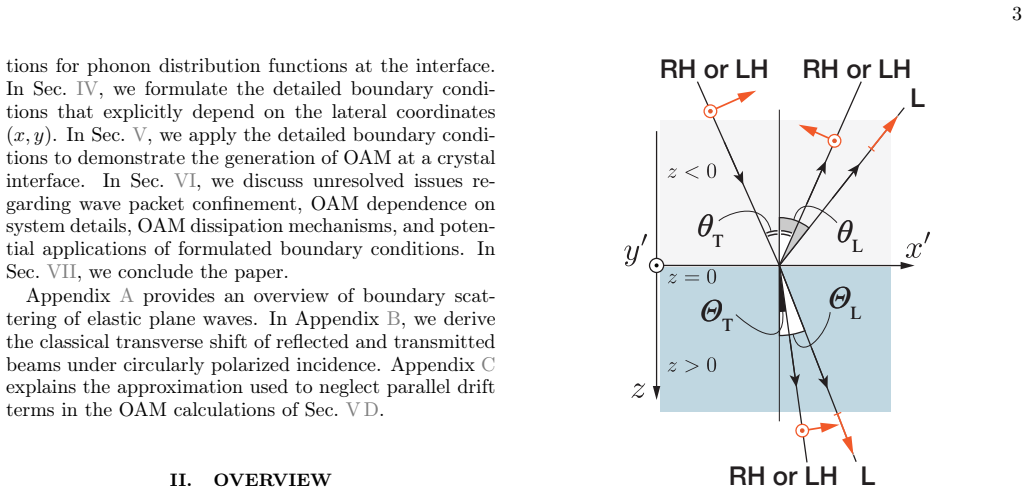
Plane wave components in the incident beam Let us consider a paraxial acoustic beam of trans- verse mode incident upon the interface planez= 0from the regionz <0, as illustrated in Fig. 7(a). We first specify the central wavevector of the incident beam as kc =k c,∥ +k c,⊥ ˆz. Herek c,∥ is parallel to the interface. We take a(x′, y′, z)coordinate withx ′ a...
-
[6]
We first consider the incidence of the central plane wave with the wavevectork c
Plane wave components in the scattered beam Wethenaddressreflectedandtransmittedbeamswhen the beam prepared in Appendix B1 is incident. We first consider the incidence of the central plane wave with the wavevectork c. We refer to the reflected and trans- mitted waves of it as the central plane waves of the re- flected and transmitted beams. We write their...
-
[7]
ua ξ ˆξa +u a η ˆηa +u a ζ ˆζa ka ∥ =ka 1,∥ #† ·
Transverse shift of beams Wederivetheshiftofthereflectedortransmittedbeam in they ′ direction. Recall that the transverse shift is de- fined with weighting by the energy flux across the inter- face. Using the expression for the energy flux, the shift is given by ∆ra IF = Z dx′dy′ω2Z a cosϑ a|ua(r, t)|2 y′ Z dx′dy′ω2Z a cosϑ a|ua(r, t)|2 z=0 .(B12) Here ac...
-
[8]
uRH uLH # = 1√ 2
Case of purely circular polarization To describe transport phenomena using the phonon distribution function, we assume that the incident wave is purely circularly polarized [119]. Under this assump- tion, only two of the four Stokes parameters, those cor- responding to intensity and circular polarization, remain finite: |uX |2 +|u y′|2 , σ= 2Im [u∗ X uy′]...
-
[9]
Zhang and Q
L. Zhang and Q. Niu, Phys. Rev. Lett.112, 085503 (2014)
2014
-
[10]
Zhang and Q
L. Zhang and Q. Niu, Phys. Rev. Lett.115, 115502 (2015)
2015
-
[11]
S.-Y. Chen, C. Zheng, M. S. Fuhrer, and J. Yan, Nano Lett.15, 2526 (2015)
2015
-
[12]
H. Zhu, J. Yi, M.-Y. Li, J. Xiao, L. Zhang, C.-W. Yang, R. A. Kaindl, L.-J. Li, Y. Wang, and X. Zhang, Science 359, 579 (2018)
2018
-
[13]
Kishine, A
J. Kishine, A. S. Ovchinnikov, and A. A. Tereshchenko, Phys. Rev. Lett.125, 245302 (2020)
2020
-
[14]
Hamada, E
M. Hamada, E. Minamitani, M. Hirayama, and S. Mu- rakami, Phys. Rev. Lett.121, 175301 (2018)
2018
-
[15]
M.HamadaandS.Murakami,Phys.Rev.B101,144306 (2020)
2020
-
[16]
Park and B.-J
S. Park and B.-J. Yang, Nano Lett.20, 7694 (2020)
2020
-
[17]
Zhang, C
H. Zhang, C. Xu, C. Carnahan, M. Sretenovic, N. Suri, D. Xiao, and X. Ke, Phys. Rev. Lett.127, 247202 (2021)
2021
-
[18]
H. Chen, W. Wu, J. Zhu, Z. Yang, W. Gong, W. Gao, S. A. Yang, and L. Zhang, Nano Lett.22, 1688 (2022)
2022
-
[19]
Yao and S
D. Yao and S. Murakami, Phys. Rev. B105, 184412 (2022)
2022
-
[20]
Zhang and S
T. Zhang and S. Murakami, Phys. Rev. Res.4, L012024 (2022)
2022
-
[21]
C. P. Romao, R. Catena, N. A. Spaldin, and M. Matas, Phys. Rev. Res.5, 043262 (2023)
2023
-
[22]
Kato and J.-i
A. Kato and J.-i. Kishine, J. Phys. Soc. Jpn.92, 075002 (2023)
2023
-
[23]
Ishito, H
K. Ishito, H. Mao, Y. Kousaka, Y. Togawa, S. Iwasaki, T. Zhang, S. Murakami, J.-i. Kishine, and T. Satoh, Nat. Phys.19, 35 (2023)
2023
-
[24]
Ishito, H
K. Ishito, H. Mao, K. Kobayashi, Y. Kousaka, Y. To- gawa, H. Kusunose, J. Kishine, and T. Satoh, Chirality 35, 338 (2023)
2023
-
[25]
Oishi, Y
E. Oishi, Y. Fujii, and A. Koreeda, Phys. Rev. B109, 104306 (2024)
2024
-
[26]
Tateishi, A
T. Tateishi, A. Kato, and J.-i. Kishine, J. Phys. Soc. Jpn.94, 053601 (2025)
2025
-
[27]
H. Ishizuka and M. Sato, arXiv preprint (2025), arXiv:2505.05313 [cond-mat.mes-hall]
Pith/arXiv arXiv 2025
-
[28]
T. Wang, H. Sun, X. Li, and L. Zhang, Nano Lett.24, 4311 (2024)
2024
-
[29]
Zhang, S
T. Zhang, S. Murakami, and H. Miao, Nat. Commun. 16, 3560 (2025)
2025
-
[30]
D. M. Juraschek, R. M. Geilhufe, H. Zhu, M. Basini, P. Baum, A. Baydin, S. Chaudhary, M. Fechner, B. Fle- bus, G. Grissonnanche, A. I. Kirilyuk, M. Lemeshko, S. F. Maehrlein, M. Mignolet, S. Murakami, Q. Niu, U. Nowak, C. P. Romao, H. Rostami, T. Satoh, N. A. Spaldin, H. Ueda, and L. Zhang, Nat. Phys.21, 1532 (2025)
2025
-
[31]
Kusunose, J.-i
H. Kusunose, J.-i. Kishine, and H. M. Yamamoto, Appl. Phys. Lett.124, 260501 (2024)
2024
-
[32]
Anastassakis, E
E. Anastassakis, E. Burstein, A. Maradudin, and R. Minnick, J. Phys. Chem. Solids33, 519 (1972)
1972
-
[33]
Y. T. Rebane, Zh. Eksp. Teor. Fiz.84, 2323 (1983), [Sov. Phys. JETP57, 1356 (1983)]
1983
-
[34]
J. H. Mentink, M. I. Katsnelson, and M. Lemeshko, Phys. Rev. B99, 064428 (2019)
2019
-
[35]
A. Kato, H. M. Yamamoto, and J.-i. Kishine, Phys. Rev. B105, 195117 (2022)
2022
-
[36]
Weißenhofer, H
M. Weißenhofer, H. Lange, A. Kamra, S. Mankovsky, S. Polesya, H. Ebert, and U. Nowak, Phys. Rev. B108, L060404 (2023)
2023
-
[37]
Shokeen, M
V. Shokeen, M. Heber, D. Kutnyakhov, X. Wang, A. Yaroslavtsev, P. Maldonado, M. Berritta, N. Wind, L. Wenthaus, F. Pressacco, C.-H. Min, M. Nissen, S. K. Mahatha, S. Dziarzhytski, P. M. Oppeneer, K. Ross- nagel, H.-J. Elmers, G. Schönhense, and H. A. Dürr, Sci. Adv.10, eadj2407 (2024)
2024
-
[38]
D. M. Juraschek, M. Fechner, A. V. Balatsky, and N. A. Spaldin, Phys. Rev. Mater.1, 014401 (2017)
2017
-
[39]
D. M. Juraschek and N. A. Spaldin, Phys. Rev. Mater. 31 3, 064405 (2019)
2019
-
[40]
M.HamadaandS.Murakami,Phys.Rev.Res.2,023275 (2020)
2020
-
[41]
Y. Ren, C. Xiao, D. Saparov, and Q. Niu, Phys. Rev. Lett.127, 186403 (2021)
2021
-
[42]
D. M. Juraschek, T. c. v. Neuman, and P. Narang, Phys. Rev. Res.4, 013129 (2022)
2022
-
[43]
Evers, H
S.R.Tauchert, M.Volkov, D.Ehberger, D.Kazenwadel, M. Evers, H. Lange, A. Donges, A. Book, W. Kreuz- paintner, U. Nowak, and P. Baum, Nature602, 73 (2022)
2022
-
[44]
Fransson, Phys
J. Fransson, Phys. Rev. Res.5, L022039 (2023)
2023
-
[45]
J. Luo, T. Lin, J. Zhang, X. Chen, E. R. Blackert, R. Xu, B. I. Yakobson, and H. Zhu, Science382, 698 (2023)
2023
-
[46]
Basini, M
M. Basini, M. Pancaldi, B. Wehinger, M. Udina, V. Unikandanunni, T. Tadano, M. C. Hoffmann, A. V. Balatsky, and S. Bonetti, Nature628, 534 (2024)
2024
-
[47]
Chaudhary, D
S. Chaudhary, D. M. Juraschek, M. Rodriguez-Vega, and G. A. Fiete, Phys. Rev. B110, 094401 (2024)
2024
-
[48]
Funato, M
T. Funato, M. Matsuo, and T. Kato, Phys. Rev. Lett. 132, 236201 (2024)
2024
-
[49]
R. Sano and T. Kato, arXiv preprint (2024), arXiv:2404.19000 [cond-mat.mes-hall]
Pith/arXiv arXiv 2024
-
[50]
Yao and S
D. Yao and S. Murakami, J. Phys. Soc. Jpn.93, 034708 (2024)
2024
-
[51]
X. Li, J. Zhong, J. Cheng, H. Chen, H. Wang, J. Liu, D. Sun, L. Zhang, and J. Zhou, Sci. China Phys., Mech. Astron.67, 237511 (2024)
2024
-
[52]
Yokoyama, J
T. Yokoyama, J. Phys. Soc. Jpn.93, 123705 (2024)
2024
-
[53]
Yao and S
D. Yao and S. Murakami, Phys. Rev. B111, 134414 (2025)
2025
-
[54]
D. Yao, D. Go, Y. Mokrousov, and S. Murakami, arXiv preprint (2025), arXiv:2511.09271 [cond-mat.mes-hall]
Pith/arXiv arXiv 2025
-
[55]
V. L. Korenev, M. Salewski, I. A. Akimov, V. F. Sapega, L. Langer, I. V. Kalitukha, J. Debus, R. I. Dzhioev, D. R. Yakovlev, D. Müller, C. Schröder, H. Hövel, G. Karczewski, M. Wiater, T. Wojtowicz, Y. G. Kus- rayev, and M. Bayer, Nat. Phys.12, 85 (2016)
2016
-
[56]
T. F. Nova, A. Cartella, A. Cantaluppi, M. Först, D. Bossini, R. V. Mikhaylovskiy, A. V. Kimel, R. Mer- lin, and A. Cavalleri, Nat. Phys.13, 132 (2017)
2017
-
[57]
Holanda, D
J. Holanda, D. Maior, A. Azevedo, and S. Rezende, Nat. Phys.14, 500 (2018)
2018
-
[58]
Sasaki, Y
R. Sasaki, Y. Nii, and Y. Onose, Nat. Commun.12, 2599 (2021)
2021
-
[59]
S. G. Jeong, J. Kim, A. Seo, S. Park, H. Y. Jeong, Y.-M. Kim, V. Lauter, T. Egami, J. H. Han, and W. S. Choi, Sci. Adv.8, 4 (2022)
2022
-
[60]
K. Kim, E. Vetter, L. Yan, C. Yang, Z. Wang, R. Sun, Y. Yang, A. H. Comstock, X. Li, J. Zhou, L. Zhang, W. You, D. Sun, and J. Liu, Nat. Mater.22, 322 (2023)
2023
-
[61]
H. Ueda, M. García-Fernández, S. Agrestini, C. P. Ro- mao, J. van den Brink, N. A. Spaldin, K.-J. Zhou, and U. Staub, Nature618, 946 (2023)
2023
-
[62]
K. Ohe, H. Shishido, M. Kato, S. Utsumi, H. Matsuura, and Y. Togawa, Phys. Rev. Lett.132, 056302 (2024)
2024
-
[63]
Davies, F
C. Davies, F. Fennema, A. Tsukamoto, I. Razdolski, A. Kimel, and A. Kirilyuk, Nature628, 540 (2024)
2024
-
[64]
I. H. Choi, S. G. Jeong, S. Song, S. Park, D. B. Shin, W. S. Choi, and J. S. Lee, Nat. Nanotechnol.19, 1277 (2024)
2024
-
[65]
Nabei, C
Y. Nabei, C. Yang, H. Sun, H. Jones, T. Mai, T. Wang, R. Bodin, B. Pandey, Z. Wang, Y. Xiong, A. H. Comstock, B. Ewing, J. Bingen, R. Sun, D. Smirnov, W. Zhang, A. Hoffmann, R. Rao, M. Hu, Z. V. Var- deny, B. Yan, X. Li, J. Zhou, J. Liu, and D. Sun, Nat. Phys. , 1 (2026)
2026
-
[66]
Nishimura, T
N. Nishimura, T. Funato, M. Matsuo, and T. Kato, J. Magn. Magn. Mater. , 173386 (2025)
2025
-
[67]
Suzuki, S
Y. Suzuki, S. Sumita, and Y. Kato (Letter), jointly sub- mitted as a companion paper
-
[68]
Caroli, R
C. Caroli, R. Combescot, P. Nozieres, and D. Saint- James, J. Phys. C4, 916 (1971)
1971
-
[69]
S. V. Vonsovskii and M. S. Svirskii, Fiz. Tverd. Tela3, 2160 (1961), [Sov. Phys. Solid State3, 7 (1962)]
1961
-
[70]
A. D. Levine, Nuovo Cimento26, 190 (1962)
1962
-
[71]
D. L. Portigal and E. Burstein, Phys. Rev.170, 673 (1968)
1968
-
[72]
A. S. Pine, Phys. Rev. B2, 2049 (1970)
2049
-
[73]
Ishii, Bussei-Kenkyu23, 217 (1975)
T. Ishii, Bussei-Kenkyu23, 217 (1975)
1975
-
[74]
McLellan, J
A. McLellan, J. Phys. C21, 1177 (1988)
1988
-
[75]
Zhang, N
H. Zhang, N. Peshcherenko, F. Yang, T. Ward, P. Raghuvanshi, L. Lindsay, C. Felser, Y. Zhang, J.-Q. Yan, and H. Miao, Nat. Phys.21, 1387 (2025)
2025
-
[76]
W. A. Little, Can. J. Phys.37, 334 (1959)
1959
-
[77]
I. M. Khalatnikov,An Introduction to the Theory of Su- perfluidity, Frontiers in Physics (W.A. Benjamin, New York, 1965) translated by P.C. Hohenberg
1965
-
[78]
E. T. Swartz and R. O. Pohl, Rev. Mod. Phys.61, 605 (1989)
1989
-
[79]
D. A. Garanin and E. M. Chudnovsky, Phys. Rev. B92, 024421 (2015)
2015
-
[80]
J. J. Nakane and H. Kohno, Phys. Rev. B97, 174403 (2018)
2018
discussion (0)
Sign in with ORCID, Apple, or X to comment. Anyone can read and Pith papers without signing in.