REVIEW 4 major objections 5 minor 79 references
Blind face restoration can be made deterministic by anchoring a diffusion generator with semantic tokens and pruning its output space with preference-aware reinforcement learning.
Reviewed by Pith at T0; open to challenge. T0 means a machine referee read the full paper against a public rubric. the ladder, T0–T4 →
T0 review · deepseek-v4-flash
2026-08-03 07:33 UTC pith:LTCMVKEU
load-bearing objection The RL-plus-AR-token system is a plausible engineering combination, but the headline 'deterministic, identity-consistent' claim rests on variance measured on the very rewards they optimized, and their own Table II shows the RL-tuned variant loses identity. the 4 major comments →
Bridging Information Asymmetry: A Hierarchical Framework for Deterministic Blind Face Restoration
The pith
A machine-rendered reading of the paper's core claim, the machinery that carries it, and where it could break.
Core claim
On its own terms, the paper's discovery is that the ill-posedness of blind face restoration can be re-balanced rather than merely regularized. Pref-Restore augments the degraded input with dense semantic tokens generated by an autoregressive visual-language model, then uses on-policy reinforcement learning on the forward diffusion flow to make the generator prefer high-fidelity trajectories and avoid hallucinated ones. The paper reports that the resulting model matches or exceeds prior methods on synthetic and real benchmarks, with stronger identity-sensitive fidelity after stage one and higher perceptual quality after stage two, and that across 16 repeated restorations the spread of prefere
What carries the argument
Three coordinated components carry the argument. (1) An AR-based semantic integrator: a quantized visual-language model trained by next-token prediction turns degraded pixels plus a text caption into discrete semantic tokens that serve as a stable high-level anchor. (2) A continuous diffusion generator built on conditional flow matching, trained in two sub-stages (semantic-to-diffusion alignment, then texture-to-diffusion alignment) so the anchor and low-level VAE features jointly condition the velocity field. (3) Preference-aware fine-tuning via an on-policy RL scheme applied to the forward diffusion flow (the paper calls this DiffusionNFT): group rollouts produce K candidates scored by a f
Load-bearing premise
The load-bearing premise is that the drop in variance of preference scores (human-preference, CLIP-alignment, and aesthetic-quality rewards) across repeated sampling measures a genuine reduction in restoration uncertainty; if the reward model simply makes the model consistently produce a pleasing but wrong face, the deterministic claim collapses.
What would settle it
Run N=16 restorations of the same degraded face under different random seeds and compute the standard deviation of identity metrics (face-embedding angle and landmark distance) rather than preference scores. If those spreads do not shrink alongside the preference-score spread—or if the mean identity error grows, as the paper's own Table II already shows for stage 2—then the claimed determinism is a property of the reward metric, not of the restored identity.
If this is right
- If the central claim is right, a single degraded face will restore to the same identity-consistent output across repeated sampling runs, which is what forensic, archival, and medical uses demand.
- Text captions act as a steerable semantic channel: richer captions improve semantic fidelity (the paper reports double-digit gains in CLIP-image similarity and DreamSim), so the same restoration engine can be directed by language at inference time.
- The two variants make the fidelity–quality trade-off explicit and controllable: stopping after stage 1 preserves identity best, while stage 2 maximizes perceptual scores but measurably worsens identity metrics—so users can choose where to sit on the curve.
- Because the RL stage needs only about 30 fine-tuning steps and operates on the forward velocity field rather than the reverse sampling policy, the same distribution-pruning recipe can be attached to other diffusion-based restoration models without re-deriving policy gradients.
Where Pith is reading between the lines
- A stronger test of 'deterministic restoration' than the paper reports would measure the spread of identity metrics (face-embedding angle and landmark distance) across the same 16 runs; if those spreads do not tighten alongside the preference-score spread, the 50% reduction may describe reward collapse rather than faithful reconstruction.
- The paper's own Table II shows stage 2 degrades identity metrics (embedding angle from 54.06 to 73.99), so 'preference-aligned' currently means aesthetically preferred, not identity-faithful; adding an explicit identity-reward term would be the natural next step.
- Because captions are generated by a separate visual-language model in deployment, caption errors become a new failure mode: a wrong attribute in the text could anchor the restoration to the wrong identity. A natural stress test is corrupting or dropping captions and measuring identity fidelity and determinism.
- The recipe—autoregressive semantic anchoring plus preference-aware forward-flow RL—generalizes beyond faces to other ill-posed inverse problems such as blind super-resolution, deblurring, or medical image restoration where structure matters more than aesthetic plausibility.
Editorial analysis
A structured set of objections, weighed in public.
Referee Report
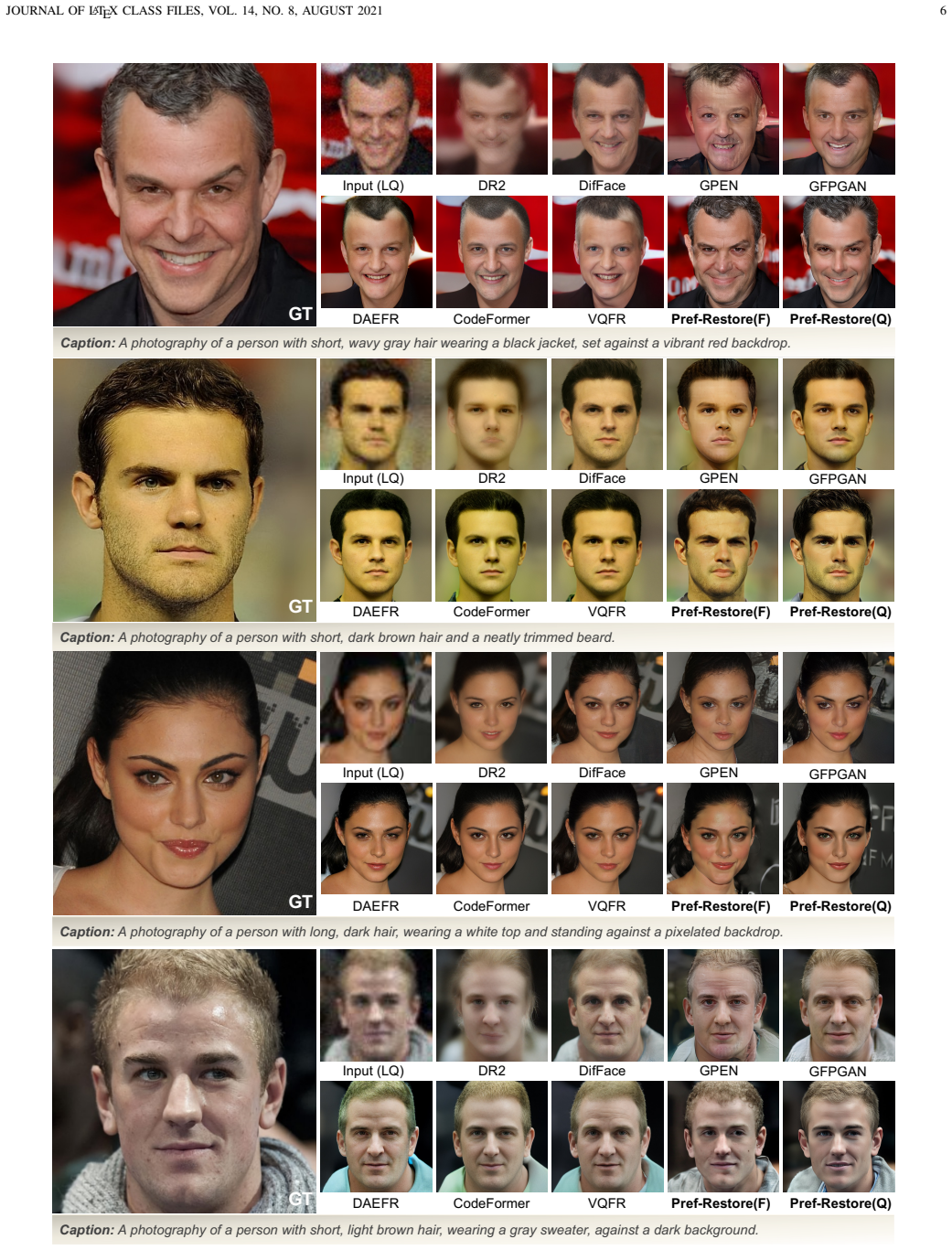
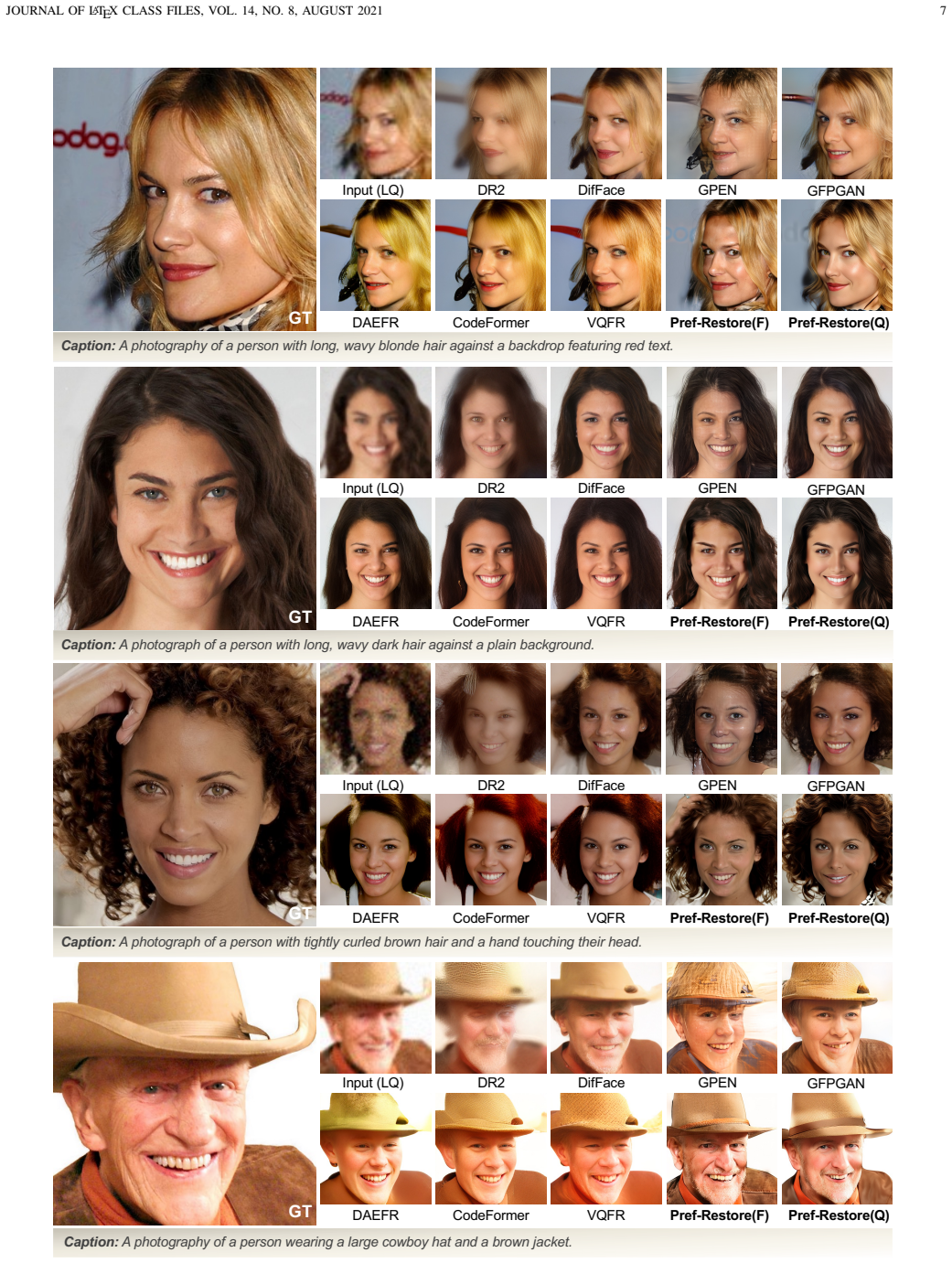
Summary. The paper proposes Pref-Restore, a hierarchical blind face restoration framework combining an auto-regressive semantic integrator (image + text to discrete tokens) with a diffusion-based generator, trained in two stages: Stage 1 performs semantic-to-diffusion and texture-to-diffusion alignment, and Stage 2 fine-tunes the diffusion velocity field via DiffusionNFT-style on-policy RL with a composite reward (HPSv2 + Clip Score + Pick Score). The authors report SOTA results on synthetic and real-world benchmarks and, as the central claim, assert that Stage 2 reduces restoration stochasticity by about 50% (Sec. V-H, Fig. 8) and yields deterministic, identity-consistent restoration. Two variants are offered: Pref-Restore Fidelity (after Stage 1) and Pref-Restore Quality (after Stage 2).
Significance. If the deterministic-restoration claim were fully supported, the paper would make a valuable contribution: using AR-derived semantic anchors and preference-based RL to stabilize diffusion restoration is a plausible route toward mitigating hallucination and identity drift in blind face restoration. The paper deserves credit for its extensive ablations (Table IX, Fig. 3, Table VII), the staged training design, and the decision to provide two clearly characterized variants. However, the central claim is not currently supported: the variance reduction is measured on the very reward function being optimized, and the authors' own Table II shows the Stage 2 'Quality' variant degrading identity metrics substantially. As written, the evidence supports 'preference-aligned aesthetic stabilization' rather than 'deterministic, identity-consistent restoration.' A major revision is needed to reframe the claim or add evidence from identity-based uncertainty metrics.
major comments (4)
- [Sec. V-H and Eq. (15)] The '50% reduction in restoration stochasticity' is measured as the standard deviation of the Sum Score (HPSv2 + PickScore + ClipScore) over 16 runs. This is exactly the reward R_pref optimized in Eq. (15) and tracked in Fig. 6. Reduced variance of the training objective across seeds is expected when the model converges to a reward-maximizing mode, and it can also result from mode collapse. It does not measure uncertainty over the restored identity or output distribution. The paper needs independent uncertainty metrics (e.g., std of ArcFace embeddings, landmark positions, or pixel-space distance between restorations) before the determinism claim can be accepted.
- [Table II and Sec. V-B/G] The abstract claims 'stronger identity-sensitive fidelity' and the Method section claims Stage 2 'prunes trajectories that deviate from human aesthetic and fidelity standards.' Yet Table II shows Pref-Restore Quality (the Stage 2 variant) has LMD 8.3588 and ArcFace Deg 73.9882, much worse than Pref-Restore Fidelity (5.1337 / 54.0623), and worse than several baselines. Table IX attributes the identity gains to Stage 1.2, not to preference RL. Thus the stage that produces the claimed stochasticity reduction is also the stage that degrades identity. The deterministic-identity reading is contradicted by the authors' own data; the claim should be restricted to aesthetic stabilization, or Stage 2 must be shown to preserve identity via an identity-aware reward.
- [Tables III-VI] On the four real-world datasets, the reported metrics are almost entirely no-reference aesthetic/quality metrics (MUSIQ, CLIPIQA+, MANIQA, topiq, DSL-FIQA) plus FID. Identity-sensitive metrics (ArcFace Deg, LMD) that appear in the synthetic CelebA-Test table are omitted. Since the paper's headline contribution is 'identity-sensitive fidelity' and 'lower restoration uncertainty,' real-world identity metrics (or a clear explanation for their omission) are necessary to support the generalization claim.
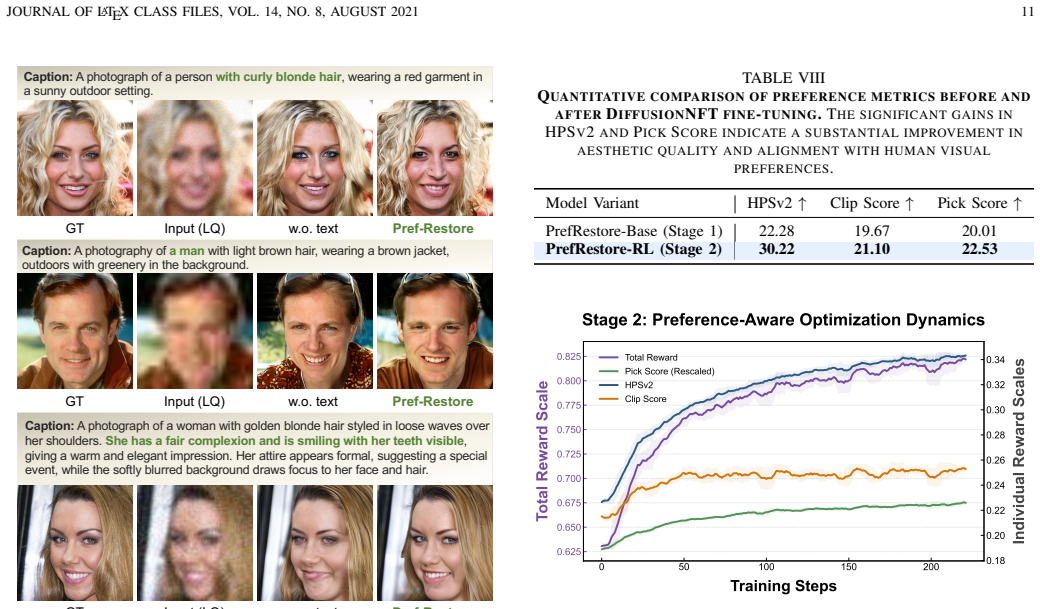
- [Sec. V-E and Table VIII] The text reporting reward gains is internally inconsistent: 'the Pick Score rises from 76.98 to 86.66 (+12.6%)' while Table VIII lists Pick Score 20.01 to 22.53, and HPSv2 is listed as 22.28 to 30.22 in the table but appears in a different scale in the text. If a rescaling or normalization is used, it must be stated explicitly; otherwise the main quantitative evidence for Stage 2's benefit is not verifiable.
minor comments (5)
- [Eq. (6) and Appendix A] The formal derivation in Appendix A is a standard MAP-plus-energy-based-prior rewrite; Eq. (7) is the elementary 'conditioning reduces entropy' inequality. The paper should not present this as a new theoretical proof. The actual contribution is the empirical architecture, which is fine, but the framing should be modest.
- [Table I / Eqs. (12)-(14)] The values of gamma, lambda, Z, and the reward composition weights are not reported. Table I lists learning rates and batch size but not these Stage-2-specific hyperparameters. Please provide them for reproducibility.
- [Fig. 8] The figure and text do not specify which model is the 'Base Model' (presumably Stage 1?) and how the Sum Score is computed/scaled. The boxplot axes are unlabeled beyond 'Std of Scores'; clarify the normalization of HPSv2/PickScore/ClipScore in this analysis.
- [Table V caption] The caption reads 'Wilder-Test' but the dataset is WIDER-Test. Fix the typo.
- [Related Work / Contributions] Given DiffusionReward [46], IRPO [49], RealSR-R1 [50], and TTPO [51] already apply RL/preference methods to restoration, the claim to 'pioneer' on-policy RL for BFR should be softened or carefully differentiated from these prior works.
Circularity Check
Deterministic claim is self-referential: the '50% reduction in restoration stochasticity' is computed on the std of HPSv2+PickScore+ClipScore—the exact reward optimized in Eq. 15—while Stage-2 identity metrics degrade.
specific steps
-
fitted input called prediction
[Sec. V-E (Reward Composition) and Sec. V-H (Deterministic Analysis), Eq. (15), Fig. 8]
"Our preference reward R_pref is a synergistic ensemble of three state-of-the-art multi-modal scoring models: HPSv2 [72] (Human Preference Score), Clip Score [73] (Semantic alignment), and Pick Score [74] (General aesthetic and quality prior). ... We calculate the standard deviation of various perceptual metrics, including HPSv2, PickScore, ClipScore, and their Sum Score, to quantify the sampling variance. ... the median standard deviation of the Sum Score drops significantly from approximately 0.032 to 0.016, representing a 50% reduction in restoration stochasticity."
The 'Sum Score' whose variance is reported as 'restoration stochasticity' is the sum of HPSv2, PickScore, and ClipScore—exactly the reward R_pref optimized in Eq. (15) through the normalized r^(k) in Eq. (12). The RL loss is built from this reward, so reporting low variance of the same reward is measuring the training objective itself, not an independent posterior-entropy estimate over true identity. The paper's own Table II shows the Stage-2 Quality variant degrades identity metrics (ArcFace Deg 54.06→73.99, LMD 5.13→8.36), so the reduced variance is consistent with aesthetic mode collapse rather than identity-consistent determinism.
-
self definitional
[Sec. V-E, Table VIII and Fig. 6]
"As summarized in Table VIII, comparing the PrefRestore-Base (end of Stage 1) with the PrefRestore-RL (end of Stage 2) reveals substantial improvements across all preference-related dimensions."
Table VIII's 'preference-related dimensions' are HPSv2, Clip Score, and Pick Score—the exact additive components of R_pref in Eq. (15). The evaluation therefore reports the training reward's own components; the same frozen scorers provide both the RL gradient and the reported 'preference' gains. While mean-reward improvement is an expected sanity check, presenting it as evidence of general 'preference-aligned restoration' or 'solution-space pruning' is self-referential: no external or held-out preference signal is used.
full rationale
The circularity is concentrated in Stage 2 and in the paper's deterministic claim. Eq. (15) defines the RL loss using normalized reward r from R_pref, which is explicitly composed of HPSv2 + ClipScore + PickScore. Section V-H then measures 'restoration stochasticity' as the standard deviation of exactly those scores (the Sum Score) across N=16 runs and reports a 50% drop. Thus the headline uncertainty reduction is computed on the training objective itself; it is a self-referential metric, not an independent measure of posterior entropy over the true identity. Table VIII's preference gains are likewise the training reward's own components. The identity-consistency part of the claim is further weakened by the paper's own Table II, where the Stage-2 Quality variant increases ArcFace Deg from 54.06 to 73.99 and LMD from 5.13 to 8.36, and by Appendix I(b), which lists identity-preserving rewards as future work, stating the authors 'primarily utilized an aesthetic reward model.' Stage 1 has independent, non-circular content: the AR semantic anchoring and Texture-to-Diffusion Alignment are validated by external metrics (LMD, ArcFace Deg, LPIPS, FID), and Table IX shows large identity gains from Stage 1.2. No load-bearing self-citation chain or imported uniqueness theorem appears; DiffusionNFT is external prior work and the authors' own AR papers are cited only as related work. The score reflects that the central 'deterministic, identity-consistent restoration' claim partially reduces to a self-referential reward-variance measure, while Stage 1 retains substantial independent evidence.
Axiom & Free-Parameter Ledger
free parameters (6)
- lambda in Eq. (6) (preference constraint weight) =
not reported
- gamma in Eqs. (13)-(14) (implicit velocity interpolation) =
not reported
- Z in Eq. (12) (reward normalization scale) =
not reported
- Reward composition weights for HPSv2 + Clip Score + Pick Score =
equal/unspecified
- p_txt = 0.95, p_rec = 0.1 (training dropouts) =
0.95 caption / 0.05 null; 0.1 degradation bypass
- K candidate rollouts in Stage 2 =
not reported
axioms (6)
- standard math Conditional entropy reduction: H(x|y,S_AR) <= H(x|y)
- domain assumption Text captions are valid and available identity anchors at deployment
- domain assumption Reward models HPSv2, CLIP Score, and Pick Score are good proxies for human perceptual fidelity
- domain assumption DiffusionNFT forward-flow contrast retains its guarantees under conditional restoration
- domain assumption Frozen diffusion backbone allows semantic token-diffusion alignment through backprop
- ad hoc to paper Reduced std of reward scores over 16 seeds equals deterministic restoration
read the original abstract
Blind face restoration remains a persistent challenge due to the inherent ill-posedness of reconstructing holistic structures from severely constrained observations. Current generative paradigms, while capable of synthesizing realistic facial details, remain limited by the under-constrained nature of blind restoration, where severely degraded inputs can be mapped to plausible yet identity-inconsistent outputs. To address this issue, we present Pref-Restore, a hierarchical framework for deterministic BFR. Our design is organized around three complementary principles: (1) Semantic Information Augmentation, where an auto-regressive semantic branch converts image and text cues into structured tokens that provide a stable high-level anchor; (2) Texture-level Fidelity Alignment, where the diffusion generator is trained under this anchor to recover identity-relevant details; and (3) Fidelity-constrained Preference Optimization, where a face-aware reward refines the diffusion trajectory while controlling the quality-fidelity trade-off. Extensive experiments on synthetic and real-world benchmarks show that Pref-Restore achieves state-of-the-art performance, with stronger identity-sensitive fidelity and lower restoration uncertainty across repeated sampling. Systematic ablations further attribute these gains to the proposed hierarchical design, showing the necessity of staged training, the robustness of the text pathway under deployment-faithful conditions, and the benefit of fidelity-constrained preference optimization.
Figures






Reference graph
Works this paper leans on
-
[1]
Towards real-world blind face restoration with generative facial prior,
X. Wang, Y . Li, H. Zhang, and Y . Shan, “Towards real-world blind face restoration with generative facial prior,” inProceedings of the IEEE/CVF conference on computer vision and pattern recognition, 2021, pp. 9168– 9178
2021
-
[2]
Gan prior embedded network for blind face restoration in the wild,
T. Yang, P. Ren, X. Xie, and L. Zhang, “Gan prior embedded network for blind face restoration in the wild,” inProceedings of the IEEE/CVF conference on computer vision and pattern recognition, 2021, pp. 672– 681
2021
-
[3]
Vqfr: Blind face restoration with vector-quantized dictionary and parallel decoder,
Y . Gu, X. Wang, L. Xie, C. Dong, G. Li, Y . Shan, and M.-M. Cheng, “Vqfr: Blind face restoration with vector-quantized dictionary and parallel decoder,” inEuropean Conference on Computer Vision. Springer, 2022, pp. 126–143
2022
-
[4]
Towards robust blind face restoration with codebook lookup transformer,
S. Zhou, K. Chan, C. Li, and C. C. Loy, “Towards robust blind face restoration with codebook lookup transformer,”Advances in Neural Information Processing Systems, vol. 35, pp. 30 599–30 611, 2022
2022
-
[5]
Difface: Blind face restoration with diffused error contraction,
Z. Yue and C. C. Loy, “Difface: Blind face restoration with diffused error contraction,”IEEE Transactions on Pattern Analysis and Machine Intelligence, 2024
2024
-
[6]
Dr2: Diffusion-based robust degradation remover for blind face restoration,
Z. Wang, Z. Zhang, X. Zhang, H. Zheng, M. Zhou, Y . Zhang, and Y . Wang, “Dr2: Diffusion-based robust degradation remover for blind face restoration,” inProceedings of the IEEE/CVF Conference on Computer Vision and Pattern Recognition, 2023, pp. 1704–1713
2023
-
[7]
Dual asso- ciated encoder for face restoration,
Y .-J. Tsai, Y .-L. Liu, L. Qi, K. C. Chan, and M.-H. Yang, “Dual asso- ciated encoder for face restoration,”arXiv preprint arXiv:2308.07314, 2023
Pith/arXiv arXiv 2023
-
[8]
Blind image restoration by anisotropic regularization,
Y .-L. You and M. Kaveh, “Blind image restoration by anisotropic regularization,”IEEE Transactions on Image Processing, vol. 8, no. 3, pp. 396–407, 1999. JOURNAL OF LATEX CLASS FILES, VOL. 14, NO. 8, AUGUST 2021 14
1999
-
[9]
Blind image deconvolution,
D. Kundur and D. Hatzinakos, “Blind image deconvolution,”IEEE signal processing magazine, vol. 13, no. 3, pp. 43–64, 2002
2002
-
[10]
Deep variational network toward blind image restoration,
Z. Yue, H. Yong, Q. Zhao, L. Zhang, D. Meng, and K.-Y . K. Wong, “Deep variational network toward blind image restoration,”IEEE Trans- actions on Pattern Analysis and Machine Intelligence, vol. 46, no. 11, pp. 7011–7026, 2024
2024
-
[11]
Diffbir: Towards blind image restoration with generative diffusion prior,
X. Lin, J. He, Z. Chen, Z. Lyu, B. Dai, F. Yu, W. Ouyang, Y . Qiao, and C. Dong, “Diffbir: Towards blind image restoration with generative diffusion prior,”arXiv preprint arXiv:2308.15070, 2023
Pith/arXiv arXiv 2023
-
[12]
Universal image restora- tion pre-training via masked degradation classification,
J. Hu, Z. Yao, L. Jin, Y . Chen, and Y . Lu, “Universal image restora- tion pre-training via masked degradation classification,”arXiv preprint arXiv:2510.13282, 2025
arXiv 2025
-
[13]
A survey on all-in- one image restoration: Taxonomy, evaluation and future trends,
J. Jiang, Z. Zuo, G. Wu, K. Jiang, and X. Liu, “A survey on all-in- one image restoration: Taxonomy, evaluation and future trends,”IEEE Transactions on Pattern Analysis and Machine Intelligence, 2025
2025
-
[14]
Photo-realistic single image super-resolution using a generative adversarial network,
C. Ledig, L. Theis, F. Husz ´ar, J. Caballero, A. Cunningham, A. Acosta, A. Aitken, A. Tejani, J. Totz, Z. Wanget al., “Photo-realistic single image super-resolution using a generative adversarial network,” in Proceedings of the IEEE conference on computer vision and pattern recognition, 2017, pp. 4681–4690
2017
-
[15]
Esrgan: Enhanced super-resolution generative adversar- ial networks,
X. Wang, K. Yu, S. Wu, J. Gu, Y . Liu, C. Dong, Y . Qiao, and C. Change Loy, “Esrgan: Enhanced super-resolution generative adversar- ial networks,” inProceedings of the European conference on computer vision (ECCV) workshops, 2018, pp. 0–0
2018
-
[16]
Real-world super- resolution via kernel estimation and noise injection,
X. Ji, Y . Cao, Y . Tai, C. Wang, J. Li, and F. Huang, “Real-world super- resolution via kernel estimation and noise injection,” inproceedings of the IEEE/CVF conference on computer vision and pattern recognition workshops, 2020, pp. 466–467
2020
-
[17]
Auto-encoding variational bayes,
D. P. Kingma and M. Welling, “Auto-encoding variational bayes,”arXiv preprint arXiv:1312.6114, 2013
Pith/arXiv arXiv 2013
-
[18]
Generative adversarial nets,
I. Goodfellow, J. Pouget-Abadie, M. Mirza, B. Xu, D. Warde-Farley, S. Ozair, A. Courville, and Y . Bengio, “Generative adversarial nets,” Advances in neural information processing systems, vol. 27, 2014
2014
-
[19]
Denoising diffusion probabilistic models,
J. Ho, A. Jain, and P. Abbeel, “Denoising diffusion probabilistic models,” Advances in neural information processing systems, vol. 33, pp. 6840– 6851, 2020
2020
-
[20]
Generative modeling by estimating gradients of the data distribution,
Y . Song and S. Ermon, “Generative modeling by estimating gradients of the data distribution,”Advances in neural information processing systems, vol. 32, 2019
2019
-
[21]
Transfer between modalities with metaqueries,
X. Pan, S. N. Shukla, A. Singh, Z. Zhao, S. K. Mishra, J. Wang, Z. Xu, J. Chen, K. Li, F. Juefei-Xuet al., “Transfer between modalities with metaqueries,”arXiv preprint arXiv:2504.06256, 2025
Pith/arXiv arXiv 2025
-
[22]
Blip3o-next: Next frontier of native image generation,
J. Chen, L. Xue, Z. Xu, X. Pan, S. Yang, C. Qin, A. Yan, H. Zhou, Z. Chen, L. Huanget al., “Blip3o-next: Next frontier of native image generation,”arXiv preprint arXiv:2510.15857, 2025
arXiv 2025
-
[23]
J. Han, H. Chen, Y . Zhao, H. Wang, Q. Zhao, Z. Yang, H. He, X. Yue, and L. Jiang, “Vision as a dialect: Unifying visual under- standing and generation via text-aligned representations,”arXiv preprint arXiv:2506.18898, 2025
Pith/arXiv arXiv 2025
-
[24]
Auto-regressively gen- erating multi-view consistent images,
J. Hu, Y . Yang, J. Liu, J. Wu, C. Zhao, and Y . Lu, “Auto-regressively gen- erating multi-view consistent images,”arXiv preprint arXiv:2506.18527, 2025
Pith/arXiv arXiv 2025
-
[25]
J. Hu, S. Zhao, Q.-G. Chen, X. Qiu, J. Liu, Z. Xu, W. Luo, K. Zhang, and Y . Lu, “Omni-view: Unlocking how generation facilitates under- standing in unified 3d model based on multiview images,”arXiv preprint arXiv:2511.07222, 2025
arXiv 2025
-
[26]
Uniworld: High-resolution semantic encoders for unified visual understanding and generation,
B. Lin, Z. Li, X. Cheng, Y . Niu, Y . Ye, X. He, S. Yuan, W. Yu, S. Wang, Y . Geet al., “Uniworld: High-resolution semantic encoders for unified visual understanding and generation,”arXiv preprint arXiv:2506.03147, 2025
Pith/arXiv arXiv 2025
-
[27]
Deepseekmath: Pushing the limits of mathematical reasoning in open language models,
Z. Shao, P. Wang, Q. Zhu, R. Xu, J. Song, X. Bi, H. Zhang, M. Zhang, Y . Li, Y . Wuet al., “Deepseekmath: Pushing the limits of mathematical reasoning in open language models,”arXiv preprint arXiv:2402.03300, 2024
Pith/arXiv arXiv 2024
-
[28]
Flow-grpo: Training flow matching models via online rl,
J. Liu, G. Liu, J. Liang, Y . Li, J. Liu, X. Wang, P. Wan, D. Zhang, and W. Ouyang, “Flow-grpo: Training flow matching models via online rl,” arXiv preprint arXiv:2505.05470, 2025
Pith/arXiv arXiv 2025
-
[29]
Diffusionnft: Online diffusion reinforcement with forward process,
K. Zheng, H. Chen, H. Ye, H. Wang, Q. Zhang, K. Jiang, H. Su, S. Ermon, J. Zhu, and M.-Y . Liu, “Diffusionnft: Online diffusion reinforcement with forward process,”arXiv preprint arXiv:2509.16117, 2025
Pith/arXiv arXiv 2025
-
[30]
Fsrnet: End-to-end learning face super-resolution with facial priors,
Y . Chen, Y . Tai, X. Liu, C. Shen, and J. Yang, “Fsrnet: End-to-end learning face super-resolution with facial priors,” inProceedings of the IEEE conference on computer vision and pattern recognition, 2018, pp. 2492–2501
2018
-
[31]
Pro- gressive semantic-aware style transformation for blind face restoration,
C. Chen, X. Li, L. Yang, X. Lin, L. Zhang, and K.-Y . K. Wong, “Pro- gressive semantic-aware style transformation for blind face restoration,” inProceedings of the IEEE/CVF conference on computer vision and pattern recognition, 2021, pp. 11 896–11 905
2021
-
[32]
Face super-resolution guided by 3d facial priors,
X. Hu, W. Ren, J. LaMaster, X. Cao, X. Li, Z. Li, B. Menze, and W. Liu, “Face super-resolution guided by 3d facial priors,” inComputer Vision– ECCV 2020: 16th European Conference, Glasgow, UK, August 23–28, 2020, Proceedings, Part IV 16. Springer, 2020, pp. 763–780
2020
-
[33]
Exemplar guided face image super- resolution without facial landmarks,
B. Dogan, S. Gu, and R. Timofte, “Exemplar guided face image super- resolution without facial landmarks,” inProceedings of the IEEE/CVF conference on computer vision and pattern recognition workshops, 2019, pp. 0–0
2019
-
[34]
Blind face restoration via deep multi-scale component dictionaries,
X. Li, C. Chen, S. Zhou, X. Lin, W. Zuo, and L. Zhang, “Blind face restoration via deep multi-scale component dictionaries,” inEuropean conference on computer vision. Springer, 2020, pp. 399–415
2020
-
[36]
Image processing using multi-code gan prior,
J. Gu, Y . Shen, and B. Zhou, “Image processing using multi-code gan prior,” inProceedings of the IEEE/CVF conference on computer vision and pattern recognition, 2020, pp. 3012–3021
2020
-
[37]
Pulse: Self- supervised photo upsampling via latent space exploration of generative models,
S. Menon, A. Damian, S. Hu, N. Ravi, and C. Rudin, “Pulse: Self- supervised photo upsampling via latent space exploration of generative models,” inProceedings of the ieee/cvf conference on computer vision and pattern recognition, 2020, pp. 2437–2445
2020
-
[38]
H. Wei, S. Liu, C. Yuan, and L. Zhang, “Perceive, understand and re- store: Real-world image super-resolution with autoregressive multimodal generative models,”arXiv preprint arXiv:2503.11073, 2025
Pith/arXiv arXiv 2025
-
[40]
Promptir: Prompting for all-in-one image restoration,
V . Potlapalli, S. W. Zamir, S. H. Khan, and F. Shahbaz Khan, “Promptir: Prompting for all-in-one image restoration,”Advances in Neural Infor- mation Processing Systems, vol. 36, pp. 71 275–71 293, 2023
2023
-
[41]
Instructir: High-quality image restoration following human instructions,
M. V . Conde, G. Geigle, and R. Timofte, “Instructir: High-quality image restoration following human instructions,” inEuropean Conference on Computer Vision. Springer, 2024, pp. 1–21
2024
-
[42]
Controlling vision-language models for multi-task image restoration,
Z. Luo, F. K. Gustafsson, Z. Zhao, J. Sj ¨olund, and T. B. Sch ¨on, “Controlling vision-language models for multi-task image restoration,” arXiv preprint arXiv:2310.01018, 2023
Pith/arXiv arXiv 2023
-
[43]
Crafting a toolchain for image restoration by deep reinforcement learning,
K. Yu, C. Dong, L. Lin, and C. C. Loy, “Crafting a toolchain for image restoration by deep reinforcement learning,” inProceedings of IEEE Conference on Computer Vision and Pattern Recognition, 2018, pp. 2443–2452
2018
-
[44]
Path-restore: Learn- ing network path selection for image restoration,
K. Yu, X. Wang, C. Dong, X. Tang, and C. C. Loy, “Path-restore: Learn- ing network path selection for image restoration,”IEEE Transactions on Pattern Analysis and Machine Intelligence, 2021
2021
-
[45]
Training language models to follow instructions with human feedback,
L. Ouyang, J. Wu, X. Jiang, D. Almeida, C. Wainwright, P. Mishkin, C. Zhang, S. Agarwal, K. Slama, A. Rayet al., “Training language models to follow instructions with human feedback,”Advances in neural information processing systems, vol. 35, pp. 27 730–27 744, 2022
2022
-
[46]
Diffusionreward: Enhancing blind face restoration through reward feedback learning,
B. Wu, W. Wang, Y . Liu, Z. Li, and Y . Zhao, “Diffusionreward: Enhancing blind face restoration through reward feedback learning,” arXiv preprint arXiv:2505.17910, 2025
Pith/arXiv arXiv 2025
-
[47]
Direct preference optimization: Your language model is secretly a reward model,
R. Rafailov, A. Sharma, E. Mitchell, C. D. Manning, S. Ermon, and C. Finn, “Direct preference optimization: Your language model is secretly a reward model,”Advances in neural information processing systems, vol. 36, pp. 53 728–53 741, 2023
2023
-
[48]
Dspo: Direct semantic preference optimization for real-world image super- resolution,
M. Cai, S. Li, W. Li, X. Huang, H. Chen, J. Hu, and Y . Wang, “Dspo: Direct semantic preference optimization for real-world image super- resolution,”arXiv preprint arXiv:2504.15176, 2025
Pith/arXiv arXiv 2025
-
[49]
Irpo: Boosting image restoration via post-training grpo,
H. X. Y . Liu, B. Jiang, J. Peng, D. Luo, X. Hu, S. Yan, and H. Li, “Irpo: Boosting image restoration via post-training grpo,”arXiv preprint arXiv:2512.00814, 2025
Pith/arXiv arXiv 2025
-
[50]
J. Qiao, M. Cai, W. Li, Y . Liu, X. Huang, G. He, J. Xie, J. Hu, X. Chen, and S. Lin, “Realsr-r1: Reinforcement learning for real-world image super-resolution with vision-language chain-of-thought,”arXiv preprint arXiv:2506.16796, 2025
Pith/arXiv arXiv 2025
-
[51]
Test- time preference optimization for image restoration,
B. Li, X. Li, J. Xu, J. Guo, W. Li, R. Pei, and Z. Chen, “Test- time preference optimization for image restoration,”arXiv preprint arXiv:2511.19169, 2025
arXiv 2025
-
[52]
Bridging supervised learning and reinforce- ment learning in math reasoning,
H. Chen, K. Zheng, Q. Zhang, G. Cui, Y . Cui, H. Ye, T.-Y . Lin, M.-Y . Liu, J. Zhu, and H. Wang, “Bridging supervised learning and reinforce- ment learning in math reasoning,”arXiv preprint arXiv:2505.18116, 2025
arXiv 2025
-
[53]
A mathematical theory of communication,
C. E. Shannon, “A mathematical theory of communication,”The Bell System Technical Journal, vol. 27, no. 3, pp. 379–423, 1948. JOURNAL OF LATEX CLASS FILES, VOL. 14, NO. 8, AUGUST 2021 15
1948
-
[54]
A tutorial on energy-based learning,
Y . LeCun, S. Chopra, R. Hadsell, M. Ranzato, and F. Huang, “A tutorial on energy-based learning,”Predicting structured data, vol. 1, no. 0, 2006
2006
-
[55]
M. Tschannen, A. Gritsenko, X. Wang, M. F. Naeem, I. Alabdul- mohsin, N. Parthasarathy, T. Evans, L. Beyer, Y . Xia, B. Mustafa et al., “Siglip 2: Multilingual vision-language encoders with improved semantic understanding, localization, and dense features,”arXiv preprint arXiv:2502.14786, 2025
Pith/arXiv arXiv 2025
-
[56]
E. Xie, J. Chen, Y . Zhao, J. Yu, L. Zhu, C. Wu, Y . Lin, Z. Zhang, M. Li, J. Chenet al., “Sana 1.5: Efficient scaling of training-time and inference-time compute in linear diffusion transformer,”arXiv preprint arXiv:2501.18427, 2025
Pith/arXiv arXiv 2025
-
[57]
A style-based generator architecture for generative adversarial networks,
T. Karras, S. Laine, and T. Aila, “A style-based generator architecture for generative adversarial networks,” inProceedings of the IEEE/CVF conference on computer vision and pattern recognition, 2019, pp. 4401– 4410
2019
-
[58]
Progressive growing of gans for improved quality, stability, and variation,
T. Karras, “Progressive growing of gans for improved quality, stability, and variation,”arXiv preprint arXiv:1710.10196, 2017
Pith/arXiv arXiv 2017
-
[59]
Labeled faces in the wild: A database forstudying face recognition in unconstrained environments,
G. B. Huang, M. Mattar, T. Berg, and E. Learned-Miller, “Labeled faces in the wild: A database forstudying face recognition in unconstrained environments,” inWorkshop on faces in’Real-Life’Images: detection, alignment, and recognition, 2008
2008
-
[60]
Wider face: A face detection benchmark,
S. Yang, P. Luo, C.-C. Loy, and X. Tang, “Wider face: A face detection benchmark,” inProceedings of the IEEE conference on computer vision and pattern recognition, 2016, pp. 5525–5533
2016
-
[61]
The unreasonable effectiveness of deep features as a perceptual metric,
R. Zhang, P. Isola, A. A. Efros, E. Shechtman, and O. Wang, “The unreasonable effectiveness of deep features as a perceptual metric,” in Proceedings of the IEEE conference on computer vision and pattern recognition, 2018, pp. 586–595
2018
-
[62]
Gans trained by a two time-scale update rule converge to a local nash equilibrium,
M. Heusel, H. Ramsauer, T. Unterthiner, B. Nessler, and S. Hochreiter, “Gans trained by a two time-scale update rule converge to a local nash equilibrium,”Advances in neural information processing systems, vol. 30, 2017
2017
-
[63]
Musiq: Multi- scale image quality transformer,
J. Ke, Q. Wang, Y . Wang, P. Milanfar, and F. Yang, “Musiq: Multi- scale image quality transformer,” inProceedings of the IEEE/CVF international conference on computer vision, 2021, pp. 5148–5157
2021
-
[64]
Exploring clip for assessing the look and feel of images,
J. Wang, K. C. Chan, and C. C. Loy, “Exploring clip for assessing the look and feel of images,” inProceedings of the AAAI Conference on Artificial Intelligence, vol. 37, no. 2, 2023, pp. 2555–2563
2023
-
[65]
Maniqa: Multi-dimension attention network for no-reference image quality assessment,
S. Yang, T. Wu, S. Shi, S. Lao, Y . Gong, M. Cao, J. Wang, and Y . Yang, “Maniqa: Multi-dimension attention network for no-reference image quality assessment,” inProceedings of the IEEE/CVF Conference on Computer Vision and Pattern Recognition, 2022, pp. 1191–1200
2022
-
[66]
Arcface: Additive angular margin loss for deep face recognition,
J. Deng, J. Guo, N. Xue, and S. Zafeiriou, “Arcface: Additive angular margin loss for deep face recognition,” inProceedings of the IEEE/CVF conference on computer vision and pattern recognition, 2019, pp. 4690– 4699
2019
-
[67]
IQA-PyTorch: Pytorch toolbox for image quality assessment,
C. Chen and J. Mo, “IQA-PyTorch: Pytorch toolbox for image quality assessment,” [Online]. Available: https://github.com/chaofengc/ IQA-PyTorch, 2022
2022
-
[68]
Restoreformer++: Towards real-world blind face restoration from undegraded key-value pairs,
Z. Wang, J. Zhang, T. Chen, W. Wang, and P. Luo, “Restoreformer++: Towards real-world blind face restoration from undegraded key-value pairs,”IEEE Transactions on Pattern Analysis and Machine Intelligence, vol. 45, no. 12, pp. 15 462–15 476, 2023
2023
-
[69]
S. Bai, K. Chen, X. Liu, J. Wang, W. Ge, S. Song, K. Dang, P. Wang, S. Wang, J. Tanget al., “Qwen2. 5-vl technical report,”arXiv preprint arXiv:2502.13923, 2025
Pith/arXiv arXiv 2025
-
[70]
Learning transferable visual models from natural language supervision,
A. Radford, J. W. Kim, C. Hallacy, A. Ramesh, G. Goh, S. Agarwal, G. Sastry, A. Askell, P. Mishkin, J. Clarket al., “Learning transferable visual models from natural language supervision,” inInternational conference on machine learning. PmLR, 2021, pp. 8748–8763
2021
-
[71]
Dreamsim: Learning new dimensions of human visual similarity using synthetic data,
S. Fu, N. Tamir, S. Sundaram, L. Chai, R. Zhang, T. Dekel, and P. Isola, “Dreamsim: Learning new dimensions of human visual similarity using synthetic data,”arXiv preprint arXiv:2306.09344, 2023
Pith/arXiv arXiv 2023
-
[72]
X. Wu, Y . Hao, K. Sun, Y . Chen, F. Zhu, R. Zhao, and H. Li, “Human preference score v2: A solid benchmark for evaluating human pref- erences of text-to-image synthesis,”arXiv preprint arXiv:2306.09341, 2023
Pith/arXiv arXiv 2023
-
[73]
Clipscore: A reference-free evaluation metric for image captioning,
J. Hessel, A. Holtzman, M. Forbes, R. Le Bras, and Y . Choi, “Clipscore: A reference-free evaluation metric for image captioning,” inProceedings of the 2021 conference on empirical methods in natural language processing, 2021, pp. 7514–7528
2021
-
[74]
Pick-a-pic: An open dataset of user preferences for text-to-image generation,
Y . Kirstain, A. Polyak, U. Singer, S. Matiana, J. Penna, and O. Levy, “Pick-a-pic: An open dataset of user preferences for text-to-image generation,”Advances in neural information processing systems, vol. 36, pp. 36 652–36 663, 2023
2023
-
[75]
Score-based generative modeling through stochastic differ- ential equations,
Y . Song, J. Sohl-Dickstein, D. P. Kingma, A. Kumar, S. Ermon, and B. Poole, “Score-based generative modeling through stochastic differ- ential equations,” inInternational Conference on Learning Representa- tions, 2021
2021
-
[76]
C. Wu, J. Li, J. Zhou, J. Lin, K. Gao, K. Yan, S.-m. Yin, S. Bai, X. Xu, Y . Chenet al., “Qwen-image technical report,”arXiv preprint arXiv:2508.02324, 2025
Pith/arXiv arXiv 2025
-
[77]
B. F. Labs, “Flux,” https://github.com/black-forest-labs/flux, 2024
2024
-
[78]
One diffusion step to real- world super-resolution via flow trajectory distillation,
J. Li, J. Cao, Y . Guo, W. Li, and Y . Zhang, “One diffusion step to real- world super-resolution via flow trajectory distillation,”arXiv preprint arXiv:2502.01993, 2025
Pith/arXiv arXiv 2025
-
[79]
One-step diffusion with distribution matching distillation,
T. Yin, M. Gharbi, R. Zhang, E. Shechtman, F. Durand, W. T. Freeman, and T. Park, “One-step diffusion with distribution matching distillation,” inProceedings of the IEEE/CVF conference on computer vision and pattern recognition, 2024, pp. 6613–6623
2024
-
[80]
Consistency models,
Y . Song, P. Dhariwal, M. Chen, and I. Sutskever, “Consistency models,” 2023. Zhengjian Yaoreceived the B.S. degree in the School of Mathematics and Statistics from Xi’an Jiaotong University in 2022. He is currently pursuing the Ph.D. degree at the Medical Intelligence Lab, Peking University. His current research interests include low-level vision, applic...
2023
-
[2021]
low-reward
He is currently a joint Ph.D. student of Peking University - Georgia Institute of Technology - Emory University Biomedical Engineering Program. His re- search mainly focuses on self-supervised contrastive learning and medical image processing. Lei Zhureceived the Ph.D. degree from Peking University, Beijing, China. He is currently a post- doc researcher a...
2024
discussion (0)
Sign in with ORCID, Apple, or X to comment. Anyone can read and Pith papers without signing in.