Rarity of rocket-driven Penrose extraction in Kerr spacetime
Pith reviewed 2026-05-16 10:59 UTC · model grok-4.3
The pith
Rocket-driven Penrose extraction succeeds in at most 1 percent of trajectories and requires high spin plus precise tuning.
A machine-rendered reading of the paper's core claim, the machinery that carries it, and where it could break.
Core claim
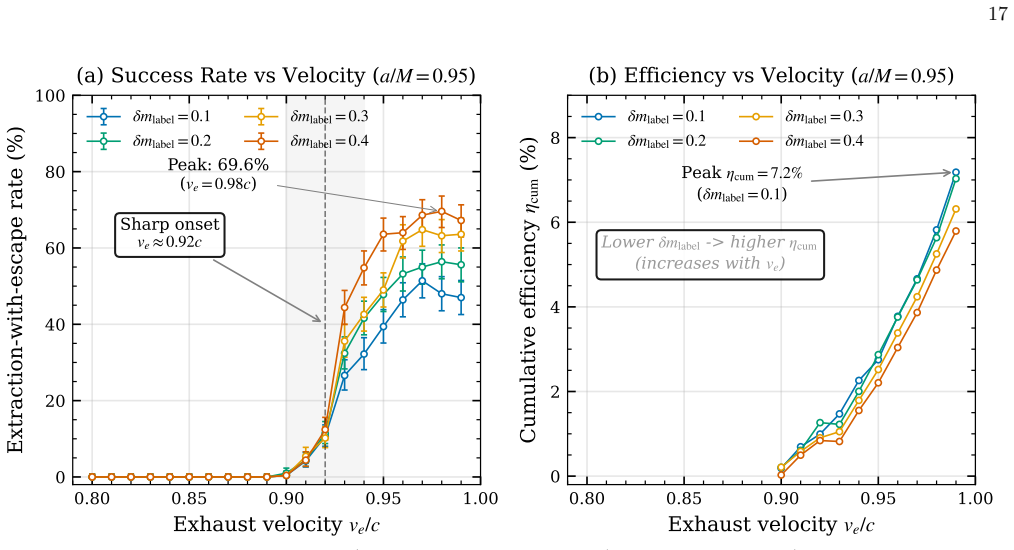
Across 320,000 simulated trajectories in the test-particle limit on a fixed Kerr background for equatorial prograde flybys, extraction with escape is rare in broad parameter scans (at most ∼1 percent) and requires high spin a/M ≳ 0.89, highly relativistic exhaust v_e ≳ 0.91c, and finely tuned initial conditions; under optimal tuning the success rate reaches ∼70 percent at a/M = 0.95, with a single periapsis impulse proving more propellant-efficient than the continuous-thrust controllers studied.
What carries the argument
Ejection of exhaust with negative Killing energy inside the ergosphere so that four-momentum conservation gives the remaining spacecraft positive energy, implemented through explicit steering prescriptions.
If this is right
- Extraction with escape occurs in at most 1 percent of trajectories over broad scans of spin, exhaust speed, and orbit parameters.
- Black-hole spin must satisfy a/M greater than or equal to 0.89.
- Exhaust velocity must satisfy v_e greater than or equal to 0.91 times the speed of light.
- Initial conditions must be finely tuned for success.
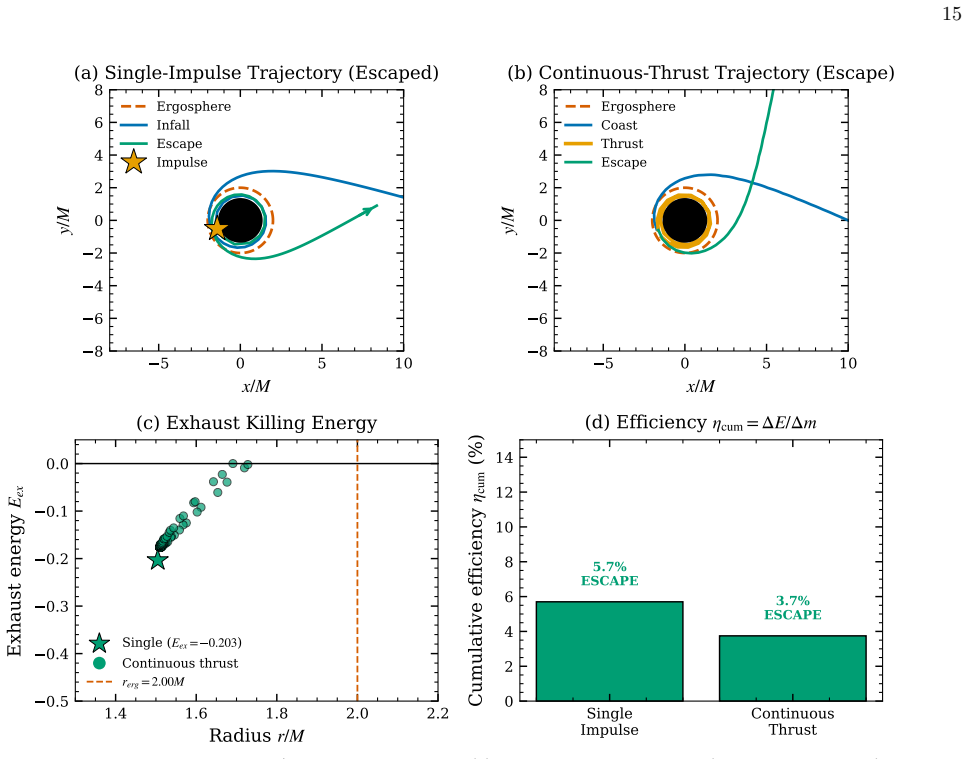
- A single impulse at periapsis uses less propellant than continuous-thrust steering.
Where Pith is reading between the lines
- Accounting for the spacecraft's own mass and the gradual loss of propellant could narrow the viable windows even further because inertia changes during the burn.
- Non-equatorial trajectories might either enlarge the set of successful paths or introduce additional constraints from frame-dragging in three dimensions.
- Practical engineering would need to target the narrow high-spin, high-velocity corner of parameter space rather than relying on generic flybys.
Load-bearing premise
The test-particle limit on a fixed Kerr background together with the chosen explicit steering prescriptions accurately represent the dynamics of a real spacecraft that must carry finite propellant mass and may experience back-reaction or non-equatorial motion.
What would settle it
A new suite of trajectories computed with finite spacecraft mass, gravitational back-reaction on the metric, or allowed non-equatorial motion would show whether the reported rarity, spin threshold, and efficiency ordering persist.
Figures
read the original abstract
We study rocket-driven Penrose extraction in the test-particle limit on a fixed Kerr background for equatorial prograde flybys under explicit steering prescriptions. A spacecraft ejects exhaust inside the ergosphere; when the exhaust attains negative Killing energy, the remaining spacecraft gains energy by 4-momentum conservation. Across 320{,}000 simulated trajectories spanning black-hole spin, exhaust velocity, and orbital parameters, extraction with escape is rare in broad parameter scans (at most ${\sim}1\%$) and requires high spin ($a/M\gtrsim 0.89$), highly relativistic exhaust ($v_e\gtrsim 0.91c$), and finely tuned initial conditions. Under optimal tuning the success rate reaches ${\sim}70\%$ at $a/M = 0.95$. For representative escape trajectories, a single periapsis impulse is more propellant-efficient than the continuous-thrust controllers studied here. All quoted thresholds are empirical and specific to the orbit family, prior, and steering protocol studied.
Editorial analysis
A structured set of objections, weighed in public.
Referee Report
Summary. The manuscript numerically investigates rocket-driven Penrose extraction in the test-particle limit on a fixed Kerr background for equatorial prograde flybys under explicit steering prescriptions. Across 320,000 simulated trajectories spanning black-hole spin, exhaust velocity, and orbital parameters, extraction with escape is found to be rare (at most ~1%) in broad scans, requiring high spin (a/M ≳ 0.89), highly relativistic exhaust (v_e ≳ 0.91c), and finely tuned initial conditions; under optimal tuning the success rate reaches ~70% at a/M = 0.95. A single periapsis impulse is reported as more propellant-efficient than the continuous-thrust controllers studied.
Significance. If the numerical results hold within the stated scope, the work supplies quantitative empirical bounds showing that rocket-assisted Penrose extraction is rare and highly sensitive to parameters, which is useful for assessing the viability of energy-extraction mechanisms. The direct integration of 320,000 trajectories with explicit parameter scans provides a reproducible, falsifiable data set that strengthens the central empirical claim; the abstract's explicit qualification that all thresholds are specific to the orbit family, prior, and protocol avoids overgeneralization.
major comments (2)
- [Results section (discussion of the 320,000-trajectory survey and reported percentages)] Results section (discussion of the 320,000-trajectory survey and reported percentages): the success rates (~1% in broad scans and ~70% under optimal tuning) are stated without error bars, confidence intervals, or binomial uncertainty estimates; given the finite sampling and the centrality of these figures to the rarity conclusion, this omission weakens the precision of the quantitative claims.
- [Methods section (steering prescriptions and trajectory integration)] Methods section (steering prescriptions and trajectory integration): the rarity thresholds depend on the specific explicit steering laws chosen; although the abstract qualifies the results as protocol-specific, no quantitative sensitivity tests to modest variations in the controllers are provided, leaving open whether the ~1% upper bound is robust to reasonable changes in the steering implementation.
minor comments (1)
- [Abstract and results] Abstract and results: the approximate symbol is rendered inconsistently as ∼ versus ~; uniform notation would improve readability.
Simulated Author's Rebuttal
We thank the referee for the positive assessment and the recommendation for minor revision. We address each major comment below.
read point-by-point responses
-
Referee: Results section (discussion of the 320,000-trajectory survey and reported percentages): the success rates (~1% in broad scans and ~70% under optimal tuning) are stated without error bars, confidence intervals, or binomial uncertainty estimates; given the finite sampling and the centrality of these figures to the rarity conclusion, this omission weakens the precision of the quantitative claims.
Authors: We agree that including uncertainty estimates would improve the precision of the reported success rates. In the revised manuscript we will add binomial confidence intervals (using the Wilson score interval) to the percentages quoted in the Results section, computed from the number of successful trajectories in each parameter bin or scan. With a total of 320,000 trajectories the statistical uncertainties are modest, but reporting them explicitly will strengthen the quantitative claims. revision: yes
-
Referee: Methods section (steering prescriptions and trajectory integration): the rarity thresholds depend on the specific explicit steering laws chosen; although the abstract qualifies the results as protocol-specific, no quantitative sensitivity tests to modest variations in the controllers are provided, leaving open whether the ~1% upper bound is robust to reasonable changes in the steering implementation.
Authors: We agree that the ~1% upper bound is tied to the particular explicit steering prescriptions. Although the abstract already qualifies all thresholds as protocol-specific, we will revise the Methods section to include an expanded discussion that more prominently cautions readers against generalizing the rarity result beyond the controllers implemented here. A full quantitative sensitivity study would require substantial additional simulations and is therefore left for future work; the revision will frame this explicitly as a limitation of the present study. revision: partial
Circularity Check
No significant circularity
full rationale
The paper's central results are empirical counts of successful extraction trajectories obtained by direct numerical integration of the Kerr geodesic equations under explicit steering laws. No parameters are fitted to a data subset and then relabeled as predictions; success rates (e.g., ~1% in broad scans, ~70% under optimal tuning) are simple tallies from 320,000 independent simulations. The test-particle limit and equatorial prograde family are modeling choices stated up front, not derived from the output statistics. No self-citations, uniqueness theorems, or ansatze are used to justify the reported rarity thresholds. The derivation chain reduces to standard conserved quantities (Killing energy, angular momentum) plus 4-momentum conservation at exhaust ejection, all independent of the final success-rate numbers.
Axiom & Free-Parameter Ledger
free parameters (2)
- black-hole spin a/M
- exhaust velocity v_e
axioms (2)
- standard math Spacetime is described by the Kerr metric
- domain assumption Test-particle limit applies
Lean theorems connected to this paper
-
IndisputableMonolith/Foundation/RealityFromDistinction.leanreality_from_one_distinction unclear?
unclearRelation between the paper passage and the cited Recognition theorem.
Across 320,000 simulated trajectories spanning black-hole spin, exhaust velocity, and orbital parameters, extraction with escape is rare in broad parameter scans (at most ∼1%) and requires high spin (a/M≳0.89), highly relativistic exhaust (v_e≳0.91c), and finely tuned initial conditions.
-
IndisputableMonolith/Cost/FunctionalEquation.leanwashburn_uniqueness_aczel unclear?
unclearRelation between the paper passage and the cited Recognition theorem.
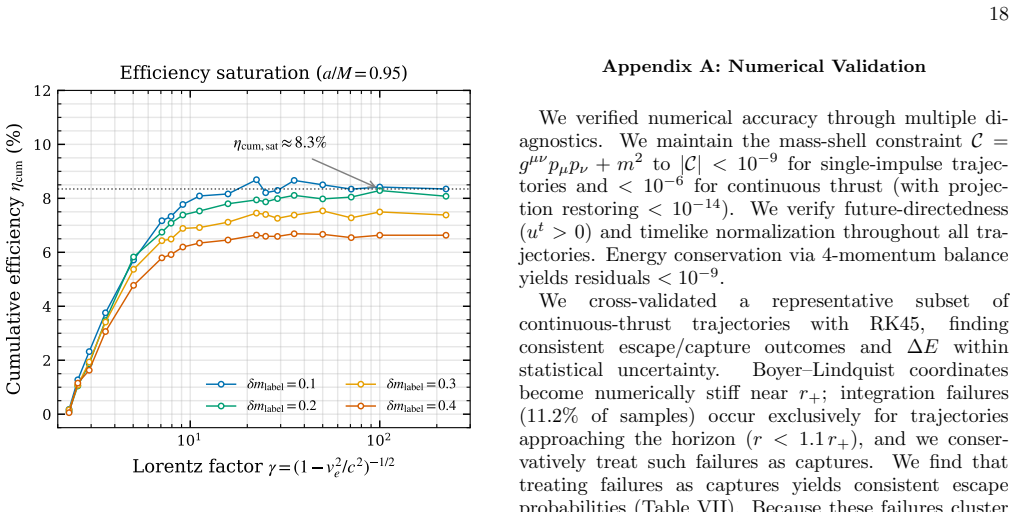
The cumulative efficiency over the maneuver is: η_cum = (E_f − E_0)/(m_0 − m_f) = ΔE/Δm.
What do these tags mean?
- matches
- The paper's claim is directly supported by a theorem in the formal canon.
- supports
- The theorem supports part of the paper's argument, but the paper may add assumptions or extra steps.
- extends
- The paper goes beyond the formal theorem; the theorem is a base layer rather than the whole result.
- uses
- The paper appears to rely on the theorem as machinery.
- contradicts
- The paper's claim conflicts with a theorem or certificate in the canon.
- unclear
- Pith found a possible connection, but the passage is too broad, indirect, or ambiguous to say the theorem truly supports the claim.
Reference graph
Works this paper leans on
-
[1]
The decay occurs inside the ergosphere:r + < r < rerg
-
[2]
The captured particle has negative Killing energy: E2 <0
-
[3]
The escaping fragment follows a geodesic that reaches spatial infinity; for a massive particle, this requires specific energyE 1/m1 >1 (unbound) to- gether with an allowed radial turning-point struc- ture. Positive total energyE 1 >0 alone is insuf- ficient, since positive-energy bound orbits exist in Kerr. A necessary condition forE 2 <0 is that the frag...
-
[4]
Ejects mass at exhaust velocityv e (in the space- craft’s rest frame)
-
[5]
Chooses a thrust orientation such that the exhaust carries retrograde angular momentum (L z,ex <0)
-
[6]
extraction-with-escape success,
Inside the ergosphere, the exhaust can then have Eex <0, transferring energy to the remaining spacecraft. Conceptually, each infinitesimal exhaust element plays the role of the captured negative-energy fragment in the classical single-decay, while the remaining spacecraft plays the role of the escaping fragment; the rocket engine provides control over the...
-
[7]
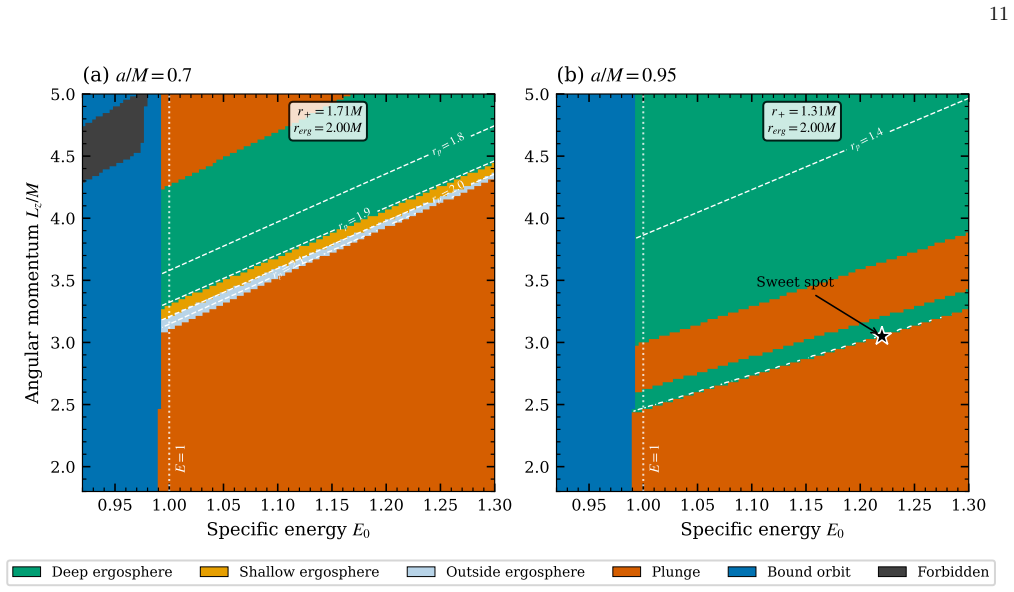
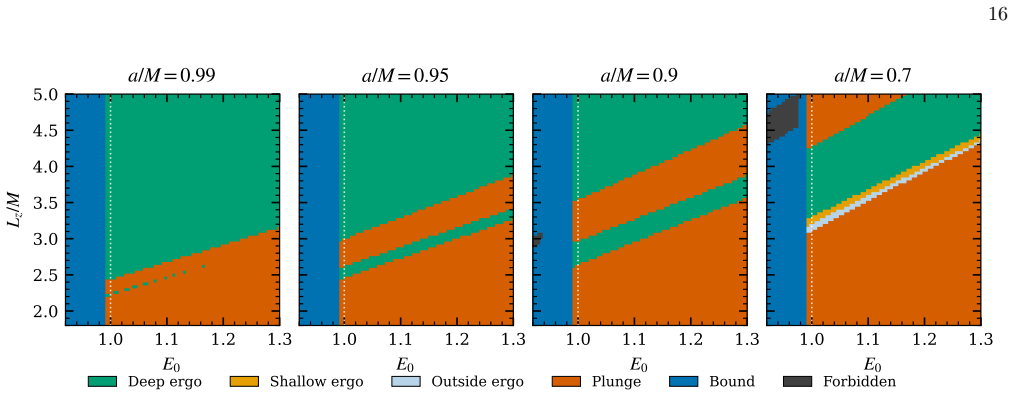
and retrograde (L z <0) conditions to map the fail- ure boundaries around the mission-relevant prograde un- 11 0.95 1.00 1.05 1.10 1.15 1.20 1.25 1.30 Specific energy E0 2.0 2.5 3.0 3.5 4.0 4.5 5.0Angular momentum Lz/M r+ = 1.71M rerg = 2.00M E = 1 (a) a/M = 0.7 rp=1.8 rp=1.9 rp=2.0 rp=2.1 0.95 1.00 1.05 1.10 1.15 1.20 1.25 1.30 Specific energy E0 2.0 2.5...
work page 1934
-
[8]
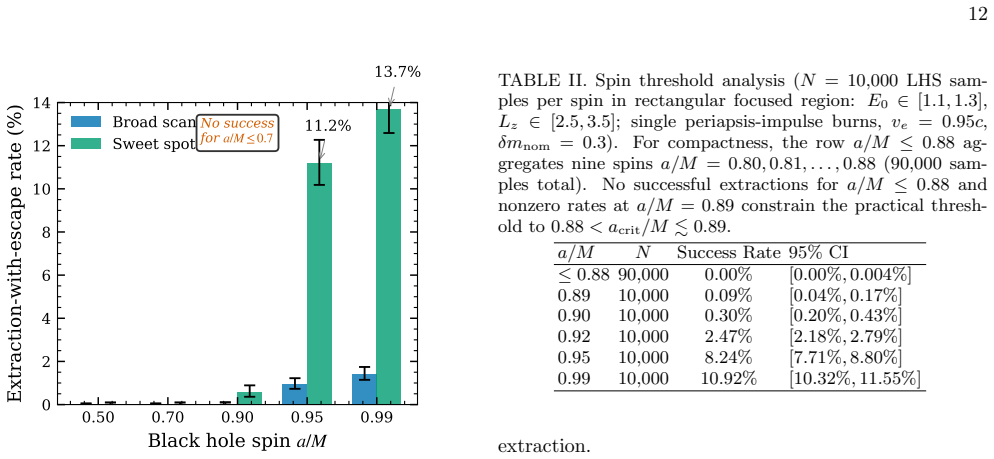
Broad Parameter Study We performed systematic parameter sweeps across a broad (E 0, Lz) domain for five spin values:E 0 ∈ [0.95,2.0],L z ∈[−3.0,6.0], using an 80×80 grid (6,400 samples per spin). We choose this domain to encompass all orbits from marginally bound (E 0 ≈1) to moderately relativistic (E 0 = 2), and from strongly retrograde to strongly progr...
-
[9]
,0.88 plusa/M∈ {0.89,0.90,0.92,0.95,0.99}, with 10,000 LHS sam- ples per spin in the focused region
Spin Threshold Analysis To precisely characterize the spin depen- dence, we performed a sweep over 14 spin val- ues:a/M= 0.80,0.81, . . . ,0.88 plusa/M∈ {0.89,0.90,0.92,0.95,0.99}, with 10,000 LHS sam- ples per spin in the focused region. Table II shows the results. Across this spin threshold sweep (140,000 additional LHS trajectories, separate from the m...
-
[10]
Focused Sweet-Spot Study We define the “sweet spot” as the region of (E 0, Lz) space corresponding to deep-ergosphere flybys with escape-capable angular momentum, identified from the orbit classification in Fig. 1. Physically, this is the inter- section of two constraints: (i) periapsis deep enough in- side the ergosphere forE ex <0 to be robustly achieva...
-
[11]
R. Penrose and R. M. Floyd, Extraction of rotational energy from a black hole, Nature Physical Science229, 177 (1971)
work page 1971
-
[12]
D. Christodoulou, Reversible and irreversible transfor- mations in black-hole physics, Physical Review Letters 25, 1596 (1970)
work page 1970
-
[13]
J. M. Bardeen, W. H. Press, and S. A. Teukolsky, Ro- tating black holes: locally nonrotating frames, energy extraction, and scalar synchrotron radiation, The Astro- physical Journal178, 347 (1972)
work page 1972
-
[14]
R. M. Wald, Energy limits on the penrose process, The Astrophysical Journal191, 231 (1974)
work page 1974
- [15]
-
[16]
M. Ba˜ nados, J. Silk, and S. M. West, Kerr black holes as particle accelerators to arbitrarily high energy, Physical review letters103, 111102 (2009)
work page 2009
- [17]
- [18]
-
[19]
J. D. Schnittman, Revised upper limit to energy extrac- tion from a kerr black hole, Physical Review Letters113, 261102 (2014)
work page 2014
-
[20]
E. Leiderschneider and T. Piran, Maximal efficiency of the collisional penrose process, Physical Review D93, 20 043015 (2016)
work page 2016
-
[21]
R. D. Blandford and R. L. Znajek, Electromagnetic ex- traction of energy from kerr black holes, Monthly Notices of the Royal Astronomical Society179, 433 (1977)
work page 1977
-
[22]
A. Tchekhovskoy, R. Narayan, and J. C. McKinney, Effi- cient generation of jets from magnetically arrested accre- tion on a rapidly spinning black hole, Monthly Notices of the Royal Astronomical Society: Letters418, L79 (2011)
work page 2011
-
[23]
L. Comisso and F. A. Asenjo, Magnetic reconnection as a mechanism for energy extraction from rotating black holes, Physical Review D103, 023014 (2021)
work page 2021
-
[24]
S. Koide and K. Arai, Energy extraction from a rotating black hole by magnetic reconnection in the ergosphere, The Astrophysical Journal682, 1124 (2008)
work page 2008
-
[25]
Chandrasekhar,The Mathematical Theory of Black Holes(Clarendon Press, 1983)
S. Chandrasekhar,The Mathematical Theory of Black Holes(Clarendon Press, 1983)
work page 1983
-
[26]
M. Bhat, S. Dhurandhar, and N. Dadhich, Energetics of the kerr-newman black hole by the penrose process, Journal of Astrophysics and Astronomy6, 85 (1985)
work page 1985
discussion (0)
Sign in with ORCID, Apple, or X to comment. Anyone can read and Pith papers without signing in.