Scattering-state theory of open Floquet lattices: transfer matrices, branch openness, and robust asymmetry
Pith reviewed 2026-05-16 10:32 UTC · model grok-4.3
The pith
The integrated left-right transmission asymmetry in open Floquet lattices equals the net chirality of an isolated Floquet band.
A machine-rendered reading of the paper's core claim, the machinery that carries it, and where it could break.
Core claim
We establish a scattering-state theory for open one-dimensional Floquet lattices based on a frequency-domain transfer-matrix formulation. For real quasienergy the conjugate-symplectic structure separates bulk Floquet-Bloch modes into propagating and evanescent sectors. Branch-resolved weights p_μ are defined and proven equal to the escape probability of a wave packet on that branch. In the open geometries considered, true bound trapping is nongeneric so p_μ equals one for generic parameters. Consequently the integrated left-right transmission asymmetry reduces to the net chirality and winding contribution of an isolated Floquet band, making the accumulated asymmetry plateau the robust topolg
What carries the argument
Branch weights p_μ defined from how incoming states populate deep-bulk propagating branches; these weights equal escape probabilities and equal one generically because of branch openness.
If this is right
- Long-sample transport is governed by deep-bulk branch populations rather than boundary-sensitive interference.
- The integrated asymmetry reduces exactly to the winding contribution of the Floquet band.
- The accumulated asymmetry plateau, not the detailed transmission line shape, serves as the robust topological observable.
- A spatially adiabatic boundary functions only as a transparent benchmark for resolving branch structure.
Where Pith is reading between the lines
- The same transfer-matrix separation of propagating branches could be applied to two-dimensional or three-dimensional open Floquet systems to extract analogous robust asymmetries.
- Experimental platforms with driven optical lattices or superconducting circuits could directly image the asymmetry plateau to read out band winding without adiabatic boundary engineering.
- The generic openness result suggests that similar scattering formulations may simplify topological diagnostics in other periodically driven open systems where boundary effects usually complicate transport.
Load-bearing premise
True bound trapping of propagating branches is nongeneric, so that p_μ equals one for generic parameters in the open geometries considered.
What would settle it
Measure the integrated left-right asymmetry in a sufficiently long open Floquet lattice and check whether its plateau value deviates from the independently computed winding number of the isolated band.
Figures


read the original abstract
We establish a scattering-state theory for open one-dimensional Floquet lattices based on a frequency-domain transfer-matrix formulation. For real quasienergy, the conjugate-symplectic structure of the transfer matrix separates bulk Floquet--Bloch modes into propagating and evanescent sectors, enabling a consistent treatment of interface matching and the shrinking-window smoothing required for long-sample transport. By tracking how incoming states populate deep-bulk propagating branches, we define branch-resolved weights \(p_{\mu\alpha}\) and total branch weights \(p_\mu\). We prove that \(p_\mu\) equals the escape probability of a wave packet initialized on the corresponding branch. In the open geometries considered here, true bound trapping of propagating branches is nongeneric, yielding \(p_\mu=1\) for generic parameters. This generic openness implies that long-sample transport is governed by deep-bulk branch populations rather than by boundary-sensitive interference. Consequently, the integrated left--right transmission asymmetry reduces to the net chirality, and hence the winding contribution, of an isolated Floquet band. The robust topological observable is therefore the accumulated asymmetry plateau, not the detailed transmission line shape, which remains strongly reshaped by nonadiabatic boundaries. A spatially adiabatic boundary serves only as a transparent benchmark for resolving the branch structure, not as the origin of the topological response.
Editorial analysis
A structured set of objections, weighed in public.
Referee Report
Summary. The manuscript develops a scattering-state theory for open one-dimensional Floquet lattices using a frequency-domain transfer-matrix formulation. For real quasienergy, the conjugate-symplectic structure of the transfer matrix separates bulk Floquet-Bloch modes into propagating and evanescent sectors. Branch-resolved weights p_{μα} and total branch weights p_μ are defined, with explicit proofs that p_μ equals the escape probability of a wave packet initialized on the corresponding branch. In the open geometries considered, true bound trapping of propagating branches is nongeneric, yielding p_μ=1 for generic parameters. This implies that long-sample transport is governed by deep-bulk branch populations, so that the integrated left-right transmission asymmetry reduces exactly to the net chirality and winding number of an isolated Floquet band; the robust topological observable is therefore the accumulated asymmetry plateau rather than the detailed transmission line shape.
Significance. If the central claims hold, the work establishes a direct, parameter-free connection between a measurable transport asymmetry in open Floquet systems and a bulk topological invariant (the winding number of an isolated band). The explicit proofs relating branch weights to escape probabilities and the reduction of asymmetry to winding number constitute a clear strength, providing a falsifiable and reproducible link that survives nonadiabatic boundaries. This framework could serve as a practical benchmark for experiments on driven open lattices.
major comments (1)
- [Abstract] Abstract and the section introducing branch weights: the claim that true bound trapping of propagating branches is nongeneric (yielding p_μ=1) is load-bearing for the reduction of integrated asymmetry to the winding number. While stated explicitly, the manuscript would be strengthened by a concise argument or eigenvalue analysis showing why this holds generically in the open geometries, rather than leaving it as an assumption.
minor comments (1)
- [Notation] The notation p_{μα} (branch-resolved) versus p_μ (total) is introduced without an early defining equation; a compact summary relation placed before the proof of the escape-probability equivalence would improve clarity.
Simulated Author's Rebuttal
We thank the referee for the supportive summary and the recommendation of minor revision. We address the single major comment below.
read point-by-point responses
-
Referee: [Abstract] Abstract and the section introducing branch weights: the claim that true bound trapping of propagating branches is nongeneric (yielding p_μ=1) is load-bearing for the reduction of integrated asymmetry to the winding number. While stated explicitly, the manuscript would be strengthened by a concise argument or eigenvalue analysis showing why this holds generically in the open geometries, rather than leaving it as an assumption.
Authors: We agree that the manuscript would benefit from an explicit argument establishing the nongeneric character of true bound trapping. In the revised version we will add a concise eigenvalue analysis immediately following the definition of the branch weights p_μ. The argument shows that, for the open boundary conditions employed, the transfer-matrix eigenvalues associated with propagating branches lie exactly on the unit circle only on a measure-zero subset of parameter space; the openness of the system generically imparts a small imaginary component that moves these eigenvalues off the circle. Consequently p_μ=1 holds for generic parameters, justifying the reduction of the integrated asymmetry to the winding number of an isolated band. revision: yes
Circularity Check
No significant circularity; central reduction follows from independent transfer-matrix proof
full rationale
The paper derives the integrated left-right asymmetry equaling the winding number of an isolated Floquet band by first proving that branch weights p_μ equal escape probabilities from the conjugate-symplectic transfer-matrix structure, then showing that true bound trapping is nongeneric so p_μ=1 for generic open geometries. This reduction is obtained from the bulk band structure and wave-packet dynamics without parameter fitting inside the transport calculation or load-bearing self-citations. The topological observable is therefore extracted directly from the Floquet-Bloch modes rather than being redefined by the transport observables themselves.
Axiom & Free-Parameter Ledger
axioms (2)
- domain assumption The transfer matrix possesses conjugate-symplectic structure for real quasienergy, separating propagating and evanescent sectors.
- ad hoc to paper True bound trapping of propagating branches is nongeneric in the open geometries considered.
invented entities (1)
-
branch-resolved weights p_μα and total branch weights p_μ
no independent evidence
Lean theorems connected to this paper
-
IndisputableMonolith/Foundation/RealityFromDistinction.leanreality_from_one_distinction unclear?
unclearRelation between the paper passage and the cited Recognition theorem.
the integrated left–right transmission asymmetry reduces to the net chirality, and hence the winding contribution, of an isolated Floquet band
-
IndisputableMonolith/Foundation/AlexanderDuality.leanalexander_duality_circle_linking unclear?
unclearRelation between the paper passage and the cited Recognition theorem.
conjugate-symplectic structure of the transfer matrix separates bulk Floquet–Bloch modes into propagating and evanescent sectors
What do these tags mean?
- matches
- The paper's claim is directly supported by a theorem in the formal canon.
- supports
- The theorem supports part of the paper's argument, but the paper may add assumptions or extra steps.
- extends
- The paper goes beyond the formal theorem; the theorem is a base layer rather than the whole result.
- uses
- The paper appears to rely on the theorem as machinery.
- contradicts
- The paper's claim conflicts with a theorem or certificate in the canon.
- unclear
- Pith found a possible connection, but the passage is too broad, indirect, or ambiguous to say the theorem truly supports the claim.
Reference graph
Works this paper leans on
-
[1]
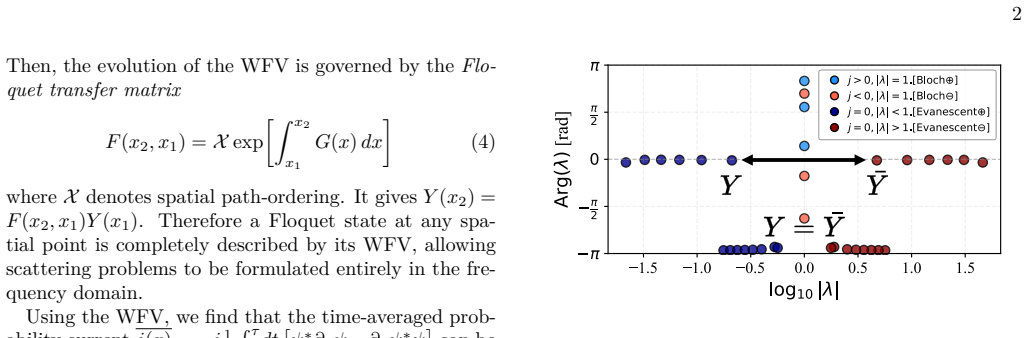
Reciprocal eigenvalue pairing: For every λ ∈ σ(F ), one has 1/λ∗ ∈ σ(F ), where σ(F ) is the spec- trum of F . Eigenvalues with |λ| ̸ = 1 come in conju- gate‑reciprocal pairs, describing left‑ and right‑decaying evanescent waves, with NE modes for each type; eigen- values on the unit circle ( |λ| = 1) are self‑reciprocal and correspond to propagating Bloc...
-
[2]
This balance is essential for constructing well‑posed scattering problems
Current‑balance: The numbers of Bloch‑wave eigenvalues with positive and negative time‑averaged cur- rent are equal, N+ = N− = NB [21, 22]. This balance is essential for constructing well‑posed scattering problems. Moreover, the eigenvectors of F obey an orthonormal- ity and completeness relation adapted to the symplectic metric. For each eigenpair (Yα, λ...
-
[3]
N. Ashcroft and N. Mermin, Solid State Physics (Holt, Rinehart and Winston, 1976)
work page 1976
-
[4]
F. Bloch, Über die quantenmechanik der elektronen in kristallgittern, Zeitschrift für Physik 52, 555–600 (1929)
work page 1929
-
[5]
R. D. L. Kronig and W. G. Penney, Quantum mechan- ics of electrons in crystal lattices, Proceedings of the Royal Society of London. Series A, Containing Papers of a Mathematical and Physical Character 130, 499–513 (1931)
work page 1931
-
[6]
A. H. Wilson, The theory of electronic semi-conductors, Proceedings of the Royal Society of London. Series A, Containing Papers of a Mathematical and Physical Char- acter 133, 458–491 (1931)
work page 1931
-
[7]
G. Floquet, Sur les équations différentielles linéaires à coefficients périodiques, Annales scientifiques de l’École normale supérieure 12, 47–88 (1883)
-
[8]
J. H. Shirley, Solution of the schrödinger equation with a hamiltonian periodic in time, Physical Review 138, B979–B987 (1965)
work page 1965
-
[9]
H. Sambe, Steady states and quasienergies of a quantum- mechanical system in an oscillating field, Physical Review A 7, 2203–2213 (1973)
work page 1973
- [10]
-
[11]
N. H. Lindner, G. Refael, and V. Galitski, Floquet topo- logical insulator in semiconductor quantum wells, Nature Physics 7, 490–495 (2011)
work page 2011
-
[12]
M. Moskalets and M. Büttiker, Floquet scattering theory of quantum pumps, Phys. Rev. B 66, 205320 (2002)
work page 2002
-
[13]
A. Emmanouilidou and L. E. Reichl, Floquet scatter- ing and classical-quantum correspondence in strong time- periodic fields, Phys. Rev. A 65, 033405 (2002)
work page 2002
- [14]
-
[15]
D. F. Martinez and L. E. Reichl, Transmission properties of the oscillating δ-function potential, Phys. Rev. B 64, 245315 (2001)
work page 2001
-
[16]
F. Kang and Q. Mengzhao, Symplectic Geometric Algo- rithms for Hamiltonian Systems (2010)
work page 2010
-
[17]
H. Weyl, The Classical Groups: Their Invariants and Representations (Princeton University Press, Princeton, NJ, 1939)
work page 1939
-
[18]
J. Pendry, Symmetry and transport of waves in one- dimensional disordered systems, Advances in Physics 43, 461–542 (1994) . 6
work page 1994
-
[19]
T. Kitagawa, E. Berg, M. Rudner, and E. Demler, Topo- logical characterization of periodically driven quantum systems, Phys. Rev. B 82, 235114 (2010)
work page 2010
-
[20]
D. J. Thouless, Quantization of particle transport, Phys. Rev. B 27, 6083 (1983)
work page 1983
-
[21]
L. Privitera, A. Russomanno, R. Citro, and G. E. San- toro, Nonadiabatic breaking of topological pumping, Phys. Rev. Lett. 120, 106601 (2018)
work page 2018
-
[22]
A conjugate symplectic matrix F is defined by the con- dition F †J F = J, which differs from the standard sym- plectic definition that utilizes the transpose operation, STJ S = J
-
[23]
See the Supplemental Material
-
[24]
V. Mehrmann, V. Noferini, F. Tisseur, and H. Xu, On the sign characteristics of hermitian matrix polynomials, Linear Algebra and its Applications 511, 328 (2016)
work page 2016
-
[25]
C. J. Fujiwara, K. Singh, Z. A. Geiger, R. Senaratne, S. V. Rajagopal, M. Lipatov, and D. M. Weld, Trans- port in floquet-bloch bands, Phys. Rev. Lett. 122, 010402 (2019)
work page 2019
-
[26]
M. Born, E. Wolf, A. B. Bhatia, P. C. Clemmow, D. Ga- bor, A. R. Stokes, A. M. Taylor, P. A. Wayman, and W. L. Wilcock, Principles of Optics: Electromagnetic Theory of Propagation, Interference and Diffraction of Light (Cambridge University Press, 1999)
work page 1999
-
[27]
C. Texier, Wigner time delay and related concepts: Ap- plication to transport in coherent conductors, Physica E: Low-dimensional Systems and Nanostructures 82, 16 (2016), frontiers in quantum electronic transport - In memory of Markus Büttiker
work page 2016
-
[28]
W. Rudin, Principles of Mathematical Analysis , Interna- tional series in pure and applied mathematics (McGraw- Hill, 1976)
work page 1976
-
[29]
M. S. Rudner, N. H. Lindner, E. Berg, and M. Levin, Anomalous edge states and the bulk-edge correspondence for periodically driven two-dimensional systems, Phys. Rev. X 3, 031005 (2013)
work page 2013
-
[30]
M. H. Kolodrubetz, F. Nathan, S. Gazit, T. Morimoto, and J. E. Moore, Topological floquet-thouless energy pump, Phys. Rev. Lett. 120, 150601 (2018)
work page 2018
-
[31]
D. Marcuse, Mode conversion caused by surface imper- fections of a dielectric slab waveguide, Bell System Tech- nical Journal 48, 3187–3215 (1969)
work page 1969
-
[32]
Marcuse, Theory of Dielectric Optical Waveguides (El- sevier, 1991)
D. Marcuse, Theory of Dielectric Optical Waveguides (El- sevier, 1991)
work page 1991
- [33]
-
[34]
D. Schrader, S. Kuhr, W. Alt, M. Müller, V. Gomer, and D. Meschede, An optical conveyor belt for single neutral atoms, Applied Physics B 73, 819–824 (2001)
work page 2001
-
[35]
C. M. Fabre, P. Cheiney, G. L. Gattobigio, F. Vermersch, S. Faure, R. Mathevet, T. Lahaye, and D. Guéry-Odelin, Realization of a distributed bragg reflector for propagat- ing guided matter waves, Phys. Rev. Lett. 107, 230401 (2011)
work page 2011
-
[36]
Datta, Electronic Transport in Mesoscopic Systems (Cambridge University Press, 1995)
S. Datta, Electronic Transport in Mesoscopic Systems (Cambridge University Press, 1995)
work page 1995
-
[37]
R. Landauer, Spatial variation of currents and fields due to localized scatterers in metallic conduction, IBM J. Res. Dev. 1, 223 (1957)
work page 1957
-
[38]
R. Landauer, Electrical resistance of disordered one- dimensional lattices, Philosophical Magazine 21, 863–867 (1970)
work page 1970
-
[39]
Büttiker, Four-terminal phase-coherent conductance, Phys
M. Büttiker, Four-terminal phase-coherent conductance, Phys. Rev. Lett. 57, 1761 (1986)
work page 1986
-
[40]
P. W. Brouwer, Scattering approach to parametric pump- ing, Phys. Rev. B 58, R10135 (1998)
work page 1998
-
[41]
N. E. Fletcher, J. Ebbecke, T. J. B. M. Janssen, F. J. Ahlers, M. Pepper, H. E. Beere, and D. A. Ritchie, Quan- tized acoustoelectric current transport through a static quantum dot using a surface acoustic wave, Phys. Rev. B 68, 245310 (2003)
work page 2003
-
[42]
J. M. Shilton, D. R. Mace, V. I. Talyanskii, M. Y. Sim- mons, M. Pepper, A. C. Churchill, and D. A. Ritchie, Experimental study of the acoustoelectric effects in gaas- algaas heterostructures, Journal of Physics: Condensed Matter 7, 7675–7685 (1995)
work page 1995
-
[43]
J. M. Shilton, D. R. Mace, V. I. Talyanskii, M. Pepper, M. Y. Simmons, A. C. Churchill, and D. A. Ritchie, Ef- fect of spatial dispersion on acoustoelectric current in a high-mobility two-dimensional electron gas, Phys. Rev. B 51, 14770 (1995)
work page 1995
-
[44]
J. M. Shilton, V. I. Talyanskii, M. Pepper, D. A. Ritchie, J. E. F. Frost, C. J. B. Ford, C. G. Smith, and G. A. C. Jones, High-frequency single-electron transport in a quasi-one-dimensional gaas channel induced by sur- face acoustic waves, Journal of Physics: Condensed Mat- ter 8, L531–L539 (1996)
work page 1996
-
[45]
Zhang, Symplectic inner products of eigenvectors of complex symplectic matrix , MathOverflow (2025)
R. Zhang, Symplectic inner products of eigenvectors of complex symplectic matrix , MathOverflow (2025)
work page 2025
-
[46]
H. E. Haber, What is the group of conjugate symplectic matrices (2017)
work page 2017
-
[47]
A. S. Glasser, Gauge Structure in Algorithms for Plasma Physics (Princeton University, 2022)
work page 2022
-
[48]
J. F. Cornwell, Group theory in physics: An introduction (Academic press, 1997). 7 Supplemental Materials A. Conjugate Symplectic Group For all the conjugate symplectic (CSp) matrix S in the set G which satisfies the condition S†J S = J, (16) we can prove that the set G is a group. Here J is the same signature matrix in the normal symplectic matrix
work page 1997
-
[49]
Identity It is straightforward to check that the Identity I satisfies the condition I †J I = J
-
[50]
Closure For any two elements S1 and S2 in the set G, let S = S1S2 here and we have S†J S = (S1S2)†J(S1S2) = S† 2S† 1J S1S2 = J. (17)
-
[51]
Associativity For any three elements S1, S2 and S3, with the matrix multiplication we have S1S2S3 = (S1S2)S3 = S1(S2S3). (18)
-
[52]
(19) Furthermore, it can be proved that the CSp group G is a Lie group
Inverse element For any element S in the set G, then the inverse element S−1 satisfies S†J S = J → J = (S†)−1J S−1 → (S−1)†J S−1 = J. (19) Furthermore, it can be proved that the CSp group G is a Lie group. It is similar to the symplectic group and change the condition ’Transpose’ to ’Hermitian Conjugate’ . Then, we follow the procedure in Ref. [ 44, 45] t...
-
[53]
the generator G(x) satisfies the infinitesimal CSp condition G†J + J G = 0
-
[54]
Condition 1: CSp property of the generator
the numerical scheme used to integrate the generator is symplectic, so that the resulting transfer matrix satisfies F †J F = J. Condition 1: CSp property of the generator. In our problem the wave-function vector satisfies d dx Y (x) = G(x)Y (x), G (x) = 0 I M (x) 0 . (40) Substituting this form into the infinitesimal CSp condition shows that it reduces to...
-
[55]
Replace each propagating factor eikj L by an independent phase variable eiθj , forming Tµν({θj})
-
[56]
Draw S independent samples {θ(s)}S s=1 uniformly from [0, 2π)2NB
-
[57]
Estimate the smoothed element by the sample mean b¯T µν = Y † µ J Yµ Y † ν J Yν 1 S SX s=1 Tµν({θ(s)}) 2 . G: Floquet Adiabatic Boundary Consider two Floquet lattices parameterized by ξ = 0 and ξ = 1 , respectively. We construct a continuous path in the parameter space where ξ varies from 0 to 1, with each ξ corresponding to a Floquet lattice whose potent...
discussion (0)
Sign in with ORCID, Apple, or X to comment. Anyone can read and Pith papers without signing in.