REVIEW 3 major objections 4 minor 49 references
Single-crystal neutron scattering on hydrothermally grown Ce2Sn2O7 shows a diffuse pattern almost identical to classical dipolar spin ice, falsifying the nearest-neighbor XYZ model's predicted all-in-all-out order near 50 mK.
Reviewed by Pith at T0; open to challenge. T0 means a machine referee read the full paper against a public rubric. the ladder, T0–T4 →
T0 review · deepseek-v4-flash
2026-08-03 07:11 UTC pith:LGHB4JR2
load-bearing objection Strong new single-crystal data, but the claimed falsification of the NN XYZ model is perched on the predicted T_N itself. the 3 major comments →
Observation of Dipolar Spin-ice--like Correlations in the Quantum Spin Ice Candidate Ce₂Sn₂O₇
The pith
A machine-rendered reading of the paper's core claim, the machinery that carries it, and where it could break.
Core claim
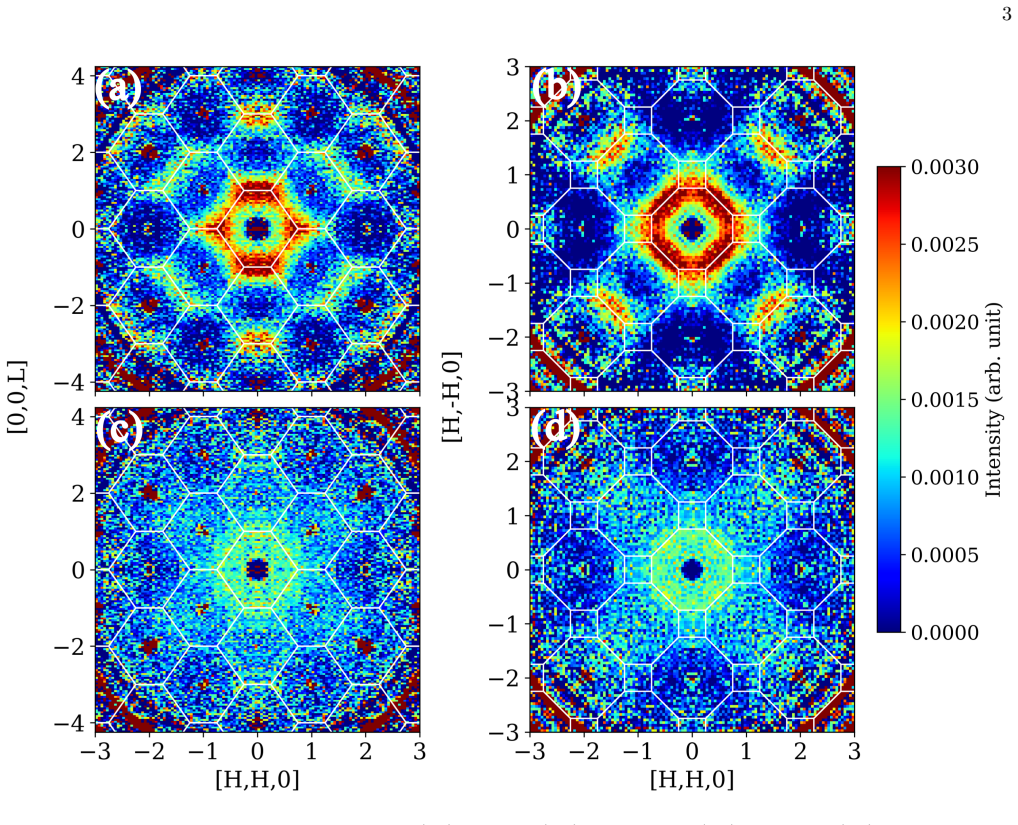
The central discovery is that the diffuse magnetic neutron scattering from Ce2Sn2O7, measured on high-quality hydrothermally grown single crystals, has a structured momentum dependence with intensity along the face-centered cubic Brillouin zone boundaries, nearly matching that of the classical dipolar spin ice Dy2Ti2O7. At 50 mK—the vicinity of the predicted ordering temperature—there are no magnetic Bragg peaks and no short-range all-in-all-out correlations. The authors take this as unambiguous evidence that the nearest-neighbor XYZ model is inadequate: its predicted all-in-all-out ground state does not form, and further-neighbor interactions must be non-perturbatively important. They also
What carries the argument
The load-bearing observable is the momentum-resolved diffuse scattering structure factor. Its fingerprint—intensity concentrated on Brillouin zone boundaries rather than the snowflake-like rods with pinch points expected for a quasi-degenerate ice manifold—is what distinguishes the measured correlations. The comparison to Dy2Ti2O7 provides the quantitative connection: cuts along [0,0,L] and [H,H,2.375] show nearly identical line shapes and relative intensities, indicating that the same organizing principle (long-range interactions lifting the ice-rule degeneracy) is at work. The absence of all-in-all-out Bragg peaks at wave vectors such as (220) and (113) is the falsification event.
Load-bearing premise
The ordering-temperature prediction depends on exchange couplings that were only inferred from bulk measurements; if those couplings are wrong, the missing all-in-all-out order near 50 mK does not by itself disprove the nearest-neighbor model.
What would settle it
A neutron diffraction measurement on the same high-quality Ce2Sn2O7 crystals that resolves magnetic Bragg peaks at the all-in-all-out wave vectors (220) and (113) below 50 mK would falsify the paper's central negative claim. The same experiment repeated after an independent determination of the exchange couplings from the magnon spectrum would show whether the model or the assumed parameters were at fault.
If this is right
- The nearest-neighbor XYZ model is not the right starting point for Ce2Sn2O7; any credible Hamiltonian must include further-neighbor exchange and/or dipolar terms on the same footing as nearest-neighbor couplings.
- The low-energy spin correlations in Ce2Sn2O7 are organized by the same physics as classical dipolar spin ice, despite a two-order-of-magnitude weaker magnetic moment and sizeable transverse exchange.
- Similar Brillouin-zone-boundary scattering in Ce2Zr2O7 indicates that further-neighbor interactions are relevant across the Ce2X2O7 family, though the underlying pseudospin character may differ.
- The failure to detect all-in-all-out order means the predicted transition near 50 mK is either absent or moved outside the probed temperature range, and bulk measurements previously analyzed within the XYZ model need to be re-evaluated.
- Polarized-neutron and inelastic single-crystal experiments are the natural next steps to test whether the zone-boundary pattern hides an ice-rule Coulomb phase.
Where Pith is reading between the lines
- Inference: if further-neighbor interactions are as dominant as the data suggest, the notion of a 'proximate quantum spin ice' tuned by nearest-neighbor couplings needs rethinking; the low-energy manifold may be an emergent classical-like ice governed by long-range constraints, with quantum fluctuations entering only at higher energies.
- Inference: the near-perfect match with Dy2Ti2O7 implies that diffraction alone may not distinguish a classical dipolar spin ice from a quantum spin ice with a photon-like structure factor; disentangling them will require measuring the dynamical response, not just the static structure factor.
- Inference: a testable extension is to compare the temperature evolution of the zone-boundary intensity with the classical dipolar spin ice prediction; a simple thermal population of the ice manifold would support a classical description, whereas quantum renormalization or a gap would point to genuine quantum spin ice behavior.
- Inference: the hydrothermal growth route may be the key enabler; applying the same sample-quality standard to Ce2Hf2O7 and Ce2Zr2O7 could reveal whether their broader diffuse scattering is intrinsic or broadened by structural defects.
Editorial analysis
A structured set of objections, weighed in public.
Referee Report
Summary. The paper reports single-crystal diffuse neutron scattering measurements on hydrothermally grown Ce2Sn2O7, a candidate quantum spin ice material. The authors observe highly structured diffuse scattering concentrated along Brillouin zone boundaries, closely resembling the classical dipolar spin ice Dy2Ti2O7. They argue that this pattern is incompatible with the predictions of the nearest-neighbor XYZ model proposed in Ref. [38], which for their parameters predicts an all-in-all-out (AIAO) ordered state with T_N ≈ 50 mK. Since no AIAO Bragg peaks or short-range AIAO correlations are observed near 50 mK, the authors conclude that the NN XYZ model is falsified and that further-neighbor interactions play a non-perturbative role in determining the low-energy spin correlations.
Significance. If the claims are substantiated, this is a significant result: it provides the highest-quality single-crystal diffuse scattering data on Ce2Sn2O7 to date, demonstrates a striking similarity to classical dipolar spin ice, and challenges the prevailing nearest-neighbor XYZ framework for Ce-pyrochlores. The experimental strengths are substantial: hydrothermal crystals with reduced disorder, full reciprocal-space coverage at CORELLI, symmetry averaging, explicit comparison with Ce2Zr2O7 and Nd2Zr2O7, and a careful caveat against a naive application of the generalized dipolar spin ice model. The paper's main weakness is not the data quality but the logical structure of the central falsification argument, which relies on a null measurement at the predicted transition temperature rather than below it.
major comments (3)
- [Discussions and Conclusions] The central falsification claim is that the NN XYZ model of Ref. [38] predicts AIAO order with T_N ≈ 50 mK and that the absence of AIAO order at the experimental temperature, which the text repeatedly states is 'close to the predicted T_N', refutes the model. This reasoning is not valid as stated: for a continuous or weakly first-order transition, long-range order exists only below T_N, so a null Bragg measurement at T ≈ T_N is the expected outcome. The paper must either reach temperatures below T_N or provide a quantitative prediction of the diffuse scattering at 50 mK within the NN XYZ model and show that the observed pattern is incompatible with it. As written, the abstract's 'unambiguously demonstrate the inadequacy' overstates what the data can prove.
- [Discussions, Fig. 3] The statement that no 'broad peaks consistent with AIAO order/correlations' are observed is qualitative. The authors reference NLC and classical Monte Carlo calculations [47,48] that predict broad AIAO peaks on top of a snowflake pattern, but they do not present a direct calculation of the expected S(Q) for the specific Ref. [38] parameters at 50 mK, nor do they quantitatively compare such a prediction with their data. Without this comparison, the absence of visible broad peaks cannot be distinguished from insufficient intensity, from the expected critical scattering at T_N, or from a small ordered moment. A model calculation of the predicted diffuse scattering and a residual/difference plot are needed.
- [Discussions] The parameters {J~x>0, J~y≈0, J~z≈ -0.3J~x, θ≈0.2π} are taken from bulk measurements modeled within the XYZ framework in Ref. [38], as the text acknowledges: 'whose exchange parameters ... were only established through modeling of bulk measurements'. The null-result falsification is therefore contingent on the accuracy of these externally derived parameters. If, for example, |J~z| is smaller or θ differs from the quoted values, the predicted T_N could fall below the experimental base temperature, making the absence of order consistent with the NN model. The authors should provide a sensitivity analysis of T_N and the ground state as a function of J~z/J~x and θ, or derive independent constraints from the present diffuse scattering data.
minor comments (4)
- [Abstract and Conclusions] The phrases 'unambiguously demonstrate the inadequacy' and 'falsifying its central prediction' are stronger than the evidence supports given the T ≈ T_N issue; the conclusions should be rephrased to reflect a challenge to the NN model rather than a definitive falsification.
- [Fig. 3(e,f)] The claim that the Q-dependence is 'almost identical' to Dy2Ti2O7 is based on visual comparison of normalized cuts. Including a quantitative measure, such as a fitted scale factor plus residual, or at least error bars on the Ce2Sn2O7 cuts, would make the comparison more convincing.
- [References] Ref. [48] points to 'Fig. S12 (a) of Ref. [40]' rather than to a self-contained calculation. The relevant NLC or MC prediction should be reproduced in the supplemental material or described in sufficient detail so that the reader can evaluate the claimed incompatibility.
- [Fig. 2 caption] The sentence 'Powder rings due to aluminum sample can of the dilution insert and the copper sample mount have also been masked out in the data' reads as incomplete; likely 'aluminum sample can of the dilution insert' should be 'aluminum sample can and the dilution insert' or similar.
Circularity Check
No significant circularity: the NN XYZ model tested is an external benchmark from Ref. [38], and the new diffuse scattering data are an independent check, not a fitted input.
full rationale
The derivation is not circular. The central falsification target is the nearest-neighbour XYZ model of Ref. [38], whose exchange parameters were established by modeling bulk measurements, not from the single-crystal diffuse scattering reported here. The paper's new observable, the Q-dependence of the diffuse scattering, is therefore an independent external check on a published prediction. The comparison with Dy2Ti2O7 is also an external empirical benchmark, not a self-referential construction. Some authors overlap with Ref. [38], but that citation is not an unverified self-citation chain: it is a published, externally falsifiable model and data set, so it does not constitute circularity. One non-circular limitation should be flagged: the experiment is run at approximately 50 mK, close to the predicted T_N ~50 mK (Discussions; similar wording in Conclusions), so the absence of static AIAO Bragg peaks is arguably what one expects at a critical point and weakens the falsification claim. However, that is a logical/burden-of-proof issue, not an equivalence between input and output, and it does not raise the circularity score.
Axiom & Free-Parameter Ledger
free parameters (1)
- XYZ exchange parameters J~x, J~y, J~z, θ =
J~x>0 (scale), J~y≈0, J~z≈−0.3 J~x, θ≈0.2π
axioms (3)
- domain assumption Ce3+ in Ce2Sn2O7 is described by a dipole-octupole doublet pseudospin-1/2, with the NN interaction taking the XYZ form after local rotation by θ.
- domain assumption The exchange parameters from Ref. [38] accurately represent Ce2Sn2O7 within the NN XYZ model.
- domain assumption The diffuse scattering pattern similarity between Ce2Sn2O7 and Dy2Ti2O7 indicates similar low-energy spin correlations and interaction structure.
Cite this review
Pith. "Pith review of Observation of Dipolar Spin-ice--like Correlations in the Quantum Spin Ice Candidate Ce$_2$Sn$_2$O$_7$." pith.science (2026). https://pith.science/paper/LGHB4JR2
@misc{pith2026260120766,
  author       = {Pith},
  title        = {Pith review of: Observation of Dipolar Spin-ice--like Correlations in the Quantum Spin Ice Candidate Ce$_2$Sn$_2$O$_7$},
  year         = {2026},
  howpublished = {\url{https://pith.science/paper/LGHB4JR2}},
  note         = {Machine review of arXiv:2601.20766}
}
read the original abstract
Ce-pyrochlores, Ce$_2$X$_2$O$_7$ (X = Sn, Hf, Zr), have gained much recent attention as new quantum spin ice (QSI) ground state candidates. Although the nearest-neighbor (NN) XYZ model has been the prevailing theoretical framework, its adequacy has been questioned by bulk measurements on Ce$_2$Hf$_2$O$_7$ and Ce$_2$Zr$_2$O$_7$, suggesting the relevance of further-neighbor interactions at low temperatures. However, clearly disentangling their effects from structural disorder has been challenging with samples grown by conventional methods. Here, we overcome this limitation and report diffuse neutron scattering measurements on Ce$_2$Sn$_2$O$_7$ single crystals synthesized by hydrothermal methods, with substantially reduced structural disorder compared to our previous floating-zone-grown samples. Our results unambiguously demonstrate the inadequacy of the NN model by falsifying its central prediction for Ce$_2$Sn$_2$O$_7$ -- a transition to an all-in-all-out (AIAO) magnetic order. Importantly, we observe neither long-range nor short-range AIAO order near the predicted $\mathrm{T_N}$, indicating that further neighbor interactions must play a non-perturbative role in determining the low-temperature spin correlations in Ce$_2$Sn$_2$O$_7$. Notably, we find that the diffuse scattering in Ce$_2$Sn$_2$O$_7$ is nearly identical to that of the classical dipolar spin ice Dy$_2$Ti$_2$O$_7$, which provides key insights into the organizing principles of the low-energy manifold in the presence of such interactions.
Figures


Reference graph
Works this paper leans on
-
[1]
L. D. C. Jaubert, Topology of the vacuum, inSpin Ice, edited by M. Udagawa and L. Jaubert (Springer Interna- tional Publishing, Cham, 2021) pp. 117–141. 6
2021
-
[2]
Fennell, O
T. Fennell, O. A. Petrenko, B. F ˚ ak, S. T. Bramwell, M. Enjalran, T. Yavors’kii, M. J. P. Gingras, R. G. Melko, and G. Balakrishnan, Neutron scattering inves- tigation of the spin ice state in Dy 2Ti2O7, Phys. Rev. B 70, 134408 (2004)
2004
-
[3]
D. J. P. Morris, D. A. Tennant, S. A. Grigera, B. Klemke, C. Castelnovo, R. Moessner, C. Czternasty, M. Meiss- ner, K. C. Rule, J.-U. Hoffmann, K. Kiefer, S. Gerischer, D. Slobinsky, and R. S. Perry, Dirac Strings and Mag- netic Monopoles in the Spin Ice Dy 2Ti2O7, Science326, 411 (2009)
2009
-
[4]
Fennell, P
T. Fennell, P. P. Deen, A. R. Wildes, K. Schmalzl, D. Prabhakaran, A. T. Boothroyd, R. J. Aldus, D. F. Mc- Morrow, and S. T. Bramwell, Magnetic Coulomb Phase in the Spin Ice Ho 2Ti2O7, Science326, 415 (2009)
2009
-
[5]
J. P. Clancy, J. P. C. Ruff, S. R. Dunsiger, Y. Zhao, H. A. Dabkowska, J. S. Gardner, Y. Qiu, J. R. D. Cop- ley, T. Jenkins, and B. D. Gaulin, Revisiting static and dynamic spin-ice correlations in Ho 2Ti2O7 with neutron scattering, Phys. Rev. B79, 014408 (2009)
2009
-
[6]
Yavors’kii, T
T. Yavors’kii, T. Fennell, M. J. P. Gingras, and S. T. Bramwell, Dy2Ti2O7 Spin Ice: A Test Case for Emergent Clusters in a Frustrated Magnet, Phys. Rev. Lett.101, 037204 (2008)
2008
-
[7]
Henelius, T
P. Henelius, T. Lin, M. Enjalran, Z. Hao, J. G. Rau, J. Al- tosaar, F. Flicker, T. Yavors’kii, and M. J. P. Gingras, Refrustration and competing orders in the prototypical Dy2Ti2O7 spin ice material, Phys. Rev. B93, 024402 (2016)
2016
-
[8]
Hermele, M
M. Hermele, M. P. A. Fisher, and L. Balents, Pyrochlore photons: TheU(1) spin liquid in aS= 1 2 three- dimensional frustrated magnet, Phys. Rev. B69, 064404 (2004)
2004
-
[9]
M. J. P. Gingras and P. A. McClarty, Quantum spin ice: a search for gapless quantum spin liquids in py- rochlore magnets, Reports on Progress in Physics77, 056501 (2014)
2014
-
[10]
Benton, O
O. Benton, O. Sikora, and N. Shannon, Seeing the light: Experimental signatures of emergent electromagnetism in a quantum spin ice, Phys. Rev. B86, 075154 (2012)
2012
-
[11]
K. A. Ross, L. Savary, B. D. Gaulin, and L. Balents, Quantum Excitations in Quantum Spin Ice, Phys. Rev. X1, 021002 (2011)
2011
-
[12]
A. M. Hallas, J. Gaudet, M. N. Wilson, T. J. Munsie, A. A. Aczel, M. B. Stone, R. S. Freitas, A. M. Arevalo- Lopez, J. P. Attfield, M. Tachibana, C. R. Wiebe, G. M. Luke, and B. D. Gaulin, XY antiferromagnetic ground state in the effectiveS= 1 2 pyrochlore Yb2Ge2O7, Phys. Rev. B93, 104405 (2016)
2016
-
[13]
Scheie, J
A. Scheie, J. Kindervater, S. Zhang, H. J. Changlani, G. Sala, G. Ehlers, A. Heinemann, G. S. Tucker, S. M. Koohpayeh, and C. Broholm, Multiphase magnetism in Yb2Ti2O7, Proceedings of the National Academy of Sci- ences117, 27245 (2020)
2020
-
[14]
Powell, L
M. Powell, L. D. Sanjeewa, C. D. McMillen, K. A. Ross, C. L. Sarkis, and J. W. Kolis, Hydrothermal Crystal Growth of Rare Earth Tin Cubic Pyrochlores, RE2Sn2O7 (RE = La–Lu): Site Ordered, Low Defect Single Crys- tals, Crystal Growth & Design19, 4920 (2019)
2019
-
[15]
J. P. C. Ruff, J. P. Clancy, A. Bourque, M. A. White, M. Ramazanoglu, J. S. Gardner, Y. Qiu, J. R. D. Copley, M. B. Johnson, H. A. Dabkowska, and B. D. Gaulin, Spin Waves and Quantum Criticality in the FrustratedXY Pyrochlore Antiferromagnet Er 2Ti2O7, Phys. Rev. Lett. 101, 147205 (2008)
2008
-
[16]
Savary, K
L. Savary, K. A. Ross, B. D. Gaulin, J. P. C. Ruff, and L. Balents, Order by Quantum Disorder in Er 2Ti2O7, Phys. Rev. Lett.109, 167201 (2012)
2012
-
[17]
D. R. Yahne, D. Pereira, L. D. C. Jaubert, L. D. San- jeewa, M. Powell, J. W. Kolis, G. Xu, M. Enjalran, M. J. P. Gingras, and K. A. Ross, Understanding Reen- trance in Frustrated Magnets: The Case of the Er2Sn2O7 Pyrochlore, Phys. Rev. Lett.127, 277206 (2021)
2021
-
[18]
Kimura, S
K. Kimura, S. Nakatsuji, J.-J. Wen, C. Broholm, M. B. Stone, E. Nishibori, and H. Sawa, Quantum fluctua- tions in spin-ice-like Pr 2Zr2O7, Nature Communications 4, 1934 (2013)
1934
-
[19]
Martin, P
N. Martin, P. Bonville, E. Lhotel, S. Guitteny, A. Wildes, C. Decorse, M. Ciomaga Hatnean, G. Balakrishnan, I. Mirebeau, and S. Petit, Disorder and Quantum Spin Ice, Phys. Rev. X7, 041028 (2017)
2017
-
[20]
J.-J. Wen, S. M. Koohpayeh, K. A. Ross, B. A. Trump, T. M. McQueen, K. Kimura, S. Nakatsuji, Y. Qiu, D. M. Pajerowski, J. R. D. Copley, and C. L. Broholm, Disor- dered Route to the Coulomb Quantum Spin Liquid: Ran- dom Transverse Fields on Spin Ice in Pr 2Zr2O7, Phys. Rev. Lett.118, 107206 (2017)
2017
-
[21]
T. J. Hicken, P. Meadows, D. Prabhakaran, A. Szab´ o, S. E. Dutton, C. Castelnovo, K. Moovendaran, T. S. N. de la Fuente, L. Mangin-Thro, G. B. G. Stenning, M. J. Gutmann, G. Sala, M. B. Stone, P. F. Henry, D. J. Voneshen, and J. P. Goff, Intrinsic disorder in the candidate quantum spin ice Pr 2Zr2O7 (2025), arXiv:2509.10101 [cond-mat.str-el]
Pith/arXiv arXiv 2025
-
[22]
Y. Luo, J. A. M. Paddison, B. R. Ortiz, M. Knudt- son, S. D. Wilson, J. Liu, B. A. Frandsen, S. A. Chen, M. Frontzek, A. Podlesnyak, and A. A. Aczel, Disorder- induced proximate quantum spin ice phase in Pr 2Sn2O7 (2025), arXiv:2508.19248 [cond-mat.str-el]
Pith/arXiv arXiv 2025
-
[23]
Huang, G
Y.-P. Huang, G. Chen, and M. Hermele, Quantum Spin Ices and Topological Phases from Dipolar-Octupolar Doublets on the Pyrochlore Lattice, Phys. Rev. Lett. 112, 167203 (2014)
2014
-
[24]
E. M. Smith, E. Lhotel, S. Petit, and B. D. Gaulin, Experimental insights into quantum spin ice physics in dipole–octupole pyrochlore magnets, Annual Review of Condensed Matter Physics16, 387 (2025)
2025
-
[25]
Desrochers and Y
F. Desrochers and Y. B. Kim, Spectroscopic Signatures of Fractionalization in Octupolar Quantum Spin Ice, Phys. Rev. Lett.132, 066502 (2024)
2024
-
[26]
Benton, Ground-state phase diagram of dipolar- octupolar pyrochlores, Phys
O. Benton, Ground-state phase diagram of dipolar- octupolar pyrochlores, Phys. Rev. B102, 104408 (2020)
2020
-
[27]
Petit, E
S. Petit, E. Lhotel, B. Canals, M. Ciomaga Hatnean, J. Ollivier, H. Mutka, E. Ressouche, A. . R. Wildes, M. R. Lees, and G. Balakrishnan, Observation of mag- netic fragmentation in spin ice, Nature Physics12, 746 (2016)
2016
-
[28]
Benton, Quantum origins of moment fragmentation in Nd2Zr2O7, Phys
O. Benton, Quantum origins of moment fragmentation in Nd2Zr2O7, Phys. Rev. B94, 104430 (2016)
2016
-
[29]
J. Xu, O. Benton, V. K. Anand, A. T. M. N. Is- lam, T. Guidi, G. Ehlers, E. Feng, Y. Su, A. Sakai, P. Gegenwart, and B. Lake, Anisotropic exchange Hamil- tonian, magnetic phase diagram, and domain inversion of Nd2Zr2O7, Phys. Rev. B99, 144420 (2019)
2019
-
[30]
Y. Luo, M. Powell, J. A. M. Paddison, B. R. Ortiz, J. R. Stewart, J. W. Kolis, and A. A. Aczel, Magnetic Moment Fragmentation in an All-in-All-out Pyrochlore Nd2Sn2O7 (2025), arXiv:2510.04845 [cond-mat.str-el]. 7
Pith/arXiv arXiv 2025
-
[31]
Sibille, E
R. Sibille, E. Lhotel, V. Pomjakushin, C. Baines, T. Fen- nell, and M. Kenzelmann, Candidate Quantum Spin Liq- uid in the Ce 3+ Pyrochlore Stannate Ce 2Sn2O7, Phys. Rev. Lett.115, 097202 (2015)
2015
-
[32]
Gaudet, E
J. Gaudet, E. M. Smith, J. Dudemaine, J. Beare, C. R. C. Buhariwalla, N. P. Butch, M. B. Stone, A. I. Kolesnikov, G. Xu, D. R. Yahne, K. A. Ross, C. A. Marjerrison, J. D. Garrett, G. M. Luke, A. D. Bianchi, and B. D. Gaulin, Quantum Spin Ice Dynamics in the Dipole-Octupole Py- rochlore Magnet Ce2Zr2O7, Phys. Rev. Lett.122, 187201 (2019)
2019
-
[33]
B. Gao, T. Chen, D. W. Tam, C.-L. Huang, K. Sas- mal, D. T. Adroja, F. Ye, H. Cao, G. Sala, M. B. Stone, C. Baines, J. A. T. Verezhak, H. Hu, J.-H. Chung, X. Xu, S.-W. Cheong, M. Nallaiyan, S. Spagna, M. B. Maple, A. H. Nevidomskyy, E. Morosan, G. Chen, and P. Dai, Experimental signatures of a three-dimensional quantum spin liquid in effective spin-1/2 Ce...
2019
-
[34]
Sibille, N
R. Sibille, N. Gauthier, E. Lhotel, V. Por´ ee, V. Pom- jakushin, R. A. Ewings, T. G. Perring, J. Ollivier, A. Wildes, C. Ritter, T. C. Hansen, D. A. Keen, G. J. Nilsen, L. Keller, S. Petit, and T. Fennell, A quantum liquid of magnetic octupoles on the pyrochlore lattice, Nature Physics16, 546 (2020)
2020
-
[35]
E. M. Smith, O. Benton, D. R. Yahne, B. Placke, R. Sch¨ afer, J. Gaudet, J. Dudemaine, A. Fitterman, J. Beare, A. R. Wildes, S. Bhattacharya, T. DeLazzer, C. R. C. Buhariwalla, N. P. Butch, R. Movshovich, J. D. Garrett, C. A. Marjerrison, J. P. Clancy, E. Kermarrec, G. M. Luke, A. D. Bianchi, K. A. Ross, and B. D. Gaulin, Case for a U(1) π Quantum Spin Li...
2022
-
[36]
E. M. Smith, J. Dudemaine, B. Placke, R. Sch¨ afer, D. R. Yahne, T. DeLazzer, A. Fitterman, J. Beare, J. Gaudet, C. R. C. Buhariwalla, A. Podlesnyak, G. Xu, J. P. Clancy, R. Movshovich, G. M. Luke, K. A. Ross, R. Moessner, O. Benton, A. D. Bianchi, and B. D. Gaulin, Quan- tum spin ice response to a magnetic field in the dipole- octupole pyrochlore Ce2Zr2O...
2023
-
[37]
Beare, E
J. Beare, E. M. Smith, J. Dudemaine, R. Sch¨ afer, M. R. Rutherford, S. Sharma, A. Fitterman, C. A. Marjerri- son, T. J. Williams, A. A. Aczel, S. R. Dunsiger, A. D. Bianchi, B. D. Gaulin, and G. M. Luke,µSR study of the dipole-octupole quantum spin ice candidate Ce 2Zr2O7, Phys. Rev. B108, 174411 (2023)
2023
-
[38]
D. R. Yahne, B. Placke, R. Sch¨ afer, O. Benton, R. Moess- ner, M. Powell, J. W. Kolis, C. M. Pasco, A. F. May, M. D. Frontzek, E. M. Smith, B. D. Gaulin, S. Calder, and K. A. Ross, Dipolar Spin Ice Regime Proximate to an All-In-All-Out N´ eel Ground State in the Dipolar-Octupolar Pyrochlore Ce 2Sn2O7, Phys. Rev. X 14, 011005 (2024)
2024
-
[39]
Por´ ee, A
V. Por´ ee, A. Bhardwaj, E. Lhotel, S. Petit, N. Gauthier, H. Yan, V. Pomjakushin, J. Ollivier, J. A. Quilliam, A. H. Nevidomskyy, H. J. Changlani, and R. Sibille, Dipolar- octupolar correlations and hierarchy of exchange interac- tions in Ce 2Hf 2O7, Phys. Rev. B112, L180404 (2025)
2025
-
[40]
E. M. Smith, A. Fitterman, R. Sch¨ afer, B. Placke, A. Woods, S. Lee, S. H.-Y. Huang, J. Beare, S. Sharma, D. Chatterjee, C. Balz, M. B. Stone, A. I. Kolesnikov, A. R. Wildes, E. Kermarrec, G. M. Luke, O. Ben- ton, R. Moessner, R. Movshovich, A. D. Bianchi, and B. D. Gaulin, Two-Peak Heat Capacity Accounts for Rln(2) Entropy and Ground State Access in the...
2025
-
[41]
E. M. Smith, R. Sch¨ afer, J. Dudemaine, B. Placke, B. Yuan, Z. Morgan, F. Ye, R. Moessner, O. Benton, A. D. Bianchi, and B. D. Gaulin, Single-Crystal Dif- fuse Neutron Scattering Study of the Dipole-Octupole Quantum Spin-Ice Candidate Ce 2Zr2O7: No Apparent Octupolar Correlations AboveT= 0.05 K, Phys. Rev. X15, 021033 (2025)
2025
-
[42]
Por´ ee, H
V. Por´ ee, H. Yan, F. Desrochers, S. Petit, E. Lhotel, M. Appel, J. Ollivier, Y. B. Kim, A. H. Nevidomskyy, and R. Sibille, Evidence for fractional matter coupled to an emergent gauge field in a quantum spin ice, Nature Physics21, 83 (2025)
2025
-
[43]
B. Gao, F. Desrochers, D. W. Tam, D. M. Kirschbaum, P. Steffens, A. Hiess, D. H. Nguyen, Y. Su, S.-W. Cheong, S. Paschen, Y. B. Kim, and P. Dai, Neutron scattering and thermodynamic evidence for emergent photons and fractionalization in a pyrochlore spin ice, Nature Physics 21, 1203 (2025)
2025
-
[44]
E. Kermarrec, G. Chen, H. Okamoto, C.-J. Huang, H. Yan, J. Yan, H. Takeda, Y. Shimizu, E. M. Smith, A. Fitterman, A. D. Bianchi, B. D. Gaulin, and M. Ya- mashita, Magnetization and magnetostriction measure- ments of the dipole-octupole quantum spin ice candidate ce2hf2o7 (2025), arXiv:2509.09189 [cond-mat.str-el]
Pith/arXiv arXiv 2025
-
[45]
Bhardwaj, S
A. Bhardwaj, S. Zhang, H. Yan, R. Moessner, A. H. Nevidomskyy, and H. J. Changlani, Sleuthing out ex- otic quantum spin liquidity in the pyrochlore magnet Ce2Zr2O7, npj Quantum Materials7, 51 (2022)
2022
-
[46]
F. Ye, Y. Liu, R. Whitfield, R. Osborn, and S. Rosenkranz, Implementation of cross correlation for energy discrimination on the time-of-flight spectrometer CORELLI, Journal of Applied Crystallography51, 315 (2018)
2018
-
[47]
J. Xu, O. Benton, A. T. M. N. Islam, T. Guidi, G. Ehlers, and B. Lake, Order out of a Coulomb Phase and Higgs Transition: Frustrated Transverse Interactions of Nd2Zr2O7, Phys. Rev. Lett.124, 097203 (2020)
2020
-
[48]
S12 (a) of Ref
See Fig. S12 (a) of Ref. [40] for NLC calculations us- ing a parameter set very similar to that proposed for Ce2Sn2O7
-
[49]
J. G. Rau and M. J. P. Gingras, Magnitude of quantum effects in classical spin ices, Phys. Rev. B92, 144417 (2015)
2015
discussion (0)
Sign in with ORCID, Apple, or X to comment. Anyone can read and Pith papers without signing in.