REVIEW 5 major objections 7 minor 1 cited by
A model-agnostic plug-in that sets each sample's dropout rate from its spectral noise score can make time series forecasters more accurate and more noise-resistant.
Reviewed by Pith at T0; open to challenge. T0 means a machine referee read the full paper against a public rubric. the ladder, T0–T4 →
T0 review · deepseek-v4-flash
2026-08-03 06:51 UTC pith:LP23IWK5
load-bearing objection A genuinely new sample-adaptive dropout mechanism with broad but thin empirical support; the noise-scoring interpretation needs validation against ground truth before the robustness story is secure. the 5 major comments →
DropoutTS: Sample-Adaptive Dropout for Robust Time Series Forecasting
The pith
A machine-rendered reading of the paper's core claim, the machinery that carries it, and where it could break.
Core claim
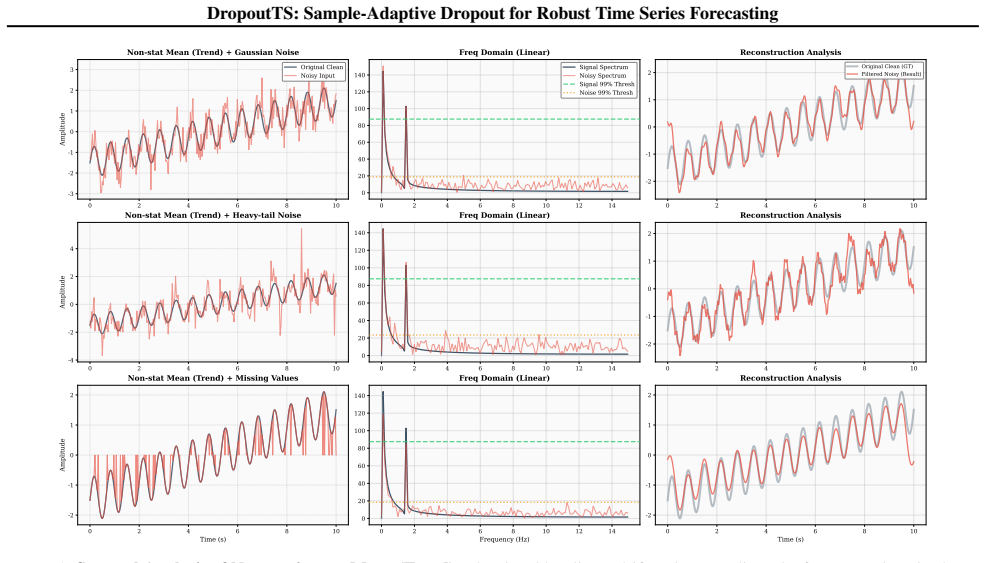
On the paper's own terms, the central claim is that spectral sparsity—the fact that valid temporal signals concentrate energy in a few dominant frequencies while noise spreads as a low broadband floor—gives a reliable, proxy-free per-instance noise metric. A learnable soft mask anchored to the Spectral Flatness Measure filters the spectrum; the mean absolute reconstruction residual becomes the noise score. Mapping that score through a batch-aware tanh/softplus curve to a dropout rate, and training the mask parameters end-to-end through a straight-through estimator, lets a backbone selectively suppress noisy samples while preserving clean ones. The result, the authors argue, is consistent acc
What carries the argument
Two coupled components carry the argument. The Spectral Noise Scorer detrends the input with global linear regression, takes log-normalized FFT amplitudes, filters them with a learnable soft threshold mask anchored to the Spectral Flatness Measure (which is near 0 for tonal signals and near 1 for white noise), and reconstructs the signal; the MAE of the residual is the per-sample noise score. The Sample-Adaptive Dropout module normalizes scores within a batch, maps them to a dropout probability p in [0.05, 0.5] via a learnable sensitivity curve, and generates a differentiable binary mask using the Straight-Through Estimator, allowing the task loss to backpropagate into the scorer parameters.
Load-bearing premise
The method assumes the per-sample noise score s (Eq. 7) measures true input noise rather than a learned proxy for sample difficulty; if s tracks hardness instead of noise, the robustness-by-noise story weakens, even if predictions still improve.
What would settle it
Instantiate the scorer on Synth-12 and compute the rank correlation between the predicted noise score s and the known injected noise level sigma (0.1 to 0.9). A weak, zero, or non-monotonic correlation would refute the claim that the spectral residual quantifies noise intensity.
If this is right
- DropoutTS can be added to existing forecasting backbones without changing their architecture or loss, with consistent gains reported across Transformer, CNN, and MLP models.
- The 'fixed dropout paradox'—where static dropout both over-regularizes clean samples and under-regularizes noisy ones—would be resolved by sample-adaptive rates, explaining why fixed-rate dropout sometimes hurts.
- Because the scorer is deactivated at inference, the robustness gains come with zero additional latency, making the method compatible with real-time forecasting.
- The sparsity validation suggests that retaining roughly 10% of spectral coefficients is enough for high-fidelity reconstruction on real benchmarks, indicating a large noise floor in many standard datasets.
- The method is complementary to data-centric selection: combining Selective Learning with DropoutTS reduces MSE further than either alone on the ILI dataset.
Where Pith is reading between the lines
- If the noise score truly tracks synthetic ground-truth sigma, the same residual could be repurposed for other per-sample policies—sample weighting, curriculum pacing, or adaptive loss scaling—beyond dropout.
- The reported negative correlation between Spectral Flatness Measure and estimated SNR (r about -0.85) suggests SFM could serve as a cheap, label-free data-quality diagnostic for forecasting datasets generally.
- The gains concentrate on strongly periodic data (Weather, ETTh2), so a natural boundary to probe is whether sample-adaptive dropout helps on aperiodic, regime-switching series or on extremely short horizons, where spectral estimates are less stable.
Editorial analysis
A structured set of objections, weighed in public.
Referee Report
Summary. DropoutTS is a model-agnostic plug-in that replaces fixed dropout in time series forecasters with a per-instance adaptive dropout rate. The rate is derived from a spectral noise score: the input is linearly detrended, transformed with FFT, filtered by a learnable soft mask anchored by the Spectral Flatness Measure, and the reconstruction residual (MAE) becomes the noise score. The score is normalized within a batch and mapped through a learned sensitivity curve to a dropout probability, with gradients flowing back through a straight-through estimator (Eq. 10). The authors evaluate the plug-in on six backbones (Informer, Crossformer, PatchTST, TimesNet, iTransformer, TimeMixer) over seven real-world datasets and a synthetic Synth-12 benchmark, reporting consistent MSE/MAE improvements, ablations, efficiency analysis, and a theoretical generalization bound in Appendix F.
Significance. If the central claims hold, DropoutTS would be a low-cost, architecture-agnostic robustness plug-in, and the 'capacity-centric modulation' frame would be a useful complement to data-pruning and prior-based robustness methods. The paper is commendable for releasing code, evaluating six diverse backbones, constructing a controllable synthetic benchmark with known noise levels, and including a compatibility study with Selective Learning. However, the currently reported evidence is not yet strong enough to support the 'universal robustness plugin' claim: there is no comparison against a tuned fixed dropout rate, no statistical uncertainty quantification, and the noise-scoring mechanism is not validated as measuring true input noise rather than sample difficulty.
major comments (5)
- [§4.1–4.2, Eq. (7)–(11)] The noise score s is computed from a learnable spectral mask whose parameters (α, w_s, b_s, γ) are optimized end-to-end with the forecasting loss. The paper never validates s against the known ground-truth noise levels available in Synth-12 (σ ∈ {0.1,...,0.9}). Since σ is controlled, please report the per-sample correlation between s and σ (or SNR) in each noise regime, and compare with a purely difficulty-based proxy (e.g., loss of a fixed-threshold spectral residual). Without this test, the 'noise quantification' interpretation is not distinguished from generic sample reweighting, which is a load-bearing part of the contribution.
- [§5.2, Tables 2 and 5] The superiority of the adaptive dropout over fixed dropout is not established. The ablation baseline uses a single fixed dropout rate p=0.1, and the Raw baselines in Tables 2–4 use the backbones' default hyperparameters. To support the 'sample-adaptive' claim, add a control in which each backbone/dataset is trained with a tuned but fixed dropout rate swept over, say, [0.05, 0.5]. If a well-chosen fixed rate matches or exceeds DropoutTS, the proposed adaptivity is not the source of the gain.
- [§5.1–5.3, Tables 2–4] No error bars, number of random seeds, or significance tests are reported. Many reported improvements are small (e.g., Table 4 shows 0.0% for PatchTST on ETTm2, iTransformer on ETTm2, TimeMixer on Electricity, and 0.3–0.5% in several other cells). Without repeated runs, 'consistently boosting performance' is not supported for gains of this size. Please report means and standard deviations over at least three seeds and, if appropriate, a paired significance test across datasets/horizons.
- [Appendix F, Theorem F.2, Eq. (15)] The generalization bound is only a proof sketch. The complexity term (1/n Σ_i (1−p(x_i))^2 K)^{1/2} is asserted without derivation, and the test-time rescaling by 1/(1−p) in Eq. (11) is not accounted for in the bound. Since §4.2 explicitly claims this mechanism 'minimizes the generalization bound', the bound must either be proved under the actual DropoutTS mask distribution and scaling rule, or the theoretical claim should be softened to a heuristic argument.
- [§5.2, Figure 5] The 'Fixed Dropout Paradox' is presented as a motivation, but Figure 5 only shows raw baselines. It is not shown that the non-monotonic behavior is caused specifically by the fixed dropout rate, nor that the raw baselines use an optimal or representative fixed rate. This is linked to the missing tuned-fixed-dropout control in Tables 2 and 5; the 'paradox' should be demonstrated by sweeping fixed dropout rates under the same noise regimes used in Figure 5.
minor comments (7)
- [Abstract / Table 4] The abstract claims DropoutTS 'consistently boosts' performance, but Table 4 contains several 0.0% improvements (e.g., ETTm2 for PatchTST, TimesNet, iTransformer, TimeMixer). Consider saying 'non-negative' or 'generally positive' and discussing the zero-gain cases.
- [Eq. (5)–(7)] The symbol σ is used both for noise level (e.g., Table 2) and for the sigmoid in Eq. (6). Please distinguish these, e.g., use ρ or sigm(·) for the sigmoid.
- [Eq. (5)] The SFM formula is the ratio of geometric mean to arithmetic mean of the amplitude spectrum. For zero-amplitude bins, log(0) is undefined; practical implementation should add a small floor, but this is not mentioned.
- [Figure 13(b)] The SFM–SNR correlation is computed over only seven datasets. The p-value is reported as p<1.7e-02, but with n=7 the confidence interval is wide. Please present the correlation with a confidence interval and note the limited sample size.
- [Appendix F, Theorem F.1] The proof sketch for Theorem F.1 uses Jensen's inequality without specifying the distribution of σ(x). Since the theorem is used to justify the 'Fixed Dropout Paradox', a fuller proof or a precise statement of assumptions would improve rigor.
- [Table 6] The efficiency table reports 'Params +4' and step latency changes, but it would be clearer to report the total training time variance or compute time per epoch with standard deviations, since the claimed 11–31% training time savings are based on a single run.
- [§4.1, Eq. (2)] Global linear detrending removes a linear trend from each input window. For forecasting data with genuine low-frequency trends, this may remove information; the paper does not discuss the effect of detrending on the downstream forecasting task (as opposed to the noise scoring). A brief discussion would help.
Circularity Check
Noise scorer is trained end-to-end on the task loss, so 'noise quantification' is a fitted surrogate; benchmark gains are empirical but do not validate the noise-scoring mechanism.
specific steps
-
fitted input called prediction
[§4.2 'End-to-End Optimization' (after Eq. 10); noise score s defined in §4.1 Eq. (7)]
"Crucially, DropoutTS requires no modification to the task objective. Through the STE-enabled path, the task loss (e.g., MSE) backpropagates to optimize the noise sensitivity parameters. This creates an implicit feedback loop: since clean samples are inherently easier to fit, gradients drive the mechanism to relax dropout to maximize information retention, while conversely increasing regularization on noisy samples to prevent overfitting."
The noise score s (Eq. 7) is the residual of a spectral mask whose parameters (α, w_s, b_s) and the sensitivity γ are optimized through the STE path of Eq. 10 by exactly the forecasting MSE used to report the gains in Tables 2 and 4. Thus s is a learned function fitted to reduce the evaluation loss, not an independent measurement of input noise. The paper validates SFM-vs-SNR only at dataset level (Fig. 13) and never compares s against the known per-sample σ available in Synth-12, so the claim that dropout rates are driven by 'instance-level noise' is an interpretation of a fitted quantity rather than a tested prediction.
full rationale
The empirical claims—lower MSE/MAE across Synth-12 and seven real benchmarks with six backbones—are self-contained and not circular: they rest on transparent baseline comparisons, ablations, and implementation details, and no load-bearing result is imported from the same authors' prior work. The self-citations (BasicTS, RobustTSF, FiLM, Selective Learning) are used as benchmarks or baselines, not as justifications of the method. However, the interpretive claim that the dropout schedule is driven by 'instance-level noise' is partially circular. The noise score s is computed from a learnable spectral mask whose parameters are optimized through the STE path by the same forecasting loss that defines the reported gains. Consequently, s is fitted to minimize the evaluation metric, and describing it as a 'proxy-free noise metric' is an untested label rather than an independently derived quantity. The paper does not validate s against the known ground-truth noise levels in Synth-12, so the noise-scoring mechanism remains an assumption; the observed robustness improvements could equally arise from generic sample-difficulty reweighting. This does not invalidate the empirical results, but it means the central 'robustness via noise quantification' narrative partially reduces to a learned sample-reweighting fit.
Axiom & Free-Parameter Ledger
free parameters (4)
- p_min, p_max (dropout bounds) =
0.05, 0.5
- γ (sensitivity) =
1.0 (default; 5.0, 10.0 tested)
- α (mask sharpness) =
initialized to 10.0, learned
- w_s, b_s (SFM anchor affine) =
learned
axioms (4)
- domain assumption Clean time-series signals are approximately K-sparse in the Fourier basis (K << L); noise is broadband.
- domain assumption The reconstruction residual of the learned soft spectral mask is monotonically related to true per-instance noise intensity.
- standard math Dropout training is equivalent to L2 regularization with λ=p/(1-p) in this setting (Wager et al. 2013).
- ad hoc to paper The Rademacher complexity bound in Theorem F.2 holds with the complexity term as written; test-time scaling by 1/(1-p) in Eq. 11 is not accounted for.
read the original abstract
Deep time series models are vulnerable to noisy data ubiquitous in real-world applications. Existing robustness strategies either prune data or rely on costly prior quantification, failing to balance effectiveness and efficiency. In this paper, we introduce DropoutTS, a model-agnostic plugin that shifts the paradigm from "what" to learn to "how much" to learn. DropoutTS employs a Sample-Adaptive Dropout mechanism: leveraging spectral sparsity to efficiently quantify instance-level noise via reconstruction residuals, it dynamically calibrates model learning capacity by mapping noise to adaptive dropout rates - selectively suppressing spurious fluctuations while preserving fine-grained fidelity. Extensive experiments across diverse noise regimes and open benchmarks show DropoutTS consistently boosts superior backbones' performance, delivering advanced robustness with negligible parameter overhead and no architectural modifications. Our code is available at https://github.com/CityMind-Lab/DropoutTS.
Figures




Forward citations
Cited by 1 Pith paper
-
Perceive, Route and Modulate: Dynamic Pattern Recalibration for Time Series Forecasting
Dynamic Pattern Recalibration (DPR) adds a perceive-route-modulate pipeline that generates time-aware modulation vectors to recalibrate hidden states in forecasting models, improving performance across architectures w...
Reference graph
Works this paper leans on
-
[1]
Alcaraz, J. M. L. and Strodthoff, N. Diffusion-based time series imputation and forecasting with structured state space models.arXiv preprint arXiv:2208.09399,
-
[8]
Wang, S., Wu, H., Shi, X., Hu, T., Luo, H., Ma, L., Zhang, J. Y ., and Zhou, J. Timemixer: Decomposable multi- scale mixing for time series forecasting.arXiv preprint arXiv:2405.14616,
-
[2002]
Yang, Y ., Zhang, D., Liang, Y ., Lu, H., Chen, G., and Li, H. Not all data are good labels: On the self-supervised labeling for time series forecasting.arXiv preprint arXiv:2502.14704,
-
[2013]
P., Salimans, T., and Welling, M
Kingma, D. P., Salimans, T., and Welling, M. Variational dropout and the local reparameterization trick.ArXiv, abs/1506.02557,
-
[2015]
Kingma, D. P. and Welling, M. Auto-encoding variational bayes.arXiv preprint arXiv:1312.6114,
-
[2019]
Dropout: A simple way to prevent neural networks from overfitting.Journal of Machine Learning Research, 15(56):1929–1958,
Srivastava, N., Hinton, G., Krizhevsky, A., Sutskever, I., and Salakhutdinov, R. Dropout: A simple way to prevent neural networks from overfitting.Journal of Machine Learning Research, 15(56):1929–1958,
1929
-
[2020]
It is characterized by smooth temporal variations and strong daily periodicity. • Electricity: Measurements of electric power consumption in one household with a one-minute sampling rate over 4 years. It includes various electrical quantities and sub-metering values from a house. • ILI (Influenza-Like Illness): Provided by the U.S. CDC, this dataset recor...
arXiv 2002
-
[2021]
Film: Frequency improved legendre memory model for long-term time series forecasting
Zhou, T., Ma, Z., Wang, X., Wen, Q., Sun, L., Yao, T., Yin, W., and Jin, R. Film: Frequency improved legendre memory model for long-term time series forecasting. In Koyejo, S., Mohamed, S., Agarwal, A., Belgrave, D., Cho, K., and Oh, A. (eds.),Advances in Neural Infor- mation Processing Systems 35: Annual Conference on Neural Information Processing System...
2022
-
[2022]
Bai, S., Kolter, J. Z., and Koltun, V . An empirical evalua- tion of generic convolutional and recurrent networks for sequence modeling.arXiv preprint arXiv:1803.01271,
-
[2023]
Bayestsf: Measuring un- certainty estimation in industrial time series forecasting from a bayesian perspective
Pan, Q., Yang, P., and Zhang, J. Bayestsf: Measuring un- certainty estimation in industrial time series forecasting from a bayesian perspective. InAdvanced Intelligent Computing Technology and Applications: 20th Interna- tional Conference, ICIC 2024, Tianjin, China, August 5–8, 2024, Proceedings, Part II, pp. 81–93. Springer-Verlag,
2024
-
[2024]
Recurrent neural networks for time series forecasting.arXiv preprint arXiv:1901.00069,
Petneh´azi, G. Recurrent neural networks for time series forecasting.arXiv preprint arXiv:1901.00069,
Pith/arXiv arXiv 1901
discussion (0)
Sign in with ORCID, Apple, or X to comment. Anyone can read and Pith papers without signing in.