REVIEW 3 major objections 5 minor 8 references
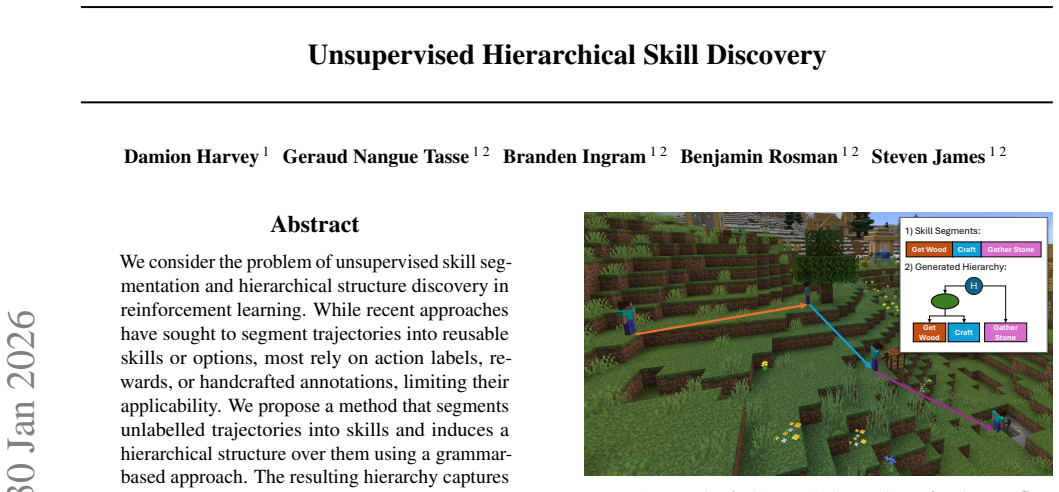
An observation-only pipeline — temporal segmentation plus grammar induction — can extract reusable skills and compositional hierarchies from unlabelled video, beating action-supervised baselines and accelerating downstream RL.
Reviewed by Pith at T0; open to challenge. T0 means a machine referee read the full paper against a public rubric. the ladder, T0–T4 →
An observation-only pipeline that combines optimal-transport skill segmentation (ASOT) with Sequitur grammar induction produces reusable skill hierarchies that accelerate reinforcement learning in Craftax and Minecraft.
T0 review reviewed 2026-08-03 challenge →
load-bearing objection The segmentation results are the real contribution; the hierarchy metrics are a self-consistency check, so the 'semantically meaningful' claims should be read with caution. the 3 major comments →
Unsupervised Hierarchical Skill Discovery
The pith
A machine-rendered reading of the paper's core claim, the machinery that carries it, and where it could break.
The reading
Core claim
HiSD claims a two-stage, fully unsupervised pipeline can recover skills and their composition from unlabelled trajectories. Temporally regularised optimal transport labels each frame as one of K visually coherent skills; same-skill runs become atomic symbols. The linear-time grammar inducer Sequitur compresses repeated symbol pairs into non-terminals, so the induced grammar's leaves are skills and its internal nodes are recurring subroutines. The paper claims this grammar tracks the intended decomposition in controlled tasks, beats action-supervised baselines on most segmentation metrics (Craftax, Minecraft), and that the hierarchy, not flat skills, gives a masked-PPO agent the inductive bia
What carries the argument
The central mechanism is the pairing of ASOT — unsupervised temporal action segmentation posed as unbalanced optimal transport with a fused Gromov-Wasserstein temporal-regularity term, which labels frames while preventing label flicker — with a modified Sequitur grammar induction. Sequitur greedily turns repeated adjacent-symbol pairs into non-terminal rules while maintaining two invariants (digram uniqueness and rule utility), and its derivation tree is the hierarchy. The modification that carries the argument is the boundary token: episodes are concatenated with a unique marker that is forbidden from entering any production rule, so subroutines never span episode boundaries, and a non-term
Load-bearing premise
The load-bearing premise is that Sequitur's compression of clean skill labels is the correct task decomposition: the paper's 'ground truth' hierarchy is its own modified Sequitur run on clean labels, so if that grammar does not encode the true sub-goal structure, the hierarchy results demonstrate self-consistency, not semantic correctness.
What would settle it
Check whether HiSD's internal grammar nodes align with independently defined subgoal points — the first frame after each crafted item appears, or human-annotated milestone frames — better than chance-level boundaries. If the non-terminals do not coincide with externally anchored subgoals, the 'semantically meaningful hierarchy' claim fails. A second check: re-run the downstream RL experiment with behaviour-cloning-from-observation instead of action-labelled cloning; if the hierarchy's advantage disappears, the observation-only claim holds only for discovery, not learning.
If this is right
- Unlabelled demonstration video becomes a usable input for structure discovery: skills and hierarchies can be mined from observations alone, skipping the expensive step of collecting action labels or rewards.
- Hierarchy matters for learning, not just description: in both evaluation domains the hierarchical option agent outperformed the flat skills-only agent, implying compositional structure helps temporal credit assignment.
- The discovered skills are object-centric and reusable: visually distinct approaches to the same resource are grouped into a single skill, which is what makes cross-episode reuse and compact grammars possible.
- The pipeline is cheap to run: the paper reports training and inference on consumer-grade GPUs with 6–10 GB of VRAM, in contrast to the roughly 24 GB the baselines required, lowering the barrier for scaling structure discovery.
Where Pith is reading between the lines
- Editorial inference: the paper's hierarchy evaluation is anchored to a ground truth it defines as its own modified Sequitur run on clean labels (§5.4; §D.3 reports 'perfect recovery' of that object). The hierarchy metrics therefore establish self-consistency under label noise; validating the 'semantically meaningful' claim requires an independent anchor, such as human- or reward-defined subgoal st
- Editorial inference: the Table 2 results in the noisiest Minecraft setting — one unique tree per episode and a 283-node average tree against a 22.7-node truth — suggest the pipeline's validity is strongest where segmentation is clean. A testable extension is to make the grammar stage probabilistic or to feed it segmentation confidence, which might resist cascading symbol errors.
- Editorial inference: the paper's own downstream experiment still assumes action labels for behaviour cloning (§7). A fuller test of the observation-only thesis is to close that loop with behaviour-cloning-from-observation, so that both discovery and control run without actions.
- Editorial inference: the boundary-token modification is a transferable recipe — keep grammar induction from merging across sequence boundaries — that should generalize to other concatenated-sequence compression tasks, such as extracting recurring routines from logged telemetry or documents.
Editorial analysis
A structured set of objections, weighed in public.
Referee Report
Summary. The paper proposes Hierarchical Skill Discovery (HiSD), a two-stage unsupervised pipeline: ASOT-based temporal action segmentation converts raw observation features into discrete skill labels, then a modified Sequitur grammar induction (with a boundary-token fix) compresses concatenated skill sequences into a hierarchical CFG. The method is evaluated on Craftax and Minecraft (VPT) datasets, comparing segmentation quality (Table 1) and tree-structure metrics (Table 2) against CompILE and OMPN, and showing a downstream RL proof-of-concept in which HiSD-derived hierarchies improve PPO sample efficiency. The manuscript claims that HiSD 'consistently produces more structured and semantically meaningful hierarchies' than baselines and that the discovered hierarchies accelerate and stabilise downstream RL.
Significance. If validated, HiSD would provide one of the first fully observation-only pipelines for multi-level skill discovery in high-dimensional pixel domains, with the practical advantage of not needing actions, rewards, or interaction during discovery. The paper deserves credit for decoupling structure discovery from policy execution, evaluating on the full MineRL action space, and including a downstream RL demonstration; the segmentation results are anchored to externally derived inventory-delta labels, which is meaningful external grounding. However, the central hierarchy-quality claims currently lack external semantic validation, and the quantitative results in the noisiest environment contradict the 'consistently' qualifier. The core method is plausible but the current claims outrun the evidence.
major comments (3)
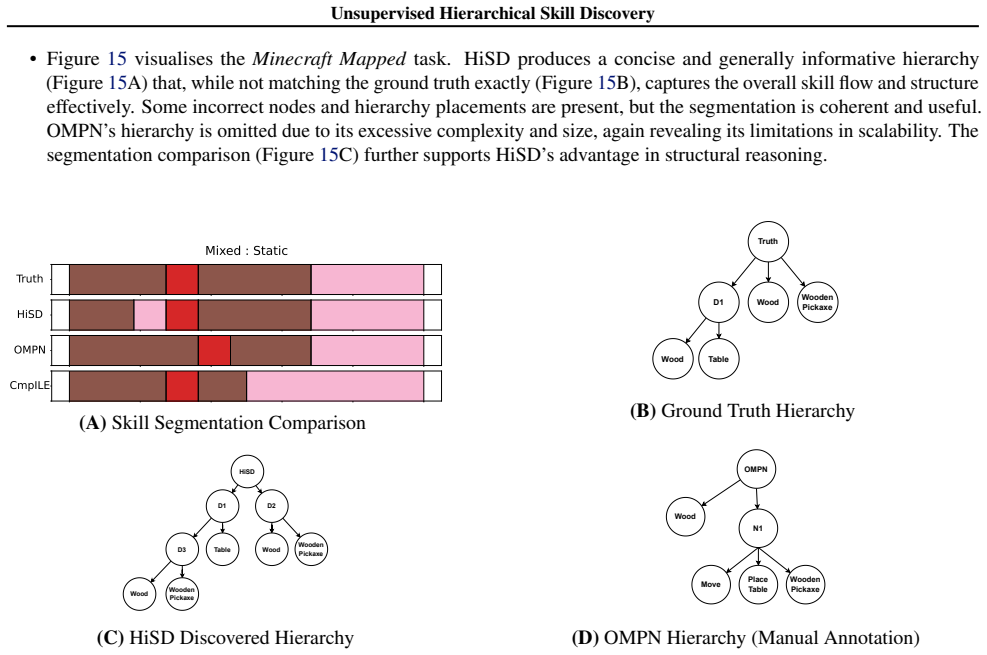
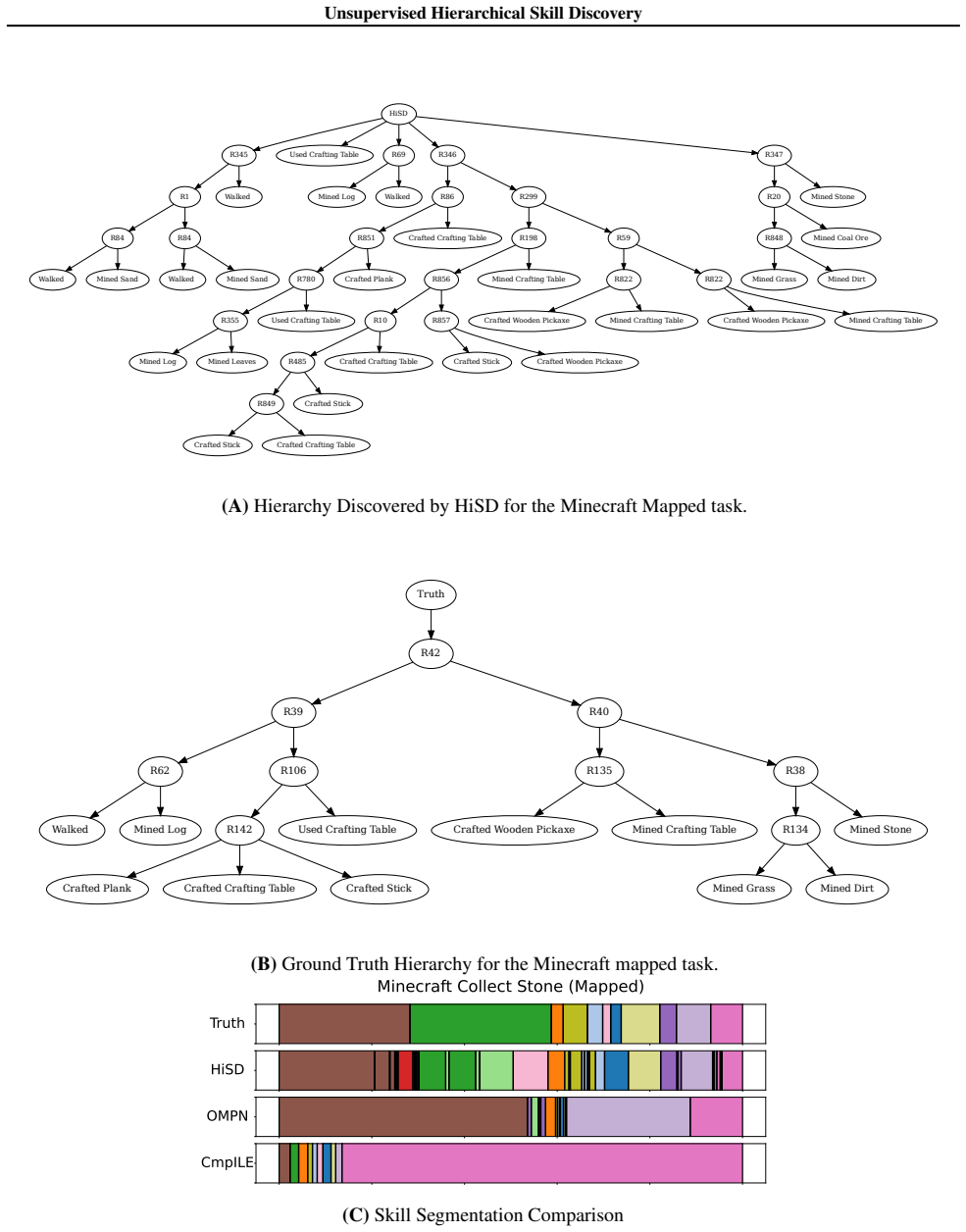
- [§5.4, Table 2, App. D.3] The 'ground truth structure' for hierarchy metrics is defined as 'generated by running our modified Sequitur on clean ground-truth labels' (§5.4). Consequently, every hierarchy-quality claim—unique tree counts, depth, size, branching, and the 'perfectly recovers' statement in App. D.3 (Fig. 12)—is a comparison of the pipeline's output against the same deterministic grammar applied to the same (clean) labels. This is a self-consistency check of the ASOT stage under label noise, not evidence that the induced non-terminals correspond to true subgoals. The abstract's central claim of 'semantically meaningful hierarchies' therefore rests on an unvalidated premise: that Sequitur's compression of the clean skill sequence is the correct semantic task decomposition. No independent semantic target (human-annotated subgoal structure, planner-generated HTN, or external benchmark) is used. Please add
- [Table 2, §6.2.2] Table 2's Minecraft-All row shows HiSD producing 500 unique trees (vs 293 for the ground-truth), mean tree size 283.25 (vs 22.69) and max branching 28.73 (vs 2.25). This directly contradicts the abstract's claim that HiSD 'consistently produces more structured and semantically meaningful hierarchies' and the §6.1.2 claim that HiSD 'matches or closely approximates the ground truth.' The text in §6.2.2 concedes that noise 'prevent[s] our deterministic grammar from discovering a consistent underlying structure.' The Mapped row is also far from the ground truth (500 vs 151 unique trees, size 83.85 vs 21.36). Thus, the hierarchy-quality advantage over baselines is not consistent across the evaluated settings. A revision should either restrict the claim to the simpler/low-noise tasks or provide evidence that the inflated trees are still semantically meaningful despite their size.
- [§7, Appendix C] The downstream RL comparison is not fully controlled. In App. C, OMPN hierarchies are not given learned low-level skill policies: 'we do not learn a BC model or a PU model for the OMPN hierarchies, only for the segmented skills OMPN produces.' OMPN leaf nodes are sequences of primitive actions, whereas HiSD's options are instantiated with BC-trained intra-option policies and PU-learned initiation/termination gates. Figure 5 therefore compares HiSD options (representation + learned controllers) with OMPN hierarchies (representation only). The observed RL improvement may be due to the added low-level controllers rather than the hierarchy structure. Please add an ablation where all methods share the same option-grounding mechanism (e.g., BC on the relevant segment labels) or explicitly state that the RL result is a combined proof of concept, not a hierarchy-quality comparison.
minor comments (5)
- [§5.3] F1 and mIoU under the 'Full' (global Hungarian) matching scheme need precise definitions: how are segment-level F1 and mIoU computed after global alignment? Please specify the matching and scoring procedure.
- [§6, first paragraph] Qualitative hierarchy analysis uses the single best-performing run per framework (selected via mIoU), which is a form of cherry-picking; the visual 'perfect recovery' examples in App. D.3 may not be representative. Please report how often the best-run hierarchy is typical, or provide aggregate visualizations.
- [§6.2.2] Typo: 'while HiSD still finds no unique trees' should read '500 unique trees' (Table 2 shows HiSD Mapped: 500 unique trees).
- [Table 19] The reported n-frames values for Craftax (60, 135, 110, 205) exceed the average episode lengths in Table 4 (14.9–33.0 steps). Please clarify what n-frames controls and how these values are applied to trajectories shorter than n-frames.
- [Appendix C, §7] In the RL evaluation, why is CompILE omitted from Figures 5 and 6 despite being a baseline in Table 1? Please state the reason (e.g., memory or training issues) for completeness.
Circularity Check
Hierarchy-quality claim rests on a self-consistency check: the 'ground truth' hierarchy is defined as the paper's own modified Sequitur run on clean labels, so 'perfect recovery' shows only label robustness under the authors' grammar, never external semantic validity.
specific steps
-
self definitional
[§5.4 (Hierarchy Metrics), Table 2, Appendix D.3 (Fig. 12)]
"To assess structural quality and reuse, we compute tree-level metrics averaged over the dataset and compare them relative to the ground truth structure (generated by running our modified Sequitur on clean ground-truth labels). [...] Here, HiSD perfectly recovers the ground truth hierarchy (Figure 12C vs. Figure 12B)."
The evaluation target ('ground truth structure') is defined as the output of the same modified Sequitur that HiSD uses for prediction, applied to clean labels. Hence 'HiSD perfectly recovers the ground truth hierarchy' is by construction the statement modified-Sequitur(ASOT-labels) ≡ modified-Sequitur(clean-labels): a self-consistency check of the segmentation labels under the paper's own grammar. It does not establish that the grammar's non-terminals correspond to true subgoals, because no external semantic target (human-annotated decomposition, HTN, planner grammar) ever validates Sequitur. The abstract's headline claim — 'semantically meaningful hierarchies' — is therefore anchored only to the algorithm's agreement with itself, so the hierarchy metrics measure robustness to label noise
full rationale
The segmentation evaluation (Table 1) is genuinely externally anchored: ground-truth labels are 'algorithmic annotations derived from domain knowledge' (§5) via 'inventory deltas and interaction logs', and HiSD competes against CompILE/OMPN on those labels — no circularity there. ASOT and Sequitur are cited external works (Xu & Gould 2024; Nevill-Manning & Witten 1997), not self-citations, so no self-citation chain is load-bearing. The downstream RL experiments (Figs 5–6) against sparse-reward tasks are empirical and not circular. The circularity is concentrated in the hierarchy-quality evaluation (§5.4, Table 2, App. D.3): the 'ground truth structure' is generated by the paper's own modified Sequitur on clean labels, so the headline claims of 'semantically meaningful hierarchies' and 'perfectly recovers the ground truth hierarchy' reduce to a self-consistency check — the grammar's output on noisy labels versus the same grammar's output on clean labels. Whether Sequitur's compression of the clean skill sequence is the correct semantic decomposition is assumed, never independently validated (no human-annotated subgoal decomposition, planner-generated HTN, or external benchmark). Additionally, the paper's own Minecraft-All row of Table 2 (HiSD: 500 unique trees, mean size 283.25; truth: 293/22.69) and §6.2.2's concession that the 'deterministic grammar' cannot find 'a consistent underlying structure' undercut the abstract's 'consistently produces... hierarchies' claim; likewise the Stone Pickaxe Static row (Truth 1 vs HiSD 36 unique trees) contradicts 'closely approximates the ground truth in simpler tasks'. Because the central semantic claim rests on a self-referential target, while the segmentation and RL components retain independent content, the paper is partially circular (6), not fully so.
Axiom & Free-Parameter Ledger
free parameters (5)
- K (maximum number of skills) =
Set to ground-truth skill count per task: 5 (Stone Pickaxe Static/Random), 2 (WSWS Random), 5 (Mixed), 44/14 (Minecraft
- ASOT hyperparameters (17 per task) =
Table 19: e.g., alpha-train 0.59, lambda-frame-train 0.10, n-frames 110 (Stone Rand); n-frames 9100 (Minecraft Mapped)
- PU decision thresholds =
Selected by grouped 5-fold cross-validation maximizing F1 (App. C.1.1, C.2.1)
- Option execution horizon and frameskip (Minecraft) =
64-step horizon, frameskip 8 (App. C.2.3)
- PCA components (Craftax) =
650 components (~99% variance)
axioms (6)
- domain assumption ASOT (Xu & Gould 2024) reliably yields latent skills aligned with semantically meaningful behavior when applied to PCA/MineCLIP features.
- ad hoc to paper Sequitur compression of a clean skill sequence equals the correct semantic task hierarchy.
- domain assumption Ground-truth skill labels derived from inventory deltas and interaction logs are the correct segmentation target.
- domain assumption Pretrained VPT and MineCLIP models encode demonstrations adequately for skill discovery.
- domain assumption A* planner trajectories in modified Craftax are representative expert demonstrations.
- domain assumption Elkan-Noto PU learning on the discovered segments yields valid option initiation sets.
invented entities (3)
-
Latent skill prototypes (K per dataset)
no independent evidence
-
Grammar non-terminals (composite subroutines)
no independent evidence
-
Boundary token phi
no independent evidence
Cite this review
Pith. "Pith review of Unsupervised Hierarchical Skill Discovery." pith.science (2026). https://pith.science/paper/RGP45SHS
@misc{pith2026260123156,
  author       = {Pith},
  title        = {Pith review of: Unsupervised Hierarchical Skill Discovery},
  year         = {2026},
  howpublished = {\url{https://pith.science/paper/RGP45SHS}},
  note         = {Machine review of arXiv:2601.23156}
}
read the original abstract
We consider the problem of unsupervised skill segmentation and hierarchical structure discovery in reinforcement learning. While recent approaches have sought to segment trajectories into reusable skills or options, most rely on action labels, rewards, or handcrafted annotations, limiting their applicability. We propose a method that segments unlabelled trajectories into skills and induces a hierarchical structure over them using a grammar-based approach. The resulting hierarchy captures both low-level behaviours and their composition into higher-level skills. We evaluate our approach in high-dimensional, pixel-based environments, including Craftax and the full, unmodified version of Minecraft. Using metrics for skill segmentation, reuse, and hierarchy quality, we find that our method consistently produces more structured and semantically meaningful hierarchies than existing baselines. Furthermore, as a proof of concept, we demonstrate that these discovered hierarchies accelerate and stabilise learning on downstream reinforcement learning tasks.
Figures




Reference graph
Works this paper leans on
-
[7]
doi: 10.1609/ aaai.v31i1.10744
ISSN 2374-3468, 2159-5399. doi: 10.1609/ aaai.v31i1.10744. URL https://ojs.aaai.org/ index.php/AAAI/article/view/10744. Pub- lisher: Association for the Advancement of Artificial Intelligence (AAAI). Torabi, F., Warnell, G., and Stone, P. Behavioral Cloning from observation.CoRR, abs/1805.01954, 2018. URL http://arxiv.org/abs/1805.01954. Xu, M. and Gould,...
Pith/arXiv arXiv 2018
-
[1933]
Kanervisto, A., Karttunen, J., and Hautam ¨aki, V
URL https://books.google.co.za/ books?id=qJfXAAAAMAAJ. Kanervisto, A., Karttunen, J., and Hautam ¨aki, V . Play- ing Minecraft with Behavioural Cloning. In Es- calante, H. J. and Hadsell, R. (eds.),Proceedings of the NeurIPS 2019 Competition and Demonstra- tion Track, volume 123 ofProceedings of Machine Learning Research, pp. 56–66. PMLR, 08–14 Dec
2019
-
[2016]
doi: 10.1109/ICRA.2016.7487760. Ho, M. K., Abel, D., Griffiths, T. L., and Littman, M. L. The value of abstraction.Current Opinion in Behav- ioral Sciences, 29:111–116, 2019. ISSN 2352-1546. doi: https://doi.org/10.1016/j.cobeha.2019.05.001. URL https://www.sciencedirect.com/ science/article/pii/S2352154619300026. Artificial Intelligence. Hogg, C., Mu˜noz...
arXiv 2016
-
[2017]
Lu, Y ., Shen, Y ., Zhou, S., Courville, A., Tenenbaum, J
doi: 10.1109/CVPR.2017.113. Lu, Y ., Shen, Y ., Zhou, S., Courville, A., Tenenbaum, J. B., and Gan, C. Learning task decomposition with Ordered Memory Policy Network. InInternational Conference on Learning Representations, 2021. URL https:// openreview.net/forum?id=vcopnwZ7bC. Matthews, M., Beukman, M., Ellis, B., Samvelyan, M., Jackson, M., Coward, S., a...
Pith/arXiv arXiv 2017
-
[2019]
org/CorpusID:199000710
URL https://api.semanticscholar. org/CorpusID:199000710. Hayes, B. and Scassellati, B. Autonomously construct- ing Hierarchical Task Networks for planning and human- robot collaboration. In2016 IEEE International Confer- ence on Robotics and Automation (ICRA), pp. 5469–5476,
-
[2020]
URL https://proceedings.mlr.press/ v123/kanervisto20a.html. Kipf, T., Li, Y ., Dai, H., Zambaldi, V ., Sanchez-Gonzalez, A., Grefenstette, E., Kohli, P., and Battaglia, P. Com- pILE: Compositional Imitation Learning and Execution. InProceedings of the 36th International Conference on Machine Learning, pp. 3418–3428. PMLR, May 2019. URL https://proceedings...
Pith/arXiv arXiv 2019
-
[2021]
URL https://proceedings.mlr.press/ v155/chen21d.html. Correa, C. G., Sanborn, S., Ho, M. K., Callaway, F., Daw, N. D., and Griffiths, T. L. Exploring the hierarchical struc- ture of human plans via program generation.Cognition, 255:105990, February 2025. ISSN 0010-0277. doi: 10. 1016/j.cognition.2024.105990. URL http://dx.doi. org/10.1016/j.cognition.2024...
arXiv 2025
-
[2022]
All” (fine-grained) and “Mapped
environments. (A)Example of an RGB observation from the modified Craftax environment (B)Example of an RGB observation from the Minecraft environ- ment Figure 7.Environment observation examples from Craftax (Matthews et al., 2024) (A) and Minecraft (Baker et al., 2022) (B). A.1. Craftax We model the Craftax environment (Matthews et al., 2024) as a fully ob...
2024
This paper was first reviewed by deepseek-v4-flash on August 3, 2026.
discussion (0)
Sign in with ORCID, Apple, or X to comment. Anyone can read and Pith papers without signing in.