REVIEW 3 major objections 6 minor 5 cited by
For GUI agents, VAGEN claims that reward modeling should be done by an interactive verifier agent that probes the environment, not a passive judge that only reads the trajectory.
Reviewed by Pith at T0; open to challenge. T0 means a machine referee read the full paper against a public rubric. the ladder, T0–T4 →
T0 review · deepseek-v4-flash
2026-08-03 05:56 UTC pith:LGLCRJJX
load-bearing objection Solid agentic-verifier extension, but the human-eval headline rests on a one-sided audit and should be re-checked before the numbers are trusted. the 3 major comments →
Agentic Reward Modeling: Verifying GUI Agent via Progressive Trajectory-Grounded Interaction
The pith
A machine-rendered reading of the paper's core claim, the machinery that carries it, and where it could break.
Core claim
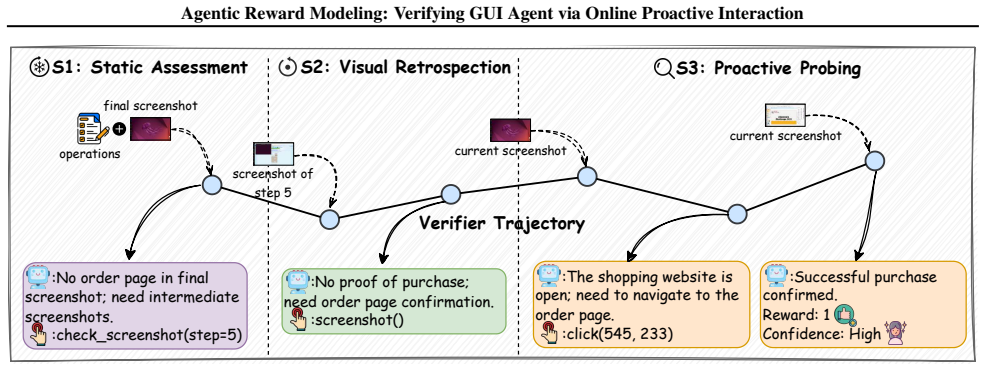
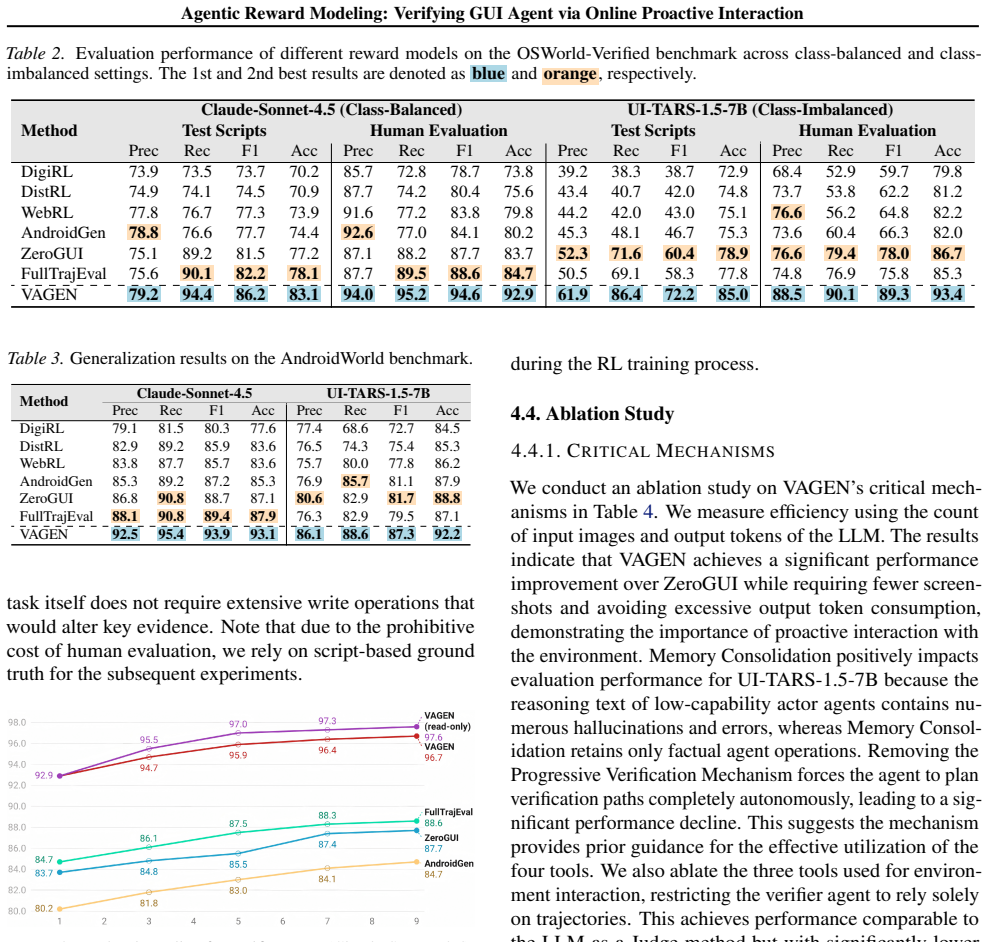
The central claim is that partial state observability, not model capability, is the main bottleneck in LLM-as-a-Judge reward models for GUI agents: screenshots and reasoning traces often do not contain the decisive evidence of task completion, which lives in latent system state. VAGEN turns the reward model into a tool-augmented verifier agent—able to re-inspect screenshots, run shell and Python checks, and perform GUI actions—and guides it with a Progressive Verification Mechanism from cheap static assessment to costly proactive probing. On OSWorld-Verified, with human-evaluation labels, VAGEN reaches 92.9% accuracy in the class-balanced setting and 93.4% in the class-imbalanced setting, ve
What carries the argument
The Progressive Verification Mechanism: a staged protocol (static assessment → visual retrospection → proactive probing) that lets the verifier agent escalate from the cheapest evidence (final screenshot plus consolidated operations) to the most expensive (shell, Python, and direct GUI interaction) only when needed. The load-bearing pieces are the four verifier tools—check screenshot, execute shell, execute python, and computer use—and the trajectory memory consolidation that strips the actor's subjective reasoning, leaving only factual operations for the verifier to audit.
Load-bearing premise
The reported accuracy gains rest on the belief that the benchmark's test script only ever wrongly marks real successes as failures, so fixing only those labels is enough; if script-marked successes also contain failures, the advantage shrinks.
What would settle it
Annotate every trajectory that the benchmark test script marked as successful. If a material share of those are human-judged failures, VAGEN's human-evaluation accuracy advantage over baselines would shrink. A second check: run the verifier unrestricted inside a copy-on-write snapshot and count state-changing operations; if write operations are common, the read-only serial-scaling assumption fails.
If this is right
- Reward signals for RLVR-style training of GUI agents become more reliable, since true task completion is checked against the environment rather than inferred from partial visual traces.
- On OSWorld-Verified and AndroidWorld, VAGEN raises evaluation accuracy above 90% across different actor models, including a weaker 7B actor, in both class-balanced and imbalanced settings.
- The read-only scaling result implies a verifier can be sampled multiple times on one environment instance without state resets, making test-time majority voting practical.
- The Best-of-N theorem and experiments show that actor success rate improves with verifier accuracy, and VAGEN reaches baseline performance with fewer samples (N=5 vs N=8).
Where Pith is reading between the lines
- If the benchmark's test script also contains false positives among its success labels, the reported human-evaluation accuracy advantage is optimistic, since the paper only re-labels script failures and leaves script successes untouched.
- Because 'read-only' is enforced by prompt instruction and a secondary LLM check rather than a hard permission boundary, a deployed verifier could perform state-altering actions, so production use would need mandatory sandboxing or filesystem-level read-only enforcement.
- The same verification trajectories (tool choices, probes, final judgments) could be used as training data to distill a cheaper specialized verifier, something the paper lists as future work.
- VAGEN's successful interactive verification suggests that outcome-level verification can serve as a foundation for step-level credit assignment by locating which actions changed the checked evidence.
Editorial analysis
A structured set of objections, weighed in public.
Referee Report
Summary. The paper proposes VAGEN, a verifier-agent framework for GUI task evaluation. Instead of relying on static trajectory inspection as in LLM-as-a-Judge methods, VAGEN equips a verifier LLM with tools (check screenshot, execute shell, execute python, computer use) and a progressive verification mechanism that first assesses the final screenshot, then revisits intermediate screenshots, and finally actively probes the environment for latent state evidence. The method is evaluated on OSWorld-Verified and AndroidWorld with multiple actor backbones, reporting accuracy gains over LLM-as-a-Judge baselines. The paper also proposes read-only test-time scaling for the verifier and a reward-guided Best-of-N scaling for the actor, and it derives a closed-form expression for the expected success rate under such scaling.
Significance. The work addresses a real bottleneck in RLVR for GUI agents: partial observability of trajectory-based verification. The proposed paradigm of agentic interactive verification is conceptually sound and, if the results hold, would be a useful contribution to reward modeling. The paper ships several concrete assets: an explicit derivation of the scaling law in Theorem 3.1, open-source code, and falsifiable claims in the form of accuracy numbers across two benchmarks and multiple backbones. The consistent improvement over the strongest LLM-as-a-Judge baseline (e.g., 83.1 vs 78.1 on OSWorld test-script accuracy) suggests that the core direction is not a mere artifact of the benchmark's known false negatives. However, the headline human-evaluation numbers are weakened by a one-sided relabeling protocol that requires careful scrutiny.
major comments (3)
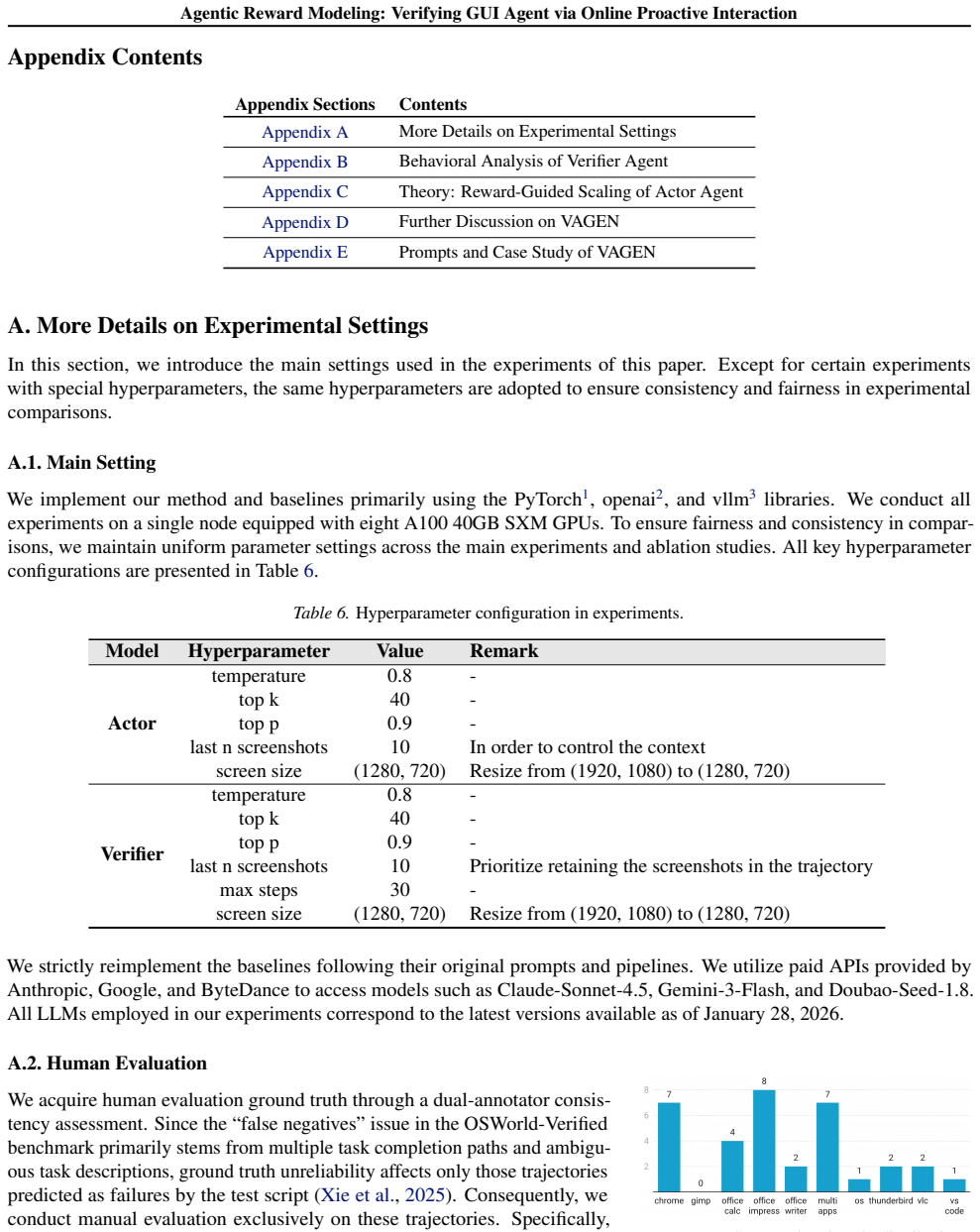
- [Appendix A.2, Table 2] The human-evaluation ground truth used in Table 2 is constructed by annotating only trajectories that the benchmark test script predicted as failures; script-predicted successes are assumed to be correct without manual inspection. This one-sided audit is load-bearing for the headline claim (e.g., 92.9% vs 84.7% class-balanced). If the test script also has false positives among its successes—which is plausible given the paper's own examples of incomplete checks (e.g., task@21ab7b40 checks only column C)—then the human ground truth is biased. A verifier that correctly labels such a script-success as failure would be scored as an error, and the reported accuracy gap is not an unbiased estimate. I request a two-sided audit: manual evaluation of a random sample of script-successes (or at least a sensitivity analysis) to bound the potential bias. Without this, the human-evaluation numbers shou
- [Section 3.6.1 and Appendix A.3] The read-only guarantee during test-time scaling is enforced only by prompt instruction and a secondary LLM check, not by a hard permission boundary. The claim that 'the environment state remains invariant' is essential for the valid serial execution of N verification samples on a single environment instance without resets. A verifier action that writes state (e.g., creates a file or changes a configuration) would silently invalidate the independence of the N samples. The paper should either hard-block write operations at the tool/environment level, reset the environment between samples, or empirically demonstrate that write attempts did not occur. At minimum, the number of observed write attempts in the scaling experiments should be reported.
- [Section 4.2, Tables 2–3] All accuracy comparisons are reported as point estimates without confidence intervals or significance tests. With 361 tasks in OSWorld-Verified and the class-imbalanced setting containing relatively few positive examples, the 4–8 point gaps could be within noise. The text repeatedly uses 'significantly', but no statistical support is provided. I request that the authors report confidence intervals (e.g., Wilson intervals or bootstrap CIs) and, where appropriate, a paired test (e.g., McNemar) for the headline comparisons in Tables 2 and 3. This does not change the direction of the results, but it is necessary to assess the strength of the claim.
minor comments (6)
- [Table 1] The column 'SR' for the verifier agent is ambiguous: for an actor, SR is naturally the task success rate, but for a verifier it should be defined as the verification accuracy (or something else). Please clarify in the caption or text.
- [Appendix E.2] The prompt text says 'where the red text is applied exclusively during read-only scaling', but in the displayed prompt the restriction is not distinguished in red. This makes it hard to see which parts were used only in the scaling experiments.
- [Section 3.5] The Progressive Verification Mechanism is described as a staged protocol, but the stages are enforced only through the prompt; the verifier agent is not constrained from skipping Stage 1 or jumping directly to probing. The ablation shows that the mechanism helps, but its implementation should be clarified—is it a prompt-level guideline or a hard control flow?
- [Appendix C] Theorem 3.1 assumes the reward model's accuracy a is symmetric for positive and negative samples. This assumption is stated but not discussed; in practice, verifier precision and recall can differ substantially (as shown in Table 2). A brief comment on how asymmetric accuracy would affect the theorem would be useful.
- [Appendix A.2] The annotators are described as 'researchers in the field of GUI agents'—please specify whether they are authors or external annotators, and report their agreement beyond the Jaccard coefficient (e.g., Cohen's kappa).
- [Authors/affiliations] There appears to be a LaTeX artifact in the author block: 'envel⌢pe' after the last affiliation. Please fix.
Circularity Check
No significant circularity: core results are benchmarked against external test scripts plus human audit; Theorem 3.1 is a closed-form probability calculation from stated assumptions.
full rationale
The paper's central empirical claim (VAGEN improves evaluation accuracy on OSWorld-Verified/AndroidWorld) is measured against ground truth from external benchmark test scripts and human audit, with baselines defined independently; VAGEN's outputs are never re-inserted as ground truth. The only analytic result, Theorem 3.1, is a direct law-of-total-probability derivation using explicitly stated actor success rate p and reward accuracy a; it is not fitted to the method's own outputs but is a parameterized formula, and the paper does not use it as a substitute for empirical measurement. The self-citations (UITron, MAI-UI) appear only in related-work enumerations and are not load-bearing. Appendix A.2's decision to manually relabel only script failures is an unverified ground-truth-symmetry assumption and a validity risk, but it is not a construction in which a prediction is defined as its input; hence it does not constitute circularity. Read-only scaling is enforced by prompt/LLM check rather than a hard boundary, which is a safety/soundness concern, not a circular derivation.
Axiom & Free-Parameter Ledger
axioms (5)
- domain assumption GUI tasks are 'easy to verify, but hard to solve'.
- domain assumption Terminal screenshot plus latent environment state contains decisive evidence for every task completion.
- ad hoc to paper Human-evaluation ground truth can be constructed by annotating only script-predicted failures; script-predicted successes are taken as true.
- ad hoc to paper Read-only prompt + secondary LLM check prevent state-altering writes.
- domain assumption Reward-model accuracy a is symmetric for positive and negative trajectories.
read the original abstract
Reinforcement learning with verifiable rewards (RLVR) provides a promising pathway for continuously advancing GUI agents, yet existing reward modeling paradigms face complementary limitations. Rule-based methods suffer from poor scalability and cannot handle open-ended tasks. LLM-as-a-Judge methods enable scalable trajectory verification but remain passive and are constrained by partial state observability, since key evidence often resides in latent environment states beyond the trajectory. Recent active environment interaction methods mitigate observability issues but tend to over-rely on probing while under-utilizing direct trajectory evidence, leading to verification inefficiency. To address these challenges, we advocate a trajectory-grounded interactive verification paradigm. We introduce VAGEN, a framework that employs a tool-augmented verifier agent governed by a Progressive Verification Mechanism, which follows a surface-to-latent and cheap-to-expensive design philosophy to extract trajectory evidence and probe environment states in a proactive end-to-end manner. Experiments on OSWorld-Verified and AndroidWorld benchmarks demonstrate that VAGEN significantly improves evaluation accuracy with a favorable performance-efficiency trade-off.
Figures






Forward citations
Cited by 5 Pith papers
-
StateAct: Program State, before Pixels, for Long-Horizon Computer-Use Agents
StateAct, a code-first multi-agent harness that acts on program state instead of pixels, improves Claude Opus 4.8 on OSWorld 2.0 from 20.6% to 26.9% binary success at ~9x lower cost.
-
Teach it to stop, not just to click
Single-run agentic computer-use RL numbers mislead because data-draw and run-to-run variance dominate, and on the hardest cell the run-to-run distribution is bimodal.
-
OpenComputer: Verifiable Software Worlds for Computer-Use Agents
OpenComputer introduces a verifier-grounded framework with state verifiers, self-evolving layers, task synthesis, and auditable evaluation for 33 desktop apps and 1000 tasks to support computer-use AI agents.
-
StainFlow: Entity-Stain Tracking and Evidence Linking for Process Rewards in GUI Agents
StainFlow proposes global entity stain tracking and local stain evidence linking modules to improve process rewards for GUI agents, reporting 3.2% relative gain in online RL success and 1.8% in judgment accuracy on An...
-
GUI Agents with Reinforcement Learning: Toward Digital Inhabitants
The paper delivers the first comprehensive overview of RL for GUI agents, organizing methods into offline, online, and hybrid strategies while analyzing trends in rewards, efficiency, and deliberation to outline a fut...
Reference graph
Works this paper leans on
-
[1]
Summarize step by step; summarize the operation of each step into one sentence (in English), do not miss any step
-
[2]
State Observation
Only summarize contents related to "State Observation" and "Action Description", discarding contents related to "Sub-goal Analysis"; please refer to the example provided below for details
-
[3]
ctrl+alt+t
Output according to the format specified in the example below; only output the summary, do not output any other irrelevant content. <Example> Model Output: Step 3: Reasoning: Good! I can see your desktop with a notification about software updates. I’ll help you install Spotify. The easiest way on Ubuntu is through Snap, which is already available on your ...
-
[4]
<Your Evaluation Process>
‘execute shell‘: Interact with the environment by bash code to verify the current state (if needed). <Your Evaluation Process>
-
[6]
Use this to examine key moments in the execution
‘check screenshot‘: View specific screenshot of one step from the trajectory (e.g., step 1, step 7, etc). Use this to examine key moments in the execution
-
[7]
‘computer‘: Interact with the environment by GUI operations to verify the current state (if needed)
-
[8]
‘execute python‘: Interact with the environment by python code to verify the current state (if needed)
-
[10]
Please begin your evaluation process based on this information
First, you will be provided with the Task Instruction, Execution Trajectory, and the Last Screenshot of the last step. Please begin your evaluation process based on this information
-
[11]
You can devise your own verification strategy. One suggested strategy is as follows: First, you can check whether there are any obvious errors or if the task can be directly judged as successful by reviewing the Execution Trajectory and the screenshot from the last step. Next, you may use the ‘check screenshot‘ tool to examine the screenshot of a specific...
-
[12]
To maintain the invariance of critical verification evidence within the environment state, you are strictly restricted to operating in a read-only mode. You can only perform inspection-oriented read operations, such as checking file content or viewing website information; you must not perform any state-altering write operations, such as creating new files...
-
[13]
[Tool Use - tool name]
Based on your analysis, determine if the task was completed successfully and provide your final judgment in the specified format. <Judgment Criteria> - Was the task objective fully achieved? - Are there any errors or incomplete steps? - Does the final state match the expected outcome? <IMPORTANT: Final Judgment Format> When you have completed your evaluat...
-
[14]
Do Not Disturb
**Step 3 Screenshot**: Shows the notification panel with "Do Not Disturb" toggle in the OFF position (grayed out/white toggle)
-
[15]
Software Updates Available to Download
**Step 4 Screenshot**: Shows a notification popup appearing ("Software Updates Available to Download"), which should NOT appear if Do Not Disturb was enabled
-
[16]
Do Not Disturb
**Current State Verification**: When I opened the notification panel during my verification, the "Do Not Disturb" toggle was still in the OFF position
-
[17]
Do Not Disturb
**System Settings Check**: The command ‘gsettings get org.gnome.desktop.notifications show-banners ‘ returned ‘true ‘, which confirms that notification banners are still being shown. When Do Not Disturb is enabled, this value should be ‘false ‘ ## Analysis: The execution trajectory claims in Step 4 that the agent clicked on the "Do Not Disturb" toggle at ...
-
[2024]
URL https://api.semanticscholar. org/CorpusID:274234014. Guo, D., Wu, F., Zhu, F., Leng, F., Shi, G., Chen, H., Fan, H., Wang, J., Jiang, J., Wang, J., et al. Seed1. 5-vl technical report. arXiv preprint arXiv:2505.07062, 2025a. Guo, D., Yang, D., Zhang, H., Song, J., Zhang, R., Xu, R., Zhu, Q., Ma, S., Wang, P., Bi, X., et al. Deepseek-r1: In- centivizin...
Pith/arXiv arXiv 2024
-
[2025]
false negatives
URL https://api.semanticscholar. org/CorpusID:284275280. 11 Agentic Reward Modeling: Verifying GUI Agent via Online Proactive Interaction Appendix Contents Appendix Sections Contents Appendix A More Details on Experimental Settings Appendix B Behavioral Analysis of Verifier Agent Appendix C Theory: Reward-Guided Scaling of Actor Agent Appendix D Further D...
1920
discussion (0)
Sign in with ORCID, Apple, or X to comment. Anyone can read and Pith papers without signing in.