REVIEW 4 major objections 4 minor 2 references
Carefully designed parameter merging can consolidate specialist information-seeking agents as effectively as joint training on mixed data, at a fraction of the cost.
Reviewed by Pith at T0; open to challenge. T0 means a machine referee read the full paper against a public rubric. the ladder, T0–T4 →
Merging separately trained information-seeking agents in weight space can rival joint data-mixing training on some knowledge-base tasks, but the paper's headline claims outrun its evidence.
T0 review reviewed 2026-08-03 challenge →
load-bearing objection A broad empirical comparison of merging vs data mixing for three agent types with a genuinely interesting LoRA failure mode, but the abstract overclaims and the missing scores plus single-run stats make the headline 'parity' claim unverifiable. the 4 major comments →
Exploring Information Seeking Agent Consolidation
The pith
A machine-rendered reading of the paper's core claim, the machinery that carries it, and where it could break.
The reading
Core claim
The central claim is that parameter-level consolidation, when designed with fine-grained (matrix-level) merging, normalization of task vectors, and a principled consensus strategy, can be comparable to data-level mixing for information-seeking agents, while being training-order-agnostic and better at preserving out-of-domain capabilities. The strongest evidence is on RAG, where RegMean++ outperforms data mixing on HotPotQA, AmbigQA, and Bamboogle at 30B scale, and the paper identifies the design factors behind this parity. The paper also reports that data-level mixing is catastrophically sensitive to training order (a Web-to-Doc-to-RAG sequence drops web performance by 74%) and that subspace
What carries the argument
The central object is the parameter-merging operator applied to task vectors — the difference between each fine-tuned expert and the shared base model. The paper organizes these operators by granularity (model, layer, matrix), consensus strategy (sign consistency, subspace filtering, activation matching), and data dependence, then evaluates them under full fine-tuning and LoRA. The load-bearing design choices are matrix-level merging and consensus based on activation-space alignment (as in RegMean++'s closed-form regression-mean solution), together with normalization of update magnitudes before merging.
Load-bearing premise
The paper's method rankings rest on single-run accuracy scores computed on small sampled subsets (200 BrowseComp, 100 BrowseComp-zh, 103 GAIA text) with no reported variance or significance testing, so evaluation noise could flip the relative standing of methods that differ by a few points.
What would settle it
Re-run the top methods (RegMean++, data mixing, Average, TIES) on 10 random subsets of BrowseComp and BrowseComp-zh of the same size and compute confidence intervals; if RegMean++ does not consistently beat data mixing on RAG across subsets and seeds, the parity claim and design principles lose support.
If this is right
- Merging specialists in weight space can reach data-mixing-level performance at a fraction of training cost, with RegMean++ surpassing data mixing on RAG benchmarks at 30B scale.
- Unlike data mixing, which drops 74% web and 59% document performance when trained Web-to-Doc-to-RAG sequentially, parameter merging is order-agnostic.
- Parameter merging preserves out-of-domain capabilities that data mixing universally forgets, per the paper's finding (ii).
- Effective merging follows design principles: matrix-level granularity, task-vector normalization, and informative consensus strategies; heuristic sign-consistency methods are fragile.
- Subspace-based merging methods fail on LoRA-trained experts due to near-orthogonal low-rank updates, so consolidation design must be adaptive to the training paradigm.
Where Pith is reading between the lines
- If the parity result holds broadly, merging could let developers consolidate agents trained on private or regulated data without ever pooling the trajectory data.
- The order-agnostic property suggests merging as a natural continual-learning or model-update mechanism when new specialist agents are added over time.
- The gap between data-free heuristics and RegMean++'s small unlabeled-sample requirement hints that a 'few-shot calibration' middle ground may dominate future practice.
- The LoRA orthogonality diagnosis implies a testable extension: merging operators that explicitly preserve subspace orthogonality should recover LoRA merging performance; conversely, random LoRA seeds with engineered shared subspaces should make current subspace methods viable.
Editorial analysis
A structured set of objections, weighed in public.
Referee Report
Summary. The paper presents an empirical comparison of two strategies for consolidating information-seeking agents specialized in web search, document understanding, and knowledge-base retrieval: data-level consolidation (training on a mixture of trajectories) and parameter-level merging (combining independently trained experts). The authors evaluate 20 merging methods on 8 benchmarks using Qwen3-30B-A3B-Think and Qwen3-4B-Think backbones, including full fine-tuning and LoRA, and analyze tool-call behaviors. The body's conclusions are hedged: data-level mixing is a strong baseline, while a few parameter-level methods are comparable on some RAG metrics. The abstract, however, claims 26 methods, introduces a geometric Composite Score and an Imbalance Score, and asserts parity with data mixing, preservation of out-of-domain capabilities, and cost advantages, none of which are operationalized in the body.
Significance. If the reported findings were fully supported, the study would provide a useful design guide for consolidating heterogeneous information-seeking agents without joint retraining, which is practically valuable given the cost of training such agents. Strengths include the systematic coverage of 20 merging methods, the use of two backbone scales and both full-parameter and LoRA training, the behavioral analysis of tool-use patterns, and the distillation of concrete design principles. However, the manuscript in its current form does not deliver the abstract's headline claims: the promised composite scores are absent, the number of evaluated methods is inconsistent, and the empirical inferences rest on single-run, small-subset evaluations without uncertainty quantification. These issues must be resolved before the practical conclusions can be relied upon.
major comments (4)
- [Abstract vs. §4/Table 2] The abstract promises a 'geometric Composite Score' and an 'Imbalance Score' for cross-benchmark comparison, but neither is defined, computed, or referenced anywhere in the body. The abstract also states that 26 parameter-level methods were evaluated, while the body (Table 2 and the contributions bullet) evaluates 20. Because the central claim that parameter-level merging attains 'parity with data mixing' depends on an undefined aggregation across heterogeneous benchmarks, that claim cannot be evaluated from the manuscript as written. Please either define and report these scores with explicit formulas and values, or revise the abstract to match the body's hedged conclusions.
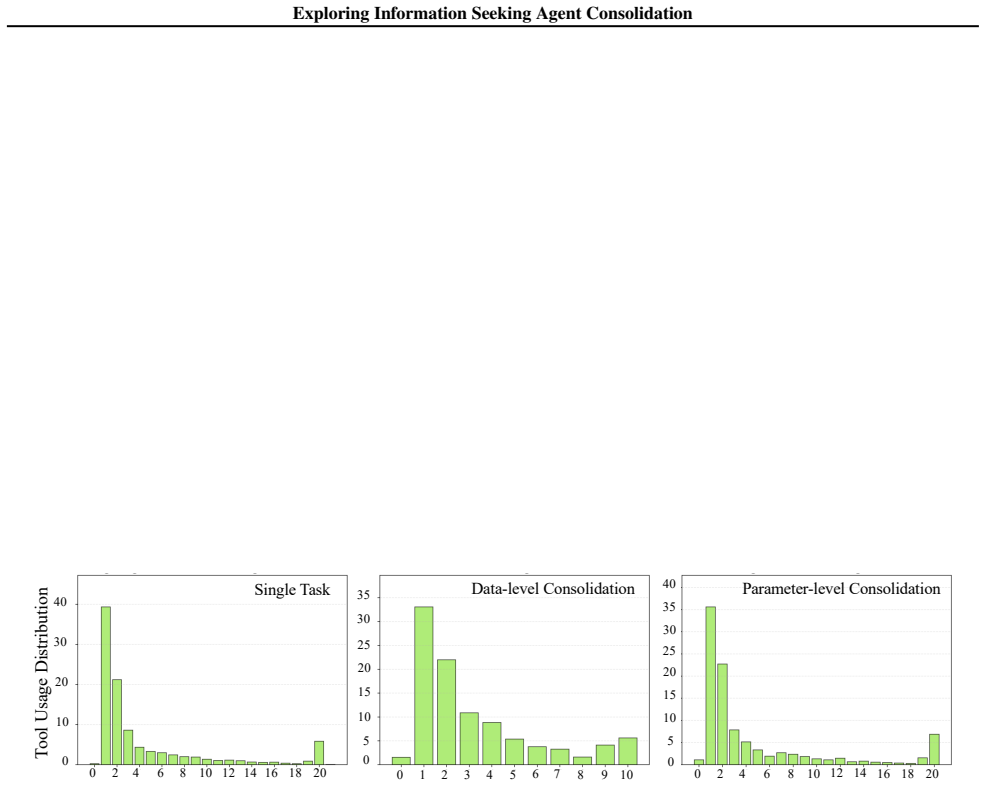
- [§4, Tables 3–5] All performance numbers are single-run; no seeds, variance, or significance tests are reported. The text notes that BrowseComp and BrowseComp-zh are randomly subsampled (200 and 100 instances) and GAIA is a 103-instance subset. Many rank-relevant differences are a few points (e.g., Table 3: GAIA 64.08 vs 64.07; BC 28.00 vs 23.00; Bamboogle EM 53.10 vs 52.80). Without uncertainty quantification, the method rankings and the design principles drawn from them (matrix-level granularity, consensus strategy, subspace methods) are not reliably established. Please report multiple seeds or error bars, or at least a significance/effect-size analysis, and temper the conclusions accordingly.
- [§5.1, RQ I; abstract claim (ii)] The abstract states that parameter-level merging 'structurally preserves out-of-domain capabilities that data mixing universally forgets.' No table or section in the body presents evidence of forgetting by data mixing. Finding ❶ in §5.1 discusses RAG as out-of-distribution and notes that consolidation methods rarely surpass the dedicated RAG agent, which is a different claim. Please either add direct evidence of data mixing forgetting or remove/qualify this abstract claim.
- [Abstract claim (i) / §5.1] The abstract claims parity 'at a fraction of its training cost,' but no training or merging cost is quantified anywhere in the manuscript. The paper only asserts that parameter-level merging avoids joint retraining. Without actual compute/cost measurements, the efficiency advantage is not demonstrated. Please include cost comparisons or substantially qualify the claim.
minor comments (4)
- [Abstract / Table 2] The abstract says 26 methods and 10 benchmarks; the body says 20 methods and lists 8 benchmarks (GAIA, BrowseComp, BrowseComp-zh, MMLongBenchDoc, DocBench, HotPotQA, AmbigQA, Bamboogle). Please reconcile these numbers.
- [Tables 3–5 captions] The caption 'The number indicates the number of cases in which the method outperforms the expert agent' appears inconsistent with the table cells, which appear to be accuracy/F1 scores. Please clarify or correct the caption.
- [References] Wei et al. 2025a and 2025b, and Wu et al. 2025a and 2025b, are duplicate entries for the same papers. Please merge or disambiguate.
- [§4] Minor typo: '20 instinct representative parameter-level consolidation methods' should read '20 representative' or '20 instances'.
Circularity Check
Empirical comparison with external benchmarks; no derived quantity reduces to its fit or to a self-citation.
full rationale
This paper is an empirical benchmarking study rather than a derivation, so the main circularity patterns do not apply. The central comparison (data mixing vs. parameter merging) is measured on external benchmarks (GAIA, BrowseComp, HotPotQA, etc.) using published merging operators, and no parameter is fitted to a target metric and then reported as a prediction. The self-citations to Webdancer/Docdancer/Ragshaper are used only to construct the three expert agents; the paper's conclusions are not inferred from those papers' claims, so they are constructional rather than load-bearing. The order-agnostic statement is a tautological property of the symmetric merge definition (Eq. 4), and the abstract's promised 'geometric Composite Score and an Imbalance Score' never appear in the body, leaving the headline 'parity' claim undefined. Both are evidential/definitional weaknesses, not circular reductions: the tables still contain independent measurements, and no claimed result reduces to its own input by construction.
Axiom & Free-Parameter Ledger
free parameters (3)
- merge coefficients for Average/SLERP (α_web, α_doc, α_rag)
- LoRA rank =
8
- evaluation subset sizes =
200 (BC), 100 (BC-zh), 103 (GAIA)
axioms (4)
- domain assumption ReAct-style trajectory format is the correct common abstraction for web, doc, and RAG agents
- domain assumption Benchmark answers via LLM-as-Judge for MMBD and DocB are reliable
- domain assumption Training trajectories (Dweb, Ddoc, Drag) do not leak evaluation benchmarks
- domain assumption GAIA/BrowseComp subsets of 100-200 instances are sufficient to rank methods
invented entities (2)
-
Geometric Composite Score
no independent evidence
-
Imbalance Score
no independent evidence
Cite this review
Pith. "Pith review of Exploring Information Seeking Agent Consolidation." pith.science (2026). https://pith.science/paper/RJL27F6X
@misc{pith2026260200585,
  author       = {Pith},
  title        = {Pith review of: Exploring Information Seeking Agent Consolidation},
  year         = {2026},
  howpublished = {\url{https://pith.science/paper/RJL27F6X}},
  note         = {Machine review of arXiv:2602.00585}
}
read the original abstract
Information-seeking agents have emerged as a powerful paradigm for knowledge-intensive tasks, yet today's systems remain specialized for the open web, documents, or local knowledge bases, hindering scalable and cross-domain deployment. We present the first systematic empirical study of consolidating these information-seeking agents into a single foundation agentic model. We compare two paradigms -- \emph{data-level mixing}, which trains a unified model on a mixture of datasets, and \emph{parameter-level merging}, which merges independently trained experts in parameter space -- across 3 training scenarios, evaluating \textbf{26} representative parameter-level methods on \textbf{10} benchmarks. To compare across heterogeneous benchmarks, we introduce a geometric Composite Score and an Imbalance Score that describe overall performance and task skew. Our analysis shows that (i) well-designed parameter-level merging attains parity with data mixing at a fraction of its training cost and is order-agnostic; (ii) parameter-level merging structurally preserves out-of-domain capabilities that data mixing universally forgets; and (iii) cross-scenario stability is strongly tied to consolidation quality. We distil our observations into a method-selection guide and design principles for next-generation merging operators.
Figures




Reference graph
Works this paper leans on
-
[2020]
and computes similarity scores between the query 3https://github.com/facebookresearch/DPR 14 Exploring Information Seeking Agent Consolidation Web RagDoc 0501001502002503001.0 1.2 1.4 1.6 0.81.01.21.41.6 0.81.01.21.41.6 00.81.01.21.41.6 Data-level Consolidate Loss Step GAIABCBC-zh 31.073.002.0052.439.0012.0050.4914.0015.00 MMBD(LasJ)DocB(LasJ) HP(F1)AmBig...
arXiv 2065
-
[2025]
One Size Does Not Fit All: A Distribution-Aware Sparsification for More Precise Model Merging
doi: 10.48550/ARXIV .2508.06163. URLhttps: //doi.org/10.48550/arXiv.2508.06163. Ma, Y ., Zang, Y ., Chen, L., Chen, M., Jiao, Y ., Li, X., Lu, X., Liu, Z., Ma, Y ., Dong, X., et al. Mmlongbench- doc: Benchmarking long-context document understand- ing with visualizations.Advances in Neural Information Processing Systems, 37:95963–96010, 2024. Maiti, S., Bu...
work page internal anchor Pith review Pith/arXiv arXiv doi:10.48550/arxiv.2508.06163 2024
This paper was first reviewed by deepseek-v4-flash on August 3, 2026.
discussion (0)
Sign in with ORCID, Apple, or X to comment. Anyone can read and Pith papers without signing in.