REVIEW 4 major objections 6 minor 1 cited by
This paper claims that aligning hidden states of as few as ten language models yields a unified item space from which a small coreset can accurately predict full-benchmark performance, outperforming output-based methods.
Reviewed by Pith at T0; open to challenge. T0 means a machine referee read the full paper against a public rubric. the ladder, T0–T4 →
T0 review · deepseek-v4-flash
2026-08-03 05:53 UTC pith:Y5OVPXRP
load-bearing objection RepCore is a credible, well-tested method for benchmark compression with hidden states, but missing error bars and a skipped same-group baseline temper the headline numbers. the 4 major comments →
Learning More from Less: Unlocking Internal Representations for Benchmark Compression
The pith
A machine-rendered reading of the paper's core claim, the machinery that carries it, and where it could break.
Core claim
REPCORE's central claim is that discrete correctness labels are a lossy view of the model's decision process, and that the final-layer, final-token hidden states — once aligned through model-specific linear projections and a shared MLP trained to predict correctness on 70% of the benchmark — yield a unified item space whose geometry preserves fine-grained inter-item relations. Averaging aligned embeddings across source models and normalizing to the unit sphere produces consensus embeddings; clustering these and selecting each cluster centroid as an anchor gives a coreset that, combined with a scalar ridge regressor, estimates full-benchmark accuracy and rankings on unseen target models. With
What carries the argument
The central mechanism is cross-model alignment: for each model-item pair, the final layer's final-token hidden state h_{m,i} is mapped through a model-specific linear projection Proj_m and a shared MLP f_θ, trained with cross-entropy to predict the item's ground-truth correctness, producing a 32-dimensional aligned embedding z_{m,i}. Averaging these embeddings over source models gives a consensus embedding e_i; after L2 normalization, the item space is partitioned to maximize within-cluster cosine similarity, and the item closest to each centroid is chosen as an anchor. The resulting coreset, together with a ridge regressor that uses average item correctness across sources as a feature, extr
Load-bearing premise
The load-bearing assumption is that hidden states from different architectures, after per-model linear projection and a shared MLP trained on 70% of the target benchmark's labels, form an aligned item space whose geometry is stable enough that consensus embeddings and clustering select coresets that also work on the held-out items and unseen target models; if that alignment overfits the training split or is architecture-specific, the coreset is no better than a random one.
What would settle it
Retrain the alignment network with the same 70% of items but with ground-truth labels randomly permuted across items; if REPCORE's coreset still outperforms random selection, the gains do not depend on correctness supervision and the claimed mechanism is suspect. If performance collapses to the random baseline, the method is label-dependent and will not transfer to benchmarks without pre-existing labels.
If this is right
- Newly released or long-tail benchmarks can be compressed for evaluation with as few as ten source models, removing the need for large historical evaluation pools.
- Because the aligned space separates difficulty from task identity, coresets can preserve item-level error patterns, not just average accuracy, improving the fidelity of extrapolated rankings.
- Source pools deliberately spanning diverse model families and capability ranges yield more reliable compression, suggesting diversity is a design choice, not a nuisance.
- The method requires hidden-state access, so it applies to open-weight models and leaves closed-source systems out of scope for now.
Where Pith is reading between the lines
- If the alignment is truly benchmark-invariant rather than fit to the 70% training labels, the same projections and consensus embeddings could transfer across benchmarks, enabling one-time coreset construction per domain; the paper lists this as future work.
- The reliance on 70% labeled items for training the alignment network means the method still pays a substantial labeling cost that scales with benchmark size; a fully unsupervised alignment would remove this bottleneck.
- On benchmarks dominated by a single ability mode, clustering may reduce to difficulty binning, so REPCORE's advantage should be largest on multi-task benchmarks; that is a testable prediction of the spectral analysis.
- The hidden-state signal is a strong prior for item structure, but the extrapolator itself is a ridge regressor over a scalar feature; a more flexible extrapolator may further close the gap to full-benchmark evaluation.
Editorial analysis
A structured set of objections, weighed in public.
Referee Report
Summary. The paper proposes REPCORE, a method for benchmark compression in source-scarce regimes (|S| <= 10 source models). REPCORE extracts final-layer hidden states from source models, projects each model's hidden space with a per-model linear layer, and passes the result through a shared MLP trained to predict source-model correctness labels. It then averages these aligned embeddings across sources to form consensus item embeddings, selects a K-item coreset by clustering, and fits a ridge regressor on target-model coreset scores to extrapolate full-benchmark performance. Experiments cover five benchmarks and over 200 models, reporting Spearman rank correlation and MAE against Random, AnchorPoints, and GP-IRT baselines, plus ablations on source size, composition, and representation type, and a spectral analysis of the learned embedding space.
Significance. If the reported gains are robust, REPCORE would be a practically relevant contribution: it would show that hidden states can reduce the number of source models needed for benchmark compression from dozens to about ten, and that the learned item geometry supports both coreset selection and extrapolation. The paper's strengths are its breadth (five benchmarks, >200 models, multiple splits), the controlled ablation isolating continuous embeddings from binary correctness vectors (Appendix C.3, Table 4), and the explicit study of source diversity (Table 5). These are real assets and make the central idea worth taking seriously. However, the headline claim of consistent gains over output-based baselines is currently weakened by two issues: lack of error bars/significance tests for the main results, and the fact that GP-IRT is not merely 'occasionally' competitive on MAE but often better at several budgets. The alignment mechanism is also not directly verified, which matters because the method's name and motivation rest on cross-model alignment.
major comments (4)
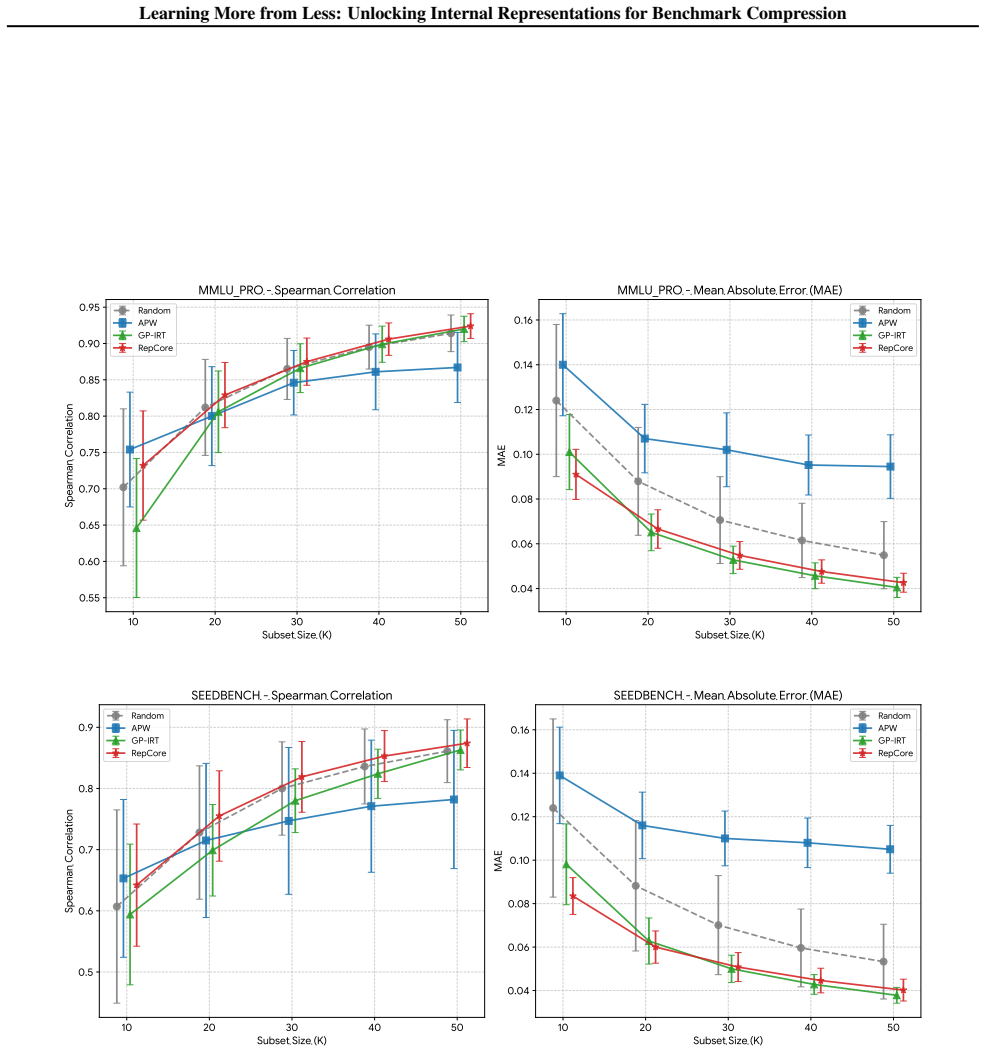
- [§3.2, Table 1; Appendix C.9] Main results are reported as 10-split averages with no standard deviations or significance tests. Appendix C.9 plots error bars, but the numbers are not given in the tables. Several margins are small: BBH K=50 ρ is 0.913 vs 0.901 for GP-IRT; GSM8K K=20 ρ is 0.872 vs 0.839; MAE differences are often within 0.003. Without paired per-split tests (e.g., Wilcoxon signed-rank over the 10 splits), the claim of 'consistent improvements' over GP-IRT is not established. This is load-bearing for the main conclusion.
- [§3.2, Tables 1 and 11; Appendix C.2] The text states REPCORE 'typically yields the lowest mean absolute error' and that GP-IRT is 'occasionally competitive' (marked with ⋆). The tables contradict this: GP-IRT has lower MAE at BBH K=10 and K=20, GSM8K K=10, SEED-Bench K=30/40/50, and MMLU-Pro K=30/40/50. The Agreement metric in Appendix C.1 is a reasonable secondary check, but the primary claim as written overstates the MAE results. The authors should either qualify the MAE claim or pre-specify Agreement as the fidelity metric.
- [§2.2–2.3, Eqs. (1)–(5)] The name and motivation of REPCORE rest on 'aligning heterogeneous hidden states,' but the training objective only optimizes per-item cross-entropy; there is no explicit cross-model consistency term. The consensus embedding is an average of per-model vectors, yet nothing in Eq. (2) guarantees that these vectors are geometrically comparable across architectures. Table 5's large drop for a single-family source pool (ρ=0.686 vs 0.868 diverse) suggests the alignment is not automatically architecture-invariant. Please provide direct evidence of alignment, e.g., same-item cross-model cosine similarity before/after training, or an ablation comparing consensus averaging against a concatenation/no-alignment baseline.
- [§4, Appendix B.4] The spectral analysis defines item difficulty and discrimination using the full model set U=S∪T (Eq. 18–20), which includes target models whose labels are not available in the actual compression setting. This is acceptable for post-hoc interpretability, but the paper should explicitly state that this analysis is diagnostic and does not reflect information available to REPCORE at deployment. As written, Section 4.1 could be read as suggesting the learned geometry is evaluated with access to target responses.
minor comments (6)
- [Appendix C.8 and Table 21] The method is referred to as 'REOCORE' instead of 'REPCORE' in the text and table. Please correct.
- [§2.2] The claim that d_z=32 is justified by 'effective rank below 20' is not supported by any figure or table. Please show the rank diagnostic or at least report the distribution across models.
- [§4.1] The phrase '100 model snapshots (10 combos × 10 models)' is unclear. Define 'combo' and how snapshots relate to the 10 source/target splits.
- [Tables 1, 11] Best/second-best bolding is inconsistent in places (e.g., SEED-Bench K=10 ρ, where ANCHORPOINTS appears to have the highest value but the formatting does not clearly mark it). Please audit all table formatting.
- [Table 5] Family A and Family B names appear only in the footnote in the appendix. Since Table 5 is in the main text, specify the model families directly in the caption.
- [§2.2] The sentence 'the classifier achieves AUC approximately 0.9 on held-out test splits' should include the variance across models and source splits, especially since the main results are criticized for lacking error bars.
Circularity Check
No significant circularity: the central compression/extrapolation pipeline is validated on held-out target models, and the one self-citation is only related work.
full rationale
The paper's load-bearing claim is that REPCORE's coreset, selected from consensus embeddings of source-model hidden states, plus a ridge regressor fit on target coreset scores, extrapolates to full-benchmark accuracy for held-out target models. This is not circular: the representation (Eq. 1) is trained with source correctness labels (Eq. 2), but target models' full-benchmark scores are never used to fit the representation or select the coreset; they are used only as evaluation ground truth. The extrapolator (Eqs. 6-8) uses target scores only on the coreset as the dependent variable in a regression whose feature is the source-average difficulty; the remaining target scores are genuinely predicted. The spectral analysis (Section 4) reports correlations between learned embeddings and difficulty/task factors, but this is post-hoc interpretability, not the basis of the compression result; the fact that PC1 correlates with difficulty is expected given the cross-entropy objective, but it is not a predicted benchmark outcome. The only author self-citation (Yuan et al., 2025) appears in related work as a prior baseline description and is not used to justify any design choice. Experiments are run across five benchmarks with held-out target models and multiple source/target splits, providing external validation. Therefore no step in the derivation chain reduces by construction to its inputs.
Axiom & Free-Parameter Ledger
free parameters (2)
- bottleneck dimension d_z =
32
- Ridge regularization lambda =
unspecified
axioms (4)
- domain assumption Final-layer last-token hidden states encode item difficulty and correctness-related signals.
- domain assumption Per-model linear projections plus a shared MLP can align heterogeneous hidden spaces into a common geometry.
- domain assumption Average correctness across source models x_i is a sufficient scalar feature for extrapolating target model item scores.
- domain assumption Ground-truth correctness labels are available for the target benchmark.
read the original abstract
The prohibitive cost of evaluating Large Language Models (LLMs) necessitates efficient alternatives to full-scale benchmarking. Prevalent approaches address this by identifying a small coreset of items to approximate full-benchmark performance. However, existing methods must estimate a reliable item profile from response patterns across many source models, which becomes statistically unstable when the source pool is small. This dependency is particularly limiting for newly released benchmarks with minimal historical evaluation data. We argue that discrete correctness labels are a lossy view of the model's decision process and fail to capture information encoded in hidden states. To address this, we introduce RepCore, which aligns heterogeneous hidden states into a unified latent space to construct representative coresets. Using these subsets for performance extrapolation, RepCore achieves precise estimation accuracy with as few as ten source models. Experiments on five benchmarks and over 200 models show consistent gains over output-based baselines in ranking correlation and estimation accuracy. Spectral analysis further indicates that the aligned representations contain separable components reflecting broad response tendencies and task-specific reasoning patterns.
Figures


Forward citations
Cited by 1 Pith paper
-
When Correct Decisions Hide Internal Stress: Decision-State Probing in Multimodal Language Models
S³E framework finds excess decision-state displacement under semantic stress in multimodal models despite consistent correct forced-choice behavior.
Reference graph
Works this paper leans on
-
[1]
L., Almeida, D., Altenschmidt, J., Altman, S., Anadkat, S., et al
Achiam, J., Adler, S., Agarwal, S., Ahmad, L., Akkaya, I., Aleman, F. L., Almeida, D., Altenschmidt, J., Altman, S., Anadkat, S., et al. Gpt-4 technical report. arXiv preprint arXiv:2303.08774,
-
[3]
Think you have solved question answering? try arc, the ai2 reasoning challenge
Clark, P., Cowhey, I., Etzioni, O., Khot, T., Sabharwal, A., Schoenick, C., and Tafjord, O. Think you have solved question answering? try arc, the ai2 reasoning challenge. arXiv preprint arXiv:1803.05457,
-
[7]
Holistic evaluation of language models
Liang, P., Bommasani, R., Lee, T., Tsipras, D., Soylu, D., Yasunaga, M., Zhang, Y ., Narayanan, D., Wu, Y ., Kumar, A., et al. Holistic evaluation of language models. arXiv preprint arXiv:2211.09110,
-
[9]
Large language models have intrinsic meta-cognition, but need a good lens
Ma, Z., Yuan, Q., Wang, Z., and Zhou, D. Large language models have intrinsic meta-cognition, but need a good lens. arXiv preprint arXiv:2506.08410,
-
[10]
Marjanovi´c, S. V ., Patel, A., Adlakha, V ., Aghajohari, M., BehnamGhader, P., Bhatia, M., Khandelwal, A., Kraft, A., Krojer, B., L`u, X. H., et al. Deepseek-r1 thoughtol- ogy: Let’s think about llm reasoning. arXiv preprint arXiv:2504.07128,
-
[11]
Llms know more than they show: On the intrinsic representation of llm hallucinations
Orgad, H., Toker, M., Gekhman, Z., Reichart, R., Szpek- tor, I., Kotek, H., and Belinkov, Y . Llms know more than they show: On the intrinsic representation of llm hallucinations. arXiv preprint arXiv:2410.02707,
-
[12]
E., Shnarch, E., Slonim, N., Shmueli-Scheuer, M., and Choshen, L
Perlitz, Y ., Bandel, E., Gera, A., Arviv, O., Dor, L. E., Shnarch, E., Slonim, N., Shmueli-Scheuer, M., and Choshen, L. Efficient benchmarking (of language mod- els). In Proceedings of the 2024 Conference of the North American Chapter of the Association for Computational Linguistics: Human Language Technologies (V olume1: Long Papers), pp. 2519–2536,
2024
-
[13]
M., Weber, L., Choshen, L., Sun, Y ., Xu, G., and Yurochkin, M
Polo, F. M., Weber, L., Choshen, L., Sun, Y ., Xu, G., and Yurochkin, M. tinybenchmarks: evaluating llms with fewer examples. arXiv preprint arXiv:2402.14992,
-
[14]
W., Chowdhery, A., Le, Q., Chi, E., Zhou, D., et al
Suzgun, M., Scales, N., Sch¨arli, N., Gehrmann, S., Tay, Y ., Chung, H. W., Chowdhery, A., Le, Q., Chi, E., Zhou, D., et al. Challenging big-bench tasks and whether chain-of- thought can solve them. In Findings of the Association for Computational Linguistics: ACL 2023, pp. 13003– 13051,
2023
-
[15]
9 Learning More from Less: Unlocking Internal Representations for Benchmark Compression Wang, Y ., Li, H., Zou, H., Zhang, J., He, X., Li, Q., and Xu, K. Faclens: Transferable probe for foreseeing non- factuality in fact-seeking question answering of large language models. In Proceedings of the 2025 Conference on Empirical Methods in Natural Language Proc...
Pith/arXiv arXiv 2025
-
[16]
Beyond one-size-fits- all: Tailored benchmarks for efficient evaluation
Yuan, P., Zhang, Y ., Feng, S., Li, Y ., Wang, X., Shi, J., Tan, C., Pan, B., Hu, Y ., and Li, K. Beyond one-size-fits- all: Tailored benchmarks for efficient evaluation. arXiv preprint arXiv:2502.13576,
-
[17]
Reasoning models know when they’re right: Probing hidden states for self-verification
Zhang, A., Chen, Y ., Pan, J., Zhao, C., Panda, A., Li, J., and He, H. Reasoning models know when they’re right: Probing hidden states for self-verification. arXiv preprint arXiv:2504.05419,
-
[18]
The llm already knows: Estimating llm-perceived ques- tion difficulty via hidden representations
Zhu, Y ., Liu, D., Lin, Z., Tong, W., Zhong, S., and Shao, J. The llm already knows: Estimating llm-perceived ques- tion difficulty via hidden representations. In Proceedings of the 2025 Conference on Empirical Methods in Natural Language Processing, pp. 1160–1176,
2025
-
[19]
Representation engineering: A top-down approach to ai transparency
Zou, A., Phan, L., Chen, S., Campbell, J., Guo, P., Ren, R., Pan, A., Yin, X., Mazeika, M., Dombrowski, A.-K., et al. Representation engineering: A top-down approach to ai transparency. arXiv preprint arXiv:2310.01405,
-
[20]
Global” metrics correspond to raw Spearman correlations, while “Stratified
and FACLENS(Wang et al., 2025a) train probes to detect hallucinations or predict correctness before generation is complete, suggesting models possess intrinsic meta-cognition regarding their knowledge boundaries (Ma et al., 2025; Orgad et al., 2024). Encoding Difficulty and Structure.Recent findings indicate that hidden representations also implicitly enc...
arXiv 2025
-
[21]
The results consistently demonstrate the robustness of REPCOREin source-scARCe regimes. As evidenced across all budget levels, output-based baselines such as ANCHORPOINTSexhibit sharp performance degradation when |S|= 5 , suggesting a 15 Learning More from Less: Unlocking Internal Representations for Benchmark Compression heavy reliance on extensive stati...
arXiv 2024
-
[2018]
Training verifiers to solve math word problems
Cobbe, K., Kosaraju, V ., Bavarian, M., Chen, M., Jun, H., Kaiser, L., Plappert, M., Tworek, J., Hilton, J., Nakano, R., et al. Training verifiers to solve math word problems. arXiv preprint arXiv:2110.14168,
-
[2022]
Lugoloobi, W. and Russell, C. Llms encode how difficult problems are. arXiv preprint arXiv:2510.18147,
-
[2023]
Azaria, A. and Mitchell, T. The internal state of an llm knows when it’s lying. arXiv preprint arXiv:2304.13734,
-
[2024]
J., Ung, M., and Williams, A
Gupta, V ., Ross, C., Pantoja, D., Passonneau, R. J., Ung, M., and Williams, A. Improving model evalu- ation using smart filtering of benchmark datasets. In Proceedings of the 2025 Conference of the Nations of the Americas Chapter of the Association for Computational Linguistics: Human Language Technologies (V olume1: Long Papers), pp. 4595–4615,
2025
-
[2025]
Li, B., Ge, Y ., Chen, Y ., Ge, Y ., Zhang, R., and Shan, Y . Seed-bench-2-plus: Benchmarking multimodal large lan- guage models with text-rich visual comprehension. arXiv preprint arXiv:2404.16790,
discussion (0)
Sign in with ORCID, Apple, or X to comment. Anyone can read and Pith papers without signing in.