Asymptotically Optimal Quantum Universal Quickest Change Detection
Pith reviewed 2026-05-16 08:17 UTC · model grok-4.3
The pith
A two-stage quantum detector using block POVMs and windowed-CUSUM achieves asymptotic optimality for unknown post-change states.
A machine-rendered reading of the paper's core claim, the machinery that carries it, and where it could break.
Core claim
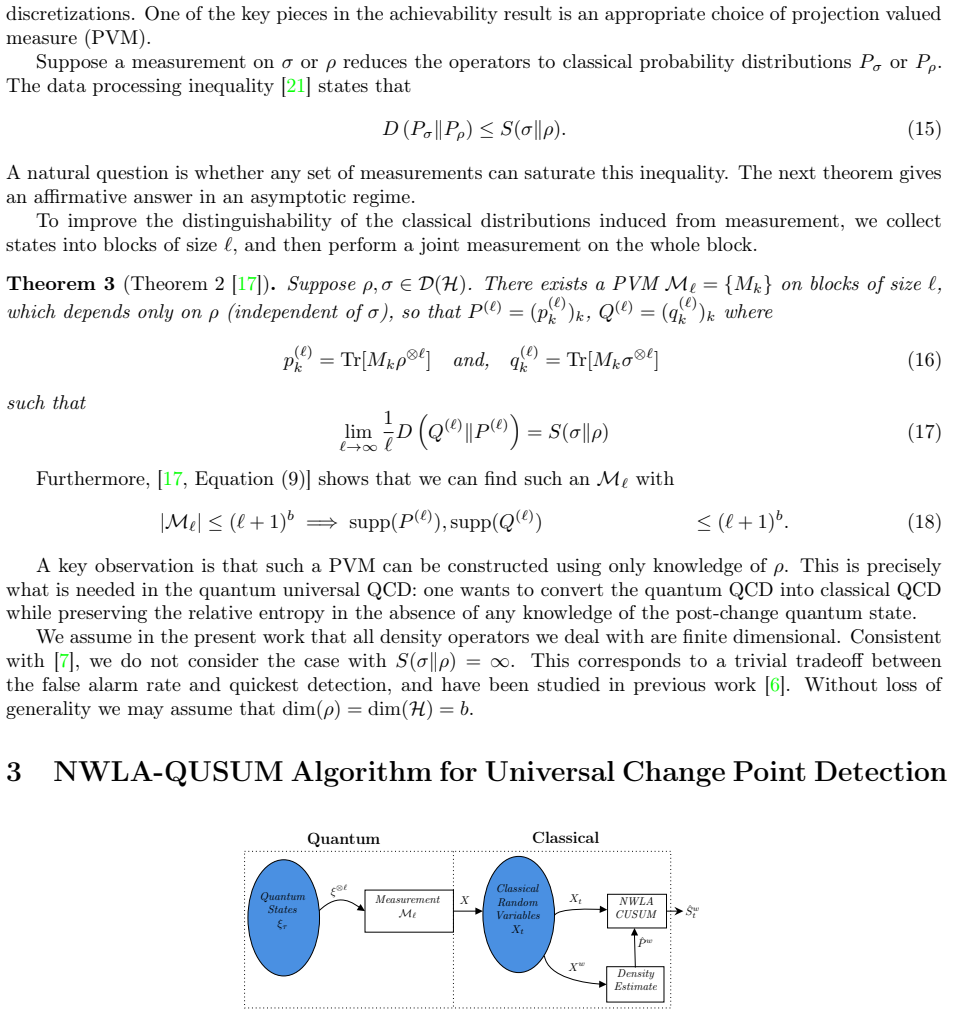
The paper establishes the asymptotic optimality of a two-stage approach for quantum universal quickest change detection in terms of worst average delay to detection. The first stage employs block POVMs with classical outputs that preserve quantum relative entropy to arbitrary precision. The second stage leverages the classical windowed-CUSUM algorithm that is known to be asymptotically optimal for quickest change detection with an unknown post-change distribution.
What carries the argument
Block POVMs that output classical data while preserving quantum relative entropy to arbitrary precision, followed by the windowed-CUSUM algorithm.
If this is right
- The worst average detection delay scales exactly as the logarithm of the inverse false-alarm probability divided by the quantum relative entropy between pre- and post-change states.
- No prior knowledge of the post-change quantum state is required for the optimality guarantee to hold.
- The quantum problem reduces to a classical one with arbitrarily small information loss, inheriting the classical windowed-CUSUM optimality result.
- The result applies to any quantum state family in which the relative entropy is strictly positive.
Where Pith is reading between the lines
- The same two-stage structure may extend to quantum sequential hypothesis testing when the alternative hypothesis is composite rather than simple.
- Finite-block-length approximations of the POVMs will introduce a tradeoff between approximation error and the time needed to collect each block.
- The optimality opens a route to adaptive quantum sensors that can respond to unanticipated environmental shifts without being pre-programmed for them.
Load-bearing premise
Block POVMs exist that can make the classical output preserve quantum relative entropy between any pair of states to within any small positive error.
What would settle it
A concrete family of quantum states and change times for which the two-stage detector's worst-case average delay stays bounded away from the quantum relative entropy lower bound by a positive constant factor as the false-alarm probability tends to zero.
Figures
read the original abstract
This paper investigates the quickest change detection of quantum states in a universal setting: specifically, where the post-change quantum state is not known a priori. We establish the asymptotic optimality of a two-stage approach in terms of worst average delay to detection. The first stage employs block POVMs with classical outputs that preserve quantum relative entropy to arbitrary precision. The second stage leverages a recently proposed windowed-CUSUM algorithm that is known to be asymptotically optimal for quickest change detection with an unknown post-change distribution in the classical setting.
Editorial analysis
A structured set of objections, weighed in public.
Referee Report
Summary. The manuscript proposes a two-stage procedure for universal quickest change detection of quantum states, where the post-change state is unknown a priori. The first stage applies fixed-length block POVMs whose classical outputs approximate the quantum relative entropy D(ρ||σ) to arbitrary precision ε. The second stage runs the classical windowed-CUSUM algorithm on these outputs, which is known to be asymptotically optimal for unknown post-change distributions. The central claim is that the resulting scheme is asymptotically optimal in the worst-case average detection delay as the false-alarm threshold γ → ∞.
Significance. If the asymptotic optimality result holds with the stated precision, the work provides a concrete bridge between classical universal change detection and quantum measurement theory. It supplies an explicit construction that achieves the information-theoretic lower bound without requiring knowledge of the post-change state, which is a non-trivial extension. The relative-entropy-preserving POVM stage is technically interesting and could serve as a template for other quantum sequential decision problems.
major comments (2)
- [§5 (proof of asymptotic optimality)] The asymptotic analysis (likely the proof of the main theorem in §5) treats the block length k as fixed while letting γ → ∞. However, the abstract states that the POVMs preserve relative entropy “to arbitrary precision,” which requires k = k(ε) → ∞ as ε → 0. The additive detection delay of order k is then no longer guaranteed to be o(log γ), so the ratio of achieved delay to the lower bound may fail to approach 1. A precise statement of the joint limit (how ε and k scale with γ) is needed.
- [§4.1 (reduction step)] The reduction to the classical windowed-CUSUM result assumes that the effective post-change distribution induced by the block POVM remains unknown but still satisfies the conditions of the classical optimality theorem. It is not shown that the approximation error ε does not degrade the universality property or introduce a bias that affects the worst-case delay bound.
minor comments (2)
- [§2 (preliminaries)] Notation for the pre- and post-change states (ρ, σ) is introduced without an explicit list of standing assumptions (e.g., finite-dimensional Hilbert space, known pre-change state).
- [Figure 1] Figure 1 (schematic of the two-stage scheme) would benefit from labeling the block boundaries and the windowed-CUSUM statistic explicitly.
Simulated Author's Rebuttal
We thank the referee for the detailed and constructive review of our manuscript. The comments highlight important aspects of the asymptotic analysis and the reduction to the classical setting that require clarification. We address each major comment below and will revise the manuscript to incorporate the necessary adjustments.
read point-by-point responses
-
Referee: [§5 (proof of asymptotic optimality)] The asymptotic analysis (likely the proof of the main theorem in §5) treats the block length k as fixed while letting γ → ∞. However, the abstract states that the POVMs preserve relative entropy “to arbitrary precision,” which requires k = k(ε) → ∞ as ε → 0. The additive detection delay of order k is then no longer guaranteed to be o(log γ), so the ratio of achieved delay to the lower bound may fail to approach 1. A precise statement of the joint limit (how ε and k scale with γ) is needed.
Authors: We acknowledge that the current presentation in §5 fixes k while taking γ → ∞, which does not fully capture the arbitrary precision requirement. To resolve this, we will revise the proof to consider a joint limit where ε = ε(γ) → 0 as γ → ∞ at a sufficiently slow rate (for example, ε = o(1/log γ)), ensuring that the corresponding block length k(ε) satisfies k = o(log γ). This way, the additive delay term remains negligible compared to the leading term, and the ratio to the lower bound approaches 1. We will add an explicit statement of this scaling in the revised §5. revision: yes
-
Referee: [§4.1 (reduction step)] The reduction to the classical windowed-CUSUM result assumes that the effective post-change distribution induced by the block POVM remains unknown but still satisfies the conditions of the classical optimality theorem. It is not shown that the approximation error ε does not degrade the universality property or introduce a bias that affects the worst-case delay bound.
Authors: The block POVM construction ensures that the induced classical distributions have relative entropies within ε of the quantum ones, preserving positivity of the divergence for any ρ ≠ σ. The windowed-CUSUM is universal over all distributions with positive KL divergence, so the approximation does not destroy universality. However, to rigorously bound the effect on the worst-case delay, we agree that additional details are needed. In the revision, we will include a lemma showing that the bias introduced by the ε-approximation leads only to an additive o(log γ) term in the detection delay, which vanishes in the asymptotic ratio. This will be added to §4.1. revision: yes
Circularity Check
No significant circularity in the two-stage quantum-to-classical reduction
full rationale
The derivation proceeds by constructing block POVMs whose classical outputs approximate the quantum relative entropy D(ρ||σ) to arbitrary precision, then invoking the known asymptotic optimality of the classical windowed-CUSUM procedure for unknown post-change distributions. No equation or step reduces the claimed worst-case average delay to a fitted parameter or to a self-citation whose content is itself the target result. The classical optimality is treated as an external benchmark whose assumptions do not embed the quantum claim, satisfying the independence criteria. The block length k is fixed for any chosen precision ε and becomes negligible in the γ→∞ limit, but this is an asymptotic detail rather than a definitional loop. Consequently the overall argument remains self-contained against the cited classical result.
Axiom & Free-Parameter Ledger
axioms (2)
- domain assumption Block POVMs exist that preserve quantum relative entropy to arbitrary precision.
- domain assumption The windowed-CUSUM algorithm is asymptotically optimal for classical quickest change detection with unknown post-change distribution.
Reference graph
Works this paper leans on
-
[1]
Continuous inspection schemes,
E. S. Page, “Continuous inspection schemes,”Biometrika, vol. 41, no. 1/2, pp. 100–115, 1954
work page 1954
-
[2]
Procedures for reacting to a change in distribution,
G. Lorden, “Procedures for reacting to a change in distribution,”The annals of mathematical statistics, pp. 1897–1908, 1971
work page 1908
-
[3]
Discrimination of the change point in a quantum setting,
D. Akimoto and M. Hayashi, “Discrimination of the change point in a quantum setting,”Physical Review A—Atomic, Molecular, and Optical Physics, vol. 83, no. 5, p. 052328, 2011
work page 2011
-
[4]
G. Sentís, E. Bagan, J. Calsamiglia, G. Chiribella, and R. Munoz-Tapia, “Quantum change point,”arXiv preprint arXiv:1605.01916, 2016
work page internal anchor Pith review Pith/arXiv arXiv 2016
-
[5]
Exact Identification of a Quantum Change Point
G. Sentís, J. Calsamiglia, and R. Munoz-Tapia, “Exact identification of a quantum change point,”arXiv preprint arXiv:1707.07769, 2017
work page internal anchor Pith review Pith/arXiv arXiv 2017
-
[6]
Online strategies for exactly identifying a quantum change point,
G. Sentís, E. Martínez-Vargas, and R. Munoz-Tapia, “Online strategies for exactly identifying a quantum change point,”Physical Review A, vol. 98, no. 5, p. 052305, 2018. 8
work page 2018
-
[7]
Ultimate limits for quickest quantum change-point detection,
M. Fanizza, C. Hirche, and J. Calsamiglia, “Ultimate limits for quickest quantum change-point detection,”Physical Review Letters, vol. 131, no. 2, p. 020602, 2023
work page 2023
-
[8]
Fundamental limits of quickest change-point detection with continuous-variable quantum states,
T. C. John, C. N. Gagatsos, and B. A. Bash, “Fundamental limits of quickest change-point detection with continuous-variable quantum states,”arXiv preprint arXiv:2504.16259, 2025
-
[9]
Information bounds and quick detection of parameter changes in stochastic systems,
T. L. Lai, “Information bounds and quick detection of parameter changes in stochastic systems,”IEEE Transactions on Information theory, vol. 44, no. 7, pp. 2917–2929, 1998
work page 1998
-
[10]
Quickest change detection with non-stationary post-change observations,
Y. Liang, A. G. Tartakovsky, and V. V. Veeravalli, “Quickest change detection with non-stationary post-change observations,”IEEE Transactions on Information Theory, vol. 69, no. 5, pp. 3400–3414, 2022
work page 2022
-
[11]
Quickest change detection with leave-one-out density estimation,
Y. Liang and V. V. Veeravalli, “Quickest change detection with leave-one-out density estimation,” inICASSP 2023-2023 IEEE International Conference on Acoustics, Speech and Signal Processing (ICASSP). IEEE, 2023, pp. 1–5
work page 2023
-
[12]
Window-limited cusum for sequential change detection,
L. Xie, G. V. Moustakides, and Y. Xie, “Window-limited cusum for sequential change detection,”IEEE Transactions on Information Theory, vol. 69, no. 9, pp. 5990–6005, 2023
work page 2023
-
[13]
Quickest change detection with post-change density estimation,
Y. Liang and V. V. Veeravalli, “Quickest change detection with post-change density estimation,”IEEE Transactions on Information Theory, vol. 70, no. 11, pp. 8072–8086, 2024
work page 2024
-
[14]
Quantum hypothesis testing for composite alternative hypotheses,
D. Fujiki, F. Tanaka, and T. Sakashita, “Quantum hypothesis testing for composite alternative hypotheses,”Physical Review A, vol. 111, no. 3, p. 032405, 2025
work page 2025
-
[15]
Quantum sequential universal hypothesis testing,
M. Zecchin, O. Simeone, and A. Ramdas, “Quantum sequential universal hypothesis testing,”arXiv preprint arXiv:2508.21594, 2025
-
[16]
Towards quantum universal hypothesis testing,
A. Grootveld, H. Yang, B. Chen, V. Gandikota, and J. Pollack, “Towards quantum universal hypothesis testing,”arXiv preprint arXiv:2504.16299, 2025
-
[17]
Asymptotics of quantum relative entropy from a representation theoretical viewpoint,
M. Hayashi, “Asymptotics of quantum relative entropy from a representation theoretical viewpoint,” Journal of Physics A: Mathematical and General, vol. 34, no. 16, p. 3413, apr 2001. [Online]. Available: https://doi.org/10.1088/0305-4470/34/16/309
-
[18]
Quantum change point and entanglement distillation,
A. Banerjee, P. Bej, and S. Bandyopadhyay, “Quantum change point and entanglement distillation,” Physical Review A, vol. 109, no. 4, p. 042407, 2024
work page 2024
-
[19]
Quantum-enhanced change detection and joint communication detection,
Z. Gong and S. Guha, “Quantum-enhanced change detection and joint communication detection,” Physical Review A, vol. 112, no. 3, p. 032604, 2025
work page 2025
-
[20]
A. Tartakovsky, I. Nikiforov, and M. Basseville,Sequential analysis: Hypothesis testing and changepoint detection. CRC press, 2014
work page 2014
-
[21]
M. M. Wilde,Quantum information theory. Cambridge University Press, 2013. 9
work page 2013
discussion (0)
Sign in with ORCID, Apple, or X to comment. Anyone can read and Pith papers without signing in.