REVIEW 3 major objections 3 minor 33 references
Adding a circularly polarized microwave field to static-field-shielded polar molecules gives wide, continuous tuning of both the s-wave scattering length and the dipole length while keeping collisional losses low.
Reviewed by Pith at T0; open to challenge. T0 means a machine referee read the full paper against a public rubric. the ladder, T0–T4 →
T0 review · deepseek-v4-flash
2026-08-03 05:02 UTC pith:NQ5IAS43
load-bearing objection Solid proposal with a clear new knob for static-field-shielded molecules; the quantitative scattering numbers need convergence checks before I'd trust the wide tuning window. the 3 major comments →
Tuning interactions between static-field-shielded polar molecules with microwaves
The pith
A machine-rendered reading of the paper's core claim, the machinery that carries it, and where it could break.
Core claim
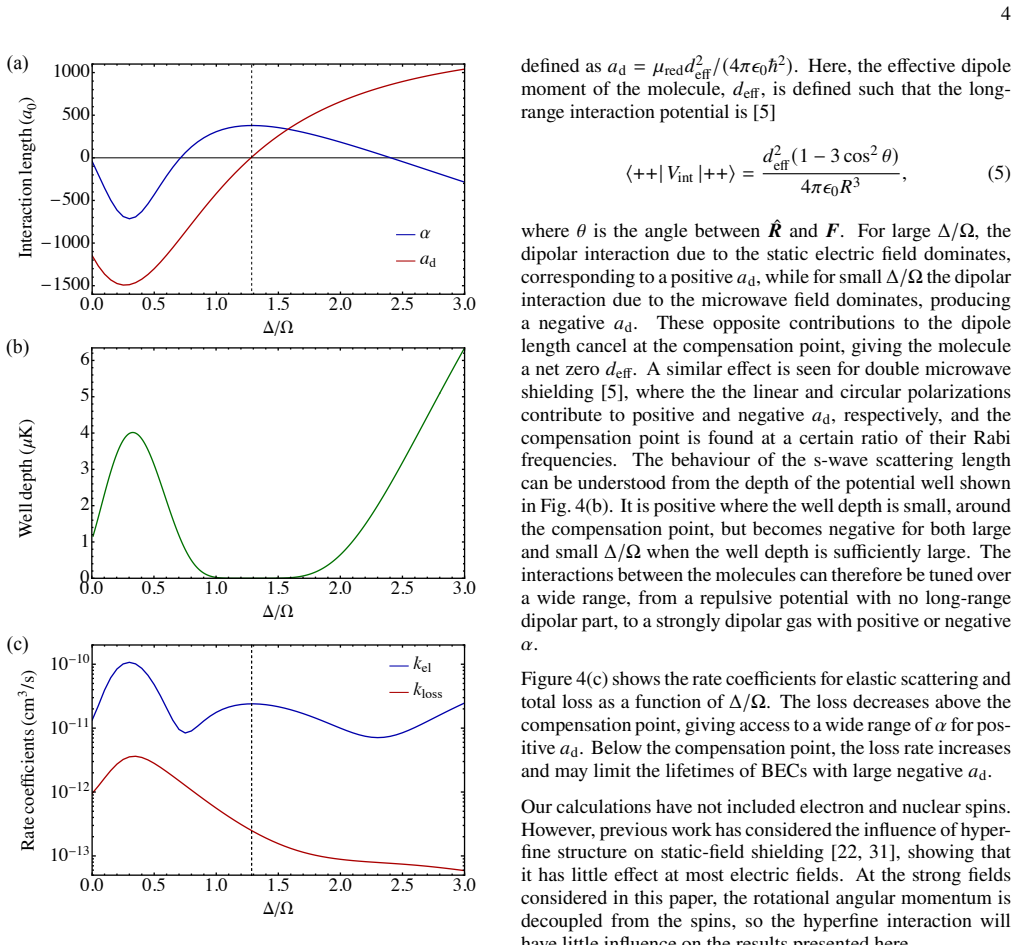
Static-field shielding protects polar molecules from destructive collisions by placing them at an electric field just above a crossing between the pair state (1,0)+(1,0) and (0,0)+(2,0), creating a repulsive barrier. The paper shows that adding a circularly polarized microwave field, red-detuned and sigma- polarized, introduces a dipole-dipole interaction whose sign is opposite to that of the static field. Tuning the ratio Δ/Ω of detuning to Rabi frequency therefore tunes the total dipole-dipole interaction; at Δ/Ω≈1.3 for CaF at 22.5 kV/cm the net dipole moment vanishes, the long-range potential well disappears, and the adiabat becomes purely repulsive. Coupled-channel scattering calculatio
What carries the argument
The machinery is the pair of field-dressed molecular states and the tuning ratio Δ/Ω. The microwave couples the static-field-dressed states |1,0> and |1,1>, producing superpositions |+> and |->, and the effective Rabi frequency Ωeff = sqrt(Ω^2 + Δ^2) controls their energies. The dipole-dipole interaction V_int ∝ R^{-3} has diagonal matrix elements whose sign alternates with the microwave dressing, so the static-field and microwave contributions can be made to cancel. The coupled-channel calculation diagonalises the internal Hamiltonian at fixed separation to obtain adiabatic potentials, then solves the full multichannel scattering problem in a basis of pair states built from (0,0), (1,0), (2
Load-bearing premise
The load-bearing premise is that the fully absorbing short-range boundary condition plus a basis truncated to n=0,1,2 and L≤12, with electron and nuclear spins neglected, captures all collision physics relevant at the tuned interaction strengths; if microwave-induced loss channels or spin-dependent couplings are significant, the predicted wide tunability at low loss will not survive in experiment.
What would settle it
Measure the two-body loss rate coefficient and elastic cross section for ultracold CaF at an electric field around 22.5 kV/cm with a circularly polarized microwave field at Ω=60 MHz while scanning Δ/Ω from 1.0 to 3.0; if the loss rate coefficient does not stay below roughly 1e-12 cm^3/s or the scattering length does not change sign as predicted, the central claim fails.
If this is right
- A single microwave knob (the detuning-to-Rabi ratio Δ/Ω) continuously sweeps the dipole length from large negative to large positive, passing through zero at the compensation point, for a fixed static field.
- The loss rate coefficient stays below ~6e-13 cm^3/s while tuning across this range, with elastic-to-inelastic ratio above 30, so the gas can thermalise and reach equilibrium rather than being destroyed.
- At Ω=60 MHz for CaF, the predicted microwave intensity is ~24 W/cm^2, and at typical BEC densities the lifetime is several seconds — long enough for experiments on many-body phases.
- The compensation point depends only on the ratio of electric field to the species-specific resonant field, so the same tuning recipe should work for other polar molecules including alkali dimers.
Where Pith is reading between the lines
- Extension: the same Δ/Ω compensation recipe may let experimentalists dial from a purely repulsive shield to strongly dipolar regimes without re-calibrating per species, since it is set by F/F_X; this is not an explicit claim but follows directly from the paper's scaling statement.
- Extension: sweeping the scattering length across zero in a molecular BEC could emulate Feshbach-resonance experiments in systems that lack magnetic Feshbach resonances, allowing controlled quench dynamics across a weakly interacting regime; the paper does not discuss quenches.
- Extension: the field-dressed basis includes a dark state that is not coupled by the microwave; the role of this dark state in three-body recombination is not calculated here, and could become a limiting loss mechanism at the high densities of a BEC — a question the paper leaves open.
Editorial analysis
A structured set of objections, weighed in public.
Referee Report
Summary. The paper proposes a general method to tune interactions between static-field-shielded ultracold polar molecules by adding a circularly polarized microwave field. For CaF at a static field of F = 22.5 kV/cm, the authors construct adiabatic potentials and perform coupled-channel scattering calculations in a field-dressed basis. They find that the microwave field introduces an opposite-sign dipole-dipole interaction that can cancel the static-field contribution at a 'compensation point' Δ/Ω ≈ 1.3, and that away from this point both the s-wave scattering length and the dipole length can be tuned over wide ranges, including sign changes, while the two-body loss rate remains below 6×10^-13 cm^3/s and the elastic-to-inelastic ratio exceeds 30 for Ω = 60 MHz and Δ/Ω ∈ [1, 3]. The authors conclude that this tunability can enable studies of strongly correlated phases in molecular BECs.
Significance. If the predictions are robust, this work offers an experimentally accessible route to widely tunable interactions in static-field-shielded polar molecules, complementing the existing double-microwave-shielding approach and extending it to the static-field-shielded regime where three-body losses are already strongly suppressed. The physical picture is clear, the calculations follow well-established coupled-channel methods, and the authors provide an open-data link. A notable strength is that the control parameters are limited to F, Ω, Δ, and collision energy, with no fitted parameters. However, the central quantitative claims rest on a truncated basis and a fully absorbing short-range boundary condition, and the paper does not report convergence or sensitivity checks for these choices. These gaps are directly relevant to whether the advertised combination of wide tunability and low loss will survive in experiment, so the paper is promising but not yet conclusive.
major comments (3)
- [Sec. IV, Eq. (4), Fig. 4] The central claims in Sec. V (loss below 6×10^-13 cm^3/s and ratio > 30 for Δ/Ω from 1.0 to 3.0) rest entirely on the coupled-channel calculations described in Sec. IV. These use a basis limited to six pair states (Eq. 4) and L_max = 12, with omitted states included via a Van Vleck transformation. The manuscript reports no convergence tests with respect to L_max, the number of pair states, or the radial grid. This is particularly concerning because the dipole length a_d reaches magnitudes of about 1000 a0 (Fig. 4a), where high partial waves may be required, and because the near-degenerate pair states 2–5 in Eq. (4) are strongly coupled to the incoming state. Please provide systematic convergence checks for alpha and k_loss over the full Δ/Ω range shown in Fig. 4.
- [Sec. IV, short-range boundary condition] The fully absorbing boundary condition at short range imposes a universal loss and removes any short-range reflection phase. The real part alpha of the scattering length is known to be sensitive to the short-range phase, and the loss rate is sensitive to the absorbing model. No sensitivity analysis is reported. Because the paper’s prediction of 'low loss over a wide tuning range' depends on the specific values of alpha and k_loss, please quantify the uncertainty by varying the absorption radius or absorption strength, or by comparing with an alternative model. This is needed to establish whether the sign changes of alpha in Fig. 4(a) are physical or numerical.
- [Sec. IV, spin degrees of freedom] The calculations neglect electron and nuclear spins, citing Refs. [22,31] to argue that hyperfine structure has little effect at strong static fields. However, those references address static-field shielding alone, whereas the present work adds a microwave field and includes microwave-dressed states. Spins could in principle open additional loss channels or modify the dressed-state couplings. The paper should either provide a test at one representative parameter point (e.g., including hyperfine levels for Δ/Ω = 1.3 and Ω = 60 MHz) or clearly state why the cited static-field conclusions carry over to the combined-field regime. As written, the loss rates and scattering lengths could be affected if such channels are not truly decoupled.
minor comments (3)
- [Sec. IV, paragraph after Fig. 4] There is a duplicate definite article: 'where the the linear and circular polarizations contribute' should read 'where the linear and circular polarizations contribute'.
- [Introduction, Refs. [9,25]] The citation 'B¨ uchler et al.[9, 25]' has a spacing/formatting issue; it should be 'B"uchler et al. [9, 25]'.
- [Fig. 2] The figure shows panels (a)–(d) but the caption does not clearly indicate which panel corresponds to which Ω value in sub-panels (a)–(d); please clarify, for example, by labeling each panel with the parameter values directly.
Circularity Check
No significant circularity: tunability results are computed from the stated Hamiltonian and scattering calculations, not fitted or defined into existence.
full rationale
The paper's central claim is that a microwave field tunes the s-wave scattering length α and the dipole length a_d of static-field-shielded molecules while suppressing loss. The dipole length is defined through the diagonal dipole-dipole matrix element in Eq. (5), with no free parameter fitted to the target result. The scattering length and loss rate coefficients are outputs of coupled-channel scattering calculations (Sec. IV) based on the single-molecule Hamiltonian of Eq. (1), the dressed-state basis of Sec. III, and a stated short-range absorbing boundary condition. The compensation point arises from the computed cancellation of two opposite dipole-dipole contributions, not from a parameter adjusted to reproduce the claimed behavior. Citations to prior work by the authors [22,23,30,31] provide the static-field-shielding starting point, numerical methods, and a supporting study of hyperfine effects, but the new microwave-tuning result is not reduced to these citations. The neglect of hyperfine structure is additionally justified by a physical strong-field decoupling argument. Missing convergence checks for the basis and partial-wave truncation are a validation concern for the numerical predictions, not a circular derivation.
Axiom & Free-Parameter Ledger
free parameters (4)
- Static electric field F =
22.5 kV/cm for CaF
- Microwave Rabi frequency Ω =
0-200 MHz; 60 MHz for detailed scans
- Microwave detuning Δ (reported as Δ/Ω) =
0-3; compensation point at Δ/Ω=1.3
- Collision energy =
10 nK × kB
axioms (5)
- domain assumption Rigid-rotor approximation for the single-molecule Hamiltonian (Eq. 1)
- domain assumption Rotating-wave approximation and restriction to four single-molecule states {|1,0>, |0,0>, |2,0>, |1,±1>}
- domain assumption Fully absorbing boundary condition at short range
- domain assumption Neglect of electron and nuclear spins
- standard math Dipole-dipole interaction form (Eq. 3) and pair-state basis (Eq. 4)
read the original abstract
The ability to tune interparticle interactions is one of the main advantages of using ultracold quantum gases for quantum simulation of many-body physics. Current experiments with ultracold polar molecules employ shielding with microwave or static electric fields to prevent destructive collisional losses. The interaction potential of microwave-shielded molecules can be tuned by using microwaves of two different polarisations, while for static-field-shielded molecules the tunability of interactions is more limited and depends on the particular species. In this work, we propose a general method to tune the interactions between static-field-shielded molecules by applying a microwave field. We carry out coupled-channel scattering calculations in a field-dressed basis set to determine loss rate coefficients and scattering lengths. We find that both the s-wave scattering length and the dipole length can be widely tuned by changing the parameters of the microwave field, while maintaining strong suppression of lossy collisions.
Figures


Reference graph
Works this paper leans on
-
[1]
Lahaye, C
T. Lahaye, C. Menotti, L. Santos, M. Lewenstein, and T. Pfau, The physics of dipolar bosonic quantum gases, Rep. Prog. Phys. 72, 126401 (2009)
2009
-
[2]
Chomaz, I
L. Chomaz, I. Ferrier-Barbut, F. Ferlaino, B. Laburthe-Tolra, B. L. Lev, and T. Pfau, Dipolar physics: a review of experiments with magnetic quantum gases, Rep. Prog. Phys.86, 026401 (2022)
2022
-
[3]
Langen, G
T. Langen, G. Valtolina, D. Wang, and J. Ye, Quantum state manipulation and cooling of ultracold molecules, Nat. Phys.20, 702 (2024)
2024
-
[4]
A. Schindewolf, J. Hertkorn, I. Stevenson, M. Ciardi, P. Gross, D. Wang, T. Karman, G. Qu ´em´ener, S. Will, T. Pohl, and T. Langen, From few- to many-body physics: Strongly dipo- lar molecular Bose-Einstein condensates and quantum fluids, arXiv:2512.14511 (2025)
Pith/arXiv arXiv 2025
-
[5]
For simplicity we consider only the state space spanned by {|1,0⟩,|0,0⟩,|2,0⟩,|1,±1⟩}
We add a𝜎 −-polarized microwave field which cou- ples the states(˜𝑛,𝑚 𝑛)=(1,0)and(1,1)in the electric field, so that ˆℎmw = ℏΩcos𝜔𝑡 [|1,0⟩⟨1,1|+|1,1⟩⟨1,0| ]. For simplicity we consider only the state space spanned by {|1,0⟩,|0,0⟩,|2,0⟩,|1,±1⟩}. After applying the rotating- wave approximation, the eigenstates of the Hamiltonian of Eq. (1) are|+⟩=𝑢𝑒 −𝑖 𝜔𝑡|1...
-
[6]
Karman, N
T. Karman, N. Bigagli, W. Yuan, S. Zhang, I. Stevenson, and S. Will, Double microwave shielding, PRX Quantum6, 020358 (2025)
2025
-
[7]
W. Yuan, S. Zhang, N. Bigagli, H. Kwak, C. Warner, T. Karman, I. Stevenson, and S. Will, Extreme Loss Suppression and Wide Tunability of Dipolar Interactions in an Ultracold Molecular Gas, arXiv:2505.08773 (2025)
Pith/arXiv arXiv 2025
-
[8]
Schmidt, L
M. Schmidt, L. Lassabli `ere, G. Qu ´em´ener, and T. Langen, Self-bound dipolar droplets and supersolids in molecular Bose- Einstein condensates, Phys. Rev. Res.4, 013235 (2022)
2022
-
[9]
G. E. Astrakharchik, J. Boronat, I. L. Kurbakov, and Y. E. Lo- zovik, Quantum phase transition in a two-dimensional system of dipoles, Phys. Rev. Lett.98, 060405 (2007)
2007
-
[10]
H. P. B¨ uchler, E. Demler, M. Lukin, A. Micheli, N. Prokof’ev, G. Pupillo, and P. Zoller, Strongly correlated 2D quantum phases with cold polar molecules: Controlling the shape of the interac- tion potential, Phys. Rev. Lett.98, 060404 (2007)
2007
-
[11]
Ciardi, K
M. Ciardi, K. R. Pedersen, T. Langen, and T. Pohl, Self-bound superfluid membranes and monolayer crystals of ultracold polar molecules, Phys. Rev. Lett.135, 153401 (2025)
2025
-
[12]
Bause, A
R. Bause, A. Christianen, A. Schindewolf, I. Bloch, and X.-Y. Luo, Ultracold sticky collisions: Theoretical and experimental status, J. Phys. Chem. A127, 729 (2023)
2023
-
[13]
A. V. Avdeenkov, M. Kajita, and J. L. Bohn, Suppression of inelastic collisions of polar1Σstate molecules in an electrostatic field, Phys. Rev. A73, 022707 (2006)
2006
-
[14]
Wang and G
G. Wang and G. Qu ´em´ener, Tuning ultracold collisions of ex- cited rotational dipolar molecules, New J. Phys.17, 035015 (2015)
2015
-
[15]
Matsuda, L
K. Matsuda, L. De Marco, J.-R. Li, W. G. Tobias, G. Valtolina, G. Qu´em´ener, and J. Ye, Resonant collisional shielding of reac- tive molecules using electric fields, Science370, 1324 (2020)
2020
-
[16]
Karman and J
T. Karman and J. M. Hutson, Microwave shielding of ultracold polar molecules, Phys. Rev. Lett.121, 163401 (2018)
2018
-
[17]
Lassabli `ere and G
L. Lassabli `ere and G. Qu ´em´ener, Controlling the scattering length of ultracold dipolar molecules, Phys. Rev. Lett.121, 163402 (2018)
2018
-
[18]
Anderegg, S
L. Anderegg, S. Burchesky, Y. Bao, S. S. Yu, T. Karman, E. Chae, K.-K. Ni, W. Ketterle, and J. M. Doyle, Observation of microwave shielding of ultracold molecules, Science373, 779 (2021)
2021
-
[19]
Valtolina, K
G. Valtolina, K. Matsuda, W. G. Tobias, J.-R. Li, L. De Marco, and J. Ye, Dipolar evaporation of reactive molecules to below the Fermi temperature, Nature588, 239 (2020)
2020
-
[20]
Schindewolf, R
A. Schindewolf, R. Bause, X.-Y. Chen, M. Duda, T. Karman, I. Bloch, and X.-Y. Luo, Evaporation of microwave-shielded polar molecules to quantum degeneracy, Nature607, 677 (2022)
2022
-
[21]
Bigagli, W
N. Bigagli, W. Yuan, S. Zhang, B. Bulatovic, T. Karman, I. Stevenson, and S. Will, Observation of Bose-Einstein con- densation of dipolar molecules, Nature631, 289 (2024)
2024
-
[22]
Z. Shi, Z. Huang, F. Deng, W.-J. Jin, S. Yi, T. Shi, and D. Wang, Bose-Einstein condensation of ultracold sodium-rubidium molecules with tunable dipolar interactions, arXiv:2508.20518 (2025)
Pith/arXiv arXiv 2025
-
[23]
Mukherjee, M
B. Mukherjee, M. D. Frye, C. R. Le Sueur, M. R. Tarbutt, and J. M. Hutson, Shielding collisions of ultracold CaF molecules with static electric fields, Phys. Rev. Res.5, 033097 (2023)
2023
-
[24]
Mukherjee and J
B. Mukherjee and J. M. Hutson, Controlling collisional loss and scattering lengths of ultracold dipolar molecules with static electric fields, Phys. Rev. Res.6, 013145 (2024)
2024
-
[25]
C. Chin, R. Grimm, P. Julienne, and E. Tiesinga, Feshbach resonances in ultracold gases, Rev. Mod. Phys.82, 1225 (2010)
2010
-
[26]
H. P. B¨ uchler, A. Micheli, and P. Zoller, Three-body interactions with cold polar molecules, Nat. Phys.3, 726 (2007)
2007
-
[27]
A. V. Gorshkov, P. Rabl, G. Pupillo, A. Micheli, P. Zoller, M. D. Lukin, and H. P. B¨ uchler, Suppression of inelastic collisions between polar molecules with a repulsive shield, Phys. Rev. Lett.101, 073201 (2008)
2008
-
[28]
Karman, Microwave shielding with far-from-circular polar- ization, Phys
T. Karman, Microwave shielding with far-from-circular polar- ization, Phys. Rev. A101, 042702 (2020)
2020
-
[29]
J. M. Hutson and C. R. Le Sueur,molscat: a program for non- reactive quantum scattering calculations on atomic and molec- ular collisions, Comp. Phys. Comm.241, 9 (2019)
2019
-
[30]
J. M. Hutson and C. R. Le Sueur,molscat,boundandfield, version 2023.0,https://github.com/molscat/molscat (2023)
2023
-
[31]
Dutta, B
J. Dutta, B. Mukherjee, and J. M. Hutson, Universality in the 6 microwave shielding of ultracold polar molecules, Phys. Rev. Res7, 023164 (2025)
2025
-
[32]
Mukherjee, J
B. Mukherjee, J. M. Hutson, and K. R. A. Hazzard, SU(N) magnetism with ultracold molecules, New J. Phys.27, 013013 (2025)
2025
-
[33]
C. J. Ho, J. Dutta, B. Mukherjee, J. M. Hutson, and M. R. Tarbutt,https://doi.org/10.5281/zenodo.18474678
discussion (0)
Sign in with ORCID, Apple, or X to comment. Anyone can read and Pith papers without signing in.