REVIEW 4 major objections 4 minor 4 references
Disentangling Intrinsic Importance from Emergent Structure in Multi-Expert Orchestration
T0 review · 4 major / 4 minor · reviewed 2026-08-03 · deepseek-v4-flash
Pith's one-line read In multi-expert LLM systems, the most frequently routed experts are often not the ones the orchestrator actually depends on; INFORM separates relational popularity from gradient-based intrinsic necessity.
desk verdict The routing-mass vs gradient-sensitivity divergence is likely a real and useful diagnostic, but the paper's 'functional necessity' framing and the masking validation that supports it do not survive close reading. read the letter →
The pith
A machine-rendered reading of the paper's core claim, the machinery that carries it, and where it could break.
The reading
What carries the argument
The central object is INFORM, an interpretability toolkit that treats the orchestrator as an explicit computation. Its load-bearing pieces are the conditional interaction matrix C(x) computed by query-key attention over expert representations (which yields relational importance as incoming mass u_j(x) = sum over i of C_ij(x)) and the selection module's marginal distribution P(E_i|x) via Gumbel-Softmax. The paper's intrinsic importance measure is the gradient norm I(E_i) = ||nabla_{h_i} log P(E_i|x)||_2, the sensitivity of selection log-probability with respect to the expert's representation. The mechanism's work is to decouple observed usage from functional necessity: one quantity tracks who
What would settle it
Find an expert ranked highly by the gradient norm, mask it, and compare against masking a same-frequency control expert: if the control produces equal or larger routing KL divergence and no smaller performance drop, the claim that gradient attribution captures causal necessity is falsified. Equivalently, if leave-one-out accuracy drops do not correlate with the gradient ranking over a random sample of inputs, the measure is not capturing functional necessity.
Extended reading notes
Core claim
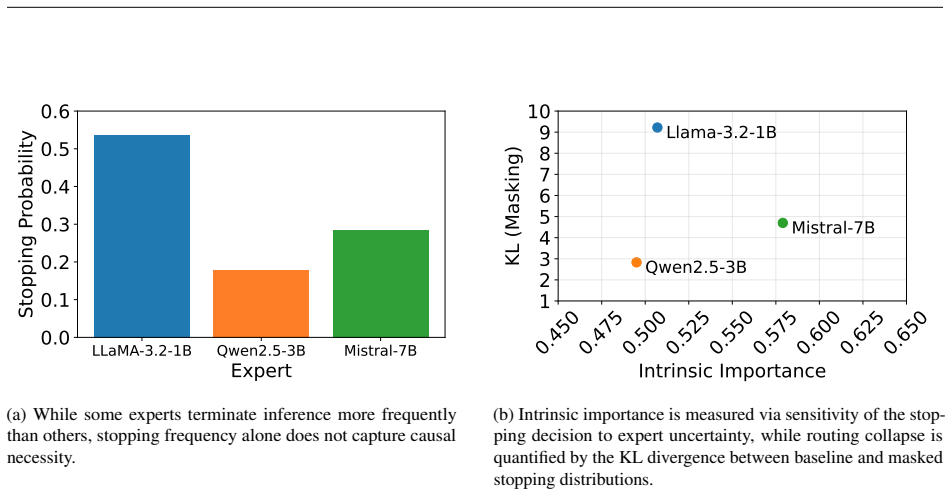
The paper's central discovery is the divergence between two notions of expert importance in a sequential orchestrator. Relational importance, measured as incoming routing mass in the learned collaboration matrix, reflects how often an expert is selected as successor. Intrinsic importance, measured as the L2 norm of the gradient of selection log-probability with respect to the expert's representation, reflects how much the orchestrator's decision causally depends on that expert's content. Across MMLU, HumanEval, and GSM8K, these two measures disagree: experts with high routing mass can have low gradient attribution, and vice versa. Masking the single most intrinsically important expert produc
Load-bearing premise
The whole distinction between intrinsic and relational importance rests on the assumption that the gradient norm with respect to an expert's representation is a valid measure of functional necessity, and that the masking ablation validates it by perturbing exactly that same representation.
Editorial extensions
If this is right
- Expert pruning based on routing frequency risks removing structurally critical specialists while keeping interaction hubs.
- Monitoring the alignment between intrinsic and relational importance can reveal brittle hubs, redundancy, and failure-propagation risks invisible to accuracy metrics.
- Orchestrator ordering should be treated as a learned, non-deterministic soft constraint rather than a fixed policy, because initializer importance is task-dependent.
- Targeted ablations that mask top-gradient experts provide a structural diagnostic that complements end-task accuracy.
- The same gradient-attribution lens applies to any differentiable routing policy, including confidence-based cascade orchestration.
Reading between the lines
- The gradient norm measures local sensitivity, not full counterfactual necessity; a natural next test would compare it with leave-one-out performance drops per expert across tasks.
- A practical diagnostic suggested by the paper: track the gap between routing mass and gradient attribution over time; a growing gap may predict cascading failure before accuracy degrades.
- Because the measure requires white-box access, an approximate version could be derived from log-probability sensitivity under input perturbation, extending the insight to API-only orchestrators.
- The asynchronous emergence finding—centralization before confidence—implies early-training routing statistics can mislead interpretation of final policies, so attribution should be computed at the deployment epoch.
Editorial analysis
A structured set of objections, weighed in public.
Referee Report
Summary. The paper introduces INFORM, an interpretability framework for multi-expert LLM orchestration. The authors train a differentiable orchestrator over a fixed consortium of ten frozen instruction-tuned LLM experts (homogeneous and heterogeneous settings) and analyze three signals: the collaboration matrix C(x), the selection distribution s(x), and a gradient-based Intrinsic Expert Importance I(E_i)=||∇_{h_i} log P(E_i|x)||_2. The central claim is that routing dominance (relational importance, measured by routing mass) is a poor proxy for functional necessity: frequently selected experts can be interaction hubs with low intrinsic influence, while sparsely routed experts can be structurally critical. The paper also reports emergent dynamics (asynchronous centralization and routing confidence) and ablation results, most notably that masking the single most intrinsically important expert on MMLU induces a 5.5× larger KL divergence in the routing distribution than in the sequence distribution.
Significance. If the central claim were fully supported, INFORM would be a useful diagnostic for multi-expert orchestration, separating structural centrality from functional indispensability. The paper has clear strengths: it ships code, includes a secondary heterogeneous consortium, reports error bars on key numbers, and includes an explicit FAQ that acknowledges several limitations (e.g., Q1 disclaims formal causal structure, Q8 concedes that masking important experts often does not reduce accuracy). The weakness is that the validation of intrinsic importance is internal to the routing policy: both the metric and the masking intervention act on the same representation h_i, and no external task-level measure of functional necessity is supplied. The contribution is therefore presently a comparison of two routing-derived quantities rather than a demonstration that routing dominance fails to track functional necessity for the end task.
major comments (4)
- [§2.2, §4.5, Appendix A (Q1/Q8)] The intrinsic-importance measure I(E_i)=||∇_{h_i} log P(E_i|x)||_2 is the gradient of the selection log-probability with respect to the representation h_i, and the masking ablation in §4.5 removes exactly that representation and measures KL divergence of the routing distribution. If the selection logit is approximately linear in h_i over the mask magnitude, the top-gradient expert is by construction the one whose masking produces the largest routing shift among single-expert masks. The 'validation' therefore confirms that the metric predicts the intervention outcome because both are defined on the same variable. The paper's own FAQ Q8 concedes that masking important experts often does not reduce accuracy, and Q1 disclaims formal causal structure. To support 'functional necessity,' the authors need an external criterion—e.g., the effect of masking on final answer correctness, or a compari
- [§4.5/Table 8, abstract] The headline result '5.5x higher routing KL divergence than sequencing divergence' on MMLU compares KL(sequence) = 0.428 ± 0.072 with KL(routing) = 2.366 ± 0.497. These are KL divergences over different probability spaces: the sequence distribution has 10 categories (9 degrees of freedom), while the transition matrix has 10×10 entries (90 degrees of freedom). Raw KL values are not comparable across spaces; the relative magnitude is partly an artifact of dimensionality. Report a normalized measure (e.g., average KL per free parameter, or symmetrized Jensen–Shannon with a common support) and provide the corresponding comparison for the 'frequent peer' control in Appendix J.2.
- [§4.2 and abstract] The paper's central claim is that 'routing dominance is a poor proxy for functional necessity.' However, I(E_i) measures the sensitivity of the orchestrator's selection log-probability, not the expert's contribution to the downstream task. FAQ Q2 explicitly states 'attribution scores reflect influence on routing, not expert correctness or output quality,' and Q8 states that masking important experts 'often' does not reduce accuracy. The measured divergence between routing mass and I(E_i) is therefore a divergence between two routing-derived quantities. The claim should either be reworded to 'routing dominance is a poor proxy for routing sensitivity' or supplemented by a task-level functional-necessity experiment (e.g., excluding the expert's output from the context and measuring final-answer accuracy).
- [§2.1, §4.5] The masking ablation zeros the representation h_i used by the routing adapter, but the expert's generated response remains in the conversation history that later experts receive. The intervention therefore alters only the router's internal computation, not the information available to downstream experts. Consequently, the 'functional necessity' of the expert for the final answer is not tested. Please clarify whether masking removes only h_i or also the expert's output from the context, and if only the former, refrain from calling it a functional/expert-removal ablation.
minor comments (4)
- [Figures 4, 5, 13, 14] In the version provided, the heatmap captions render as broken /uni... character sequences; if this is not a rendering artifact, the figures need to be repaired for review.
- [Table 8] The 95% CIs are computed across the 5 training epochs; state the number of epochs/samples used for the CI and report per-epoch values in the text or appendix.
- [Notation throughout] I(E_i) is defined in §2.2 but later referred to as 'intrinsic attribution,' 'gradient attribution,' and 'causal attribution'—unify the terminology.
- [§2.1] The claim 'INFORM explicitly does not require attention-based interaction, or oracle distillation' is not demonstrated; only the proposed attention-based orchestrator is analyzed. Add a small experiment with a different router or soften the claim.
Circularity Check
Gradient-norm definition of intrinsic importance makes the §4.5 masking validation near-tautological: the metric and the intervention act on the same h_i, so top-gradient experts trivially disrupt routing.
-
self definitional
[§2.2 (Intrinsic Expert Importance, Eq. I(Ei)=||∇_hi logP(Ei|x)||_2); §4.5/Appendix F (masking the highest-ranked expert); Appendix A Q2/Q8 (scope disclaimers)]
"We calculate the gradient norm of the log-probability of the selected expert with respect to the representation hi: I(Ei)=∥∇ hi logP(E i|x)∥ 2 ... To probe the role of intrinsically important experts, we mask the single highest-ranked expert (by gradient-based intrinsic attribution) and measure the resulting changes in both the sequence and routing distributions. ... This ablation evaluates whether gradient-based attribution reflects functional necessity rather than correlational importance."
I(E_i) is exactly the first-order sensitivity of the selection log-probability to h_i. Masking the expert removes/perturbs h_i, so the induced shift in log P(E_i|x) is, to first order, controlled by the same gradient whose norm defines the ranking. The measured routing KL is a functional of the same P(E_i|x); hence the argmax-I expert is, by construction, the single expert whose masking most shifts the routing distribution. The ablation therefore restates the definition of intrinsic importance rather than independently validating functional necessity for the task. The paper itself concedes the limit: Q2 says attribution scores reflect influence on routing, not output quality, and Q8 says masking often does not reduce accuracy.
full rationale
The paper is not globally circular: the empirical divergence between routing mass and gradient sensitivity, the asynchrony of centralization versus routing confidence, and the MetaGPT/accuracy comparisons are self-contained and could have come out differently. However, the central validation loop for the headline claim is internal to the routing policy. Intrinsic importance is defined as a gradient with respect to h_i, and the primary confirmation measures routing-distribution shift when that same h_i is masked; this is a consistency check of the gradient, not an independent test of causal/functional necessity. The authors' FAQ (Q1, Q2, Q8) explicitly narrows the claim to influence on routing and admits accuracy is often preserved, which supports scoring 6 rather than 0, but also shows the overreach is in terminology more than in hidden fitting. No load-bearing self-citation or ansatz-smuggling is present.
Assumptions & free parameters
free parameters (5)
- loss weights lambda_* =
lambda_select=1.0, lambda_oracle=0.5, lambda_util=0.5, lambda_distill=0.5, lambda_len=0.5, lambda_symm=0.05, lambda_spar
- Gumbel temperature schedule =
initial tau=1.0, min tau=0.5, decay gamma=0.999
- adaptive top-k schedule =
k decays from N to 1 based on moving average of selection confidence
- learnable interaction weight lambda in C(x) =
learned
- length penalty coefficient alpha =
not reported
assumptions (4)
- domain assumption A frozen BERT encoder maps expert outputs into a shared representation, and gradients w.r.t. h_i are a meaningful basis for attribution.
- domain assumption The collaboration matrix C(x) and selection distribution s(x) fully capture the orchestration policy.
- domain assumption Oracle distillation from GPT-OSS-20B only accelerates early training and does not shape final routing topology.
- standard math Gumbel-Softmax is a valid differentiable approximation for analyzing selection decisions.
invented entities (2)
-
Intrinsic Expert Importance I(E_i)
-
Relational Importance u_j
Cite this review
Pith. "Pith review of Disentangling Intrinsic Importance from Emergent Structure in Multi-Expert Orchestration." pith.science (2026). https://pith.science/paper/NQQW7F6V
@misc{pith2026260204291,
  author       = {Pith},
  title        = {Pith review of: Disentangling Intrinsic Importance from Emergent Structure in Multi-Expert Orchestration},
  year         = {2026},
  howpublished = {\url{https://pith.science/paper/NQQW7F6V}},
  note         = {Machine review of arXiv:2602.04291}
}
read the original abstract
Multi-expert systems, where multiple Large Language Models (LLMs) collaborate to solve complex tasks, are increasingly adopted for high-performance reasoning and generation. However, the orchestration policies governing expert interaction and sequencing remain largely opaque. We introduce INFORM, an interpretability analysis that treats orchestration as an explicit, analyzable computation, enabling the decoupling of expert interaction structure, execution order, and functional attribution. We use INFORM to evaluate an orchestrator on GSM8K, HumanEval, and MMLU using a homogeneous consortium of ten instruction-tuned experts drawn from LLaMA-3.1 8B, Qwen3 8B, and DeepSeek-R1 8B, with controlled decoding-temperature variation, and a secondary heterogeneous consortium spanning 1B-7B parameter models. Across tasks, routing dominance is a poor proxy for functional necessity. We reveal a divergence between relational importance, captured by routing mass and interaction topology, and intrinsic importance, measured via gradient sensitivity: frequently selected experts often act as interaction hubs with limited influence, while sparsely routed experts can be structurally critical. Orchestration behaviors emerge asynchronously, with expert centralization preceding stable routing confidence and expert ordering remaining non-deterministic. Targeted ablations show that masking intrinsically important experts induces disproportionate collapse in interaction structure compared to masking frequent peers, confirming that INFORM exposes functional and structural dependencies beyond accuracy metrics alone. Our code is available at https://github.com/parmanu-lcs2/inform.
Figures


Figures from the paper (11 more)


Reference graph
Works this paper leans on
-
[1]
Building upon correct reasoning
-
[2]
Correcting or refining mistakes
-
[3]
Adding missing details
-
[4]
Always state explicitly what you are doing and why
Passing an intermediate or final answer if complete. Always state explicitly what you are doing and why. Avoid repeating identical reasoning unless you are clarifying or improving it. /no_think {task_instance} 22 Table 6: Models, parameter scale, and decoding tempera- tures used in experiments forHomogeneous Consortium. Expert Model Family Size Temperatur...
arXiv 2024
Reviewed August 3, 2026 · model on record in the stance chip above.
Discussion (0). Continue with ORCID to comment.