REVIEW 2 major objections 5 minor 2 cited by
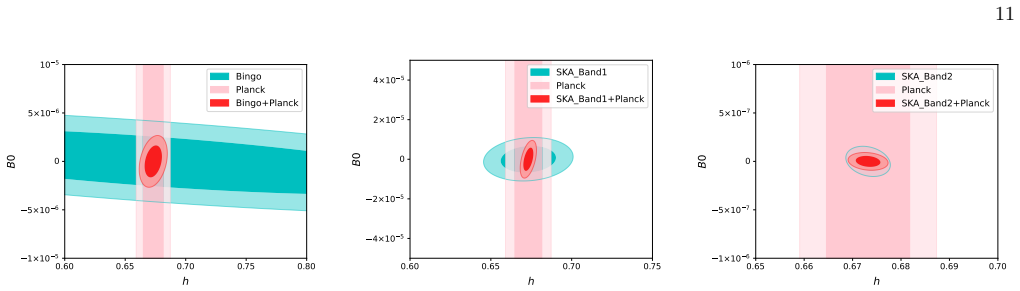
Forecast: HI 21-cm surveys can pin the f(R) gravity parameter B0 down to 3.75×10⁻⁸
Reviewed by Pith at T0; open to challenge. T0 means a machine referee read the full paper against a public rubric. the ladder, T0–T4 →
T0 review · deepseek-v4-flash
2026-08-03 04:11 UTC pith:RC2E74BW
load-bearing objection A workmanlike Fisher forecast for f(R) gravity with HI intensity mapping, but the headline σ(B0) is set by mildly nonlinear scales beyond the model's validity and needs a physically motivated cutoff before being taken at face value. the 2 major comments →
Forecast on f(R) Gravity with HI 21cm Intensity Mapping Surveys
The pith
A machine-rendered reading of the paper's core claim, the machinery that carries it, and where it could break.
Core claim
The paper's central claim is that low-redshift 21-cm intensity mapping measures not just the background expansion but the growth of structure, and that this gives it strong leverage on f(R) gravity. Building the brightness-temperature angular power spectrum from the density and redshift-space distortion terms, and using the quasi-static μ,γ parameterization for f(R) perturbations, the forecast finds σ(B0) ≈ 6.37×10⁻⁸ for SKA1-MID Band 2 alone and σ(B0) ≈ 3.75×10⁻⁸ when CMB priors are added. The authors also argue that most of the constraining power for B0 comes from multipoles up to a few hundred, where the linear approximation is expected to hold.
What carries the argument
The forecasts are carried by the quasi-static μ(a,k) and γ(a,k) functions that encode how f(R) modifies the Poisson equation and the metric anisotropy ratio, together with the 21-cm angular power spectrum C_l built from the density and redshift-space-distortion terms of the brightness temperature. The Fisher matrix then converts these spectra and the survey's thermal and shot noise into marginalized uncertainties. The named central object is B0, the present-day Compton wavelength of the scalaron in units of the Hubble length; B0=0 recovers ΛCDM.
Load-bearing premise
The forecast assumes the linear, quasi-static f(R) approximation holds on the small scales (ℓ up to 400, k≳0.3 Mpc⁻¹) that provide most of the B0 signal; if nonlinearities or screening become important there, the quoted σ(B0) values are too optimistic.
What would settle it
Recompute the same forecasts with a nonlinear prescription or with a conservative small-scale cutoff (e.g., k_max ≈ 0.2 Mpc⁻¹) and compare the resulting σ(B0); if the constraint degrades by more than a factor of a few, the linear-only claim is falsified. Observationally, a measurement of the 21-cm angular power spectrum from SKA1-MID Band 2 that does not show the predicted scale-dependent growth enhancement at ℓ≈100–400 would also rule out the claimed sensitivity.
If this is right
- BINGO alone would reach σ(B0) ≈ 2.27×10⁻⁶, already surpassing current cosmological limits near 10⁻⁴.
- SKA1-MID Band 2 alone yields σ(B0) ≈ 6.37×10⁻⁸, and combining with CMB priors tightens this to ≈ 3.75×10⁻⁸.
- Adding CMB priors breaks the strong degeneracy between B0 and the Hubble parameter, shrinking the allowed region dramatically.
- Constraints on most parameters saturate by ℓ_max ≈ 300–400, and B0 is dominated by large-scale modes, where linear theory is safest.
Where Pith is reading between the lines
- If nonlinear structure growth or chameleon screening suppresses the small-scale enhancement on k≳0.3 Mpc⁻¹, the real SKA Band 2 constraint on B0 will be weaker than 3.75×10⁻⁸; a simulation-based forecast with a nonlinear cutoff would test this directly.
- The B0–bHI degeneracy shown in the paper is only partially broken by CMB priors; cross-correlating the 21-cm maps with a galaxy catalog that independently measures the HI bias could tighten B0 further.
- The same μ,γ formalism is specific to f(R), but the scale-dependent 21-cm power spectrum would also carry signatures of other modified-gravity theories, so the survey will yield general growth-of-structure tests.
- A practical next step is to verify whether the predicted scale-dependent bump in C_l at ℓ≈100–400 survives realistic foreground subtraction; the forecast assumes this cleanly, making it the riskiest observational step.
Editorial analysis
A structured set of objections, weighed in public.
Referee Report
Summary. This paper presents Fisher-matrix forecasts for the f(R) gravity Compton-wavelength parameter B0 using HI 21-cm intensity mapping, for BINGO, SKA1-MID Band 1, and SKA1-MID Band 2, both alone and combined with Planck priors. The signal is modeled with angular power spectra based on density and redshift-space distortion terms, using a quasi-static mu,gamma parameterization of f(R) gravity; thermal and shot noise are included. The headline results are sigma(B0) = 2.27e-6 for BINGO, 4.48e-6 for SKA Band 1, 6.37e-8 for SKA Band 2, and 3.75e-8 for SKA Band 2 + Planck, which the paper interprets as showing that future 21-cm IM surveys can probe f(R) gravity orders of magnitude below current bounds.
Significance. If the forecasts are robust, the paper would demonstrate a genuinely powerful new probe of modified gravity: SKA Band 2 constraints on B0 would be roughly three to four orders of magnitude tighter than current limits. The paper is clearly structured, uses a standard Fisher formalism, and includes a convergence test in Fig. 5. However, the central numbers rest on linear perturbation theory and quasi-static screening-free f(R) modeling up to multipoles where the signal is not converged, and a key input, Omega_HI, is never specified. These issues must be addressed before the quantitative claims can be accepted.
major comments (2)
- [§V, Fig. 5, Eqs. (12)-(13), Eq. (38)] The headline sigma(B0) values are set by multipoles where the linear quasi-static treatment is not valid. In the f(R) parameterization, mu-1 grows approximately as lambda^2 k^2 for small B0, so the Fisher derivative is strongly weighted toward the largest k included. At z≈0.27, ell_max=400 corresponds to k≈0.3-0.4 Mpc^-1, well inside the mildly nonlinear regime, and the chameleon screening that suppresses f(R) modifications in collapsed regions is absent from Eqs. (12)-(13). Fig. 5's right axes show that sigma(B0;ell_max)/sigma(B0;400) is very large at low ell_max and still decreasing at 400, so the constraint is dominated by scales where the model is least trustworthy. The Conclusion acknowledges that nonlinear effects are not included. Please recompute with a physically motivated k_max (e.g., k≈0.2-0.3 Mpc^-1) and report how sigma(B0) changes; this is a necessary robustness check for t
- [§III, Eq. (15)] The signal amplitude, and therefore all Fisher errors, depend on Omega_HI(z), but no fiducial value is given anywhere. Equation (15) defines T_bar_b proportional to h Omega_HI, and Eq. (38) uses this T_bar_b for both signal and shot noise, yet Table II lists fiducial values only for the seven parameters in Eq. (34). Without Omega_HI, the forecast is not reproducible and the absolute scale of sigma(B0) cannot be checked. Please state the assumed value and redshift dependence, if any, and provide a sensitivity test over a plausible range of Omega_HI.
minor comments (5)
- [§IV A, Table I, Figs. 1-2] The text and Table I adopt a 10 MHz channel bandwidth, but the captions of Figs. 1 and 2 quote 9.33 MHz. Since thermal noise in Eq. (29) depends on delta_nu, these must be harmonized.
- [§IV B, Eq. (38)] The noise term N_l(zi,zj) B_l(zi,zj) is not specified for i != j. If N_l is diagonal as stated, the expression should be written with the diagonal restriction made explicit.
- [§II, Eq. (5)] The definition of B is typeset ambiguously; the factors H, dR/dtau, and (dH/dtau - H^2) are not clearly attached. Please clarify the notation.
- [§IV B, Eq. (33)] The integral for the source density has no lower limit and uses chi^2(z) without defining the variable; please specify the integration range and all symbols.
- [General] The manuscript contains numerous typographical errors and missing spaces (e.g., 'FLR W metrcds', 'opetaion', 'Figrue', 'decipted', 'tunned', 'examlpe'), and the title formatting is inconsistent. A careful language and proofreading pass is recommended.
Circularity Check
No significant circularity: the B0 forecast signal comes from the external MGCAMB quasi-static f(R) parameterization, and the only self-citation is methodological.
full rationale
This is a Fisher-matrix forecast rather than a fit to data: there is no observed data vector being matched, so no fitted parameter is renamed as a prediction. The f(R) signal entering the Fisher derivatives is the quasi-static mu,gamma parameterization of Eqs. (12)-(13), which is taken from MGCAMB and earlier independent literature (refs. [17,28,37-39]); the B0 dependence enters analytically through B0 = 2 H0^2 lambda^2, not through a parameter fitted to the same observable being 'predicted'. The 21-cm perturbation equations and angular power spectra follow the external Hall et al. formalism (Eqs. (19)-(26)). Self-citation appears in the reuse of the BINGO/SKA Fisher pipeline from Ref. [40] and in the lmax-convergence plot convention adopted from Fig. 11 of that paper, but this is methodological support, not a load-bearing theoretical premise. The central constraint sigma(B0) ~ 6.37e-8 for SKA Band 2 follows from the assumed signal, noise model, and Fisher information content, and no equation reduces by construction to its own input. The acknowledged neglect of nonlinear effects, foregrounds, and systematics in the Conclusion is a physical robustness caveat, not circularity.
Axiom & Free-Parameter Ledger
free parameters (5)
- Ω_HI (mean HI density) =
not stated
- HI bias b_HI fiducial =
1.00
- Maximum multipole ℓmax =
400
- Fiducial B0 =
0
- Shot-noise source density n0 =
0.03 h³ Mpc⁻³
axioms (6)
- domain assumption Quasi-static approximation for f(R) perturbations is valid on the scales and redshifts used.
- domain assumption HI bias is scale- and redshift-independent at linear order.
- ad hoc to paper Linear perturbation theory is valid up to ℓmax=400 at z≈0.1–0.5.
- domain assumption Ω_HI is constant and has a fixed, implicitly chosen value.
- domain assumption The Fisher/Gaussian likelihood approximation is accurate around B0=0.
- domain assumption No foreground contamination or instrumental systematics affect the effective noise.
read the original abstract
Modified gravity theories offer a well-motivated extension of General Relativity and provide a possible explanation for the late-time accelerated expansion of the Universe. Among them, $f(R)$ gravity represents a minimal and theoretically appealing class, characterized by the Compton wavelength parameter $B_0$, which quantifies deviations from General Relativity. In this work, we explore the capability of future neutral hydrogen (HI) 21 cm intensity mapping (IM) observations to constrain $f(R)$ gravity at low redshifts. We perform Fisher-matrix forecasts for $B_0$ and standard cosmological parameters using upcoming 21 cm IM experiments, including BINGO and SKA1-MID (Band 1 and Band 2), both individually and in combination with Planck cosmic microwave background (CMB) priors. We find that even near-term experiments such as BINGO are able to place nontrivial bounds on $B_0$, $\sigma(B_0)\simeq 2.27\times 10^{-6}$, while SKA1-MID yields substantially tighter constraints, with SKA Band 2 providing the strongest sensitivity among the considered configurations, $\sigma(B_0)\simeq 6.37\times 10^{-8}$. We further demonstrate that the combination of low-redshift 21 cm IM data with CMB observations efficiently breaks degeneracies with background cosmological parameters and leads to a significant improvement in the constraints on $B_0$. These results highlight the potential of future HI intensity mapping surveys, in combination with CMB measurements, to provide stringent tests of General Relativity on cosmological scales.
Figures



Forward citations
Cited by 2 Pith papers
-
Unveiling $f(R)$ Gravity with Void-Galaxy Cross-Correlation Multipoles
Void-galaxy cross-correlation multipoles exhibit amplified size-dependent deviations from LCDM in f(R) gravity due to the scalaron fifth force and nonlinear shell dynamics, providing a new probe for modified gravity.
-
Unveiling $f(R)$ Gravity with Void-Galaxy Cross-Correlation Multipoles
Semi-analytical calculation of void-galaxy cross-correlation multipoles in Hu-Sawicki f(R) gravity reveals size-dependent deviations from LambdaCDM up to 29.7 percent for small voids, amplified by nonlinear evolution ...
Reference graph
Works this paper leans on
-
[1]
Measurements of Ω and Λ from 42 High Redshift Supernovae,
S. Perlmutteret al.(Supernova Cosmology Project), “Measurements of Ω and Λ from 42 High Redshift Supernovae,” Astrophys. J.517, 565–586 (1999), arXiv:astro-ph/9812133
Pith/arXiv arXiv 1999
-
[2]
Adam G. Riesset al., “A Comprehensive Measurement of the Local Value of the Hubble Constant with 1 km s −1 Mpc−1 Uncertainty from the Hubble Space Telescope and the SH0ES Team,” Astrophys. J. Lett.934, L7 (2022), arXiv:2112.04510 [astro-ph.CO]
Pith/arXiv arXiv 2022
-
[3]
Planck 2018 results. VI. Cosmological parameters,
N. Aghanimet al.(Planck), “Planck 2018 results. VI. Cosmological parameters,” Astron. Astrophys.641, A6 (2020), [Erratum: Astron.Astrophys. 652, C4 (2021)], arXiv:1807.06209 [astro-ph.CO]
Pith/arXiv arXiv 2018
-
[4]
KiDS-1000 Cosmology: Cosmic shear constraints and comparison between two point statis- tics,
Marika Asgariet al.(KiDS), “KiDS-1000 Cosmology: Cosmic shear constraints and comparison between two point statis- tics,” Astron. Astrophys.645, A104 (2021), arXiv:2007.15633 [astro-ph.CO]
Pith/arXiv arXiv 2021
-
[5]
C. Douxet al.(DES), “Dark energy survey year 3 results: cosmological constraints from the analysis of cosmic shear in harmonic space,” Mon. Not. Roy. Astron. Soc.515, 1942–1972 (2022), arXiv:2203.07128 [astro-ph.CO]
Pith/arXiv arXiv 1942
-
[6]
A New Type of Isotropic Cosmological Models Without Singularity,
Alexei A. Starobinsky, “A New Type of Isotropic Cosmological Models Without Singularity,” Phys. Lett. B91, 99–102 (1980)
1980
-
[7]
Antonio De Felice and Shinji Tsujikawa, “f(R) theories,” Living Rev. Rel.13, 3 (2010), arXiv:1002.4928 [gr-qc]
Pith/arXiv arXiv 2010
-
[8]
Cosmic History of Chameleonic Dark Matter inF(R) Gravity,
Taishi Katsuragawa and Shinya Matsuzaki, “Cosmic History of Chameleonic Dark Matter inF(R) Gravity,” Phys. Rev. D97, 064037 (2018), [Erratum: Phys.Rev.D 97, 129902 (2018)], arXiv:1708.08702 [gr-qc]
Pith/arXiv arXiv 2018
-
[9]
Thomas P. Sotiriou and Valerio Faraoni, “f(R) Theories Of Gravity,” Rev. Mod. Phys.82, 451–497 (2010), arXiv:0805.1726 [gr-qc]
Pith/arXiv arXiv 2010
-
[10]
Introduction to modified gravity and gravitational alternative for dark energy,
Shin’ichi Nojiri and Sergei D. Odintsov, “Introduction to modified gravity and gravitational alternative for dark energy,” eConfC0602061, 06 (2006), arXiv:hep-th/0601213
Pith/arXiv arXiv 2006
-
[11]
Parametrized modified gravity constraints after Planck,
Bin Hu, Michele Liguori, Nicola Bartolo, and Sabino Matarrese, “Parametrized modified gravity constraints after Planck,” Phys. Rev. D88, 123514 (2013), arXiv:1307.5276 [astro-ph.CO]
Pith/arXiv arXiv 2013
-
[12]
Constraints on f(R) gravity from probing the large-scale structure,
Lucas Lombriser, Anze Slosar, Uros Seljak, and Wayne Hu, “Constraints on f(R) gravity from probing the large-scale structure,” Phys. Rev. D85, 124038 (2012), arXiv:1003.3009 [astro-ph.CO]
Pith/arXiv arXiv 2012
-
[13]
Do cosmological data rule outf(R) withw̸=−1?
Richard A. Battye, Boris Bolliet, and Francesco Pace, “Do cosmological data rule outf(R) withw̸=−1?” Phys. Rev. D 97, 104070 (2018), arXiv:1712.05976 [astro-ph.CO]
Pith/arXiv arXiv 2018
-
[14]
Constraining models of f(R) gravity with Planck and WiggleZ power spectrum data,
Jason Dossett, Bin Hu, and David Parkinson, “Constraining models of f(R) gravity with Planck and WiggleZ power spectrum data,” JCAP03, 046 (2014), arXiv:1401.3980 [astro-ph.CO]
Pith/arXiv arXiv 2014
-
[15]
New constraints onf(R) gravity from clusters of galaxies,
Matteo Cataneo, David Rapetti, Fabian Schmidt, Adam B. Mantz, Steven W. Allen, Douglas E. Applegate, Patrick L. Kelly, Anja von der Linden, and R. Glenn Morris, “New constraints onf(R) gravity from clusters of galaxies,” Phys. Rev. D92, 044009 (2015), arXiv:1412.0133 [astro-ph.CO]
Pith/arXiv arXiv 2015
-
[16]
Yun-He Li, Jing-Fei Zhang, and Xin Zhang, “Probingf(R) cosmology with sterile neutrinos via measurements of scale- dependent growth rate of structure,” Phys. Lett. B744, 213–217 (2015), arXiv:1502.01136 [astro-ph.CO]
Pith/arXiv arXiv 2015
-
[17]
Testing General Relativity with 21-cm intensity mapping,
Alex Hall, Camille Bonvin, and Anthony Challinor, “Testing General Relativity with 21-cm intensity mapping,” Phys. Rev. D87, 064026 (2013), arXiv:1212.0728 [astro-ph.CO]
Pith/arXiv arXiv 2013
-
[18]
Neutral hydrogen surveys for high redshift galaxy clusters and proto-clusters,
Richard A. Battye, Rod D. Davies, and Jochen Weller, “Neutral hydrogen surveys for high redshift galaxy clusters and proto-clusters,” Mon. Not. Roy. Astron. Soc.355, 1339–1347 (2004), arXiv:astro-ph/0401340
Pith/arXiv arXiv 2004
-
[19]
21-CM tomography of the intergalactic medium at high redshift,
Piero Madau, Avery Meiksin, and Martin J. Rees, “21-CM tomography of the intergalactic medium at high redshift,” Astrophys. J.475, 429 (1997), arXiv:astro-ph/9608010
Pith/arXiv arXiv 1997
-
[20]
The 21-cm Line as a Probe of Reionization,
Steven R. Furlanetto, “The 21-cm Line as a Probe of Reionization,” (2015), arXiv:1511.01131 [astro-ph.CO]
Pith/arXiv arXiv 2015
-
[21]
Astrophysics from the 21-cm background,
Jordan Mirocha, “Astrophysics from the 21-cm background,” (2019), arXiv:1909.12595 [astro-ph.CO]
Pith/arXiv arXiv 2019
-
[22]
The BINGO project - I. Baryon acoustic oscillations from integrated neutral gas observations,
Elcio Abdallaet al., “The BINGO project - I. Baryon acoustic oscillations from integrated neutral gas observations,” Astron. Astrophys.664, A14 (2022), arXiv:2107.01633 [astro-ph.CO]
Pith/arXiv arXiv 2022
-
[23]
The BINGO project - II. Instrument description,
Carlos A. Wuenscheet al., “The BINGO project - II. Instrument description,” Astron. Astrophys.664, A15 (2022), arXiv:2107.01634 [astro-ph.IM]
Pith/arXiv arXiv 2022
-
[24]
The BINGO Project - III. Optical design and optimization of the focal plane,
Filipe B. Abdallaet al., “The BINGO Project - III. Optical design and optimization of the focal plane,” Astron. Astrophys. 664, A16 (2022), arXiv:2107.01635 [astro-ph.IM]
Pith/arXiv arXiv 2022
-
[25]
Vincenzo Liccardoet al., “The BINGO project - IV. Simulations for mission performance assessment and preliminary component separation steps,” Astron. Astrophys.664, A17 (2022), arXiv:2107.01636 [astro-ph.CO]
Pith/arXiv arXiv 2022
-
[26]
The BINGO project - V. Further steps in component separation and bispectrum analysis,
Karin S. F. Fornazieret al., “The BINGO project - V. Further steps in component separation and bispectrum analysis,” Astron. Astrophys.664, A18 (2022), arXiv:2107.01637 [astro-ph.CO]
Pith/arXiv arXiv 2022
-
[27]
The BINGO project - VI. HI halo occupation distribution and mock building,
Jiajun Zhanget al., “The BINGO project - VI. HI halo occupation distribution and mock building,” Astron. Astrophys. 664, A19 (2022), arXiv:2107.01638 [astro-ph.CO]
Pith/arXiv arXiv 2022
-
[28]
The BINGO project - VII. Cosmological forecasts from 21 cm intensity mapping,
Andre A. Costaet al., “The BINGO project - VII. Cosmological forecasts from 21 cm intensity mapping,” Astron. Astro- 13 phys.664, A20 (2022), arXiv:2107.01639 [astro-ph.CO]
Pith/arXiv arXiv 2022
-
[29]
Marcelo V. dos Santoset al., “The BINGO Project - IX. Search for fast radio bursts – A forecast for the BINGO interferometry system,” Astron. Astrophys.681, A120 (2024), arXiv:2308.06805 [astro-ph.IM]
Pith/arXiv arXiv 2024
-
[30]
The BINGO/ABDUS Project: Forecast for Cosmological Parameters from a Mock Fast Radio Burst Survey,
Xue Zhanget al., “The BINGO/ABDUS Project: Forecast for Cosmological Parameters from a Mock Fast Radio Burst Survey,” Astrophys. J.991, 189 (2025), arXiv:2411.17516 [astro-ph.CO]
arXiv 2025
-
[31]
David J. Baconet al.(SKA), “Cosmology with Phase 1 of the Square Kilometre Array: Red Book 2018: Technical specifications and performance forecasts,” Publ. Astron. Soc. Austral.37, e007 (2020), arXiv:1811.02743 [astro-ph.CO]
Pith/arXiv arXiv 2018
-
[32]
The Large Scale Structure of f(R) Gravity,
Yong-Seon Song, Wayne Hu, and Ignacy Sawicki, “The Large Scale Structure of f(R) Gravity,” Phys. Rev. D75, 044004 (2007), arXiv:astro-ph/0610532
Pith/arXiv arXiv 2007
-
[33]
Models of f(R) Cosmic Acceleration that Evade Solar-System Tests,
Wayne Hu and Ignacy Sawicki, “Models of f(R) Cosmic Acceleration that Evade Solar-System Tests,” Phys. Rev. D76, 064004 (2007), arXiv:0705.1158 [astro-ph]
Pith/arXiv arXiv 2007
-
[34]
Here we want to focus on the effective anisotropy and the modified Poisson equations that generally describe the deflections of modified gravities from GR
for the explicit expression of these equations. Here we want to focus on the effective anisotropy and the modified Poisson equations that generally describe the deflections of modified gravities from GR. As in MGCAMB [37], the modification to Poisson and anisotropy equations are encoded in two functionsµ(a, k) andγ(a, k) defined by k2Ψ =− a2 2M 2 pl µ(a, ...
2000
-
[35]
The pattern of growth in viable f(R) cosmologies,
Levon Pogosian and Alessandra Silvestri, “The pattern of growth in viable f(R) cosmologies,” Phys. Rev. D77, 023503 (2008), [Erratum: Phys.Rev.D 81, 049901 (2010)], arXiv:0709.0296 [astro-ph]
Pith/arXiv arXiv 2008
-
[36]
Practical solutions for perturbed f(R) gravity,
Alireza Hojjati, Levon Pogosian, Alessandra Silvestri, and Starla Talbot, “Practical solutions for perturbed f(R) gravity,” Phys. Rev. D86, 123503 (2012), arXiv:1210.6880 [astro-ph.CO]
Pith/arXiv arXiv 2012
-
[37]
Effective Field Theory of Cosmic Acceleration: constraining dark energy with CMB data,
Marco Raveri, Bin Hu, Noemi Frusciante, and Alessandra Silvestri, “Effective Field Theory of Cosmic Acceleration: constraining dark energy with CMB data,” Phys. Rev. D90, 043513 (2014), arXiv:1405.1022 [astro-ph.CO]
Pith/arXiv arXiv 2014
-
[38]
New MGCAMB tests of gravity with CosmoMC and Cobaya,
Zhuangfei Wang, Seyed Hamidreza Mirpoorian, Levon Pogosian, Alessandra Silvestri, and Gong-Bo Zhao, “New MGCAMB tests of gravity with CosmoMC and Cobaya,” JCAP08, 038 (2023), arXiv:2305.05667 [astro-ph.CO]
Pith/arXiv arXiv 2023
-
[39]
Testing gravity with CAMB and CosmoMC,
Alireza Hojjati, Levon Pogosian, and Gong-Bo Zhao, “Testing gravity with CAMB and CosmoMC,” JCAP08, 005 (2011), arXiv:1106.4543 [astro-ph.CO]
Pith/arXiv arXiv 2011
-
[40]
Tommaso Giannantonio, Matteo Martinelli, Alessandra Silvestri, and Alessandro Melchiorri, “New constraints on parametrised modified gravity from correlations of the CMB with large scale structure,” JCAP04, 030 (2010), arXiv:0909.2045 [astro-ph.CO]
Pith/arXiv arXiv 2010
-
[41]
Linfeng Xiao, Andre A. Costa, and Bin Wang, “Forecasts on interacting dark energy from the 21-cm angular power spectrum with BINGO and SKA observations,” Mon. Not. Roy. Astron. Soc.510, 1495–1514 (2021), arXiv:2103.01796 [astro-ph.CO]
Pith/arXiv arXiv 2021
-
[42]
Impact of 1/fnoise on cosmological parameter constraints for SKA intensity mapping,
T. Chen, R. A. Battye, A. A. Costa, C. Dickinson, and S. E. Harper, “Impact of 1/fnoise on cosmological parameter constraints for SKA intensity mapping,” Mon. Not. Roy. Astron. Soc.491, 4254–4266 (2020), arXiv:1907.12132 [astro- ph.CO]
Pith/arXiv arXiv 2020
-
[43]
Late-time cosmology with 21cm intensity mapping experiments,
Philip Bull, Pedro G. Ferreira, Prina Patel, and Mario G. Santos, “Late-time cosmology with 21cm intensity mapping experiments,” Astrophys. J.803, 21 (2015), arXiv:1405.1452 [astro-ph.CO]
Pith/arXiv arXiv 2015
-
[44]
Projected Constraints on Modified Gravity Cosmologies from 21cm Intensity Mapping,
Kiyoshi Wesley Masui, Fabian Schmidt, Ue-Li Pen, and Patrick McDonald, “Projected Constraints on Modified Gravity Cosmologies from 21cm Intensity Mapping,” Phys. Rev. D81, 062001 (2010), arXiv:0911.3552 [astro-ph.CO]
Pith/arXiv arXiv 2010
-
[45]
Recovering 3D clustering information with angular correlations,
Jacobo Asorey, Martin Crocce, Enrique Gaztanaga, and Antony Lewis, “Recovering 3D clustering information with angular correlations,” Mon. Not. Roy. Astron. Soc.427, 1891 (2012), arXiv:1207.6487 [astro-ph.CO]
Pith/arXiv arXiv 2012
discussion (0)
Sign in with ORCID, Apple, or X to comment. Anyone can read and Pith papers without signing in.