Representations of the D=2 Euclidean and Poincar\'e groups
Pith reviewed 2026-05-21 14:02 UTC · model grok-4.3
The pith
Unitary irreducible representations of the two-dimensional Euclidean and Poincaré groups are built explicitly from Mackey induction on their little groups.
A machine-rendered reading of the paper's core claim, the machinery that carries it, and where it could break.
Core claim
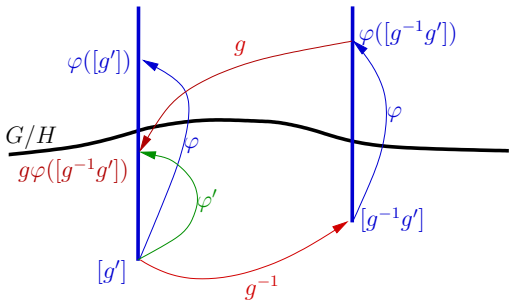
We present an explicit construction of the unitary irreducible representations of the two-dimensional Euclidean and Poincaré groups, together with their Spin double covers, by means of Mackey's theory of induced representations for semidirect products. In dimension D=2, the simplicity of the corresponding little groups allows a complete explicit treatment of momentum orbits, equivariant wavefunctions, and representation operators. For the Euclidean group the matrix elements are expressed in terms of Bessel functions; for the Poincaré group the richer orbit structure leads to modified Bessel and Hankel functions and, in some cases, tempered distributions treated in rigged Hilbert spaces.
What carries the argument
Mackey's induced representations for semidirect products, applied to the 2D Euclidean and Poincaré groups where the little groups are low-dimensional and permit explicit orbit classification and wavefunction construction.
If this is right
- All momentum orbits and corresponding equivariant wavefunctions receive explicit parametrizations.
- Matrix elements of the infinite-dimensional representations for the Euclidean group are given by Bessel functions.
- Matrix elements for the Poincaré group involve modified Bessel functions, Hankel functions, or tempered distributions.
- The same explicit treatment extends to the spin double covers of both groups.
- Rigged Hilbert spaces are required to make the distributional representations rigorous.
Where Pith is reading between the lines
- These closed-form operators could be inserted directly into 2D relativistic quantum mechanics to compute transition amplitudes without further abstract work.
- The orbit-by-orbit construction supplies a concrete test case for comparing Mackey induction with other methods such as geometric quantization on the same groups.
- The pattern of using rigged Hilbert spaces for certain Poincaré representations may recur in other low-dimensional groups that possess continuous-series representations.
Load-bearing premise
The little groups in two dimensions are simple enough to allow a complete explicit parametrization of all momentum orbits and equivariant wavefunctions while keeping the induced operators unitary on rigged Hilbert spaces for the distributional cases.
What would settle it
A direct calculation, for a chosen timelike orbit of the Poincaré group, showing that the induced operator for a Lorentz boost fails to preserve the norm of the corresponding equivariant wavefunction when the wavefunction is a tempered distribution.
Figures
read the original abstract
We present an explicit construction of the unitary irreducible representations of the two-dimensional Euclidean and Poincar\'e groups, together with their Spin double covers, by means of Mackey's theory of induced representations for semidirect products. In dimension D=2, the simplicity of the corresponding little groups allows a complete explicit treatment of momentum orbits, equivariant wavefunctions, and representation operators. For the Euclidean group, the matrix elements of the infinite-dimensional representations are expressed in terms of Bessel functions. For the Poincar\'e group, the richer Lorentzian orbit structure leads to matrix elements involving modified Bessel and Hankel functions and, in some cases, tempered distributions, requiring the use of Rigged Hilbert Spaces. This work illustrates the interplay among induced representations, harmonic analysis on Lie groups, Spin geometry, and special functions in a fully explicit relativistic setting.
Editorial analysis
A structured set of objections, weighed in public.
Referee Report
Summary. The manuscript presents an explicit construction of the unitary irreducible representations of the two-dimensional Euclidean and Poincaré groups, together with their Spin double covers, via Mackey's theory of induced representations for semidirect products. In D=2 the little groups are simple enough to permit complete parametrization of momentum orbits, equivariant wavefunctions, and representation operators. Matrix elements for the Euclidean case are given in terms of Bessel functions on L² spaces; for the Poincaré group they involve modified Bessel and Hankel functions, with lightlike orbits realized on tempered distributions via rigged Hilbert spaces.
Significance. If the constructions are fully rigorous, the paper supplies a valuable explicit reference for low-dimensional relativistic representations, demonstrating the interplay of induced-representation theory, harmonic analysis, and special functions. The complete orbit classification and the explicit matrix-element formulae constitute a clear strength.
major comments (1)
- [Poincaré lightlike case (rigged Hilbert space extension)] The section treating lightlike Poincaré orbits invokes rigged Hilbert spaces to restore unitarity for the distributional realizations, yet supplies neither an explicit sesquilinear form on the rigged space nor continuity estimates showing that the induced operators extend to unitary operators on that space. This verification step is load-bearing for the central claim that all representations, including the distributional ones, are unitary.
minor comments (1)
- Clarify in the text whether the cocycle data for the Spin double covers are derived explicitly or taken from standard references.
Simulated Author's Rebuttal
We thank the referee for the careful reading of our manuscript and for the constructive comment on the lightlike case. We address the concern directly below and will revise the manuscript to strengthen the presentation.
read point-by-point responses
-
Referee: The section treating lightlike Poincaré orbits invokes rigged Hilbert spaces to restore unitarity for the distributional realizations, yet supplies neither an explicit sesquilinear form on the rigged space nor continuity estimates showing that the induced operators extend to unitary operators on that space. This verification step is load-bearing for the central claim that all representations, including the distributional ones, are unitary.
Authors: We agree that the current treatment would benefit from greater explicitness on this point. In the revised manuscript we will add a dedicated subsection that defines the sesquilinear form on the rigged Hilbert space explicitly and supplies the requisite continuity estimates for the induced operators, thereby confirming that they extend to unitary operators on the completed space. This addition will make the unitarity claim fully rigorous without altering the overall construction. revision: yes
Circularity Check
No circularity: explicit Mackey induction on external semidirect-product structure with standard rigged-Hilbert extension
full rationale
The derivation applies Mackey's theorem for induced representations of semidirect products to the D=2 Euclidean and Poincaré groups, parametrizing orbits and little-group representations explicitly because the little groups are low-dimensional and abelian or compact. Matrix elements are expressed via Bessel, modified Bessel, and Hankel functions on L2 spaces for timelike and spacelike orbits, while lightlike cases are realized on tempered distributions extended via rigged Hilbert spaces. All steps rest on independently established external results (Mackey theory, harmonic analysis on Lie groups, and rigged-Hilbert-space functional analysis) rather than any self-definition, fitted parameter renamed as prediction, or load-bearing self-citation chain. The central claims therefore remain non-circular and self-contained against external benchmarks.
Axiom & Free-Parameter Ledger
axioms (2)
- standard math Mackey's theorem on induced representations for semidirect products
- standard math Existence and properties of rigged Hilbert spaces for tempered distributions
Lean theorems connected to this paper
-
IndisputableMonolith/Foundation/AlexanderDuality.leanalexander_duality_circle_linking unclear?
unclearRelation between the paper passage and the cited Recognition theorem.
We present an explicit construction of the unitary irreducible representations of the two-dimensional Euclidean and Poincaré groups... by means of Mackey's theory of induced representations for semidirect products. In dimension D=2, the simplicity of the corresponding little groups allows a complete explicit treatment of momentum orbits, equivariant wavefunctions, and representation operators.
What do these tags mean?
- matches
- The paper's claim is directly supported by a theorem in the formal canon.
- supports
- The theorem supports part of the paper's argument, but the paper may add assumptions or extra steps.
- extends
- The paper goes beyond the formal theorem; the theorem is a base layer rather than the whole result.
- uses
- The paper appears to rely on the theorem as machinery.
- contradicts
- The paper's claim conflicts with a theorem or certificate in the canon.
- unclear
- Pith found a possible connection, but the passage is too broad, indirect, or ambiguous to say the theorem truly supports the claim.
Reference graph
Works this paper leans on
-
[1]
G. W. Mackey Induced Representations of Locally Compact Groups I . Ann. Math. 55 no.1, 101-139 (1952)
work page 1952
-
[2]
G. W. Mackey Induced Representations of Locally Compact Groups II. The Frobenius Reciprocity Theorem. Ann. Math. 58 no.2, 193 - 221(1953)
work page 1953
-
[3]
C. Carmeli, G. Cassinelli, A. Toigo, V.S. Varadarajan, Unitary Repre- sentations of Super Lie Groups and Applications to the Class ification and Multiplet Structure of Super Particles . Commun. Math. Phys. 263, 217–258 (2006)
work page 2006
-
[4]
E. P. Wigner, On unitary representations of the inhomogeneous Lorentz group. Ann. Math. 40 149-204 (1939)
work page 1939
-
[5]
G. W. Mackey Infinite dimensional Group Representations . Bull. Amer. Math. Soc. 69 no.5, 628–686 (1963)
work page 1963
-
[6]
V. S. Varadarajan, Geometry of Quantum Theory . Springer, New York (2006)
work page 2006
-
[7]
G. N. Watson, A Treatise on the Theory of Bessel Functions . Cambridge University Press. Cambridge, (1958)
work page 1958
-
[8]
Wu-Ki Tung, Group Theory in Physics . World Scientific Publishing. Singapore, (1993)
work page 1993
-
[9]
U.H. Niederer, L. O’Raifeartaight, Realizations of the Unitary Repre- sentations of the Inhomogeneous Space-Time Groups I. Fortschritte der Phys. 22. 111-129 (1974). 33
work page 1974
- [10]
-
[11]
B. H. Lawson, M. L. Michelsohn, Spin Geometry . Princeton Math. Se- ries, 38. Princeton University Press, (1989)
work page 1989
-
[12]
Varadarajan, Supersymmetry for mathematician: an introduction
V.S. Varadarajan, Supersymmetry for mathematician: an introduction . Courant Lecture Notes. American Mathematical Society. Provide nce, RI (2004)
work page 2004
-
[13]
Clifford Algebras, Clifford Groups, and a Generalization of the Quaternions
J. Gallier, Clifford algebras, Clifford groups and a generalization of th e quaternions: The Pin and the Spin groups. arXiv:0805.0311
work page internal anchor Pith review Pith/arXiv arXiv
-
[14]
Deligne, Notes on spinors in Quantum fields and strings: a course for mathematicians
P. Deligne, Notes on spinors in Quantum fields and strings: a course for mathematicians . American Mathematical Society. Providence, RI (1999)
work page 1999
-
[15]
R. D’Auria, S. Ferrara, M. A. Lled´ o. V.S. Varadarajan, Spinor algebras J. Geom. Phys. 40 101-129 (2001)
work page 2001
-
[16]
F.G. Friedlander, Introduction to the theory of distributions , Cambridge University Press, Cambridge (1982)
work page 1982
-
[17]
H¨ ormander, The analysis of linear partial differential operators , vol
L. H¨ ormander, The analysis of linear partial differential operators , vol. 1, Springer-Verlag, Berlin (1983)
work page 1983
-
[18]
A. J. Weir, Lebesgue Integration and Measure , Cambridge: Cambridge Univ. Press. (1973) 34
work page 1973
discussion (0)
Sign in with ORCID, Apple, or X to comment. Anyone can read and Pith papers without signing in.