REVIEW 4 major objections 6 minor 3 cited by
SpecAttn claims that the verification pass's own attention logits—collected from just the first draft token and the bonus token—can select the KV cache entries for the next sparse drafting phase, delivering up to 2.81x decoding throughput w
Reviewed by Pith at T0; open to challenge. T0 means a machine referee read the full paper against a public rubric. the ladder, T0–T4 →
T0 review · deepseek-v4-flash
2026-08-03 03:38 UTC pith:M7YHSS75
load-bearing objection Verification-guided KV selection is a genuinely new idea, and the engineering is solid, but the reported margin over baselines is insecure because the hyperparameters are not tuned symmetrically. the 4 major comments →
Vegas: Self-Speculative Decoding with Verification-Guided Sparse Attention
The pith
A machine-rendered reading of the paper's core claim, the machinery that carries it, and where it could break.
Core claim
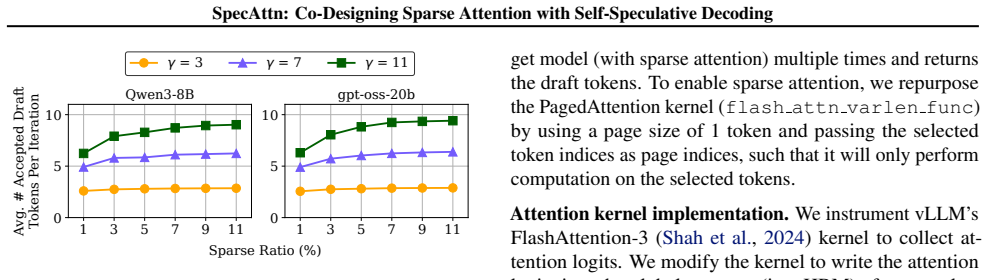
The central claim is that the full-attention pass used to verify draft tokens also produces, for free, a ranking of which KV cache entries matter. The paper's mechanism reads the pre-softmax attention logits from the first draft token and the bonus token (the extra token produced when all drafts are accepted), averages them across attention heads, keeps the top k prefix positions, and uses exactly those entries for sparse attention during the next drafting phase. Because the selected set is drawn from two far-apart boundary tokens rather than a single token, it avoids overfitting to one attention pattern and keeps acceptance rates high down the draft chain, while doing so with a small, const
What carries the argument
The load-bearing object is the verification-guided KV selector: it aggregates attention logits from the first draft token and the bonus token across all query heads, then keeps the k prefix positions with the largest combined scores. The 'Collect-2-Query' mechanism is the implementation trick that makes this cheap: instead of dumping logits for every drafted token, it writes only two rows of the logit matrix to memory, which keeps overhead in the low single digits while still capturing the diversity of the draft chain.
Load-bearing premise
The load-bearing premise is that the attention logits of the first draft token and the bonus token, averaged across heads, identify essentially the same critical KV entries as averaging over every token in the draft chain—and that these entries remain the right ones for the next iteration.
What would settle it
Take a long-context model not used in the paper and run the draft/verify loop for several hundred iterations. Record the top-k prefix indices selected by the boundary-token rule and by the all-draft-tokens rule; if the overlap drops well below the roughly 60–75% range the paper reports while the boundary rule's accepted-tokens-per-iteration also drops by more than 10%, the central proxy fails.
If this is right
- If the central claim is right, long-context inference can be sped up without any training step: the only requirement is reading two rows of logits out of a kernel that is already running.
- Draft chains stop decaying at later positions, because combining two far-apart boundary tokens avoids the overfitting that a single-token selector suffers from.
- The KV-selection overhead stays roughly constant as the draft length grows, so the speedup can scale with context length rather than being eaten by selection costs.
- Because verification still uses full attention, the output distribution is identical to vanilla decoding; the acceleration is lossless.
- The approach is compatible with other self-speculative optimizations, such as skipping layers during drafting, so it composes rather than competing.
Where Pith is reading between the lines
- I infer the boundary-token heuristic is general: any scheme that runs full attention once per iteration could feed those logits into a drafter that is not the same model, so the idea may transfer to auxiliary-draft-model settings.
- I infer the 'rejected tokens still carry signal' observation could be sharpened: weight each discarded token's logits by its acceptance probability or semantic distance instead of simply averaging, which might extend the usable draft chain.
- I infer that the method's advantage should grow with batch depth, because the constant two-token collection cost is amortized over more concurrent requests—though this scaling is not demonstrated in the paper.
Editorial analysis
A structured set of objections, weighed in public.
Referee Report
Summary. SpecAttn (referred to as 'Vegas' in the abstract) is a training-free self-speculative decoding method for long-context LLM inference. In each decoding iteration, a draft sequence is generated autoregressively with sparse attention over a selected subset of the KV cache, then verified in parallel with full attention. The paper's key novelty is to reuse the attention logits computed during verification as a 'free oracle' for selecting which KV entries to keep for the next drafting round, rather than using a standalone KV-selection algorithm. To keep logit-collection overhead low, the method collects logits only from the first draft token and the bonus token (Eq. 3). The manuscript reports 1.25–2.81× throughput improvement over default vLLM and 1.15–1.29× over state-of-the-art sparse self-speculative baselines (MagicDec-Stream, MagicDec-Quest, SpecExtend) on AIME25, CodeElo, and LongBench-v2 with Qwen3-4B/8B/30B and gpt-oss-20b. The method is claimed to preserve the output distribution of full-attention decoding through standard speculative-sampling rejection.
Significance. If the experimental claims hold, the contribution is practically valuable: instead of paying extra for KV selection, SpecAttn derives criticality information as a byproduct of the verification pass, resulting in high drafting accuracy with low overhead. The implementation in vLLM with instrumented FlashAttention-3 and PagedAttention is nontrivial, and the losslessness guarantee is sound because the final acceptance decision is made against full-attention verification. The evaluation covers four models, three benchmarks, and two regimes (short-context reasoning and long-context reasoning), which is a strength. However, the quantitative comparison against the SOTA baselines currently rests on a hyperparameter-tuning protocol that is asymmetric and partly evaluated on the same data used for tuning; the small reported margins over baselines (1.15–1.29×) are therefore fragile until these issues are addressed.
major comments (4)
- [Appendix B, Figure 12 / Table 2] The claimed speedups over MagicDec-Stream, MagicDec-Quest, and SpecExtend depend on a symmetric hyperparameter comparison. Table 2 shows that SpecAttn's draft count γ is selected per model and per benchmark (e.g., γ=9 for Qwen3-8B on LongBench-v2), while all baselines use fixed γ values (4 or 5) with no reported tuning on the same grid. Figure 12 shows that SpecAttn's chosen (γ, sparse-ratio) cell is near a maximum after a dense sweep; baselines may require different γ because their acceptance-length behavior differs (Fig. 2). Moreover, the sparse ratio is fixed at 7% for all methods, but 7% is selected from SpecAttn's sweep on one model/benchmark and may not be optimal for StreamingLLM or Quest. Without a symmetric tuning protocol or a sensitivity analysis demonstrating that the ordering of methods is stable over the γ/sparse-ratio grid, the 1.15–1.29× baseline-relative speedup is not e
- [§5.3 / Appendix B, Figure 12] The long-context evaluation is entangled with hyperparameter selection. Figure 12 profiles the γ×sparse-ratio grid using Qwen3-8B on LongBench-v2, and §5.3 reports LongBench-v2 throughput for the same model using the configuration selected from that grid. Thus the long-context speedup numbers in Figure 11 are obtained on a benchmark that was used to choose the hyperparameters. The authors should tune on a separate validation set or, at minimum, report the evaluation results across the grid to rule out selection bias.
- [§3.3, Eq. (3), Table 1] The central low-overhead claim rests on the assertion that attention logits from the first draft token and the bonus token are as informative as logits from all draft tokens. This is supported only by Table 1 and Figure 7 for Qwen3-8B and gpt-oss-20b on LongBench-v2 at a fixed 7% sparse ratio. No evidence is given for AIME25/CodeElo, for the other two models, or for different sparse ratios. Since the boundary-token proxy directly determines both drafting accuracy and KV-selection overhead, the paper should provide broader validation (additional datasets/models and varying γ and sparse ratio) or an analysis of when the proxy degrades.
- [§5, Figures 9–11] All throughput numbers are reported as point estimates with no error bars, standard deviations, or number of seeds. Given that the benchmarks are sampled and system performance can vary across runs, the small margins over some baselines (e.g., 1.15–1.23× in §5.2) require confidence intervals to be convincing. The authors should report at least three independent runs or provide error bars; this is especially important because the 'replayed until stable' methodology in §5.2 is not precisely defined.
minor comments (6)
- [Title / Abstract] The title and abstract use 'Vegas', while the body and headings use 'SpecAttn'. The naming must be made consistent throughout the manuscript.
- [§2.3, Figures 2–3] Please clarify that 'MagicDec' in these figures refers to the self-speculative framework instantiated with StreamingLLM or Quest as the drafting sparsity algorithm, since the original MagicDec may be configured differently.
- [§2.2] The reference '(Li et al., 2025a; Zhang et al.)' is incomplete: the 'Zhang et al.' entry lacks a year and venue. Please fix the citation.
- [§3.2] Typo: 'alldraft' should be 'all draft'. Also, please make the notation for 'γ+1' tokens consistent (bonus token counted as a draft token) throughout the text and equations.
- [§5.2] 'Datasets are replayed until a stable decoding throughput is measured' — please define the stability criterion (e.g., relative change below a threshold over a window).
- [Appendix B] The statement that 'a sparse ratio of 7% achieves a near-optimal trade-off for all designs and all models' is justified only by Figure 12, which is for one model on one benchmark. Please state the evidence for the other model/benchmark combinations.
Circularity Check
No load-bearing circularity: losslessness is standard speculative sampling and the speedup claims are empirical measurements, not derived from fitted inputs.
full rationale
The paper's central mechanism is empirical systems work rather than a derivation that reduces to its own inputs. The KV-selection rule in Eq. 3 is a heuristic top-k criterion over attention logits produced by full-attention verification; it does not define the acceptance rates or throughputs it is later used to explain. The losslessness guarantee is imported from the standard speculative-sampling theorem (Leviathan et al., 2023), which holds for any draft distribution and therefore does not depend on SpecAttn's particular KV-selection choices. There are no overlapping-author citations used as load-bearing evidence, no imported uniqueness theorem, and no ansatz smuggled in via citation. The main validity concern is evaluation tuning: Appendix B and Figure 12 show SpecAttn's gamma and 7% sparse ratio are selected by sweeping on the same LongBench-v2-style workloads used in the headline comparison, while no equivalent sweep is reported for the baselines. That is a fairness and overfitting risk, not a circularity, because the reported throughputs are independent measurements rather than algebraic consequences of the tuning. The incomplete 'Zhang et al.' citation is a completeness issue, not a circular step. No claim in the paper reduces by construction to a fitted parameter, a self-citation, or a definition of the target quantity.
Axiom & Free-Parameter Ledger
free parameters (3)
- sparse ratio (selected KV fraction) =
7%
- draft token count gamma =
5–9 depending on model/dataset (Table 2)
- logit-collection token subset =
2 (first draft + bonus token)
axioms (4)
- domain assumption Speculative sampling with a known draft distribution is lossless (Leviathan et al., 2023)
- domain assumption Attention logits from boundary tokens (first draft + bonus) approximate cumulatively critical KV entries across all draft tokens
- domain assumption KV criticality measured during verification of the current draft chain predicts criticality for the next drafting phase
- domain assumption The modified FlashAttention-3 logit-collection overhead is as profiled
read the original abstract
Long-context large language model (LLM) inference has become the norm for today's AI applications. However, it is severely bottlenecked by the increasing memory demands of its KV cache. Previous works have shown that self-speculative decoding with sparse attention, where tokens are drafted using a subset of the KV cache and verified in parallel against the full KV cache, speeds up inference in a lossless manner. However, they rely on a standalone KV selection algorithm to select the KV entries used for drafting and overlook the fact that the criticality of each KV entry is inherently computed during verification. In this paper, we propose Vegas, a self-speculative decoding method with verification-guided sparse attention. Vegas identifies critical KV cache entries as a byproduct of verification and computes attention only over these entries when drafting subsequent tokens. This not only improves the draft token acceptance rate but also incurs low KV selection overhead, thereby improving decoding throughput. Vegas achieves a 1.25$\times$-2.81$\times$ speedup in decoding throughput over default vLLM and a 1.15$\times$-1.29$\times$ speedup over state-of-the-art sparse attention-based self-speculative decoding methods. Our code is available at https://github.com/platformxlab/vegas.
Figures




Forward citations
Cited by 3 Pith papers
-
A Sparse Glimpse of the Whole: Train-Free Self-Speculative Decoding
A training-free self-speculative decoding system with a recallable sparse KV cache and entropy-guided adaptive speculation achieves up to 2.79× speedup while preserving the target distribution.
-
Spectral Origins of the Self-Correction Blind Spot in Autoregressive Generation
Self-correction blind spots in residual-stream autoregressive models arise iff the product of attention Jacobians has spectral radius ≥1, with a sharp marker threshold and RL coupling condition derived from that radius.
-
EfficientRollout: System-Aware Self-Speculative Decoding for RL Rollouts
EfficientRollout applies self-speculative decoding with quantized drafter induction and system-aware acceptance policies to cut RL rollout latency up to 19.6% while preserving final model quality.
Reference graph
Works this paper leans on
-
[2]
URL https://aclanthology.org/2024. naacl-industry.2/. Quan, S., Yang, J., Yu, B., Zheng, B., Liu, D., Yang, A., Ren, X., Gao, B., Miao, Y ., Feng, Y ., et al. Codeelo: Benchmarking competition-level code generation of llms with human-comparable elo ratings.arXiv preprint arXiv:2501.01257, 2025. Sadhukhan, R., Chen, J., Chen, Z., Tiwari, V ., Lai, R., Shi,...
Pith/arXiv arXiv 2024
-
[5]
12 SpecAttn: Co-Designing Sparse Attention with Self-Speculative Decoding A
URL https://openreview.net/forum? id=RuZ80yl71h. 12 SpecAttn: Co-Designing Sparse Attention with Self-Speculative Decoding A. Attention Weights vs. Attention Logits As discussed in §3.2, SpecAttn uses attention logits (qK ⊤) as the metric to select critical KV entries, which incurs low overhead and achieves high drafting accuracy. Another KV selection app...
2024
-
[257]
URL https://aclanthology.org/2023. findings-emnlp.257/. Xia, H., Li, Y ., Zhang, J., Du, C., and Li, W. SWIFT: On-the-fly self-speculative decoding for LLM inference acceleration. InThe Thirteenth International Conference on Learning Representations, 2025. URL https:// openreview.net/forum?id=EKJhH5D5wA. Xiao, C., Zhang, P., Han, X., Xiao, G., Lin, Y ., Z...
Pith/arXiv arXiv 2023
-
[2024]
Fu, Y ., Bailis, P., Stoica, I., and Zhang, H
URL https://doi.org/10.18653/v1/ 2024.acl-long.681. Fu, Y ., Bailis, P., Stoica, I., and Zhang, H. Break the se- quential dependency of LLM inference using lookahead decoding. In Salakhutdinov, R., Kolter, Z., Heller, K., Weller, A., Oliver, N., Scarlett, J., and Berkenkamp, F. (eds.),Proceedings of the 41st International Conference on Machine Learning, v...
Pith/arXiv arXiv 2024
-
[2025]
Shah, J., Bikshandi, G., Zhang, Y ., Thakkar, V ., Ramani, P., and Dao, T
URL https://openreview.net/forum? id=CS2JWaziYr. Shah, J., Bikshandi, G., Zhang, Y ., Thakkar, V ., Ramani, P., and Dao, T. Flashattention-3: Fast and accurate attention with asynchrony and low-precision, 2024. URL https: //arxiv.org/abs/2407.08608. Su, J., Ahmed, M., Lu, Y ., Pan, S., Bo, W., and Liu, Y . Roformer: Enhanced transformer with rotary positi...
Pith/arXiv arXiv 2024
discussion (0)
Sign in with ORCID, Apple, or X to comment. Anyone can read and Pith papers without signing in.