REVIEW 3 major objections 6 minor 55 references
This paper claims that slot-attention object segmentation can be improved by running slot attention over several feature layers of a pre-trained vision transformer and fusing the resulting slot sets into one representation, with gains large
Reviewed by Pith at T0; open to challenge. T0 means a machine referee read the full paper against a public rubric. the ladder, T0–T4 →
T0 review · deepseek-v4-flash
2026-08-03 03:32 UTC pith:IPOPPPB4
load-bearing objection MUFASA's multi-layer slot attention is a real, well-ablated contribution; the SPOT-M SOTA claim is muddied by a simultaneous distillation-target change that the paper itself admits but never controls for. the 3 major comments →
MUFASA: A Multi-Layer Framework for Slot Attention
The pith
A machine-rendered reading of the paper's core claim, the machinery that carries it, and where it could break.
Core claim
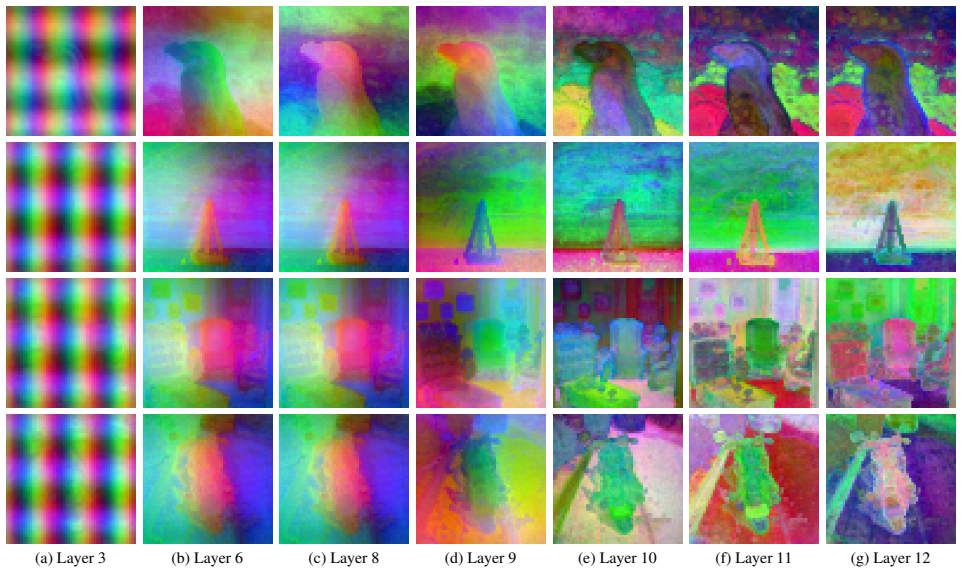
The central claim is that layer-wise segmentation quality does not saturate at the final ViT layer. Independent slot-attention modules on the last four DINO layers produce masks that are individually competitive but complementary; aligning the slot sets by Hungarian matching and fusing them through M-Fusion yields masks that are more accurate than any single layer's, because layers compensate for each other's noise. Concretely, the paper reports that SPOT-M reaches 59.8 mBOc on PASCAL VOC versus 55.3 for SPOT, 45.5 versus 44.3 mBOc on COCO, and 49.2 versus 47.0 mBOi on MOVi-C, and that DINOSAUR-M improves on DINOSAUR on nearly every metric and dataset. These gains come with faster convergenc
What carries the argument
The central object is M-Fusion, a slot-fusion module. For each of M selected encoder layers, an independent slot-attention module produces its own set of K slots and an attention mask over image patches. Hungarian matching — an assignment algorithm that pairs up slots across layers so that same-index slots bind to the same object — reorders the slot sets. The aligned slots are combined in adjacent pairs, a design choice that encodes local-layer interactions as an inductive bias, and the concatenated pairs are projected through an MLP into a single fused slot set. The attention masks are fused by a learned weighted sum when teacher–student distillation is present (SPOT-M) and by a uniform ave
Load-bearing premise
The attribution of SPOT-M's state-of-the-art gains to multi-layer fusion is load-bearing; because the same model also switches the distillation target from decoder masks to slot-attention masks (Sec. 4.1, Implementation), the gains may in part or whole come from that switch, and no ablation separates the two.
What would settle it
Train a single-layer SPOT variant (last encoder layer only, all other MUFASA machinery removed) but with the same slot-attention-mask distillation target and hyperparameters as SPOT-M, and compare on PASCAL VOC; if that variant matches SPOT-M's 59.8 mBOc, the multi-layer fusion is not the source of the gain.
If this is right
- Integrating MUFASA into SPOT improves segmentation across VOC, COCO, and MOVi-C, setting a new state of the art (e.g., 59.8 vs 55.3 mBOc on VOC).
- Integrating MUFASA into DINOSAUR improves it on essentially all metrics, surpassing the previous SPOT state of the art on VOC and MOVi-C despite having fewer parameters.
- MUFASA reaches baseline-level accuracy substantially faster, reducing time-to-baseline by about 90% or more on VOC and COCO, and reaches peak results earlier on all datasets.
- The gains hold across encoder backbones and pretraining schemes (DINO, MAE, DINOv2; ViT-B/16, ViT-B/14, ViT-S/8), and across decoder choices.
- The method adds no auxiliary losses to either base model; it is trained with the base training signal and a modest parameter overhead (e.g., +12% for SPOT-M).
Where Pith is reading between the lines
- An implication left implicit is that because SPOT-M simultaneously changes the distillation target (from SPOT's decoder attention masks to slot-attention masks), the reported SPOT-M gains are not cleanly attributable to multi-layer fusion alone; a single-layer SPOT variant with the same distillation target would isolate the contribution.
- The paper's layer-selection ablation shows performance peaks at four consecutive layers, with five slightly worse; this suggests the benefit is not simply 'more layers' but something like a sweet spot where information is semantically rich but not yet over-fit to class-level grouping — a testable hypothesis for other feature hierarchies.
- If the multi-layer fusion genuinely helps slot binding, the same recipe (independent slot attention per layer + Hungarian alignment + pairwise fusion) could transfer to other slot-attention-based tasks such as compositional generation or world models, where richer slot representations are also desirable.
- The complementary-information story predicts a specific failure mode: fused masks should help most when individual layers disagree, and help least when layers already agree; a disagreement-weighted analysis across images would test this directly.
Editorial analysis
A structured set of objections, weighed in public.
Referee Report
Summary. The paper proposes MUFASA, a plug-and-play module for slot-attention-based unsupervised object segmentation. Instead of running slot attention only on the last DINO ViT layer, MUFASA runs independent slot-attention modules on several (typically the last four) encoder layers, aligns the resulting slots with Hungarian matching on binarized attention masks, and fuses them with a learned MLP-based M-Fusion plus a weighted mask fusion. The module is integrated into DINOSAUR and SPOT, yielding DINOSAUR-M and SPOT-M. The main empirical claims are that both variants improve over their baselines on PASCAL VOC, COCO, and MOVi-C, that SPOT-M sets a new state of the art (Table 1: SPOT-M reaches 59.8 mBOc on VOC and 45.5 mBOc on COCO vs. SPOT's 55.3 and 44.3), and that training converges considerably faster with only modest parameter/inference overhead. The paper also includes ablations on layer choice, fusion strategy, encoder backbone, pre-training scheme, and decoder type.
Significance. The multi-layer slot-attention idea is well motivated by the known layer-wise semantics of DINO ViTs, and the paper provides a systematic experimental study: three datasets, multiple backbones and pre-training schemes, decoder and fusion ablations, and training-time analysis. The DINOSAUR-M results are strong across all three datasets and, because DINOSAUR-M changes only the multi-layer mechanism relative to DINOSAUR, they provide genuine support for the central multi-layer claim. The claimed SPOT-M state of the art is, however, not cleanly attributable to the multi-layer mechanism because SPOT-M simultaneously changes the distillation target (decoder masks to slot-attention masks), and the COCO SOTA is fragile on several metrics. The paper is therefore a solid contribution whose headline claim needs additional controls before it can be accepted at face value.
major comments (3)
- [Sec. 4.1 (Implementation) and Table 1] SPOT-M differs from SPOT in at least two ways: the multi-layer SA/fusion mechanism, and the distillation target. The text states: 'Contrary to SPOT, we use segmentation masks of the SA module to distill knowledge of the teacher to the student.' The supplement discusses slot vs. decoder masks but does not report a single-layer SPOT variant with SA-mask distillation. Therefore the reported SOTA gains on VOC (+4.5 mBOc), COCO (+1.2 mBOc), and MOVi-C (+2.2 mBOi) cannot be attributed to MUFASA's multi-layer mechanism. Please add an ablation: SPOT with a single layer (L12) but with SA-mask distillation (and the same distillation settings), and ideally also SPOT-M with decoder-mask distillation. Without this control, the paper should not claim that the SPOT-M gains come from multi-layer fusion.
- [Table 1 (COCO) and Sec. 4.1] The COCO SOTA claim is fragile. SPOT-M improves mBOc by 1.2 and mBOi by 0.1, but the mBOi difference is within the reported standard deviations (34.8±0.2 vs. 34.7±0.1), while mIoU drops by 0.2 and FG-ARI drops by 2.2 (35.6 vs. 37.8). The text says 'only one marginal exception in mIoU on COCO,' which overlooks the FG-ARI decline. If 'new state of the art' on COCO is claimed, it should be based on metrics with meaningful differences, or supported by paired significance testing, or the claim should be qualified.
- [Sec. 3.2 / Eq. (6) and Sec. 4.3] The layer index set I and the learned fusion weights w_m are design choices made on the same benchmarks where the SOTA numbers are reported. The layer set (last four layers) is selected from the VOC ablation in Fig. 6, and SPOT-M's fusion weights are learned during self-training on the evaluation datasets. The manuscript does not state that a held-out validation split was used for model selection. Given the small margins on COCO, this selection procedure could inflate the reported gains. Please clarify the validation protocol, or report results on a held-out split.
minor comments (6)
- [Supplementary A] The sentence 'We assign a greater weight to this loss as opposed to [26] with λ= 0.01' is ambiguous, and Table 7 lists 'Distillation λ 0.01'. Please clarify whether SPOT-M uses λ=0.01 or a larger value, and whether λ was tuned per dataset.
- [Sec. 3.2 (Hungarian matching)] The binarization of the slot-attention masks used for Hungarian matching is not described. Please specify the threshold/procedure.
- [Sec. 4.2 / Table 2] The '94.4% reduction in training time' for SPOT-M on VOC uses EBase (time to reach baseline-level results), not EPeak. Please state this explicitly, since the peak-time reduction is much smaller.
- [Table 2] Minor formatting: '12.18 h' has an inconsistent number of decimals compared with the other entries.
- [Sec. 3.1] Equation (2) writes softmax over K without a subscript in the displayed formula; please clarify that the softmax is along the slot dimension.
- [Sec. 4.3 / Table 3] The differences among Concat-Fusion, T-Fusion, and M-Fusion are small (59.0 vs. 59.8 mBOc) and are reported without standard deviations or significance tests. Please add error bars or note that the comparison is directional.
Circularity Check
No circularity found: MUFASA's gains are measured benchmark results, not quantities forced by construction or by a self-citation chain.
full rationale
The paper is an empirical architecture-and-benchmark contribution, not a derivation, so the main circularity patterns do not apply. The fused slots and masks are defined by the new equations (4)-(6) and are trained/evaluated on the datasets; no reported number is the same quantity as an input parameter by construction. The learned mask-fusion weights w in Eq. (6) are not 'predictions'—they are fit on the benchmarks where results are reported, so model-selection/overfitting risk exists, but that is not circularity. The one genuine attribution confound is flagged in Sec. 4 (Implementation): 'Contrary to SPOT, we use segmentation masks of the SA module to distill knowledge of the teacher to the student'; no single-layer SPOT with that distillation target is ablated, so the SPOT-M SOTA gain is not cleanly separable from the multi-layer fusion claim. That weakens the causal attribution but does not make the result equivalent to its input. Likewise, Supplementary Material Sec. C says 'decoder metrics do not reliably reflect the quality of the slot-object binding itself' and the paper reports the max of slot/decoder metrics; that is a measurement-convention concern, not circularity. The cited prior work ([26], [45], [1], [53], [41]) is external, and no load-bearing self-citation or imported uniqueness/ansatz from the authors' own unverified work appears. Therefore no circular step is established.
Axiom & Free-Parameter Ledger
free parameters (4)
- Layer index set / number of layers M =
4 consecutive layers: {9, 10, 11, 12}
- Mask fusion weights w_m (SPOT-M) =
learned, softmax-normalized (not reported)
- Number of slots K =
6 (VOC), 7 (COCO), 11 (MOVi-C)
- Distillation weight lambda =
0.01 (per Tab. 7)
axioms (3)
- domain assumption DINO ViT layers at different depths provide semantically complementary, object-relevant features, with deeper layers most useful.
- domain assumption After Hungarian matching by mask mIoU, corresponding slots across layers bind to the same object, so slot-wise summation is meaningful.
- domain assumption Slot attention modules trained independently on each layer with only the base model's reconstruction/distillation losses learn compatible object-centric slots.
Cite this review
Pith. "Pith review of MUFASA: A Multi-Layer Framework for Slot Attention." pith.science (2026). https://pith.science/paper/IPOPPPB4
@misc{pith2026260207544,
  author       = {Pith},
  title        = {Pith review of: MUFASA: A Multi-Layer Framework for Slot Attention},
  year         = {2026},
  howpublished = {\url{https://pith.science/paper/IPOPPPB4}},
  note         = {Machine review of arXiv:2602.07544}
}
read the original abstract
Unsupervised object-centric learning (OCL) decomposes visual scenes into distinct entities. Slot attention is a popular approach that represents individual objects as latent vectors, called slots. Current methods obtain these slot representations solely from the last layer of a pre-trained vision transformer (ViT), ignoring valuable, semantically rich information encoded across the other layers. To better utilize this latent semantic information, we introduce MUFASA, a lightweight plug-and-play framework for slot-attention-based approaches to unsupervised object segmentation. Our model computes slot attention across multiple feature layers of the ViT encoder, fully leveraging their semantic richness. We propose a fusion strategy to aggregate slots obtained on multiple layers into a unified object-centric representation. Integrating MUFASA into existing OCL methods improves their segmentation results across multiple datasets, setting a new state of the art while simultaneously improving training convergence with only minor inference overhead.
Figures




Reference graph
Works this paper leans on
-
[1]
On the effectiveness of ViT features as local semantic descrip- tors
Shir Amir, Yossi Gandelsman, Shai Bagon, and Tali Dekel. On the effectiveness of ViT features as local semantic descrip- tors. InECCV Workshop on What is Motion For, 2022. 1, 2, 3, 8
2022
-
[2]
Christopher P. Burgess, Loic Matthey, Nicholas Watters, Rishabh Kabra, Irina Higgins, Matt Botvinick, and Alexander Lerchner. MONet: Unsupervised scene decomposition and representation.arXiv:1901.11390 [cs.CV], 2019. 1, 2
Pith/arXiv arXiv 1901
-
[3]
Yue Cao, Yangzhou Liu, Zhe Chen, Guangchen Shi, Wenhai Wang, Danhuai Zhao, and Tong Lu. MMFuser: Multimodal multi-layer feature fuser for fine-grained vision-language un- derstanding.arXiv:2410.11829 [cs.CV], 2024. 2
Pith/arXiv arXiv 2024
-
[4]
Unsupervised learning of visual features by contrasting cluster assignments.NeurIPS, pages 9912–9924, 2020
Mathilde Caron, Ishan Misra, Julien Mairal, Priya Goyal, Piotr Bojanowski, and Armand Joulin. Unsupervised learning of visual features by contrasting cluster assignments.NeurIPS, pages 9912–9924, 2020. 1, 2
2020
-
[5]
Emerg- ing properties in self-supervised vision transformers
Mathilde Caron, Hugo Touvron, Ishan Misra, Herv´e J´egou, Julien Mairal, Piotr Bojanowski, and Armand Joulin. Emerg- ing properties in self-supervised vision transformers. InICCV, pages 9650–9660, 2021. 1, 2, 5, 8
2021
-
[6]
Learning phrase representations using RNN encoder–decoder for statistical machine translation
Kyunghyun Cho, Bart van Merri ¨enboer, Caglar Gulcehre, Dzmitry Bahdanau, Fethi Bougares, Holger Schwenk, and Yoshua Bengio. Learning phrase representations using RNN encoder–decoder for statistical machine translation. In EMNLP, pages 1724–1734, 2014. 3
2014
-
[7]
Jonathan Collu, Riccardo Majellaro, Aske Plaat, and Thomas M. Moerland. Slot structured world models. arXiv:2402.03326 [cs.CV], 2024. 1
Pith/arXiv arXiv 2024
-
[8]
Zero-shot object-centric representation learning
Aniket Didolkar, Andrii Zadaianchuk, Anirudh Goyal, Mike Mozer, Yoshua Bengio, Georg Martius, and Maximilian Seitzer. Zero-shot object-centric representation learning. In ICLR, 2025. 1
2025
-
[9]
General- ization and robustness implications in object-centric learning
Andrea Dittadi, Samuele Papa, Michele De Vita, Bernhard Sch¨olkopf, Ole Winther, and Francesco Locatello. General- ization and robustness implications in object-centric learning. InICML, pages 5221–5285, 2021. 1
2021
-
[10]
An image is worth 16x16 words: Transformers for image recognition at scale
Alexey Dosovitskiy, Lucas Beyer, Alexander Kolesnikov, et al. An image is worth 16x16 words: Transformers for image recognition at scale. InICLR, 2021. 2
2021
-
[11]
Kosiorek, Oiwi Parker Jones, and Ingmar Posner
Martin Engelcke, Adam R. Kosiorek, Oiwi Parker Jones, and Ingmar Posner. GENESIS: Generative scene inference and sampling with object-centric latent representations. InICLR,
-
[12]
S. M. Ali Eslami, Nicolas Heess, Theophane Weber, Yuval Tassa, David Szepesvari, Koray Kavukcuoglu, and Geoffrey E. Hinton. Attend, infer, repeat: Fast scene understanding with generative models. InNIPS, 2016. 2
2016
-
[13]
Williams, John Winn, and Andrew Zisserman
Mark Everingham, Luc Van Gool, Christopher K.I. Williams, John Winn, and Andrew Zisserman. The PASCAL visual object classes (VOC) challenge.IJCV, pages 303–338, 2010. 2, 5
2010
-
[14]
Vision meets robotics: The KITTI dataset.IJRR,
Andreas Geiger, Philip Lenz, Christoph Stiller, and Raquel Urtasun. Vision meets robotics: The KITTI dataset.IJRR,
-
[15]
Multi-object representation learning with iterative variational inference
Klaus Greff, Rapha¨el Lopez Kaufman, Rishabh Kabra, Nick Watters, Christopher Burgess, Daniel Zoran, Loic Matthey, Matthew Botvinick, and Alexander Lerchner. Multi-object representation learning with iterative variational inference. In ICML, pages 2424–2433, 2019. 1, 2
2019
-
[16]
Kubric: A scalable dataset generator
Klaus Greff, Francois Belletti, Lucas Beyer, Carl Doersch, et al. Kubric: A scalable dataset generator. InCVPR, pages 3749–3761, 2022. 5
2022
-
[17]
Fuchs, Ingmar Posner, and Andrea Vedaldi
Oliver Groth, Fabian B. Fuchs, Ingmar Posner, and Andrea Vedaldi. Shapestacks: Learning vision-based physical intu- ition for generalised object stacking. InECCV, pages 702– 717, 2018. 1, 2
2018
-
[18]
Masked autoencoders are scalable vision learners
Kaiming He, Xinlei Chen, Saining Xie, Yanghao Li, Piotr Doll´ar, and Ross Girshick. Masked autoencoders are scalable vision learners. InCVPR, pages 16000–16009, 2022. 8, 1
2022
-
[19]
Bridging nonlinearities and stochastic regularizers with Gaussian error linear units
Dan Hendrycks and Kevin Gimpel. Bridging nonlinearities and stochastic regularizers with Gaussian error linear units. arXiv:1606.08415 [cs.LG], 2016. 5, 2
Pith/arXiv arXiv 2016
-
[20]
Visuomotor control in multi-object scenes using object-aware representations
Negin Heravi, Ayzaan Wahid, Corey Lynch, Pete Florence, Travis Armstrong, Jonathan Tompson, Pierre Sermanet, Jean- nette Bohg, and Debidatta Dwibedi. Visuomotor control in multi-object scenes using object-aware representations. In ICRA, pages 9515–9522, 2023. 1
2023
-
[21]
Improving object- centric learning with query optimization
Baoxiong Jia, Yu Liu, and Siyuan Huang. Improving object- centric learning with query optimization. InICLR, 2022. 1
2022
-
[22]
Scalor: Generative world models with scalable object representations
Jindong Jiang, Sepehr Janghorbani, Gerard De Melo, and Sungjin Ahn. Scalor: Generative world models with scalable object representations. InICLR, 2019. 2
2019
-
[23]
Object-centric slot diffusion
Jindong Jiang, Fei Deng, Gautam Singh, and Sungjin Ahn. Object-centric slot diffusion. InNeurIPS, 2023. 1, 2
2023
-
[24]
Denoising criterion for variational auto- encoding framework
Daniel Jiwoong Im, Sungjin Ahn, Roland Memisevic, and Yoshua Bengio. Denoising criterion for variational auto- encoding framework. InAAAI, 2017. 2
2017
-
[25]
Lawrence Zitnick, and Ross Girshick
Justin Johnson, Bharath Hariharan, Laurens Van Der Maaten, Li Fei-Fei, C. Lawrence Zitnick, and Ross Girshick. CLEVR: A diagnostic dataset for compositional language and elemen- tary visual reasoning. InCVPR, pages 2901–2910, 2017. 1, 2
2017
-
[26]
SPOT: Self-training with patch-order permutation for object-centric learning with autoregressive transformers
Ioannis Kakogeorgiou, Spyros Gidaris, Konstantinos Karantzalos, and Nikos Komodakis. SPOT: Self-training with patch-order permutation for object-centric learning with autoregressive transformers. InCVPR, pages 22776–22786,
-
[27]
Clevr- Tex: A texture-rich benchmark for unsupervised multi-object segmentation
Laurynas Karazija, Iro Laina, and Christian Rupprecht. Clevr- Tex: A texture-rich benchmark for unsupervised multi-object segmentation. InNeurIPS Datasets and Benchmarks Track,
-
[28]
Bootstrapping top-down information for self-modulating slot attention
Dongwon Kim, Seoyeon Kim, and Suha Kwak. Bootstrapping top-down information for self-modulating slot attention. In NeurIPS, pages 103751–103773, 2024. 1 9
2024
-
[29]
The perception of hierarchical structure
Ruth Kimchi. The perception of hierarchical structure. In The Oxford Handbook of Perceptual Organization. Oxford University Press, 2015. 1
2015
-
[30]
Kingma and Jimmy Ba
Diederik P. Kingma and Jimmy Ba. Adam: A method for stochastic optimization. InICLR, 2014. 1
2014
-
[31]
Elsayed, Aravindh Mahen- dran, Austin Stone, Sara Sabour, Georg Heigold, Rico Jon- schkowski, Alexey Dosovitskiy, and Klaus Greff
Thomas Kipf, Gamaleldin F. Elsayed, Aravindh Mahen- dran, Austin Stone, Sara Sabour, Georg Heigold, Rico Jon- schkowski, Alexey Dosovitskiy, and Klaus Greff. Conditional object-centric learning from video. InICLR, 2022. 2
2022
-
[32]
Sequential attend, infer, repeat: Generative modelling of moving objects.NeurIPS, 31, 2018
Adam Kosiorek, Hyunjik Kim, Yee Whye Teh, and Ingmar Posner. Sequential attend, infer, repeat: Generative modelling of moving objects.NeurIPS, 31, 2018. 2
2018
-
[33]
Harold W. Kuhn. The Hungarian method for the assignment problem.Naval Research Logistics Quarterly, pages 83–97,
-
[34]
Scouter: Slot attention- based classifier for explainable image recognition
Liangzhi Li, Bowen Wang, Manisha Verma, Yuta Nakashima, Ryo Kawasaki, and Hajime Nagahara. Scouter: Slot attention- based classifier for explainable image recognition. InICCV, pages 1046–1055, 2021. 1
2021
-
[35]
Learning object- centric representations of multi-object scenes from multiple views
Nanbo Li, Cian Eastwood, and Robert Fisher. Learning object- centric representations of multi-object scenes from multiple views. InNeurIPS, pages 5656–5666, 2020. 2
2020
-
[36]
Lawrence Zitnick
Tsung-Yi Lin, Michael Maire, Serge Belongie, James Hays, Pietro Perona, Deva Ramanan, Piotr Doll´ar, and C. Lawrence Zitnick. Microsoft COCO: Common objects in context. In ECCV, pages 740–755, 2014. 2, 5
2014
-
[37]
Improving generative imagination in object-centric world models
Zhixuan Lin, Yi-Fu Wu, Skand Peri, Bofeng Fu, Jindong Jiang, and Sungjin Ahn. Improving generative imagination in object-centric world models. InICML, pages 6140–6149,
-
[38]
Space: Unsupervised object-oriented scene representation via spatial attention and decomposition
Zhixuan Lin, Yi-Fu Wu, Skand Vishwanath Peri, Weihao Sun, Gautam Singh, Fei Deng, Jindong Jiang, and Sungjin Ahn. Space: Unsupervised object-oriented scene representation via spatial attention and decomposition. InICLR, 2020. 2
2020
-
[39]
StructDiffusion: Language-guided creation of physically-valid structures using unseen objects
Weiyu Liu, Yilun Du, Tucker Hermans, Sonia Chernova, and Chris Paxton. StructDiffusion: Language-guided creation of physically-valid structures using unseen objects. InRSS,
-
[40]
Object-centric learn- ing with slot attention
Francesco Locatello, Dirk Weissenborn, Thomas Unterthiner, Aravindh Mahendran, Georg Heigold, Jakob Uszkoreit, Alexey Dosovitskiy, and Thomas Kipf. Object-centric learn- ing with slot attention. InNeurIPS, pages 11525–11538, 2020. 1, 2, 6
2020
-
[41]
Diffusion hyperfeatures: Searching through time and space for semantic correspondence
Grace Luo, Lisa Dunlap, Dong Huk Park, Aleksander Holyn- ski, and Trevor Darrell. Diffusion hyperfeatures: Searching through time and space for semantic correspondence. In NeurIPS, pages 47500–47510, 2023. 7
2023
-
[42]
DI- NOv2: Learning robust visual features without supervision
Maxime Oquab, Timoth´ee Darcet, Th´eo Moutakanni, Huy V o, Marc Szafraniec, Vasil Khalidov, Pierre Fernandez, Daniel Haziza, Francisco Massa, Alaaeldin El-Nouby, et al. DI- NOv2: Learning robust visual features without supervision. arXiv:2304.07193 [cs.CV], 2023. 2, 8, 1
Pith/arXiv arXiv 2023
-
[43]
Barron, Ferran Marques, and Jitendra Malik
Jordi Pont-Tuset, Pablo Arbelaez, Jonathan T. Barron, Ferran Marques, and Jitendra Malik. Multiscale combinatorial group- ing for image segmentation and object proposal generation. TPAMI, pages 128–140, 2016. 5
2016
-
[44]
Do vision trans- formers see like convolutional neural networks? InNeurIPS, pages 12116–12128, 2021
Maithra Raghu, Thomas Unterthiner, Simon Kornblith, Chiyuan Zhang, and Alexey Dosovitskiy. Do vision trans- formers see like convolutional neural networks? InNeurIPS, pages 12116–12128, 2021. 2
2021
-
[45]
Bridging the gap to real-world object- centric learning
Maximilian Seitzer, Max Horn, Andrii Zadaianchuk, Dominik Zietlow, Tianjun Xiao, Carl-Johann Simon-Gabriel, Tong He, Zheng Zhang, Bernhard Sch ¨olkopf, Thomas Brox, and Francesco Locatello. Bridging the gap to real-world object- centric learning. InICLR, 2022. 1, 2, 3, 5, 8
2022
-
[46]
Illiterate DALL-E learns to compose
Gautam Singh, Fei Deng, and Sungjin Ahn. Illiterate DALL-E learns to compose. InICLR, 2021. 2, 3, 6
2021
-
[47]
Simple unsu- pervised object-centric learning for complex and naturalistic videos.NeurIPS, pages 18181–18196, 2022
Gautam Singh, Yi-Fu Wu, and Sungjin Ahn. Simple unsu- pervised object-centric learning for complex and naturalistic videos.NeurIPS, pages 18181–18196, 2022. 2
2022
-
[48]
Ani Vanyan, Alvard Barseghyan, Hakob Tamazyan, Vahan Huroyan, Hrant Khachatrian, and Martin Danelljan. Analyz- ing local representations of self-supervised vision transform- ers.arXiv:2401.00463 [cs.CV], 2024. 2
Pith/arXiv arXiv 2024
-
[49]
Gomez, Łukasz Kaiser, and Illia Polosukhin
Ashish Vaswani, Noam Shazeer, Niki Parmar, Jakob Uszko- reit, Llion Jones, Aidan N. Gomez, Łukasz Kaiser, and Illia Polosukhin. Attention is all you need.NIPS, 2017. 2, 3
2017
-
[50]
Burgess, and Alexander Lerchner
Nick Watters, Loic Matthey, Chris P. Burgess, and Alexander Lerchner. Spatial broadcast decoder: A simple architecture for disentangled representations in V AEs. InICLR Workshop on Learning from Limited Labeled Data, 2019. 2, 1
2019
-
[51]
SlotFormer: Unsupervised visual dynamics simulation with object-centric models
Ziyi Wu, Nikita Dvornik, Klaus Greff, Thomas Kipf, and Animesh Garg. SlotFormer: Unsupervised visual dynamics simulation with object-centric models. InICLR, 2023. 1
2023
-
[52]
SlotDiffusion: Object-centric generative model- ing with diffusion models
Ziyi Wu, Jingyu Hu, Wuyue Lu, Igor Gilitschenski, and Ani- mesh Garg. SlotDiffusion: Object-centric generative model- ing with diffusion models. InNeurIPS, 2023. 1, 2
2023
-
[53]
Dense connector for MLLMs
Huanjin Yao, Wenhao Wu, Taojiannan Yang, YuXin Song, Mengxi Zhang, Haocheng Feng, Yifan Sun, Zhiheng Li, Wanli Ouyang, and Jingdong Wang. Dense connector for MLLMs. InNeurIPS, 2024. 1, 2, 4
2024
-
[54]
Zeiler and Rob Fergus
Matthew D. Zeiler and Rob Fergus. Visualizing and under- standing convolutional networks. InECCV, pages 818–833,
-
[2014]
Implementation Details In this section, we provide a more detailed overview of the training and implementation details for DINOSAUR-M and SPOT-M
2 10 MUFASA: A Multi-Layer Framework for Slot Attention Supplementary Material Sebastian Bock ∗1,2 Leonie Sch¨ußler ∗1,2 Krishnakant Singh 1 Simone Schaub-Meyer 1,3 Stefan Roth 1,2,3 1TU Darmstadt 2Zuse School ELIZA 3hessian.AI ∗equal contribution A. Implementation Details In this section, we provide a more detailed overview of the training and implementa...
discussion (0)
Sign in with ORCID, Apple, or X to comment. Anyone can read and Pith papers without signing in.