REVIEW 4 major objections 5 minor 6 references
This paper argues that the Euclidean geometry used by dense retrievers is the wrong shape for RAG, and that moving to hyperbolic space makes retrieved evidence more relevant and less prone to hallucination.
Reviewed by Pith at T0; open to challenge. T0 means a machine referee read the full paper against a public rubric. the ladder, T0–T4 →
T0 review · deepseek-v4-flash
2026-08-03 03:29 UTC pith:LVXVDNLH
load-bearing objection The headline 29% gain rests on an unmatched fine-tuning comparison; the paper's own controlled test shows 6-23% gains, so the idea has promise but the claim overreaches. the 4 major comments →
HypRAG: Hyperbolic Dense Retrieval for Retrieval Augmented Generation
The pith
A machine-rendered reading of the paper's core claim, the machinery that carries it, and where it could break.
Core claim
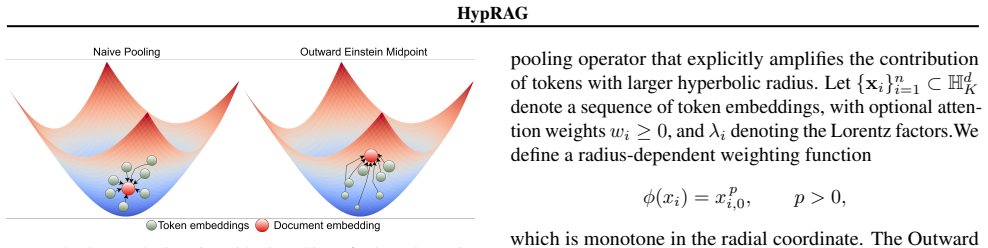
The paper's central claim is that hyperbolic representations are more effective at retrieving structurally relevant evidence for RAG, and that this improvement carries through to downstream generation quality. Concretely, it introduces HyTE-FH, a fully hyperbolic transformer operating in the Lorentz model, and HyTE-H, which maps pretrained Euclidean embeddings into hyperbolic space. To avoid representational collapse when aggregating token embeddings into document vectors, it defines the Outward Einstein Midpoint, a pooling operator with a provable outward bias: for any p≥1 it yields a document vector at least as far from the origin as the standard Einstein midpoint. Empirically, HyTE-H outp
What carries the argument
The central objects are the Lorentz model of hyperbolic space (the upper sheet of a hyperboloid with constant negative curvature, where geodesic distances have closed forms) and the Outward Einstein Midpoint pooling operator. The pooling operator reweights token contributions by a power of their radial coordinate x₀^p, p≥1, which amplifies specific, high-radius tokens and provably prevents the radial contraction that both Euclidean averaging and the standard Einstein midpoint suffer. The paper also treats hyperbolic geodesic distance, rather than cosine or dot product, as the similarity metric during contrastive training.
Load-bearing premise
The headline comparison pits HyTE-H, fine-tuned on supervised retrieval data, against off-the-shelf Euclidean embedders that were not fine-tuned on that data, so the measured gain could come from extra supervision rather than from hyperbolic geometry.
What would settle it
Run a controlled experiment where a Euclidean bi-encoder is fine-tuned on the exact same supervised retrieval splits and contrastive objective as HyTE-H, then compare on the RAG benchmark; if the Euclidean model matches or exceeds the hyperbolic one, the geometric hypothesis fails. A second check: train HyTE-H without the supervised stage; if its gains disappear, the '29%' is supervision, not geometry.
If this is right
- Dense retrievers for RAG can be made more reliable by switching the embedding space to hyperbolic geometry without changing the asymptotic computational cost.
- Smaller hyperbolic retrievers can match or exceed larger Euclidean models, so retrieval quality does not require model scale alone.
- Hyperbolic embeddings encode document specificity along radius, giving a measurable signature of hierarchy that Euclidean embeddings lack.
- The Outward Einstein Midpoint is a provably hierarchy-preserving pooling operator applicable to any hyperbolic encoder.
Where Pith is reading between the lines
- The reported gains may partly stem from supervised fine-tuning on retrieval data rather than geometry; a matched fine-tuning of Euclidean baselines would isolate the geometric contribution.
- The hierarchy probe uses synthetic documents; testing on real large-scale corpora with known taxonomy could show whether radial separation persists at scale.
- The same pooling trick could apply to hyperbolic models in other domains, like vision-language retrieval, where hierarchies also matter.
Editorial analysis
A structured set of objections, weighed in public.
Referee Report
Summary. The paper proposes hyperbolic dense retrieval for retrieval-augmented generation (RAG), replacing Euclidean embeddings with Lorentz-model hyperbolic space. Two model variants are introduced: HyTE-FH, a fully hyperbolic transformer trained from scratch, and HyTE-H, a hybrid that projects pretrained Euclidean embeddings into hyperbolic space. To avoid radial collapse during token-to-document pooling, the authors introduce the Outward Einstein Midpoint (OEM), a geometry-aware pooling operator with claimed theoretical guarantees (Propositions 4.3 and 4.5, Theorems 4.6 and 4.7). Training has three stages: hyperbolic masked language modeling, unsupervised contrastive pretraining, and supervised contrastive fine-tuning on BEIR. The paper reports MTEB results, RAGBench results with up to 29% gains over Euclidean baselines, and a concept-level hierarchy probe showing radial separation of general versus specific concepts. The abstract emphasizes that hyperbolic geometry, not model scale, drives the improvements.
Significance. If validated, the work would make a meaningful contribution: it targets a real bottleneck in RAG (evidence selection) through geometric inductive bias, introduces a pooling operator that addresses a known issue in hyperbolic sequence modeling, and reports parameter efficiency relative to strong baselines. The controlled same-architecture comparison in Table 2 (EucBERT vs. HyTE-HEuc vs. HyTE-FH) is a genuine strength and supports the direction of the paper. The code release and the formal statements for the pooling operators are also positives. However, the headline RAGBench result is currently supported by a confounded comparison; the MTEB tables are internally inconsistent; and the main proof of Theorem 4.7 is incomplete. These issues are load-bearing for the central claims and must be resolved before the paper can be accepted.
major comments (4)
- [Table 3 / Section 5.1] The headline 29% gain in context relevance (0.904 vs. 0.701) and 28% in answer relevance (0.832 vs. 0.650) compares HyTE-Hbert — which underwent supervised contrastive fine-tuning on BEIR (Stage 3, Section 4.4) — against GTE, Gemma, and KaLM-mini-v1, which appear to be off-the-shelf embedding models. This confound means the gains could be largely due to the added supervision, not to hyperbolic geometry. A matched Euclidean baseline trained with the same three-stage pipeline and the same base model is required. Without it, the abstract's quantitative claim overattributes the improvement to geometric inductive bias.
- [Table 1 vs. Appendix Table A1 / Section 5.2] The MTEB reporting is internally inconsistent. Table 1 lists three models, with HyTE-FH best at 56.41/53.75. Appendix Table A1 assigns exactly those scores to HyTE-Hbert, adds a ModernBert-embed* row (58.32/55.59), adds a HyTE-H row (59.89/57.15), and omits HyTE-FH entirely. The appendix text states that HyTE-H achieves the best score. This makes it impossible to determine which model was actually evaluated on MTEB and contradicts the main-text claim. The tables and model names must be reconciled.
- [Appendix A.5 / Theorem 4.7] The proof of OEM outward bias is incomplete. The key step — 'As weights concentrate on fewer points, the sum decreases toward 1' — is not generally true: K⟨x_i,x_j⟩_L can be large for two high-radius points that are spatially far apart, so moving weight to high-radius points can increase the denominator. The claimed monotonicity of r(m^(q)) is therefore not established. Since Theorem 4.7 is the main theoretical guarantee for OEM's hierarchy-preserving property, a rigorous proof, or a corrected statement with additional assumptions, is needed.
- [Section 5.2 / Appendix C] The concept-level hierarchy probe is a toy set of five hand-written paragraphs, one per hierarchical level. The reported +20.2% radial increase from Level 1 to Level 5 is also what one would expect from OEM, which by construction amplifies high-radius tokens during pooling. Without a larger, statistically powered document set and a Euclidean-pooling control, this evidence is weak and partly circular with respect to the design of OEM. The claim that hyperbolic representations naturally encode document specificity through norm-based separation needs a more substantial validation.
minor comments (5)
- [Notation / Section 5.1] The names HyTE-H and HyTE-Hbert are used interchangeably. Define the relationship once (e.g., HyTE-H is the family; HyTE-Hbert is the instance with ModernBert base).
- [Section 4.4] For HyTE-H, Stage 1 says 'we choose a pre-trained Euclidean model as the MLM base.' Clarify whether hyperbolic masked language modeling is skipped for HyTE-H or applied to projected Euclidean embeddings.
- [Proposition 4.5] The statement of Proposition 4.5 should explicitly include the condition d ≥ 3; currently the dimension condition appears only in the proof.
- [Table 3] To support the claim that HyTE-H is '2–3x smaller' than baselines, include parameter counts for all models in Table 3.
- [Figure 4] The caption mentions HyTE-H while the text refers to 'the fine-tuned hybrid.' Align the terminology so the figure and text refer to the same model.
Circularity Check
No significant circularity: central gains are empirically tested against external benchmarks and a same-architecture Euclidean baseline; self-citations are not load-bearing.
full rationale
The paper's main claim—that hyperbolic geometry improves RAG retrieval—is supported by a controlled comparison (Table 2) in which EucBERT is trained with the same architecture and data, and by external benchmarks (MTEB, RAGBench). The Table 3 comparison of fine-tuned HyTE-Hbert with off-the-shelf baselines is a possible confound, but it is not a circularity: fine-tuning on BEIR does not define the RAGBench outcome, and the prediction is not forced by construction. The radial-specificity analysis is empirical, not a derivation; although OEM explicitly amplifies radial coordinates (Section 4.3), the monotonic increase across externally labeled hierarchy levels is not guaranteed by the pooling operator alone. Self-citations (HELM, Hypformer, HyperCore) supply building blocks but are not used to justify the central empirical result or to forbid alternatives. The theoretical propositions are proven from definitions in the appendix. No step in the derivation chain reduces by definition or by fitted parameter to its own inputs.
Axiom & Free-Parameter Ledger
free parameters (3)
- OEM exponent p
- Lorentz curvature K (and layer-wise K1, K2)
- Contrastive temperature tau
axioms (6)
- standard math Lorentz model definitions, exp/log maps, and Lemma A.1 (K<x,y>_L >= 1)
- domain assumption Language and document collections have tree-like hierarchical structure; retriever embeddings inherit negative curvature.
- domain assumption Radial depth x0 (distance from origin) is a faithful measure of semantic specificity: general concepts near origin, specific far out.
- ad hoc to paper The Outward Einstein Midpoint's radial amplification is the correct fix for token-to-document aggregation.
- ad hoc to paper Monotonicity of the denominator in Appendix A.5 (K<v(q),v(q)>_L decreases as q increases).
- domain assumption RAGAS scores from Llama-3.1-8B-Instruct are reliable proxies for faithfulness and relevance.
read the original abstract
Embedding geometry plays a fundamental role in retrieval quality, yet dense retrievers for retrieval-augmented generation (RAG) remain largely confined to Euclidean space. However, natural language exhibits hierarchical structure from broad topics to specific entities that Euclidean embeddings fail to preserve, causing semantically distant documents to appear spuriously similar and increasing hallucination risk. To address these limitations, we introduce hyperbolic dense retrieval, developing two model variants in the Lorentz model of hyperbolic space: HyTE-FH, a fully hyperbolic transformer, and HyTE-H, a hybrid architecture projecting pre-trained Euclidean embeddings into hyperbolic space. To prevent representational collapse during sequence aggregation, we introduce the Outward Einstein Midpoint, a geometry-aware pooling operator that provably preserves hierarchical structure. On MTEB, HyTE-FH outperforms equivalent Euclidean baselines, while on RAGBench, HyTE-H achieves up to 29% gains over Euclidean baselines in context relevance and answer relevance using substantially smaller models than current state-of-the-art retrievers. Our analysis also reveals that hyperbolic representations encode document specificity through norm-based separation, with over 20% radial increase from general to specific concepts, a property absent in Euclidean embeddings, underscoring the critical role of geometric inductive bias in faithful RAG systems.
Figures



Reference graph
Works this paper leans on
-
[104]
What is the feature of Bixby guide?
URL https://aclanthology.org/2020. findings-emnlp.104/. 12 HypRAG A. Proofs Throughout, we work in the Lorentz model with curvatureK <0, where Hd K ={x∈R d+1 :⟨x,x⟩ L = 1/K, x0 >0} and⟨x,y⟩ L =−x 0y0 + Pd i=1 xiyi denotes the Lorentzian inner product. A.1. Auxiliary Lemma Lemma A.1(Lorentzian Inner Product Bound).For any x,y∈H d K, we have K⟨x,y⟩ L ≥1 , w...
2020
-
[148]
URL https://aclanthology.org/2023. eacl-main.148/. Muennighoff, N., Hongjin, S., Wang, L., Yang, N., Wei, F., Yu, T., Singh, A., and Kiela, D. Generative representa- tional instruction tuning. InThe Thirteenth International Conference on Learning Representations, 2024. Ni, B., Liu, Z., Wang, L., Lei, Y ., Zhao, Y ., Cheng, X., Zeng, Q., Dong, L., Xia, Y ....
Pith/arXiv arXiv 2023
-
[552]
URL https://aclanthology.org/2021. emnlp-main.552/. Gulcehre, C., Denil, M., Malinowski, M., Razavi, A., Pas- canu, R., Hermann, K. M., Battaglia, P., Bapst, V ., Ra- poso, D., Santoro, A., and de Freitas, N. Hyperbolic atten- tion networks. InInternational Conference on Learning Representations, 2019. URL https://openreview. net/forum?id=rJxHsjRqFQ. Han,...
Pith/arXiv arXiv 2021
-
[2019]
cc/paper_files/paper/2019/file/ 103303dd56a731e377d01f6a37badae3-Paper
URL https://proceedings.neurips. cc/paper_files/paper/2019/file/ 103303dd56a731e377d01f6a37badae3-Paper. pdf. 10 HypRAG Muennighoff, N., Tazi, N., Magne, L., and Reimers, N. MTEB: Massive text embedding benchmark. In Vla- chos, A. and Augenstein, I. (eds.),Proceedings of the 17th Conference of the European Chapter of the Asso- ciation for Computational Li...
-
[2021]
URL https://openreview.net/forum? id=wCu6T5xFjeJ. Vera, H. S., Dua, S., Zhang, B., Salz, D., Mullins, R., Pa- nyam, S. R., Smoot, S., Naim, I., Zou, J., Chen, F., et al. Embeddinggemma: Powerful and lightweight text repre- sentations.arXiv preprint arXiv:2509.20354, 2025. Wang, L., Yang, N., Huang, X., Jiao, B., Yang, L., Jiang, D., Majumder, R., and Wei,...
Pith/arXiv arXiv 2025
-
[8856]
Izacard, G., Caron, M., Hosseini, L., Riedel, S., Bojanowski, P., Joulin, A., and Grave, E
URL https://openreview.net/forum? id=P5D2gfi4Gg. Izacard, G., Caron, M., Hosseini, L., Riedel, S., Bojanowski, P., Joulin, A., and Grave, E. Unsupervised dense infor- mation retrieval with contrastive learning.arXiv preprint arXiv:2112.09118, 2021. Karpukhin, V ., Oguz, B., Min, S., Lewis, P. S., Wu, L., Edunov, S., Chen, D., and Yih, W.-t. Dense passage ...
Pith/arXiv arXiv 2021
discussion (0)
Sign in with ORCID, Apple, or X to comment. Anyone can read and Pith papers without signing in.