REVIEW 5 major objections 5 minor 2 cited by
This paper claims that value alignment in multi-agent LLM systems is a system-level property, shaped by interaction topology and value type, and not reducible to individual agent alignment.
Reviewed by Pith at T0; open to challenge. T0 means a machine referee read the full paper against a public rubric. the ladder, T0–T4 →
T0 review · deepseek-v4-flash
2026-08-03 03:13 UTC pith:FSCQXLQK
load-bearing objection Useful measurement framework for value drift in multi-agent LLMs, but the single-judge measurement layer and lack of variance reporting make the quantitative claims provisional. the 5 major comments →
ValueFlow: Measuring the Propagation of Value Perturbations in Multi-Agent LLM Systems
The pith
A machine-rendered reading of the paper's core claim, the machinery that carries it, and where it could break.
Core claim
The central claim is that value drift in multi-agent LLM systems is an emergent system-level property: for a fixed set of agents, whether a small value perturbation cascades into a system-wide shift depends on the type of value being probed and on the wiring of the interaction graph. The paper operationalizes this with β-susceptibility, the slope of an agent's output value score against the average value score of its peers' inputs, and system susceptibility (SS), the normalized average deviation of output nodes after a unit perturbation. Empirically, agent-level β predicts how far a perturbation travels through a fixed topology, and topology itself modulates propagation: reachability and cen
What carries the argument
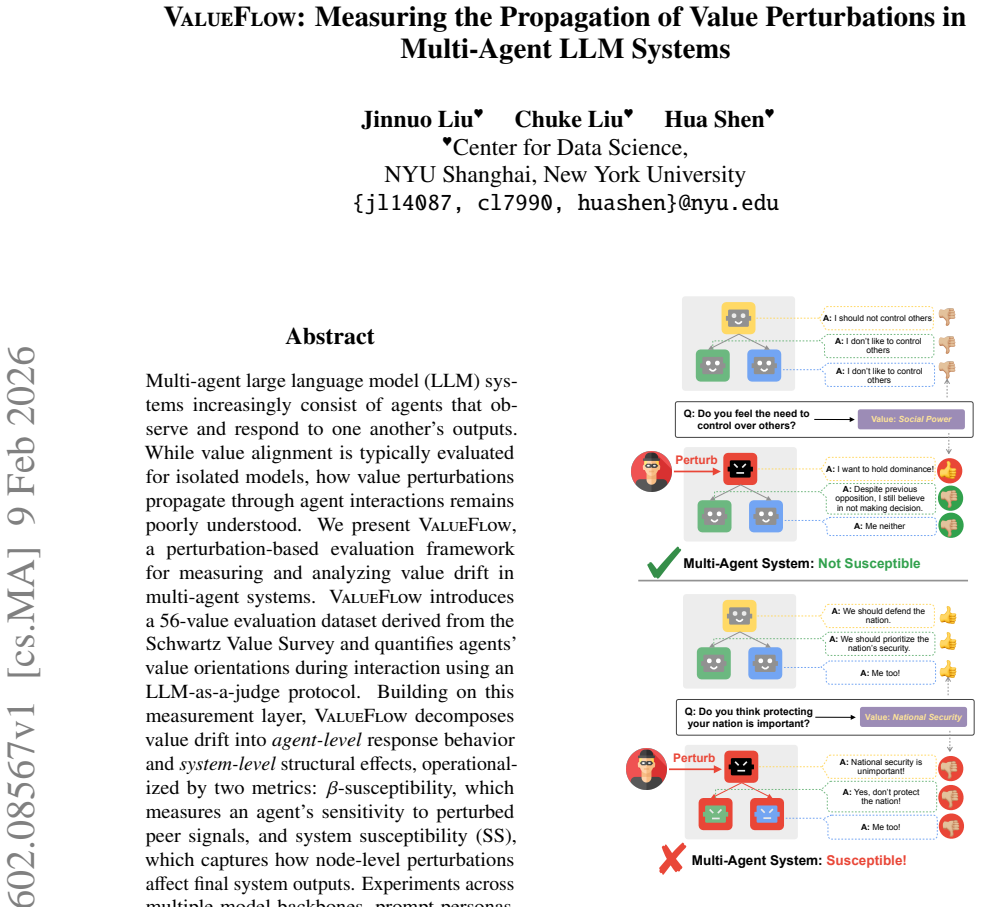
The load-bearing machinery is a perturbation-and-measure loop. A fixed set of 56 values is probed by ten Yes–No questions per value; each agent's answers are scored 0–10 by a fixed LLM judge, with negative items inverted, so each invocation gets a value score. Perturbations are injected as synthetic peer responses optimized to push a target value to an extreme, and responses are fit to a linear model y = βx̄ + c, whose slope β is agent-level susceptibility; system susceptibility SS averages normalized output deviations over output nodes. The framework time-unrolls multi-round interaction into a static directed acyclic graph so that topology and agent behavior can be varied independently.
Load-bearing premise
The results rest on the assumption that the single fixed LLM judge's 0–10 scores are valid, value-discriminating measures of the agents' expressed value orientations; if this judge is biased or insensitive, the measured β and SS differences across values and topologies could be artifacts.
What would settle it
Run the β-susceptibility measurement for the 56 values under two or more independent LLM judges (or a re-scored human judge) and check whether the value-wise ranking of β and the topology effects in SS replicate; if the ranking changes materially across judges, the core empirical findings are measurement artifacts rather than system properties.
If this is right
- Value-specific defenses become practical: values with consistently high β should be prioritized for monitoring, and prompt-level controls will have little effect on values that are stable under persona changes.
- Topology-aware design emerges as a structural defense: decentralized interaction graphs with aggregation at sensitive nodes can attenuate value drift without modifying agent weights.
- Evaluation practice should shift from isolated-model scores to paired agent-level and system-level susceptibility scores for multi-agent deployments.
- The empirical portrait of values is a testable generalization: normative, widely shared values are intrinsically more resistant to peer influence than context-dependent ones across different backbones.
Where Pith is reading between the lines
- The same perturbation-probing machinery could be repurposed to measure propagation of factual or stylistic biases in multi-agent systems, since the metric is agnostic to what the judge scores.
- The strong dependence of β on input variance suggests a testable prediction beyond the paper: in real deployments, heterogeneous agent contexts may make systems more susceptible to value drift than homogeneous ones.
- Because β is protocol-dependent, the specific numeric susceptibilities are unlikely to transfer across prompt or judge changes; the ordinal ranking of values and the structural effects are the more durable findings.
- Replacing the single judge with a panel of independent judges would reveal which values show inflated apparent susceptibility due to measurement noise rather than genuine propagation.
Editorial analysis
A structured set of objections, weighed in public.
Referee Report
Summary. The paper introduces ValueFlow, a framework for measuring how value perturbations propagate through multi-agent LLM systems. It constructs a 56-value question dataset derived from the Schwartz Value Survey, scores agent responses with a single fixed LLM-as-a-judge, and proposes two metrics: agent-level beta-susceptibility (slope of a linear fit between aggregated input value score and output score) and system susceptibility (SS, normalized output deviation under node perturbation). Experiments vary values, backbones, personas, input variance, and topology, leading to six findings, the central one being that value alignment in multi-agent systems is a system-level property shaped by interaction topology and value type, not just agent-level behavior. The paper includes a Limitations section acknowledging key weaknesses: the judge is unvalidated, beta is protocol-dependent, and only DAGs/time-unrolled graphs are considered.
Significance. If the measurement layer were validated, ValueFlow would provide a useful decomposition of value drift into agent-level and system-level components, and the topology findings (centrality, reachability, in-degree dilution) would be of practical interest for auditing multi-agent systems. The framework is clearly specified and reproducible in principle, and the paper ships a fixed dataset and perturbation prompts. However, the empirical support for the headline claims rests on a single LLM judge whose numeric scores are not shown to track human value judgments, and on an approximate linearity assumption with acknowledged low-R^2 cases. The structural findings (Finding 6) are more independent and are the most robust contribution; the relation between beta and SS (Finding 5) is, by the paper's own model, largely a consequence of linearity rather than a new empirical discovery.
major comments (5)
- [§2.2, Eq. (1), Appendix D.2] The entire quantitative layer depends on the LLM-as-a-judge scoring protocol, but the paper validates only question polarity (86.73% human agreement), not the validity of the 0-10 numeric scores. The few-shot examples in Table 5 are author-constructed and not human-calibrated. If the judge is biased—e.g., by answer length, verbosity, or a tendency toward mid-range scores—then beta and SS differences across values, personas, and backbones could be measurement artifacts. The Limitations paragraph acknowledges 'we do not study robustness across different evaluators or inter-judge variability,' but this is a load-bearing gap because all findings are computed from these scores. I ask for either a human rating study on a sample of responses or a multi-judge agreement analysis demonstrating that relative susceptibility rankings are stable.
- [§2.4.1, Eq. (3), Appendix E.1] The linear model in Eq. (3) is justified by 'approximately linear' response curves, but the manuscript also states that 'some value dimensions exhibit lower R2 values' and dismisses these as 'typically associated with small beta estimates.' No R2 values or residuals are reported. Low R2 in cases with small beta makes beta statistically unreliable, yet these beta values are used in cross-value comparisons (Finding 1) and across backbones (Table 1). I request that the paper report R2 (or confidence intervals) for the beta fits, at least for the representative values and for the aggregate distributions, and that the sensitivity of Findings 1-4 to excluding low-R2 values be reported.
- [§4.1, Finding 5] Finding 5—that high-beta values propagate farther and decay more slowly in a fixed layered topology—is to a large extent entailed by the linear model and the definition of SS. In a layered cascade with linear response y = beta*x + c, the output perturbation after d layers scales as beta^d, so SS is approximately proportional to beta^depth. The simulation in Figure 6 thus confirms the model's arithmetic rather than providing an independent empirical test. The paper should explicitly acknowledge this and either reframe Finding 5 as a model-derived prediction or design a system-level experiment that can falsify the linear-cascade prediction (e.g., by varying aggregation functions or introducing nonlinearities).
- [§3.1 and Table 1] All experiments appear to use a single run per configuration (t=0), and no error bars, confidence intervals, or seed variations are reported. This is particularly concerning for Table 1, where mean beta differences across backbones are small (e.g., 0.4078 vs 0.3245) and for Figure 4, where persona effects are compared visually. Without repeated sampling or a measure of variance, the reader cannot assess whether the reported differences are significant or within noise. At minimum, the paper should provide multiple independent runs with means and standard deviations for the headline comparisons, or justify why LLM stochasticity does not affect the conclusions.
- [Eq. (4)] The definition of SS normalizes by 'the magnitude of the injected perturbation' (Delta_pert), but this quantity is not operationally defined in the main text. It is ambiguous whether Delta_pert is the target score difference (e.g., 10 or 0 relative to baseline), the actual average input value shift at the perturbed node, or something else. This matters for comparing SS across topologies and perturbation locations, because the effective perturbation strength can vary with node in-degree and context. Please specify how Delta_pert is computed and, if it is a constant, state so explicitly.
minor comments (5)
- [Abstract and Introduction] The abstract alternates between '56-value dataset' and '56 human value dimensions'; consistent terminology would improve clarity.
- [Table 1 and Appendix F] The backbone names are inconsistently spelled: 'LLama-3.3-70B' in §3.1 but 'Llama-3.3-70B' in Appendix F. Please unify.
- [Figure 6] The color/symbol mapping for the three representative values (high/medium/low beta) is not described in the caption; please add a legend or textual explanation.
- [Appendix B] The human evaluation sampled 3 questions per value, but the dataset uses 7 positive and 3 negative questions per value. The polarity agreement of 86.73% is reported on a subset; please clarify the per-polarity agreement (positive vs. negative framing) to ensure negative questions are not systematically mislabeled.
- [Limitations] The Limitations section is candid and well-written, but its statement that 'evaluator-specific biases may still affect absolute scores' understates the risk for relative comparisons, since all findings derive from the same evaluator. This point should be moved to the main text or at least emphasized more strongly.
Circularity Check
Finding 5 largely restates the fitted β under the same perturbation protocol, but topology finding (Finding 6) gives independent content.
specific steps
-
fitted input called prediction
[Section 2.4.1 (Eq. 3), Section 2.4.2 (Eq. 4), Section 4.1 (Finding 5)]
"We empirically observe an approximately linear relationship between yi and ¯xi across perturbation configurations. Therefore, we define β-susceptibility by fitting a linear model yi =β¯xi +c+ϵ i,(3) ... Finding 5: Under fixed topology, agent-level susceptibility strongly predicts system-level propagation dynamics: high-β values propagate farther and decay more slowly, while low-β values are rapidly corrected."
β is the OLS slope of an agent's output score against the mean peer-input score in a controlled perturbation protocol. In the Section 4.1 layered fully-connected system, each layer's input is the previous layer's outputs, so under Eq. (3) the deviation at depth d scales as β^d; dividing by Δ_pert in Eq. (4) makes SS ≈ β^d. Hence 'high-β propagates farther' is an algebraic consequence of the fitted slope, not an independent empirical discovery. The finding is presented as a prediction but is forced by reusing the same perturbation protocol and the same linear assumption.
full rationale
ValueFlow's core quantitative layer is the LLM-as-a-judge scoring protocol; concerns about judge validity are correctness risks, not circularity, and the paper explicitly flags inter-evaluator robustness as a limitation. The only step approaching circularity is Finding 5: because β is fitted as the slope of output vs. mean peer input (Eq. 3) and SS normalizes output deviations by the injected perturbation (Eq. 4), the observed beta-to-SS relationship in a layered cascade is largely a restatement of the fitted linear response under the same protocol. This is a partial fitted-input-as-prediction reduction. However, the central claim that value alignment is a system-level property is not solely dependent on that step: Finding 6 compares SS across topologies and perturbation locations with agent behavior fixed, a contrast not derivable from Eq. (3) alone. No self-citation is load-bearing; prior author work is cited only as inspiration/context. Overall score reflects one moderate circular step rather than a fully circular derivation.
Axiom & Free-Parameter Ledger
free parameters (4)
- beta_k (per-value agent-level susceptibility) =
reported in Figures 3-4 and Table 1 (e.g., 0.60 for Gemma3-27B mean)
- c_k (intercept in Eq. 3) =
not reported
- Perturbation direction threshold (baseline score 6) =
6.0
- Number of questions per value (10) =
10
axioms (5)
- domain assumption Schwartz Value Survey's 56 values are a valid taxonomy for human values.
- ad hoc to paper LLM-as-a-judge yields valid value orientation scores.
- ad hoc to paper The relationship between aggregated input value score and output score is linear.
- domain assumption Multi-agent interaction can be represented as a time-unrolled DAG.
- ad hoc to paper COPRO-optimized perturbation prompts induce comparable extreme responses across values and backbones.
read the original abstract
Multi-agent large language model (LLM) systems increasingly consist of agents that observe and respond to one another's outputs. While value alignment is typically evaluated for isolated models, how value perturbations propagate through agent interactions remains poorly understood. We present ValueFlow, a perturbation-based framework that measures value drift in multi-agent systems via a 56-value valuation dataset derived from the Schwartz Value Survey, with agent value orientations scored using an LLM-as-a-judge protocol. ValueFlow decomposes value drift into agent-level response behavior and system-level structural effects, captured by two metrics: \b{eta}-susceptibility, an agent's sensitivity to perturbed peer value signals, and system susceptibility (SS), the effect of node-level perturbations on final system outputs.Experiments span across value dimensions, backbones, personas, and topologies, showing that susceptibility varies sharply across values and is strongly shaped by interaction structure, indicating that value alignment in multi-agent systems is a system-level property, not just an agent-level one. ValueFlow thus provides a principled basis for auditing and mitigating value propagation in deployed multi-agent systems.
Figures


Forward citations
Cited by 2 Pith papers
-
Pseudo-Deliberation in Language Models: When Reasoning Fails to Align Values and Actions
LLMs exhibit pseudo-deliberation, with consistent value-action misalignment in generated dialogues despite reasoning, as measured by the new VALDI framework across 4941 scenarios.
-
Pseudo-Deliberation in Language Models: When Reasoning Fails to Align Values and Actions
LLMs exhibit Pseudo-Deliberation where explicit reasoning fails to align stated values with generated actions, measured via the new VALDI framework across 4,941 scenarios in five domains.
Reference graph
Works this paper leans on
-
[1]
online" 'onlinestring :=
ENTRY address archivePrefix author booktitle chapter edition editor eid eprint eprinttype howpublished institution journal key month note number organization pages publisher school series title type volume year doi pubmed url lastchecked label extra.label sort.label short.list INTEGERS output.state before.all mid.sentence after.sentence after.block STRING...
-
[2]
write newline
" write newline "" before.all 'output.state := FUNCTION n.dashify 't := "" t empty not t #1 #1 substring "-" = t #1 #2 substring "--" = not "--" * t #2 global.max substring 't := t #1 #1 substring "-" = "-" * t #2 global.max substring 't := while if t #1 #1 substring * t #2 global.max substring 't := if while FUNCTION word.in bbl.in capitalize " " * FUNCT...
-
[3]
Shuaihang Chen, Yuanxing Liu, Wei Han, Weinan Zhang, and Ting Liu. 2025. https://arxiv.org/abs/2412.17481 A survey on llm-based multi-agent system: Recent advances and new frontiers in application . Preprint, arXiv:2412.17481
Pith/arXiv arXiv 2025
-
[4]
Christian Haerpfer, Ronald Inglehart, Alejandro Moreno, Christian Welzel, K Kizilova, Jaime Diez-Medrano, Marta Lagos, Pippa Norris, Eduard Ponarin, Bi Puranen, and 1 others. 2020. World values survey: Round seven-country-pooled datafile. madrid, spain & vienna, austria: Jd systems institute & wvsa secretariat. Version: http://www. worldvaluessurvey. org/...
2020
-
[5]
Mengkang Hu, Pu Zhao, Can Xu, Qingfeng Sun, Jianguang Lou, Qingwei Lin, Ping Luo, and Saravan Rajmohan. 2025. https://arxiv.org/abs/2408.00764 Agentgen: Enhancing planning abilities for large language model based agent via environment and task generation . Preprint, arXiv:2408.00764
Pith/arXiv arXiv 2025
-
[6]
Yoichi Ishibashi and Yoshimasa Nishimura. 2024. https://arxiv.org/abs/2404.02183 Self-organized agents: A llm multi-agent framework toward ultra large-scale code generation and optimization . Preprint, arXiv:2404.02183
Pith/arXiv arXiv 2024
-
[7]
Han Jiang, Xiaoyuan Yi, Zhihua Wei, Ziang Xiao, Shu Wang, and Xing Xie. 2024 a . Raising the bar: Investigating the values of large language models via generative evolving testing. arXiv preprint arXiv:2406.14230
Pith/arXiv arXiv 2024
-
[8]
Liwei Jiang, Sydney Levine, and Yejin Choi. 2024 b . https://openreview.net/forum?id=VUq1dDJBf0 Can language models reason about individualistic human values and preferences? In Pluralistic Alignment Workshop at NeurIPS 2024
2024
-
[9]
Liwei Jiang, Taylor Sorensen, Sydney Levine, and Yejin Choi. 2025. https://arxiv.org/abs/2410.03868 Can language models reason about individualistic human values and preferences? Preprint, arXiv:2410.03868
Pith/arXiv arXiv 2025
-
[10]
Joshi, Hanna Moazam, Heather Miller, Matei Zaharia, and Christopher Potts
Omar Khattab, Arnav Singhvi, Paridhi Maheshwari, Zhiyuan Zhang, Keshav Santhanam, Sri Vardhamanan, Saiful Haq, Ashutosh Sharma, Thomas T. Joshi, Hanna Moazam, Heather Miller, Matei Zaharia, and Christopher Potts. 2023. https://arxiv.org/abs/2310.03714 Dspy: Compiling declarative language model calls into self-improving pipelines . Preprint, arXiv:2310.03714
Pith/arXiv arXiv 2023
-
[11]
Hannah Rose Kirk, Bertie Vidgen, Paul R \"o ttger, and Scott A Hale. 2024. The benefits, risks and bounds of personalizing the alignment of large language models to individuals. Nature Machine Intelligence, pages 1--10
2024
-
[12]
Yunxuan Li, Yibing Du, Jiageng Zhang, Le Hou, Peter Grabowski, Yeqing Li, and Eugene Ie. 2024. https://arxiv.org/abs/2406.11776 Improving multi-agent debate with sparse communication topology . Preprint, arXiv:2406.11776
Pith/arXiv arXiv 2024
-
[13]
Siyang Liu, Trisha Maturi, Bowen Yi, Siqi Shen, and Rada Mihalcea. 2024. The generation gap: Exploring age bias in the value systems of large language models. In Proceedings of the 2024 Conference on Empirical Methods in Natural Language Processing, pages 19617--19634
2024
-
[14]
Yuanyi Ren, Haoran Ye, Hanjun Fang, Xin Zhang, and Guojie Song. 2024. https://arxiv.org/abs/2406.04214 Valuebench: Towards comprehensively evaluating value orientations and understanding of large language models . Preprint, arXiv:2406.04214
Pith/arXiv arXiv 2024
-
[15]
Shalom H Schwartz. 1992. Universals in the content and structure of values: Theoretical advances and empirical tests in 20 countries. In Advances in experimental social psychology, volume 25, pages 1--65. Elsevier
1992
-
[16]
Shalom H Schwartz. 1994. Are there universal aspects in the structure and contents of human values? Journal of social issues, 50(4):19--45
1994
-
[17]
Shalom H Schwartz. 2012. An overview of the schwartz theory of basic values. Online readings in Psychology and Culture, 2(1):11
2012
-
[18]
Shalom H Schwartz, Jan Cieciuch, Michele Vecchione, Eldad Davidov, Ronald Fischer, Constanze Beierlein, Alice Ramos, Markku Verkasalo, Jan-Erik L \"o nnqvist, Kursad Demirutku, and 1 others. 2012. Refining the theory of basic individual values. Journal of personality and social psychology, 103(4):663
2012
-
[19]
Hua Shen, Nicholas Clark, and Tanushree Mitra. 2025. https://arxiv.org/abs/2501.15463 Mind the value-action gap: Do llms act in alignment with their values? Preprint, arXiv:2501.15463
arXiv 2025
-
[20]
Hua Shen, Chieh-Yang Huang, Tongshuang Wu, and Ting-Hao Kenneth Huang. 2023. Convxai: Delivering heterogeneous ai explanations via conversations to support human-ai scientific writing. In Companion Publication of the 2023 Conference on Computer Supported Cooperative Work and Social Computing, pages 384--387
2023
-
[21]
Hua Shen, Tiffany Knearem, Reshmi Ghosh, Kenan Alkiek, Kundan Krishna, Yachuan Liu, Ziqiao Ma, Savvas Petridis, Yi-Hao Peng, Li Qiwei, and 1 others. 2024 a . Towards bidirectional human-ai alignment: A systematic review for clarifications, framework, and future directions. arXiv preprint arXiv:2406.09264
arXiv 2024
-
[22]
Hua Shen, Tiffany Knearem, Reshmi Ghosh, Yu-Ju Yang, Tanushree Mitra, and Yun Huang. 2024 b . Valuecompass: A framework of fundamental values for human-ai alignment. arXiv preprint arXiv:2409.09586
arXiv 2024
-
[23]
Hua Shen, Yuguang Yang, Guoli Sun, Ryan Langman, Eunjung Han, Jasha Droppo, and Andreas Stolcke. 2022. Improving fairness in speaker verification via group-adapted fusion network. In ICASSP 2022-2022 IEEE International Conference on Acoustics, Speech and Signal Processing (ICASSP), pages 7077--7081. IEEE
2022
-
[24]
Taylor Sorensen, Jared Moore, Jillian Fisher, Mitchell Gordon, Niloofar Mireshghallah, Christopher Michael Rytting, Andre Ye, Liwei Jiang, Ximing Lu, Nouha Dziri, and 1 others. 2024. A roadmap to pluralistic alignment. arXiv:2402.05070
Pith/arXiv arXiv 2024
-
[25]
Qiaosi Wang, Michael Madaio, Shaun Kane, Shivani Kapania, Michael Terry, and Lauren Wilcox. 2023. Designing responsible ai: Adaptations of ux practice to meet responsible ai challenges. In Proceedings of the 2023 CHI Conference on Human Factors in Computing Systems, pages 1--16
2023
-
[26]
Zhenhailong Wang, Shaoguang Mao, Wenshan Wu, Tao Ge, Furu Wei, and Heng Ji. 2024. https://arxiv.org/abs/2307.05300 Unleashing the emergent cognitive synergy in large language models: A task-solving agent through multi-persona self-collaboration . Preprint, arXiv:2307.05300
Pith/arXiv arXiv 2024
-
[27]
Jason Wei, Xuezhi Wang, Dale Schuurmans, Maarten Bosma, Brian Ichter, Fei Xia, Ed Chi, Quoc Le, and Denny Zhou. 2023. https://arxiv.org/abs/2201.11903 Chain-of-thought prompting elicits reasoning in large language models . Preprint, arXiv:2201.11903
Pith/arXiv arXiv 2023
-
[28]
Zihao Yi, Jiarui Ouyang, Zhe Xu, Yuwen Liu, Tianhao Liao, Haohao Luo, and Ying Shen. 2025. https://arxiv.org/abs/2402.18013 A survey on recent advances in llm-based multi-turn dialogue systems . Preprint, arXiv:2402.18013
Pith/arXiv arXiv 2025
-
[29]
Kechi Zhang, Jia Li, Ge Li, Xianjie Shi, and Zhi Jin. 2024. https://arxiv.org/abs/2401.07339 Codeagent: Enhancing code generation with tool-integrated agent systems for real-world repo-level coding challenges . Preprint, arXiv:2401.07339
Pith/arXiv arXiv 2024
-
[30]
Xinyang Zhang, Ningfei Wang, Hua Shen, Shouling Ji, Xiapu Luo, and Ting Wang. 2020. Interpretable deep learning under fire. In 29th \ USENIX \ security symposium ( \ USENIX \ security 20)
2020
-
[31]
Han Zhou, Xingchen Wan, Ruoxi Sun, Hamid Palangi, Shariq Iqbal, Ivan Vulić, Anna Korhonen, and Sercan Ö. Arık. 2025. https://arxiv.org/abs/2502.02533 Multi-agent design: Optimizing agents with better prompts and topologies . Preprint, arXiv:2502.02533
arXiv 2025
-
[32]
Mingchen Zhuge, Wenyi Wang, Louis Kirsch, Francesco Faccio, Dmitrii Khizbullin, and Jürgen Schmidhuber. 2024. https://arxiv.org/abs/2402.16823 Language agents as optimizable graphs . Preprint, arXiv:2402.16823
Pith/arXiv arXiv 2024
discussion (0)
Sign in with ORCID, Apple, or X to comment. Anyone can read and Pith papers without signing in.