REVIEW 4 major objections 6 minor 53 references
How College Students Use AI to Navigate Course Readings: Evidence from an Eight-Week Study
T0 review · 4 major / 6 minor · reviewed 2026-08-03 · deepseek-v4-flash
Pith's one-line read This paper claims that college students, when using AI chatbots for course reading, primarily outsource comprehension rather than engage deeply: 59.6% of prompts were comprehension-focused, 30.3% were simple summary requests, and 72% of ses
desk verdict A genuine longitudinal look at how students actually prompt AI for course readings, with an honest limitations section, but the 'outsourcing comprehension' headline overstates what prompt data can establish. read the letter →
The pith
A machine-rendered reading of the paper's core claim, the machinery that carries it, and where it could break.
The reading
What carries the argument
The central mechanism is a coding schema that maps each prompt to one of four cognitive themes—Decoding, Comprehension, Reasoning, Metacognition—grounded in reading-comprehension and metacognition literature. This schema turns student prompts into trace data of cognitive engagement. The key technical move is analyzing how theme distributions shift across prompt positions (first, second, third, fourth+), which reveals the truncated progression: the first prompt is overwhelmingly comprehension-focused, but by the third prompt reasoning overtakes comprehension, only for the session to end.
What would settle it
Conduct a controlled study where students read a new passage with AI assistance and then take a comprehension test that measures both explicit recall and inferential understanding, comparing students who used AI summaries with a control group who read the original text. If the AI-summary group performs as well or better than the original-text group on inference questions, the central claim that reading through AI truncates cognitive engagement would be challenged.
Extended reading notes
Core claim
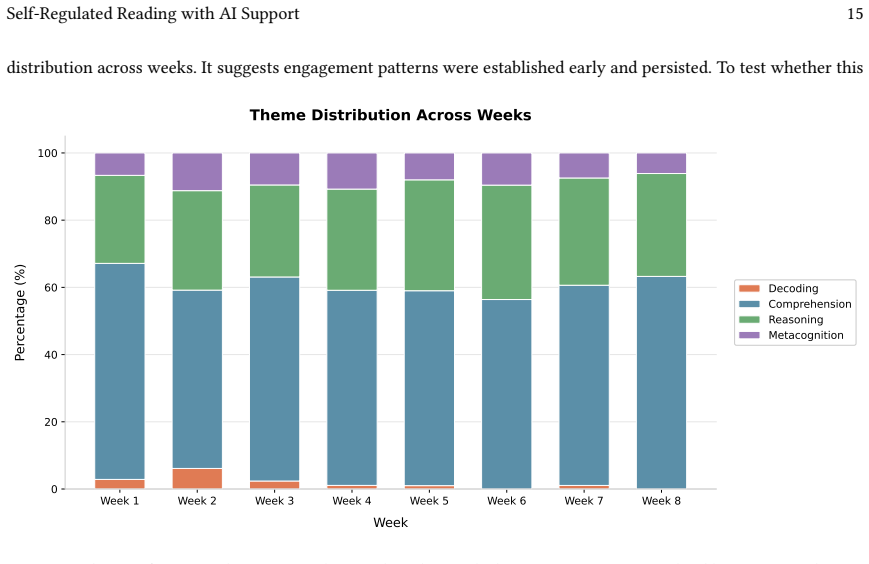
Across 239 reading sessions, students predominantly used AI to externalize comprehension: 59.6% of coded prompts fell under Comprehension, with Summary alone at 30.3%, while Reasoning (29.8%), Metacognition (8.5%), and Decoding (2.1%) were far less frequent. Within a session, students showed a natural progression from comprehension toward reasoning, but 72% of sessions ended at the required three prompts, cutting the progression short. Across the eight weeks, engagement patterns remained stable, and individual differences in prompting style persisted. Students recognized that effective prompting required effort but rarely applied it, revealing an intention-behavior gap; they strategically tr
Load-bearing premise
The study assumes that the text of a student's prompt is a valid externalized trace of their cognitive engagement—that a summary request indicates comprehension-level thinking and an inference request indicates reasoning—but the paper itself concedes that prompts do not fully capture internal cognitive processes, and if prompts are just task-completion requests or crafted to satisfy the assignment, the entire theme distribution and the 'truncated progression' interpretation d
Editorial extensions
If this is right
- If students are reading through AI rather than with it, AI reading tools should be designed to scaffold sustained cognitive progression—guiding users from comprehension into reasoning and reflection—rather than passively responding.
- Because 72% of sessions stopped at the required three prompts, the assignment minimum functioned as a ceiling: requiring more conversational turns may prolong engagement, though this needs to be tested.
- Instruction in prompt engineering did not shift behavior across eight weeks, implying that knowledge alone is insufficient; interventions must target structural and motivational factors.
- The 'illusion of coverage'—students believing they have read a text after reading their query-filtered version—suggests a need for system features that surface unexplored content and prompt metacognitive awareness.
- The findings imply that general-purpose chatbots, by optimizing for immediate task completion, may inadvertently encourage shallow reading unless specifically adapted for learning contexts.
Reading between the lines
- The observed pattern could be partly an artifact of the assignment design: requiring a minimum of three prompts may signal to students that three is the expected amount, so the 'truncation' may reflect task framing rather than an intrinsic property of AI interaction.
- If the coding schema treats prompt phrasing as a direct proxy for cognitive process, it may overestimate shallow engagement; students could be doing significant thinking before or after a prompt that the log does not capture.
- A testable extension: raising the minimum to five or six prompts, or having the AI proactively pose a follow-up reasoning question after a summary, may restore the progression the paper shows is truncated.
- The 'reading through AI' pattern may generalize beyond reading to other task domains (e.g., writing, problem-solving), suggesting that triage via AI output is a broader epistemic habit that could be studied in other academic contexts.
Editorial analysis
A structured set of objections, weighed in public.
Referee Report
Summary. This paper reports an eight-week longitudinal study of 15 undergraduates using AI chatbots to support course readings. The authors collected 838 prompts across 239 reading sessions, developed a four-theme coding scheme (Decoding, Comprehension, Reasoning, Metacognition), and report that Comprehension prompts dominate (59.6%), that 72% of sessions contain exactly the required minimum of three prompts, and that within-session theme distributions shift from comprehension toward reasoning before terminating. Qualitative interviews and optional reflections are used to argue for an intention-behavior gap, efficiency-driven triage, and a pattern the authors call 'reading through AI rather than with it.' The paper concludes with design implications for AI reading systems intended to scaffold deeper engagement.
Significance. If the central interpretive claims are accepted, this is a valuable naturalistic contribution to the HCI literature on AI-mediated reading. The dataset is non-trivial, the coding process reports good inter-rater reliability (Cohen's κ = .824), and the coding schema is explicitly grounded in existing reading-comprehension and self-regulated-learning frameworks. The longitudinal design and the combination of prompt logs with reflections/interviews are strengths, and the paper gives concrete, falsifiable descriptive findings (e.g., prompt-position distributions, stability across weeks, ICC estimates of individual differences). However, the headline inference that students 'outsource comprehension' depends on treating prompt categories as direct measures of cognitive engagement, an assumption the paper itself concedes is incomplete. Because the quantitative results are consistently interpreted in cognitive terms, the contribution is currently stronger as a description of prompting behavior than as evidence about students' internal reading processes.
major comments (4)
- [§2.2, §6.1, §6.4] The central claim that students 'primarily used AI to outsource comprehension' depends on equating the coded theme of a prompt with the cognitive process the student actually performed. §2.2 positions prompts as 'externalized trace data of questioning, monitoring, and help-seeking,' but §6.4 concedes prompts 'do not fully capture students' internal cognitive processes.' The problem is not just incompleteness: a Summary prompt (30.3% of all prompts) is compatible with a student who read closely and wants verification, a student who skimmed and wants a check, and a student who has not read and wants to avoid reading. The aggregate distribution cannot distinguish these. The qualitative reflections and interviews provide some support for the avoidance interpretation, but they are not systematically linked to specific prompts or sessions. I recommend reframing the quantitative claims as evide
- [§3.4] The post hoc exclusion of three participants for 'consistently demonstrated minimal engagement' is concerning because the paper's core finding is about minimal engagement. The operationalization ('generic very short prompts' or 'templated copy-and-paste prompts identical across sessions') is not quantified, and no robustness analysis is reported. If the excluded participants are the clearest cases of outsourcing, removing them may attenuate the very phenomenon the paper claims to characterize. Please report the number of sessions/prompts excluded, the exact threshold used, and key distributions (theme proportions, sessions at exactly three prompts) with and without the excluded participants, or justify why their exclusion cannot affect the conclusions.
- [§4.3, Table 5] The 'truncated progression' interpretation is underdetermined by the data. Because 72% of sessions contain exactly the required minimum of three prompts and the analysis collapses across all sessions, the position-based shift from Comprehension at position 1 to Reasoning at position 3 may reflect the assignment's minimum-turn structure rather than a natural cognitive trajectory. A third prompt could be produced simply to satisfy the requirement, or as a follow-up to a requested summary, without indicating that the student had 'progressed' to reasoning. The regression to Comprehension at 4th+ positions is also interpreted as 'concluding with key takeaways,' which is consistent with task closure rather than cognitive regression. To support the progression claim, the authors should report position-based distributions separately for sessions with exactly three prompts and sessions with more
- [§6.1, §6.4] The Discussion makes strong claims about learning costs—'they bypass the productive struggle of meaning-making,' 'cost to epistemic breadth,' 'durable understanding'—even though §6.4 states that the study did not measure comprehension outcomes and the course graded logs credit/no-credit. The absence of an outcome measure means these statements are speculative. I would either soften the language to describe potential risks (as the qualitative data support) or explicitly mark these as hypotheses for future work. This is a load-bearing issue because the paper's design implications are motivated by the assumption that the observed prompting patterns harm learning.
minor comments (6)
- [§4.1] The text says 'eleven codes' but Table 4 lists ten codes (including Unknown). Also, Figure 2 labels one code 'Explaining' while the text and Table 4 use 'Explanation.'
- [§4.1.1] The text reports the top three codes account for 75.3% of all prompts, while Figure 2 caption says 75.4%. Please reconcile.
- [§4.2.1 vs §4.5] Prompt length is reported as M=16.1, SD=11.9 at the prompt level in §4.2.1, but §4.5 reports M=16.1, SD=7.9 after discussing participant means. The latter appears to be the between-participant SD; please label which level the SD refers to.
- [§6.4] Typo: 'resutls' should be 'results.'
- [Table 5] The table would be easier to interpret with the number of prompts (n) at each position, especially for the 4th+ category, which includes sessions of varying length.
- [§3.6.2] The paper reports five interviews but treats them together with 109 reflections. It would help to distinguish which qualitative themes emerged primarily from interviews versus session reflections, given the small interview sample.
Circularity Check
No circularity: empirical coding study with no fitted parameters, no self-citation chain, and acknowledged validity limitation that is not a derivation.
full rationale
The paper is an empirical observational study, not a derivation. There are no fitted parameters, no equations, and no prediction is constructed from its own inputs. The central quantitative claims (59.6% Comprehension, 30.3% Summary, 72% of sessions at the three-prompt minimum) are descriptive statistics of coded prompts, not outputs of a model derived from those same statistics. The coding schema is explicitly grounded in external frameworks (Bloom's taxonomy, Barrett's taxonomy, Constructive Responsive Reading strategies, metacognition literature), and inter-rater reliability was computed (Cohen's kappa = 0.824), providing independent support for the coding procedure. The data-driven step in codebook development is a standard inductive method; it raises generalizability concerns but does not make the reported distribution true by construction. The paper's interpretive leap from 'Comprehension prompts dominated' to 'students outsource comprehension' is a validity inference, and the authors themselves flag the key limitation in §6.4: prompts 'do not fully capture students' internal cognitive processes.' Underdetermination of cognition from behavior is an acknowledged weakness, not a circular step. There are no load-bearing self-citations: the cited prompt-coding works ([30], [31], [37]) are by other research groups and are used as related method references, not to justify the present results. The only self-referential feature—the course instructor being an author—is addressed with positionality and post-grade interviews, and it does not create a derivation loop. Overall, the derivation chain is self-contained for the claims actually made, and the validity limitation is explicitly disclosed rather than hidden.
Assumptions & free parameters
assumptions (4)
- domain assumption Prompts submitted to AI are valid externalized traces of students' cognitive engagement (questioning, monitoring, help-seeking).
- domain assumption The four cognitive themes and ten codes map monotonically to cognitive depth (Decoding < Comprehension < Reasoning < Metacognition).
- domain assumption Self-reports in interviews and optional reflections reflect genuine motivations rather than social desirability.
- domain assumption No group-level change across weeks indicates stable engagement habits rather than measurement insensitivity.
Cite this review
Pith. "Pith review of How College Students Use AI to Navigate Course Readings: Evidence from an Eight-Week Study." pith.science (2026). https://pith.science/paper/VH2PHCZ6
@misc{pith2026260209907,
  author       = {Pith},
  title        = {Pith review of: How College Students Use AI to Navigate Course Readings: Evidence from an Eight-Week Study},
  year         = {2026},
  howpublished = {\url{https://pith.science/paper/VH2PHCZ6}},
  note         = {Machine review of arXiv:2602.09907}
}
read the original abstract
College students increasingly use AI chatbots to support academic reading, yet we lack granular understanding of how these interactions shape their reading experience and cognitive engagement. We conducted an eight-week longitudinal study with 15 undergraduates who used AI to support assigned readings in a course. We collected 838 prompts across 239 reading sessions and developed a coding schema categorizing prompts into four cognitive themes: Decoding, Comprehension, Reasoning, and Metacognition. Comprehension prompts dominated (59.6%), with Reasoning (29.8%), Metacognition (8.5%), and Decoding (2.1%) less frequent. Most sessions (72%) contained exactly three prompts, the required minimum of the reading assignment. Within sessions, students showed natural cognitive progression from comprehension toward reasoning, but this progression was truncated. Across eight weeks, students' engagement patterns remained stable, with substantial individual differences persisting throughout. Qualitative analysis revealed an intention-behavior gap: students recognized that effective prompting required effort but rarely applied this knowledge, with efficiency emerging as the primary driver. Students also strategically triaged their engagement based on interest and academic pressures, exhibiting a novel pattern of reading through AI rather than with it: using AI-generated summaries as primary material to filter which sections merited deeper attention. We discuss design implications for AI reading systems that scaffold sustained cognitive engagement.
Figures


Figures from the paper (5 more)



Reference graph
Works this paper leans on
-
[1]
Nancy E Adams. 2015. Bloom’s taxonomy of cognitive learning objectives.Journal of the Medical Library Association: JMLA103, 3 (2015), 152
2015
-
[2]
OE Ademola. 2024. Reading strategies in the AI age: Enhancing comprehension and engagement with advanced technologies. InProceedings of the 38th iSTEAMS Multidisciplinary Bespoke Conference
2024
-
[3]
Rudaiba Adnin, Atharva Pandkar, Bingsheng Yao, Dakuo Wang, and Maitraye Das. 2025. Examining Student and Teacher Perspectives on Undisclosed Use of Generative AI in Academic Work. InProceedings of the 2025 CHI Conference on Human Factors in Computing Systems (CHI ’25). Article 1071, 17 pages. doi:10.1145/3706598.3713393
arXiv 2025
-
[4]
Peter Afflerbach and Byeong-Young Cho. 2009. Identifying and describing constructively responsive comprehension strategies in new and traditional forms of reading.Handbook of research on reading comprehension4 (2009), 69–90
2009
-
[5]
Peter Afflerbach, P David Pearson, and Scott G Paris. 2008. Clarifying differences between reading skills and reading strategies.The reading teacher 61, 5 (2008), 364–373
2008
-
[6]
Thomas C Barrett. 1968. The Barrett taxonomy: cognitive and affective dimensions of reading comprehension.HM Robinson, Innovation and change in reading instruction(1968), 1–30
1968
-
[7]
Lotta Bergman. 2024. Students’ reading in higher education: Challenges and ways forward.Journal of Adolescent & Adult Literacy67, 6 (2024), 414–423
2024
-
[8]
1956.Taxonomy of educational objectives: The classification of educational goals
Benjamin S Bloom, Max D Engelhart, Edward J Furst, Walker H Hill, David R Krathwohl, et al . 1956.Taxonomy of educational objectives: The classification of educational goals. Handbook 1: Cognitive domain. Longman New York
1956
Show all 53 references
-
[9]
Ivar Bråten and Helge I Strømsø. 2003. A longitudinal think-aloud study of spontaneous strategic processing during the reading of multiple expository texts.Reading and Writing16, 3 (2003), 195–218
2003
-
[10]
Virginia Braun and Victoria Clarke. 2019. Reflecting on reflexive thematic analysis.Qualitative research in sport, exercise and health11, 4 (2019), 589–597
2019
-
[11]
2021.Thematic analysis: A practical guide
Virginia Braun and Victoria Clarke. 2021.Thematic analysis: A practical guide. SAGE publications Ltd
2021
-
[12]
R Yeni Dewi Cahyani, Octavia Chandra Dewi, and Adam Darmawan. 2023. AI and critical skill among university students (The impact of artificial intelligence (AI) on Al-Ghifari University Students’ critical reading skills).The GIST6, 1 (2023)
2023
-
[13]
Xiang “Anthony” Chen, Chien-Sheng Wu, Lidiya Murakhovs’ka, Philippe Laban, Tong Niu, Wenhao Liu, and Caiming Xiong. 2023. Marvista: Exploring the Design of a Human-AI Collaborative News Reading Tool.ACM Trans. Comput.-Hum. Interact.30, 6, Article 92 (Sept. 2023), 27 pages. doi...
2023 doi
-
[14]
Theodore Clymer. 1968. What is “reading”?: Some current concepts.Teachers College Record69, 10 (1968), 7–29
1968
-
[15]
Thomas Corbin, Yifei Liang, Margaret Bearman, Tim Fawns, Gene Flenady, Paul Formosa, Lucinda McKnight, Jack Reynolds, and Jack Walton. 2024. Reading at university in the time of GenAI.Learning Letters3 (2024), 35–35
2024
-
[16]
GovTech Data Science & AI Division. 2023. PROMPT ENGINEERING PLAYBOOK (Beta v3) Produced By GovTech Data Science & AI Division. https: //www.developer.tech.gov.sg/products/collections/data-science-and-artificial-intelligence/playbooks/prompt-engineering-playbook-beta-v3.pdf
2023
-
[17]
Nash, Viktoria Jakcsiova, and Ellen Turner
Lewis Doyle, Robert A. Nash, Viktoria Jakcsiova, and Ellen Turner. 2025. ‘They want You to Read Their Work’: Teachers’ and Students’ Perspectives on the Use of AI for School Feedback.Technology, Knowledge and Learning30, 4 (2025), 1917–1941. doi:10.1007/s10758-025-09903-0
2025 doi
-
[18]
Hudson Etkin, Kai Etkin, Ryan Carter, and Camarin Rolle. 2024. Differential effects of GPT-based tools on comprehension of standardized passages. Research Square(2024)
2024
-
[19]
Fatma Kayan Fadlelmula and Meric Ozgeldi. 2010. How a Learner Self-Regulates Reading Comprehension: A Case Study for Graduate Level Reading. Online Submission7, 10 (2010), 22–28
2010
-
[20]
Pam Hollander, Duke Dawson, Charlotte Haller, Erika Briesacher, Caroline Collins, Kristina Rearick, and Elise Lemieux. 2022. The importance of college reading: Professors’ and students’ views.Journal of Effective Teaching in Higher Education5, 1 (2022), 90–109
2022
-
[21]
Jodi Patrick Holschuh. 2019. College reading and studying: The complexity of academic literacy task demands.Journal of Adolescent & Adult Literacy62, 6 (2019), 599–604
2019
-
[22]
Jodi Patrick Holschuh and Jodi P Lampi. 2018. Comprehension. InHandbook of college reading and study strategy research. Routledge, 118–142
2018
-
[23]
Jingjing Hu and Xuesong Andy Gao. 2017. Using think-aloud protocol in self-regulated reading research.Educational Research Review22 (2017), 181–193
2017
-
[24]
Walter Kintsch. 1988. The role of knowledge in discourse comprehension: a construction-integration model.Psychological review95, 2 (1988), 163
1988
-
[25]
van Dijk
Walter Kintsch and Teun A. van Dijk. 1978. Toward a model of text comprehension and production.Psychological Review85 (1978), 363–394. https://api.semanticscholar.org/CorpusID:1825457
1978
-
[26]
1989.The making of an adult educator: An autobiographical journey.Jossey-Bass
Malcolm S Knowles. 1989.The making of an adult educator: An autobiographical journey.Jossey-Bass
1989
-
[27]
2019.How Do I Read? What Colleges Can Learn about Supporting the Transition to College Reading from First-Year Students’ Self Reported Reading Lives
Bridget A Lepore. 2019.How Do I Read? What Colleges Can Learn about Supporting the Transition to College Reading from First-Year Students’ Self Reported Reading Lives. Ph. D. Dissertation. Rutgers The State University of New Jersey, School of Graduate Studies. Self-Regulated R...
2019
-
[28]
Indika Liyanage and Brendan John Bartlett. 2012. Gender and language learning strategies: Looking beyond the categories.The Language Learning Journal40, 2 (2012), 237–253
2012
-
[29]
Kyle Lo, Joseph Chee Chang, Andrew Head, Jonathan Bragg, Amy X. Zhang, Cassidy Trier, Chloe Anastasiades, Tal August, Russell Authur, Danielle Bragg, Erin Bransom, Isabel Cachola, Stefan Candra, Yoganand Chandrasekhar, Yen-Sung Chen, Evie Yu-Yen Cheng, Yvonne Chou, Doug Downey...
2023 arXiv
-
[30]
Boxuan Ma, Huiyong Li, Gen Li, Li Chen, Cheng Tang, Yinjie Xie, Chenghao Gu, Atsushi Shimada, and Shin’ichi Konomi. 2025. Scaffolding Metacognition in Programming Education: Understanding Student-AI Interactions and Design Implications.arXiv preprint arXiv:2511.04144(2025)
2025
-
[31]
Hunter McNichols, Fareya Ikram, and Andrew Lan. 2025. The studychat dataset: Student dialogues with chatgpt in an artificial intelligence course. arXiv preprint arXiv:2503.07928(2025)
2025
-
[32]
Sherrie L Nist and Michele Simpson. 2002. College studying.Reading Online5, 8 (2002), n8
2002
-
[33]
Mengru Pan, Chun Lai, and Kai Guo. 2025. AI chatbots as reading companions in self-directed out-of-class reading: A self-determination theory perspective.British Journal of Educational Technologyn/a, n/a (2025). doi:10.1111/bjet.70002
2025 doi
-
[34]
Mengru Pan, Chun Lai, and Kai Guo. 2025. Effects of GenAI-empowered interactive support on university EFL students’ self-regulated strategy use and engagement in reading.The Internet and Higher Education65 (2025), 100991
2025
-
[35]
Paul R Pintrich. 2000. The role of goal orientation in self-regulated learning. InHandbook of self-regulation. Elsevier, 451–502
2000
-
[36]
Sunny Prakash Prajapati and Syaamantak Das. 2025. Understanding students’ active reading in phygital learning environments: a study of smartphone-based textbook companions in Indian classrooms.Frontiers in EducationVolume 10 (2025). doi:10.3389/feduc.2025.1660133
2025
-
[37]
Prajish Prasad and Aamod Sane. 2024. A self-regulated learning framework using generative AI and its application in CS educational intervention design. InProceedings of the 55th ACM Technical Symposium on Computer Science Education V. 1. 1070–1076
2024
-
[38]
2012.Verbal protocols of reading: The nature of constructively responsive reading
Michael Pressley and Peter Afflerbach. 2012.Verbal protocols of reading: The nature of constructively responsive reading. Routledge
2012
-
[39]
Zekai Shao, Siyu Yuan, Lin Gao, Yixuan He, Deqing Yang, and Siming Chen. 2025. Unlocking Scientific Concepts: How Effective Are LLM-Generated Analogies for Student Understanding and Classroom Practice?. InProceedings of the 2025 CHI Conference on Human Factors in Computing Sys...
2025
-
[40]
Jared B Stang, Megan Barker, Sarah Perez, Joss Ives, and Ido Roll. 2016. Active learning in pre-class assignments: Exploring the use of interactive simulations to enhance reading assignments.arXiv preprint arXiv:1607.04588(2016)
2016 arXiv
-
[41]
Sheila Teo. 2023. How I Won Singapore’s GPT-4 Prompt Engineering Competition | Towards Data Science. https://towardsdatascience.com/how-i- won-singapores-gpt-4-prompt-engineering-competition-34c195a93d41/
2023
-
[42]
Marcel VJ Veenman and Marleen A Spaans. 2005. Relation between intellectual and metacognitive skills: Age and task differences.Learning and individual differences15, 2 (2005), 159–176
2005
-
[43]
Marcel VJ Veenman, Bernadette HAM Van Hout-Wolters, and Peter Afflerbach. 2006. Metacognition and learning: Conceptual and methodological considerations.Metacognition and learning1, 1 (2006), 3–14
2006
-
[44]
Echo Read
Yulana Watanabe, Yuuha Tokomoto, and Eiichi Yubune. 2025. A Proposal of “Echo Read” as an Interactive AI Reading System to Support Rereading. Engineering Proceedings107, 1 (2025). doi:10.3390/engproc2025107015
2025 doi
-
[45]
Sharon Whitfield and Melissa A. Hofmann. 2023. Elicit: AI literature review research assistant.Public Services Quarterly19, 3 (2023), 201–207. doi:10.1080/15228959.2023.2224125
2023
-
[46]
Philip Winne and Allyson Hadwin. 1998. Studying as Self-Regulated Learning.Metacognition in Educational Theory and Practice93 (01 1998), 277–304
1998
-
[47]
Yuansong Xu, Shuhao Zhang, Yijie Fan, Shaohan Shi, Zhenhui Peng, and Quan Li. 2025. ReviseMate: Exploring Contextual Support for Digesting STEM Paper Reviews.Proc. ACM Hum.-Comput. Interact.9, 7, Article CSCW321 (Oct. 2025), 44 pages. doi:10.1145/3757502
2025 doi
-
[48]
Reed, Udayan Tandon, Eric B
Matin Yarmand, Courtney N. Reed, Udayan Tandon, Eric B. Hekler, Nadir Weibel, and April Yi Wang. 2025. Towards Dialogic and On-Demand Metaphors for Interdisciplinary Reading. InProceedings of the 2025 CHI Conference on Human Factors in Computing Systems (CHI ’25). Article 1069...
2025
-
[49]
Rzeszotarski
Chao Zhang, Shengqi Zhu, Xinyu Yang, Yu-Chia Tseng, Shenrong Jiang, and Jeffrey M. Rzeszotarski. 2025. Navigating the Fog: How University Students Recalibrate Sensemaking Practices to Address Plausible Falsehoods in LLM Outputs. InProceedings of the 7th ACM Conference on Conve...
2025
-
[50]
Zhiping Zhang, Chenxinran Shen, Bingsheng Yao, Dakuo Wang, and Tianshi Li. 2025. Secret Use of Large Language Model (LLM).Proc. ACM Hum.-Comput. Interact.9, 2, Article CSCW163 (May 2025), 26 pages. doi:10.1145/3711061
2025 doi
-
[51]
Xiaochuan Zheng and Hao Fan. 2024. Exploration of the Effectiveness and Experience of AI-Assisted Academic Reading.Proceedings of the Association for Information Science and Technology61, 1 (2024), 447–456. doi:10.1002/pra2.1041
2024 doi
-
[52]
Yihao Zhu, Zhoutong Ye, Yichen Yuan, Wenxuan Tang, Chun Yu, and Yuanchun Shi. 2025. AutoPBL: An LLM-powered Platform to Guide and Support Individual Learners Through Self Project-based Learning. InProceedings of the 2025 CHI Conference on Human Factors in Computing Systems 26 ...
2025
-
[53]
Barry J Zimmerman. 2002. Becoming a self-regulated learner: An overview.Theory into practice41, 2 (2002), 64–70
2002
Reviewed August 3, 2026 · model on record in the stance chip above.
Discussion (0). Sign in to comment.