Recognition: 2 theorem links
· Lean TheoremEntanglement percolation in random quantum networks
Pith reviewed 2026-05-16 02:29 UTC · model grok-4.3
The pith
In quantum networks with randomly varying initial entanglement, classical percolation depends only on the average while quantum protocols worsen with greater variation.
A machine-rendered reading of the paper's core claim, the machinery that carries it, and where it could break.
Core claim
The paper establishes that classical entanglement percolation in random quantum networks is governed only by the mean initial entanglement, while the quantum entanglement percolation protocol within the q-swap framework degrades as the width of the entanglement distribution increases, potentially making random classical entanglement percolation the optimal LOCC strategy in sufficiently heterogeneous networks.
What carries the argument
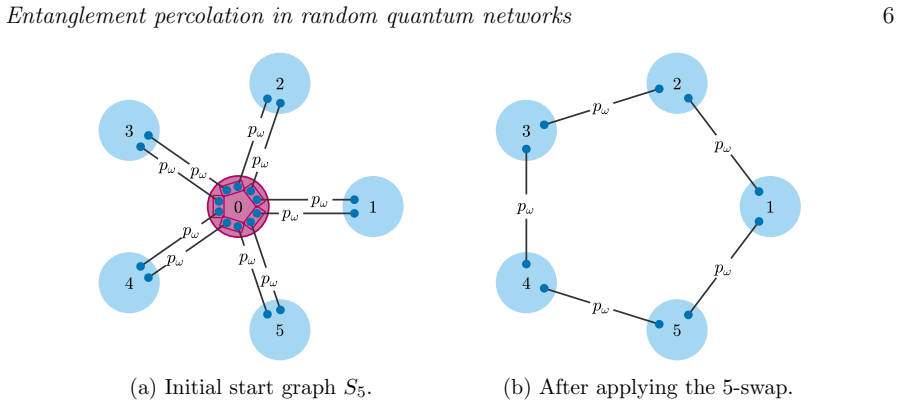
The q-swap framework, which uses local swap operations and classical communication to propagate entanglement across the network according to its topology.
If this is right
- Classical entanglement percolation thresholds depend only on the average initial entanglement value, independent of distribution width.
- Quantum entanglement percolation success rates decrease as the width of the initial entanglement distribution increases.
- In sufficiently heterogeneous networks, classical CEP may become the optimal LOCC strategy compared with q-swap quantum protocols.
- Network topology continues to set the minimum average entanglement required for percolation to occur.
Where Pith is reading between the lines
- Practical quantum networks with probabilistic entanglement sources may benefit from prioritizing classical strategies when link quality varies widely.
- Designers could reduce the overhead of enforcing uniform entanglement by accepting classical percolation in heterogeneous settings.
- Finite-size simulations with controlled variance levels could quantify the crossover point where classical methods overtake quantum ones.
Load-bearing premise
The randomness in initial entanglement is independent across links and the network is large enough for percolation thresholds to apply without finite-size effects dominating.
What would settle it
A simulation or experiment on a large random network that increases the variance of initial entanglement while holding the mean fixed and checks whether quantum protocol success probability drops while classical success probability remains unchanged.
Figures




read the original abstract
Entanglement percolation aims at generating maximal entanglement between any two nodes of a quantum network by utilizing strategies based solely on local operations and classical communication between the nodes. As it happens in classical percolation theory, the topology of the network is crucial, but also the entanglement shared between the nodes of the network. In a network of identically partially entangled states, the network topology determines the minimum entanglement needed for percolation. In this work, we generalize the protocol to scenarios where the initial entanglement shared between any two nodes of the network is not the same but has some randomness. In such cases, we find that for classical entanglement percolation, only the average initial entanglement is relevant. In contrast, the quantum entanglement percolation protocol (within the q-swap framework) degrades under these more realistic conditions as the width of the distribution increases, suggesting that Random CEP may become the optimal LOCC strategy in sufficiently heterogeneous quantum networks.
Editorial analysis
A structured set of objections, weighed in public.
Referee Report
Summary. The manuscript generalizes entanglement percolation to quantum networks in which the initial entanglement shared across links is drawn from a heterogeneous distribution rather than being uniform. It asserts that classical entanglement percolation (CEP) depends only on the mean entanglement value, whereas the q-swap quantum protocol exhibits progressive degradation as the width of the entanglement distribution increases, suggesting that random CEP may become the preferred LOCC strategy in sufficiently heterogeneous networks.
Significance. If the central contrast survives rigorous verification, the result clarifies the robustness of quantum versus classical percolation strategies under realistic randomness, with direct implications for the design of large-scale quantum communication networks. The application of standard percolation theory to random bond strengths is a natural and potentially useful extension, though the manuscript would benefit from explicit checks that the reported degradation is not an artifact of finite-size or correlation assumptions.
major comments (2)
- [§3] §3 (Classical CEP analysis): the assertion that percolation depends solely on the average entanglement requires an explicit derivation or theorem showing that the effective bond probability is insensitive to higher moments of the distribution; without this step the claimed parameter-free character of the classical threshold remains unproven.
- [§4.2] §4.2 and associated figures (q-swap numerics): the reported degradation with distribution width is observed for finite networks; no finite-size scaling collapse or extrapolation to the thermodynamic limit is provided, leaving open the possibility that the effect is partly due to local fluctuations or boundary corrections rather than an intrinsic protocol difference.
minor comments (2)
- [Abstract] The term 'Random CEP' is introduced in the abstract but defined only later; a brief parenthetical definition on first use would improve readability.
- [Figures] Figure captions should state the network size N, number of disorder realizations, and any averaging procedure used to obtain the plotted curves.
Simulated Author's Rebuttal
We thank the referee for the careful reading and constructive feedback. The comments highlight important points for strengthening the rigor of our claims. We address each major comment below and will revise the manuscript to incorporate the requested clarifications and additional analysis.
read point-by-point responses
-
Referee: [§3] §3 (Classical CEP analysis): the assertion that percolation depends solely on the average entanglement requires an explicit derivation or theorem showing that the effective bond probability is insensitive to higher moments of the distribution; without this step the claimed parameter-free character of the classical threshold remains unproven.
Authors: We agree that an explicit derivation is needed to fully substantiate the claim. In the classical CEP protocol, the effective bond occupation is determined by a linear threshold condition on the entanglement parameter, such that the percolation probability depends only on the first moment of the distribution; higher moments cancel in the averaging over independent links. In the revised manuscript we will insert a short theorem and derivation in §3 proving this insensitivity, thereby confirming the parameter-free character of the classical threshold. revision: yes
-
Referee: [§4.2] §4.2 and associated figures (q-swap numerics): the reported degradation with distribution width is observed for finite networks; no finite-size scaling collapse or extrapolation to the thermodynamic limit is provided, leaving open the possibility that the effect is partly due to local fluctuations or boundary corrections rather than an intrinsic protocol difference.
Authors: We acknowledge that the absence of explicit finite-size scaling leaves room for doubt about intrinsic versus finite-size origins. Additional simulations we have performed on larger lattices (up to several thousand nodes) show the degradation persists with increasing system size. In the revised version we will add a finite-size scaling collapse plot together with an extrapolation to the thermodynamic limit, demonstrating that the width-induced degradation is a genuine feature of the q-swap protocol. revision: yes
Circularity Check
No circularity: derivation applies external percolation theory to random inputs
full rationale
The paper generalizes entanglement percolation to heterogeneous initial states with independent randomness across links. It reports that classical percolation depends only on the average entanglement (a standard result from percolation theory on random graphs) while the q-swap quantum protocol shows degradation with distribution width. No equations reduce a claimed prediction to a fitted parameter by construction, no uniqueness theorems are imported from the authors' prior work, and no ansatz is smuggled via self-citation. The central claims rest on external percolation thresholds applied to stated assumptions of link independence and large-network limit, making the derivation self-contained against external benchmarks.
Axiom & Free-Parameter Ledger
axioms (2)
- standard math LOCC operations and classical communication suffice for entanglement manipulation
- domain assumption Percolation theory applies to large random networks with independent link strengths
Lean theorems connected to this paper
-
IndisputableMonolith/Cost/FunctionalEquation.leanwashburn_uniqueness_aczel unclear?
unclearRelation between the paper passage and the cited Recognition theorem.
for classical entanglement percolation, only the average initial entanglement is relevant... the quantum entanglement percolation protocol (within the q-swap framework) degrades... as the width of the distribution increases
-
IndisputableMonolith/Foundation/AlexanderDuality.leanalexander_duality_circle_linking unclear?
unclearRelation between the paper passage and the cited Recognition theorem.
pRCEP({pi}) = pCEP(<p>) = pc ... <pmin> = <p> - C sigma
What do these tags mean?
- matches
- The paper's claim is directly supported by a theorem in the formal canon.
- supports
- The theorem supports part of the paper's argument, but the paper may add assumptions or extra steps.
- extends
- The paper goes beyond the formal theorem; the theorem is a base layer rather than the whole result.
- uses
- The paper appears to rely on the theorem as machinery.
- contradicts
- The paper's claim conflicts with a theorem or certificate in the canon.
- unclear
- Pith found a possible connection, but the passage is too broad, indirect, or ambiguous to say the theorem truly supports the claim.
Reference graph
Works this paper leans on
-
[1]
Ramakrishnan R Ket al.2023Journal of the Indian Institute of Science103547–467
-
[2]
Wei S Het al.2022Laser & Photonics Reviews162100219
-
[3]
Joshi S Ket al.2020Science Advances6eaba0959
-
[4]
Brekenfeld M, Niemietz D, Christesen J D and Rempe G 2020Nature Physics16647–651 Entanglement percolation in random quantum networks14
-
[5]
Thomas S E, Wagner L, Joos R, Sittig R, Nawrath C, Burdekin P, de Buy Wenniger I M, Rasiah M J, Huber-Loyola T, Sagona-Stophel Set al.2024Science Advances10eadi7346
-
[6]
Kimble H J 2008Nature4531023–1030
-
[7]
Wehner S, Elkouss D and Hanson R 2018Science362eaam9288
- [8]
- [9]
-
[10]
Ekert A K 1991Physical Review Letters67661–663
-
[11]
Bennett C H and Brassard G 1991Theoretical Computer Science5607–11
-
[12]
Bennett C H and Wiesner S J 1992Physical Review Letters692881–2884
-
[13]
Lo H K, Curty M and Tamaki K 2014Nature Photonics8595–604 ISSN 1749-4885, 1749-4893 (arXiv:1505.05303)
work page internal anchor Pith review Pith/arXiv arXiv
-
[14]
Bennett C H, Brassard G, Cr´ epeau C, Jozsa R, Peres A and Wootters W K 1993Physical Review Letters701895–1899
-
[15]
Yin Jet al.2017Science3561140–1144
-
[16]
Neumann S P, Buchner A, Bulla L, Bohmann M and Ursin R 2022Nature Communications13 6134
-
[17]
Briegel H J, D¨ ur W, Cirac J I and Zoller P 1998Physical Review Letters815932–5935
-
[18]
Cirac J I, Zoller P, Kimble H J and Mabuchi H 1997Physical Review Letters783221
-
[19]
D¨ ur W, Briegel H J, Cirac J and Zoller P 1999Physical Review A59169–181
-
[20]
˙Zukowski M, Zeilinger A, Horne M A and Ekert A K 1993Physical Review Letters714287–4290
-
[21]
Bose S, Vedral V and Knight P L 1999Physical Review A60194–197
-
[22]
Bennett C H, Brassard G, Popescu S, Schumacher B, Smolin J A and Wootters W K 1996Physical Review Letters76722–725
-
[23]
Bennett C H, Bernstein H J, Popescu S and Schumacher B 1996Physical Review A532046–2052
work page 2052
-
[24]
Bennett C H, DiVincenzo D P, Smolin J A and Wootters W K 1996Physical Review A543824– 3851
-
[25]
Deutsch D, Ekert A, Jozsa R, Macchiavello C, Popescu S and Sanpera A 1996Physical Review Letters772818–2821
-
[26]
Pirandola S, Laurenza R, Ottaviani C and Banchi L 2017Nature communications81–15
-
[27]
Winnel M S, Guanzon J J, Hosseinidehaj N and Ralph T C 2022npj Quantum Information8129
-
[28]
Ruskuc A, Wu C J, Green E, Hermans S L N, Pajak W, Choi J and Faraon A 2025Nature639 54–59 ISSN 1476-4687
-
[29]
Ac´ ın A, Cirac J I and Lewenstein M 2007Nature Physics3256–259
-
[30]
Cuquet M and Calsamiglia J 2009Physical Review Letters103240503
-
[31]
Perseguers S, Cirac J I, Ac´ ın A, Lewenstein M and Wehr J 2008Physical Review A77022308
-
[32]
Lapeyre G J, Wehr J and Lewenstein M 2009Physical Review A79042324
-
[33]
Perseguers S, Lapeyre G J, Cavalcanti D, Lewenstein M and Ac´ ın A 2013Reports on Progress in Physics76096001
-
[34]
Siomau M 2016Journal of Physics B: Atomic, Molecular and Optical Physics49175506
-
[35]
Meng X, Hu X, Tian Y, Dong G, Lambiotte R, Gao J and Havlin S 2023Entropy251564
-
[36]
Wang C, Hu X and Dong G 2024Mathematics123568 ISSN 2227-7390
-
[37]
Biamonte J, Faccin M and De Domenico M 2019Communications Physics253
-
[38]
Das S, Khatri S and Dowling J P 2018Physical Review A97012335
-
[39]
Newman M 2018Networks (2nd Edition)(Oxford University Press)
-
[40]
Wu L and Zhu S 2011Physical Review A84052304
-
[41]
De Girolamo A, Magnifico G and Lupo C 2025Quantum Science and Technology10035047 ISSN 2058-9565
work page 2058
-
[42]
Broadfoot S, Dorner U and Jaksch D 2009Europhysics Letters8850002
-
[43]
Wang H, Malik O, Hou J, Zhang Y, He K and Meng X 2026Communications Physics928 ISSN Entanglement percolation in random quantum networks15 2399-3650
-
[44]
Perseguers S, Cavalcanti D, Lapeyre G J, Lewenstein M and Ac´ ın A 2010Physical Review A81 032327
-
[45]
Khanna S, Halder S and Sen U 2024Physical Review A109012419
-
[46]
Oh S M, Shin H, Marano S, Conti A and Win M 2024 Entanglement Percolation in Noisy Quantum Networks2024 International Conference on Quantum Communications, Networking, and Computing (QCNC)pp 143–149
work page 2024
-
[47]
Zhao Y, He K, Hou J and Meng X 2025Journal of Physics: Complexity6045004 ISSN 2632-072X
- [48]
- [49]
-
[50]
Vidal G 1999Physical Review Letters831046–1049
-
[51]
Zangi S M, Shukla C, ur Rahman A and Zheng B 2023Entropy251099–4300
-
[52]
Kesten H 1980Communications in Mathematical Physics7441–59
-
[53]
Latora V, Nicosia V and Russo G 2017Complex Networks: Principles, Methods and Applications (Cambridge University Press)
-
[54]
Cuquet M and Calsamiglia J 2011Physical Review A83032319
-
[55]
Sykes M F and Essam J W 1964Journal of Mathematical Physics51117–1127
-
[56]
Diaconis P 2005Notices of the American Mathematical Society521348–1349 URLhttps: //finmath.stanford.edu/~cgates/PERSI/papers/what-is.pdf
-
[57]
˙Zyczkowski K, Penson K A, Nechita I and Collins B 2011Journal of Mathematical Physics52 062201
-
[58]
Lloyd S and Pagels H 1988Annals of Physics188186–213
-
[59]
Hall M J 1998Physics Letters A242123–129
-
[60]
Xing J and Zhang F 2026Scientific Reports168194 ISSN 2045-2322
work page 2045
-
[61]
Leadbetter M R, Lindgren G and Rootz´ en H 1983Extremes and Related Properties of Random Sequences and Processes(Springer)
- [62]
- [63]
-
[64]
Meng X, Gao J and Havlin S 2021Physical Review Letters126170501
-
[65]
Malik O, Meng X, Havlin S, Korniss G, Szymanski B K and Gao J 2022Communications Physics 5193 ISSN 2399-3650
- [66]
- [67]
-
[68]
Albert R and Barab´ asi A L 2002Reviews of Modern Physics7447–97
-
[69]
Boccaletti S, Latora V, Moreno Y, Chavez M and Hwang D U 2006Physics Reports424175–308
-
[70]
d Mata A S 2020Brazilian Journal of Physics50658–672
-
[71]
Duminil-Copin H 2017arXiv(arXiv:1712.04651)
work page internal anchor Pith review Pith/arXiv arXiv
-
[72]
Li M, Liu R, L¨ u L, Hu M, Xu S and Zhang Y 2021Physics Reports9071–68
-
[73]
Grimmett G 1999Percolation (2nd edition)(Springer)
-
[74]
Stauffer D and Aharony A 1992Introduction To Percolation Theory (2nd edition)(Taylor & Francis)
- [75]
-
[76]
Chitambar E, Leung D, Manˇ cinska L, Ozols M and Winter A 2014Physical Review Letters328 303–326
-
[77]
Nielsen M A and Chuang I L 2010Quantum Computation and Quantum Information (10th Anniversary Edition)(Cambridge University Press) Entanglement percolation in random quantum networks16 0.0 0.2 0.4 0.6 0.8 1.0pc Edge Probability p 0.0 0.5 1.0 Percolation Strength P∞ Figure A1: The plot shows an edge percolation simulation performed on a 100×100 square latti...
-
[78]
Chitambar E and Gour G 2019Reviews of Modern Physics91025001
-
[79]
Nielsen M A 1999Physical Review Letters83436–439
-
[80]
Bhatia R 1997Matrix Analysis(Springer)
discussion (0)
Sign in with ORCID, Apple, or X to comment. Anyone can read and Pith papers without signing in.