REVIEW 3 major objections 5 minor 4 cited by
AIvilization v0 claims that a publicly deployed society of tens of thousands of LLM-driven agents can sustain long-horizon autonomy and, in its mature phase, generate markets whose returns are heavy-tailed and volatility-clustered plus educ
Reviewed by Pith at T0; open to challenge. T0 means a machine referee read the full paper against a public rubric. the ladder, T0–T4 →
T0 review · deepseek-v4-flash
2026-08-03 01:16 UTC pith:JWUMQIMT
load-bearing objection Real platform, real engineering, but the numbers don't back the headline claims: the market 'stylized facts' are likely discretization artifacts and the stratification is mostly rule-driven. the 3 major comments →
AIvilization v0: Toward Large-Scale Artificial Social Simulation with a Unified Agent Architecture and Adaptive Agent Profiles
The pith
A machine-rendered reading of the paper's core claim, the machinery that carries it, and where it could break.
Core claim
On the paper's own terms, the discovery is that a persistent simulated economy built from LLM agents—who buy, sell, produce, study, and sleep under physiological and eligibility constraints—spontaneously displays real-world market regularities. In a block of 400,000 high-frequency transactions from the mature public deployment, the fish market's price stayed between 304.398 and 304.808 (log-price range 0.001), yet 5-minute log returns across ten commodities show excess kurtosis above 6 (up to 9.873) and significant lag-1 autocorrelation of absolute returns, which the authors interpret as heavy tails and volatility clustering. The same logs show a monotonically increasing, nonlinear relation
What carries the argument
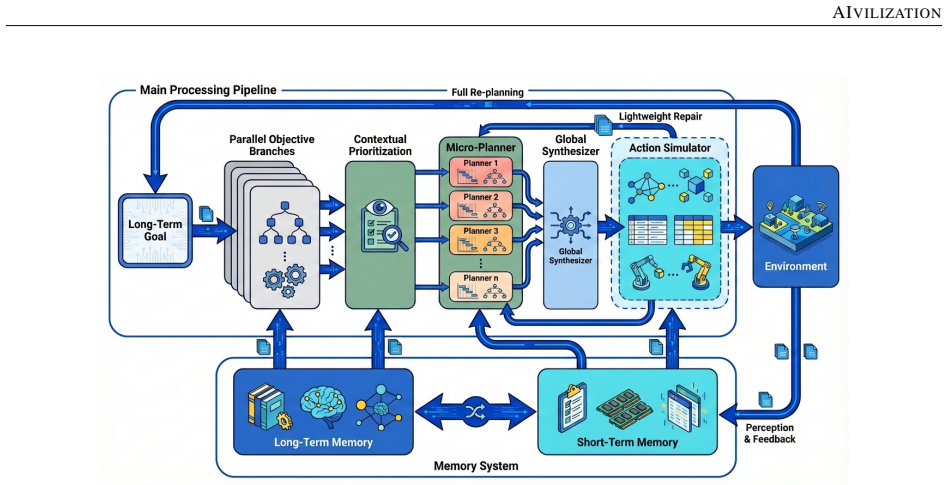
The load-bearing machinery is a three-part loop: (1) a Branch-Thinking Planner that decomposes a life goal into parallel objective branches and uses context-based prioritization plus pre-execution Action Simulator rollouts to keep actions feasible; (2) a dual-process memory that separates short-term execution traces from long-term semantic consolidation, letting identity persist yet evolve; and (3) a constant-product Automated Market Maker (IS_i·CR_i=k) that sets prices through liquidity-pool ratios and couples money supply to real output. The AMM is what converts agent actions into a price series, and the education-occupation gate is what converts human-capital investment into wage and weal
Load-bearing premise
The empirical validation treats one week of 5-minute OHLC data from the fish market—where prices move over a range of only 0.001 in log space—as a meaningful price-discovery series; if those tiny movements are rounding artifacts or pool-granularity noise rather than endogenous economic dynamics, the headline stylized-facts result loses its evidentiary base.
What would settle it
Take the same 400,000-transaction block, rebuild prices at coarser granularity (e.g., 30-minute or 1-hour bins), and exclude intervals with zero trades or identical quotes; if excess kurtosis collapses toward Gaussian levels and the Ljung-Box test no longer rejects independence of |r|, then the reported stylized facts are artifacts of binning and price discretization.
If this is right
- If the market regularities are genuine, then agent-based social simulators with hard constraints and LLM decision-making can produce emergent financial statistics without being explicitly calibrated to do so.
- The platform's wage regime, tying dynamic wages to a knowledge-threshold quantile, implies that rising average education will automatically raise entry requirements for top jobs, preserving positional competition as the population upskills.
- The ablation results imply that a lightweight planning route is enough for simple tasks, so future systems can save compute by activating the full branch-thinking stack only for multi-objective, long-horizon goals.
- The correlation between early educational steering and upward mobility, if causal, suggests targeted long-horizon prompts could be a policy lever inside such simulations.
- The architecture's memory-mediated steering suggests a path to hybrid-autonomy platforms where human influence is absorbed into agent identity rather than overwriting prompts.
Where Pith is reading between the lines
- The stylized-fact evidence rests on a single week of one liquid market; a natural extension would check whether the same excess kurtosis appears in the silicon and wood supply chains' price series while controlling for tick size.
- If the fish price barely moved, the heavy tails may reflect the discreteness of 5-minute bins or AMM pool granularity; a cleaner test would use trade-level returns or compare against a null model of random trades through the same AMM.
- The paper leaves implicit that the same architecture could be used to study institutional changes, such as removing residential barriers, and measure their effect on inequality; an A/B experiment varying the education threshold quantile is a concrete next step.
- Because the deployed population includes human-steered agents, the data confounds autonomous emergence with human guidance; the causal claim about steering would need a fully autonomous control cohort.
Editorial analysis
A structured set of objections, weighed in public.
Referee Report
Summary. The paper presents AIvilization v0, a publicly deployed large-scale artificial society coupling an LLM-agent architecture (branch-thinking planner, dual-process memory, human-in-the-loop steering) with a resource-constrained economic environment (physiological costs, multi-tier production, AMM pricing, gated education-occupation system). Using 400,000 transactions from a mature phase of the platform, the authors construct 5-minute OHLC series and report that simulated markets reproduce heavy-tailed returns and volatility clustering, and that wealth stratification is driven by education and access constraints. A controlled ablation study compares the full planner with two simplified variants on multi-objective and simple tasks. The central claim is that the platform is a research-grade artificial society for studying emergent macro-social phenomena.
Significance. If the empirical claims held, this would be a notable contribution: a large-scale, public LLM-agent society with tens of thousands of agents and 600k+ transactions, showing real-economy-like statistical regularities and structured inequality. The architecture itself—hierarchical branch planning, adaptive profiles, memory-mediated steering—contains useful ideas and the ablation study is a reasonable start. The paper ships no code or data release, and the central validation rests on one week of fish-market OHLC data. The claimed stylized facts are, however, plausibly artifacts of price discretization, and the stratification result is largely forced by the model's own eligibility equations. These issues are load-bearing for the paper's headline contribution, so the significance of the paper as it stands is limited.
major comments (3)
- [§4.2, §4.3, Table 1, Eqs. (18)–(19)] The central claim that the market 'reproduces key stylized facts (heavy-tailed returns and volatility clustering)' is not supported because the reported statistics are consistent with a discretization artifact. The fish price is confined to [304.398, 304.808] (log range 0.001) with a maximum drawdown of 0.0715% (§4.2). Under such extreme quantization, returns are zero in most 5-minute bins and one-tick jumps otherwise; the standardized distribution automatically has a large spike at zero and excess kurtosis of 9.489, and the ACF of |r| can be produced by any time-varying trade intensity. The paper provides no null model, no minimum-tick analysis, no event-time returns, and no pool-depth/trade-size context. Table 1 therefore does not discriminate between endogenous economic dynamics and a zero-inflation artifact.
- [§4.4, Eqs. (10)–(12), (15), Table 11] The claimed 'emergent' wealth stratification is to a large degree hard-wired by the model's own rules. Equation (10) gates occupation eligibility on dynamic knowledge thresholds; Eq. (12) defines these thresholds as the (1−πj) quantile of the education distribution, so eligibility shares are fixed by hand-chosen πj parameters (Table 11); Eq. (15) makes high-tier wages increase with the very same threshold. Since wealth is tied to occupation wages, the positive education-wealth gradient and occupation-tier wealth ordering shown in Figures 9–10 follow almost algebraically. The authors acknowledge in §4.4 that stratification is 'an outcome of the simulation’s core rules,' but they nevertheless claim a dynamic sorting process. No counterfactual (e.g., fixed thresholds, no residential gates, or random πj) is provided to separate the rule-forced component from truly emergent sorting. Thus the
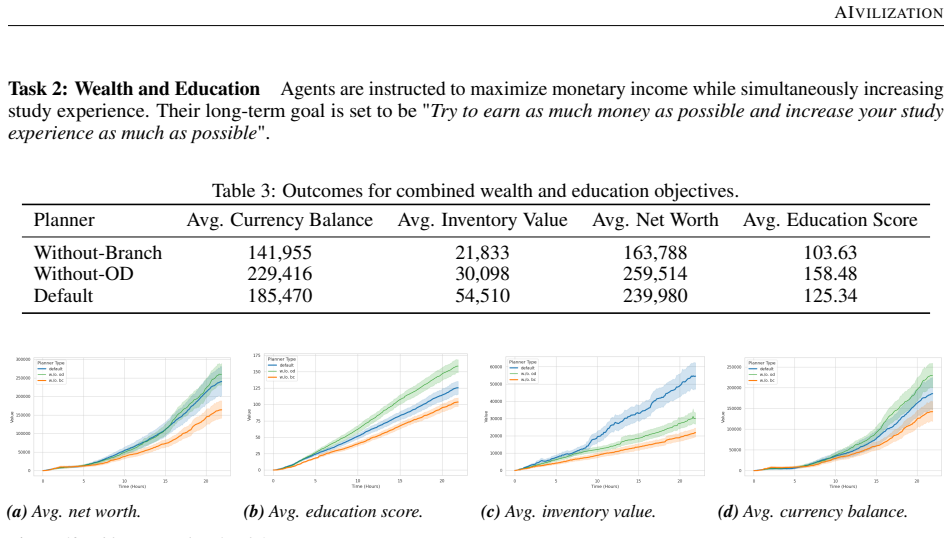
- [§5, Tables 2–5] The ablation conclusions are overstated relative to the evidence. In Task 2 (Table 3), the Default planner ranks second on both net worth and education score, behind Without-OD; the paper acknowledges this but the overall discussion (§5.4) claims the full architecture 'consistently' and 'materially' outperforms on complex multi-objective tasks. No standard errors, confidence intervals, or multiple seeds are reported—each condition uses 80 agents with no indication of replication. The differences (e.g., Task 1 net worth 110,098 vs. 95,279) may be real, but with a single run the claim of robustness is not statistically grounded. At minimum, the paper should present per-agent distributions and effect sizes, not only means.
minor comments (5)
- [§5.1] Typo: 'Their Their long-term goal' should read 'Their long-term goal.'
- [§2.1] Typo: 'econciling' should be 'reconciling.'
- [Table 1] The table reports no sample size, number of 5-minute intervals, or time span per commodity; with 400,000 transactions split across ten assets, intervals may vary widely. Also, p-values are shown as '<10⁻⁶' without reporting the Ljung-Box statistic or the number of lags used.
- [§4.1 and §5.1] The deployment data uses a 7× time compression, while the ablation uses 35×. The paper should clarify whether the 35× scaling is used in the mature-phase transaction data or only in the controlled experiments, since this affects the interpretation of 5-minute returns.
- [§4.2, Figure 4] The price series is visually displayed on an extremely narrow y-axis (304.398–304.808). The authors should also show the corresponding number of trades per bin and the pool depth to allow readers to judge whether the 'micro-fluctuations' are genuine price discovery or just quote noise.
Circularity Check
Wealth stratification is encoded directly into the eligibility and wage equations (Eqs. 10-12 and 15), then reported as an emergent finding; the market stylized-facts claim is a validity concern but not a chain-circular reduction.
specific steps
-
self definitional
[Section 3.2.2 (Eqs. 10-12), Section 3.2.4 (Eq. 15), Section 4.4]
"For example, πj = 0.28 means the platform sets the knowledge threshold so that approximately the top 28% of agents sorted by education score can meet the requirement. ... w(j)(t) = w(j)0 · Φ( bH(j)min(t)) · ¯PCRoverall · (1 + δt). ... It is important to note that this stratification is an outcome of the simulation’s core rules, which explicitly link high tier occupations to prerequisites in education and residential tiers."
The headline result 'structured wealth stratification driven by education and access constraints' is true by construction: Eq. (12) sets each occupation's effective education threshold to a quantile of the education distribution, forcing a fixed eligible share; Eq. (10) gates access by residential tier; and Eq. (15) makes high-tier wages a non-decreasing function of that same threshold. Therefore, higher-education agents sorted into higher-wage occupations is an immediate consequence of the rule set, not a discovered emergent regularity. The paper itself concedes the stratification is 'an outcome of the simulation's core rules', leaving only the dynamic sorting process as genuinely emergent. Presenting the education-wealth gradient as a validated macro-level finding partially restates the
full rationale
Most of the paper's technical content is self-contained and non-circular: the Branch-Thinking Planner, dual-process memory, steering interface, AMM/environment design, and the ablation study do not reduce to their inputs. The ablations use standardized initial conditions and compare planner variants under identical environments; the results (e.g., Without-OD outperforming Default on Task 2) are not forced. There are no load-bearing self-citations: the references are prior external work, and the paper invokes no self-authored uniqueness theorem. The market stylized-facts claim (heavy tails and volatility clustering) is not a definitional circularity, but the paper's own reported fish log-price range of 0.001 and max drawdown of 0.0715% create a serious external-validity threat: the reported kurtosis and |r| ACF may be mechanical artifacts of price discretization or activity clustering rather than endogenous dynamics. That is a correctness/validation issue, not a circularity reduction, so it is noted but not scored. The genuine circular step is the wealth-stratification claim: eligibility quantiles and threshold-linked wages define the education-wealth gradient, and the paper explicitly concedes this. Score 6 reflects partial circularity of one headline empirical claim, while the platform and agent architecture retain independent content.
Axiom & Free-Parameter Ledger
free parameters (10)
- Production recipe coefficients (materials, α, ε, σ, τ) =
not reported as a single set; Table 9 lists per-commodity recipes
- Occupation knowledge floors H_floor and residential gates R_min =
Tiers 1-6: MinH 0, 20, 70, 110, 180, 320; MinR 1, 2, 3, 4, 5, 6
- Eligibility share parameters π_j =
0.065 to 1.00 per occupation (Table 11)
- Base wages w0 and dynamic wage scaling Φ(·) =
w0 values 250-1411; Φ unspecified
- Education accumulation rate η =
not reported
- Efficiency function G(·) =
not specified
- AMM initial reserves and constant k =
not reported
- Time compression factors =
7× (deployment), 35× (ablations)
- Stochastic reward probabilities =
0.5%, 0.8%, 1%, 2%, 5%
- Survival thresholds and physiological upper bounds =
partially reported, mainly qualitative
axioms (6)
- domain assumption The underlying LLM can act as a reliable long-horizon planner and persona within the scaffolded architecture.
- domain assumption A constant-product AMM (Eq. 3) is an appropriate economy-wide price discovery and money-supply mechanism.
- domain assumption A Leontief minimum production function with non-substitutable inputs (Eq. 8) captures the supply-chain dynamics the paper claims to study.
- ad hoc to paper Dynamic knowledge thresholds defined by quantiles (Eqs. 11-12) preserve scarcity and positional competition.
- domain assumption Kurtosis and ACF of returns computed from 5-minute binned data on a near-constant price series are comparable to real-world daily return stylized facts.
- domain assumption The ablation results generalize from a single run with 80 agents per condition.
read the original abstract
AIvilization v0 is a publicly deployed large-scale artificial society that couples a resource-constrained sandbox with a unified LLM-agent architecture, aiming to sustain long-horizon autonomy while remaining executable under a rapidly changing environment. To mitigate the tension between goal stability and reactive correctness, keeping long-horizon objectives on course while each action remains valid in a fast-changing shared world, we introduce (i) a hierarchical branch-thinking planner that decomposes life goals into parallel objective branches and uses simulation-guided validation plus tiered re-planning to ensure feasibility; (ii) an adaptive agent profile with dual-process memory that separates short-term execution traces from long-term semantic consolidation, enabling persistent yet evolving identity; and (iii) a human-in-the-loop steering interface that injects long-horizon objectives and short commands at appropriate abstraction levels, with effects propagated through memory instead of brittle prompt overrides. The environment integrates physiological survival costs, non-substitutable multi-tier production, an AMM-based price mechanism, and a gated education-occupation system. In a large-scale public deployment with tens of thousands of agents, high-frequency transactions from the platform's mature phase reveal stable markets that reproduce key stylized facts of real economies and structured wealth stratification driven by education and access constraints. At the agent level, portraits evolve coherently over long horizons, and human steering is associated with measurably larger short-horizon profile updates. Controlled ablation experiments complement the deployment evidence, showing that our agent architecture is robust in multi-objective, long-horizon settings.
Figures




Forward citations
Cited by 4 Pith papers
-
Agentic World Modeling: Foundations, Capabilities, Laws, and Beyond
Proposes a levels x laws taxonomy for world models in AI agents, defining L1-L3 capabilities across physical, digital, social, and scientific regimes while reviewing over 400 works to outline a roadmap for advanced ag...
-
Bounded Autonomy: Controlling LLM Characters in Live Multiplayer Games
Bounded autonomy is a new control architecture that makes LLM characters workable in live multiplayer games by combining interaction stability techniques, action grounding, and lightweight player steering, validated t...
-
Bounded Autonomy: Controlling LLM Characters in Live Multiplayer Games
Bounded autonomy—reply-chain decay, embedding action grounding with fallback, and whisper soft steering—makes player-owned LLM characters workable in a live multiplayer social game.
-
Agentic World Modeling: Foundations, Capabilities, Laws, and Beyond
A survey proposing a three-level capability taxonomy (L1 Predictor, L2 Simulator, L3 Evolver) for world models across physical, digital, social, and scientific domains.
Reference graph
Works this paper leans on
-
[1]
Acemoglu, V
D. Acemoglu, V . M. Carvalho, A. Ozdaglar, and A. Tahbaz-Salehi. The network origins of aggregate fluctuations. Econometrica, 80(5):1977–2016, 2012
1977
-
[2]
Adams, N
H. Adams, N. Zinsmeister, and D. Robinson. Uniswap v2 core. https://uniswap.org/whitepaper.pdf, 2020
2020
-
[3]
M. Ahn, A. Brohan, N. Brown, Y . Chebotar, O. Cortes, B. David, C. Finn, C. Fu, K. Gopalakrishnan, K. Hausman, et al. Do as i can, not as i say: Grounding language in robotic affordances.arXiv preprint arXiv:2204.01691, 2022
Pith/arXiv arXiv 2022
-
[4]
A. AL, A. Ahn, N. Becker, S. Carroll, N. Christie, M. Cortes, A. Demirci, M. Du, F. Li, S. Luo, et al. Project sid: Many-agent simulations toward ai civilization.arXiv preprint arXiv:2411.00114, 2024
Pith/arXiv arXiv 2024
-
[5]
Angeris and T
G. Angeris and T. Chitra. Improved price oracles: Constant function market makers. InProceedings of the 2nd ACM Conference on Advances in Financial Technologies, pages 80–91, 2020
2020
-
[6]
Angeris, H.-T
G. Angeris, H.-T. Kao, R. Chiang, C. Noyes, and T. Chitra. An analysis of uniswap markets. 2021
2021
-
[7]
W. B. Arthur. Competing technologies, increasing returns, and lock-in by historical events.The economic journal, 99(394):116–131, 1989
1989
-
[8]
Axelrod.The Complexity of Cooperation: Agent-Based Models of Competition and Collaboration: Agent-Based Models of Competition and Collaboration
R. Axelrod.The Complexity of Cooperation: Agent-Based Models of Competition and Collaboration: Agent-Based Models of Competition and Collaboration. Princeton university press, 1997
1997
-
[9]
Y . Bai, S. Kadavath, S. Kundu, A. Askell, J. Kernion, A. Jones, A. Chen, A. Goldie, A. Mirhoseini, C. McKinnon, et al. Constitutional ai: Harmlessness from ai feedback.arXiv preprint arXiv:2212.08073, 2022
Pith/arXiv arXiv 2022
-
[10]
G. S. Becker. Investment in human capital: A theoretical analysis.Journal of political economy, 70(5, Part 2): 9–49, 1962
1962
-
[11]
I. Berg. Education for jobs; the great training robbery. 1970
1970
-
[12]
Bourdieu
P. Bourdieu. The forms of capital. InThe sociology of economic life, pages 78–92. Routledge, 2018
2018
-
[13]
V . M. Carvalho. From micro to macro via production networks.Journal of Economic Perspectives, 28(4):23–48, 2014
2014
-
[14]
Chakraborti, I
A. Chakraborti, I. M. Toke, M. Patriarca, and F. Abergel. Econophysics review: Ii. agent-based models.Quantita- tive Finance, 11(7):1013–1041, 2011
2011
-
[15]
Chekhlov, S
A. Chekhlov, S. Uryasev, and M. Zabarankin. Drawdown measure in portfolio optimization.International Journal of Theoretical and Applied Finance, 8(01):13–58, 2005
2005
-
[16]
W. Chen, Y . Su, J. Zuo, C. Yang, C. Yuan, C.-M. Chan, H. Yu, Y . Lu, Y .-H. Hung, C. Qian, et al. Agentverse: Facilitating multi-agent collaboration and exploring emergent behaviors. InThe Twelfth International Conference on Learning Representations, 2023
2023
-
[17]
K. Christakopoulou, S. Mourad, and M. Matari´c. Agents thinking fast and slow: A talker-reasoner architecture. arXiv preprint arXiv:2410.08328, 2024
Pith/arXiv arXiv 2024
-
[18]
Collins.The credential society: An historical sociology of education and stratification
R. Collins.The credential society: An historical sociology of education and stratification. Columbia University Press, 2019
2019
-
[19]
R. Cont. Empirical properties of asset returns: stylized facts and statistical issues.Quantitative finance, 1(2):223, 2001
2001
-
[20]
P. A. David. Clio and the economics of qwerty.The American economic review, 75(2):332–337, 1985
1985
-
[21]
W. E. Diewert. Axiomatic and economic approaches to elementary price indexes, 1995
1995
-
[22]
P. B. Doeringer and M. J. Piore.Internal labor markets and manpower analysis. Routledge, 2020
2020
-
[23]
R. F. Engle. Autoregressive conditional heteroscedasticity with estimates of the variance of united kingdom inflation.Econometrica: Journal of the econometric society, pages 987–1007, 1982
1982
-
[24]
J. M. Epstein and R. Axtell.Growing artificial societies: social science from the bottom up. Brookings Institution Press, 1996
1996
-
[25]
E. F. Fama. The behavior of stock-market prices.The journal of Business, 38(1):34–105, 1965
1965
-
[26]
J. D. Farmer and D. Foley. The economy needs agent-based modelling.Nature, 460(7256):685–686, 2009
2009
-
[27]
A. G. Fisher. Production, primary, secondary and tertiary.Economic record, 15(1):24–38, 1939. 24 AIVILIZATION
1939
-
[28]
R. H. Frank. The darwin economy: Liberty, competition, and the common good. InThe Darwin Economy. Princeton University Press, 2012
2012
-
[29]
J. J. Heckman. Skill formation and the economics of investing in disadvantaged children.Science, 312(5782): 1900–1902, 2006
1900
-
[30]
S. Hong, M. Zhuge, J. Chen, X. Zheng, Y . Cheng, J. Wang, C. Zhang, Z. Wang, S. K. S. Yau, Z. Lin, et al. Metagpt: Meta programming for a multi-agent collaborative framework. InThe twelfth international conference on learning representations, 2023
2023
-
[31]
Huang, P
W. Huang, P. Abbeel, D. Pathak, and I. Mordatch. Language models as zero-shot planners: Extracting actionable knowledge for embodied agents. InInternational conference on machine learning, pages 9118–9147. PMLR, 2022
2022
-
[32]
B. LeBaron. Agent-based financial markets: Matching stylized facts with style.Post Walrasian Macroeconomics: Beyond the DSGE Model, 221:235, 2006
2006
-
[33]
G. Li, H. Hammoud, H. Itani, D. Khizbullin, and B. Ghanem. Camel: Communicative agents for" mind" exploration of large language model society.Advances in Neural Information Processing Systems, 36:51991– 52008, 2023
2023
-
[34]
G. M. Ljung and G. E. Box. On a measure of lack of fit in time series models.Biometrika, 65(2):297–303, 1978
1978
-
[35]
Madaan, N
A. Madaan, N. Tandon, P. Gupta, S. Hallinan, L. Gao, S. Wiegreffe, U. Alon, N. Dziri, S. Prabhumoye, Y . Yang, et al. Self-refine: Iterative refinement with self-feedback.Advances in Neural Information Processing Systems, 36:46534–46594, 2023
2023
-
[36]
Mandelbrot et al
B. Mandelbrot et al. The variation of certain speculative prices.Journal of business, 36(4):394, 1963
1963
-
[37]
Meyer and S
J. Meyer and S. von Cramon-Taubadel. Asymmetric price transmission: a survey.Journal of agricultural economics, 55(3):581–611, 2004
2004
-
[38]
R. E. Miller and P. D. Blair.Input-output analysis: foundations and extensions. Cambridge university press, 2009
2009
-
[39]
J. Mincer. Schooling, experience, and earnings. human behavior & social institutions no. 2. 1974
1974
-
[40]
D. T. Mortensen. Job search and labor market analysis.Handbook of labor economics, 2:849–919, 1986
1986
-
[41]
J. S. Park, J. O’Brien, C. J. Cai, M. R. Morris, P. Liang, and M. S. Bernstein. Generative agents: Interactive simulacra of human behavior. InProceedings of the 36th annual acm symposium on user interface software and technology, pages 1–22, 2023
2023
-
[42]
J. S. Park, C. Q. Zou, A. Shaw, B. M. Hill, C. Cai, M. R. Morris, R. Willer, P. Liang, and M. S. Bernstein. Generative agent simulations of 1,000 people.arXiv preprint arXiv:2411.10109, 2024
Pith/arXiv arXiv 2024
-
[43]
J. Piao, Y . Yan, J. Zhang, N. Li, J. Yan, X. Lan, Z. Lu, Z. Zheng, J. Y . Wang, D. Zhou, C. Gao, F. Xu, F. Zhang, K. Rong, J. Su, and Y . Li. Agentsociety: Large-scale simulation of llm-driven generative agents.arXiv preprint arXiv.2502.08691, 2025. URLhttps://doi.org/10.48550/arXiv.2502.08691
-
[44]
J. Piao, Y . Yan, J. Zhang, N. Li, J. Yan, X. Lan, Z. Lu, Z. Zheng, J. Y . Wang, D. Zhou, et al. Agentsociety: Large-scale simulation of llm-driven generative agents advances understanding of human behaviors and society. arXiv preprint arXiv:2502.08691, 2025
Pith/arXiv arXiv 2025
-
[45]
Y . Qin, S. Liang, Y . Ye, K. Zhu, L. Yan, Y . Lu, Y . Lin, X. Cong, X. Tang, B. Qian, et al. Toolllm: Facilitating large language models to master 16000+ real-world apis.arXiv preprint arXiv:2307.16789, 2023
Pith/arXiv arXiv 2023
-
[46]
J. A. Robinson and D. Acemoglu.Why nations fail: The origins of power, prosperity and poverty. Profile London, 2012
2012
-
[47]
R. Sams. A note on cryptocurrency stabilisation: Seigniorage shares.Brave New Coin, 2015:1–8, 2015
2015
-
[48]
T. C. Schelling. Dynamic models of segregation.Journal of mathematical sociology, 1(2):143–186, 1971
1971
-
[49]
Schick, J
T. Schick, J. Dwivedi-Yu, R. Dessì, R. Raileanu, M. Lomeli, E. Hambro, L. Zettlemoyer, N. Cancedda, and T. Scialom. Toolformer: Language models can teach themselves to use tools.Advances in Neural Information Processing Systems, 36:68539–68551, 2023
2023
-
[50]
T. W. Schultz. Investment in human capital.The American economic review, 51(1):1–17, 1961
1961
-
[51]
Shinn, F
N. Shinn, F. Cassano, A. Gopinath, K. Narasimhan, and S. Yao. Reflexion: Language agents with verbal reinforcement learning.Advances in Neural Information Processing Systems, 36:8634–8652, 2023
2023
-
[52]
A. B. Sørensen. The structural basis of social inequality.American Journal of Sociology, 101(5):1333–1365, 1996. 25 AIVILIZATION
1996
-
[53]
A. R. Team. Project sid: The emergence of civilization in multi-agent worlds. https://altera.al/, 2024. Demonstrates emergent laws, religion, and economy in Minecraft using PIANO architecture
2024
-
[54]
Topsakal and T
O. Topsakal and T. C. Akinci. Creating large language model applications utilizing langchain: A primer on developing llm apps fast. InInternational conference on applied engineering and natural sciences, volume 1, pages 1050–1056, 2023
2023
-
[55]
R. S. Tsay.Analysis of financial time series. John wiley & sons, 2005
2005
-
[56]
S. H. Vemprala, R. Bonatti, A. Bucker, and A. Kapoor. Chatgpt for robotics: Design principles and model abilities. Ieee Access, 12:55682–55696, 2024
2024
-
[57]
G. Wang, Y . Xie, Y . Jiang, A. Mandlekar, C. Xiao, Y . Zhu, L. Fan, and A. Anandkumar. V oyager: An open-ended embodied agent with large language models.arXiv preprint arXiv:2305.16291, 2023
Pith/arXiv arXiv 2023
-
[58]
Weber.Economy and society: A new translation
M. Weber.Economy and society: A new translation. Harvard University Press, 2019
2019
-
[59]
Q. Wu, G. Bansal, J. Zhang, Y . Wu, B. Li, E. Zhu, L. Jiang, X. Zhang, S. Zhang, J. Liu, et al. Autogen: Enabling next-gen llm applications via multi-agent conversations. InFirst Conference on Language Modeling, 2024
2024
-
[60]
S. Yao, D. Yu, J. Zhao, I. Shafran, T. Griffiths, Y . Cao, and K. Narasimhan. Tree of thoughts: Deliberate problem solving with large language models.Advances in neural information processing systems, 36:11809–11822, 2023
2023
-
[61]
A. A. Youno. Increasing returns and economic progress.The economic journal, 38(152):527–542, 1928
1928
-
[62]
X. Zhang, J. Lin, X. Mou, S. Yang, X. Liu, L. Sun, H. Lyu, Y . Yang, W. Qi, Y . Chen, et al. Socioverse: A world model for social simulation powered by llm agents and a pool of 10 million real-world users.arXiv preprint arXiv:2504.10157, 2025. 26 AIVILIZATION Appendix A: Example of agent profile. Table 6: An example of agent profile Category Attribute Con...
Pith/arXiv arXiv 2025
discussion (0)
Sign in with ORCID, Apple, or X to comment. Anyone can read and Pith papers without signing in.