REVIEW 3 major objections 5 minor 4 references
Federated learning can carry a (t,K)-threshold watermark: only t-client coalitions can verify it, and it survives at 128 clients and under common attacks.
Reviewed by Pith at T0; open to challenge. T0 means a machine referee read the full paper against a public rubric. the ladder, T0–T4 →
T0 review · deepseek-v4-flash
2026-08-03 00:58 UTC pith:VRJCTBM6
load-bearing objection Threshold watermarking via secret sharing is a real idea; trust the protocol, not the adaptive-attack numbers. the 3 major comments →
Collaborative Threshold Watermarking
The pith
A machine-rendered reading of the paper's core claim, the machinery that carries it, and where it could break.
Core claim
The paper's central discovery is that secret-sharing a random watermark vector tau into K shares, then converting those shares into additive embedding shares via public interpolation coefficients, produces a watermark that is (i) additively consistent (the shares sum to tau), (ii) hidden from an untrusted server during secure aggregation, and (iii) verifiable by any coalition of at least t clients without reconstructing tau in the clear. Verification reduces to computing the inner product between the suspect model and tau from the shares alone, then a one-sided z-score against a fitted null distribution. Empirically the authors report z >= 4 at K = 128 with minimal accuracy loss, and that z
What carries the argument
The protocol is carried by two primitives plus a statistical test. A (t,K)-threshold secret-sharing scheme splits a random watermark vector tau into K shares such that any t shares reconstruct tau and any fewer reveal nothing; public interpolation coefficients convert each share into an embedding share that sums to tau. Secure aggregation lets the server see only the sum of client updates, so the watermark direction is embedded without the server learning tau or any individual share. An exponential moving average of per-client update norms adaptively scales the watermark contribution each round. Verification uses a one-sided z-test on the cosine similarity between the suspect model and tau,
Load-bearing premise
The false-positive claims rest on the assumption that the cosine similarity between an unwatermarked model and a random vector is approximately normal, with mean and standard deviation estimated from 10,000 samples per dataset and extrapolated to the z = 4 tail and to attacked models.
What would settle it
Train many independently initialized unwatermarked models, compute their cosine similarity with many random vectors, and compare the empirical frequency of z >= 4 against the claimed 3.2e-5 false-positive rate; if the observed tail is orders of magnitude heavier, the detection statistics are not calibrated.
If this is right
- Federated learning platforms can offer collective ownership verification without a trusted server, because the watermark key never appears in the clear and individual shares remain hidden under secure aggregation.
- Scaling to many clients (up to 128 tested) preserves detectability where per-client watermarks fail, since the shared watermark direction accumulates instead of averaging toward zero.
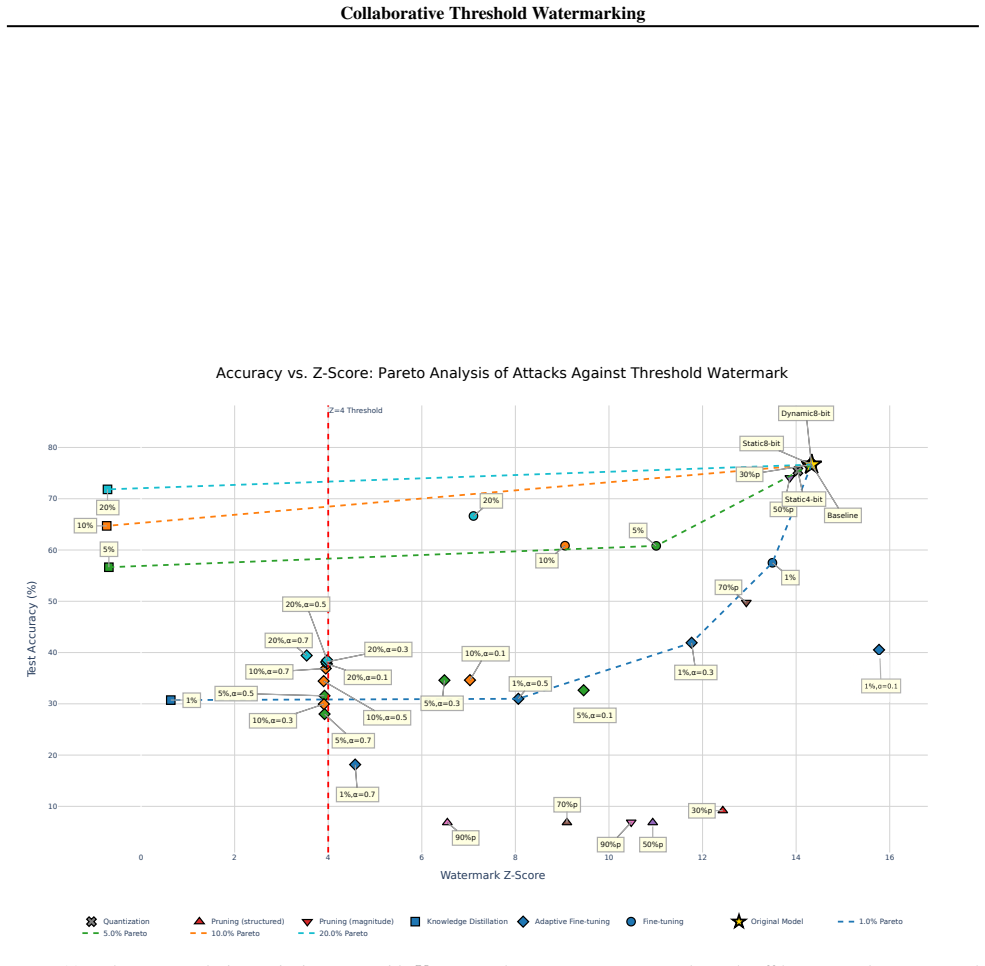
- Post-training removal resistance holds against pruning, quantization, fine-tuning, and adaptive fine-tuning when the attacker has at most 20% of training data; only distillation with substantial data removes the mark.
- The same verified key can be checked repeatedly across checkpoints without revealing tau, enabling provenance checks over time.
- Threshold t gives a tunable governance knob: choose t = K for unanimous verification or t = 3 for majority control in a consortium.
Where Pith is reading between the lines
- Beyond the paper: the protocol in its current form is white-box, so it cannot verify models exposed only through an API; a black-box route would need a different embedding and verification layer.
- Beyond the paper: the normality assumption for the null distribution is fitted on 10,000 samples per dataset; if the true tail is heavier than the fitted normal, the claimed 3.2e-5 false-positive rate at z = 4 may be optimistic.
- Beyond the paper: the authors do not provide a theoretical lower bound on an attacker's ability to estimate the watermark direction from the visible training trajectory, so stronger adaptive attacks than the one tested may exist.
- Beyond the paper: the protocol assumes honest-but-curious participants; extending it to Byzantine clients or a malicious server would require additional robustness mechanisms.
Editorial analysis
A structured set of objections, weighed in public.
Referee Report
Summary. The paper proposes a (t,K)-threshold watermarking protocol for federated learning. A trusted dealer (or a dealer-free DKG) distributes Shamir shares of a secret key τ; each client derives an additive embedding share w_k = λ_k s_k so that Σ w_k = τ. During FedAvg training, clients add a globally scaled watermark vector to their local updates under secure aggregation, so the aggregate update carries a component proportional to τ. Verification by any coalition of at least t clients computes ⟨θ_s, τ⟩ through Lagrange-weighted inner products with their shares, without revealing τ, and then applies a one-sided z-test calibrated from the cosine similarity of unwatermarked models with random vectors. Experiments on CIFAR-10, CIFAR-100, and Tiny ImageNet show detectability for K up to 128, small accuracy loss, and robustness to fine-tuning, pruning, quantization, and adaptive fine-tuning; distillation is reported as the main successful removal attack.
Significance. The threshold property is a natural and practically motivated extension of model watermarking, and the algebraic core is sound: Eq. (2)–(3) correctly convert Shamir shares into additive embedding shares, and Eq. (8) correctly computes the verification inner product without reconstructing τ. The paper also provides a useful baseline comparison showing that per-client watermarks dilute with K. If the empirical claims are sustained, this would be a meaningful advance for collaborative ownership verification. However, two load-bearing empirical claims currently rest on weak evidence: the z=4 false-positive rate is a normal-tail extrapolation from a small fitted null, and the adaptive fine-tuning attack uses an estimator of τ that may be confounded with the watermark itself. These issues do not invalidate the protocol construction, but they require substantial revision before the robustness and FPR claims can be accepted.
major comments (3)
- [§5.1, Eq. (9)] The detection threshold z*=4 is justified by 'FPR ≈ 3.2e-5', which is a normal-tail extrapolation. The null mean and standard deviation are fitted from 10,000 cosine samples per dataset (five models × 2000 random vectors), and the histograms in Figure 2 span approximately ±0.04, i.e., only about ±4 fitted σ. No empirical mass is available at the 4σ tail, so a heavier-tailed distribution would make the actual FPR orders of magnitude larger. Additionally, after attacks the null distribution of cosine similarity for unwatermarked models may shift, yet the same fitted μ and σ are used for all post-attack z-scores. Please replace the normal-tail claim with an empirical CDF/order-statistic calibration, a conservative threshold, or a direct measurement of FPR on a large set of unwatermarked, attacked models.
- [Appendix D.2, Eq. (10), Fig. 4] The adaptive fine-tuning attack estimates τ′ by 'accumulating the gradient over the training process.' Because each round's global update contains (scaletotal/K)·τ, this estimator is likely strongly correlated with τ. Under the attack loss L′ = (1−α)L + α‖τ′‖₁, penalizing a τ′-correlated vector is not equivalent to removing the true watermark; in the extreme case τ′=τ, the penalty is ordinary L1 regularization, which need not reduce alignment with τ. The paper itself acknowledges in Section 6 that 'an attacker may attempt to estimate the watermark key from checkpoints' and provides no theoretical lower bound. To support the claimed robustness against adaptive fine-tuning, the attack must be rerun with an estimator that is provably unbiased or whose correlation with τ is measured and reported; otherwise the high post-attack z-scores in Figure 4 may be an artifact of attacking a correlated
- [§2.4, §4.1, Appendix B] The protocol is described over real-valued vectors τ, s_i, w_i ∈ R^d, but Shamir secret sharing and secure aggregation are defined over finite fields. The paper does not specify the fixed-point encoding, field size, or rounding behavior. This is not a pedantic point: Lagrange reconstruction over rounded floating-point shares introduces an error in Eq. (2) and Eq. (8), and the dealer-free DKG in Appendix B samples additive shares from N(0, I_d/K) and evaluates polynomials over the reals, which is not a finite-field operation as written. Please specify the encoding and quantify the reconstruction error relative to the watermark strength c. Without this, the exact identity Σ w_k = τ and the information-theoretic secrecy claims are only approximate.
minor comments (5)
- [Abstract / §6 Limitations] The abstract states the method is evaluated on 'both IID and non-IID partitions,' but Section 6 says 'our experiments assume IID partitions,' and no non-IID experiments appear in the main text or appendices. Please correct the abstract or add non-IID results.
- [Eq. (5)] The adaptive scaling formula scalek = c·‖Δθ‖₂·ema_k multiplies the current update norm by its EMA, so the effective strength scales quadratically with update magnitude. The text describes this as scaling by 'recent update norms' but does not motivate the product form. Either explain the design or simplify to c·ema_k (or another monotone function).
- [Figure 7 caption] The caption says 'varying watermark strengths (c∈{0.075,0.05,0.025})' while the main text reports c=0.025; the figure legend is also inconsistent with the notation used elsewhere (capital C vs lowercase c). Please harmonize.
- [Table 2 / Appendix D.2] The notation table omits τ′ (used in Appendix D.2) and does not list z_s/z_t from Eq. (11). Please complete the table.
- [§4.2, Algorithm 2] The text states that the server is untrusted, but the server observes the entire global model trajectory, which is watermarked. The paper acknowledges this in Section 6 but should also state explicitly in the threat model that the server can attempt the same checkpoint-based key-estimation attack as a coalition of <t clients, and that no security claim is made against such an adversary.
Circularity Check
No significant circularity: the threshold-watermarking algebra is self-contained; the only self-citation is background and not load-bearing.
full rationale
The paper's central derivation chain is algebraic and self-contained. The watermark key τ is sampled, Shamir-shared, and converted to additive shares via public Lagrange coefficients (Eq. 3: w_k = λ_k s_k, so Σw_k = τ). Embedding adds (scale_total/K)·τ per round by construction (Eq. 6–7), and verification computes ⟨θ_s, τ⟩ from shares by linearity (Eq. 8). These are definitions/algebra, not predictions derived from fitted inputs. The z-score (Eq. 9) uses μ and σ calibrated from unwatermarked models' cosine similarities with random vectors; this is standard null calibration, and the claimed FPR at z=4 rests on a normality assumption that is a statistical validity concern, not circularity. The only self-citation is Lukas et al. (2021), which supports background robustness claims and a stated limitation ('not robust when the adversary has sufficient training data'); it is not load-bearing for the protocol construction. Section 6 explicitly acknowledges no theoretical lower bound on estimating the key, and the adaptive fine-tuning loss (Eq. 10: L' = (1−α)L + α∥τ′∥₁) is questionable—if τ′ is fixed, the penalty is constant w.r.t. model parameters, so the 'adaptive' attack may reduce to scaled fine-tuning. This is a correctness risk in the empirical robustness evidence, not a circular reduction of the protocol's derivation. Overall, no step in the claimed derivation is equivalent to its inputs by construction; score 2 reflects only the minor, non-load-bearing self-citation and the caveats around the adaptive-attack evaluation.
Axiom & Free-Parameter Ledger
free parameters (4)
- watermark strength c =
0.025 default; 0.05, 0.075, 0.10 in ablations
- EMA decay beta =
0.9
- detection threshold z* =
4
- null distribution mu, sigma =
e.g., CIFAR-10 mu≈-0.0001, sigma≈0.0101
axioms (5)
- standard math Shamir (t,K)-threshold secret sharing hides tau from any <t shares
- standard math Secure aggregation returns only the sum and hides individual inputs
- domain assumption Honest-but-curious clients; no training-time malicious adversaries
- domain assumption Cosine similarity of unwatermarked models with random vectors is approximately normal
- ad hoc to paper Real-valued weight vectors can be Shamir-shared via fixed-point encoding without leaking info
Cite this review
Pith. "Pith review of Collaborative Threshold Watermarking." pith.science (2026). https://pith.science/paper/VRJCTBM6
@misc{pith2026260210765,
  author       = {Pith},
  title        = {Pith review of: Collaborative Threshold Watermarking},
  year         = {2026},
  howpublished = {\url{https://pith.science/paper/VRJCTBM6}},
  note         = {Machine review of arXiv:2602.10765}
}
read the original abstract
In federated learning (FL), $K$ clients jointly train a model without sharing raw data. Because each participant invests data and compute, clients need mechanisms to later prove the provenance of a jointly trained model. Model watermarking embeds a hidden signal in the weights, but naive approaches either do not scale with many clients as per-client watermarks dilute as $K$ grows, or give any individual client the ability to verify and potentially remove the watermark. We introduce $(t,K)$-threshold watermarking: clients collaboratively embed a shared watermark during training, while only coalitions of at least $t$ clients can reconstruct the watermark key and verify a suspect model. We secret-share the watermark key $\tau$ so that coalitions of fewer than $t$ clients cannot reconstruct it, and verification can be performed without revealing $\tau$ in the clear. We instantiate our protocol in the white-box setting and evaluate it on image classification tasks on both IID and non-IID partitions, as well as language models fine-tuning setting. Our watermark remains detectable at scale ($K=128$) with minimal accuracy loss and stays above the detection threshold ($z\ge 4$) under attacks including adaptive fine-tuning using up to 20% of the training data. Code is available at https://github.com/tameemalaa/collaborative-threshold-watermark.
Figures



Reference graph
Works this paper leans on
-
[2020]
ISBN 978-0367331756. Krizhevsky, A. Learning multiple layers of features from tiny images. Technical Report TR-2009, University of Toronto, 2009. Lansari, M., Bellafqira, R., Kapusta, K., Thouvenot, V ., Bettan, O., and Coatrieux, G. When federated learning meets watermarking: A comprehensive overview of tech- niques for intellectual property protection, ...
Pith/arXiv arXiv 2009
-
[2022]
Beaufays, F., Rao, K., Mathews, R., and Ramaswamy, S
URL https://proceedings.mlr.press/ v162/bansal22a.html. Beaufays, F., Rao, K., Mathews, R., and Ramaswamy, S. Federated learning for emoji prediction in a mobile keyboard, 2019. URL https://arxiv.org/abs/ 1906.04329. Boenisch, F. A systematic review on model water- marking for neural networks.Frontiers in Big Data, V olume 4 - 2021, 2021. ISSN 2624-909X. ...
Pith/arXiv arXiv 2019
-
[2023]
ISBN 978-1-57735-880-0. doi: 10.1609/aaai. v37i13.26847. URL https://doi.org/10.1609/ aaai.v37i13.26847. Paszke, A., Gross, S., Massa, F., Lerer, A., Bradbury, J., Chanan, G., Killeen, T., Lin, Z., Gimelshein, N., Antiga, L., Desmaison, A., K¨opf, A., Yang, E., DeVito, Z., Rai- son, M., Tejani, A., Chilamkurthy, S., Steiner, B., Fang, L., Bai, J., and Chi...
Pith/arXiv arXiv 2019
-
[2024]
URL https://www.biorxiv.org/content/ early/2024/12/10/2024.12.06.627138
doi: 10.1101/2024.12.06.627138. URL https://www.biorxiv.org/content/ early/2024/12/10/2024.12.06.627138. NVIDIA. Federated learning for healthcare using nvidia clara, September 2021. URL https:// developer.download.nvidia.com/CLARA/ Federated-Learning-Training-for-Healthcare-Using-NVIDIA-Clara. pdf. SWE-CLARA-001-USCA. Oldenhof, M., ´Acs, G., Pej´o, B., S...
discussion (0)
Sign in with ORCID, Apple, or X to comment. Anyone can read and Pith papers without signing in.