REVIEW 4 major objections 6 minor 53 references
Hi-SAM claims that disentangling shared cross-modal semantics from modality-specific detail in semantic IDs, plus a hierarchy-aware transformer with anchor memory, consistently beats prior recommenders and lifts online response rate by 6.55
Reviewed by Pith at T0; open to challenge. T0 means a machine referee read the full paper against a public rubric. the ladder, T0–T4 →
T0 review · deepseek-v4-flash
2026-08-02 23:59 UTC pith:RMVLFQI4
load-bearing objection Credible architecture, plausible mechanism, but the empirical case is under-specified: baseline feature pipelines and the H parameter conflict need pinning down before the headline gains can be evaluated. the 4 major comments →
Hi-SAM: A Hierarchical Structure-Aware Multi-modal Framework for Large-Scale Recommendation
The pith
A machine-rendered reading of the paper's core claim, the machinery that carries it, and where it could break.
Core claim
Central claim: disentangled semantic IDs plus a hierarchy-aware decoder let multimodal content beat both sparse-ID and prior semantic-ID recommenders overall, not just in cold start. The DST aligns image, text, and behavior embeddings on a hypersphere, quantizes shared consensus with one codebook stack, recovers per-modality detail from residuals, and minimizes mutual information between the two. The HMAT encodes item order and within-item position in orthogonal RoPE subspaces and forces historical attention through compressed anchor tokens. Reported evidence: higher AUC and GAUC on all datasets, several-point cold-start gains, a 6.55% online Response Rate lift, and 35% lower latency.
What carries the argument
Two coupled mechanisms carry the argument. (1) Disentangled Semantic Tokenizer (DST): cross-modal geometric alignment projects each modality onto a unit hypersphere and shrinks the volume of the parallelotope they span; Disentangled Modal-Residual Quantization then aggregates aligned features, quantizes residuals with shared codebooks for consensus, unfolds the leftover residual into subspaces, and uses each modality's aligned features as queries to recover modality-specific codes, with an upper-bound mutual-information term enforcing that specific codes carry no shared information. (2) Hierarchical Memory-Anchor Transformer (HMAT): Hierarchical RoPE gives each token a coordinate (item index
Load-bearing premise
The load-bearing premise is Section 4.1's assertion that baselines were 'strictly aligned' in feature configuration and model complexity, plus the claim that the behavior encoder, trained on time-isolated samples, is leakage-free; if either fails, the reported GAUC gaps may reflect encoder capacity or leakage rather than the architecture.
What would settle it
Re-run the main comparison with every baseline given the same input features and encoder stack as Hi-SAM (same vision-language and behavior embeddings, same compute budget) and with the behavior encoder trained without the time-isolation restriction; if the GAUC gaps shrink to noise, the reported gains are mostly encoder capacity or leakage. A second check: remove the mutual-information term from DST and see whether the layer-wise code-correlation diagonal pattern in Figure 3 disappears.
If this is right
- If the claims hold, semantic-ID recommenders can surpass sparse-ID models on overall ranking, closing the gap that earlier semantic-ID methods left open.
- Cold-start users are the main beneficiaries: the online A/B test reports a +16.62% Response Rate lift for cold-start users, alongside offline GAUC and AUC gains of several points.
- Hierarchical position encoding plus anchor memory makes long multimodal sequences computationally tractable, with about 35% lower response time at matched compute.
- Pre-training the decoder on next-token prediction before supervised fine-tuning adds consistent gains, suggesting that learning semantics and modeling preferences should be decoupled.
- The framework scales smoothly with depth and sequence length, with GAUC rising as compute increases.
Where Pith is reading between the lines
- My inference, not the paper's claim: the mutual-information penalty is directly testable—if DST truly disentangles, ablating one modality's specific code should degrade prediction for that modality's attributes while leaving others intact.
- My inference: part of the gain may come from noise filtering rather than semantic richness; an ablation replacing semantic IDs with random but hierarchy-preserving tokens would isolate the two effects.
- My inference: because the online baseline is a DLRM, the 6.55% lift likely bundles encoder-capacity gains with architecture gains; an online A/B against the strongest semantic-ID baseline would separate them.
- My inference: a natural untested extension is reusing Hi-SAM's item codes across domains or platforms, since content-level IDs should transfer better than sparse IDs.
Editorial analysis
A structured set of objections, weighed in public.
Referee Report
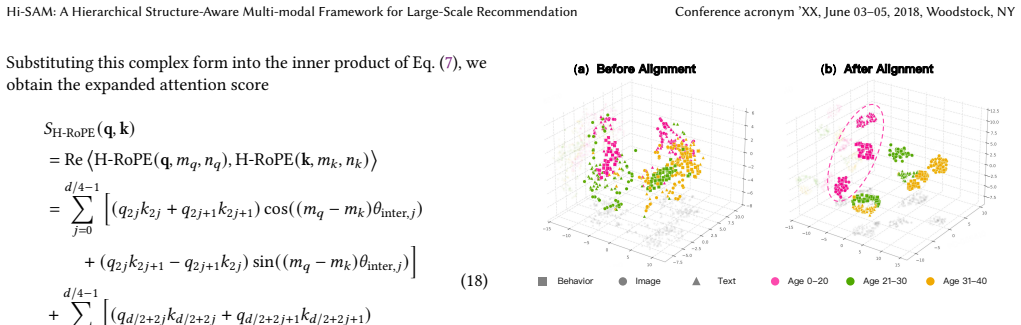
Summary. This manuscript proposes Hi-SAM, a two-stage framework for multimodal semantic-ID-based recommendation. Stage 1 (DST) aligns image/text/behavior embeddings on a hypersphere (CGA, via GRAM-style volume minimization) and quantizes them into shared and modality-specific discrete tokens (DMRQ) under a mutual-information penalty. Stage 2 (HMAT) introduces Hierarchical RoPE with split inter-item/intra-item subspaces and Memory-Anchor Attention, along with anchor-based KV-cache eviction. Offline experiments on Amazon Books, Movies & TV, and an industrial dating dataset report consistent state-of-the-art gains, with especially large cold-start improvements; online A/B reports a +6.55% Response Rate gain and a 35% latency reduction. The appendix contains derivations of the vCLUB MI bound, the quantization losses, and the H-RoPE attention expansion.
Significance. The design is well-motivated and timely: semantic-ID recommenders do suffer from flat tokenization and cross-modal redundancy, and the proposed disentangled tokenizer plus hierarchy-aware transformer is a plausible and practically relevant direction. The anchor-based attention with lossless KV-cache eviction is also a useful industrial contribution. The paper provides clear derivations and fairly detailed hyperparameters, which is a strength. However, the central empirical attribution is currently under-supported: the claimed gains may reflect the capacity of the large pretrained encoders or the behavioral encoder rather than the proposed architecture, the leakage barrier for the behavioral encoder is not specified, and the offline results lack any uncertainty quantification. If these issues are resolved, the work would make a solid contribution to large-scale multimodal recommendation.
major comments (4)
- [§4.1, §4.2, Appendix B.2] The claim that all baselines are 'strictly aligned' in feature configuration is not substantiated. Only Hi-SAM's input pipeline is specified: BLIP-2 (2.7B) for image/text plus a SASRec-based behavioral encoder (Appendix B.2); the baselines use official implementations or 'strictly follow original papers.' The reported gains — e.g., Industrial GAUC from 0.6131 (PSRQ+MCCA) to 0.6410 (Hi-SAM-Small) in Table 2 — may therefore reflect dense encoder capacity rather than DST/HMAT. The same confound affects Table 3, where DST is compared against QARM/PSRQ under a common HSTU backbone: if the tokenizers receive different content features, the ablation does not isolate the tokenizer. Additionally, MTGR receives extra cross features, contradicting the 'same feature set' statement. Please provide per-baseline encoder/preprocessing specifications and add an experiment where every tokenizer is applied
- [§4.1 Implementation Details vs. Appendix B.2] The number of PSGR subspaces is inconsistent: Section 4.1 states H=8, while Appendix B.2 states H=4. PSGR is a load-bearing component of DMRQ (Section 3.2.2, Eq. (2)), so the discrepancy is not cosmetic. Please state the actual value used for Tables 2–4 and correct the affected text, or re-run the results with the correct configuration.
- [§4.2, Table 2] No measure of uncertainty is reported for any offline metric. The data are from a single 90/10 chronological split; there are no seeds, standard deviations, or significance tests. Several headline differences on the public datasets are small (e.g., Book GAUC 0.6501 vs. 0.6588; Book Cold AUC 0.6877 vs. 0.6924), so the claim of 'consistently outperforms all baselines across all metrics' is not yet established. Please report repeated-seed means with error bars and paired significance tests, or at least bootstrap confidence intervals. Online A/B results in Table 5 should likewise report confidence intervals and should account for testing multiple variants.
- [Appendix B.2] The behavioral encoder's leakage barrier is asserted but not specified. The text says the SASRec encoder is 'trained on samples strictly isolated by time from the downstream ranking data,' but it does not state the isolation interval, how user/item identity is handled, or how behavioral embeddings are computed at test time. Since Figure 2 shows the behavioral modality alone is the strongest input and cold-start gains are a core claim, any temporal overlap would inflate Cold GAUC (e.g., 0.5835 in Table 2). Please give the exact protocol, including the exclusion-window length, and provide a leakage check (e.g., behavior-embedding accuracy under randomly permuted time).
minor comments (6)
- [§3.2.1, Eq. (1)] K is undefined. Specify how many negatives are used and whether they are in-batch negatives or sampled from a separate memory bank.
- [§3.3.2, Eq. (10)] The condition 'k=[ANC]' compares a key index with a token. Rephrase as 'the key token is an Anchor Token' to avoid confusion.
- [§4.2, Table 2] Clarify whether the 'w/PT+SFT' row is Hi-SAM-Large with semantic pretraining; the row label is ambiguous as printed.
- [§3.4.2] In 'One-Pass Parallel Ranking,' specify how the candidate coordinates are reset — for all candidate tokens or only item tokens — and how this interacts with the H-RoPE positions of the action tokens.
- [§4.5, Figure 4(c)] Provide the exact (depth, sequence length, GFLOPs) values for the plotted points. As printed, the scaling-law claim cannot be reproduced from the figure.
- [§4.6, Table 5] Report the A/B test duration, number of users per bucket, and statistical significance. Also state whether the DLRM baseline was concurrently updated during the two-month experiment.
Circularity Check
No significant circularity; Hi-SAM's derivation is self-contained against external methods and external benchmarks.
full rationale
The paper's derivation chain does not reduce to its own inputs. The DST tokenizer is built from external, independently published components (GRAM [6], RQ-VAE [28], vCLUB [5]); its objectives (Eq. 1, Eq. 2) are geometric alignment, residual reconstruction, and mutual-information minimization, none of which contains the recommendation metric being predicted. The HMAT stage is trained with standard next-token/NLL objectives (Eq. 11 and the pre-training loss) over the discrete token stream; no equation defines an output in terms of the target GAUC, Cold GAUC, or Response Rate. The only author self-citations are PSRQ+MCCA [37] and Climber [40]. PSRQ+MCCA is used as a baseline competitor whose reported results are compared against, not as evidence for Hi-SAM's effectiveness; Climber is cited for an established one-pass ranking/inference trick and does not carry the central claim. Evaluation is against external Amazon 2023 benchmarks and a production DLRM baseline, so the main results are externally falsifiable. Concerns raised in the reader's take about baseline feature-alignment and possible leakage are experimental-validity risks, not circularity: even if the 'strictly aligned' claim (Sec. 4.1) were false, it would weaken attribution but would not make any derivation equivalent to its inputs. The H=8 vs H=4 discrepancy and under-specified baseline encoders are transparency/correctness issues, not circular steps. Therefore, no circularity is found.
Axiom & Free-Parameter Ledger
free parameters (6)
- Codebook size (512 x 256) =
512 codes x 256 dims
- Quantization depth N_sh=3, N_sp=1 =
3 shared layers + 1 per modality
- PSGR subspace count H =
8 (Section 4.1) vs 4 (Appendix B.2)
- H-RoPE base frequencies =
B_inter=10^4, B_intra=10^2
- Loss weights beta and lambda =
not reported
- Maximum sequence length =
300
axioms (5)
- domain assumption GRAM volume minimization on the unit hypersphere is a valid way to align multiple modalities
- standard math vCLUB with a Gaussian variational family yields a reliable upper bound on mutual information
- domain assumption RQ-VAE residual quantization converges to useful codebooks
- domain assumption The SASRec behavioral encoder trained on time-separated samples contains no label leakage
- standard math Block-diagonal rotation applies separately to the first d/2 and last d/2 dimensions without cross-interference
invented entities (3)
-
Anchor Token ([ANC])
no independent evidence
-
H-RoPE coordinate (m,n) with split inter/intra subspaces
no independent evidence
-
Shared and modality-specific codebooks
no independent evidence
read the original abstract
Multi-modal recommendation has gained traction as items possess rich attributes like text and images. Semantic ID-based approaches effectively discretize this information into compact tokens. However, two challenges persist: (1) Suboptimal Tokenization: existing methods (e.g., RQ-VAE) lack disentanglement between shared cross-modal semantics and modality-specific details, causing redundancy or collapse; (2) Architecture-Data Mismatch: vanilla Transformers treat semantic IDs as flat streams, ignoring the hierarchy of user interactions, items, and tokens. Expanding items into multiple tokens amplifies length and noise, biasing attention toward local details over holistic semantics. We propose Hi-SAM, a Hierarchical Structure-Aware Multi-modal framework with two designs: (1) Disentangled Semantic Tokenizer (DST): unifies modalities via geometry-aware alignment and quantizes them via a coarse-to-fine strategy. Shared codebooks distill consensus while modality-specific ones recover nuances from residuals, enforced by mutual information minimization; (2) Hierarchical Memory-Anchor Transformer (HMAT): splits positional encoding into inter- and intra-item subspaces via Hierarchical RoPE to restore hierarchy. It inserts Anchor Tokens to condense items into compact memory, retaining details for the current item while accessing history only through compressed summaries. Experiments on real-world datasets show consistent improvements over SOTA baselines, especially in cold-start scenarios. Deployed on a large-scale social platform serving millions of users, Hi-SAM achieved a 6.55% gain in the core online metric.
Figures


Reference graph
Works this paper leans on
-
[1]
Understanding scaling laws for recommendation models.arXiv preprint arXiv:2208.08489, 2022
Newsha Ardalani, Carole-Jean Wu, Zeliang Chen, Bhargav Bhushanam, and Adnan Aziz. Understanding scaling laws for recommendation models.arXiv preprint arXiv:2208.08489, 2022
Pith/arXiv arXiv 2022
-
[2]
Qwen technical report.arXiv preprint arXiv:2309.16609, 2023
Jinze Bai, Shuai Bai, Yunfei Chu, Zeyu Cui, Kai Dang, Xiaodong Deng, Yang Fan, Wenbin Ge, Yu Han, Fei Huang, et al. Qwen technical report.arXiv preprint arXiv:2309.16609, 2023
Pith/arXiv arXiv 2023
-
[3]
Tallrec: An effective and efficient tuning framework to align large language model with recommendation
Keqin Bao, Jizhi Zhang, Yang Zhang, Wenjie Wang, Fuli Feng, and Xiangnan He. Tallrec: An effective and efficient tuning framework to align large language model with recommendation. InProceedings of the 17th ACM conference on recommender systems, pages 1007–1014, 2023
2023
-
[4]
Wide & deep learning for recommender systems
Heng-Tze Cheng, Levent Koc, Jeremiah Harmsen, Tal Shaked, Tushar Chandra, Hrishi Aradhye, Glen Anderson, Greg Corrado, Wei Chai, Mustafa Ispir, et al. Wide & deep learning for recommender systems. InProceedings of the 1st workshop on deep learning for recommender systems, pages 7–10, 2016
2016
-
[5]
Club: A contrastive log-ratio upper bound of mutual information
Pengyu Cheng, Weituo Hao, Shuyang Dai, Jiachang Liu, Zhe Gan, and Lawrence Carin. Club: A contrastive log-ratio upper bound of mutual information. In International conference on machine learning, pages 1779–1788. PMLR, 2020
2020
-
[6]
Gramian multimodal representation learning and alignment
Giordano Cicchetti, Eleonora Grassucci, Luigi Sigillo, Danilo Comminiello, et al. Gramian multimodal representation learning and alignment. InProceedings of International Conference on Learning Representations (ICLR 2025). ICLR, 2025
2025
-
[7]
Early vs late fusion in multimodal convolutional neural networks
Konrad Gadzicki, Razieh Khamsehashari, and Christoph Zetzsche. Early vs late fusion in multimodal convolutional neural networks. In2020 IEEE 23rd international conference on information fusion (FUSION), pages 1–6. IEEE, 2020
2020
-
[8]
Recommendation as language processing (rlp): A unified pretrain, personalized prompt & predict paradigm (p5)
Shijie Geng, Shuchang Liu, Zuohui Fu, Yingqiang Ge, and Yongfeng Zhang. Recommendation as language processing (rlp): A unified pretrain, personalized prompt & predict paradigm (p5). InProceedings of the 16th ACM conference on recommender systems, pages 299–315, 2022
2022
-
[9]
Huifeng Guo, Ruiming Tang, Yunming Ye, Zhenguo Li, and Xiuqiang He. Deepfm: a factorization-machine based neural network for ctr prediction.arXiv preprint arXiv:1703.04247, 2017
Pith/arXiv arXiv 2017
-
[10]
Mtgr: Industrial-scale generative recommendation framework in meituan
Ruidong Han, Bin Yin, Shangyu Chen, He Jiang, Fei Jiang, Xiang Li, Chi Ma, Mincong Huang, Xiaoguang Li, Chunzhen Jing, et al. Mtgr: Industrial-scale generative recommendation framework in meituan. InProceedings of the 34th ACM International Conference on Information and Knowledge Management, pages 5731–5738, 2025
2025
-
[11]
Vbpr: visual bayesian personalized ranking from implicit feedback
Ruining He and Julian McAuley. Vbpr: visual bayesian personalized ranking from implicit feedback. InProceedings of the AAAI conference on artificial intelligence, volume 30, 2016
2016
-
[12]
Towards universal sequence representation learning for recommender sys- tems
Yupeng Hou, Shanlei Mu, Wayne Xin Zhao, Yaliang Li, Bolin Ding, and Ji-Rong Wen. Towards universal sequence representation learning for recommender sys- tems. InProceedings of the 28th ACM SIGKDD conference on knowledge discovery and data mining, pages 585–593, 2022
2022
-
[13]
Learning vector-quantized item representation for transferable sequential recommenders
Yupeng Hou, Zhankui He, Julian McAuley, and Wayne Xin Zhao. Learning vector-quantized item representation for transferable sequential recommenders. InProceedings of the ACM Web Conference 2023, pages 1162–1171, 2023
2023
-
[14]
Bridging language and items for retrieval and recommendation.arXiv preprint arXiv:2403.03952, 2024
Yupeng Hou, Jiacheng Li, Zhankui He, An Yan, Xiusi Chen, and Julian McAuley. Bridging language and items for retrieval and recommendation.arXiv preprint arXiv:2403.03952, 2024
Pith/arXiv arXiv 2024
-
[15]
Multimodal representation learning for recommendation in internet of things.IEEE Internet of Things Journal, 6(6):10675–10685, 2019
Zhenhua Huang, Xin Xu, Juan Ni, Honghao Zhu, and Cheng Wang. Multimodal representation learning for recommendation in internet of things.IEEE Internet of Things Journal, 6(6):10675–10685, 2019
2019
-
[16]
Self-attentive sequential recommenda- tion
Wang-Cheng Kang and Julian McAuley. Self-attentive sequential recommenda- tion. In2018 IEEE international conference on data mining (ICDM), pages 197–206. IEEE, 2018
2018
-
[17]
Scaling laws for neural language models.arXiv preprint arXiv:2001.08361, 2020
Jared Kaplan, Sam McCandlish, Tom Henighan, Tom B Brown, Benjamin Chess, Rewon Child, Scott Gray, Alec Radford, Jeffrey Wu, and Dario Amodei. Scaling laws for neural language models.arXiv preprint arXiv:2001.08361, 2020
Pith/arXiv arXiv 2001
-
[18]
Au- toregressive image generation using residual quantization
Doyup Lee, Chiheon Kim, Saehoon Kim, Minsu Cho, and Wook-Shin Han. Au- toregressive image generation using residual quantization. InProceedings of the IEEE/CVF conference on computer vision and pattern recognition, pages 11523– 11532, 2022
2022
-
[19]
Blip-2: Bootstrapping language-image pre-training with frozen image encoders and large language models
Junnan Li, Dongxu Li, Silvio Savarese, and Steven Hoi. Blip-2: Bootstrapping language-image pre-training with frozen image encoders and large language models. InInternational conference on machine learning, pages 19730–19742. PMLR, 2023
2023
-
[20]
Wenhao Li, Qiangchang Wang, Xianjing Meng, Zhibin Wu, and Yilong Yin. Vt- fsl: Bridging vision and text with llms for few-shot learning.arXiv preprint arXiv:2509.25033, 2025
arXiv 2025
-
[21]
Qarm: Quantitative alignment multi-modal recommendation at kuaishou
Xinchen Luo, Jiangxia Cao, Tianyu Sun, Jinkai Yu, Rui Huang, Wei Yuan, Hezheng Lin, Yichen Zheng, Shiyao Wang, Qigen Hu, et al. Qarm: Quantitative alignment multi-modal recommendation at kuaishou. InProceedings of the 34th ACM International Conference on Information and Knowledge Management, pages 5915– 5922, 2025
2025
-
[22]
Entire space multi-task model: An effective approach for estimating post-click conversion rate
Xiao Ma, Liqin Zhao, Guan Huang, Zhi Wang, Zelin Hu, Xiaoqiang Zhu, and Kun Gai. Entire space multi-task model: An effective approach for estimating post-click conversion rate. InThe 41st International ACM SIGIR Conference on Research & Development in Information Retrieval, pages 1137–1140, 2018
2018
-
[23]
Multimodal movie recommendation system using deep learning.Mathematics, 11(4):895, 2023
Yongheng Mu and Yun Wu. Multimodal movie recommendation system using deep learning.Mathematics, 11(4):895, 2023
2023
-
[24]
Multimodal deep learning
Jiquan Ngiam, Aditya Khosla, Mingyu Kim, Juhan Nam, Honglak Lee, Andrew Y Ng, et al. Multimodal deep learning. InICML, volume 11, pages 689–696, 2011
2011
-
[25]
Balanced multimodal learning via on-the-fly gradient modulation
Xiaokang Peng, Yake Wei, Andong Deng, Dong Wang, and Di Hu. Balanced multimodal learning via on-the-fly gradient modulation. InProceedings of the IEEE/CVF conference on computer vision and pattern recognition, pages 8238–8247, 2022
2022
-
[26]
Shutong Qiao, Wei Yuan, Tong Chen, Xiangyu Zhao, Quoc Viet Hung Nguyen, and Hongzhi Yin. When text-as-vision meets semantic ids in generative recom- mendation: An empirical study.arXiv preprint arXiv:2601.14697, 2026
arXiv 2026
-
[27]
Learning transferable visual models from natural language supervision
Alec Radford, Jong Wook Kim, Chris Hallacy, Aditya Ramesh, Gabriel Goh, Sandhini Agarwal, Girish Sastry, Amanda Askell, Pamela Mishkin, Jack Clark, et al. Learning transferable visual models from natural language supervision. In International conference on machine learning, pages 8748–8763. PmLR, 2021
2021
-
[28]
Recommender systems with generative retrieval.Advances in Neural Information Processing Systems, 36:10299–10315, 2023
Shashank Rajput, Nikhil Mehta, Anima Singh, Raghunandan Hulikal Keshavan, Trung Vu, Lukasz Heldt, Lichan Hong, Yi Tay, Vinh Tran, Jonah Samost, et al. Recommender systems with generative retrieval.Advances in Neural Information Processing Systems, 36:10299–10315, 2023
2023
-
[29]
Sentence-bert: Sentence embeddings using siamese bert-networks.arXiv preprint arXiv:1908.10084, 2019
Nils Reimers and Iryna Gurevych. Sentence-bert: Sentence embeddings using siamese bert-networks.arXiv preprint arXiv:1908.10084, 2019
Pith/arXiv arXiv 1908
-
[30]
The persistence and transience of memory.Neuron, 94(6):1071–1084, 2017
Blake A Richards and Paul W Frankland. The persistence and transience of memory.Neuron, 94(6):1071–1084, 2017
2017
-
[31]
Scaling law for recommendation models: Towards general-purpose user representations
Kyuyong Shin, Hanock Kwak, Su Young Kim, Max Nihlén Ramström, Jisu Jeong, Jung-Woo Ha, and Kyung-Min Kim. Scaling law for recommendation models: Towards general-purpose user representations. InProceedings of the AAAI con- ference on artificial intelligence, volume 37, pages 4596–4604, 2023
2023
-
[32]
Better generalization with semantic ids: A case study in ranking for recommendations
Anima Singh, Trung Vu, Nikhil Mehta, Raghunandan Keshavan, Maheswaran Sathiamoorthy, Yilin Zheng, Lichan Hong, Lukasz Heldt, Li Wei, Devansh Tandon, et al. Better generalization with semantic ids: A case study in ranking for recommendations. InProceedings of the 18th ACM Conference on Recommender Systems, pages 1039–1044, 2024
2024
-
[33]
Bert4rec: Sequential recommendation with bidirectional encoder representations from transformer
Fei Sun, Jun Liu, Jian Wu, Changhua Pei, Xiao Lin, Wenwu Ou, and Peng Jiang. Bert4rec: Sequential recommendation with bidirectional encoder representations from transformer. InProceedings of the 28th ACM international conference on information and knowledge management, pages 1441–1450, 2019
2019
-
[34]
Setrank: A setwise bayesian approach for collaborative ranking from implicit feedback
Chao Wang, Hengshu Zhu, Chen Zhu, Chuan Qin, and Hui Xiong. Setrank: A setwise bayesian approach for collaborative ranking from implicit feedback. InProceedings of the aaai conference on artificial intelligence, volume 34, pages 6127–6136, 2020
2020
-
[35]
Deep & cross network for ad click predictions
Ruoxi Wang, Bin Fu, Gang Fu, and Mingliang Wang. Deep & cross network for ad click predictions. InProceedings of the ADKDD’17, pages 1–7. 2017
2017
-
[36]
Dcn v2: Improved deep & cross network and practical lessons for web-scale learning to rank systems
Ruoxi Wang, Rakesh Shivanna, Derek Cheng, Sagar Jain, Dong Lin, Lichan Hong, and Ed Chi. Dcn v2: Improved deep & cross network and practical lessons for web-scale learning to rank systems. InProceedings of the web conference 2021, pages 1785–1797, 2021
2021
-
[37]
Progressive semantic residual quantization for multimodal-joint interest modeling in music recommendation
Shijia Wang, Tianpei Ouyang, Qiang Xiao, Dongjing Wang, Yintao Ren, Songpei Xu, Da Guo, and Chuanjiang Luo. Progressive semantic residual quantization for multimodal-joint interest modeling in music recommendation. InProceedings of the 34th ACM International Conference on Information and Knowledge Management, pages 6119–6127, 2025
2025
-
[38]
Multi-modal self- supervised learning for recommendation
Wei Wei, Chao Huang, Lianghao Xia, and Chuxu Zhang. Multi-modal self- supervised learning for recommendation. InProceedings of the ACM web confer- ence 2023, pages 790–800, 2023
2023
-
[39]
A survey on large language models for recommendation.World Wide Web, 27(5):60, 2024
Likang Wu, Zhi Zheng, Zhaopeng Qiu, Hao Wang, Hongchao Gu, Tingjia Shen, Chuan Qin, Chen Zhu, Hengshu Zhu, Qi Liu, et al. A survey on large language models for recommendation.World Wide Web, 27(5):60, 2024
2024
-
[40]
Climber: Toward efficient scaling laws for large recommendation models
Songpei Xu, Shijia Wang, Da Guo, Xianwen Guo, Qiang Xiao, Bin Huang, Guanlin Wu, and Chuanjiang Luo. Climber: Toward efficient scaling laws for large recommendation models. InProceedings of the 34th ACM International Conference on Information and Knowledge Management, pages 6193–6200, 2025
2025
-
[41]
Where to go next for recommender systems? id-vs
Zheng Yuan, Fajie Yuan, Yu Song, Youhua Li, Junchen Fu, Fei Yang, Yunzhu Pan, and Yongxin Ni. Where to go next for recommender systems? id-vs. modality- based recommender models revisited. InProceedings of the 46th International ACM SIGIR Conference on Research and Development in Information Retrieval, pages 2639–2649, 2023
2023
-
[42]
Soundstream: An end-to-end neural audio codec.IEEE/ACM Trans- actions on Audio, Speech, and Language Processing, 30:495–507, 2021
Neil Zeghidour, Alejandro Luebs, Ahmed Omran, Jan Skoglund, and Marco Tagliasacchi. Soundstream: An end-to-end neural audio codec.IEEE/ACM Trans- actions on Audio, Speech, and Language Processing, 30:495–507, 2021
2021
-
[43]
Jiaqi Zhai, Lucy Liao, Xing Liu, Yueming Wang, Rui Li, Xuan Cao, Leon Gao, Zhaojie Gong, Fangda Gu, Michael He, et al. Actions speak louder than words: Trillion-parameter sequential transducers for generative recommendations.arXiv preprint arXiv:2402.17152, 2024
Pith/arXiv arXiv 2024
-
[44]
Wukong: Towards a scaling law for large-scale recommendation.arXiv preprint arXiv:2403.02545, 2024
Buyun Zhang, Liang Luo, Yuxin Chen, Jade Nie, Xi Liu, Daifeng Guo, Yanli Zhao, Shen Li, Yuchen Hao, Yantao Yao, et al. Wukong: Towards a scaling law for large-scale recommendation.arXiv preprint arXiv:2403.02545, 2024. Conference acronym ’XX, June 03–05, 2018, Woodstock, NY Pan et al
Pith/arXiv arXiv 2024
-
[45]
Scaling law of large sequential recommendation models
Gaowei Zhang, Yupeng Hou, Hongyu Lu, Yu Chen, Wayne Xin Zhao, and Ji-Rong Wen. Scaling law of large sequential recommendation models. InProceedings of the 18th ACM Conference on Recommender Systems, pages 444–453, 2024
2024
-
[46]
Mining latent structures for multimedia recommendation
Jinghao Zhang, Yanqiao Zhu, Qiang Liu, Shu Wu, Shuhui Wang, and Liang Wang. Mining latent structures for multimedia recommendation. InProceedings of the 29th ACM international conference on multimedia, pages 3872–3880, 2021
2021
-
[47]
Latent structure mining with contrastive modality fusion for multimedia recommendation.IEEE Transactions on Knowledge and Data Engineering, 35(9): 9154–9167, 2022
Jinghao Zhang, Yanqiao Zhu, Qiang Liu, Mengqi Zhang, Shu Wu, and Liang Wang. Latent structure mining with contrastive modality fusion for multimedia recommendation.IEEE Transactions on Knowledge and Data Engineering, 35(9): 9154–9167, 2022
2022
-
[48]
Collm: Integrating collaborative embeddings into large language models for recommendation.IEEE Transactions on Knowledge and Data Engineering, 2025
Yang Zhang, Fuli Feng, Jizhi Zhang, Keqin Bao, Qifan Wang, and Xiangnan He. Collm: Integrating collaborative embeddings into large language models for recommendation.IEEE Transactions on Knowledge and Data Engineering, 2025
2025
-
[49]
H2o: Heavy- hitter oracle for efficient generative inference of large language models.Advances in Neural Information Processing Systems, 36:34661–34710, 2023
Zhenyu Zhang, Ying Sheng, Tianyi Zhou, Tianlong Chen, Lianmin Zheng, Ruisi Cai, Zhao Song, Yuandong Tian, Christopher Ré, Clark Barrett, et al. H2o: Heavy- hitter oracle for efficient generative inference of large language models.Advances in Neural Information Processing Systems, 36:34661–34710, 2023
2023
-
[50]
Personalized multi modal alignment encoding for ctr-recommendation in wechat
Jiawei Zheng, Hao Gu, Lingling Yi, Jie Wen, and Chuan Chen. Personalized multi modal alignment encoding for ctr-recommendation in wechat. InProceedings of the 34th ACM International Conference on Information and Knowledge Management, pages 6301–6308, 2025
2025
-
[51]
Deep interest network for click-through rate prediction
Guorui Zhou, Xiaoqiang Zhu, Chenru Song, Ying Fan, Han Zhu, Xiao Ma, Yanghui Yan, Junqi Jin, Han Li, and Kun Gai. Deep interest network for click-through rate prediction. InProceedings of the 24th ACM SIGKDD international conference on knowledge discovery & data mining, pages 1059–1068, 2018
2018
-
[52]
Deep interest evolution network for click-through rate prediction
Guorui Zhou, Na Mou, Ying Fan, Qi Pi, Weijie Bian, Chang Zhou, Xiaoqiang Zhu, and Kun Gai. Deep interest evolution network for click-through rate prediction. InProceedings of the AAAI conference on artificial intelligence, volume 33, pages 5941–5948, 2019
2019
-
[53]
Hongyu Zhou, Xin Zhou, Zhiwei Zeng, Lingzi Zhang, and Zhiqi Shen. A com- prehensive survey on multimodal recommender systems: Taxonomy, evaluation, and future directions.arXiv preprint arXiv:2302.04473, 2023. A Supplement to Method A.1 Derivation of Mutual Information Minimization In this section, we provide the detailed derivation of the Mutual Informati...
Pith/arXiv arXiv 2023
discussion (0)
Sign in with ORCID, Apple, or X to comment. Anyone can read and Pith papers without signing in.