REVIEW 4 major objections 5 minor 31 references
Unifying Model-Free Efficiency and Model-Based Representations via Latent Dynamics
T0 review · 4 major / 5 minor · reviewed 2026-08-02 · deepseek-v4-flash
Pith's one-line read The central claim is that in a latent space where the value function is approximately linear, model-free temporal-difference learning and model-based value expansion converge to the same fixed point, and that a practical model-free algorith
desk verdict ULD's high-level idea is reasonable and its theory is correct but standard, yet the central 80-environment empirical claim is unsupported by internally inconsistent tables—reject until the data are fixed and code is released. read the letter →
The pith
A machine-rendered reading of the paper's core claim, the machinery that carries it, and where it could break.
The reading
What carries the argument
The load-bearing identity is Theorem 4.1: with embedding matrix Z, next-embedding matrix Z', and reward vector r, the semi-gradient TD fixed point and the model-based expansion both equal (Z^T Z - gamma Z^T Z')^{-1} Z^T r. The practical machinery is ULD: a state encoder, a state-action encoder, and a linear latent model predicting next embedding, reward, and termination, trained with a finite-horizon unrolled objective using state-only target embeddings from a slowly updated target network; the resulting embeddings feed two nonlinear critics and a policy, with reward-scale normalization and multi-step returns. The linear theorem justifies the representation objective; the nonlinear critic ab
What would settle it
Run the practical ULD objective on a small tabular MDP with known true values, enumerate all embeddings, and compare the fixed point of the adjusted loss (9) with the model-based expansion (3); if they differ, or if value error exceeds the paper's bound under the actual training distribution, the bridge from theorem to algorithm is broken. Also, any single 80-benchmark task where fixed-hyperparameter ULD fails to match the reported normalized scores would falsify the empirical claim.
Extended reading notes
Core claim
The paper claims that the fixed point of semi-gradient TD learning on state-action embeddings is exactly the solution of a linear model-based value expansion, provided both use the same embedding matrix and linear dynamics/reward fits. It then introduces ULD, a model-free algorithm that trains an encoder, a latent linear dynamics model, critics, and a policy end-to-end, with the encoder trained to make the true value function approximately linear in the embedding. The empirical claim is that with one hyperparameter set and no planning at execution, ULD matches or exceeds specialized model-free and model-based baselines on 80 environments spanning low-dimensional control, pixel-based control,
Load-bearing premise
The practical loss the algorithm actually trains with uses state-only target embeddings and a target network, and no proof shows that this adjusted objective still satisfies the representability conditions needed for the theorems; the equivalence is also proven for a fixed data distribution, while ULD trains off-policy with a changing replay distribution.
Editorial extensions
If this is right
- If the equivalence holds, model-free agents can obtain model-based-style value accuracy without ever simulating trajectories or planning.
- Value approximation error is bounded by latent reward and dynamics prediction error, so improving the latent model directly tightens value guarantees.
- One fixed hyperparameter set suffices across low-dimensional control, pixel-based control, and discrete-action game domains, implying the representation objective is the main transferable ingredient.
- Planning appears unnecessary for these 80 benchmark environments; value-linear latent representations alone are sufficient for competitive performance.
- The result reframes model-based RL's apparent sample-efficiency advantage as a representation-learning effect rather than a planning effect.
Reading between the lines
- This points toward a research program where full world models are replaced by representation objectives that force value linearity; the paper's own caveats about long-horizon reasoning and hard exploration indicate where the approach should next be stress-tested.
- The theorem suggests a practical diagnostic: when a model-free agent fails, measure latent reward and dynamics error and compare it with the paper's value-error bound; failures should track representability violations.
- An obvious extension is to apply ULD-style state-only embedding targets to partially observable or non-Markovian environments, where Theorem 4.3's assumptions will likely be violated and the approach's limits would become visible.
- If the equivalence turns out to survive off-policy replay with a changing policy, that would be a stronger claim than the paper proves and would be worth testing directly.
Editorial analysis
A structured set of objections, weighed in public.
Referee Report
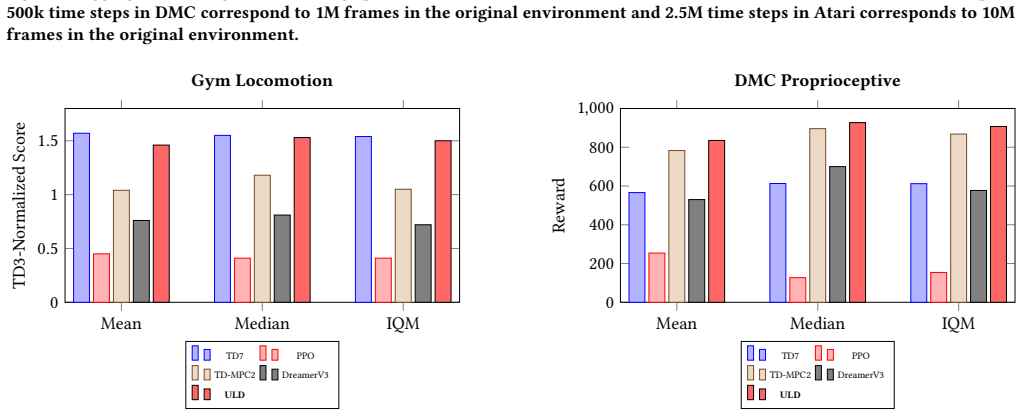
Summary. The paper proposes Unified Latent Dynamics (ULD), a model-free reinforcement learning algorithm that learns state-action embeddings and auxiliary losses for reward, dynamics, and termination prediction. It claims three theoretical results: (i) the fixed point of semi-gradient linear TD equals the solution of a linear model-based value expansion (Theorem 4.1); (ii) a value-error bound in terms of reward and transition model error (Theorem 4.2); and (iii) a nonlinear representability result if reward and transition functions can be defined on the latent space (Theorem 4.3). The practical algorithm uses a modified objective with state-only target embeddings, target networks, nonlinear critics, and a shared hyperparameter set. The paper claims to match or exceed specialized model-free and general model-based baselines on Gym, DMC proprioceptive/visual, and Atari, with no planning overhead.
Significance. The intended contribution — cross-domain model-free RL with model-based representations and no planning — is potentially significant. The theoretical part is a standard reformulation of Parr et al. and is not by itself novel; its validity is conditional on invertibility assumptions not stated. The practical connection is missing: the paper never shows that the optimized objective (9) yields embeddings satisfying the conditions of Theorem 4.3 or the linearity required by Theorem 4.1. The empirical evidence, however, contains multiple internal inconsistencies and exact duplicate entries, so the headline '80 environments' claim is unsupported. The paper ships no code or raw data that would allow verification. If corrected and the gap between objective and theory is closed, the idea may be worth revisiting; as it stands, the central claims are not established.
major comments (4)
- [§4.4, Eq. (9); §4.5, Thm. 4.3] The practical objective (9) departs from the setting of Theorem 4.1 in two ways: it replaces the action-dependent target z_{s'a'} with a state-only target \bar z_{s'} produced by a slowly updated target encoder, and the final value estimator is a nonlinear function of z_{sa}. Section 4.4 explicitly acknowledges that these adjustments break the linear relationship. Theorem 4.3 supplies representability conditions (10)-(11) that would suffice, but the paper never shows that optimizing (9) (with finite-horizon unrolling, linear environment model m, and auxiliary losses) produces embeddings satisfying those conditions, nor that the resulting value approximation is close to the linear fixed point of Theorem 4.1. Thus the theoretical results do not justify the algorithm that is actually evaluated.
- [§4.3, Thm. 4.1; Appendix A.1] The proof of Theorem 4.1 assumes Z^T Z is invertible and A := Z^T Z - γ Z^T Z' is invertible, but the theorem statement gives no such assumptions. For an arbitrary feature matrix Z, A can be singular, in which case the semi-gradient TD fixed point may fail to exist or be unique, and the model-based inverse (I - γW_p)^{-1} may fail. The 'mild conditions' mentioned in the abstract are never specified. The theorem should state explicit conditions (e.g., full-column-rank features and a nonsingular projected Bellman operator) before the claimed equivalence is used as a foundation.
- [Table 4; §6.1] The empirical tables are internally inconsistent. In Table 4, the Defender row's DQN entry equals the CrazyClimber ULD entry exactly (116954 [111371,122032]), and the Surround row's DQN entry equals the StarGunner ULD entry exactly (3488 [1032,8241]); the DreamerV3 Krull entry reports mean 322092 with 95% CI [14679,28172], which excludes the mean. Table 4 lists 57 Atari rows while §6.1 and Figure 1 state 43 games; Table 3 lists 28 DMC proprioceptive tasks while §6.1 states 23; Figure 1 labels DMC-Visual as 8 tasks while §6.1 says visual tasks are identical to the proprioceptive set and no visual results are presented. These discrepancies make the claimed total of 80 environments and the aggregate scores in Table 1 and Figures 1-2 impossible to reproduce. The central empirical claim is therefore unsupported by the reported data.
- [§4.5, Thm. 4.3] Theorem 4.3 is an existence statement under the assumed conditions (10)-(11), not a theorem about learning. These conditions require exact reward and transition consistency between the original MDP and the latent model. The paper does not characterize which encoders satisfy them, how the finite-horizon representation loss enforces them, or how approximation error in (10)-(11) propagates into the value error in (12). Without such a characterization, the nonlinear representability result cannot be invoked to support ULD. This is related to the first major comment but concerns the statement of the theorem itself.
minor comments (5)
- [General] Several typos and inconsistencies: 'Eqivalence' in the Theorem 4.1 heading, 'environemnts' in Section 1, and the Environment Model in Eq. (13) is referenced with unclear notation 'T m'.
- [Table 1] Table 1 has blank entries for TD7 in DMC-V and Atari; also DrQ-v2 is listed as a baseline in §6.1 but is absent from Table 1. Please clarify which baselines are included in the aggregate summary.
- [Algorithm 1] Algorithm 1 initializes t in line 4 but uses \tau in line 6; the variable should be consistent.
- [Appendix B] The appendix does not present any DMC-Visual results, despite Figure 1 and §6.1 describing them. Either add the missing results or explicitly state that visual results are omitted.
- [References] When reporting PPO results from Stable Baselines 3 and DQN/Rainbow results from Dopamine, cite those software frameworks so that the baseline numbers are reproducible.
Circularity Check
No significant circularity: the theoretical equivalence is a self-contained algebraic derivation, and the empirical inconsistencies are data-integrity issues, not circular reasoning.
full rationale
The paper's central theoretical result (Theorem 4.1 / Appendix A.1) is an explicit algebraic identity: the semi-gradient TD fixed point solves Aw = B with A = Z^T Z - gamma Z^T Z' and B = Z^T r, and the linear model-based rollout w_mb = sum gamma^t W_p^t w_r is manipulated to satisfy the same equation. The model-based object is defined independently before the equivalence is shown, so the conclusion is derived, not assumed. Theorem 4.2 is standard error propagation, and Theorem 4.3 is a constructive representability proof whose assumptions (10)-(11) are sufficient conditions rather than the desired conclusion. The practical objective (9) is explicitly an adjustment that 'breaks the theoretical linear relationship,' so the gap between theorem and algorithm is an unproven transfer, not a circular step. Self-citation to Ravindran (2004) appears only as background in related work and is not load-bearing; the paper supplies its own proofs and external citations. The benchmark tables contain internal inconsistencies (duplicate rows, environment-count mismatches, impossible confidence intervals), and the adjusted objective is not shown to satisfy the theorem's conditions, but these are correctness and evidential problems, not circularity. No fitted parameter is renamed as a prediction, and no load-bearing claim reduces to a self-citation chain. Therefore no circular step is established and the circularity score is 0.
Assumptions & free parameters
free parameters (1)
- Shared hyperparameters (lambda_r, lambda_d, lambda_t, lambda_pre, H_enc, H_Q, T_target, learning rate, batch size, netwo =
not reported
assumptions (4)
- standard math MDP formulation and Markov property
- standard math Invertibility of A = Z^T Z - gamma Z^T Z' and of I - gamma W_p
- ad hoc to paper Existence of reward and transition functions on embeddings satisfying (10)-(11)
- domain assumption Fixed data distribution for the linear equivalence
Cite this review
Pith. "Pith review of Unifying Model-Free Efficiency and Model-Based Representations via Latent Dynamics." pith.science (2026). https://pith.science/paper/PVONKTCV
@misc{pith2026260212643,
  author       = {Pith},
  title        = {Pith review of: Unifying Model-Free Efficiency and Model-Based Representations via Latent Dynamics},
  year         = {2026},
  howpublished = {\url{https://pith.science/paper/PVONKTCV}},
  note         = {Machine review of arXiv:2602.12643}
}
read the original abstract
We present Unified Latent Dynamics (ULD), a novel reinforcement learning algorithm that unifies the efficiency of model-free methods with the representational strengths of model-based approaches, without incurring planning overhead. By embedding state-action pairs into a latent space in which the true value function is approximately linear, our method supports a single set of hyperparameters across diverse domains -- from continuous control with low-dimensional and pixel inputs to high-dimensional Atari games. We prove that, under mild conditions, the fixed point of our embedding-based temporal-difference updates coincides with that of a corresponding linear model-based value expansion, and we derive explicit error bounds relating embedding fidelity to value approximation quality. In practice, ULD employs synchronized updates of encoder, value, and policy networks, auxiliary losses for short-horizon predictive dynamics, and reward-scale normalization to ensure stable learning under sparse rewards. Evaluated on 80 environments spanning Gym locomotion, DeepMind Control (proprioceptive and visual), and Atari, our approach matches or exceeds the performance of specialized model-free and general model-based baselines -- achieving cross-domain competence with minimal tuning and a fraction of the parameter footprint. These results indicate that value-aligned latent representations alone can deliver the adaptability and sample efficiency traditionally attributed to full model-based planning.
Figures


Figures from the paper (1 more)

Reference graph
Works this paper leans on
-
[1]
Alekh Agarwal, Sham Kakade, Akshay Krishnamurthy, and Wen Sun. 2020. Flambe: Structural complexity and representation learning of low rank mdps. Advances in neural information processing systems33 (2020), 20095–20107
2020
-
[2]
Marc G Bellemare, Yavar Naddaf, Joel Veness, and Michael Bowling. 2013. The arcade learning environment: An evaluation platform for general agents.Journal of artificial intelligence research47 (2013), 253–279
2013
-
[3]
Greg Brockman, Vicki Cheung, Ludwig Pettersson, Jonas Schneider, John Schul- man, Jie Tang, and Wojciech Zaremba. 2016. OpenAI Gym.arXiv preprint arXiv:1606.01540(2016)
arXiv 2016
-
[4]
Pablo Samuel Castro. 2020. Scalable methods for computing state similarity in deterministic Markov decision processes. InProceedings of the AAAI Conference on Artificial Intelligence, Vol. 34. 10069–10076
2020
-
[5]
Wesley Chung, Somjit Nath, Ajin Joseph, and Martha White. 2019. Two-timescale networks for nonlinear value function approximation. InInternational Conference on Learning Representations (ICLR)
2019
-
[6]
Norm Ferns, Prakash Panangaden, and Doina Precup. 2004. Metrics for finite Markov decision processes. InProceedings of the 20th Conference on Uncertainty in Artificial Intelligence (UAI). 162–169
2004
-
[7]
Norm Ferns, Prakash Panangaden, and Doina Precup. 2011. Bisimulation metrics for continuous Markov decision processes.SIAM J. Comput.40, 6 (2011), 1662– 1714
2011
-
[8]
Scott Fujimoto, David Guo, and David Meger. 2024. TD7: Transformer-based Representation for Continuous Control.arXiv preprint arXiv:2406.08672(2024)
arXiv 2024
Show all 31 references
-
[9]
Scott Fujimoto, Herke Hoof, and David Meger. 2018. Addressing function ap- proximation error in actor-critic methods. InInternational conference on machine learning. PMLR, 1587–1596
2018
-
[10]
Danijar Hafner, Jurgis Pasukonis, Jimmy Ba, and Timothy Lillicrap. 2023. Mas- tering Diverse Domains through World Models.arXiv preprint arXiv:2301.04104 (2023)
2023 arXiv
-
[11]
Nicklas Hansen, Hao Su, and Xiaolong Wang. 2024. TD-MPC2: Scalable, Robust World Models for Continuous Control.arXiv preprint arXiv:2405.17577(2024)
2024 arXiv
-
[12]
Matteo Hessel, Joseph Modayil, Hado Van Hasselt, Tom Schaul, Georg Ostro- vski, Will Dabney, Dan Horgan, Bilal Piot, Mohammad Azar, and David Silver
-
[13]
Chi Jin, Zhuoran Yang, Zhaoran Wang, and Michael I Jordan. 2023. Provably efficient reinforcement learning with linear function approximation.Mathematics of Operations Research48, 3 (2023), 1496–1521
2023
-
[14]
Nir Levine, Tom Zahavy, Daniel J Mankowitz, Aviv Tamar, and Shie Mannor
-
[15]
Marlos C Machado, Marc G Bellemare, Erik Talvitie, Joel Veness, Matthew Hausknecht, and Michael Bowling. 2018. Revisiting the Arcade Learning Envi- ronment: Evaluation protocols and open problems for general agents.JAIR61 (2018)
2018
-
[16]
Volodymyr Mnih, Koray Kavukcuoglu, David Silver, Andrei A Rusu, Joel Veness, Marc G Bellemare, Alex Graves, Martin Riedmiller, Andreas K Fidjeland, Georg Ostrovski, et al. 2015. Human-level control through deep reinforcement learning. Nature518, 7540 (2015)
2015
-
[17]
Ronald Parr, Lihong Li, Gavin Taylor, Christopher Painter-Wakefield, and Michael L. Littman. 2008. An analysis of linear models, linear value-function approximation, and feature selection for reinforcement learning. InProceedings of the 25th International Conference on Machine...
2008
-
[18]
2004.An algebraic approach to abstraction in reinforcement learning
Balaraman Ravindran. 2004.An algebraic approach to abstraction in reinforcement learning. PhD thesis. University of Massachusetts Amherst
2004
-
[19]
Tongzheng Ren, Tianjun Zhang, Csaba Szepesvári, and Bo Dai. 2022. A free lunch from the noise: Provable and practical exploration for representation learning. In Uncertainty in Artificial Intelligence. PMLR, 1686–1696
2022
-
[20]
Sahand Rezaei-Shoshtari, Rosie Zhao, Prakash Panangaden, David Meger, and Doina Precup. 2022. Continuous MDP homomorphisms and homomorphic policy gradient. InAdvances in Neural Information Processing Systems (NeurIPS)
2022
-
[21]
John Schulman, Filip Wolski, Prafulla Dhariwal, Alec Radford, and Oleg Klimov
-
[22]
Yuval Tassa, Yotam Doron, Alistair Muldal, Tom Erez, Yazhe Li, Diego de Las Casas, David Budden, Abbas Abdolmaleki, Josh Merel, Andy Lefrancq, et al. 2018. DeepMind Control Suite.arXiv preprint arXiv:1801.00690(2018)
2018 arXiv
-
[23]
Emanuel Todorov, Tom Erez, and Yuval Tassa. 2012. MuJoCo: A physics engine for model-based control. In2012 IEEE/RSJ International Conference on Intelligent Robots and Systems. 5026–5033. https://doi.org/10.1109/IROS.2012.6386109
2012
-
[24]
InProceedings of the 34th ICML
Proximal policy optimization algorithms. InProceedings of the 34th ICML
-
[25]
Mark Towers, Jordan K Terry, Ariel Kwiatkowski, John Balis, Gianluca de Cola, Tristan Deleu, Manuel Goulão, Andreas Kallinteris, Arjun KG, Markus Krimmel, et al. 2024. Gymnasium.arXiv preprint arXiv:2401.12961(2024)
2024 arXiv
-
[26]
Elise van der Pol, Thomas Kipf, Frans A Oliehoek, and Max Welling. 2020. Plannable approximations to MDP homomorphisms: Equivariance under ac- tions. InProceedings of the 19th International Conference on Autonomous Agents and MultiAgent Systems (AAMAS). 1431–1439
2020
-
[27]
Emanuel Todorov, Tom Erez, and Yuval Tassa. 2012. MuJoCo: A physics engine for model-based control. In2012 IEEE/RSJ IROS
2012
-
[28]
Denis Yarats, Rob Fergus, Alessandro Lazaric, and Lerrel Pinto. 2022. DrQ- v2: Improved Data-Augmented Deep Reinforcement Learning.arXiv preprint arXiv:2205.12730(2022). SUPPLEMENTARY MATERIAL A PROOFS Theorem A.1 (Solution Eqivalence).The fixed point of the model-free approac...
2022 arXiv
-
[30]
Elise van der Pol, Daniel Worrall, Herke van Hoof, Frans Oliehoek, and Max Welling. 2020. MDP homomorphic networks: Group symmetries in reinforcement learning. InAdvances in Neural Information Processing Systems (NeurIPS), Vol. 33. 4199–4210
2020
-
[2017]
InAdvances in Neural Information Processing Systems (NeurIPS), Vol
Shallow updates for deep reinforcement learning. InAdvances in Neural Information Processing Systems (NeurIPS), Vol. 30
-
[2018]
In Proceedings of the AAAI conference on artificial intelligence, Vol
Rainbow: Combining improvements in deep reinforcement learning. In Proceedings of the AAAI conference on artificial intelligence, Vol. 32
Reviewed August 2, 2026 · model on record in the stance chip above.
Discussion (0). Continue with ORCID to comment.