REVIEW 3 major objections 4 minor 15 references
This paper presents WISE, an open-source engine that unifies scene, object, face, audio-event, speech, and metadata search in one tool for image and video collections.
Reviewed by Pith at T0; open to challenge. T0 means a machine referee read the full paper against a public rubric. the ladder, T0–T4 →
T0 review · deepseek-v4-flash
2026-08-02 23:40 UTC pith:4PQFCDQC
load-bearing objection Useful open-source systems paper that extends WISE to audio/face/speech/composite search, but the lack of any retrieval-accuracy evaluation leaves the central search-utility claim unverified. the 3 major comments →
WISE: A Multimodal Search Engine for Visual Scenes, Audio, Objects, Faces, Speech, and Metadata
The pith
A machine-rendered reading of the paper's core claim, the machinery that carries it, and where it could break.
Core claim
WISE's core discovery is that diverse retrieval tasks—scene, object, face, audio event, speech, metadata—can be handled by one architecture that treats every modality as feature vectors in a shared embedding space. Visual frames are embedded at scene level and region level; audio windows are embedded for acoustic events; speech is transcribed to text; and metadata is indexed with full-text search. All embeddings are stored in a vector store supporting approximate nearest-neighbour retrieval, and the same encoders are applied to queries at search time. Composite queries are implemented by combining filters across these indexes. The result is a system that performs content-based retrieval at s
What carries the argument
The central mechanism is the two-stream processing pipeline: a visual stream of images and sampled video frames, and an audio stream of windowed snippets. Pre-trained feature extractors map each stream into vectors—scene-level embeddings for whole frames, region-level embeddings for objects and faces, and acoustic embeddings for audio windows—while an automatic-speech-recognition stage transcribes spoken words into text. These vectors are stored in approximate-nearest-neighbour indexes (with an inverted-file index, optionally product-quantised for region features), and media-level metadata is indexed with full-text search. At query time, the query is embedded with the same extractor, and nea
Load-bearing premise
The system's usefulness rests on the assumption that off-the-shelf pretrained encoders embed archival, historical, and wildlife content accurately enough that nearest-neighbour search returns relevant results; the paper does not measure this retrieval accuracy.
What would settle it
Run a benchmark that compares WISE's retrieval precision and recall against human-annotated relevance judgments on a diverse set of collections (e.g., historical films, wildlife footage, news archives). If recall@k on these target domains is close to random or far below the paper's implied usefulness, the claim that WISE provides practical multimodal search would be falsified.
If this is right
- Non-technical users can search private or sensitive audiovisual collections locally, without uploading content to third-party services.
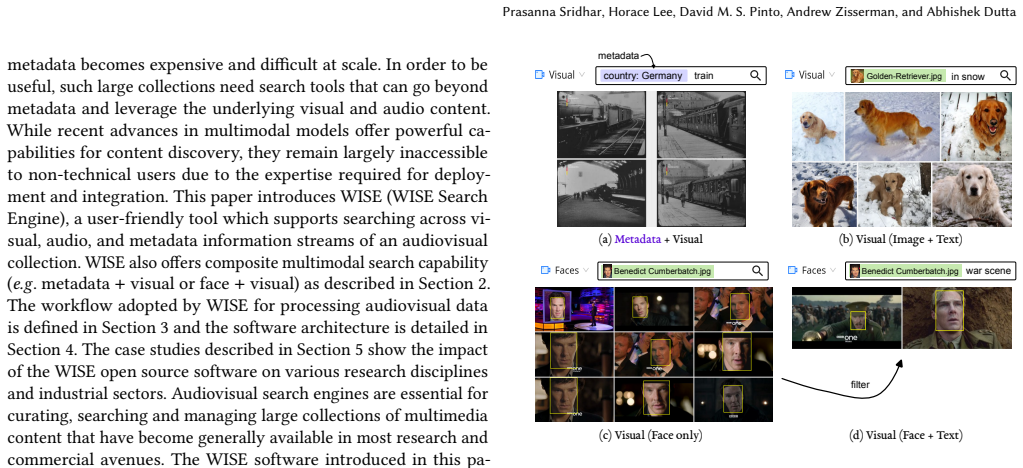
- Composite queries across modalities enable new forms of exploration, such as retrieving 'trains in Germany' or 'this actor in a war scene' from historical archives.
- The modular design allows new feature extractors to be swapped in, so the same engine can be repurposed for other domains, such as studying chimpanzee behaviour from camera-trap footage.
- With aggregator mode, a collection can be split across multiple machines and queried as a single unified index, supporting deployments with millions of images or thousands of hours of video.
- Indexing happens once offline, and retrieval returns results in under a second on large datasets, making the system practical for daily use.
Where Pith is reading between the lines
- Because the paper reports no retrieval-accuracy numbers on the target domains, the practical value will hinge on how well the chosen pretrained encoders generalise to archival, historical, and wildlife content; the system is best thought of as a framework whose quality tracks its embeddings.
- The same architecture could naturally support cross-modal queries that are not currently exposed, such as retrieving a video segment by simultaneous audio and visual similarity, or ranking results by joint audio-visual evidence.
- The engine could serve as a reproducible harness for evaluating new embedding models on real-world retrieval tasks, since swapping a single extractor changes the entire search behaviour.
- If open-source deployments like this become standard, they could shift the default for media archives from metadata curation to content-based exploration, changing how researchers and journalists formulate queries.
Editorial analysis
A structured set of objections, weighed in public.
Referee Report
Summary. This paper introduces WISE, a modular open-source audiovisual search engine. It indexes images and video through scene-level OpenCLIP embeddings, OWLv2 object proposals, InsightFace face embeddings, CLAP audio embeddings, and WhisperX ASR transcripts, with Faiss approximate nearest-neighbour indices and SQLite FTS for metadata. The paper describes composite queries (metadata + visual, image + text, face + scene), an aggregator mode for distributed search, and reports deployments on 55M images and 6,000 hours of video. The reported evidence is qualitative: illustrative retrieval examples in Figs. 1–2 and narrative case studies in §5. No retrieval-accuracy metrics, latency measurement methodology, or hardware/configuration details are provided.
Significance. WISE addresses a real gap: non-expert access to multimodal search over large private and archival collections. The modular design and open-source release are concrete strengths; integration with standard models and Faiss makes the system plausible and easy to adapt, and the composite-query interface is a useful practical contribution. If the scaling and accuracy claims were verified, the system would be valuable to journalism, archival research, and wildlife conservation. However, as submitted, the central search-utility claim is not empirically supported. The paper is a system description with qualitative demonstrations only, so its significance is conditional on a quantitative evaluation demonstrating that the embedding and ANN stack returns relevant results across modalities and target domains.
major comments (3)
- [§3, §5; Figs. 1–2] No retrieval-accuracy evaluation is provided. The core claim that WISE is a useful multimodal search engine is supported only by qualitative examples and anecdotal case studies. This leaves the central capability unverified, especially because the system composes off-the-shelf embeddings (OpenCLIP, OWLv2, InsightFace, CLAP, WhisperX) whose cross-modal alignment on archival, historical, and wildlife collections is an empirical assumption. Please add quantitative retrieval evaluation per modality and for composite queries, e.g. recall@k or mAP on standard benchmarks, together with exact index parameters. Without this, the paper cannot substantiate that the system retrieves relevant content rather than merely performing nearest-neighbour search.
- [§4, High-performance] The performance claims are not measurable: 'A one hour video can be processed in under 10 minutes on a modern computer with a GPU' and 'WISE returns results in under 1 second' are stated without hardware configuration, dataset size, index types, nlist/nprobe or IVFPQ settings, query batch, or measurement methodology. Since the choice of approximate index directly affects latency and recall, please report concrete measurements with hardware, index parameters, and percentiles on at least one large collection.
- [§3, indexing pipeline] The manuscript acknowledges that the more aggressive IVFPQ compression 'can be used to reduce compute and storage costs with a minor impact on retrieval accuracy' but does not quantify this impact. Frame sampling at 2 fps and 4 s audio windows with 2 s overlap are also free parameters that affect recall, especially for short events. These choices are load-bearing for the system's search utility; please report accuracy/latency/storage trade-offs for these choices and justify the defaults used in any evaluation.
minor comments (4)
- [After author list, before Fig. 1] The line 'Wait, what would her ideal man be?' appears immediately after the author list and before Figure 1. It looks like a stray caption or placeholder; remove or integrate it into the figure caption.
- [§3, Fig. 3] Several encoding/formatting issues appear: 'sampled, for example, at2frames per second' is missing a space; 'S�Lite FTS' and 'Type�uery' contain replacement characters. These should be fixed in the camera-ready version.
- [§3, §4] For reproducibility, please specify the exact model variants and checkpoints used (e.g., OpenCLIP architecture and pretraining data, CLAP checkpoint, WhisperX model size) and the Faiss index hyperparameters. Currently only 'e.g.' examples are given, so a reader cannot replicate the described deployments.
- [§5, public demos] The public demos are referenced via a footnote URL, but no details are given about which collections, model versions, or index settings the demos use. If the demos are intended as evidence of deployment, please state what they demonstrate and for how long they have been available.
Circularity Check
No circular derivation: WISE is an integration paper whose search-utility claim is unverified but not circular.
full rationale
WISE is a systems/integration paper; it does not present a derivation from first principles or a fitted prediction. The retrieval pipeline relies on pre-trained external embeddings (OpenCLIP, OWLv2, InsightFace, CLAP, WhisperX) and Faiss indices; Section 3 states that these feature extractors map text, images, video frames, and audio into a shared vector space where semantically related items lie close together. That is an assumption about the pretrained models, not a result derived from the paper's own outputs. No parameter is fitted to a target result and then reported as a prediction, and no target result is defined in terms of the system's own embeddings. The paper cites several self-authored components (WhisperX [1], ChimpUFE [8], prior WISE workshop paper [13]), but these are cited as existing tools or extensions, not as the justification for the central claim, and they are not invoked as a uniqueness theorem or as an unverified load-bearing premise. The main weakness is the absence of a quantitative retrieval-accuracy evaluation, so the practical usefulness and scale claims are unverified; that is a correctness/evaluation gap, not circularity.
Axiom & Free-Parameter Ledger
free parameters (2)
- frame sampling rate =
2 frames per second
- audio window and overlap =
4 s window, 2 s overlap
axioms (3)
- domain assumption Pretrained feature extractors (OpenCLIP, OWLv2, InsightFace, CLAP, WhisperX) provide semantically aligned embeddings for retrieval
- domain assumption Uniform temporal sampling of frames and audio snippets captures all searchable content
- domain assumption Approximate nearest neighbor search returns sufficiently accurate matches
read the original abstract
In this paper, we present WISE, an open-source audiovisual search engine which integrates a range of multimodal retrieval capabilities into a single, practical tool accessible to users without machine learning expertise. WISE supports natural-language and reverse-image queries at both the scene level (e.g. empty street) and object level (e.g. horse) across images and videos; face-based search for specific individuals; audio retrieval of acoustic events using text (e.g. wood creak) or an audio file; search over automatically transcribed speech; and filtering by user-provided metadata. Rich insights can be obtained by combining queries across modalities -- for example, retrieving German trains from a historical archive by applying the object query "train" and the metadata query "Germany", or searching for a face in a place. By employing vector search techniques, WISE can scale to support efficient retrieval over millions of images or thousands of hours of video. Its modular architecture facilitates the integration of new models. WISE can be deployed locally for private or sensitive collections, and has been applied to various real-world use cases. Our code is open-source and available at https://gitlab.com/vgg/wise/wise.
Figures



Reference graph
Works this paper leans on
-
[1]
Max Bain, Jaesung Huh, Tengda Han, and Andrew Zisserman. 2023. WhisperX: Time-Accurate Speech Transcription of Long-Form Audio. InInterspeech 2023. 4489–4493. doi:10.21437/Interspeech.2023-78
-
[2]
Max Bain, Arsha Nagrani, Daniel Schofield, Sophie Berdugo, Joana Bessa, Jake Owen, Kimberley J Hockings, Tetsuro Matsuzawa, Misato Hayashi, Dora Biro, et al. 2021. Automated audiovisual behavior recognition in wild primates.Science advances7, 46 (2021), eabi4883
2021
-
[3]
Jiankang Deng, Jia Guo, Xue Niannan, and Stefanos Zafeiriou. 2019. ArcFace: Additive Angular Margin Loss for Deep Face Recognition. InCVPR
2019
-
[4]
Matthijs Douze, Alexandr Guzhva, Chengqi Deng, Jeff Johnson, Gergely Szilvasy, Pierre-Emmanuel Mazaré, Maria Lomeli, Lucas Hosseini, and Hervé Jégou. 2024. The Faiss library. (2024). arXiv:2401.08281 [cs.LG]
Pith/arXiv arXiv 2024
-
[5]
Benjamin Elizalde, Soham Deshmukh, Mahmoud Al Ismail, and Huaming Wang
-
[6]
Richard Hipp
D. Richard Hipp. 2025.SQLite. https://sqlite.org/
2025
-
[7]
Chuong Huynh, Jinyu Yang, Ashish Tawari, Mubarak Shah, Son Tran, Raffay Hamid, Trishul Chilimbi, and Abhinav Shrivastava. 2025. Collm: A large language model for composed image retrieval. InProceedings of the Computer Vision and Pattern Recognition Conference. 3994–4004
2025
-
[8]
Vladimir Iashin, Horace Lee, Dan Schofield, and Andrew Zisserman. 2025. Self- supervised Learning on Camera Trap Footage Yields a Strong Universal Face Embedder.arXiv preprint arXiv:2507.10552(2025)
Pith/arXiv arXiv 2025
-
[9]
Gabriel Ilharco, Mitchell Wortsman, Ross Wightman, Cade Gordon, Nicholas Carlini, Rohan Taori, Achal Dave, Vaishaal Shankar, Hongseok Namkoong, John 4 WISE: A Multimodal Search Engine for Visual Scenes, Audio, Objects, Faces, Speech, and Metadata Miller, Hannaneh Hajishirzi, Ali Farhadi, and Ludwig Schmidt. 2025.OpenCLIP. doi:10.5281/zenodo.17171361
-
[10]
Yusuke Matsui, Yusuke Uchida, Hervé Jégou, and Shin’ichi Satoh. 2018. A survey of product quantization.ITE Transactions on Media Technology and Applications 6, 1 (2018), 2–10
2018
-
[11]
Matthias Minderer, Alexey Gritsenko, and Neil Houlsby. 2023. Scaling open- vocabulary object detection.Advances in Neural Information Processing Systems 36 (2023), 72983–73007
2023
-
[12]
Alec Radford, Jong Wook Kim, Chris Hallacy, Aditya Ramesh, Gabriel Goh, Sand- hini Agarwal, Girish Sastry, Amanda Askell, Pamela Mishkin, Jack Clark, et al
-
[13]
Prasanna Sridhar, Horace Lee, Abhishek Dutta, and Andrew Zisserman. 2023. WISE image search engine (WISE). InWiki workshop, virtual event. Received 12 February 2026 5
2023
-
[2021]
In International conference on machine learning
Learning transferable visual models from natural language supervision. In International conference on machine learning. PmLR, 8748–8763
-
[2023]
InICASSP 2023-2023 IEEE International Conference on Acoustics, Speech and Signal Processing (ICASSP)
Clap learning audio concepts from natural language supervision. InICASSP 2023-2023 IEEE International Conference on Acoustics, Speech and Signal Processing (ICASSP). IEEE, 1–5
2023
discussion (0)
Sign in with ORCID, Apple, or X to comment. Anyone can read and Pith papers without signing in.