REVIEW 2 major objections 5 minor 26 references
A multilayer graphene stack of any stacking order has its zero-energy momenta fully determined by its maximal same-letter (parallel) runs: those momenta are exactly the AA-stack roots, |p| = (2t⊥/v) cos(rπ/(N+1)).
Reviewed by Pith at T0; open to challenge. T0 means a machine referee read the full paper against a public rubric. the ladder, T0–T4 →
T0 review · deepseek-v4-flash
2026-08-02 23:30 UTC pith:BPTWEVNV
load-bearing objection Genuine analytical result with a real proof gap in the general 'iff' claim; worth refereeing but needs an explicit induction over interior runs. the 2 major comments →
Electronic Structure of Multilayer Graphene with Arbitrary Stackings
The pith
A machine-rendered reading of the paper's core claim, the machinery that carries it, and where it could break.
Core claim
On the paper's own terms, the discovery is a determinant identity and its consequence: for an arbitrary N-layer stacking sequence S decomposed into maximal parallel runs S_i of lengths N_i, the condition det H_S(p)=0 is equivalent to |p| ∈ union over i of { (2t⊥/v) cos(rπ/(N_i+1)) : r=1,...,N_i }. Bernal and rhombohedral links only pass the determinant condition down the stack and force |p|=0 on their own; the sole sources of nonzero-momentum zero modes are AA blocks. The same machinery shows that an embedded ABC substack pins a flat band to the full stack—localizing at the substack's edges when embedded in Bernal material—and that parallel runs move additional zero crossings outward, giving
What carries the argument
The central object is the 2N×2N tight-binding Hamiltonian H_S(p) built from monolayer Dirac blocks vσ·p and interlayer hopping t⊥ between vertically aligned atoms, with stacking encoded by a letter A, B, or C. The proof rides on a determinant recurrence: peeling off the top layer expresses det H in terms of the determinant of the remaining substack; for non-AA links this reduces to det H ∝ |p|^{2N}, zero only at |p|=0. For an AA link, a block-determinant formula replaces the low-energy block by an effective momentum factor (1−Q_n)vπ, and the recurrence Q_{n+1}=t⊥²/((1−Q_n)v²|p|²) is solved by recognizing x f_n(x)=U_{n+1}(x/2)/U_n(x/2) in terms of Chebyshev polynomials of the second kind. The
Load-bearing premise
The whole result assumes that only nearest-neighbor intralayer hopping and a single vertical interlayer hopping t⊥ are present; real graphene has additional interlayer couplings and trigonal warping that can open gaps or distort the predicted zero-energy rings, so the exact radii in Eq. (56) are only guaranteed in that ideal model.
What would settle it
A full tight-binding or first-principles calculation for a stack with a long same-letter run, such as AAAABBB or AAABCCC, including the standard extra interlayer hoppings, should be compared with Eq. (56): if any of the predicted zero-energy rings splits or gaps out at momenta |p|=2t⊥/v cos(rπ/(N+1)), the 'if and only if' statement fails quantitatively; if the rings survive with energies below measurement resolution, the decomposition rule holds.
If this is right
- Any stack containing a same-letter run of length N acquires zero-energy band crossings on rings of radius 2t⊥/v cos(rπ/(N+1)) around each Dirac point; the ring radii are determined by that run alone.
- Stacks with no same-letter runs of length ≥2 (pure Bernal/rhombohedral alternation) have zero-energy states only at |p|=0; any flat bands there come from embedded ABC substacks, not from the alternating parts.
- Embedding an ABC substack yields the ABC flat band in the full stack; in a Bernal host the low-energy wavefunction localizes at the edges of the ABC block, while in an AA host it does not.
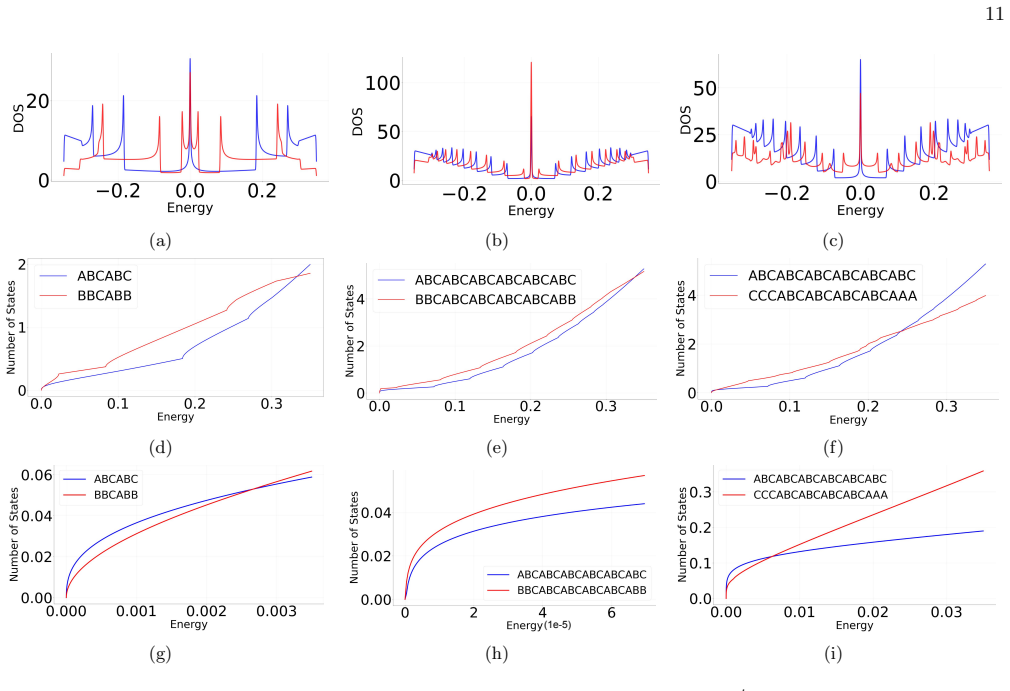
- Parallel runs combined with rhombohedral substacks extend the flat-band radius to at least 2t⊥/v in the large-N limit, twice the pure-ABC radius of t⊥/v, with a correspondingly higher density of states near the Fermi level.
- Density-functional calculations for stacks such as AAABCCC and AAAAAABCABCCCCCC show flat bands extending beyond the pure-ABC limit, with the parallel-fault crossings roughly matching Eq. (56) along Γ–K–M.
Where Pith is reading between the lines
- A directly testable prediction follows from the radius bound: scanning tunnelling spectroscopy on AA-plus-ABC stacks should show a wider low-energy DOS plateau than pure ABC of comparable thickness, with the plateau width scaling as 2t⊥/v rather than t⊥/v.
- Because the zero-energy roots are set only by run lengths, stacking sequence becomes a discrete design parameter: one could engineer stacks with several zero-energy rings at chosen radii simply by choosing parallel-run lengths—an untwisted route to flat-band platforms.
- The determinant retention mechanism is not obviously specific to graphene: any bipartite layered lattice with AA-style vertical registry should show the same cosine-root spectrum, so the design rule may transfer to other van der Waals materials.
- The paper leaves open whether the zero-energy rings carry nontrivial topology; if the rings are protected by the chiral (sublattice) symmetry of the nearest-neighbor model, realistic symmetry-breaking terms would gap them, which is the main quantitative risk to the rule.
Editorial analysis
A structured set of objections, weighed in public.
Referee Report
Summary. The paper studies multilayer graphene with arbitrary stacking sequences within a nearest-neighbor tight-binding model containing a single interlayer hopping t⊥ between vertically aligned atoms. It derives or recalls the dispersions for pure AA, AB, and ABC stacks, and then analyzes stacks with stacking faults. The central analytical result is stated in Eqs. (56)–(57): for any stack decomposed into maximal parallel runs S_i of lengths N_i, a momentum p is a zero-energy point if and only if |p| belongs to the union of the isolated AA-run zero sets { (2t⊥/v) cos(rπ/(N_i+1)) }. The paper also presents DOS/IDOS calculations for rhombohedral stacks with parallel faults and DFT band structures for selected stacks. The conclusion proposes flat-band engineering by combining parallel and rhombohedral stackings.
Significance. If fully established, the result is an elegant and useful design rule: in the chiral nearest-neighbor limit, the zero-energy manifold of an arbitrary stack is completely determined by its maximal AA blocks, and the quantitative ring positions are parameter-free predictions. The paper is self-contained, uses no fitted parameters (only t, t⊥, and a DOS smearing width), and the DFT/DOS calculations are independent checks rather than inputs. The determinant recurrence for a single AA block at the edge and the Chebyshev solution are genuine analytic contributions. However, the generalization from one edge AA block to arbitrary run decompositions is asserted rather than proved, and the real-graphene robustness of the rings is not quantitatively tested. Both issues are repairable but are load-bearing for the paper's headline claim.
major comments (2)
- [Section III.C, Eqs. (49)–(57)] The 'if and only if' statement for arbitrary stacks is not proved. The derivation establishes two ingredients: (i) stacks with no parallel connections have only the |p|=0 zero (Eq. (28)); (ii) a stack with a single parallel block at one end has zero-energy momenta given by the AA-block radii (Eqs. (29)–(49)). The step to arbitrary stacks is the sentence 'It is understood by its derivation that Eq. (49) is true for all arbitrary stacks,' followed by the decomposition into maximal runs. No induction over multiple runs or interior runs is given. In particular, the Schur-complement argument in Eq. (31) is applied from one end with a monolayer top block; for a run buried between non-parallel layers the same argument must be repeated from the other side or replaced by a different factorization, and the text does not show that an interior run contributes exactly its isolated radii and no additi
- [Section IV / Fig. 7] The conclusion states that the formula is 'quantitatively accurate for finding the rings of zero energy,' but the analytical result is obtained in a nearest-neighbor chiral model with a single t⊥. Actual graphene has Slonczewski-Weiss-McClure hoppings and trigonal warping that can gap or distort these rings. The paper acknowledges this limitation in Section III.C but does not test it quantitatively. The DFT data in Fig. 7 are band dispersions along Γ→K→M; they give only a visual, rough match to the predicted crossings and do not confirm the closed-ring structure implied by Eq. (56). I recommend either (a) restating the quantitative claim as a theorem about the nearest-neighbor model, or (b) adding a full SWMcC calculation for at least one representative stack (e.g., AAABCCC) and comparing the actual zero-energy contours with Eq. (56).
minor comments (5)
- [Eq. (56)] The definition of p_{r_i}^i in Eq. (56) lacks an absolute value, although radii must be non-negative. The text later says one may take absolute values; the definition should match Eq. (17).
- [Eq. (55)] The notation S = P_{i=1}^M S_i for string concatenation is unusual and undefined; use e.g. S = S_1 S_2 ⋯ S_M to avoid confusion with a sum.
- [Section II / after Eq. (23)] Typo: 'psuedopotentials' should be 'pseudopotentials'. Also, 'for |p > Δ|p|' is missing a norm bar; it should read 'for |p| > Δ|p|'.
- [Reference [23]] Reference [23] (Bohr) appears unrelated to the statement about electrons filling zero-energy regions; please check whether a different citation is intended.
- [Abstract / Introduction] The abstract and introduction state that low-energy dispersions may be deduced from substacks in isolation. In the body this is demonstrated mainly for zero-energy momenta and flat-band presence, not for the full dispersion. Please qualify the wording.
Circularity Check
No circularity: the central zero-energy theorem is derived from the stated tight-binding Hamiltonian with independent DFT checks; the only notable weakness is an omitted induction step, which is a proof gap rather than a circular reduction.
full rationale
The paper's central claim, Eqs. (56)-(57), is not equivalent to its inputs by construction. The zero-energy radii for AA blocks are derived independently in Eq. (17), and the subsequent Schur-complement/Chebyshev argument (Eqs. 29-49) attempts to extend the result to stacks with a parallel block. The final generalization to arbitrary stacks is stated rather than fully proved: 'It is understood by its derivation that Eq. (49) is true for all arbitrary stacks.' This is an omitted induction over maximal parallel runs, i.e. a proof gap, not a circularity: the theorem is not presupposed or fitted. The DFT/DOS comparisons are independent checks with fixed model parameters; no fitted input is relabeled as a prediction. The only self-citation, Ref. [4] by co-author Jia-An Yan, is used for a known ABC transcendental-equation representation and is not load-bearing for the main derivation, which relies on Refs. [5] and [21]. The acknowledged limitation 'Our derivation was done for nearest neighbor hopping only' is a scope restriction, not circular reasoning. Because no load-bearing step reduces to its own input, the circularity score is 0.
Axiom & Free-Parameter Ledger
free parameters (3)
- intralayer hopping t =
t = 3 (eV), with a=1, ℏ=1
- interlayer hopping t⊥ =
t⊥ = t/10 = 0.3
- DOS Gaussian smearing σ =
σ = t⊥/300
axioms (4)
- domain assumption Nearest-neighbor tight-binding Hamiltonian with only 2pz orbitals and single interlayer hopping t⊥ for directly-overlapping atoms (Section II).
- domain assumption Low-energy Dirac approximation vπ around K/K' with linear dispersion (Section III.A).
- standard math Schur complement/determinant identities (Abadir-Magnus [24]) and Chebyshev polynomial identities (Abramowitz-Stegun [25]).
- domain assumption Schrieffer-Wolff transformation validity for energies much smaller than t⊥ (Section III.B).
read the original abstract
Stacking geometry in multilayer graphene (MLG) provides an interesting degree of freedom to engineer its electronic structure near the Fermi level, wherein the linear bands in single layer graphene could retain or evolve into parabolic or flat bands. Using a tight-binding model, we carried out a detailed analytical analysis of the electronic band structures for arbitrarily stacked MLGs. We show that their low energy band dispersions near the Fermi level may be deduced from its substacks in isolation. The analytical solutions of the momenta with zero eigenvalue for an AA stacking allows us to generalize the results of the zero energy momenta for arbitrarily stacked MLGs. Moreover, we find that an interplay of parallel and rhombohedral stackings allows for flat band engineering and enhancement in arbitrarily stacked MLGs. The existence of flat bands in MLGs might offer another interesting platform for exploring the superconductivity in graphene systems beyond the twisted bilayer graphene.
Figures



Reference graph
Works this paper leans on
-
[1]
D. R. Cooper, B. D’Anjou, N. Ghattamaneni, B. Harack, M. Hilke, A. Horth, N. Majlis, M. Massicotte, L. Vands- burger, E. Whiteway, and V. Yu, Experimental review of graphene (2011), arXiv:1110.6557 [cond-mat.mes-hall]
Pith/arXiv arXiv 2011
-
[2]
Latil and L
S. Latil and L. Henrard, Charge carriers in few-layer graphene films, Physical Review Letters97, 036803 (2006)
2006
-
[3]
A. H. Castro Neto, F. Guinea, N. M. R. Peres, K. S. Novoselov, and A. K. Geim, The electronic properties of graphene, Reviews of Modern Physics81, 109–162 (2009)
2009
-
[5]
Min and A
H. Min and A. H. MacDonald, Electronic structure of multilayer graphene, Progress of Theoretical Physics Supplement176, 227–252 (2008)
2008
-
[6]
O. A. Awoga, T. L¨ othman, and A. M. Black-Schaffer, Superconductivity and magnetism in the surface states of abc-stacked multilayer graphene, Physical Review B 108, 10.1103/physrevb.108.144504 (2023)
-
[8]
E. Y. Andrei and A. H. MacDonald, Graphene bilayers with a twist, Nature Materials19, 1265–1275 (2020)
2020
-
[9]
J. M. Park, Y. Cao, L. Xia, S. Sun, K. Watanabe, T. Taniguchi, and P. Jarillo-Herrero, Magic-angle mul- tilayer graphene: A robust family of moir´ e super- conductors, arXiv preprint arXiv:2112.10760 (2021), arXiv:2112.10760 [cond-mat.supr-con]
Pith/arXiv arXiv 2021
-
[10]
G. Chen, A. L. Sharpe, P. Gallagher, I. T. Rosen, E. Fox, L. Jiang, B. Lyu, H. Li, K. Watanabe, T. Taniguchi, J. Jung, Z. Shi, D. Goldhaber-Gordon, Y. Zhang, and F. Wang, Signatures of gate-tunable superconductivity in trilayer graphene/boron nitride moir´ e superlattice, arXiv preprint arXiv:1901.04621 (2019), arXiv:1901.04621 [cond-mat.mes-hall]
Pith/arXiv arXiv 1901
-
[11]
H. Zhou, T. Xie, T. Taniguchi, K. Watanabe, and A. F. Young, Superconductivity in rhombohedral trilayer graphene, Nature598, 434 (2021), arXiv:2106.07640 [cond-mat.mes-hall]
Pith/arXiv arXiv 2021
-
[12]
T. Han, Z. Lu, Z. Hadjri, L. Shi, Z. Wu, W. Xu, Y. Yao, A. A. Cotten, O. S. Sedeh, H. Weldeyesus, J. Yang, J. Seo, S. Ye, M. Zhou, H. Liu, G. Shi, Z. Hua, K. Watan- abe, T. Taniguchi, P. Xiong, D. M. Zumb¨ uhl, L. Fu, and L. Ju, Signatures of chiral superconductivity in rhom- bohedral graphene, arXiv preprint arXiv:2408.15233 (2024), arXiv:2408.15233 [con...
Pith/arXiv arXiv 2024
-
[13]
Kittel,Introduction to Solid State Physics, 8th ed
C. Kittel,Introduction to Solid State Physics, 8th ed. (John Wiley and Son, 2004)
2004
-
[14]
A. M. Marques and R. G. Dias, Analytical solution of open crystalline linear 1d tight-binding models, Journal of Physics A: Mathematical and Theoretical53, 075303 (2020)
2020
-
[15]
Roy, The tight binding model (2015)
M. Roy, The tight binding model (2015)
2015
-
[16]
Giannozzi, S
P. Giannozzi, S. Baroni, N. Bonini, M. Calandra, R. Car, C. Cavazzoni, D. Ceresoli, G. L. Chiarotti, M. Cococ- cioni, I. Dabo, A. Dal Corso, S. de Gironcoli, S. Fabris, G. Fratesi, R. Gebauer, U. Gerstmann, C. Gougoussis, A. Kokalj, M. Lazzeri, L. Martin-Samos, N. Marzari, F. Mauri, R. Mazzarello, S. Paolini, A. Pasquarello, L. Paulatto, C. Sbraccia, S. S...
2009
-
[17]
D. Gray, A. McCaughan, and B. Mookerji, Crystal struc- ture of graphite, graphene and silicon (2009)
2009
-
[18]
Oreg, Tutorial 1: Introduction to graphene (2017)
Y. Oreg, Tutorial 1: Introduction to graphene (2017)
2017
-
[19]
G. W. Semenoff, Condensed-matter simulation of a three- dimensional anomaly, Phys. Rev. Lett.53, 2449 (1984)
1984
-
[20]
P. R. Wallace, The band theory of graphite, Phys. Rev. 71, 622 (1947)
1947
-
[21]
J. M. Luttinger and W. Kohn, Motion of electrons and holes in perturbed periodic fields, Phys. Rev.97, 869 (1955)
1955
-
[22]
P. Sarsfield, S. Slizovskiy, M. Koshino, and F. V., Elec- tronic properties of stacking faults in bernal graphite, npj Computational Materials11, 10.1038/s41524-025-01641- 2 (2025)
-
[23]
Bohr, On the application of quantum theory to atomic structure, Zeitschrift f¨ ur Physik13, 117 (1923)
N. Bohr, On the application of quantum theory to atomic structure, Zeitschrift f¨ ur Physik13, 117 (1923)
1923
-
[24]
K. M. Abadir and J. R. Magnus,Matrix Algebra, Econo- metric Exercises (Cambridge University Press, 2005)
2005
-
[25]
Abramowitz and I
M. Abramowitz and I. A. Stegun,Handbook of Mathe- matical Functions with Formulas, Graphs, and Mathe- matical Tables(Dover Publications, New York, 1964)
1964
-
[27]
A. Garcia-Ruiz, H.-Y. Deng, V. V. Enaldiev, and V. I. Fal’ko, Full slonczewski-weiss-mcclure parametrization of few-layer twistronic graphene, Physical Review B104, 10.1103/physrevb.104.085402 (2021)
-
[28]
H. Henck, J. Avila, Z. Ben Aziza, D. Pierucci, J. Baima, B. Pamuk, J. Chaste, D. Utt, M. Bartos, K. Nogajew- ski, B. A. Piot, M. Orlita, M. Potemski, M. Calandra, M. C. Asensio, F. Mauri, C. Faugeras, and A. Ouerghi, Flat electronic bands in long sequences of rhombohedral- stacked graphene, Physical Review B97, 10.1103/phys- revb.97.245421 (2018)
doi:10.1103/phys- 2018
-
[29]
Y. Guo, O. I. Sheekey, T. Arp, K. Kol´ aˇ r, T. Charpentier, L. Holleis, B. Foutty, A. Keough, M. Kang-Chou, M. E. Huber, T. Taniguchi, K. Watanabe, C. Lewandowski, and A. F. Young, Flat band surface state superconductivity in thick rhombohedral graphene (2025), arXiv:2511.17423 [cond-mat.supr-con]
arXiv 2025
discussion (0)
Sign in with ORCID, Apple, or X to comment. Anyone can read and Pith papers without signing in.