REVIEW 4 major objections 4 minor 2 cited by
The paper sets out to determine which ingredients actually drive targeted instruction selection for LLM fine-tuning, and concludes that the data representation—not the selection algorithm—is the decisive component: only gradient-based repre
Reviewed by Pith at T0; open to challenge. T0 means a machine referee read the full paper against a public rubric. the ladder, T0–T4 →
T0 review · deepseek-v4-flash
2026-08-02 23:05 UTC pith:GBEBBKCK
load-bearing objection A genuinely useful empirical comparison, but the abstract's 'consistently predicts' overstates downstream evidence; worth a serious referee after a revision. the 4 major comments →
A Critical Look at Targeted Instruction Selection: Disentangling What Matters (and What Doesn't)
The pith
A machine-rendered reading of the paper's core claim, the machinery that carries it, and where it could break.
Core claim
The paper's central claim is that targeted instruction selection is best understood as approximate distance minimization between the selected subset and the query set, and that the data representation used to compute that distance is the decisive component. Concretely, only gradient-based representations—low-dimensional projections of Adam update vectors computed during warm-up training, as in LESS—produce subset-query distances that correlate monotonically with query-set loss and downstream performance. Under these representations, greedy round-robin selection is the strongest method at small budgets, while unbalanced optimal transport offers modest gains at larger budgets. The advantage ov
What carries the argument
The central object is the subset-to-query distance computed in a representation space. The paper's key representation is gradient-based: each instruction-response pair becomes a low-dimensional random projection of Adam update vectors, aggregated across checkpoints of a warm-up-trained LoRA model (the LESS representation). Selection algorithms are then viewed as approximate minimizers of a distributional distance—chiefly the 1-Wasserstein distance between the empirical distributions of the selected subset and the query set. Theorem 6.1 bounds test loss by the sum of the subset-query Wasserstein distance, an irreducible query-test mismatch term, training error, and an ideal joint error; Theor
Load-bearing premise
The load-bearing premise is that the small query set (8–81 examples per task) faithfully represents the true target-test distribution; if the query set is unrepresentative or contaminated, minimizing distance to the query set is untethered from actual test performance.
What would settle it
Construct a benchmark where the query set is drawn from an easy or distributionally close slice of a task while the held-out test set comes from a hard or shifted slice; then run LESS-based greedy round-robin at a 500-example budget. If selection then fails to beat random sampling, or if the Spearman correlation between LESS distance quantiles and query loss is near zero, the paper's central claim that gradient representations make distance predictive would be refuted.
If this is right
- At small budgets, practitioners should use gradient-based representations (LESS) with greedy round-robin selection; it beats hidden-state and embedding-based methods on most of the five tasks and several models.
- At large budgets, optimal-transport selectors (UOT, KNN-KDE) become competitive, but no method reliably beats random sampling.
- A subset's distance to the query set should not be trusted as a selection signal unless it is computed with gradient-based representations.
- Cheap proxy models with about 135M parameters can produce LESS representations that match or beat full-model representations, cutting the compute cost of selection.
- The theoretical bounds imply that the advantage of any query-aware method over random has a hard ceiling set by pool-query mismatch and the dimension-driven B^{-1/d} decay.
Where Pith is reading between the lines
- A practical extension the paper leaves implicit: use distance-based selection only under a critical budget threshold, then fall back to random sampling to save compute once the B^{-1/d} catch-up becomes visible.
- The paper excludes saturated tasks where zero-shot performance is already high; an implicit corollary is that targeted selection is only worth doing when the base model has clear headroom on the target task, and skipping selection entirely is a legitimate option.
- LESS-selected subsets are shorter on average than those from embedding-based methods, so part of its advantage may come from length regularization rather than pure gradient influence; a testable follow-up is to control for token length before comparing selection methods.
- The theory suggests a new algorithm family: directly minimize the 1-Wasserstein distance between subset and query while explicitly tolerating the measured pool-query mismatch, which could outperform both round-robin and current OT heuristics.
Editorial analysis
A structured set of objections, weighed in public.
Referee Report
Summary. The paper presents a systematic, disentangled evaluation of targeted instruction selection for LLM fine-tuning, separating data representations (RDS+, EMBED, LESS) from selection algorithms (round-robin, doubly greedy, KNN-Uniform, KNN-KDE, and a proposed UOT method). It evaluates these components across five target tasks and several base models, with three-seed averaged experiments for the main budget sweeps. The authors report that gradient-based LESS representations give the most consistent relationship between subset-query distance and query loss, that greedy round-robin performs best at small budgets, that UOT/KNN-KDE become competitive at larger budgets, and that random sampling is a surprisingly strong baseline. The paper also contributes a theoretical unification of selection methods as approximate Wasserstein-distance minimizers, with two generalization bounds and a discussion of diminishing returns.
Significance. If the results hold, this is a valuable empirical contribution. The paper addresses a real fragmentation in the instruction-selection literature by controlling representation and selection algorithm separately, and it provides a rare multi-model, multi-task comparison with released code, three-seed averaging, and a strong random baseline. The finding that random sampling is competitive at larger budgets is practically important and helps explain conflicting results in prior work. The theoretical unification, while not the main contribution, offers a useful conceptual framing. The main risk is that the headline claim of consistent prediction is broader than the reported evidence supports, especially for downstream performance on newer models; the paper's own appendix contains multiple wrong-sign correlations. The theory also has proof gaps that need attention.
major comments (4)
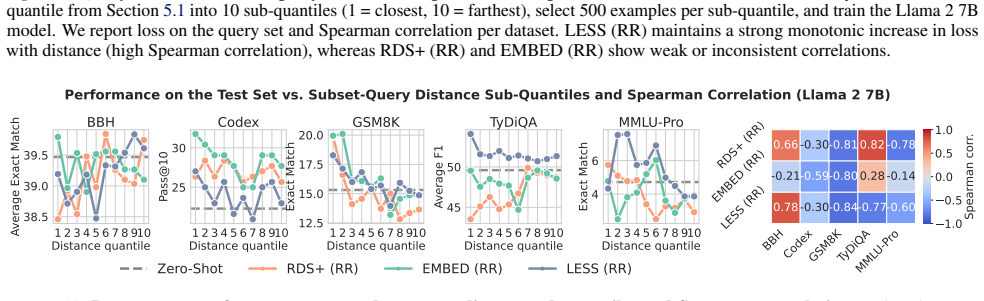
- [Abstract; Section 5.1; Appendix M] The abstract claims that only gradient-based representations choose subsets whose similarity to the query 'consistently predicts performance across datasets, models, and candidate pools.' The downstream Spearman correlations in Figure 3 and Appendix M (Figures 15-18) contradict this for a substantial fraction of model-task pairs: positive (wrong-sign) or weak correlations for LESS appear in 7 of 25 pairs, including Llama-2 Codex (+0.72), Llama 3.2 Codex (+0.28), SmolLM3 BBH (+0.88), SmolLM3 Codex (+0.68), SmolLM3 MMLU-Pro (+0.28), Qwen3 BBH (+0.18), and Olmo3 BBH (+0.58). The manuscript itself concedes in Section 5.1 that 'trends are less consistent on downstream performance with newer, over-trained models.' Please restrict the 'consistently predicts' claim to query loss, or explicitly scope it to downstream performance and temper the practical guidance accordingly.
- [Section 5.1, Figures 2-3] The central correlation analysis rests on single training runs. Figures 2 and 3 report Spearman correlations over 10 distance quantiles, but there are no confidence intervals, seed repetitions, or significance tests for these correlations. This is unlike the budget experiments in Sections 5.2-5.3, which average over three seeds. Given that the paper's central claim is about consistency of correlation, please provide seed-resampled uncertainty estimates or at minimum state explicitly that the quantile experiment is single-run and therefore should be interpreted with caution.
- [Theorem 6.1, Eq. (1), Lemma L.1] The proof of Theorem 6.1 is not justified by the cited lemma. Lemma L.1 (Appendix L.1) is a high-probability bound for samples S and T drawn i.i.d. from underlying measures P_S and P_T. In Theorem 6.1, S is an arbitrary deterministic subset of the candidate pool D, and the proof applies Lemma L.1 twice treating S and then Q as source samples. Without an i.i.d. or exchangeability assumption on S, the probabilistic statement does not follow from Lemma L.1. Additionally, Eq. (1) contains L_S(theta_S) and a term lambda-tilde that depends on S (through the L_S term in its definition), so the sentence 'only W1(P_S, P_Q) is directly affected by the choice of S' is not consistent with the displayed bound. Please repair the proof or state clearly the additional conditions under which the bound is valid.
- [Section 6.2, Theorem 6.2, Figure 8] Theorem 6.2's assumptions (mu-strong convexity of the empirical risk, K-Lipschitzness of L_T, and Gtheta_z-Lipschitz gradients) are not verified for the LoRA fine-tuning setup used in the experiments. The qualitative statement about diminishing returns is plausible and empirically supported, but the quantitative reference to a B^{-1/d} decay with d=8192 in Figure 8 is illustrative only; the constants and residual terms in the bound are not measured. Please clarify that the empirical agreement is qualitative and that the theorem does not provide a fitted decay law for the actual training setup.
minor comments (4)
- [Section 3.2, Appendix D] The term 'gradient-based representations' is used throughout, but LESS actually combines LoRA gradients with Adam update vectors and random projections. Please make this explicit in the main text to avoid confusion with full-gradient influence methods.
- [Table 1] The budget for Xia et al. is written as '13,533' while the text elsewhere uses '13,533' consistently; please harmonize comma styling across tables and text.
- [Figures 2, 3, 9, 10] TyDiQA is rendered as 'T yDiQA' in the figure panels and captions; please fix the spacing.
- [Appendix B, Table 2] The Codex split is described as '164 examples' in Appendix B, and Table 2 lists 16 query + 148 test = 164; please verify the arithmetic and clarify the split in one place.
Circularity Check
No circularity found: the central claims rest on empirical forks and explicit-assumption bounds, not on fitted inputs or load-bearing self-citations.
full rationale
The paper's main empirical claims are genuine empirical forks. Section 5.1 trains models on distance-stratified quantiles and measures Spearman correlations; Sections 5.2-5.3 train on selected subsets and compare against random and zero-shot baselines. The selection representations (RDS+, EMBED, LESS) and most selection algorithms are adopted from prior external work rather than fit to the reported trends, and the new UOT algorithm is presented with fixed hyperparameters rather than tuned to the results. LESS is itself an influence estimator, so finding that LESS distance correlates with query loss validates an approximation rather than being forced by construction: the paper trains full models and observes whether the ordering holds after nonlinear fine-tuning. The theoretical results (Theorems 6.1 and 6.2) are derived from explicit assumptions (strong convexity, Lipschitzness, loss form, bounded support) and do not assume the conclusion; the bounds explicitly include irreducible terms such as W1(P̂_Q, P̂_T), L_S(θ_S), and λ̃. The 'distance minimization' unification is an interpretive framing and does not feed back into the empirical comparisons. The only self-citations (Alvarez-Melis & Fusi 2020 in Appendix C; Hulkund et al. 2025 in Related Work) are non-load-bearing, and the central derivation is independent of them. The paper itself flags a genuine limitation in Appendix M: LESS query-loss correlations are consistent but downstream correlations are 'less consistent with newer, over-trained models.' This weakens the abstract's universal phrasing but is a robustness/correctness concern, not circularity. No equation or fitted parameter reduces to the paper's conclusions by construction.
Axiom & Free-Parameter Ledger
free parameters (4)
- UOT marginal relaxation τ2 =
0.0001
- UOT entropy regularization ε =
0.01
- KNN-KDE hyperparameters (L, KKDE, σ, C) =
L=5000, KKDE=1000, σ=0.75, C=5.0
- LoRA rank/α/dropout =
rank=128, α=512, dropout=0.1
axioms (4)
- domain assumption Query set Q is an i.i.d. sample from the target task distribution T.
- standard math Loss ℓ is symmetric, convex, bounded, satisfies triangle inequality, and has form |y-fθ(x)|^q for some q>0.
- domain assumption A1-A3: empirical risk µ-strongly convex, gradient Lipschitz in data, and ERM loss K-Lipschitz in parameters.
- domain assumption Wasserstein distance in embedding space is a meaningful proxy for task-relevant similarity.
read the original abstract
Instruction fine-tuning of large language models (LLMs) often involves selecting a subset of instruction training data from a large candidate pool, using a small query set from the target task. Despite growing interest, the literature on targeted instruction selection remains fragmented and opaque: methods vary widely in selection budgets, often omit zero-shot baselines, and frequently entangle the contributions of key components. As a result, practitioners lack actionable guidance on selecting instructions for their target tasks. In this work, we aim to bring clarity to this landscape by disentangling and systematically analyzing the two core ingredients: data representation and selection algorithms. Our framework enables controlled comparisons across models, tasks, and budgets. We find that only gradient-based data representations choose subsets whose similarity to the query consistently predicts performance across datasets, models, and candidate pools. While no single method dominates, gradient-based representations paired with greedy round-robin selection often perform best on average at low budgets, but these gains diminish at larger budgets. Finally, we unify several existing selection algorithms as forms of approximate distance minimization between the selected subset and the query set, and support this view with new generalization bounds. More broadly, our findings provide critical insights and a foundation for more principled data selection in LLM fine-tuning. The code is available at https://github.com/dcml-lab/targeted-instruction-selection.
Figures




Forward citations
Cited by 2 Pith papers
-
From Instance Selection to Fixed-Pool Data Recipe Search for Supervised Fine-Tuning
AutoSelection discovers data recipes from a 90K instruction pool that outperform full-data training and other selectors on reasoning tasks for SFT across multiple models.
-
Influcoder: Distilling Decoders' Gradient Influence Rankings into an Encoder for Data Attribution
Influcoder distills decoders' gradient influence rankings into an encoder for scalable influence-based data attribution.
Reference graph
Works this paper leans on
-
[1]
write newline
" write newline "" before.all 'output.state := FUNCTION n.dashify 't := "" t empty not t #1 #1 substring "-" = t #1 #2 substring "--" = not "--" * t #2 global.max substring 't := t #1 #1 substring "-" = "-" * t #2 global.max substring 't := while if t #1 #1 substring * t #2 global.max substring 't := if while FUNCTION format.date year duplicate empty "emp...
-
[2]
K., Bai, Y., Baker, B., Bao, H., et al
Agarwal, S., Ahmad, L., Ai, J., Altman, S., Applebaum, A., Arbus, E., Arora, R. K., Bai, Y., Baker, B., Bao, H., et al. gpt-oss-120b & gpt-oss-20b model card. ArXiv preprint, abs/2508.10925, 2025. URL https://arxiv.org/abs/2508.10925
Pith/arXiv arXiv 2025
-
[3]
M., Longpre, S., Lambert, N., Wang, X., Muennighoff, N., Hou, B., Pan, L., Jeong, H., Raffel, C., Chang, S., Hashimoto, T., and Wang, W
Albalak, A., Elazar, Y., Xie, S. M., Longpre, S., Lambert, N., Wang, X., Muennighoff, N., Hou, B., Pan, L., Jeong, H., Raffel, C., Chang, S., Hashimoto, T., and Wang, W. Y. A survey on data selection for language models. Transactions on Machine Learning Research, 2024. ISSN 2835-8856. URL https://openreview.net/forum?id=XfHWcNTSHp. Survey Certification, F...
2024
-
[4]
B., Lozhkov, A., Bakouch, E., von Werra, L., and Wolf, T
Allal, L. B., Lozhkov, A., Bakouch, E., von Werra, L., and Wolf, T. Smollm - blazingly fast and remarkably powerful, 2024
2024
-
[5]
B., Lozhkov, A., Bakouch, E., Bl \'a zquez, G
Allal, L. B., Lozhkov, A., Bakouch, E., Bl \'a zquez, G. M., Penedo, G., Tunstall, L., Marafioti, A., Kydl \' c ek, H., Lajar \' n, A. P., Srivastav, V., et al. Smollm2: When smol goes big--data-centric training of a small language model. arXiv preprint arXiv:2502.02737, 2025
Pith/arXiv arXiv 2025
-
[6]
and Fusi, N
Alvarez-Melis, D. and Fusi, N. Geometric dataset distances via optimal transport. Advances in Neural Information Processing Systems, 33: 0 21428--21439, 2020
2020
-
[7]
Ankner, Z., Blakeney, C., Sreenivasan, K., Marion, M., Leavitt, M. L., and Paul, M. Perplexed by perplexity: Perplexity-based data pruning with small reference models. ArXiv preprint, abs/2405.20541, 2024. URL https://arxiv.org/abs/2405.20541
Pith/arXiv arXiv 2024
-
[8]
Wasserstein generative adversarial networks
Arjovsky, M., Chintala, S., and Bottou, L. Wasserstein generative adversarial networks. In Proceedings of the 34th International Conference on Machine Learning - Volume 70, ICML'17, pp.\ 214–223. JMLR.org, 2017
2017
-
[9]
M., Beeching, E., Roucher, A., Reedi, A
Bakouch, E., Ben Allal, L., Lozhkov, A., Tazi, N., Tunstall, L., Patiño, C. M., Beeching, E., Roucher, A., Reedi, A. J., Gallouédec, Q., Rasul, K., Habib, N., Fourrier, C., Kydlicek, H., Penedo, G., Larcher, H., Morlon, M., Srivastav, V., Lochner, J., Nguyen, X.-S., Raffel, C., von Werra, L., and Wolf, T. SmolLM3: smol, multilingual, long-context reasoner...
2025
-
[10]
unbalanced
Benamou, J.-D. Numerical resolution of an “unbalanced” mass transport problem. ESAIM: Mathematical Modelling and Numerical Analysis, 37 0 (5): 0 851--868, 2003
2003
-
[11]
G., Bradley, H., O’Brien, K., Hallahan, E., Khan, M
Biderman, S., Schoelkopf, H., Anthony, Q. G., Bradley, H., O’Brien, K., Hallahan, E., Khan, M. A., Purohit, S., Prashanth, U. S., Raff, E., et al. Pythia: A suite for analyzing large language models across training and scaling. In International Conference on Machine Learning, pp.\ 2397--2430. PMLR, 2023
2023
-
[12]
M., Gong, A., Shetty, A., Dwivedi, R., and Mackey, L
Carrell, A. M., Gong, A., Shetty, A., Dwivedi, R., and Mackey, L. Low-rank thinning. In Forty-second International Conference on Machine Learning, 2025. URL https://openreview.net/forum?id=iAkg2nVmvN
2025
-
[13]
A., Rajagopal, D., Bolukbasi, T., Dixon, L., and Tenney, I
Chang, T. A., Rajagopal, D., Bolukbasi, T., Dixon, L., and Tenney, I. Scalable influence and fact tracing for large language model pretraining. In The Thirteenth International Conference on Learning Representations, 2025. URL https://openreview.net/forum?id=gLa96FlWwn
2025
-
[14]
Maybe only 0.5\ ArXiv preprint, abs/2305.09246, 2023
Chen, H., Zhang, Y., Zhang, Q., Yang, H., Hu, X., Ma, X., Yanggong, Y., and Zhao, J. Maybe only 0.5\ ArXiv preprint, abs/2305.09246, 2023. URL https://arxiv.org/abs/2305.09246
Pith/arXiv arXiv 2023
-
[15]
Chen, M., Tworek, J., Jun, H., Yuan, Q., Pond \'e , H., Kaplan, J., Edwards, H., Burda, Y., Joseph, N., Brockman, G., Ray, A., Puri, R., Krueger, G., Petrov, M., Khlaaf, H., Sastry, G., Mishkin, P., Chan, B., Gray, S., Ryder, N., Pavlov, M., Power, A., Kaiser, L., Bavarian, M., Winter, C., Tillet, P., Such, F. P., Cummings, D. W., Plappert, M., Chantzis, ...
Pith/arXiv arXiv 2021
-
[16]
Scaling algorithms for unbalanced optimal transport problems
Chizat, L., Peyr \'e , G., Schmitzer, B., and Vialard, F.-X. Scaling algorithms for unbalanced optimal transport problems. Mathematics of computation, 87 0 (314): 0 2563--2609, 2018
2018
-
[17]
Optimal transport for domain adaptation
Courty, N., Flamary, R., Tuia, D., and Rakotomamonjy, A. Optimal transport for domain adaptation. IEEE Transactions on Pattern Analysis and Machine Intelligence, 39: 0 1853--1865, 2014. URL https://api.semanticscholar.org/CorpusID:13347901
2014
-
[18]
Joint distribution optimal transportation for domain adaptation
Courty, N., Flamary, R., Habrard, A., and Rakotomamonjy, A. Joint distribution optimal transportation for domain adaptation. Advances in neural information processing systems, 30, 2017
2017
-
[19]
and Mackey, L
Dwivedi, R. and Mackey, L. Kernel thinning. Journal of Machine Learning Research, 25 0 (152): 0 1--77, 2024. URL http://jmlr.org/papers/v25/21-1334.html
2024
-
[20]
Z., Boisbunon, A., Chambon, S., Chapel, L., Corenflos, A., Fatras, K., Fournier, N., Gautheron, L., Gayraud, N
Flamary, R., Courty, N., Gramfort, A., Alaya, M. Z., Boisbunon, A., Chambon, S., Chapel, L., Corenflos, A., Fatras, K., Fournier, N., Gautheron, L., Gayraud, N. T., Janati, H., Rakotomamonjy, A., Redko, I., Rolet, A., Schutz, A., Seguy, V., Sutherland, D. J., Tavenard, R., Tong, A., and Vayer, T. Pot: Python optimal transport. Journal of Machine Learning ...
2021
-
[21]
Pot python optimal transport (version 0.9.5), 2024
Flamary, R., Vincent-Cuaz, C., Courty, N., Gramfort, A., Kachaiev, O., Quang Tran, H., David, L., Bonet, C., Cassereau, N., Gnassounou, T., Tanguy, E., Delon, J., Collas, A., Mazelet, S., Chapel, L., Kerdoncuff, T., Yu, X., Feickert, M., Krzakala, P., Liu, T., and Fernandes Montesuma, E. Pot python optimal transport (version 0.9.5), 2024. URL https://gith...
2024
-
[22]
and Guillin, A
Fournier, N. and Guillin, A. On the rate of convergence in wasserstein distance of the empirical measure. Probability theory and related fields, 162 0 (3): 0 707--738, 2015
2015
-
[23]
Gabriel, P. and Marco, C. Computational optimal transport with applications to data sciences. Foundations and Trends in Machine Learning, 11 0 (5-6): 0 355--607, 02 2019. ISSN 1935-8237. doi:10.1561/2200000073. URL https://doi.org/10.1561/2200000073
-
[24]
Grattafiori, A., Dubey, A., Jauhri, A., Pandey, A., Kadian, A., Al-Dahle, A., Letman, A., Mathur, A., Schelten, A., Vaughan, A., et al. The llama 3 herd of models. arXiv preprint arXiv:2407.21783, 2024
Pith/arXiv arXiv 2024
-
[25]
Studying large language model generalization with influence functions
Grosse, R., Bae, J., Anil, C., Elhage, N., Tamkin, A., Tajdini, A., Steiner, B., Li, D., Durmus, E., Perez, E., et al. Studying large language model generalization with influence functions. arXiv preprint arXiv:2308.03296, 2023
Pith/arXiv arXiv 2023
-
[26]
Openthoughts: Data recipes for reasoning models
Guha, E., Marten, R., Keh, S., Raoof, N., Smyrnis, G., Bansal, H., Nezhurina, M., Mercat, J., Vu, T., Sprague, Z., et al. Openthoughts: Data recipes for reasoning models. ArXiv preprint, abs/2506.04178, 2025. URL https://arxiv.org/abs/2506.04178
Pith/arXiv arXiv 2025
-
[27]
and Mazumdar, S
Har-Peled, S. and Mazumdar, S. On coresets for k-means and k-median clustering. In Proceedings of the thirty-sixth annual ACM symposium on Theory of computing, pp.\ 291--300, 2004
2004
-
[28]
J., Shen, Y., Wallis, P., Allen - Zhu, Z., Li, Y., Wang, S., Wang, L., and Chen, W
Hu, E. J., Shen, Y., Wallis, P., Allen - Zhu, Z., Li, Y., Wang, S., Wang, L., and Chen, W. Lora: Low-rank adaptation of large language models. In The Tenth International Conference on Learning Representations, ICLR 2022, Virtual Event, April 25-29, 2022 . OpenReview.net, 2022. URL https://openreview.net/forum?id=nZeVKeeFYf9
2022
-
[29]
Coresets for clustering with fairness constraints
Huang, L., Jiang, S., and Vishnoi, N. Coresets for clustering with fairness constraints. Advances in neural information processing systems, 32, 2019
2019
-
[30]
Hulkund, N., Maalouf, A., Cai, L., Yang, D., Wang, T.-H., O'Neil, A., Haucke, T., Mukherjee, S., Ramaswamy, V., Shen, J. H., et al. Datas\^ 3: Dataset subset selection for specialization. ArXiv preprint, abs/2504.16277, 2025. URL https://arxiv.org/abs/2504.16277
Pith/arXiv arXiv 2025
-
[31]
P., Perelman, A., Ramesh, A., Clark, A., Ostrow, A., Welihinda, A., Hayes, A., Radford, A., et al
Hurst, A., Lerer, A., Goucher, A. P., Perelman, A., Ramesh, A., Clark, A., Ostrow, A., Welihinda, A., Hayes, A., Radford, A., et al. Gpt-4o system card. ArXiv preprint, abs/2410.21276, 2024. URL https://arxiv.org/abs/2410.21276
Pith/arXiv arXiv 2024
-
[32]
Ivison, H., Wang, Y., Pyatkin, V., Lambert, N., Peters, M., Dasigi, P., Jang, J., Wadden, D., Smith, N. A., Beltagy, I., et al. Camels in a changing climate: Enhancing lm adaptation with tulu 2. ArXiv preprint, abs/2311.10702, 2023. URL https://arxiv.org/abs/2311.10702
Pith/arXiv arXiv 2023
-
[33]
Ivison, H., Zhang, M., Brahman, F., Koh, P. W., and Dasigi, P. Large-Scale Data Selection for Instruction Tuning . ArXiv preprint, abs/2503.01807, 2025. URL https://arxiv.org/abs/2503.01807
Pith/arXiv arXiv 2025
-
[34]
Johnson, W. B. and Lindenstrauss, J. Extensions of lipschitz mappings into hilbert space. Contemporary mathematics, 26: 0 189--206, 1984. URL https://api.semanticscholar.org/CorpusID:117819162
1984
-
[35]
Small-to-large generalization: Training data influences models consistently across scale
Khaddaj, A., Engstrom, L., and Madry, A. Small-to-large generalization: Training data influences models consistently across scale. In The Thirteenth International Conference on Learning Representations, 2025. URL https://openreview.net/forum?id=79ZkWgY2FI
2025
-
[36]
Killamsetty, K., Sivasubramanian, D., Ramakrishnan, G., De, A., and Iyer, R. K. GRAD-MATCH: gradient matching based data subset selection for efficient deep model training. In Meila, M. and Zhang, T. (eds.), Proceedings of the 38th International Conference on Machine Learning, ICML 2021, 18-24 July 2021, Virtual Event , volume 139 of Proceedings of Machin...
2021
-
[37]
Kingma, D. P. and Ba, J. Adam: A method for stochastic optimization. In Bengio, Y. and LeCun, Y. (eds.), 3rd International Conference on Learning Representations, ICLR 2015, San Diego, CA, USA, May 7-9, 2015, Conference Track Proceedings , 2015. URL http://arxiv.org/abs/1412.6980
Pith/arXiv arXiv 2015
-
[38]
Datainf: Efficiently estimating data influence in lo RA -tuned LLM s and diffusion models
Kwon, Y., Wu, E., Wu, K., and Zou, J. Datainf: Efficiently estimating data influence in lo RA -tuned LLM s and diffusion models. In The Twelfth International Conference on Learning Representations, 2024. URL https://openreview.net/forum?id=9m02ib92Wz
2024
-
[39]
Naturalthoughts: Selecting and distilling reasoning traces for general reasoning tasks
Li, Y., Emad, Y., Padthe, K., Lanchantin, J., Yuan, W., Nguyen, T., Weston, J., Li, S.-W., Wang, D., Kulikov, I., et al. Naturalthoughts: Selecting and distilling reasoning traces for general reasoning tasks. ArXiv preprint, abs/2507.01921, 2025. URL https://arxiv.org/abs/2507.01921
Pith/arXiv arXiv 2025
-
[40]
Optimal entropy-transport problems and a new hellinger--kantorovich distance between positive measures
Liero, M., Mielke, A., and Savar \'e , G. Optimal entropy-transport problems and a new hellinger--kantorovich distance between positive measures. Inventiones mathematicae, 211 0 (3): 0 969--1117, 2018
2018
-
[41]
What makes good data for alignment? A comprehensive study of automatic data selection in instruction tuning
Liu, W., Zeng, W., He, K., Jiang, Y., and He, J. What makes good data for alignment? A comprehensive study of automatic data selection in instruction tuning. In The Twelfth International Conference on Learning Representations, ICLR 2024, Vienna, Austria, May 7-11, 2024 . OpenReview.net, 2024 a . URL https://openreview.net/forum?id=BTKAeLqLMw
2024
-
[42]
TSDS: data selection for task-specific model finetuning
Liu, Z., Karbasi, A., and Rekatsinas, T. TSDS: data selection for task-specific model finetuning. In Globersons, A., Mackey, L., Belgrave, D., Fan, A., Paquet, U., Tomczak, J. M., and Zhang, C. (eds.), Advances in Neural Information Processing Systems 38: Annual Conference on Neural Information Processing Systems 2024, NeurIPS 2024, Vancouver, BC, Canada,...
2024
-
[43]
W., Tay, Y., Zhou, D., Le, Q
Longpre, S., Hou, L., Vu, T., Webson, A., Chung, H. W., Tay, Y., Zhou, D., Le, Q. V., Zoph, B., Wei, J., and Roberts, A. The flan collection: Designing data and methods for effective instruction tuning. In Krause, A., Brunskill, E., Cho, K., Engelhardt, B., Sabato, S., and Scarlett, J. (eds.), International Conference on Machine Learning, ICML 2023, 23-29...
2023
-
[44]
D., Soldaini, L., Bhagia, A., Liu, J., Groeneveld, D., Tafjord, O., et al
Magnusson, I., Tai, N., Bogin, B., Heineman, D., Hwang, J. D., Soldaini, L., Bhagia, A., Liu, J., Groeneveld, D., Tafjord, O., et al. Datadecide: How to predict best pretraining data with small experiments. ArXiv preprint, abs/2504.11393, 2025. URL https://arxiv.org/abs/2504.11393
Pith/arXiv arXiv 2025
-
[45]
On the method of bounded differences, pp.\ 148–188
McDiarmid, C. On the method of bounded differences, pp.\ 148–188. London Mathematical Society Lecture Note Series. Cambridge University Press, 1989
1989
-
[46]
Moser, B. B., Shanbhag, A. S., Frolov, S., Raue, F., Folz, J., and Dengel, A. A coreset selection of coreset selection literature: Introduction and recent advances. arXiv preprint arXiv:2505.17799, 2025
arXiv 2025
-
[47]
Sgpt: Gpt sentence embeddings for semantic search
Muennighoff, N. Sgpt: Gpt sentence embeddings for semantic search. ArXiv preprint, abs/2202.08904, 2022. URL https://arxiv.org/abs/2202.08904
Pith/arXiv arXiv 2022
-
[48]
Large dual encoders are generalizable retrievers
Ni, J., Qu, C., Lu, J., Dai, Z., Hernandez Abrego, G., Ma, J., Zhao, V., Luan, Y., Hall, K., Chang, M.-W., and Yang, Y. Large dual encoders are generalizable retrievers. In Goldberg, Y., Kozareva, Z., and Zhang, Y. (eds.), Proceedings of the 2022 Conference on Empirical Methods in Natural Language Processing, pp.\ 9844--9855, Abu Dhabi, United Arab Emirat...
-
[49]
Efficient data selection at scale via influence distillation
Nikdan, M., Cohen-Addad, V., Alistarh, D., and Mirrokni, V. Efficient data selection at scale via influence distillation. In The Thirty-ninth Annual Conference on Neural Information Processing Systems, 2025. URL https://openreview.net/forum?id=E6ZdfjtoiX
2025
-
[50]
Olmo, T., Ettinger, A., Bertsch, A., Kuehl, B., Graham, D., Heineman, D., Groeneveld, D., Brahman, F., Timbers, F., Ivison, H., et al. Olmo 3. ArXiv preprint, abs/2512.13961, 2025. URL https://arxiv.org/abs/2512.13961
Pith/arXiv arXiv 2025
-
[51]
M., Georgiev, K., Ilyas, A., Leclerc, G., and Madry, A
Park, S. M., Georgiev, K., Ilyas, A., Leclerc, G., and Madry, A. TRAK: attributing model behavior at scale. In Krause, A., Brunskill, E., Cho, K., Engelhardt, B., Sabato, S., and Scarlett, J. (eds.), International Conference on Machine Learning, ICML 2023, 23-29 July 2023, Honolulu, Hawaii, USA , volume 202 of Proceedings of Machine Learning Research, pp....
2023
-
[52]
Estimating training data influence by tracing gradient descent
Pruthi, G., Liu, F., Kale, S., and Sundararajan, M. Estimating training data influence by tracing gradient descent. In Larochelle, H., Ranzato, M., Hadsell, R., Balcan, M., and Lin, H. (eds.), Advances in Neural Information Processing Systems 33: Annual Conference on Neural Information Processing Systems 2020, NeurIPS 2020, December 6-12, 2020, virtual, 2...
2020
-
[53]
Theoretical analysis of domain adaptation with optimal transport
Redko, I., Habrard, A., and Sebban, M. Theoretical analysis of domain adaptation with optimal transport. In Joint European Conference on Machine Learning and Knowledge Discovery in Databases, pp.\ 737--753. Springer, 2017
2017
-
[54]
R., Gnaneshwar, D., Locatelli, A., Kirk, R., Rockt \"a schel, T., Grefenstette, E., and Bartolo, M
Ruis, L., Mozes, M., Bae, J., Kamalakara, S. R., Gnaneshwar, D., Locatelli, A., Kirk, R., Rockt \"a schel, T., Grefenstette, E., and Bartolo, M. Procedural knowledge in pretraining drives reasoning in large language models. In The Thirteenth International Conference on Learning Representations, 2025. URL https://openreview.net/forum?id=1hQKHHUsMx
2025
-
[55]
Schulman, J. and Lab, T. M. Lora without regret. Thinking Machines Lab: Connectionism, 2025. doi:10.64434/tml.20250929. https://thinkingmachines.ai/blog/lora/
-
[56]
Unbalanced optimal transport, from theory to numerics
S'ejourn'e, T., Peyr'e, G., and Vialard, F.-X. Unbalanced optimal transport, from theory to numerics. ArXiv, abs/2211.08775, 2022. URL https://api.semanticscholar.org/CorpusID:253553361
Pith/arXiv arXiv 2022
-
[57]
A relationship between arbitrary positive matrices and doubly stochastic matrices
Sinkhorn, R. A relationship between arbitrary positive matrices and doubly stochastic matrices. The annals of mathematical statistics, 35 0 (2): 0 876--879, 1964
1964
-
[58]
\ k\ -variance: A clustered notion of variance
Solomon, J., Greenewald, K., and Nagaraja, H. \ k\ -variance: A clustered notion of variance. SIAM Journal on Mathematics of Data Science, 4 0 (3): 0 957--978, 2022. doi:10.1137/20M1385895
-
[59]
W., Chowdhery, A., Le, Q., Chi, E., Zhou, D., and Wei, J
Suzgun, M., Scales, N., Sch \"a rli, N., Gehrmann, S., Tay, Y., Chung, H. W., Chowdhery, A., Le, Q., Chi, E., Zhou, D., and Wei, J. Challenging BIG -bench tasks and whether chain-of-thought can solve them. In Rogers, A., Boyd-Graber, J., and Okazaki, N. (eds.), Findings of the Association for Computational Linguistics: ACL 2023, pp.\ 13003--13051, Toronto...
-
[60]
Climategpt: Towards ai synthesizing interdisciplinary research on climate change
Thulke, D., Gao, Y., Pelser, P., Brune, R., Jalota, R., Fok, F., Ramos, M., Van Wyk, I., Nasir, A., Goldstein, H., et al. Climategpt: Towards ai synthesizing interdisciplinary research on climate change. ArXiv preprint, abs/2401.09646, 2024. URL https://arxiv.org/abs/2401.09646
Pith/arXiv arXiv 2024
-
[61]
Optimal transport: old and new, volume 338
Villani, C. Optimal transport: old and new, volume 338. Springer, 2008
2008
-
[62]
W., Foo, C.-S., and Low, B
Wang, J., Lin, X., Qiao, R., Koh, P. W., Foo, C.-S., and Low, B. K. H. Nice data selection for instruction tuning in LLM s with non-differentiable evaluation metric. In Forty-second International Conference on Machine Learning, 2025. URL https://openreview.net/forum?id=2wt8m5HUBs
2025
-
[63]
Mmlu-pro: A more robust and challenging multi-task language understanding benchmark
Wang, Y., Ma, X., Zhang, G., Ni, Y., Chandra, A., Guo, S., Ren, W., Arulraj, A., He, X., Jiang, Z., Li, T., Ku, M., Wang, K., Zhuang, A., Fan, R., Yue, X., and Chen, W. Mmlu-pro: A more robust and challenging multi-task language understanding benchmark. In Globersons, A., Mackey, L., Belgrave, D., Fan, A., Paquet, U., Tomczak, J. M., and Zhang, C. (eds.),...
2024
-
[64]
Submodularity in data subset selection and active learning
Wei, K., Iyer, R., and Bilmes, J. Submodularity in data subset selection and active learning. In International conference on machine learning, pp.\ 1954--1963. PMLR, 2015
1954
-
[65]
LESS: selecting influential data for targeted instruction tuning
Xia, M., Malladi, S., Gururangan, S., Arora, S., and Chen, D. LESS: selecting influential data for targeted instruction tuning. In Forty-first International Conference on Machine Learning, ICML 2024, Vienna, Austria, July 21-27, 2024 . OpenReview.net, 2024. URL https://openreview.net/forum?id=PG5fV50maR
2024
-
[66]
Yang, A., Li, A., Yang, B., Zhang, B., Hui, B., Zheng, B., Yu, B., Gao, C., Huang, C., Lv, C., et al. Qwen3 technical report. arXiv preprint arXiv:2505.09388, 2025
Pith/arXiv arXiv 2025
-
[67]
Data mixing laws: Optimizing data mixtures by predicting language modeling performance
Ye, J., Liu, P., Sun, T., Zhan, J., Zhou, Y., and Qiu, X. Data mixing laws: Optimizing data mixtures by predicting language modeling performance. In The Thirteenth International Conference on Learning Representations, 2025
2025
-
[68]
and Rush, A
Yin, J. and Rush, A. M. Compute-constrained data selection. In The Thirteenth International Conference on Learning Representations, 2025. URL https://openreview.net/forum?id=4es2oO9tw1
2025
-
[69]
Long is more for alignment: A simple but tough-to-beat baseline for instruction fine-tuning
Zhao, H., Andriushchenko, M., Croce, F., and Flammarion, N. Long is more for alignment: A simple but tough-to-beat baseline for instruction fine-tuning. In Forty-first International Conference on Machine Learning, ICML 2024, Vienna, Austria, July 21-27, 2024 . OpenReview.net, 2024 a . URL https://openreview.net/forum?id=0AZAjkXhit
2024
-
[70]
Artificial intelligence for geoscience: Progress, challenges, and perspectives
Zhao, T., Wang, S., Ouyang, C., Chen, M., Liu, C., Zhang, J., Yu, L., Wang, F., Xie, Y., Li, J., et al. Artificial intelligence for geoscience: Progress, challenges, and perspectives. The Innovation, 5 0 (5), 2024 b
2024
-
[71]
@esa (Ref
\@ifxundefined[1] #1\@undefined \@firstoftwo \@secondoftwo \@ifnum[1] #1 \@firstoftwo \@secondoftwo \@ifx[1] #1 \@firstoftwo \@secondoftwo [2] @ #1 \@temptokena #2 #1 @ \@temptokena \@ifclassloaded agu2001 natbib The agu2001 class already includes natbib coding, so you should not add it explicitly Type <Return> for now, but then later remove the command n...
-
[72]
\@lbibitem[] @bibitem@first@sw\@secondoftwo \@lbibitem[#1]#2 \@extra@b@citeb \@ifundefined br@#2\@extra@b@citeb \@namedef br@#2 \@nameuse br@#2\@extra@b@citeb \@ifundefined b@#2\@extra@b@citeb @num @parse #2 @tmp #1 NAT@b@open@#2 NAT@b@shut@#2 \@ifnum @merge>\@ne @bibitem@first@sw \@firstoftwo \@ifundefined NAT@b*@#2 \@firstoftwo @num @NAT@ctr \@secondoft...
-
[73]
First, the query set (stars) and candidate pool (dots) are encoded as data representations
@open @close @open @close and [1] URL: #1 \@ifundefined chapter * \@mkboth \@ifxundefined @sectionbib * \@mkboth * \@mkboth\@gobbletwo \@ifclassloaded amsart * \@ifclassloaded amsbook * \@ifxundefined @heading @heading NAT@ctr thebibliography [1] @ \@biblabel @NAT@ctr \@bibsetup #1 @NAT@ctr @ @openbib .11em \@plus.33em \@minus.07em 4000 4000 `\.\@m @bibit...
discussion (0)
Sign in with ORCID, Apple, or X to comment. Anyone can read and Pith papers without signing in.