REVIEW 4 major objections 5 minor 1 cited by
The paper argues that a simple MLP pre-trained on LAMOST low-resolution spectra transfers to DESI’s medium-resolution spectra so effectively that it beats the DESI pipeline even with zero shot transfer, and that modest fine-tuning improves
Reviewed by Pith at T0; open to challenge. T0 means a machine referee read the full paper against a public rubric. the ladder, T0–T4 →
T0 review · deepseek-v4-flash
2026-08-02 22:57 UTC pith:DFO7FX5V
load-bearing objection Useful cross-survey benchmark, but the zero-shot claim needs a source-disjointness check before it can be trusted. the 4 major comments →
Generalization from Low- to Moderate-Resolution Spectra with Neural Networks for Stellar Parameter Estimation: A Case Study with DESI
The pith
A machine-rendered reading of the paper's core claim, the machinery that carries it, and where it could break.
Core claim
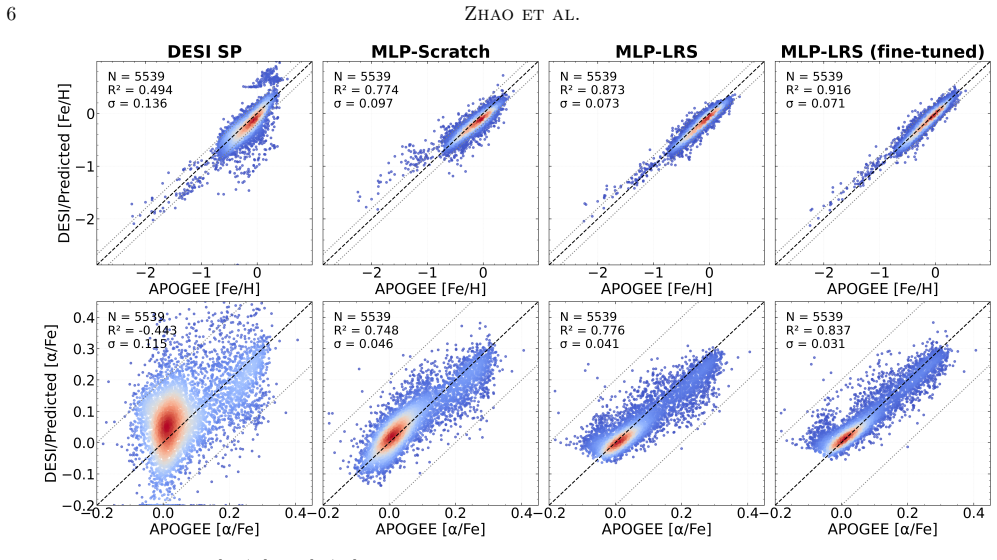
On its own terms, the discovery is that cross-survey stellar label transfer does not require a large foundation model: an MLP pre-trained on LAMOST low-resolution spectra, applied to DESI with no fine-tuning, agrees with APOGEE labels better than the DESI SP pipeline or an MLP trained from scratch on DESI. Fine-tuning with roughly 2,000 DESI spectra (as few as 100–500 for some metrics) further improves accuracy and corrects the zero-shot metal-rich [Fe/H] bias. Transformer-based spectral embeddings help only in the metal-rich [Fe/H] regime, hurt in the metal-poor regime (79 test stars), and do not help [α/Fe]. The best fine-tuning strategy depends on the parameter: residual-head adaptation f
What carries the argument
The load-bearing object is a pre-trained multilayer perceptron that maps 1,462 continuum-normalized flux bins (400–560 nm) to [Fe/H] or [α/Fe], trained on LAMOST low-resolution spectra with APOGEE-based labels. For comparison, the same MLP is trained on 768-dimensional embeddings from SpecCLIP, a self-supervised transformer with contrastive alignment between LAMOST and Gaia XP spectra. Three adaptation mechanisms are compared: residual-head adapters (a small parallel MLP correcting the output), LoRA (low-rank weight updates), and full fine-tuning. The MLP is what carries the transfer; the embeddings and fine-tuning variants are the comparison arms.
Load-bearing premise
The regime-specific conclusions—that embeddings underperform for metal-poor stars and that residual-head fine-tuning is best for [Fe/H]—rest on just 79 metal-poor test stars, and noisy APOGEE labels there could reverse those differences.
What would settle it
Cross-match a larger DESI sample (a few hundred stars with [Fe/H] < -1.0) to APOGEE, recompute the Table 1 R2 values for zero-shot and fine-tuned models, and check whether the MLP trained directly on spectra still beats the embedding-based MLPs in that regime; if not, the paper's central regime-specific claim fails.
If this is right
- Cross-survey stellar parameter pipelines can be deployed quickly: pre-train a simple MLP on an existing low-resolution sample with high-quality labels, then apply it to a new medium-resolution survey immediately without retraining.
- A few hundred to roughly 2,000 labeled spectra from the target survey are enough to correct resolution-driven biases; larger samples mainly tighten scatter.
- Foundation-model embeddings are not automatically better for transfer: their advantage is limited to metal-rich [Fe/H], and they can degrade metal-poor estimates.
- Fine-tuning strategy should be chosen per stellar parameter: residual heads preserve the metal-poor regime for [Fe/H], while LoRA best adapts [α/Fe].
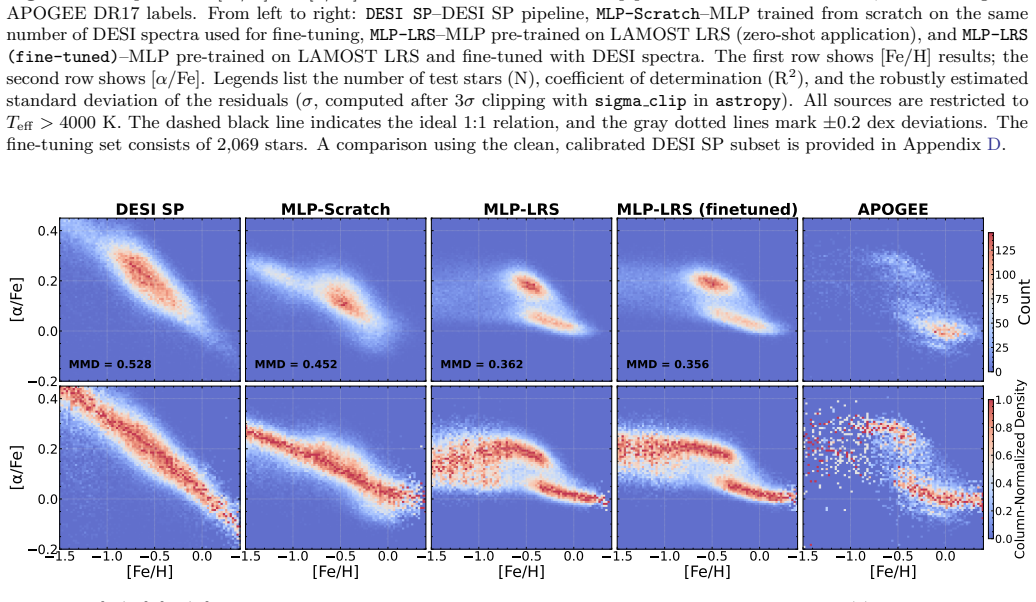
- Physical structure such as the thin–thick disk separation in the [α/Fe]–[Fe/H] diagram can be recovered by a transferred model even when the target survey's own pipeline does not show it.
Where Pith is reading between the lines
- If the zero-shot MLP result holds up, it gives a strong null hypothesis for future claims about spectral foundation models: a cheap MLP trained on the same labels should be the baseline before attributing gains to transformer representations.
- The 79-star metal-poor subset is too small to settle whether embeddings are genuinely worse there; a dedicated sample of a few hundred metal-poor DESI stars would test this directly.
- Because fine-tuning shifts which population the model fits best, a natural extension is to split metal-poor and metal-rich stars and apply separate adapters to each, a testable refinement of the residual-head versus LoRA finding.
- The same pretrained LAMOST MLP should transfer to other medium-resolution surveys with similar wavelength coverage; if it does, resolution differences matter less than label quality and continuum normalization.
Editorial analysis
A structured set of objections, weighed in public.
Referee Report
Summary. The paper investigates cross-survey generalization from LAMOST low-resolution spectra (R≈1800) to DESI medium-resolution spectra (R≈2000–3200) using pre-trained multilayer perceptrons (MLPs). The authors pre-train MLPs on LAMOST LRS (90,106 spectra for [Fe/H], 85,400 for [α/Fe]) with labels drawn primarily from APOGEE and supplemented by metal-poor compilations, and also train MLPs on SpecCLIP transformer embeddings. They apply these models zero-shot to 5,539 DESI DR1/APOGEE cross-matched stars and fine-tune them with 2,069 DESI spectra using residual-head, LoRA, and full fine-tuning. The main claims are: (1) zero-shot MLP-LRS agrees with APOGEE better than the DESI SP pipeline and from-scratch models; (2) modest fine-tuning further improves accuracy; (3) SpecCLIP embeddings help [Fe/H] only in the metal-rich regime and underperform in the metal-poor regime; and (4) the optimal fine-tuning strategy depends on the stellar parameter. Supporting evidence includes R² and robust σ statistics, MMD comparisons of [α/Fe]–[Fe/H] diagrams, five-seed averages, ablations, loss-landscape visualizations, and a saliency analysis.
Significance. If the central claims survive a source-disjointness check, the paper would establish that lightweight pre-trained MLPs are a strong, practical baseline for cross-survey stellar parameter estimation, with implications for rapid deployment in DESI DR2, SDSS-V, and PFS. The study has clear strengths: evaluation against external APOGEE labels, five-seed averaging, systematic ablations, a clean calibrated DESI SP comparison in Appendix D, and physically interpretable saliency checks. However, the central zero-shot claim is currently unverifiable because the manuscript never states that DESI test stars were excluded from the LAMOST pre-training sample. In addition, several headline comparisons—especially those involving the 79-star metal-poor subset and the MMD differences—are reported without uncertainties. The paper is a useful empirical contribution if these issues are resolved, but the main conclusions are not yet fully established.
major comments (4)
- [§4, §5.1, Table 1] The zero-shot claim in the abstract and §5.1 requires that DESI test stars were not seen during LAMOST pre-training. Section 4 describes pre-training on 90,106 LAMOST LRS spectra and testing on 5,539 DESI DR1 stars cross-matched to APOGEE via Gaia DR3 source_id, but it never states that the DESI test set is source-disjoint from the LAMOST training set. Given the heavy sky overlap between DESI and LAMOST, many of these stars plausibly have LAMOST LRS spectra in the pre-training sample. If so, the MLP could have memorized APOGEE labels for those stars from their LAMOST spectra, inflating the reported zero-shot R² values in Table 1 and the MMD improvement in Figure 3, and also contaminating the fine-tuning experiments. This is load-bearing for the paper's central claim. Please either explicitly confirm source disjointness or rerun the analysis after removing all overlapping Gaia source_ids
- [Table 1, §6.1, §6.2] The nuanced conclusions—that embedding-based models underperform in the metal-poor regime and that residual-head fine-tuning is best for [Fe/H]—rest heavily on the metal-poor test subset of only 79 stars. Table 1 reports R² values without uncertainties; for example, zero-shot [Fe/H] on the metal-poor subset is 0.678 for lrs versus 0.694 for embed, and after fine-tuning it is 0.636 for residual versus 0.571 for LoRA. These differences are plausibly within sampling noise. The authors acknowledge the small sample in §6.1, but the abstract still states the metal-poor underperformance as a conclusion. Please provide bootstrap confidence intervals or significance tests for these comparisons, and qualify the claims accordingly if the differences are not significant.
- [§5.2, §6.2, Table 1] The choice of fine-tuning strategy appears to be made after inspecting the test-set results. Section 5.2 states that LoRA is used for [α/Fe] and residual-head for [Fe/H], and §6.2 explains that LoRA was adopted because it 'achieves slightly better performance across experiments.' Given the large number of strategy/subset combinations in Table 1 and the modest differences among several entries, this is post-hoc selection on the test set and the reported advantage may reflect noise. Please either (a) select strategies on a held-out validation set before evaluating on the test set, or (b) clearly disclose the selection procedure, report confidence intervals, and avoid presenting the selected strategy as genuinely superior without a significance test.
- [Figure 3, Eq. (1)] The MMD values in Figure 3 are point estimates with a fixed RBF bandwidth γ=2.0 and no uncertainty quantification. The central comparison is between MMD=0.362 (MLP-LRS zero-shot), MMD=0.356 (fine-tuned), and MMD=0.452 (MLP-Scratch), but without bootstrap confidence intervals it is unclear whether these differences are significant. Since the MMD improvement is used to support the claim that pre-trained MLPs reproduce the APOGEE [α/Fe]–[Fe/H] distribution better than the alternatives, please provide bootstrap error bars or another significance assessment for the MMD values.
minor comments (5)
- [§1] Duplicate wording: 'is how to to generalize' should be 'is how to generalize.' In several places 'R VS' appears with odd spacing; presumably 'RVS.'
- [§2] The ReLU activation is cited to Blanco-Cuaresma (2019), which is not the standard reference for the ReLU activation function; please cite the original source or a standard ML reference.
- [Figure 4 / Figure A1/A2] The captions note that residual-head fine-tuning is used for [Fe/H] and LoRA for [α/Fe], but these choices are justified only later in §6.2. Please add a pointer to the strategy-selection discussion so the reader understands this is not an arbitrary choice.
- [Table 1, Tables A1/A2] The captions say the top three entries are 'highlighted with decreasing shades of blue,' but in a monochrome print or plain-text rendering this information is lost. Consider using boldface or explicit markers.
- [§6.4] The limitations section does not mention source disjointness between the LAMOST pre-training set and the DESI test set, nor does it state whether the MLP training code is publicly available. Both are relevant for reproducibility and for interpreting the zero-shot result.
Circularity Check
No circular derivation: transfer claims are benchmarked against external APOGEE labels; self-citations supply model components, not conclusions.
full rationale
The derivation chain is empirical rather than definitional: published MLPs and SpecCLIP embeddings from Zhao et al. (2025b) are applied to DESI DR1/EDR spectra, and the resulting [Fe/H] and [alpha/Fe] estimates are compared with APOGEE DR17 labels for DESI cross-matched stars, with fine-tuning performed on a separate 2,069-star DESI subset and testing on a disjoint 5,539-star sample. No equation in the paper defines a predicted quantity in terms of the target metric; R^2 and MMD are computed against external APOGEE labels, and the APOGEE labels used for pre-training are the standard supervised training labels, not a fitted parameter renamed as a prediction. The self-citations (adoption of the pre-trained MLPs and SpecCLIP from Zhao et al. 2025b, and LoRA behavior from Zhao et al. 2025a) are component sources or corroborating context, not logical premises that force the reported transfer results; the central claims stand or fall on the independent DESI/APOGEE benchmark. Section 6.4 lists limitations such as blue-only wavelength coverage, model scale, restricted parameter set, and small fine-tuning sample sizes, and Section 6.1 notes the metal-poor comparison may be limited by only 79 test stars; these are robustness concerns, not circular reductions. One additional concern is that Section 4 does not explicitly state that DESI test stars were excluded from the LAMOST pre-training set, and Section 6.4 does not mention this source-disjointness requirement; that is a possible data-leakage/correctness risk for the zero-shot claim, but it is not a circular step because even with overlap the outputs are still compared with external APOGEE labels rather than derived from the inputs by construction. Overall, I find no circularity and assign the lowest score.
Axiom & Free-Parameter Ledger
free parameters (6)
- LoRA rank r and scaling alpha =
r=128, alpha=256
- Residual-head hidden size =
384
- MMD kernel bandwidth gamma =
2.0
- Metallicity split threshold =
[Fe/H] = -1.0
- Fine-tuning sample composition =
2,069 stars (all 469 with [Fe/H] < -0.7 plus 1,600 random metal-rich)
- Learning rate / weight decay / batch size =
1e-5 / 1e-4 / 32
axioms (4)
- domain assumption APOGEE DR17 labels are accurate ground truth for [Fe/H] and [α/Fe].
- domain assumption Re-gridding and continuum normalization of DESI spectra to LAMOST bins preserves the information needed for parameter estimation.
- domain assumption SpecCLIP embeddings trained on LAMOST LRS and Gaia XP are valid inputs for DESI spectra.
- ad hoc to paper The 79-star metal-poor test subset is representative enough to support the reported R2 differences.
Cite this review
Pith. "Pith review of Generalization from Low- to Moderate-Resolution Spectra with Neural Networks for Stellar Parameter Estimation: A Case Study with DESI." pith.science (2026). https://pith.science/paper/DFO7FX5V
@misc{pith2026260215021,
  author       = {Pith},
  title        = {Pith review of: Generalization from Low- to Moderate-Resolution Spectra with Neural Networks for Stellar Parameter Estimation: A Case Study with DESI},
  year         = {2026},
  howpublished = {\url{https://pith.science/paper/DFO7FX5V}},
  note         = {Machine review of arXiv:2602.15021}
}
read the original abstract
Cross-survey generalization is a critical challenge in stellar spectral analysis, particularly in cases such as transferring from low- to moderate-resolution surveys. We investigate this problem using pre-trained models, focusing on simple neural networks such as multilayer perceptrons (MLPs), with a case study transferring from LAMOST low-resolution spectra (LRS) to DESI medium-resolution spectra (MRS). Specifically, we pre-train MLPs on either LRS or their embeddings and fine-tune them for application to DESI stellar spectra. We compare MLPs trained directly on spectra with those trained on embeddings derived from transformer-based models (self-supervised foundation models pre-trained for multiple downstream tasks). We also evaluate different fine-tuning strategies, including residual-head fine-tuning, LoRA, and full fine-tuning. We find that MLPs pre-trained on LAMOST LRS achieve strong performance, even without fine-tuning, and that modest fine-tuning with DESI spectra further improves the results. For iron abundance, embeddings from a transformer-based model yield advantages in the metal-rich ([Fe/H] > -1.0) regime, but underperform in the metal-poor regime compared to MLPs trained directly on LRS. We also show that the optimal fine-tuning strategy depends on the specific stellar parameter under consideration. These results highlight that simple pre-trained MLPs can provide competitive cross-survey generalization, while the role of spectral foundation models for cross-survey stellar parameter estimation requires further exploration.
Figures



Forward citations
Cited by 1 Pith paper
-
Foundation Models for Astrophysics
Astronomical 'foundation models' largely reuse transformers and self-supervised pretraining, but evidence of transfer to new instruments, populations, or tasks remains rare; the paper argues such evidence, not archite...
Reference graph
Works this paper leans on
-
[1]
2022, ApJS, 259, 35, doi: 10.3847/1538-4365/ac4414
Abdurro’uf, Accetta, K., Aerts, C., et al. 2022, ApJS, 259, 35, doi: 10.3847/1538-4365/ac4414
-
[2]
Allende-Prieto, C., & Apogee Team. 2023, FERRE: Match physical models to measurements, Astrophysics Source Code Library, record ascl:2301.016. http://ascl.net/2301.016 Astropy Collaboration, Robitaille, T. P., Tollerud, E. J., et al. 2013, A&A, 558, A33, doi: 10.1051/0004-6361/201322068 Astropy Collaboration, Price-Whelan, A. M., Sip˝ ocz, B. M., et al. 2...
-
[3]
2019, MNRAS, 486, 2075, doi: 10.1093/mnras/stz549
Blanco-Cuaresma, S. 2019, MNRAS, 486, 2075, doi: 10.1093/mnras/stz549
-
[4]
2020, in Advances in Neural Information Processing Systems, ed
Brown, T., Mann, B., Ryder, N., et al. 2020, in Advances in Neural Information Processing Systems, ed. H. Larochelle, M. Ranzato, R. Hadsell, M. Balcan, & H. Lin, Vol. 33 (Curran Associates, Inc.), 1877–1901
2020
-
[5]
Buck, T., & Schwarz, C. 2024, arXiv e-prints, arXiv:2410.16081, doi: 10.48550/arXiv.2410.16081 De Angeli, F., Weiler, M., Montegriffo, P., et al. 2023, A&A, 674, A2, doi: 10.1051/0004-6361/202243680 de Jong, J. T. A., Yanny, B., Rix, H.-W., et al. 2010, ApJ, 714, 663, doi: 10.1088/0004-637X/714/1/663 De Silva, G. M., Freeman, K. C., Bland-Hawthorn, J., et...
-
[6]
Devlin, J., Chang, M.-W., Lee, K., & Toutanova, K. 2018, arXiv e-prints, arXiv:1810.04805, doi: 10.48550/arXiv.1810.04805 Devon Hjelm, R., Fedorov, A., Lavoie-Marchildon, S., et al. 2018, arXiv e-prints, arXiv:1808.06670, doi: 10.48550/arXiv.1808.06670 Euclid Collaboration, Siudek, M., Huertas-Company, M., et al. 2025, arXiv e-prints, arXiv:2503.15312, do...
-
[7]
J., Olsen, K., Economou, F., et al
Fitzpatrick, M. J., Olsen, K., Economou, F., et al. 2014, in Observatory Operations: Strategies, Processes, and Systems V, ed. A. B. Peck, C. R. Benn, & R. L. Seaman, Vol. 9149, International Society for Optics and Photonics (SPIE), 91491T, doi: 10.1117/12.2057445 Gaia Collaboration, Vallenari, A., Brown, A. G. A., et al. 2023, A&A, 674, A1, doi: 10.1051/...
-
[8]
M., Rasch, M
Gretton, A., Borgwardt, K. M., Rasch, M. J., Sch¨ olkopf, B., & Smola, A. 2012, Journal of Machine Learning Research, 13, 723
2012
-
[9]
J., Shen, Y., Wallis, P., et al
Hu, E. J., Shen, Y., Wallis, P., et al. 2021, arXiv e-prints, arXiv:2106.09685, doi: 10.48550/arXiv.2106.09685
-
[10]
Huang, Y., Beers, T. C., Xiao, K., et al. 2024, ApJ, 974, 192, doi: 10.3847/1538-4357/ad6b94
-
[11]
2021, Computing in Science & Engineering, 23, 15, doi: 10.1109/MCSE.2021.3057097
Juneau, S., Olsen, K., Nikutta, R., Jacques, A., & Bailey, S. 2021, Computing in Science & Engineering, 23, 15, doi: 10.1109/MCSE.2021.3057097
arXiv 2021
-
[12]
SPARCL: SPectra Analysis and Retrievable Catalog Lab
Juneau, S., Jacques, A., Pothier, S., et al. 2024, arXiv e-prints, arXiv:2401.05576, doi: 10.48550/arXiv.2401.05576
work page internal anchor Pith review Pith/arXiv arXiv doi:10.48550/arxiv.2401.05576 2024
-
[13]
2024, arXiv e-prints, arXiv:2411.04750, doi: 10.48550/arXiv.2411.04750
Koblischke, N., & Bovy, J. 2024, arXiv e-prints, arXiv:2411.04750, doi: 10.48550/arXiv.2411.04750
-
[14]
E., Allende Prieto, C., Cooper, A
Koposov, S. E., Allende Prieto, C., Cooper, A. P., et al. 2024, MNRAS, 533, 1012, doi: 10.1093/mnras/stae1842
-
[15]
Koposov, S. E., Li, T. S., Allende Prieto, C., et al. 2025, arXiv e-prints, arXiv:2505.14787, doi: 10.48550/arXiv.2505.14787
-
[16]
Kramida, A., Ralchenko, Y., Reader, J., & NIST ASD Team. 2024, NIST Atomic Spectra Database, https://physics.nist.gov/asd, Gaithersburg, MD: National Institute of Standards and Technology, doi: 10.18434/T4W30F
doi:10.18434/t4w30f 2024
-
[17]
Leung, H. W., & Bovy, J. 2024, MNRAS, 527, 1494, doi: 10.1093/mnras/stad3015
-
[18]
2017, arXiv e-prints, arXiv:1712.09913, doi: 10.48550/arXiv.1712.09913
Li, H., Xu, Z., Taylor, G., Studer, C., & Goldstein, T. 2017, arXiv e-prints, arXiv:1712.09913, doi: 10.48550/arXiv.1712.09913
-
[19]
2022, ApJ, 931, 147, doi: 10.3847/1538-4357/ac6514
Li, H., Aoki, W., Matsuno, T., et al. 2022, ApJ, 931, 147, doi: 10.3847/1538-4357/ac6514
-
[20]
2017, arXiv e-prints, arXiv:1711.05101, doi: 10.48550/arXiv.1711.05101
Loshchilov, I., & Hutter, F. 2017, arXiv e-prints, arXiv:1711.05101, doi: 10.48550/arXiv.1711.05101
-
[21]
Majewski, S. R., Schiavon, R. P., Frinchaboy, P. M., et al. 2017, AJ, 154, 94, doi: 10.3847/1538-3881/aa784d
-
[22]
2015, ApJ, 808, 16, doi: 10.1088/0004-637X/808/1/16
Zasowski, G. 2015, ApJ, 808, 16, doi: 10.1088/0004-637X/808/1/16
-
[23]
2020, Astronomy and Computing, 33, 100411, doi: https://doi.org/10.1016/j.ascom.2020.100411
Nikutta, R., Fitzpatrick, M., Scott, A., & Weaver, B. 2020, Astronomy and Computing, 33, 100411, doi: https://doi.org/10.1016/j.ascom.2020.100411
arXiv 2020
-
[24]
2024, MNRAS, 531, 4990, doi: 10.1093/mnras/stae1450
Parker, L., Lanusse, F., Golkar, S., et al. 2024, MNRAS, 531, 4990, doi: 10.1093/mnras/stae1450
-
[25]
2019, in Advances in Neural Information Processing Systems 32 (Curran
Paszke, A., Gross, S., Massa, F., et al. 2019, in Advances in Neural Information Processing Systems 32 (Curran
2019
-
[26]
Pattnaik, R., Kartaltepe, J. S., & Binu, C. 2025, arXiv e-prints, arXiv:2501.01070, doi: 10.48550/arXiv.2501.01070
work page internal anchor Pith review Pith/arXiv arXiv doi:10.48550/arxiv.2501.01070 2025
-
[27]
2009, WSEAS Transactions on Circuits and Systems, 8, 579
Mastorakis, N. 2009, WSEAS Transactions on Circuits and Systems, 8, 579
2009
-
[28]
Radford, A., Narasimhan, K., Salimans, T., & Sutskever, I. 2018
2018
-
[29]
2019, Language models are unsupervised multitask learners
Radford, A., Wu, J., Child, R., et al. 2019, Language models are unsupervised multitask learners
2019
-
[30]
Rizhko, M., & Bloom, J. S. 2024, arXiv e-prints, arXiv:2411.08842, doi: 10.48550/arXiv.2411.08842 R´ o˙ za´ nski, T., Ting, Y.-S., & Jab lo´ nska, M. 2025, ApJ, 980, 66, doi: 10.3847/1538-4357/ad9b99
-
[31]
Sestito, F., Longeard, N., Martin, N. F., et al. 2019, MNRAS, 484, 2166, doi: 10.1093/mnras/stz043
-
[32]
2013, arXiv e-prints, arXiv:1312.6034
Simonyan, K., Vedaldi, A., & Zisserman, A. 2013, arXiv e-prints, arXiv:1312.6034. https://arxiv.org/abs/1312.6034
Pith/arXiv arXiv 2013
-
[33]
2024, arXiv e-prints, arXiv:2405.14930, doi: 10.48550/arXiv.2405.14930
Huertas-Company, M. 2024, arXiv e-prints, arXiv:2405.14930, doi: 10.48550/arXiv.2405.14930
-
[34]
2016, A&A, 591, A118, doi: 10.1051/0004-6361/201628497
Soubiran, C., Le Campion, J.-F., Brouillet, N., & Chemin, L. 2016, A&A, 591, A118, doi: 10.1051/0004-6361/201628497
-
[35]
2006, AJ, 132, 1645, doi: 10.1086/506564
Steinmetz, M., Zwitter, T., Siebert, A., et al. 2006, AJ, 132, 1645, doi: 10.1086/506564
doi:10.1086/506564 2006
-
[36]
2008, PASJ, 60, 1159, doi: 10.1093/pasj/60.5.1159
Suda, T., Katsuta, Y., Yamada, S., et al. 2008, PASJ, 60, 1159, doi: 10.1093/pasj/60.5.1159
-
[37]
2019, ApJ, 879, 69, doi: 10.3847/1538-4357/ab2331
Ting, Y.-S., Conroy, C., Rix, H.-W., & Cargile, P. 2019, ApJ, 879, 69, doi: 10.3847/1538-4357/ab2331
-
[38]
Ting, Y.-S., Rix, H.-W., Conroy, C., Ho, A. Y. Q., & Lin, J. 2017, ApJL, 849, L9, doi: 10.3847/2041-8213/aa921c
-
[39]
2017, in Advances in Neural Information Processing Systems, ed
Vaswani, A., Shazeer, N., Parmar, N., et al. 2017, in Advances in Neural Information Processing Systems, ed. I. Guyon, U. V. Luxburg, S. Bengio, H. Wallach, R. Fergus, S. Vishwanathan, & R. Garnett, Vol. 30 (Curran Associates, Inc.)
2017
-
[40]
2019, ApJS, 245, 34, doi: 10.3847/1538-4365/ab5364
Xiang, M., Ting, Y.-S., Rix, H.-W., et al. 2019, ApJS, 245, 34, doi: 10.3847/1538-4365/ab5364
-
[41]
2024, ApJS, 273, 19, doi: 10.3847/1538-4365/ad51dd
Zhang, M., Xiang, M., Ting, Y.-S., et al. 2024, ApJS, 273, 19, doi: 10.3847/1538-4365/ad51dd
-
[42]
2012, Research in Astronomy and Astrophysics, 12, 723, doi: 10.1088/1674-4527/12/7/002
Zhao, G., Zhao, Y.-H., Chu, Y.-Q., Jing, Y.-P., & Deng, L.-C. 2012, Research in Astronomy and Astrophysics, 12, 723, doi: 10.1088/1674-4527/12/7/002
-
[43]
Zhao, X., & Huang, Y. 2025, SpecCLIP v1.0.0: Aligning and Translating Spectroscopic Measurements for Stars, v1.0.0, Zenodo, doi: 10.5281/zenodo.17824840
-
[44]
Zhao, X., Ting, Y.-S., Szalay, A. S., & Huang, Y. 2025a, arXiv e-prints, arXiv:2507.20972. https://arxiv.org/abs/2507.20972
-
[45]
2025b, arXiv e-prints, arXiv:2507.01939, doi: 10.48550/arXiv.2507.01939
Zhao, X., Huang, Y., Xue, G., et al. 2025b, arXiv e-prints, arXiv:2507.01939, doi: 10.48550/arXiv.2507.01939
-
[46]
Zhong, F., Napolitano, N. R., Heneka, C., et al. 2024, arXiv e-prints, arXiv:2412.21130, doi: 10.48550/arXiv.2412.21130
discussion (0)
Sign in with ORCID, Apple, or X to comment. Anyone can read and Pith papers without signing in.