Diode effect in microwave irradiated Josephson junctions with Yu-Shiba-Rusinov states
Pith reviewed 2026-05-15 21:25 UTC · model grok-4.3
The pith
Microwave irradiation induces asymmetric critical currents in Josephson junctions with Yu-Shiba-Rusinov states when particle-hole and inversion symmetries are broken.
A machine-rendered reading of the paper's core claim, the machinery that carries it, and where it could break.
Core claim
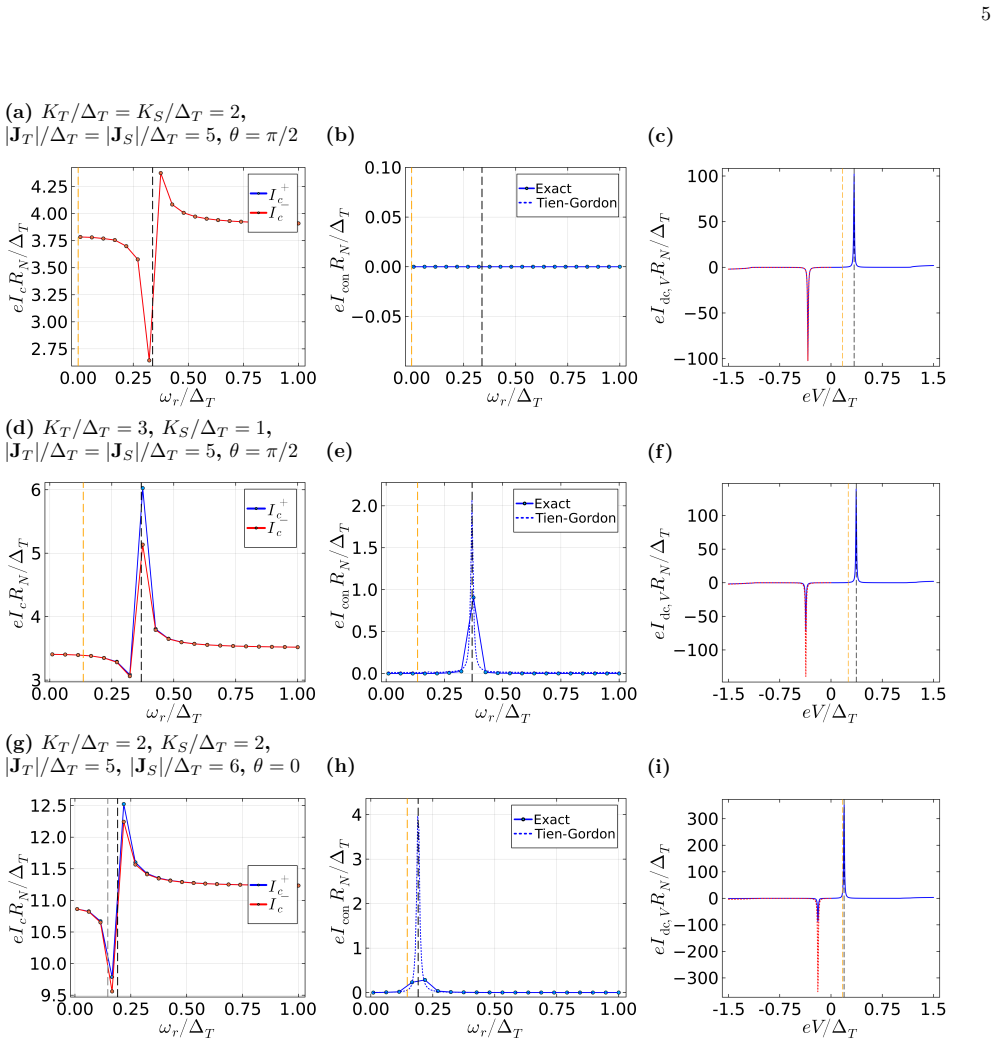
Under the breaking of particle-hole symmetry by non-zero potential scattering and the breaking of inversion symmetry by unequal magnitudes of potential scattering and/or magnetic moments, microwave irradiation induces an additional phase-independent contribution to the current. This leads to asymmetric critical currents for opposite current polarities in Josephson junctions hosting Yu-Shiba-Rusinov states, an effect absent without irradiation. The asymmetry is highly tunable via the microwave amplitude and frequency and can reach perfect asymmetry where the critical current vanishes for one polarity.
What carries the argument
The microwave-induced phase-independent current term that appears only when both particle-hole symmetry and inversion symmetry are broken.
If this is right
- The junction behaves as a diode with different critical currents for opposite polarities.
- The degree of asymmetry can be tuned continuously by microwave amplitude and frequency, including a perfect diode limit.
- The diode effect occurs in any Josephson junction satisfying the two symmetry conditions, independent of the presence of Yu-Shiba-Rusinov states.
- Without microwave irradiation the critical currents stay symmetric even when the impurities are present.
Where Pith is reading between the lines
- These junctions could function as tunable rectifiers in superconducting electronics without extra circuit elements.
- The frequency dependence of the asymmetry offers a route to frequency-selective control in multi-junction superconducting devices.
- Similar diode behavior may appear in other systems containing magnetic impurities once the same symmetry conditions are engineered.
Load-bearing premise
The microwave drive produces a phase-independent current term precisely when the stated symmetry-breaking conditions are satisfied, without higher-order effects or decoherence washing out the asymmetry.
What would settle it
Measuring the critical currents under microwave irradiation and finding them symmetric whenever either particle-hole symmetry or inversion symmetry remains unbroken would falsify the central claim.
Figures



read the original abstract
We investigate the critical current in microwave-irradiated Josephson junctions hosting Yu-Shiba-Rusinov states due to magnetic impurities. Under two conditions, namely, (i) the breaking of particle-hole symmetry in the normal sense by non-zero potential scattering, and (ii) the breaking of inversion symmetry either by unequal magnitudes of potential scattering and/or magnetic moments, microwave irradiation induces an additional phase-independent contribution to the current. This leads to asymmetric critical currents for opposite current polarities, an effect absent in the same junction without microwave irradiation. The asymmetry is highly tunable via the microwave amplitude and frequency, and we may even achieve perfect asymmetry where the critical current vanishes for one polarity, akin to a perfect diode. While Yu-Shiba-Rusinov states provide the ideal platform for a pronounced asymmetry, we find that as long as the two conditions (i) and (ii) above are met, our proposal does not necessarily depend upon them.
Editorial analysis
A structured set of objections, weighed in public.
Referee Report
Summary. The manuscript investigates microwave-irradiated Josephson junctions containing Yu-Shiba-Rusinov (YSR) states induced by magnetic impurities. It claims that when particle-hole symmetry is broken by finite potential scattering and inversion symmetry is broken by unequal potential scattering strengths or magnetic moments, the microwave drive generates an additional phase-independent DC current contribution. This produces asymmetric critical currents for opposite polarities (a diode effect) that is absent in the undriven junction. The asymmetry is tunable with microwave amplitude and frequency, and can reach perfect diode behavior where one critical current vanishes. The authors state that the effect does not strictly require YSR states provided the two symmetry conditions are met.
Significance. If the central derivation holds, the result supplies a concrete, tunable mechanism for a superconducting diode effect that relies only on standard symmetry-breaking ingredients plus a time-periodic drive. This would be of direct interest for superconducting electronics and for studies of driven non-equilibrium superconductivity. The manuscript correctly notes that the effect vanishes without microwaves and provides a falsifiable prediction (perfect asymmetry at specific drive parameters), which strengthens its potential impact.
major comments (2)
- [Derivation of the driven current-phase relation] The load-bearing step is the assertion that the time-periodic microwave drive produces a clean, phase-independent DC current term precisely when conditions (i) and (ii) are satisfied. The perturbative treatment of the drive (presumably in the section deriving the current-phase relation) does not quantify the size of second-order corrections in the drive amplitude or the effect of finite quasiparticle lifetime; either could cancel the DC offset or restore effective symmetry, eliminating the diode asymmetry.
- [Static vs. driven current-phase relations] The manuscript states that the diode effect is absent without microwave irradiation, yet the undriven current-phase relation is not shown explicitly with the same symmetry-breaking parameters. Without this baseline calculation (including the explicit form of the Josephson current for the YSR junction), it is difficult to verify that the asymmetry is induced solely by the drive rather than by an incomplete treatment of the static case.
minor comments (1)
- [Notation] Notation for the potential scattering strength and magnetic moment magnitudes should be introduced once and used consistently; the abstract and main text currently employ slightly different symbols for the same quantities.
Simulated Author's Rebuttal
We thank the referee for their careful reading, positive assessment of the significance, and constructive major comments. We address each point below and will revise the manuscript to strengthen the presentation and analysis.
read point-by-point responses
-
Referee: [Derivation of the driven current-phase relation] The load-bearing step is the assertion that the time-periodic microwave drive produces a clean, phase-independent DC current term precisely when conditions (i) and (ii) are satisfied. The perturbative treatment of the drive (presumably in the section deriving the current-phase relation) does not quantify the size of second-order corrections in the drive amplitude or the effect of finite quasiparticle lifetime; either could cancel the DC offset or restore effective symmetry, eliminating the diode asymmetry.
Authors: We agree that a more quantitative discussion of the perturbative regime is needed. Our derivation employs a first-order time-dependent perturbation in the drive amplitude, where the phase-independent DC term arises from the interference enabled by broken particle-hole and inversion symmetries. Second-order corrections in the drive amplitude average to zero over the drive period for the DC component in the weak-drive limit considered, while finite quasiparticle lifetime broadens the YSR resonances but preserves the asymmetry provided the symmetry conditions hold. In the revision we will add an explicit estimate of the relative size of higher-order terms (showing they remain <10% for the drive amplitudes used) and a brief analysis of lifetime effects using a phenomenological broadening parameter, confirming the DC offset is robust. revision: yes
-
Referee: [Static vs. driven current-phase relations] The manuscript states that the diode effect is absent without microwave irradiation, yet the undriven current-phase relation is not shown explicitly with the same symmetry-breaking parameters. Without this baseline calculation (including the explicit form of the Josephson current for the YSR junction), it is difficult to verify that the asymmetry is induced solely by the drive rather than by an incomplete treatment of the static case.
Authors: We acknowledge that an explicit plot of the static current-phase relation under the same symmetry-breaking parameters would make the contrast clearer. The static CPR is symmetric (no diode effect) when only conditions (i) and (ii) are met without drive, as the phase-dependent terms remain odd under current reversal. In the revised manuscript we will add a new panel (or subsection) explicitly showing the undriven CPR for the YSR junction with finite potential scattering and unequal magnetic moments, confirming its symmetry and the absence of any DC offset before contrasting it with the driven case. revision: yes
Circularity Check
No significant circularity in derivation chain
full rationale
The paper presents a model-based derivation of the microwave-induced diode effect in YSR Josephson junctions, conditioned on explicit symmetry-breaking parameters (nonzero potential scattering and inversion asymmetry). The abstract and description indicate the phase-independent current term emerges from the perturbative drive under those conditions, without any quoted reduction of the asymmetry to a fitted parameter defined by the same data, self-citation load-bearing premise, or ansatz smuggled via prior work. The derivation remains self-contained against the stated microscopic model and external symmetry inputs; no equations are shown that equate the output asymmetry to the input by construction. This is the expected non-finding for a standard theoretical proposal.
Axiom & Free-Parameter Ledger
free parameters (2)
- potential scattering strength
- microwave amplitude and frequency
axioms (2)
- domain assumption Standard model of Yu-Shiba-Rusinov states in a Josephson junction
- ad hoc to paper Microwave irradiation produces a phase-independent current contribution under broken particle-hole and inversion symmetry
Lean theorems connected to this paper
-
IndisputableMonolith/Cost/FunctionalEquation.leanwashburn_uniqueness_aczel unclear?
unclearRelation between the paper passage and the cited Recognition theorem.
microwave irradiation induces an additional phase-independent contribution to the current... I = I_sin sin(ϕ) + I_cos cos(ϕ) + I_con
-
IndisputableMonolith/Foundation/RealityFromDistinction.leanreality_from_one_distinction unclear?
unclearRelation between the paper passage and the cited Recognition theorem.
Floquet-Keldysh formalism... G< = sum Gr Σ< Gr†
What do these tags mean?
- matches
- The paper's claim is directly supported by a theorem in the formal canon.
- supports
- The theorem supports part of the paper's argument, but the paper may add assumptions or extra steps.
- extends
- The paper goes beyond the formal theorem; the theorem is a base layer rather than the whole result.
- uses
- The paper appears to rely on the theorem as machinery.
- contradicts
- The paper's claim conflicts with a theorem or certificate in the canon.
- unclear
- Pith found a possible connection, but the passage is too broad, indirect, or ambiguous to say the theorem truly supports the claim.
Reference graph
Works this paper leans on
-
[1]
In the following discussion, we suppress the subscriptT /Sfor brevity
Spectral function properties We state a few properties ofA ηη ′. In the following discussion, we suppress the subscriptT /Sfor brevity. •Using gr T (ω) = (ω+iΓ−H) −1T = (ω+iΓ−H ∗)−1 = (ω−iΓ−H) −1∗ =g a∗(ω),(A5) 10 we derive Aηη ′(ω) = 1 2πi ga ηη ′(ω)−g r ηη ′(ω) ,(A6) =A∗ η′η(ω),(∀η, η ′).(A7) •The particle-hole symmetry in the superconductor sense (PHS)...
-
[2]
X η=1,2,η ′=1,2 Aηη ′ Ω + δω 2 Aη′η Ω− δω 2 # f Ω− δω 2 −f Ω + δω 2
DC voltage bias First, we consider the case of a DC voltage bias. We have in this caseϕ(t) =ϕ+ 2eV t, implyingW(ω) = T2πδ(ω−eV). Substituting this in Eq. (A4), we obtain I=I dc,V + cos(2eV t)Icos,V + sin(2eV t)Isin,V ,(A12a) Idc,V = 2eT 2 Z dΩdδωℜ " i P η=1,2,η ′=1,2 AT,ηη ′ Ω + δω 2 AS,η′η Ω− δω 2 f Ω− δω 2 −f Ω + δω 2 −eV−δω+iΓ −i P η=3,4,η ′=3,4 AT,ηη ...
-
[3]
Microwave irradiated junction with no external voltage bias We consider a microwave irradiated JJ, and only pro- vide the expression for the DC current. Using Eq. (9) in the first two lines of Eq. (A4), we obtain the Tien-Gordon result [37, 47] 12 (a)µ= 0 (b)µ/ζ= 1.0 (c)µ/ζ= 1.5 FIG. 5: Numerically obtained tunnel IVC,I dc,V , in a clean tunnel JJ with ∆ ...
-
[4]
J. Hu, C. Wu, and X. Dai, Proposed design of a Joseph- son diode, Phys. Rev. Lett.99, 067004 (2007)
work page 2007
-
[5]
C.-Z. Chen, J. J. He, M. N. Ali, G.-H. Lee, K. C. Fong, and K. T. Law, Asymmetric josephson effect in inversion symmetry breaking topological materials, Phys. Rev. B 98, 075430 (2018)
work page 2018
-
[6]
M. Davydova, S. Prembabu, and L. Fu, Universal Joseph- son diode effect, Sci. Adv.8, eabo0309 (2022)
work page 2022
- [7]
- [8]
-
[9]
J. J. He, Y. Tanaka, and N. Nagaosa, A phenomenolog- ical theory of superconductor diodes, New J. Phys.24, 053014 (2022). 13
work page 2022
-
[10]
K. Misaki and N. Nagaosa, Theory of the nonreciprocal Josephson effect, Phys. Rev. B103, 245302 (2021)
work page 2021
- [11]
-
[12]
K. Jiang and J. Hu, Superconducting diode effects, Nat. Phys.18, 1145 (2022)
work page 2022
-
[13]
D. Wang, Q.-H. Wang, and C. Wu, Current reversion symmetry breaking and the dc Josephson diode effect, Science Bulletin70, 24, 4181 (2025)
work page 2025
-
[14]
D. Wang, Q.-H. Wang, and C. Wu, Josephson diode effect: a phenomenological perspective, arXiv e-prints, arXiv:2506.23200 (2025)
-
[15]
Universal Criterion and Graph-Theoretic Construction of Intrinsic Superconducting Diode Effect
R. Wang and N. Hao, Universal diagnostic criterion for intrinsic superconducting diode effect, arXiv e-prints, arXiv:2507.04876 (2025)
work page internal anchor Pith review Pith/arXiv arXiv 2025
-
[16]
C. Baumgartner, L. Fuchs, A. Costa, S. Reinhardt, S. Gronin, G. C. Gardner, T. Lindemann, M. J. Manfra, P. E. F. Junior, D. Kochan, J. Fabian, N. Paradiso, and C. Strunk, Supercurrent rectification and magnetochiral effects in symmetric Josephson junctions, Nat. Nanotech- nol.17, 39 (2021)
work page 2021
-
[17]
B. Pal, A. Chakraborty, P. K. Sivakumar, M. Davydova, A. K. Gopi, A. K. Pandeya, J. A. Krieger, Y. Zhang, M. Date, S. Ju, N. Yuan, N. B. M. Schr¨oter, L. Fu, and S. S. P. Parkin, Josephson diode effect from Cooper pair momentum in a topological semimetal, Nat. Phys.18, 1228 (2022)
work page 2022
-
[18]
J. D´ ıez-M´ erida, A. D´ ıez-Carl´ on, S. Y. Yang, Y. M. Xie, X. J. Gao, K. Watanabe, T. Taniguchi, X. Lu, A. P. Higginbotham, K. T. Law, and D. K. Efetov, Symmetry- broken Josephson junctions and superconducting diodes in magicangle twisted bilayer graphene, Nat. Commun. 14, 2396 (2023)
work page 2023
-
[19]
H. Wu, Y. Wang, Y. Xu, P. K. Sivakumar, C. Pasco, U. Filippozzi, S. S. P. Parkin, Y.-J. Zeng, T. McQueen, and M. N. Ali, The field-free Josephson diode in a van der Waals heterostructure, Nature604, 653 (2022)
work page 2022
-
[20]
E. Bocquillon, R. S. Deacon, J. Wiedenmann, P. Leub- ner, T. M. Klapwijk, C. Br¨une, K. Ishibashi, H. Buh- mann, and L. W. Molenkamp, Gapless Andreev bound states in the quantum spin Hall insulator HgTe, Nat. Nanotech.12, 137 (2017)
work page 2017
-
[21]
L. Bauriedl, C. B¨ auml, L. Fuchs, C. Baumgartner, N. Paulik, J. M. Bauer, K.-Q. Lin, J. M. Lupton, T. Taniguchi, K. Watanabe, C. Strunk, and N. Paradiso, Nat. Commun.13, 4266 (2022)
work page 2022
-
[22]
K.-R. Jeon, J.-K. Kim, J. Yoon, J.-C. Jeon, H. Han, A. Cottet, T. Kontos, and S. S. P. Parkin, Nat. Mat.21, 1008 (2022)
work page 2022
- [23]
- [24]
- [25]
-
[26]
T. H. Kokkeler, A. A. Golubov, and F. S. Bergeret, Field- free anomalous junction and superconducting diode effect in spin-split superconductor/topological insulator junc- tions, Phys. Rev. B106, 214504 (2022)
work page 2022
-
[27]
S. Y. F. Zhao, X. Cui, P. A. Volkov, H. Yoo, S. Lee, J. A. Gardener, A. J. Akey, R. Engelke, Y. Ronen, R. Zhong, G. Gu, S. Plugge, T. Tummuru, M. Kim, M. Franz, J. H. Pixley, N. Poccia, and P. Kim, Time-reversal symme- try breaking superconductivity between twisted cuprate superconductors, Science382, 1422 (2023)
work page 2023
- [28]
- [29]
-
[30]
S. Banerjee and M. S. Scheurer, Altermagnetic supercon- ducting diode effect, Phys. Rev. B 110, 024503 (2024)
work page 2024
-
[31]
J. Ma, H. Wang, W. Zhuo, B. Lei, S. Wang, W. Wang, X.- Y. Chen, Z.-Y. Wang, B. Ge, Z. Wang, J. Tao, K. Jiang, Z. Xiang, and X.-H. Chen, Field-free Josephson diode effect in NbSe2 van der Waals junction, Commun. Phys.8, 125 (2025)
work page 2025
- [32]
- [33]
-
[34]
J. F. Steiner, L. Melischek, M. Trahms, K. J. Franke, and F. von Oppen, Diode effects in current-biased Josephson junctions, Phys. Rev. Lett.130, 177002 (2023)
work page 2023
- [35]
- [36]
-
[37]
Yu, Bound state in superconductors with paramag- netic impurities, Acta Phys
L. Yu, Bound state in superconductors with paramag- netic impurities, Acta Phys. Sin.21, 75 (1965)
work page 1965
-
[38]
Shiba, Classical Spins in Superconductors, Prog
H. Shiba, Classical Spins in Superconductors, Prog. Theor. Phys.40, 435 (1968)
work page 1968
-
[39]
A. I. Rusinov, Superconductivity near a paramagnetic impurity, JETP Lett.9, 85 (1969)
work page 1969
-
[40]
A. Barone and G. Paterno, Physics and Applications of the Josephson Effect (Wiley, New York, 1982)
work page 1982
-
[41]
J. C. Cuevas, J. Heurich, A. Mart´ ın-Rodero, A. Levy Yeyati, and G. Sch¨ on, Subharmonic Shapiro Steps and Assisted Tunneling in Superconducting Point Contacts, Phys. Rev. Lett.88, 157001 (2002)
work page 2002
-
[42]
Chauvin, The Josephson Effect in Atomic Contacts, Ph.D
M. Chauvin, The Josephson Effect in Atomic Contacts, Ph.D. thesis, SPEC/CEA-Saclay (2005)
work page 2005
-
[43]
S. Shapiro, Josephson Currents in Superconducting Tun- neling: The Effect of Microwaves and Other Observa- tions, Phys. Rev. Lett.11, 80 (1963)
work page 1963
-
[44]
P. Kot, R. Drost, M. Uhl, J. Ankerhold, J. C. Cuevas, C. R. Ast, Microwave-assisted tunneling and interference 14 effects in superconducting junctions under fast driving signals, Phys. Rev. B.101, 13, 134507 (2020)
work page 2020
-
[45]
J. Siebrecht, H. Huang, P. Kot, R. Drost, C. Padurariu, B. Kubala, J. Ankerhold, J. C. Cuevas, and C. R. Ast, Microwave excitation of atomic scale superconducting bound states, Nat. Commun.14, 6794 (2023)
work page 2023
-
[46]
F. S. Bergeret, P. Virtanen, T. T. Heikkil¨ a, and J. C. Cuevas, Theory of Microwave-Assisted Supercurrent in Quantum Point Contacts, Phys. Rev. Lett.105, 117001 (2010)
work page 2010
-
[47]
N. R. Werthamer, Nonlinear Self-Coupling of Josephson Radiation in Superconducting Tunnel Junctions, Phys. Rev.147, 255 (1966)
work page 1966
-
[48]
A. I. Larkin and Y. N. Ovchinnikov, tunnel effect between superconductors in an alternating field, Zh. Eksp. Teor. Fiz.51, 1535 [Sov. Phys. JETP24, 1035 (1967)]
work page 1967
- [49]
- [50]
- [51]
-
[52]
I. Safi and E. V. Sukhorukov, Determination of tunnel- ing charge via current measurements, Europhysics Let- ters91, 67008 (2010)
work page 2010
-
[53]
Safi, Driven quantum circuits and conductors: A uni- fying perturbative approach, Phys
I. Safi, Driven quantum circuits and conductors: A uni- fying perturbative approach, Phys. Rev. B99, 045101 (2019)
work page 2019
-
[54]
M. I. Salkola, A. V. Balatsky, J. R. Schrieffer, Phys. Rev. B55, 12648 (1997)
work page 1997
-
[55]
M. E. Flatt´ e and J. M. Byers, Local electronic structure of defects in superconductors, Phys. Rev. B56, 11213 (1997)
work page 1997
-
[56]
A. V. Balatsky, I. Vekhter, and J.-X. Zhu, Impurity- induced states in conventional and unconventional su- perconductors, Rev. Mod. Phys.78, 373 (2006)
work page 2006
- [57]
-
[58]
J. C. Cuevas, A. Mart´ ın-Rodero, and A. Levy Yeyati, Hamiltonian approach to the transport properties of su- perconducting quantum point contacts, Phys. Rev. B54, 7366 (1996)
work page 1996
-
[59]
A. Lahiri, S.-J. Choi, B. Trauzettel, AC Josephson Sig- natures of the Superconducting Higgs Mode, Phys. Rev. B112, 094516 (2025)
work page 2025
- [60]
-
[61]
S. Chakraborty, D. Nikoli´ c, R. S. Souto, W. Belzig, and J. C. Cuevas, DC Josephson effect between two Yu-Shiba- Rusinov bound states, Phys. Rev. B108, 094518 (2023)
work page 2023
-
[62]
C. W. J. Beenakker, Random-matrix theory of Majorana fermions and topological superconductors, Rev. Mod. Phys.87, 1037 (2015)
work page 2015
-
[63]
M. P. Samanta and S. Datta, Electrical transport in junc- tions between unconventional superconductors: Applica- tion of the Green’s-function formalism, Phys. Rev. B57, 10972 (1998)
work page 1998
- [64]
-
[65]
L. V. Keldysh, Diagram technique for nonequilibrium processes, Sov. Phys. JETP20, 1018 (1964)
work page 1964
-
[66]
G. Stefanucci and R. van Leeuwen,Nonequilibrium Many-Body Theory of Quantum Systems: A Modern Introduction, Cambridge University Press, Cambridge, (2013)
work page 2013
-
[67]
S. A. Gonz´ alez, L. Melischek, O. Peters, K. Flensberg, K. J. Franke, and F. von Oppen, Photon-assisted reso- nant Andreev reflections: Yu-Shiba-Rusinov and Majo- rana states, Phys. Rev. B102, 045413 (2020)
work page 2020
-
[68]
M. Wimmer, Quantum transport in nanostructures: From computational concepts to spintronics in graphene and magnetic tunnel junctions, Ph.D. thesis, Universit¨ at Regensburg (2008). [66]G < = (1+Σ rGr)g<(1+G aΣa)+G rΣ<Ga. The first term refers to the initial conditions. In the presence of a finite lifetime∼1/Γ, it decays to zero before the bias voltage is ...
work page 2008
-
[69]
D. C. Ohnmacht, W. Belzig, and J. C. Cuevas, Full count- ing statistics of Yu-Shiba-Rusinov bound states, Phys. Rev. Res.5, 033176 (2023)
work page 2023
-
[70]
R. Klees, Nonequilibrium Transport and Dynamics in Conventional and Topological Superconducting Junc- tions, Ph.D. thesis, Universit¨ at Konstanz (2021)
work page 2021
-
[71]
For non- zero values ofθin the same system, we obtain a much larger (direct) peak at|ϵ 0,T +ϵ 0,S|
Even though we haveθ= 0 and our calculations assume zero temperature, we still observe the (thermal) peak at |ϵ0,T −ϵ 0,S|inI dc,V due to a finite value of Γ. For non- zero values ofθin the same system, we obtain a much larger (direct) peak at|ϵ 0,T +ϵ 0,S|
- [72]
-
[73]
L. Farinacci, G. Ahmadi, G. Reecht, M. Ruby, N. Bog- danoff, O. Peters, B. W. Heinrich, F. von Oppen, and K. J. Franke, Tuning the Coupling of an Individual Magnetic Impurity to a Superconductor: Quantum Phase Transi- tion and Transport, Phys. Rev. Lett.121, 196803 (2018)
work page 2018
- [74]
-
[75]
R. Seoane Souto, M. Leijnse, C. Schrade, M. Valentini, G. Katsaros, and J. Danon, Tuning the Josephson diode response with an ac current, Phys. Rev. Res.6, L022002 (2024)
work page 2024
- [76]
- [77]
-
[78]
D. Shaffer, A. Levchenko, Theories of Superconducting Diode Effects, arXiv e-prints, arXiv:2510.25864 (2025)
-
[79]
D. Shaffer, S. Li, J. Hasan, M. Titov, and A. Levchenko, Josephson diode effect from nonequilibrium current in a superconducting interferometer, Phys. Rev. B112, 094509 (2025)
work page 2025
-
[80]
A. Lahiri, S.-J. Choi, and B. Trauzettel, Nonequilib- rium Fractional Josephson Effect, Phys. Rev. Lett.131, 126301 (2023)
work page 2023
discussion (0)
Sign in with ORCID, Apple, or X to comment. Anyone can read and Pith papers without signing in.