REVIEW 5 major objections 4 minor 28 references
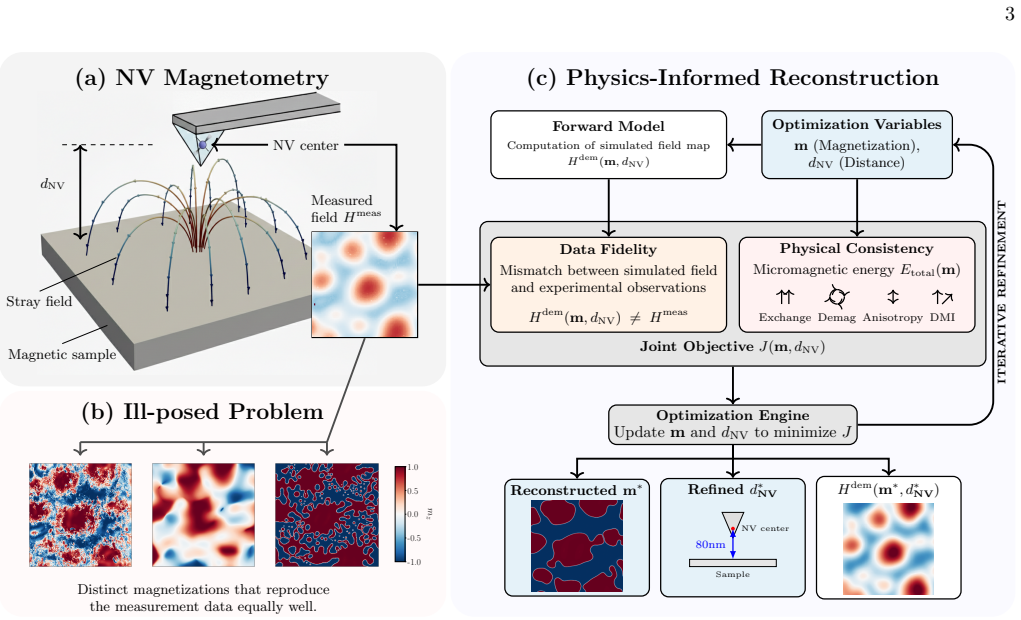
Incorporating the full micromagnetic energy directly into the inversion turns ill-posed NV magnetometry reconstruction into a joint optimization that recovers both the spin texture and the unknown sensor-sample distance.
Reviewed by Pith at T0; open to challenge. T0 means a machine referee read the full paper against a public rubric. the ladder, T0–T4 →
A micromagnetic-energy-regularized Fourier-space inversion simultaneously reconstructs magnetization textures and the unknown NV sensor-sample distance (~80 nm) from stray-field maps.
T0 review reviewed 2026-08-02 challenge →
load-bearing objection The variational inversion method is genuinely useful; the 81-nm sensor distance is a fitted parameter with no independent check, so treat that number as provisional. the 5 major comments →
A Fourier-Space Approach to Physics-Informed Magnetization Reconstruction from Nitrogen-Vacancy Measurements
The pith
A machine-rendered reading of the paper's core claim, the machinery that carries it, and where it could break.
The reading
Core claim
The central claim is that incorporating the micromagnetic energy functional directly into the variational formulation filters out unphysical, high-energy configurations that plague purely data-driven inversions, and that treating the sensor–sample distance as a differentiable parameter via Fourier-space upward continuation allows simultaneous recovery of the magnetization texture and the effective NV height. On the experimental Fe3−xGaTe2 flake, the joint optimization converges to an effective distance of roughly 80 nm (stable at 77–80 nm for regularization strengths up to the L-curve optimum) and produces configurations whose simulated stray fields match the measured map. The paper further
What carries the argument
The load-bearing element is the total micromagnetic energy Etotal(m), composed of exchange, demagnetization, uniaxial anisotropy, and interfacial Dzyaloshinskii–Moriya interaction terms, used as a regularizer in the loss J = ||H_dem(m,d_NV) − H_meas|| + λEtotal(m). The second key piece is the Fourier-space transfer function H̃(d_NV) = ⟨H̃⟩ · [kΔz/(1−e^{−kΔz})] e^{−k(d_NV−z0)}, which corrects for vertical cell-volume averaging and upward-continues the stray field to an arbitrary sensor height, making the forward model explicitly differentiable with respect to d_NV. Together these enable joint gradient-based optimization of the magnetization (constrained to the unit sphere) and the distance, w
Load-bearing premise
The forward model — the finite-difference FFT stray-field solver, the de-averaging/upward-continuation transfer function, and the ODMR processing H_meas = |H_∥| − H_bias — must be an unbiased image of the true NV measurement, so that the fitted d_NV is the actual geometry and not a catch-all that absorbs model–sample mismatch.
What would settle it
Measure the same Fe3−xGaTe2 flake with two different NV center depths (or a separately calibrated sensor height) and run the reconstruction on each; if the recovered d*_NV differs between the two scans, the forward-model assumption fails. Equivalently, generate a synthetic dataset with an independent micromagnetic solver (e.g., a finite-element code) at a known height and test whether the inversion recovers the known height and texture.
If this is right
- The effective sensor–sample distance can be estimated from the same scan that yields the magnetization, eliminating the need for independent calibration of NV implantation depth, surface oxidation, and gap.
- The physics-informed regularizer suppresses fragmented, unphysical states that result from unconstrained (λ=0) inversion, producing reconstructions that sit in a low-energy region of state space.
- Because the optimization is differentiable in the distance, the method can in principle be applied to any stray-field magnetic imaging modality with a forward model, not just NV magnetometry.
- The reconstruction's sensitivity to the choice of energy terms suggests a route to identifying the underlying physics (e.g., DMI sign and chirality) from the field data alone.
Where Pith is reading between the lines
- The paper's own synthetic validation generates the measurement with the same forward operator used for inversion; a stronger test would use an independent solver (e.g., finite-element) or a second experimental scan at a different height to confirm the distance estimate is not an artifact of the transfer function.
- The observed drift of d*_NV at high λ (up to 131 nm) could serve as a diagnostic: if the reconstructed height changes sharply with the regularization weight, that is a sign of forward-model mismatch or over-regularization, rather than a true geometric parameter.
- The same energy-regularized framework could be extended to time-resolved or three-dimensional reconstructions by augmenting the energy functional, though depth resolution is fundamentally limited by the exponential decay of stray fields with distance.
- Replacing the present L-curve selection with a more principled statistical criterion (e.g., generalized cross-validation or Bayesian evidence) could make the optimal λ and the distance estimate less ad hoc, but the paper does not explore this.
Editorial analysis
A structured set of objections, weighed in public.
Referee Report
Summary. The manuscript presents a Fourier-space physics-informed inversion method for NV magnetometry. The forward model combines magnum.np finite-difference stray-field computation with an analytical upward-continuation operator (Eq. 1, derived in the Supplemental as Eq. S17) that de-averages the cell-averaged field and extrapolates it to an arbitrary sensor height. The inverse problem is posed as joint minimization of a data-fidelity term and the micromagnetic total energy, with the magnetization optimized on the unit sphere via Riemannian Adam and the sensor distance d_NV treated as a free parameter. The method is validated on synthetic data generated from a known 80 nm standoff and then applied to a room-temperature NV scan of Fe_{3-x}GaTe2, where it yields d*_NV ≈ 80 nm at the L-curve-selected lambda_opt = 2.8×10^17. The paper claims that this removes the need for independent sensor-height calibration and that the reconstructed low-energy spin textures reproduce the measured field.
Significance. If the experimental distance estimate is robust, the method is a significant practical advance: it replaces heuristic Tikhonov regularization with quantitative micromagnetic energies, provides a differentiable forward model with an exact Fourier-space standoff dependence, and enables joint estimation of the sensor-sample distance. The derivation of Eq. (1) is clean and self-contained, and the synthetic tests demonstrate that the optimization can recover a known magnetization texture and height when the forward model is exact. The use of Riemannian optimization to enforce |m|=1, the L-curve criterion, and the open-source magnum.np backend are concrete strengths. However, the central experimental claim rests on a fitted d_NV that is not independently calibrated, and the synthetic validation is circular in that the data-generating operator is the same one used in inversion. The paper's own Discussion concedes that model mismatch can bias d*_NV and that the reconstructed states show slow drift under LLG relaxation, which tempers the claim of physically plausible reconstructions.
major comments (5)
- [Results, Fig. 3(b); Discussion] The headline quantitative result is the recovered sensor height d*_NV ≈ 81 nm, yet Fig. 3(b) shows this estimate is strongly lambda-dependent in the over-regularized regime, rising to 131 nm. The Discussion explains the mechanism: for lambda > lambda_opt, d_NV is 'artificially increased to blur and dampen the simulated stray field.' Because exactly the same compensation can absorb forward-model mismatch at any lambda, the absence of an independent d_NV calibration (e.g., a control sample with a known NV depth, or a second measurement modality) leaves the 80 nm value conditional on the model. Please provide uncertainty bars or confidence intervals for d*_NV and validate the standoff estimate on a sample with an independently known sensor height before claiming distance recovery as a key result.
- [Supplemental, 'Validation with synthetic data'] The synthetic validation is self-consistent but not a test of forward-model fidelity: the synthetic H_meas is generated with the same magnum.np FFT demagnetization solver and the same upward-continuation transfer function (Eq. S17) that are used in the inversion. This demonstrates that the optimizer can invert the forward map, but it says nothing about how faithfully that map represents an actual NV measurement. To support the 'precise sensor height estimation' claim, the authors should validate against an independent forward solver (e.g., a different discretization or a boundary-element method) or against an experimental dataset with a known standoff.
- [Discussion, LLG relaxation check] The consistency check states that the reconstructed configurations 'exhibit a slow spatial drift or gradual deformation' under LLG relaxation. This is direct evidence that the reconstructed states are not stationary solutions of the assumed energy, undermining the claim that the method produces 'low-energy configurations that reproduce the observed field.' The drift is attributed to model-sample mismatch, but the manuscript does not quantify it. Please report the torque norm or time-dependent evolution, and specify convergence tolerances for the reconstruction. Without this, the physical plausibility of m* is not established beyond field agreement.
- [Methods, Eq. (S2)-(S3); Discussion] The material parameters are not error-free inputs: M_s is derived from a phenomenological domain-wall model with a fitting parameter beta ≈ 0.31, and K_u is obtained from K_eff by re-adding the shape anisotropy. The Discussion concedes that inaccuracies in M_s or film thickness 'can bias the reconstructed sensor height d*_NV.' Since d_NV is a single scalar that can absorb multiple model discrepancies, a sensitivity analysis is needed. Show how d*_NV varies under plausible changes in M_s, K_u, A, D_i, and thickness, and whether the 77–80 nm stability holds across that range.
- [Supplemental, 'Analysis of ODMR sign ambiguity artifacts'] The measured signal is H_meas = |H_parallel| - H_bias, which is nonlinear in regions where the stray field opposes and exceeds the bias field. The Supplemental argues that Measurement 1 has minimal sign-ambiguity artifacts, but it does not state whether the flagged lowest-10% pixels are masked or downweighted in L_data, or whether the raw H_meas values are used directly in Eq. (2). If artifact-prone pixels are included without modeling the absolute value, they can bias both the field residual and the optimized d_NV. Please quantify the fraction of pixels in the reconstruction region affected by sign ambiguity and either mask them or incorporate the nonlinear ODMR response in the forward model.
minor comments (4)
- [Methods, L-curve] The L-curve corner is identified visually ('the corner'), but no quantitative criterion is given. Please state the algorithm used to locate the corner and report the coordinates used for λ_opt = 2.8×10^17.
- [Methods, optimization] The stopping criterion, number of epochs, learning rates, and gradient tolerances are not reported. For reproducibility, please provide these details for both the magnetization and the distance optimization.
- [Results, Fig. 4] The figure labels λ_low = 10^17 in the main text but the text of §4 says λ_low = 1.0×10^16. Please reconcile the value and ensure all figure labels and text match.
- [General] The specific reconstruction scripts and the experimental data used for Measurement 1 are not linked. Given the claim of an end-to-end reproducible framework, please provide a code/data repository or an explicit statement of availability.
Circularity Check
Partial circularity: the synthetic validation re-inverts the same forward operator that generated the data (so its recovered 80 nm is a self-consistency property), and the headline experimental 81 nm is a fitted parameter the paper shows can absorb regularization trade-offs and forward-model mismatch, with no independent calibration.
specific steps
-
fitted input called prediction
[Supplemental Material, 'Validation with Synthetic Data' (Figs. S2, S3); forward model in Methods Eq. (1)]
"we generated a simulated measurement signal, H_meas, from a known ground-truth magnetization state, m_ref. This simulation assumed a reference sensor height of d_NV,ref = 80 nm ... Using λ_opt, the final reconstructed magnetization state m* shows excellent agreement with the reference state m_ref ... the optimized sensor height d*_NV successfully converges close to the true ground-truth value of d_NV,ref = 80 nm."
The synthetic H_meas is generated with the same forward operator that the inversion fits: magnum.np FFT demagnetization plus the identical de-averaging and upward-continuation transfer function of Eq. (1)/(S17). Recovering d*_NV ≈ 80 nm and m* ≈ m_ref therefore verifies only that the optimizer can invert its own forward map; any systematic error in the forward model or in the transfer function cancels between data generation and inversion. The abstract's claim that 'Validation on synthetic data demonstrates high-fidelity reconstruction of spin textures and precise sensor height estimation' presents this construction-level self-consistency as if it were independent validation of the forward-model physics, which the test cannot exercise.
-
fitted input called prediction
[Abstract; Results Fig. 3(b); Discussion]
"it recovers an effective distance estimate of approximately 81nm and low-energy configurations that reproduce the observed field. ... for values larger than λ_opt, the optimized height significantly increases, reaching up to 131 nm for λ_high. ... inaccuracies in parameters such as M_s or film thickness can bias the reconstructed sensor height d*_NV."
The headline experimental quantity d*_NV is a free parameter optimized to minimize the loss of Eq. (2); it is not measured or calibrated independently. The paper itself shows the fit is not identified: d*_NV ranges from 77 to 131 nm depending solely on the regularization weight λ, and the Discussion states the optimizer 'artificially increase[s]' the distance to 'blur and dampen the simulated stray field' when data and physics conflict, and that M_s or thickness errors 'can bias the reconstructed sensor height.' Presenting this trade-off- and model-error-absorbing fitted parameter as a recovered physical distance of approximately 81 nm places a fit output in the role of a measured prediction without independent verification (e.g., known NV depth or a forward model validated on a calibrant)
full rationale
The central derivation chain is largely independent. The upward-continuation transfer function Eq. (1)/(S17) is derived from first principles (Laplace's equation, Supplemental Material) and is not tuned to force 80 nm; the micromagnetic energy functional and its parameters come from standard references and external measurements (Abert et al. [16], Zhang et al. [17]); the magnum.np self-citation points to open-source, code-reproduced software, which counts as independent support; and no uniqueness theorem is imported from the authors. The circularity is partial and located in two places. First, the synthetic 'validation' generates its ground truth with the exact same forward operator used for inversion, making the recovered d*_NV ≈ 80 nm and m* a self-consistency check rather than an independent test of forward-model fidelity, noise robustness, or transfer-function correctness. Second, the experimental result d*_NV ≈ 81 nm is a fitted nuisance parameter, and the manuscript's own statements show it absorbs the regularization trade-off (77 nm at low λ up to 131 nm at high λ) and can absorb forward-model mismatch (M_s or thickness inaccuracies bias d*_NV). The LLG relaxation check corroborates this: reconstructed states 'often exhibit a slow spatial drift or gradual deformation', indicating the energy-regularized solution is not even an equilibrium of the assumed model. These are limitation passages explicitly present in the paper, and they are weighed here: they do not collapse the method's first-principles forward operator, but they do undercut the claim that the 81 nm distance is a recovered, calibrated physical quantity rather than a fitted value conditioned on an untested model. Score 5: the core derivation is non-circular, but one 'prediction' (the synthetic height/texture recovery) reduces to a self-consistency property by construction, and the headline experimental distance is a demonstrably trade-off- and mismatch-absorbing fit presented without independent calibration.
Axiom & Free-Parameter Ledger
free parameters (4)
- Regularization weight lambda =
2.8e17 (experimental), 2.2e17 (synthetic)
- Sensor-sample distance d_NV =
76.8-79.9 nm (experimental; ~80 nm synthetic)
- Saturation magnetization M_s =
approx. 53 kA/m
- Uniaxial anisotropy K_u =
approx. 0.302 MJ/m^3 (from K_eff + 0.5 mu0 M_s^2)
axioms (6)
- standard math The stray field above the sample satisfies Laplace's equation and decays as exp(-k z) in 2D Fourier space (Supplementary Eqs. S4-S10), and the NV senses the projection onto n_NV.
- domain assumption The magnum.np finite-difference FFT demagnetization field of a single 100-nm cell, corrected by the Eq. (1) de-averaging/upward-continuation operator, equals the physical stray field of the real sample at the sensor.
- domain assumption Magnetization is uniform along the film normal (one 100-nm mesh cell in z).
- domain assumption Material parameters A ~ 0.70 pJ/m, D_i ~ -0.51 mJ/m^2, K_u, M_s from Zhang et al. [17] hold for this specific flake.
- domain assumption The ODMR processing H_meas = |H_parallel| - H_bias with a spatially uniform H_bias ~ 3.2 kA/m recovers the projected stray field in artifact-free pixels.
- ad hoc to paper The L-curve corner identifies the 'optimal' lambda.
Cite this review
Pith. "Pith review of A Fourier-Space Approach to Physics-Informed Magnetization Reconstruction from Nitrogen-Vacancy Measurements." pith.science (2026). https://pith.science/paper/VECJXORZ
@misc{pith2026260217180,
  author       = {Pith},
  title        = {Pith review of: A Fourier-Space Approach to Physics-Informed Magnetization Reconstruction from Nitrogen-Vacancy Measurements},
  year         = {2026},
  howpublished = {\url{https://pith.science/paper/VECJXORZ}},
  note         = {Machine review of arXiv:2602.17180}
}
abstract
Reconstructing magnetization textures from nitrogen-vacancy (NV) magnetometry stray-field measurements is a challenging, fundamentally ill-posed inverse problem, further complicated by the unknown effective distance between sensor and magnetic material. Here we show that incorporating a micromagnetic energy functional directly into the inversion filters out unphysical, high-energy configurations, while Fourier-space upward continuation of the stray field allows us to simultaneously fit the distance. Applied to measurements of the van der Waals ferromagnet Fe$_{3-x}$GaTe$_2$, it recovers an effective distance estimate of approximately 81nm and low-energy configurations that reproduce the observed field. More broadly, embedding physics directly into the reconstruction turns ill-posed magnetic inverse problems into transparent, interpretable reconstructions, with applicability well beyond NV magnetometry.
Figures


Reference graph
Works this paper leans on
-
[1]
Casola, T
F. Casola, T. van der Sar, and A. Yacoby, Probing condensed matter physics with magnetometry based on nitrogen-vacancy centres in diamond, Nature Reviews Materials3, 17088 (2018)
2018
-
[2]
Y. Xu, W. Zhang, and C. Tian, Recent advances on applications of NV - magnetometry in condensed matter physics, Photonics Research11, 393 (2023)
2023
-
[3]
G. E. Backus, Non-uniqueness of the external geomagnetic field determined by surface inten- sity measurements, Journal of Geophysical Re- search (1896-1977)75, 6339 (1970), eprint: https://agupubs.onlinelibrary.wiley.com/doi/pdf/10.1029/JA075i031p06339
-
[4]
Bruckner, C
F. Bruckner, C. Abert, G. Wautischer, C. Huber, C. Vogler, M. Hinze, and D. Suess, Solving Large- Scale Inverse Magnetostatic Problems using the Adjoint Method, Scientific Reports7, 40816 (2017)
2017
-
[5]
C. B. Clement, J. P. Sethna, and K. C. Nowack, Recon- struction of Current Densities from Magnetic Images by Bayesian Inference (2021), arXiv:1910.12929 [physics]
Pith/arXiv arXiv 2021
-
[6]
H. J. Hug, B. Stiefel, P. J. A. van Schendel, A. Moser, R. Hofer, S. Martin, H.-J. G¨ untherodt, S. Porthun, L. Abelmann, J. C. Lodder, G. Bochi, and R. C. O’Handley, Quantitative magnetic force microscopy on perpendicularly magnetized samples, Journal of Applied Physics83, 5609 (1998)
1998
-
[7]
Feng, A.-O
Y. Feng, A.-O. Mandru, O. Yıldırım, and H. Hug, Quan- titative Magnetic Force Microscopy: Transfer-Function Method Revisited, Physical Review Applied18, 024016 (2022)
2022
-
[8]
C. Yao, Y. Yu, Y. Shi, J.-I. Jung, Z. V´ aci, Y. Wang, Z. Liu, C. Zhang, S. Tikoo-Schantz, and C. Zu, Universal reconstruction of complex magnetic profiles with minimal prior assumptions, Physical Review Applied24, 064020 (2025)
2025
-
[9]
D. A. Broadway, M. Flaks, A. E. Dubois, and P. Maletinsky, Reconstruction of nontrivial magnetiza- tion textures from magnetic field images using neural networks, Physical Review Applied23, 044012 (2025)
2025
-
[10]
Dubois, D
A. Dubois, D. Broadway, A. Stark, M. Tschudin, A. Healey, S. Huber, J.-P. Tetienne, E. Greplova, and P. Maletinsky, Untrained Physically Informed Neural Network for Image Reconstruction of Magnetic Field Sources, Physical Review Applied18, 064076 (2022)
2022
-
[11]
Suess, A
D. Suess, A. Setescak, J. Smith, F. Bruckner, H. J. Hug, and C. Abert, Reconstruction of magnetic structures and material parameters with convolutional neural network and bias field-constrained micromagnetic relaxation, Sci- entific Reports15, 42867 (2025)
2025
-
[12]
P. C. Hansen and D. P. O’Leary, The Use of the L- Curve in the Regularization of Discrete Ill-Posed Prob- lems, SIAM Journal on Scientific Computing14, 1487 (1993)
1993
-
[13]
Calvetti, S
D. Calvetti, S. Morigi, L. Reichel, and F. Sgallari, Tikhonov regularization and the L-curve for large dis- crete ill-posed problems, Journal of Computational and Applied Mathematics Numerical Analysis 2000. Vol. III: Linear Algebra,123, 423 (2000)
2000
-
[14]
Bruckner, S
F. Bruckner, S. Koraltan, C. Abert, and D. Suess, mag- num.np: a PyTorch based GPU enhanced finite differ- ence micromagnetic simulation framework for high level development and inverse design, Scientific Reports13, 12054 (2023)
2023
-
[15]
See Supplemental Material at the end of this document for further methodological details, analytical derivations of the upward-continuation operator, and validation via synthetic data, which includes Refs. [25–28]
-
[16]
Abert, Micromagnetics and spintronics: models and numerical methods, The European Physical Journal B 92, 120 (2019)
C. Abert, Micromagnetics and spintronics: models and numerical methods, The European Physical Journal B 92, 120 (2019)
2019
-
[17]
Zhang, Z
C. Zhang, Z. Jiang, J. Jiang, W. He, J. Zhang, F. Hu, S. Zhao, D. Yang, Y. Liu, Y. Peng, H. Yang, and H. Yang, Above-room-temperature chiral skyrmion lat- tice and Dzyaloshinskii–Moriya interaction in a van der Waals ferromagnetF e 3−xGaT e2, Nature Communica- tions15, 4472 (2024)
2024
-
[18]
Paszke, S
A. Paszke, S. Gross, F. Massa, A. Lerer, J. Bradbury, G. Chanan, T. Killeen, Z. Lin, N. Gimelshein, L. Antiga, A. Desmaison, A. K¨ opf, E. Yang, Z. DeVito, M. Rai- son, A. Tejani, S. Chilamkurthy, B. Steiner, L. Fang, and S. Chintala,PyTorch: An Imperative Style, High- Performance Deep Learning Library(2019)
2019
-
[19]
M. Kochurov, R. Karimov, and S. Kozlukov, Geoopt: Riemannian Optimization in PyTorch (2020), arXiv:2005.02819 [cs]
Pith/arXiv arXiv 2020
-
[20]
D. P. Kingma and J. Ba, Adam: A Method for Stochastic Optimization (2017), arXiv:1412.6980 [cs]
Pith/arXiv arXiv 2017
-
[21]
magnum.np developers, Inverse Problems — magnum.np 2.2.0 documentation,https://magnum.np.gitlab.io/ magnum.np/inverse_problems.html(2026), accessed: 2026-02-18
2026
-
[22]
Z. Xu, M. L. Palm, W. Huxter, K. Herb, J. M. Aben- droth, K. Bouzehouane, O. Boulle, M. S. Gabor, J. Ur- restarazu Larranaga, A. Morales, J. Rhensius, G. Puebla- Hellmann, and C. L. Degen, Minimizing Sensor-Sample Distances in Scanning Nitrogen-Vacancy Magnetometry, ACS Nano19, 8255 (2025)
2025
-
[23]
L. D. Landau and E. M. Lifshitz, Theory of the disper- sion of magnetic permeability in ferromagnetic bodies, Physikalische Zeitschrift der Sowjetunion8, 153 (1935)
1935
-
[24]
T. L. Gilbert, A phenomenological theory of damping in ferromagnetic materials, IEEE Transactions on Magnet- ics40, 3443 (2004)
2004
-
[25]
R. Bodenberger and A. Hubert, Zur bestimmung der blochwandenergie von einachsigen ferromag- neten, physica status solidi (a)44, K7 (1977), eprint: https://onlinelibrary.wiley.com/doi/pdf/10.1002/pssa.2210440146
-
[26]
Hubert and R
A. Hubert and R. Sch¨ afer,Magnetic domains: the anal- ysis of magnetic microstructures, softcover reprint of the hardcover 1st ed. 1998, corrected printing 2000 ed. (Springer, Berlin Heidelberg, 2014)
1998
-
[27]
Rohart and A
S. Rohart and A. Thiaville, Skyrmion confinement in ultrathin film nanostructures in the presence of Dzyaloshinskii-Moriya interaction, Physical Review B 88, 184422 (2013)
2013
-
[28]
A Fourier-Space Approach to Physics-Informed Magnetization Reconstruction from Nitrogen-Vacancy Measurements
L. Rondin, J.-P. Tetienne, T. Hingant, J.-F. Roch, P. Maletinsky, and V. Jacques, Magnetometry with nitrogen-vacancy defects in diamond, Reports on Progress in Physics77, 056503 (2014). 8 Supplementary Material for “A Fourier-Space Approach to Physics-Informed Magnetization Reconstruction from Nitrogen-Vacancy Measurements” DET AILED SIMULA TION SETUP The...
2014
This paper was first reviewed by deepseek-v4-flash on August 2, 2026.
discussion (0)
Sign in with ORCID, Apple, or X to comment. Anyone can read and Pith papers without signing in.