REVIEW 3 major objections 6 minor 39 references
The paper predicts that a fluid confined in a small closed cavity can flip between a bubbled and a bubble-free state, and derives the mean waiting times for both transitions.
Reviewed by Pith at T0; open to challenge. T0 means a machine referee read the full paper against a public rubric. the ladder, T0–T4 →
T0 review · deepseek-v4-flash
2026-08-02 21:52 UTC pith:JR35N3K4
load-bearing objection A plausible new kinetic framework for bubble lifetimes in closed cavities, with a nice phase-flipping prediction that is demonstrated in a single simulation but not quantitatively validated—treat the MFPT numbers as illustrative. the 3 major comments →
Phase fluctuations in a confined fluid
The pith
A machine-rendered reading of the paper's core claim, the machinery that carries it, and where it could break.
Core claim
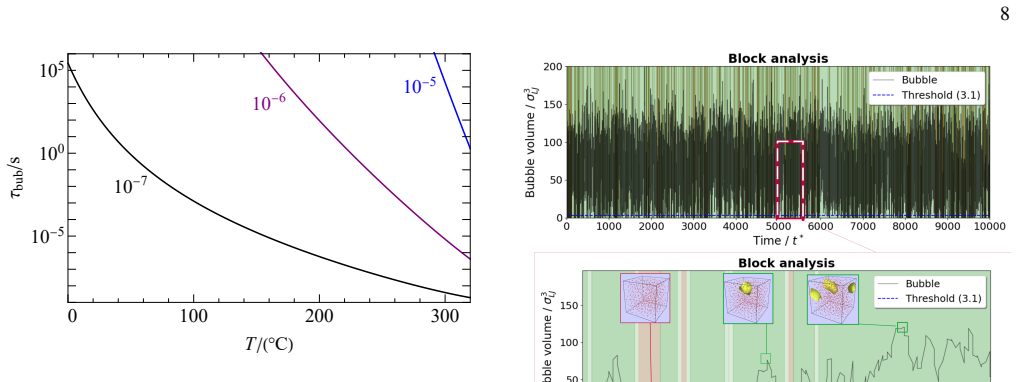
In a closed cavity, the free energy of a bubble as a function of its volume fraction has three regimes; in the metastable-bubble regime, the paper computes the rate of barrier crossing with a diffusive, volume-dependent mobility. This yields closed-form mean first-passage times for bubble collapse and for bubble nucleation, whose ratio equals the equilibrium probability ratio between the two sides of the barrier. The formulas predict that for cavities with water at room temperature and volumes around 1 µm³, bubble collapse within one second requires being within a few tenths of a percent of the bubble spinodal in density. For volumes below roughly 10^-5 µm³ at high temperature, the barrier a
What carries the argument
The central object is a reduced free-energy landscape φ(x) = (δ0(1−x)/2 − 1)x + 9ε x^{2/3}, where x is the vapor volume fraction, δ0 the reduced average density, and ε the ratio of a microscopic length (surface tension times compressibility) to the cavity radius. The landscape's two minima and intervening barrier are analyzed analytically in the small-ε limit. Escape rates are obtained from the standard diffusive barrier-crossing formula with a friction coefficient from the overdamped equation of motion of a spherical bubble, yielding a diffusion coefficient proportional to the bubble volume; that coefficient, together with the barrier curvature and height, sets the two mean first-passage ti
Load-bearing premise
The lifetimes rely on the assumption that the only slow coordinate is the bubble volume and that the viscous damping of the bubble is the same as in an unbounded liquid, described by an overdamped equation of motion; if this dynamical picture is wrong, the predicted lifetimes and flipping conditions fail.
What would settle it
Run a direct molecular-dynamics simulation of a Lennard-Jones fluid in a closed cavity with a higher free-energy barrier (larger volume or lower temperature) and measure the mean first-passage times from liquid to bubble and back; if the measured times do not follow the predicted scaling with barrier height and volume, the kinetic model is refuted.
If this is right
- For water-filled cavities of 1 µm³ and above at 20 °C, bubble collapse is predicted to occur only within about 0.7% of the gap between binodal and spinodal density, i.e., within a fraction of a degree of the spinodal temperature.
- In the phase-flipping regime (small V, high T), the usual definitions of the binodal as equal well depths do not imply equal probability of observing liquid versus bubble, because the bubble side contains vastly more configurations.
- The ratio of the two mean first-passage times is fixed by the equilibrium probability ratio, giving a direct check of the theory in simulation or experiment.
- The model provides a kinetic route to set bounds on fluid inclusion density and temperature at bubble collapse, rather than only thermodynamic bounds.
- The Lennard-Jones simulation demonstrates that phase flipping is real, though the quantitative mismatch highlights where the simplified free energy and reaction-coordinate description need refinement.
Where Pith is reading between the lines
- If the predicted lifetimes are confirmed, a single measured collapse time could be inverted to infer the fluid density in an inclusion, because τbub changes by orders of magnitude over a narrow density window near the spinodal.
- The same flipping mechanism should appear in other confined systems with a nucleation barrier, such as cavitation in nanopores or droplet condensation in small wells, whenever the barrier is a few tens of k_BT or less.
- The most likely source of the simulation discrepancy is the neglect of curvature-dependent surface tension for nanometre-size bubbles; a curvature-corrected surface tension would likely raise the barrier and bring the predicted lifetimes closer to the simulated ones.
Editorial analysis
A structured set of objections, weighed in public.
Referee Report
Summary. The paper develops a free-energy model for a liquid in a closed cavity containing a vapor bubble, using a linearized equation of state (Eq. 2). It applies Kramers theory to compute mean first-passage times for bubble collapse and formation (Eqs. 28, 30), predicting that for geologically relevant cavities (V ≥ 1 µm³) bubble disappearance occurs only extremely close to the bubble spinodal (Fig. 9). It also predicts phase flipping in small systems and presents a preliminary NVT simulation of a Lennard-Jones fluid showing such flipping. The authors acknowledge large quantitative differences between model and simulation at the end of the paper.
Significance. The qualitative prediction of phase flipping in small confined systems is novel and interesting, and the simulation provides a direct demonstration. The thermodynamic framework could offer useful kinetic bounds for fluid–inclusion geothermometry, going beyond the earlier thermodynamic-only treatments. However, the quantitative MFPT predictions are not validated: the only benchmark shows discrepancies of 4–5 orders of magnitude and a much lower energy barrier than the model. Because the central geoscience conclusion (Fig. 9) is controlled by the exponential of the free-energy barrier, the quantitative claims currently rest on an unvalidated barrier. The paper is transparent about these limitations, which is a strength, but the limitations are load-bearing for the main quantitative conclusions.
major comments (3)
- [Sec. III C, Table II, Eqs. (28), (30)] The quantitative predictions are dominated by the exponential of the free-energy barrier. The only simulation benchmark gives a barrier of 0.84 kBT at the simulated binodal, whereas the model predicts 11.1 kBT at its own binodal. The resulting MFPTs differ by factors of ~1.4×10^4 (τliq) and ~1.2×10^5 (τbub). The authors state in Sec. IV that Kramers theory is inaccurate for small barriers, but the discrepancy is not merely a prefactor issue: the exponential alone contributes a factor ~3×10^4. Since Fig. 9 and the associated geoscience claim depend on this barrier, the quantitative predictions are not supported by the evidence presented. Additional validation for larger cavities or a revised free-energy model is needed before these numbers can be used.
- [Sec. III C, Table II] The simulated bubble binodal at ρ ≈ 0.6107 lies far below the model binodal (ρ0,eq = 0.706) and even below the model spinodal (ρ0,sp = 0.720) in reduced density. Since δ0 = 0.743 < δ0,sp, the model is actually in regime (iii) with two minima, so the claim that Eq. 2 would forbid flipping is not correct. However, the 13% displacement of the binodal density shows that the linear-EOS free energy (Eq. 2) is not quantitatively predictive for this Lennard-Jones system. The qualitative shape may match (Fig. 15), but the exponential barrier is not under control, and no test is provided at the ε ≈ 10^-5 water scale used in Fig. 9.
- [Sec. III C, Sec. II B] The MFPTs quoted in Table II are extracted from a single simulation trajectory, as acknowledged in Sec. II B ('results discussed here should be treated as preliminary'). No error bars, multiple independent runs, or block-statistics analysis are provided. This is acceptable for a proof-of-principle demonstration of phase flipping, but it is insufficient to support the quantitative comparison in Table II. At minimum, the authors should provide several independent runs and report the variance of the block durations.
minor comments (6)
- [Eqs. (10)–(11)] The definitions of Ax and Aϕ appear to contain ε^{3/4} and ε^{3/2} respectively, which would make xc and ϕc scale as ε^{3/2} and ε^3, contradicting Eq. (9). Likely these factors should be constants; please clarify.
- [Sec. II B] The formula v = s^{3/2}/(4√π) for a sphere volume from its surface area s is incorrect; the correct factor is 1/(6√π). Please check whether this affects the reported effective volumes.
- [Sec. II A 2, after Eq. (24)] The statement that 'confinement does not modify the dissipation' is presented as a fact without support. It should be explicitly flagged as an assumption, and the relevant analysis (e.g., Vincent & Marmottant 2017) should be cited.
- [Sec. III C, Fig. 14] The vertical axis of the PMF panel is labeled 'U(V)' but the text uses v; also the normalization constant v0 used to set U(v=0)=0 is not defined precisely.
- [References] Reference 9 contains garbled text: 'Novembre 00, 1948'.
- [Eq. (31), Sec. III C] The ratio τbub/τliq = Zbub/Zliq is a detailed-balance identity; it does not test the kinetic prefactor or the barrier height. The factor-12 agreement for the ratio in Sec. III C therefore only checks relative thermodynamic weights, not the kinetic model.
Circularity Check
No circularity: model inputs come from independently published work and literature values; the admitted LJ discrepancies are a validity concern, not an input-output equivalence.
full rationale
The derivation is not circular. The free-energy model (Eq. 2) and the spinodal/binodal expressions are taken from an independently published prior model (Ref. 21, Caupin 2022) whose stated assumptions (linear chemical potential, perfect-gas vapor, rho_V << rho_L) do not include the MFPT predictions made here. The kinetic part follows Kramers' theory and the overdamped Rayleigh-Plesset equation (Eqs. 24-25), with diffusion coefficient from fluctuation-dissipation, and all material parameters (gamma, kappa, eta, rho_L^inf) are literature values for the Lennard-Jones fluid, not fitted to the simulation. The LJ simulation is a genuine external benchmark, and the paper honestly reports that it is preliminary and shows large quantitative differences (`the agreement is better for the ratio of the two MFPTs`, `Most of the discrepancy stems from the difference in energy barrier`); this is a correctness/validity limitation, explicitly acknowledged in the Discussion (`there are large quantitative differences`, `Kramers’ theory is expected to become inaccurate`), not a circular reduction. Equation (31), tau_bub/tau_liq = Z_bub/Z_liq, is an equilibrium detailed-balance identity rather than a fitted prediction. The self-citations (Refs. 12 and 21) are to published, peer-reviewed work with stated assumptions; they are not invoked to forbid alternatives, and no uniqueness theorem is imported. Therefore no load-bearing step reduces to its own inputs or to an unverified self-citation chain.
Axiom & Free-Parameter Ledger
free parameters (3)
- OVITO smoothing level =
2
- probe sphere radius =
tailored
- liquid/bubble threshold =
local maximum of U(v)
axioms (6)
- domain assumption The free energy of a bubble in a closed cavity is given by the linearized-EOS expression φ = (δ0/(2(1-x))-1)x + 9ε x^{2/3} (Eq. 2), from Ref. [21].
- domain assumption The vapor is a perfect gas with density much smaller than the liquid, and the liquid wets the walls so the bubble is spherical.
- domain assumption The surface tension is independent of curvature (classical nucleation theory); curvature corrections are neglected.
- domain assumption Kramers' theory with the bubble volume as reaction coordinate gives the escape rate; D(v) follows from the overdamped Rayleigh-Plesset equation with no confinement modification to dissipation (Eqs. 24-25).
- domain assumption The system is canonical (fixed N,V,T) and at equilibrium, so detailed balance holds (Eq. 26).
- domain assumption The simulation's effective bubble volume, obtained from the surface area of the largest vacuum region, corresponds to the theoretical bubble volume v.
read the original abstract
Fluid phase equilibrium depends on the external constraints imposed on a system. In a closed system with fixed volume, depending on the average density, a vapor bubble may be stable, metastable, or unstable, with respect to the homogeneous liquid phase. In the case where the bubble is metastable, we study its lifetime, i.e. the average waiting time needed to observe bubble collapse, and the corresponding lifetime of the homogeneous liquid. For the smallest systems, we predict the possibility to observe phase flipping, when the fluid oscillates between states with and without bubble. We provide an example of phase flipping in a simulation of a Lennard-Jones fluid.
Figures




Reference graph
Works this paper leans on
-
[1]
author author G. C. \ Rollins \ and\ author K. A. \ Dill ,\ 10.1021/ja5049434 journal journal J. Am. Chem. Soc. \ volume 136 ,\ pages 11420 ( year 2014 ) NoStop
-
[2]
author author A. Lyons , author A. Devi , author N. Q. \ Hoffer , \ and\ author M. T. \ Woodside ,\ 10.1103/PhysRevX.14.011017 journal journal Phys. Rev. X \ volume 14 ,\ pages 011017 ( year 2024 ) NoStop
-
[3]
author author L. I. \ McCann , author M. Dykman , \ and\ author B. Golding ,\ 10.1038/45492 journal journal Nature \ volume 402 ,\ pages 785 ( year 1999 ) NoStop
-
[4]
author author M. Chupeau , author J. Gladrow , author A. Chepelianskii , author U. F. \ Keyser , \ and\ author E. Trizac ,\ 10.1073/pnas.1910677116 journal journal Proc. Natl. Acad. Sci. U.S.A. \ volume 117 ,\ pages 1383 ( year 2020 ) NoStop
-
[5]
author author P. G. \ Debenedetti ,\ @noop title Metastable Liquids \ ( publisher Princeton University Press ,\ year 1996 ) NoStop
1996
-
[6]
author author F. Caupin \ and\ author R. E. \ Grisenti ,\ 10.1021/acs.jpclett.5c03082 journal journal J. Phys. Chem. Lett. \ ( year 2026 ),\ 10.1021/acs.jpclett.5c03082 NoStop
-
[7]
author author J. W. \ Gibbs ,\ @noop journal journal Trans. Conn. Acad. \ volume 3 ,\ pages 343 ( year 1878 ) NoStop
-
[8]
author author M. Volmer \ and\ author A. Weber ,\ 10.1515/zpch-1926-11927 journal journal Zeitschrift f\"ur Physikalische Chemie \ volume 119U ,\ pages 277 ( year 1926 ) NoStop
-
[9]
author author J. C. \ Fisher ,\ 10.1063/1.1698012 journal journal J. Appl. Phys. \ volume 19 ,\ pages 1062 ( year Novembre 00, 1948 ) NoStop
-
[10]
author author Q. Zheng , author D. J. \ Durben , author G. H. \ Wolf , \ and\ author C. A. \ Angell ,\ 10.1126/science.254.5033.829 journal journal Science \ volume 254 ,\ pages 829 ( year 1991 ) NoStop
-
[11]
author author M. E. M. \ Azouzi , author C. Ramboz , author J.-F. \ Lenain , \ and\ author F. Caupin ,\ 10.1038/nphys2475 journal journal Nature Physics \ volume 9 ,\ pages 38 ( year 2012 ) NoStop
-
[12]
author author G. Menzl , author M. A. \ Gonzalez , author P. Geiger , author F. Caupin , author J. L. F. \ Abascal , author C. Valeriani , \ and\ author C. Dellago ,\ 10.1073/pnas.1608421113 journal journal Proceedings of the National Academy of Sciences \ volume 113 ,\ pages 13582 ( year 2016 ) NoStop
-
[13]
editor V. Hurai , editor M. Huraiov \'a , editor M. Slobodn \'i k , \ and\ editor R. Thomas ,\ eds.,\ 10.1016/C2014-0-03099-7 title Geofluids ,\ Vapor- Liquid Equilibrium Data Bibliography \ ( publisher Elsevier ,\ year 2015 ) NoStop
-
[14]
Roedder ,\ 10.1515/9781501508271 title Fluid Inclusions ,\ series Reviews in Mineralogy \ No
author author E. Roedder ,\ 10.1515/9781501508271 title Fluid Inclusions ,\ series Reviews in Mineralogy \ No. number 12 \ ( publisher De Gruyter ,\ year 1984 ) NoStop
-
[15]
author author Y. Kr \"u ger , author D. Marti , author R. H. \ Staub , author D. Fleitmann , \ and\ author M. Frenz ,\ 10.1016/j.chemgeo.2011.07.009 journal journal Chemical Geology \ volume 289 ,\ pages 39 ( year 2011 ) NoStop
-
[16]
author author E. Guillerm , author T. K. \ Lowenstein , author V. Gardien , author A. Brauer , author Y. Kr \"u ger , author W. D. \ Arnuk , \ and\ author F. Caupin ,\ 10.2475/001c.130836 journal journal American Journal of Science \ volume 325 ( year 2025 ),\ 10.2475/001c.130836 NoStop
-
[17]
author author D. Marti , author Y. Kr \"u ger , author D. Fleitmann , author M. Frenz , \ and\ author J. Ri c ka ,\ 10.1016/j.fluid.2011.08.010 journal journal Fluid Phase Equilib. \ volume 314 ,\ pages 13 ( year 2012 ) NoStop
-
[18]
author author . Wilhelmsen , author D. Bedeaux , author S. Kjelstrup , \ and\ author D. Reguera ,\ 10.1063/1.4893701 journal journal The Journal of Chemical Physics \ volume 141 ,\ pages 071103 ( year 2014 ) NoStop
-
[19]
author author . Wilhelmsen \ and\ author D. Reguera ,\ 10.1063/1.4907367 journal journal The Journal of Chemical Physics \ volume 142 ,\ pages 064703 ( year 2015 ) NoStop
-
[20]
author author O. Vincent \ and\ author P. Marmottant ,\ 10.1017/jfm.2017.487 journal journal J. Fluid Mech. \ volume 827 ,\ pages 194 ( year 2017 ) NoStop
-
[21]
Caupin ,\ 10.1063/5.0098969 journal journal J
author author F. Caupin ,\ 10.1063/5.0098969 journal journal J. Chem. Phys. \ volume 157 ,\ pages 054506 ( year 2022 ) NoStop
-
[22]
author author H. A. \ Kramers ,\ 10.1016/S0031-8914(40)90098-2 journal journal Physica \ volume 7 ,\ pages 284 ( year 1940 ) NoStop
-
[23]
author author K. Schulten , author Z. Schulten , \ and\ author A. Szabo ,\ 10.1063/1.441684 journal journal J. Chem. Phys. \ volume 74 ,\ pages 4426 ( year 1981 ) NoStop
-
[24]
author author C. E. \ Brennen ,\ 10.1093/oso/9780195094091.001.0001 title Cavitation And Bubble Dynamics \ ( publisher Oxford University Press ,\ year 1995 ) NoStop
arXiv 1995
-
[25]
author author B. Chen , author J. I. \ Siepmann , \ and\ author M. L. \ Klein ,\ 10.1021/jp011950p journal journal The Journal of Physical Chemistry B \ volume 105 ,\ pages 9840 ( year 2001 ) NoStop
-
[26]
author author S. Stephan , author M. Thol , author J. Vrabec , \ and\ author H. Hasse ,\ 10.1021/acs.jcim.9b00620 journal journal Journal of Chemical Information and Modeling \ volume 59 ,\ pages 4248 ( year 2019 ) NoStop
-
[27]
author author A. Lotfi , author J. Vrabec , \ and\ author J. Fischer ,\ 10.1080/00268979200101611 journal journal Molecular Physics \ volume 76 ,\ pages 1319 ( year 1992 ) NoStop
-
[28]
author author K. Meier , author A. Laesecke , \ and\ author S. Kabelac ,\ 10.1063/1.1770695 journal journal The Journal of Chemical Physics \ volume 121 ,\ pages 3671 ( year 2004 ) NoStop
-
[29]
author author A. P. \ Thompson , author H. M. \ Aktulga , author R. Berger , author D. S. \ Bolintineanu , author W. M. \ Brown , author P. S. \ Crozier , author P. J. \ in 't Veld , author A. Kohlmeyer , author S. G. \ Moore , author T. D. \ Nguyen , author R. Shan , author M. J. \ Stevens , author J. Tranchida , author C. Trott , \ and\ author S. J. \ P...
arXiv 2021
-
[30]
author author S. Nosé ,\ 10.1063/1.447334 journal journal Journal of Chemical Physics \ volume 81 ,\ pages 511 ( year 1984 ) NoStop
doi:10.1063/1.447334 1984
-
[31]
author author W. G. \ Hoover ,\ 10.1103/PhysRevA.31.1695 journal journal Physical Review A \ volume 31 ,\ pages 1695 ( year 1985 ) NoStop
-
[32]
author author G. J. \ Martyna , author M. L. \ Klein , \ and\ author M. Tuckerman ,\ 10.1063/1.463940 journal journal Journal of Chemical Physics \ volume 97 ,\ pages 2635 ( year 1992 ) NoStop
doi:10.1063/1.463940 1992
-
[33]
Stukowski ,\ 10.1088/0965-0393/18/1/015012 journal journal Modelling Simul
author author A. Stukowski ,\ 10.1088/0965-0393/18/1/015012 journal journal Modelling Simul. Mater. Sci. Eng. \ volume 18 ,\ pages 015012 ( year 2009 ) NoStop
-
[34]
author author J. Puibasset ,\ 10.1063/5.0272545 journal journal The Journal of Chemical Physics \ volume 163 ,\ pages 034110 ( year 2025 ) NoStop
-
[35]
author author F. Caupin ,\ 10.1103/PhysRevE.71.051605 journal journal Physical Review E \ volume 71 ,\ pages 051605 ( year 2005 ) NoStop
-
[36]
author author M. W. \ Cole \ and\ author W. F. \ Saam ,\ 10.1103/PhysRevLett.32.985 journal journal Phys. Rev. Lett. \ volume 32 ,\ pages 985 ( year 1974 ) NoStop
-
[37]
author author W. F. \ Saam \ and\ author M. W. \ Cole ,\ 10.1103/PhysRevB.11.1086 journal journal Phys. Rev. B \ volume 11 ,\ pages 1086 ( year 1975 ) NoStop
-
[38]
author author T. A. \ Kesselring , author G. Franzese , author S. V. \ Buldyrev , author H. J. \ Herrmann , \ and\ author H. E. \ Stanley ,\ 10.1038/srep00474 journal journal Scientific Reports \ volume 2 ( year 2012 ),\ 10.1038/srep00474 NoStop
-
[39]
author author N. Bruot \ and\ author F. Caupin ,\ 10.1103/PhysRevLett.116.056102 journal journal Phys. Rev. Lett. \ volume 116 ,\ pages 056102 ( year 2016 ) NoStop
discussion (0)
Sign in with ORCID, Apple, or X to comment. Anyone can read and Pith papers without signing in.