REVIEW 4 major objections 5 minor 71 references
Safe deployment of LLM-based systems requires enforceable, pre-execution supply-chain guarantees, including cryptographic attestation of model artifacts and verification of agentic dependencies, rather than post-deployment monitoring or pol
Reviewed by Pith at T0; open to challenge. T0 means a machine referee read the full paper against a public rubric. the ladder, T0–T4 →
T0 review · deepseek-v4-flash
2026-08-02 21:45 UTC pith:GAS26FYR
load-bearing objection Useful survey with an honest prototype, but the central index is missing its equation and the abstract overclaims what attestation proves. the 4 major comments →
Trustworthy AI LLM Scalability Risk Index (LSRI): A Cybersecurity Framework Assessing Agentic-AI Security & Software Model Supply Chain Safety Boosting AI-Generated Malware Defense & Explainability Mitigating Emerging Risks of Generative AI
The pith
A machine-rendered reading of the paper's core claim, the machinery that carries it, and where it could break.
Core claim
The paper's central claim: security and governance of large language models cannot be achieved through post-deployment monitoring or policy alone; enforceable, pre-execution supply-chain guarantees spanning build-time artifacts and run-time agentic dependencies are a necessary condition for scalable, safe, governable deployment. It introduces the LLM Scalability Risk Index (LSRI), a parametric framework that normalizes raw operational metrics through nonlinear risk-mapping functions, weights them contextually, and multiplies by an integrity multiplier Φ representing the system's aggregate security health—so a model that fails fundamental security or compliance boundaries cannot earn a 'safe'
What carries the argument
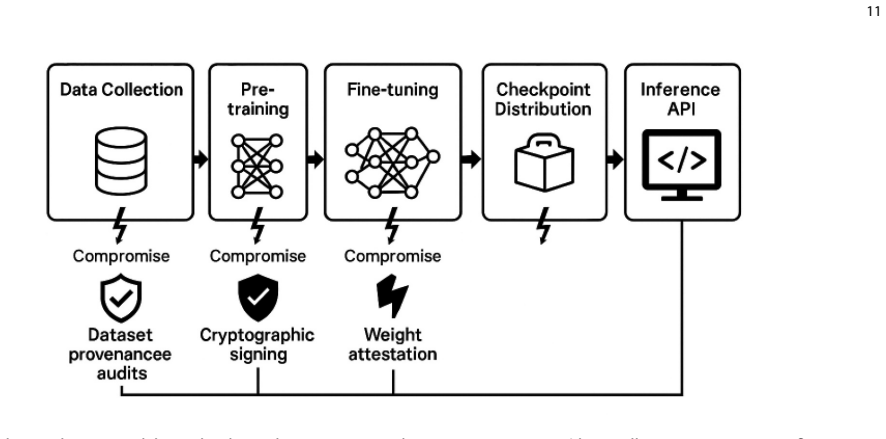
The central object is the LLM Scalability Risk Index (LSRI), a weighted parametric score that maps raw metrics (latency, throughput, regulatory compliance, model size, update frequency, cost) through nonlinear risk functions and scales the weighted sum by an integrity multiplier Φ built from measured violation magnitudes such as prompt-injection success rate or PII leakage. The load-bearing mechanism is the verifiable root-of-trust architecture: cryptographic attestation—hashing the model checkpoint, signing the hash with an ephemeral build identity, recording it in an append-only transparency log—followed by mandatory verification gates before inference. This transforms supply-chain assuran
Load-bearing premise
The load-bearing premise is that a cryptographically valid signature on a model checkpoint is a meaningful proxy for the trustworthiness of that model's behavior; an attestation proves where a file came from, not that its training data was clean or that its runtime behavior under prompt injection is safe.
What would settle it
A concrete falsifier: take a checkpoint that passes the paper's verification gates—valid signature, anchored in the transparency log, policy-compliant metadata—and show that a malicious adapter or indirect prompt injection causes a security-relevant action, such as data exfiltration or a policy-violating tool call, at a high success rate without breaking the signature. This would demonstrate that pre-execution cryptographic attestation is not sufficient for safe deployment, undermining the necessity claim.
If this is right
- LSRI can be used as a sensitivity-analysis tool: security teams can vary a single metric, such as latency or prompt-injection success rate, and see the deployment-readiness score cross a threshold that signals warning or failure.
- Checkpoint attestation becomes a pre-execution gate: a model whose signature or provenance metadata fails verification cannot be loaded, regardless of performance or cost.
- The trust chain is transitive: each downstream fine-tune or redistribution inherits a cryptographically verified predecessor, so tampering anywhere in the chain breaks the attestation.
- Agentic runtime behavior can be brought under the same umbrella by gating tool invocation, memory, and action plans against signed manifests and policy.
- Governance frameworks gain a machine-verifiable compliance signal, which the paper argues is what makes regulation of LLMs feasible at scale.
Where Pith is reading between the lines
- If the paper's central claim is right, the next bottleneck is semantic trust: a signed artifact can still harbor poisoned training data or a backdoor inserted before signing. The paper sketches this gap, but does not close it, so the practical value of the whole architecture will hinge on that extension.
- The LSRI weights and thresholds are presented as illustrative baselines; with incident data they could be calibrated empirically, turning the index from a sensitivity rubric into a predictive risk score. That calibration is not in the paper.
- The attestation argument naturally extends beyond checkpoints to training data and fine-tuning scripts: if dataset hashes are committed to the transparency log before training, poisoning resistance becomes a property of the attested lineage. This is a testable extension of the paper's proof of concept.
- The paper's capital-markets mention suggests a further consequence: if LSRI becomes a standard, financial exposure to LLM-dependent vendors could be priced by their verifiable supply-chain posture, but the paper does not develop that link.
Editorial analysis
A structured set of objections, weighed in public.
Referee Report
Summary. The paper is a broad survey/position piece on dual-use LLMs in cybersecurity. It proposes two contributions: (i) the LLM Scalability Risk Index (LSRI), a parametric formula intended to quantify deployment readiness under latency, throughput, regulatory, model-size, update-frequency, and cost constraints, together with an "Integrity Multiplier" Phi; and (ii) a model-supply-chain framework that uses cryptographic attestation (SHA-256 hashing and Sigstore signing of a model checkpoint) to establish a "verifiable root of trust." The authors claim that LSRI plus this root-of-trust architecture provides a deployable compliance baseline, defends against data poisoning, backdoors, malicious LoRA adapters, and weight tampering, and shifts security from zero-trust to semantic trust. The paper includes worked examples, a sensitivity table, a policy maturity matrix, and references to 70 sources.
Significance. If the claims were supported, the paper could be useful as a decision rubric: a well-defined parametric scalability/security risk score, combined with provenance attestation for model artifacts, would address a real need in LLM deployment governance. The cryptographic-attestation prototype is a sensible use of existing software supply-chain tooling (Sigstore, transparency logs), and the literature synthesis is broad. However, the significance is not yet realized: the central equation is never actually displayed; the sensitivity analysis is computed from the same hand-set thresholds it purports to test; and the root-of-trust prototype proves file provenance, not behavioral safety. The paper is best read as a position/survey and a partial engineering sketch, not as a validated framework. The authors deserve credit for stating, in the LSRI section, that the index is not an empirically calibrated estimator of real-world incident probability; that caveat needs to be prominent throughout the paper and reflected in the abstract.
major comments (4)
- [Section IV, "Equation 1" and Table 5] The central object of the paper, LSRI, is not actually defined. The text names variables (x_i, f_i, w_i, tau, sigma, lambda, Phi) and labels Equations (1)-(8), but no displayed formula for LSRI or Phi appears anywhere. A reader cannot compute LSRI for any scenario or check the algebra. Table 5 is called a "sensitivity analysis," but it is generated by substituting one latency value into Scenario A using the same hand-set sigmoid threshold (tau=100ms, sigma=15) from Table 3; it is an illustration of the sigmoid function, not validation. The paper's own statement that LSRI is "not an empirically calibrated estimator of real-world incident probability" should be moved to the abstract and the section should be retitled from "practical validation" to "worked example."
- [Section V, "Prototype implementation" and "Verifiable provenance and data integrity"] The security guarantees claimed in the abstract are not supported by the implemented PoC. Signing SHA-256(model.ckpt) with Sigstore and verifying the signature/hash/metadata establishes only that the file came from a particular build pipeline. It does not establish that the model is free of poisoned training data, backdoors, or malicious LoRA adapters; a checkpoint from a compromised or negligent pipeline passes every verification gate. The paper itself concedes that the PoC "does not yet capture why a model behaves as it does," and that semantic trust is future work. This concession is load-bearing: it contradicts the abstract's claim that LSRI plus the root-of-trust architecture defends against data poisoning, backdoors, and malicious adapters. The claims must be narrowed to provenance attestation, or a mechanism binding behavioral safety properties to the attestation must be implement
- [Section IV, Table 6] The quantitative performance comparison of static analyzers versus LLM-based zero-day detectors has no cited source or experimental description. The recall figures (62%, 88%, 91%), latencies (80/105/96 ms), false-positive rates (11%/13%/12%), and the resulting "~42-47% relative improvement" are presented as empirical results but no dataset, benchmark, or repository is provided. Since this is the only quantitative empirical evidence in the paper for LLM superiority in zero-day detection, it must either be removed and labeled as hypothetical, or replaced with references to actual benchmark measurements.
- [Section V, "Robustness against agentic LLM attacks"] The transition from "zero-trust" to "semantic trust" is asserted but not operationalized. The paper lists multi-stage plan validation, signed manifests, and constraint-aware memory management as "practical extensions" of the attestation framework, but no mechanism, policy language, or evaluation is given. The claim that the architecture secures run-time agentic dependencies is therefore unsupported. This is not a minor omission: the abstract advertises defense against agentic-AI threats, while the implemented portion addresses only static artifact integrity. The authors should either present a concrete semantic-enforcement mechanism or explicitly state that agentic robustness is a research direction.
minor comments (5)
- [Title/Abstract (submission header vs full text)] The submission contains two inconsistent abstracts. The header abstract emphasizes MCP, NASDAQ-100/QQQ, and capital-market analysis; the full-text abstract does not mention these. The authors must choose one abstract and align it with the actual content.
- [Equations (1)-(8)] All equation numbers are referenced but none of the equations are typeset. For a parametric framework, Equations (2)-(8) (mapping functions, Phi, regulatory risk, frequency) need to be displayed explicitly; otherwise the framework is not reproducible.
- [Table 1] The Policy Maturity Matrix says it is "weighted equally across five pillars," but the table lists only four criteria and no scoring rubric or raw scores. The columns "High/Medium" and "Required/Encouraged" cannot be reproduced from the stated methodology.
- [Author affiliations] Author names have typographical inconsistencies: "Ahia" vs "Ahi" in the contact line, "Agrawalb," "Valizadehb," and superscript letters that do not match affiliations. These should be corrected.
- [References] Several references lack standard bibliographic detail or venue information (e.g., [4], [9], [28], [29], [30], [35], [36], [37], [45], [46]). If the paper is intended for journal submission, the reference list must be completed and checked.
Circularity Check
No significant circularity: LSRI is explicitly a parametric scoring rubric, and the attestation PoC is an engineering demonstration with an acknowledged semantic-trust gap.
full rationale
The paper's central quantitative contribution, LSRI, is presented as a definitional risk-scoring framework, not as an empirical estimator or a prediction derived from fitted data. The paper explicitly states: 'The LSRI provides a structured, forward-looking risk score that supports comparative assessment of scalability—security stress across deployment scenarios, rather than an empirically calibrated estimator of real-world incident probability.' The worked examples and sensitivity analysis in Tables 4 and 5 are introduced as demonstrations of the rubric ('To demonstrate the application of the LSRI, we evaluate two hypothetical model deployment scenarios'), and the Table 5 footnote says the LSRI values are computed by substituting the specified latency into the Scenario A baseline while holding other factors constant. This is a self-consistency check of a definitional index, not a fitted parameter being renamed as a prediction. The supply-chain argument is built on external primitives (SHA-256, Sigstore) and external prior work (Tramèr et al., Goldblum et al.), with no load-bearing self-citation chain. The paper also candidly concedes the key limitation of its PoC: 'it does not yet capture why a model behaves as it does—namely, which datasets, transformations, and alignment steps influenced its training.' That limitation undercuts the strength of the security claim, but it is a validity gap, not a circular reduction. No equation is shown to be equivalent to its own inputs by construction, and no fitted value is relabeled as an independent prediction. Therefore no circularity is present.
Axiom & Free-Parameter Ledger
free parameters (8)
- Latency sigmoid threshold τ =
100 ms
- Latency sigmoid sensitivity σ =
15
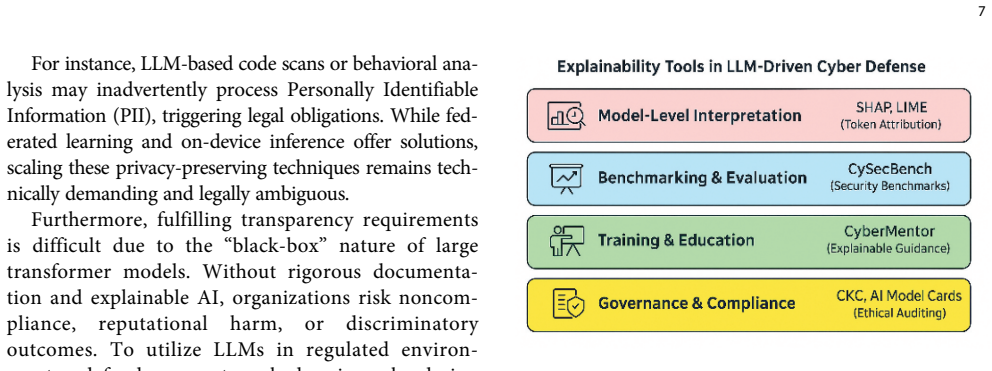
- Throughput baseline λ =
10^6 requests/day
- Model-size step threshold =
20B parameters
- Cost ceiling =
$1000/day
- Update frequency target =
2 updates/day
- Equal feature weights wi = 1/n =
1/6 in worked examples
- Integrity multiplier sensitivity coefficients α_j =
unspecified
axioms (5)
- domain assumption Operational risk can be represented as a weighted sum of normalized monotonic metric mappings.
- domain assumption The Table 3 thresholds reflect industrial deployment baselines.
- domain assumption A zero integrity multiplier (Φ=0) should veto all other risk factors.
- domain assumption A SHA-256/Sigstore signature on a checkpoint establishes a verifiable root of trust for that model artifact.
- ad hoc to paper The performance numbers in Table 6 are accurate.
invented entities (1)
-
LLM Scalability Risk Index (LSRI) score
no independent evidence
read the original abstract
As AI shifts from human-in-the-loop interfaces to autonomous multi-agent systems capable of real-time code execution and tool integration through protocols like the Model Context Protocol (MCP), traditional SAST, DAST, and legacy AI safety methods fail to detect modern agentic-AI threats. This paper introduces the LLM Scalability Risk Index (LSRI), a parametric framework and cybersecurity standard for stress-testing autonomous orchestration pipelines. LSRI measures the operational thresholds where load, compounding hallucinations, data poisoning, and adversarial prompt injections including jailbreaking and indirect prompt injection cause security boundaries to fail. Beyond RLHF and RLAIF, we present a Verifiable Root of Trust architecture using cryptographic attestation, semantic policy enforcement, and continuous runtime verification to secure the AI software supply chain. LSRI defends against malicious LoRA adapters, weight tampering, dependency typosquatting, and unsafe model artifacts from public registries such as Hugging Face and GitHub. By replacing post-hoc alignment with verifiable runtime controls, LSRI provides scalable API defense, safer agentic orchestration under heavy cloud workloads, stronger polymorphic malware detection, automated red-teaming, and improved system explainability. Aligned with NIST AI RMF, OWASP Top 10 for LLMs, and ISO 42001, LSRI establishes a deployable compliance baseline for securing generative AI ecosystems including ChatGPT, GPT-4o, Claude 3.5 Sonnet, Copilot, LLaMA, Gemini, and Bedrock. LSRI also supports capital market risk analysis by reducing exposure across technology portfolios linked to indices such as NASDAQ-100, QQQ, and semiconductor-driven supply chains.
Figures

Reference graph
Works this paper leans on
- [1]
-
[2]
Gemini overview
Google AI Blog. Gemini overview. Google LLC; 2023
2023
-
[3]
Introducing security copilot
Microsoft. Introducing security copilot. Microsoft; 2023
2023
-
[4]
Emerging security risks with AI
Gartner. Emerging security risks with AI. Gartner Report; 2023
2023
-
[5]
When LLMs meet cybersecurity: a systematic literature review
Zhang J, Bu H, Wen H, Liu Y, Fei H, Xi R, Li L, Yang Y, Zhu H, Meng D. When LLMs meet cybersecurity: a systematic literature review. Cybersecurity. 2025 ;8 (1):55. doi: 10.1186/s42400-025-00361-w
-
[6]
Global challenge for safe and secure LLMs track 1
Jia X, Dong Y, Liu Z, Zhu J, Chen J, Su H. Global challenge for safe and secure LLMs track 1. arXiv:2411.14502. 2024
Pith/arXiv arXiv 2024
-
[7]
Policy enforce - ment in app stores
Zhang X, Wang X, Pang W, Zhang X. Policy enforce - ment in app stores. Ieee Tse. 2020 ;46:1005–1025
2020
-
[8]
Fake review detection
Jiang L, Sheng VS, Liu S, Xu J. Fake review detection. Acm Cikm. 2019 ;28:2657–2665
2019
-
[9]
Dynamic analysis of malicious apps
Narayanan S, Santhosh Kumar SVN, Dakshinamurthy J. Dynamic analysis of malicious apps. IEEE Access. 2023 ;11:21545–21558
2023
-
[10]
Automated code generation security risks
Pearce K, Ahmad B, Tan B, Dolan-Gavitt B, Karri R. Automated code generation security risks. IEEE Secur Privacy. 2022 ;20:30–40
2022
-
[11]
Static analysis using LLMs
Chen J, Huang J, Jeng JE. Static analysis using LLMs. IEEE Security & Privacy. 2023 ;21: 92–96
2023
-
[12]
Risks of LLM data leakage
Carlini N, Tramèr F, Wallace E, Jagielski M, Herbert- Voss A, Lee K, Roberts A, Brown T, Song D, Erlingsson Ú, et al. Risks of LLM data leakage. USENIX Secur. 2021 ;30:2633–2650
2021
-
[13]
A survey on large language model (LLM) security and privacy: the good, the bad, and the ugly
Yao Y, Duan J, Xu K, Cai Y, Sun Z, Zhang Y. A survey on large language model (LLM) security and privacy: the good, the bad, and the ugly. High-Confid Comput. 2024 ;2(2):100211. doi: 10.1016/j.hcc.2024.100211
arXiv 2024
-
[14]
Exploring the dual role of LLMs in cybersecur - ity: threats and defenses
Bryce C, Kalousis A, Leroux I, Madinier H, Pasche T, Ruch P. Exploring the dual role of LLMs in cybersecur - ity: threats and defenses. In: Vorobeychik Y, Kantarcioglu M, editors. Large language models in cybersecurity. Springer; 2024 . p. 235–242. doi: 10. 1007/978-3-031-54827-7_26
2024
-
[15]
Artificial intelligence act
European Commission. Artificial intelligence act. EU; 2023
2023
-
[16]
Toward trustworthy AI development
Brundage M, Avin S, Clark J, Toner H, Eckersley P, Garfinkel B, Dafoe A, Scharre P, Zeitzoff T, Filar B, et al. Toward trustworthy AI development. arXiv:2004.07213. 2020
Pith/arXiv arXiv 2004
-
[17]
Auto DevSecOps powered by AI
GitLab. Auto DevSecOps powered by AI. GitLab Docs; 2023
2023
-
[18]
Secure development lifecycle
Microsoft Azure. Secure development lifecycle. Azure Blog; 2023
2023
-
[19]
Interim measures for the management of generative artificial intelligence services
Cyberspace Administration of China. Interim measures for the management of generative artificial intelligence services. Beijing China; 2023
2023
-
[20]
Government of Japan
Cabinet Office. Government of Japan. AI strategy 2022. Tokyo Japan; 2022
2022
-
[21]
National strategy for artificial intelligence
Ministry of Science and ICT, Republic of Korea. National strategy for artificial intelligence. Seoul Korea; 2023
2023
-
[22]
Model AI governance framework
Infocomm Media Development Authority (IMDA) Singapore. Model AI governance framework. 2023
2023
-
[23]
Advances and open pro - blems in federated learning
Kairouz P, McMahan HB. Advances and open pro - blems in federated learning. Found Trends ML. 2021 ;14(1–2):1–210. doi: 10.1561/2200000083
-
[24]
Towards federated learning at scale
Bonawitz K, Eichner H, Grieskamp W, Huba D, Ingerman A, Ivanov V, Kiddon C, Konečný J, Mazzocchi S, McMahan B, et al. Towards federated learning at scale. SysML. 2019 ;1:1–5
2019
-
[25]
Why should I trust you? Explaining the predictions of any classifier
Ribeiro MT, Singh S, Guestrin. Why should I trust you? Explaining the predictions of any classifier. KDD. 2016 ;22: 1135–1144
2016
-
[26]
Explainable artificial intelligence
Samek W, Montavon G, Lapuschkin S, Anders CJ, Müller KR. Explainable artificial intelligence. Springer; 2021
2021
-
[27]
Pi-bench: evaluating the robustness of large language models to prompt injection
Zhu H, Liu J, Yi P, Zhao X. Pi-bench: evaluating the robustness of large language models to prompt injection. arXiv:2402.00349. 2024 . Table 7. Recommended immediate actions for key stakeholder groups to mitigate dual-use risks of LLMs. Stakeholder What They Must Do Now Governments Enact dual-use-specific AI policies & register frontier models Enterprises...
Pith/arXiv arXiv 2024
-
[28]
Cybersecurity almanac: 100 facts, figures, predictions and statistics
Cybersecurity Ventures. Cybersecurity almanac: 100 facts, figures, predictions and statistics. Cybercrime Magazine. 2024 June 26
2024
-
[29]
Automated vulnerability detection
Amazon AWS. Automated vulnerability detection. AWS; 2023
2023
-
[30]
Watsonx security applications
IBM Research. Watsonx security applications. IBM; 2023
2023
-
[31]
Asleep at the keyboard? Assessing the security of GitHub Copilot’s code contributions
Pearce K, Ahmad B, Tan B, Dolan-Gavitt B, Karri R. Asleep at the keyboard? Assessing the security of GitHub Copilot’s code contributions. Proc IEEE Symp Security and Privacy. 2022;43:754–768
2022
-
[32]
Security implications of AI-generated code
Sandoval S, Pearce H, Nys T, Mansouri M, Dolan- Gavitt B. Security implications of AI-generated code. Proc ACM Int Conf Foundations of Software Engineering (FSE); 2024, Vol. 32, p. 2205–2222
2024
-
[33]
Code contamination: legal and security risks of LLM code generation
Jagielski M, Nasr M, Choquette-Choo CA, Lee K, Carlini N, Tramèr F. Code contamination: legal and security risks of LLM code generation. arXiv:2401.05078. 2024
Pith/arXiv arXiv 2024
-
[34]
Cybersecurity almanac: 2024 edition
Cybersecurity Ventures. Cybersecurity almanac: 2024 edition. Cybersecurity Ventures; 2024 Jan 2
2024
-
[35]
Combating WormGPT: What you need to know
Abnormal Security. Combating WormGPT: What you need to know. 2025
2025
-
[36]
What is WormGPT? 2025
Lookout. What is WormGPT? 2025
2025
-
[37]
Cybernews
Ferrari executive nearly fooled by AI voice clone of CEO. Cybernews. 2023 Nov
2023
-
[38]
Forewarned is forearmed: a survey on large language model-based agents in autonomous cyberattacks
Xu M, Fan J, Huang X, Zhou Z, Kang J, Niyato D, Mao S, Han Z, Shen X, Lam K. Forewarned is forearmed: a survey on large language model-based agents in autonomous cyberattacks. arXiv:2505.12786. 2025
Pith/arXiv arXiv 2025
-
[39]
On the feasibility of using LLMs to autonomously execute multi-host network attacks
Singer B, Lucas K, Adiga L, Jain M, Bauer L, Sekar V. On the feasibility of using LLMs to autonomously execute multi-host network attacks. arXiv:2501.16466. 2025
arXiv 2025
-
[40]
AI risk management framework
NIST. AI risk management framework. NIST Special Publication; 2023
2023
-
[41]
Global AI security standards
World Economic Forum. Global AI security standards. WEF; 2023
2023
-
[42]
Safe framework implementation
Google Security Blog. Safe framework implementation. Google; 2023
2023
-
[43]
Operationalizing large language models for cybersecurity: Infrastructure, scalability, and perfor - mance benchmarks
Zhang Y. Operationalizing large language models for cybersecurity: Infrastructure, scalability, and perfor - mance benchmarks. J Cyber Inf Syst (JCIS). 2025;15 (1):102–118
2025
-
[44]
Fairness and safety of LLMs
Palo Alto Networks. Fairness and safety of LLMs. 2024 June
2024
-
[45]
Data privacy and compliance for large language models (LLMs)
Mohindroo S. Data privacy and compliance for large language models (LLMs). Medium. 2024 Sep
2024
-
[46]
What is large language model (LLM) security
Qualys. What is large language model (LLM) security. 2025 Apr
2025
-
[47]
A framework for trustworthy AI in cybersecurity operations
Rajkomar A, Anthi E, Burnap P. A framework for trustworthy AI in cybersecurity operations. IEEE Commun Surv Tutorials. 2024;26:412–438
2024
-
[48]
CrowdStrike vs Palo Alto: 5 key differences and pros & cons
Cynet. CrowdStrike vs Palo Alto: 5 key differences and pros & cons. Cynet blog. 2025
2025
-
[49]
Artificial intelligence act final text
European Union. Artificial intelligence act final text. Official Journal of the EU OJ L. 2025:55–56
2025
-
[50]
Owasp top 10 for large language model applications
OWASP Foundation. Owasp top 10 for large language model applications. OWASP; 2025
2025
-
[51]
General Data Protection Regulation (GDPR); 2016
European Union. General Data Protection Regulation (GDPR); 2016. Publications Office of the European Union
2016
-
[52]
California consumer privacy act (CCPA)
State of California Department of Justice. California consumer privacy act (CCPA). 2018
2018
-
[53]
Explainable AI in cybersecurity: bridging trans - parency and trust
Silva J. Explainable AI in cybersecurity: bridging trans - parency and trust. Proc IEEE Conf Cybersecurity Innovations; Lisbon, Portugal; 2025. p. 78–83
2025
-
[54]
CyberMentor: enhancing cybersecurity learning through explainable AI
Wang F, Zhao L, Chen M. CyberMentor: enhancing cybersecurity learning through explainable AI. Proc IEEE Int Conf Emerging Trends in Cyber Training Zhengzhou, China; 2025. p. 102–107
2025
-
[55]
Ethical auditing in AI: the role of model cards and the cyber kill chain
Barrett R, Lee S, Harmon T. Ethical auditing in AI: the role of model cards and the cyber kill chain. IEEE Trans Technol Soc. 2023;10(2):123–132
2023
-
[56]
A framework for ethical AI compliance under the EU AI Act
Gupta P, Sharma N, Desai K. A framework for ethical AI compliance under the EU AI Act. Proc IEEE Workshop on AI Governance Washington, DC, USA
-
[57]
Cloud CISO perspectives: Our big sleep agent makes big leap
Google Cloud. Cloud CISO perspectives: Our big sleep agent makes big leap. Google cloud blog. 2024
2024
-
[58]
Benchmarking LLMs for zero-day vulnerabilities
Lisha M, Agarwal V, Kamthania S, Vutkur P, Chari M. Benchmarking LLMs for zero-day vulnerabilities. Proc IEEE International Conference on Electronics, Computing and Communication Technologies (CONECCT); Bengaluru, India; 2024. p. 95–102
2024
-
[59]
The curse of recursion: training on generated data makes models forget
Shumailov I, Shumaylov Z, Zhao Y, Gal Y, Papernot N. The curse of recursion: training on generated data makes models forget. arXiv:2305.17493. 2023
Pith/arXiv arXiv 2023
-
[60]
A watermark for large language models
Kirchenbauer J, Geiping J, Wen Y, Katz J, Miers I, Goldstein T. A watermark for large language models
-
[61]
Instruction backdoor attacks against customized LLMs
Zhang R, Li H, Wen R, Jiang W, Zhang Y, Backes M, Shen Y, Zhang Y. Instruction backdoor attacks against customized LLMs. USENIX Secur. 2024; 33:3085–3102
2024
-
[62]
deberta-v3-base-prompt-injection-v2
Protect AI. deberta-v3-base-prompt-injection-v2. Hugging Face; 2024
2024
-
[63]
Red teaming network report: findings from phase I
OpenAI. Red teaming network report: findings from phase I. OpenAi. 2024 Jul
2024
-
[64]
Privacy side channels in machine learning systems
Debenedetti E, Severi J, Carlini N, Choquette-Choo CA, Jagielski M, Nasr M, Wallace E, Tramèr F. Privacy side channels in machine learning systems. Proc USENIX Security; 2024:33:3121–3138
2024
-
[65]
Dataset and model supply chain security for foundation models
Goldblum J, Fowl L, Goldblum M, Goldstein T. Dataset and model supply chain security for foundation models. Proc NeurIPS; 2024;37:12431–12445
2024
-
[66]
Sigstore: software signing for everybody
Dodds L, Torres-Arias S, Newman Z, Moore M, Kuppusamy TK. Sigstore: software signing for everybody. Proc USENIX Security Symposium. 2022;31:1827–1844
2022
-
[67]
Stealing and misusing machine learning models
Tramèr F, Zhang F, Juels A, Reiter MK, Ristenpart T. Stealing and misusing machine learning models. Proc USENIX Security Symposium; Austin, Texas, USA; 2016:25:601–618
2016
-
[68]
Dataset security for machine learning
Goldblum M, Tsipras D, Xie C, Chen X, Schwarzschild A, Song D, Madry A, Li B, Goldstein T. Dataset security for machine learning. Proc NeurIPS. 2020:33:14781– 14792
2020
-
[69]
Rethinking deep neural net - work ownership verification
Fan L, Ali K, Atallah MJ. Rethinking deep neural net - work ownership verification. Proc NDSS; San Diego, California, USA; 2019
2019
-
[70]
Guidelines for secure use of large language models
UK National Cyber Security Centre. Guidelines for secure use of large language models. NCSC; 2024. 17
2024
-
[2023]
11561–11575
p. 11561–11575. In: Proc Int Conf on Machine Learning (ICML)
discussion (0)
Sign in with ORCID, Apple, or X to comment. Anyone can read and Pith papers without signing in.