REVIEW 4 major objections 5 minor 24 references
In pp collisions simulated with PYTHIA 8, selecting events with high underlying-event activity (2.5 < R_T ≤ 5.0) produces a long-range near-side ridge in the charge-independent two-particle number correlator R₂^CI, without any hydrodynamic
Reviewed by Pith at T0; open to challenge. T0 means a machine referee read the full paper against a public rubric. the ladder, T0–T4 →
T0 review · deepseek-v4-flash
2026-08-02 21:35 UTC pith:XH7QIFPX
load-bearing objection Useful PYTHIA baseline for R2/P2 with RT classification, but the causal claim about MPI/CR is untested and the R_T/N_ch correlation is not controlled. the 4 major comments →
Relative transverse activity as a probe of collectivity-like long-range correlations in pp collisions at sqrt{s}=13 TeV
The pith
A machine-rendered reading of the paper's core claim, the machinery that carries it, and where it could break.
Core claim
The central claim is that a finite long-range near-side component emerges in the charge-independent correlator R₂^CI for UE-dominated events classified by 2.5 < R_T ≤ 5.0, while no corresponding long-range structure is observed in the charge-dependent correlators R₂^CD and P₂^CD. The authors interpret this as evidence that enhanced underlying-event activity — mainly multiple partonic interactions and color reconnection in PYTHIA 8 — can generate collectivity-like long-range correlations without hydrodynamic evolution. As R_T increases, the CI near-side peak narrows in Δφ, while CD peaks stay localized with mild broadening; away-side structures weaken. The transverse-momentum correlator P₂^CI
What carries the argument
The relative transverse activity R_T, defined as the charged-particle density in the azimuthal transverse region (60° < |Δφ| < 120° around the leading particle) normalized by its event-ensemble average, is the classifier that separates events by underlying-event activity. The observables are the two-particle number correlator R₂ and transverse-momentum correlator P₂, decomposed into charge-independent and charge-dependent combinations. R₂ weights all pairs equally and is sensitive to soft UE contributions; P₂ weights pairs by Δp_T Δp_T and is sensitive to harder, more collimated particles. The contrast between CI and CD correlators, together with R_T binning, is what isolates the long-range,
Load-bearing premise
The load-bearing premise is that the highest-R_T class isolates enhanced underlying-event activity as the cause of the ridge, even though that class also has the highest charged-particle multiplicity and the paper shows no multiplicity-matched control, so the long-range component could be a high-multiplicity selection effect rather than a UE-specific one.
What would settle it
Running the identical analysis with PYTHIA 8 configurations in which multiple partonic interactions and/or color reconnection are switched off: if the long-range near-side component in R₂^CI for 2.5 < R_T ≤ 5.0 persists, the attribution to MPI/CR is wrong; if it disappears, the claim is supported. Alternatively, repeating the R_T binning at fixed N_ch would falsify the UE-specific interpretation if the ridge vanishes when multiplicity is held constant.
If this is right
- If correct, ridge-like signals in high-multiplicity pp and p–Pb collisions can be reproduced by microscopic QCD mechanisms (MPI plus color reconnection) without invoking a hydrodynamic medium.
- R_T becomes a practical differential event classifier: UE-dominated events (2.5 < R_T ≤ 5.0) can be selected to isolate soft-QCD-driven long-range correlations.
- The near-side Δφ narrowing of R₂^CI with increasing R_T predicts an observable trend in experimental two-particle correlations across event-activity classes.
- The absence of long-range structure in CD correlators predicts that any measured ridge in pp collisions should be charge-independent, with balance functions remaining short-range.
- The different behavior of R₂ versus P₂ provides a way to separate soft UE effects from jet-dominated correlations in data.
Where Pith is reading between the lines
- A testable extension would be to run the same analysis with PYTHIA configurations in which multiple partonic interactions or color reconnection are disabled; if the high-R_T ridge disappears, the causal attribution would be confirmed.
- Because N_ch rises monotonically with R_T in the shown multiplicity distributions, the ridge seen in the highest R_T class could partly be a high-multiplicity selection effect; a multiplicity-matched control across R_T bins would settle this.
- The same R_T classification could be applied to experimental pp data and to other generators (e.g., with and without string shoving or rope hadronization) to see how model-dependent the ridge is.
- The narrowing of the CI near-side peak in Δφ as R_T increases suggests that high-UE events are more azimuthally collimated even in the soft sector; this could be compared with color-reconnection-sensitive observables.
Editorial analysis
A structured set of objections, weighed in public.
Referee Report
Summary. The paper uses PYTHIA 8 with the Monash 2013 tune to study two-particle number (R2) and transverse-momentum (P2) correlation functions in pp collisions at sqrt(s)=13 TeV, classifying events by the relative transverse activity RT. The central observation is that a long-range near-side component appears in the charge-independent correlator R2^CI only for the highest RT class (2.5 < RT <= 5.0), while the charge-dependent correlators show no such component. The authors interpret this as evidence that enhanced underlying-event activity, driven by multiple partonic interactions and color reconnection, can generate collectivity-like long-range correlations without hydrodynamic evolution, and they propose RT as a differential event classifier for non-hydrodynamic baselines.
Significance. If the interpretation holds, the paper would provide a useful PYTHIA baseline for LHC small-system studies and would sharpen the debate on whether ridge-like signals in pp collisions can arise from soft-QCD mechanisms. The differential comparison of CI and CD correlators as a function of RT is a sensible approach, and the observation of a long-range near-side component in R2^CI for high-RT events is qualitatively visible in the projections of Fig. 6. However, the strength of the claim currently exceeds what the analysis establishes: the RT classes are strongly correlated with total multiplicity, the statistical and systematic uncertainties are not quantified, and the attribution to MPI and color reconnection is not tested by any model variation. The paper is therefore a promising baseline study, but the central causal interpretation needs additional controls and a more cautious formulation.
major comments (4)
- [§II, Fig. 3; §IV.A, Fig. 6] The central claim is that enhanced UE activity, not high multiplicity per se, produces the long-range component. However, Fig. 3 shows that N_ch increases monotonically with RT, so the highest-RT class is also the highest-multiplicity class. The paper explicitly acknowledges this correlation but does not provide a multiplicity-matched control. Without such a control, the ridge observed in the 2.5 < RT <= 5.0 class could be a high-multiplicity selection effect rather than a UE-specific effect. Please add an N_ch-matched comparison (e.g., bin events at fixed RT in sub-bins of N_ch, or compare equal-N_ch samples with different RT) or clearly restrict the claim to 'RT-selected high-activity events' rather than 'UE activity causes the ridge.'
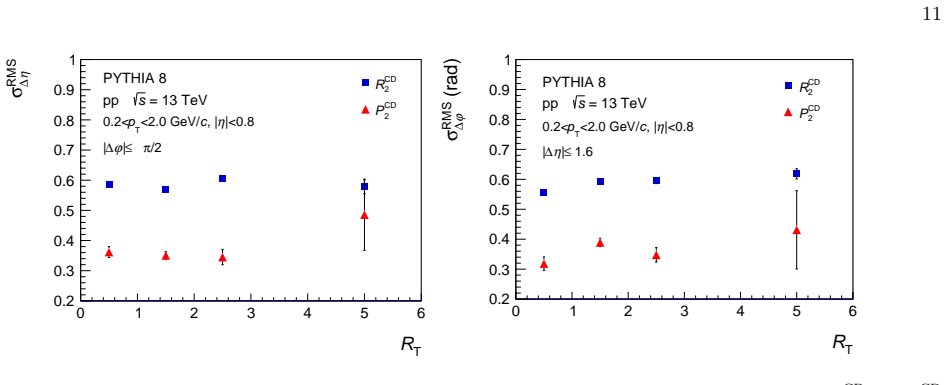
- [§IV.A, Fig. 6; §IV.C, Figs. 9–12] No statistical uncertainties are shown in any of the correlation plots or RMS-width figures. With about 5e6 selected events, statistical errors can and should be quantified; they are essential for supporting the 'finite long-range component emerges' statement and the 'no corresponding structure' conclusion. In addition, the ZYAM subtraction is not fully specified: the polynomial order and the fit range in the near-side region are not given. Since the 'exclusively' claim and the RMS widths depend directly on this subtraction, please specify the procedure and test the sensitivity of the long-range signal to the ZYAM choices.
- [§IV.A and §V (Summary)] The abstract and summary assert that the long-range component is 'driven by multiple partonic interactions and color reconnection,' but no generator-level test is performed. This attribution is an unsupported hypothesis: PYTHIA 8 contains many coupled mechanisms, and the observed pattern could also reflect other features of the Monash tune (e.g., string shoving, hadronization parameters). Please either run controlled variations (e.g., switching color reconnection on/off, varying the MPI regularization scale) or explicitly state that the MPI/CR interpretation is a plausible but untested mechanism.
- [§IV.A, Fig. 6 (left)] The statement that the long-range near-side component appears 'exclusively' for the highest RT class is too strong given the analysis shown. The lowest-RT class also exhibits sizable correlations at |Delta eta| > 1.2, which are dismissed as hard-scattering/jet contributions without a quantitative separation. A quantitative definition of the long-range yield, with its statistical significance, is needed before claiming exclusivity. Also, the adjacent intermediate class (1.5 < RT <= 2.5) shows a small but nonzero residual in the ZYAM-corrected projection; the distinction between 'substantially reduced' and 'absent' should be backed by uncertainties.
minor comments (5)
- [§V (Summary)] Typo: 'activi y' should be 'activity.'
- [Fig. 3] The vertical-axis label appears malformed ('1/N_ev d^2 N_ch/(d eta d phi)'); the normalization and logarithmic scale should be clearly defined.
- [Eq. (5)] The notation p_T,min and p_T,max is used but not defined explicitly; please state that these are the lower and upper bounds of the p_T acceptance.
- [Eq. (6)] The integration domain Omega for the average over eta_bar and phi_bar is not specified. Please define it (presumably the acceptance region |eta_i|<0.8 and the full azimuth).
- [References] Reference [10] is missing publication year/volume; several references have incomplete journal information (e.g., [7], [8], [9]). Please unify the bibliography style.
Circularity Check
No significant circularity: the correlation signals are emergent outputs of PYTHIA 8, not constructed from the fitted observables or from self-citations.
full rationale
The paper is a PYTHIA 8 simulation study and does not derive a quantity from the same quantity it claims to predict. R_T is defined by Eq. (1) from the transverse-region multiplicity N_T before the correlation measurement, and the R_2 and P_2 correlators are defined independently by Eqs. (4) and (5). The long-range near-side component in R_2^CI for the highest R_T class is an output of the generator simulation; no parameter is fitted to that ridge and then renamed as a prediction. The Monash 2013 tune is an external calibration to LHC data, and it is not adjusted to reproduce the specific correlation structure claimed in the paper. The paper does invoke prior work for the R_T observable [20], the correlator definitions [16], and the physics interpretation of color reconnection [15], but none of these citations are by the present authors, so no self-citation chain carries the argument. The interpretation that MPI and color reconnection generate the ridge is an attribution about internal model dynamics, not a circular derivation: the paper does not test generator variants with MPI or CR disabled, which is a correctness/evidence concern, not a circularity. Similarly, the fact that N_ch increases monotonically with R_T (Fig. 3) and the absence of a multiplicity-matched control are potential confounds for the causal claim about UE activity, but they do not make the observed correlator equal to its input by construction. No fitted input is called a prediction, no uniqueness theorem is imported from the authors' own work, and no ansatz is smuggled in via self-citation. The central observation is self-contained with respect to the generator output and is therefore appropriately scored 0.
Axiom & Free-Parameter Ledger
free parameters (4)
- PYTHIA 8 Monash 2013 tune parameters (e.g., color reconnection strength, MPI regularization) =
not stated (from global LHC fits)
- RT bin boundaries =
0.5, 1.5, 2.5, 5.0
- ZYAM polynomial fit order and fit range =
not specified
- Ensemble-averaged transverse activity <N_T> =
7.39
axioms (4)
- domain assumption PYTHIA 8 with Monash 2013 tune provides an adequate description of soft-QCD and underlying-event activity in pp collisions.
- domain assumption The leading-particle selection (5<=pT<=40 GeV/c) and the transverse region (60<|Δφ|<120 deg) isolate UE activity.
- domain assumption ZYAM subtraction with a polynomial fit removes the uncorrelated pedestal without removing real signal.
- domain assumption Charge-independent/charge-dependent decomposition isolates charge-conservation dynamics.
read the original abstract
Understanding the origin of collectivity-like signatures in small collision systems is a central open question in high-energy nuclear physics, and two-particle correlation functions offer unique sensitivity to the underlying-event (UE) dynamics that may drive such behavior in proton--proton (pp) collisions. In this work, the two-particle number ($R_{2}$) and transverse-momentum ($P_{2}$) correlation functions are studied in pp collisions at $\sqrt{s}=13$ TeV using PYTHIA 8, for final state charged hadrons within $|\eta|<0.8$ and $0.2<p_{\rm T}<2.0$ GeV/$c$, with events classified by the relative transverse activity $R_{\mathrm{T}}$ to probe how UE activity shapes correlation structures in the soft-QCD-dominated regime. A collectivity-like long-range near-side component is observed in the charge-independent correlator $R_{2}^{\mathrm{CI}}$ exclusively for the highest $R_{\mathrm{T}}$ class ($2.5 < R_{\mathrm{T}} \leq 5.0$), while no corresponding structure appears in the charge-dependent correlators. This indicates that enhanced UE activity, driven by multiple partonic interactions and color reconnection, can generate collectivity-like long-range correlations without hydrodynamic evolution. These findings establish $R_{\mathrm{T}}$ as a differential event classifier to provide a non-hydrodynamic baseline for interpreting such signatures in small-system measurements at the LHC.
Figures


Reference graph
Works this paper leans on
-
[1]
C. A. et al. (STAR Collaboration), Disappearance of back-to-back high-p t hadron correlations in central au+au collisions at √sN N = 200 gev, Phys. Rev. Lett. 10 1.5 −1 −0.5 −0 0.5 1 1.5 η Δ0 0.01 0.02 0.03 0.04 0.05 0.06 0.07 (ZYAM-Corrected) CD 2 R 0.5 ≤ TR0 < 1.5 ≤ TR0.5 < 2.5 ≤ TR1.5 < 5.0 ≤ TR2.5 < PYTHIA 8 = 13 TeV spp, /2 π ≤| ϕΔ| 1 −0 1 2 3 4 (rad...
Pith/arXiv arXiv 2003
-
[2]
A. A. et al. (PHENIX Collaboration), Transverse mo- mentum and centrality dependence of dihadron correla- tions in au+au collisions at√sN N= 200 gev: Jet quench- ing and the response of partonic matter, Phys. Rev. C77, 011901 (2008), arXiv:0705.3238 [nucl-ex]
Pith/arXiv arXiv 2008
-
[3]
J. A. et al. (STAR Collaboration), Experimental and theoretical challenges in the search for the quark–gluon plasma: The star collaboration’s critical assessment of the evidence from rhic collisions, Nucl. Phys. A757, 102 (2005), arXiv:nucl-ex/0501009 [nucl-ex]
Pith/arXiv arXiv 2005
-
[5]
J. Adamet al.(ALICE), Centrality dependence of the pseudorapidity density distribution for charged particles in Pb-Pb collisions at √sNN = 5.02 TeV, Phys. Lett. B 11 0 1 2 3 4 5 6 T R0.2 0.3 0.4 0.5 0.6 0.7 0.8 0.9 1 η Δ RMS σ CD 2 RCD 2 PPYTHIA 8 = 13 TeV spp |<0.8 η, |c<2.0 GeV/Tp0.2</2 π ≤|ϕΔ| 0 1 2 3 4 5 6 T R0.2 0.3 0.4 0.5 0.6 0.7 0.8 0.9 1 (rad) ϕ ...
Pith/arXiv arXiv 2017
-
[6]
K. A. et al. (ALICE Collaboration), Higher harmonic anisotropic flow measurements of charged particles in pb–pb collisions at √sN N= 2.76 tev, Phys. Rev. Lett. 107, 032301 (2011), arXiv:1105.3865 [nucl-ex]
Pith/arXiv arXiv 2011
-
[7]
A. e. a. P. C. Adare, Scaling properties of azimuthal anisotropy in au+au and cu+cu collisions at √sN N = 200 gev, Physical Review Letters98, 162301 (2007), arXiv:nucl-ex/0608033, arXiv:nucl-ex/0608033 [nucl-ex]
Pith/arXiv arXiv 2007
-
[8]
B. e. a. A. C. Abelev, Elliptic flow of identified hadrons in pb–pb collisions at √sN N = 2.76 tev, Journal of High Energy Physics06, 190 (2015), arXiv:1405.4632, arXiv:1405.4632 [nucl-ex]
Pith/arXiv arXiv 2015
-
[9]
J. e. a. A. C. Adam, Higher harmonic flow coefficients of identified hadrons in pb–pb collisions at √sN N = 2.76 tev, Journal of High Energy Physics09, 164 (2016), , arXiv:1606.06057 [nucl-ex]
Pith/arXiv arXiv 2016
-
[10]
V. Khachatryanet al.(CMS), Observation of Long- Range Near-Side Angular Correlations in Proton-Proton Collisions at the LHC, JHEP09, 091, arXiv:1009.4122 [hep-ex]
-
[11]
B. Abelevet al.(ALICE), Long-range angular corre- lations on the near and away side inp-Pb collisions at √sN N = 5.02 TeV, Phys. Lett. B719, 29 (2013), arXiv:1212.2001 [nucl-ex]
Pith/arXiv arXiv 2013
-
[12]
G. Aadet al.(ATLAS), Observation of Associated Near-Side and Away-Side Long-Range Correlations in√sN N=5.02 TeV Proton-Lead Collisions with the AT- LAS Detector, Phys. Rev. Lett.110, 182302 (2013), arXiv:1212.5198 [hep-ex]
Pith/arXiv arXiv 2013
-
[13]
B. Schenke, P. Tribedy, and R. Venugopalan, Fluctuat- ing glasma initial conditions and flow in heavy ion col- lisions, Physical Review Letters108, 252301 (2012), , arXiv:1202.6646 [nucl-th]
Pith/arXiv arXiv 2012
-
[14]
K. Dusling and R. Venugopalan, Explanation of system- atics of cms p+pb high multiplicity dihadron data at√sN N= 5.02 tev, Physical Review D87, 054014 (2013), , arXiv:1211.3701 [hep-ph]
Pith/arXiv arXiv 2013
-
[15]
A. Ortiz, P. Christiansen, E. Cuautle, I. Maldonado, and G. Pai´ c, Color reconnection and flowlike patterns in pp collisions, Physical Review Letters111, 042001 (2013), , arXiv:1303.6326 [hep-ph]
Pith/arXiv arXiv 2013
-
[16]
M. Sharma and C. A. Pruneau, Methods for the study of transverse momentum differential correlations, Phys. Rev. C79, 024905 (2009), arXiv:0810.0716, arXiv:0810.0716 [nucl-ex]
Pith/arXiv arXiv 2009
-
[17]
S. Acharyaet al.(ALICE), Two particle differential transverse momentum and number density correlations in p-Pb and Pb-Pb at the LHC, Phys. Rev. C100, 044903 (2019), arXiv:1805.04422 [nucl-ex]
Pith/arXiv arXiv 2019
-
[18]
Aamodtet al.(ALICE), Elliptic flow of charged par- ticles in Pb-Pb collisions at 2.76 TeV, Phys
K. Aamodtet al.(ALICE), Elliptic flow of charged par- ticles in Pb-Pb collisions at 2.76 TeV, Phys. Rev. Lett. 105, 252302 (2010), arXiv:1011.3914 [nucl-ex]
Pith/arXiv arXiv 2010
-
[19]
S. Basu, V. Gonzalez, J. Pan, A. Knospe, A. Marin, C. Markert, and C. Pruneau, Differential two-particle number and momentum correlations with the ampt, urqmd, and epos models in pb–pb collisions at√sNN = 2.76 tev, Phys. Rev. C104, 064902 (2021), arXiv:2001.07167 [nucl-ex]
Pith/arXiv arXiv 2021
-
[20]
T. Martin, P. Skands, and S. Farrington, Probing col- lective effects in hadronisation with the extremes of the underlying event, Eur. Phys. J. C76, 299 (2016), , arXiv:1603.05298 [hep-ph]
Pith/arXiv arXiv 2016
-
[21]
S. Acharyaet al.(ALICE), Underlying Event proper- ties in pp collisions at √s= 13 TeV, JHEP04, 192, arXiv:1910.14400 [nucl-ex]
Pith/arXiv arXiv 1910
-
[22]
P. Skands, S. Carrazza, and J. Rojo, Tuning PYTHIA 8.1: the Monash 2013 Tune, Eur. Phys. J. C74, 3024 (2014), arXiv:1404.5630 [hep-ph]
Pith/arXiv arXiv 2013
-
[23]
S. A. Bass, P. Danielewicz, and S. Pratt, Clocking hadronization in relativistic heavy ion collisions with balance functions, Phys. Rev. Lett.85, 2689 (2000), arXiv:nucl-th/0005044
Pith/arXiv arXiv 2000
-
[24]
S. Acharyaet al.(ALICE), General balance functions of identified charged hadron pairs of (π,K,p) in Pb–Pb collisions at sNN= 2.76 TeV, Phys. Lett. B833, 137338 (2022), arXiv:2110.06566 [nucl-ex]
Pith/arXiv arXiv 2022
-
[25]
S. Acharyaet al.(ALICE), Measurements of differential two-particle number and transverse momentum correla- tion functions in pp collisions at √s= 13 TeV, Eur. Phys. J. C85, 866 (2025), arXiv:2411.07059 [nucl-ex]
arXiv 2025
discussion (0)
Sign in with ORCID, Apple, or X to comment. Anyone can read and Pith papers without signing in.