Distributed, Parallel, and Cluster Computing · arXiv:2602.19802 v3 · submitted 23 Feb 2026 · 15 references
Fast Linear Reservoirs via Diagonalization
The paper says
“We introduce a diagonalization-based optimization for Linear Echo State Networks (ESNs) that reduces the per-step computational complexity of reservoir state updates from quadratic to linear.”
more of the abstract
By reformulating reservoir dynamics in the eigenbasis of the recurrent matrix, the recurrent update becomes a set of independent element-wise operations, eliminating the matrix multiplication. We further propose three methods to use our optimization depending on the situation: (i) Eigenbasis Weight Transformation (EWT), which preserves the dynamics of standard and trained Linear ESNs, (ii) End-to-End Eigenbasis Training (EET), which directly optimizes readout weights in the transformed space and (iii) Direct Parameter Generation (DPG), that bypasses matrix diagonalization by directly sampling eigenvalues and eigenvectors, achieving comparable performance to standard Linear ESNs. Across all experiments, both our methods preserve predictive accuracy while offering significant computational speedups, making them a replacement for standard Linear ESNs computations and training, and suggesting a shift of paradigm in linear ESN towards the direct selection of eigenvalues.
from the abstract
Pith says
Machine review · deepseek-v4-flash · 2 Aug 2026 · what was read was not recorded · not checked by a person
It can be wrong. Challenge this review or reply to it.
Holds up, with conditions. The diagonalization core is sound and the O(N) per-step update is real, but the DPG performance claims rest on two benchmarks without error bars and a printed algorithm that does not parse, so the paper needs a substantial empirical revision before I would trust the replacement story. This line is wrong
4 major objections · 6 minor
How often objections from reviews like this one are right: not yet measured
Not checked: figures, code, what the 15 references say.
The paper says, at §4.4.2, Algorithm 3 (GoldenEigenvalues), lines 2–3
The review did not quote this passage.
Pith says: Objection 1 of 4 · major
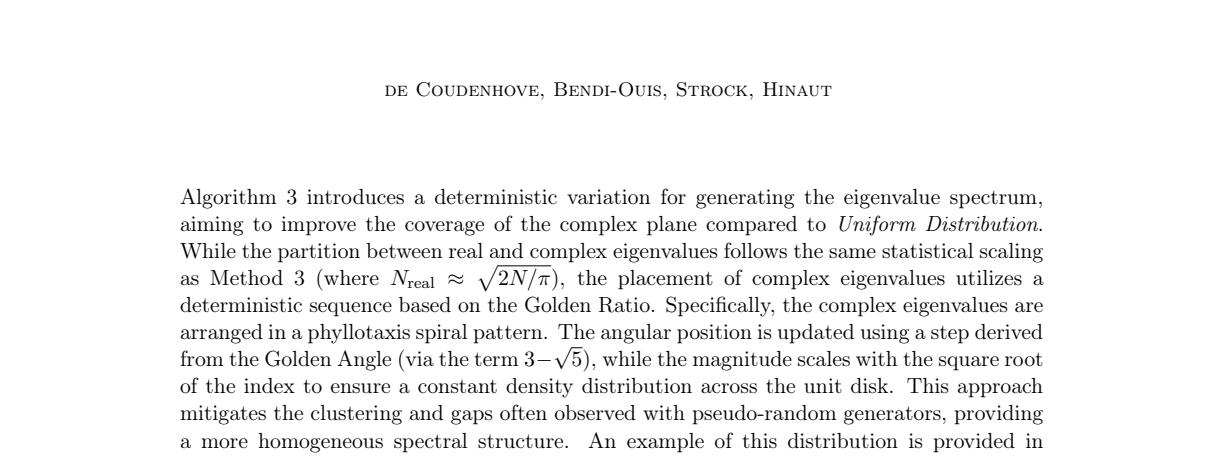
The printed algorithm computes Nreal ← floor(sqrt(2N/π)) and then overwrites it with Nreal ← (N − Nreal) mod 2. This turns Nreal into a parity bit, not a count. For N = 100, the value used in Table 2, Nreal becomes 1 and Ncpx = (N − Nreal)/2 = 49.5, so the construction of conjugate pairs is undefined.
more of objection 1
The intended parity correction is almost certainly Nreal ← Nreal + ((N − Nreal) mod 2). As printed, the Golden and Noisy Golden DPG results in Table 2 and Figure 3 cannot be reproduced.
The paper says, at §4.4 and Appendix A
The review did not quote this passage.
Pith says: Objection 2 of 4 · major
DPG is described as 'directly generating (Λ, [Win]_P, P)', but Algorithms 1–3 only generate Λ and Algorithm 2 only generates P. The distribution of [Win]_P (and feedback weights, if used) is never specified. In addition, DPG works with a complex P-basis, while Appendix A's real-basis construction is presented for the eigenvector matrix of a real W, with no explicit statement that it applies to DPG's randomly sampled P.
more of objection 2
Without these details, the MSO/MC results for DPG are not reproducible and the claim that DPG is equivalent to a standard linear ESN is not well defined.
The paper says, at §5.1, Table 2
The review did not quote this passage.
Pith says: Objection 3 of 4 · major
The table reports only 10-seed means, with no standard deviations, confidence intervals, or paired comparisons. The headline claim is a '6-to-6 tie' between Normal and Noisy Golden, yet many pairwise differences are small (e.g., MSO4: Normal 1.39e-10 vs Noisy Golden 6.93e-11; MSO5: 2.75e-9 vs 1.63e-9). Without variance or tests, these differences cannot be distinguished from seed noise. The hyperparameter selection procedure is also not fully specified (e.g., whether the validation-based grid search is per seed).
The paper says, at §5.2, Figure 6 and §6
The review did not quote this passage.
Pith says: Objection 4 of 4 · major
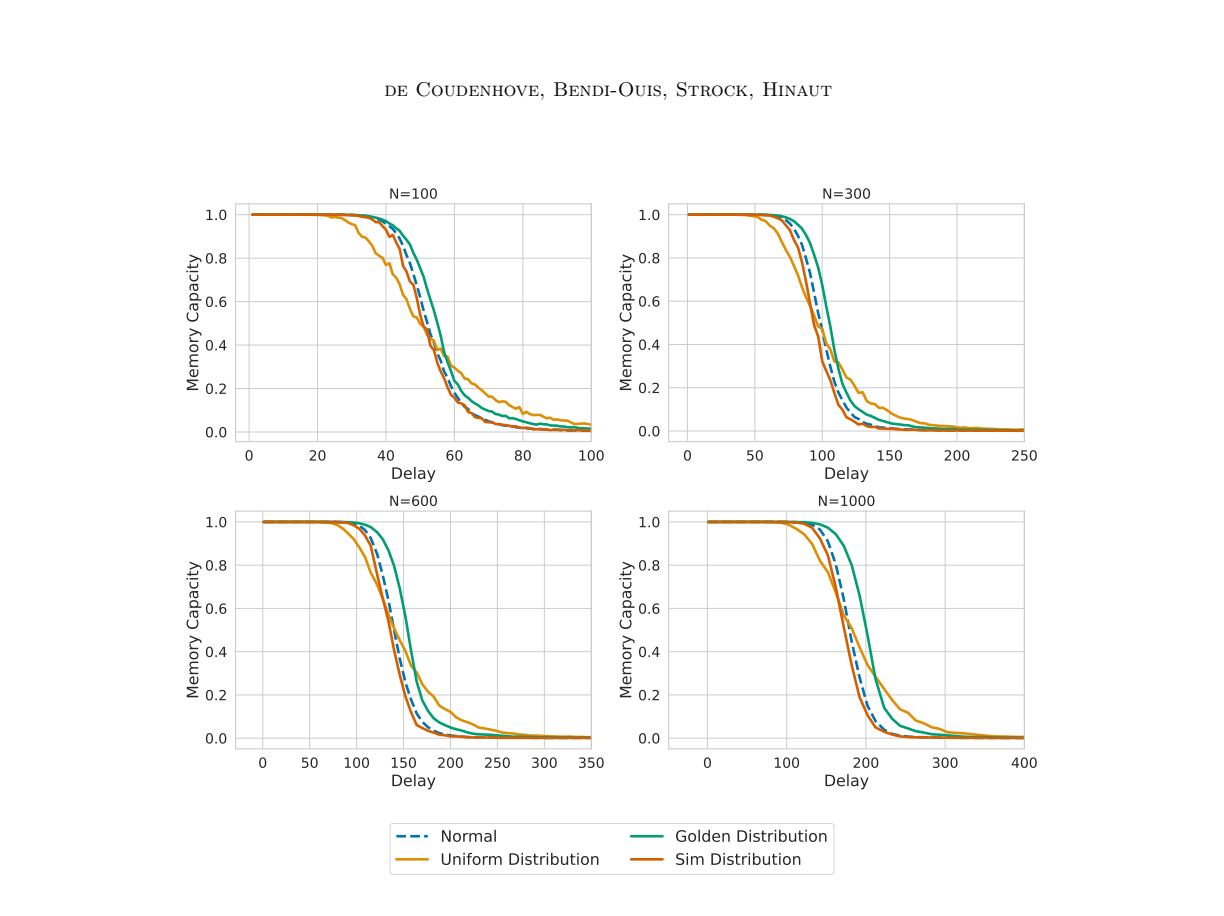
The Sim Distribution, which uses eigenvalues from a real random W but a randomly regenerated eigenvector matrix P, is reported to show a 'small but consistent underperformance' relative to Normal. This is direct evidence that the eigenvector basis is not completely irrelevant to predictive performance.
more of objection 4
The conclusion in §6 that 'the explicit matrix structure of the reservoir is secondary to the distribution of its eigenvalues' is therefore too strong as stated, and the DPG claim of general parity with standard ESNs is not established. Please quantify the Sim-vs-Normal gap, compare it with inter-seed variability, and either temper the conclusion or provide additional evidence that the effect is negligible.
6 minor objections
The paper says, at Abstract
Pith says: minor objection 1 of 6
Typo: 'comparable performance than' should be 'comparable performance to'.
The paper says, at Notation, Corollary 2 and Lemma 3
Pith says: minor objection 2 of 6
The symbol Λ is used both as a diagonal matrix (Corollary 2) and as a vector for element-wise operations (Lemma 3, Eq. 15). Please disambiguate.
show 4 more
The paper says, at §5.1, Table 2 vs §4.4.2, Figure 3
Pith says: minor objection 3 of 6
The Noisy Golden experiments in Table 2 use σ = 0.2, while Figure 3 illustrates the same distribution with σ = 0.050. Please explain the choice or clarify the discrepancy.
The paper says, at Figure 6 caption
Pith says: minor objection 4 of 6
The caption states that 'five different methods' are compared, but only four curves are plotted (Normal, Uniform, Golden, Sim). Either add the missing method (e.g., Noisy Golden) or correct the caption.
The paper says, at Algorithm 1, line 2
Pith says: minor objection 5 of 6
The floor is missing: Nreal should be floor(sqrt(2N/π)), not 'q 2N π'. The same issue appears in Algorithm 3.
The paper says, at §4.4.2 and Figure 3
Pith says: minor objection 6 of 6
Minor textual issues: 'same statistical scaling as Method 3' should likely read 'Algorithm 1' or 'Section 4.4.1'; 'specturm' is a typo; and Algorithm 3 uses inconsistent case for 'ncpx'/'Ncpx'.
What would settle it
Run a paired benchmark on MSO and MC for N=100,300,600,1000 with ≥30 seeds. For each seed, fix one random W for Normal; for Sim, reuse the same eigenvalues but draw a fresh Gaussian P (Algorithm 2); for DPG-Golden, implement Algorithm 3 literally, including the printed parity line. Report per-seed RMSE/MC with 95% confidence intervals and test whether Normal−Sim and Normal−DPG are nonzero. If Sim≈Normal, the eigenvector premise holds; if Sim underperforms systematically (as Figure 6 suggests), the premise fails and DPG's MSO tie must be explained by benchmark insensitivity or hyperparameter selection. Also verify the printed σ discrepancy between Table 2 (0.2) and Figure 3 (0.050) by reproducing the winning Noisy Golden configuration under both values.
from the skeptic's reading
How the review went
4 readings by deepseek-v4-flash · 2 Aug 2026
- Reader holds up, with conditions
- Skeptic agrees
- Editor wrote the verdict above
- Referee major revision: 4 major objections, 6 minor
Not run on this paper: the simulated authors' defence.
Pith did not check this review's objections against the paper.
The review in full
The review in brief, machine-written
Bottom line up front: the algebraic core is right, and the O(N) per-step reservoir update is a genuine, useful simplification for linear ESNs. The broader claim that you can just sample eigenvalues and ignore the eigenvectors is not established by the experiments as they stand. I would send this to serious review, but the revision needs real work.
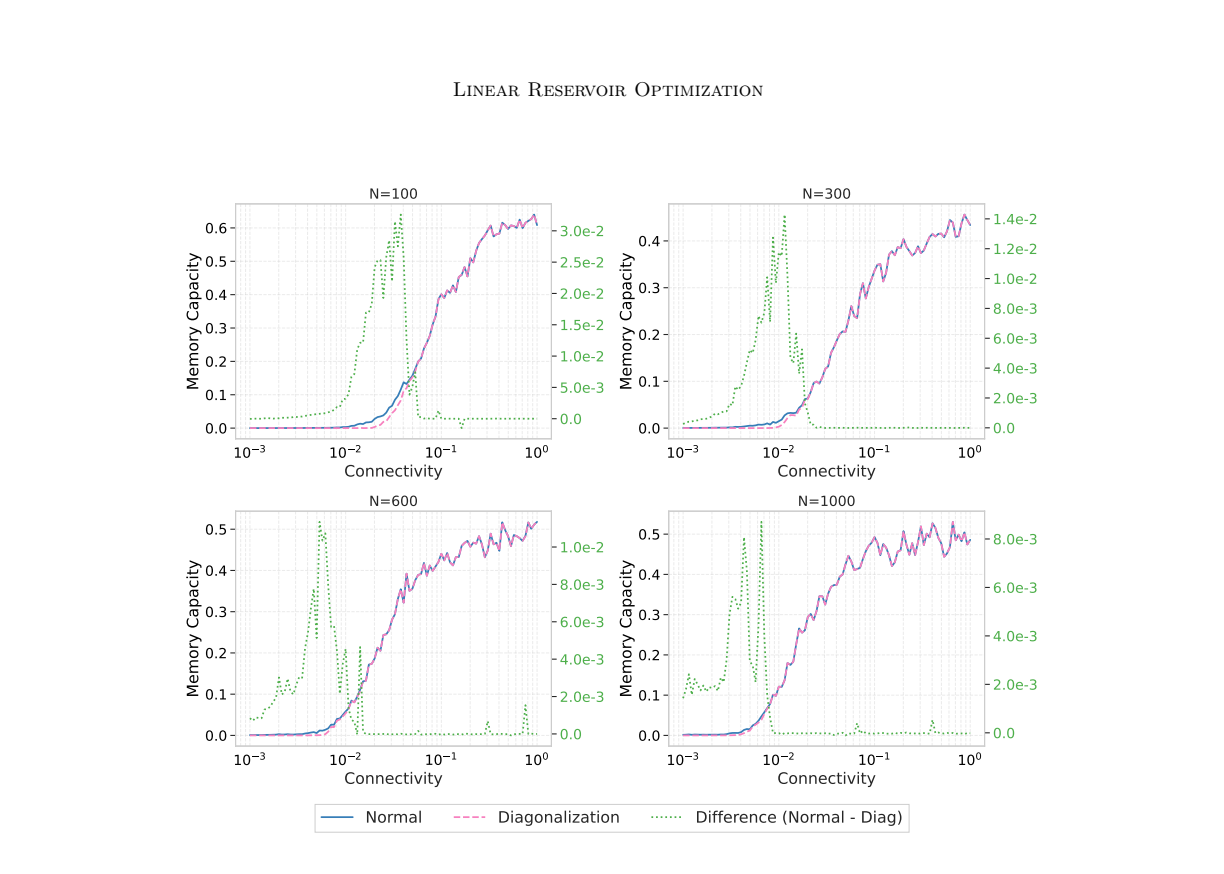
What is actually new: EWT and EET are clean reformulations, and the main derivations—Theorem 1, Corollary 2, Lemma 3, and Theorem 5—check out. DPG is a reasonable way to avoid the one-time O(N3) diagonalization cost, and the Golden/Noisy Golden spectrum is a nice attempt at uniform spectral coverage. The Appendix A real/complex memory trick is clever and plausible. I also credit Figure 7 for identifying a real limitation: at very low connectivity, diagonalization loses useful basis structure and underperforms.
Soft spots, in order of severity. First, the empirical support for DPG is thin. Table 2 gives 10-seed averages with no standard deviations and no paired tests; many entries are near machine precision, so a 6-to-6 tie on MSO does not mean much without variance information. The MC curves appear to be single runs, and no code is released. Second, Algorithm 3 as printed is broken: line 3 sets Nreal to (N - Nreal) mod 2, which for N=100 gives Nreal=1 and leaves an odd number of eigenvalues, so the conjugate-pair construction cannot complete. That is the flagship DPG variant, so this needs to be fixed. There is also a mismatch in the noise scale: Table 2 reports sigma=0.2 for Noisy Golden while Figure 3 uses sigma=0.050; that needs reconciling. Third, the EET equivalence is overstated. Equation (14) uses alpha block-diag(I, PT P) in the ridge penalty. For non-orthogonal P this is not the same as the original ridge objective, so end-to-end eigenbasis training changes the regularization. The grid search may mask the difference, but the paper should say so. Fourth, the novelty framing should be more careful: diagonalized linear recurrences are standard in the state-space model literature, and the paper cites Mamba without engaging that body of work. The contribution is ESN-specific and should be framed that way.
The stress-test concern about eigenvector interchangeability is real but secondary. Figure 6 shows the Sim distribution consistently below Normal in MC, so the basis is not wholly irrelevant; DPG's success on MSO and MC does not yet generalize.
Who this is for: people working on scaling linear ESNs, and maybe people building efficient recurrent models who could borrow the direct spectral generation idea. It deserves peer review because the mathematical core is sound and useful. My recommendation: send it out, but require corrected algorithms, released code, error bars, and ideally more tasks before acceptance.
The strongest objection
The paper's central replacement claim is that DPG — sampling eigenvalues from a designed distribution and eigenvectors as i.i.d. Gaussian columns — matches a standard linear ESN. This requires that, for a fixed spectrum, the eigenvector basis P is statistically irrelevant to readout performance. The paper's own Figure 6 contradicts that: 'Sim Distribution' (eigenvalues from a real random W, P regenerated randomly) consistently falls below the Normal curve in MC at every N, described as a 'small but consistent underperformance.' So the basis is not interchangeable, and DPG's MSO tie (Table 2, 6-to-6) is asserted without error bars, paired comparisons, or statistical tests. The winning Noisy Golden variant is also under-specified: Table 2 says σ=0.2 while Fig. 3 uses σ=0.050, and Algorithm 3 as printed assigns Nreal ← (N−Nreal) mod 2, which for N=100 gives Nreal=1 and makes the subsequent conjugate-pair construction impossible. These are not cosmetic: if the eigenvector distribution or the Golden algorithm is mis-specified, the DPG accuracy result cannot be reproduced or generalized beyond the two benchmarks.
The O(N) diagonalized update is algebraically sound; I see no flaw in Corollary 2 or Theorem 1, so the complexity reduction stands as a genuine contribution. The insecure part is the empirical equivalence claim for DPG. The authors need the eigenvector basis to be statistically irrelevant once the spectrum is fixed. Figure 6 is internal evidence against this: Sim Distribution, which fixes the spectrum of a real W but randomizes P, consistently underperforms Normal in memory capacity. This directly undermines the claim that eigenvectors play only a secondary role. On MSO, Table 2 reports a 6-to-6 tie without confidence intervals or paired tests, so the tie could be noise. The printed Golden algorithm has a parity bug and the σ value is inconsistent between Table 2 and Figure 3, making the winning DPG configuration non-reproducible from the text. A paired, multi-seed experiment comparing Normal, Sim, and DPG would settle whether the premise lands. If Sim≈Normal, the concern is resolved; if Sim underperforms, DPG's comparable performance is not a general property but an artifact of the chosen benchmarks and hyperparameter grid. The verdict should remain CONDITIONAL: the algebraic core is sound, but the replacement/near-equivalence claim needs stronger statistical support and a code release.
The referee's report
If fully established, the paper would provide a simple, useful optimization for linear ESNs: diagonalizing the reservoir turns the sequential O(N²) update into an element-wise O(N) form, a fact that is not new in the state-space model literature but is here developed specifically for reservoir computing. The EWT/EET constructions are clean and exact, and the DPG idea of directly designing the spectrum is an interesting direction. The paper also includes an honest analysis of the sparse-connectivity regime and a clever real/complex memory-reinterpretation trick. However, the central empirical claim—that DPG achieves comparable accuracy to standard ESNs—is not yet supported with sufficient rigor: key parts of the DPG algorithm are under-specified, the Golden algorithm as printed is invalid for the reported reservoir sizes, and the reported comparisons lack error bars and statistical tests. The contribution is potentially valuable but needs substantial revision before it can be accepted.
Pith's reading of the paper (a machine's summary, not the authors')
The paper shows that a Linear Echo State Network—whose reservoir state is normally updated by multiplying a vector by a weight matrix at each time step—can be run in the eigenbasis of that matrix. In the eigenbasis, the recurrent update becomes a pointwise multiplication by the eigenvalues, cutting per-step cost from O(N^2) to O(N). The authors go further and propose skipping the weight matrix entirely by sampling eigenvalues and eigenvectors directly (Direct Parameter Generation). On the MSO and Memory Capacity benchmarks, this direct spectral approach matches the accuracy of standard linear reservoirs, with the noisy 'Golden' eigenvalue distribution tying the standard baseline 6-to-6 across 12 MSO tasks. The result matters because it suggests that a linear reservoir's behavior is governed by its eigenvalue spectrum, not the fine structure of its weights.
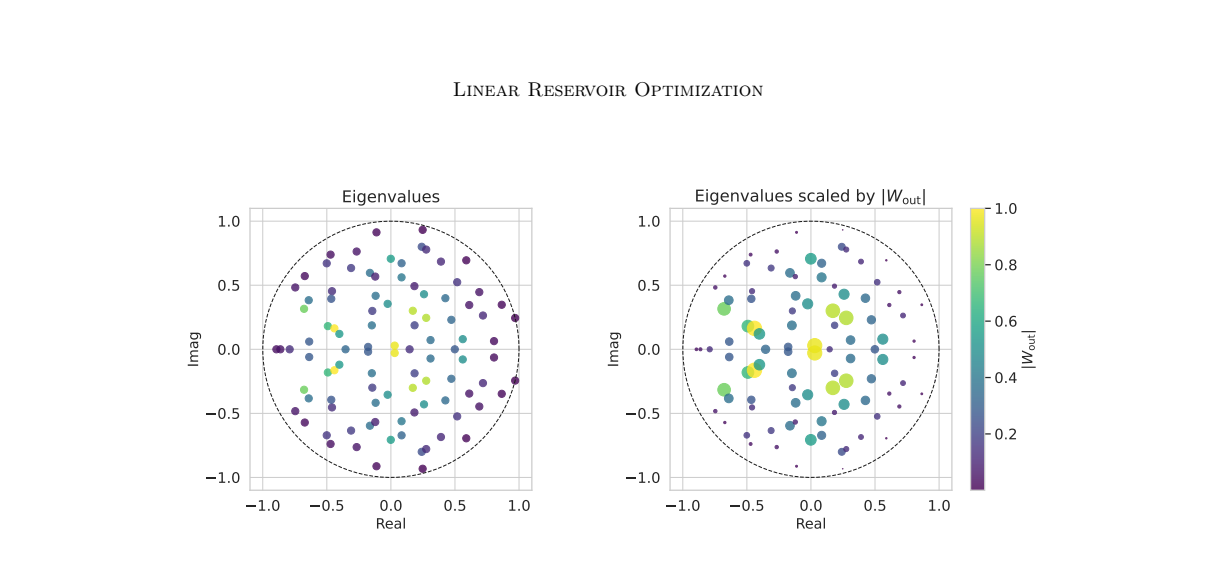
What carries the argument. The eigen-decomposition W = P D P^{-1} (Corollary 2) turns the recurrent product into elementwise multiplication: [r(t)]_P = [r(t-1)]_P ⊙ Λ + u(t)[Win]_P + y(t-1)[Wfb]_P. Three methods use it: EWT transforms a pretrained readout into the eigenbasis; EET trains the readout directly in the eigenbasis using a penalized ridge regression with a P^TP penalty term; DPG bypasses W by sampling Λ and P from designed distributions—'Uniform', deterministic 'Golden' (a phyllotaxis spiral with the golden angle), and 'Noisy Golden' with added Gaussian noise. A memory-reinterpretation trick keeps readout training in real arithmetic while the reservoir step runs in complex elementwise mode.
Core claim. The central claim is that the reservoir dynamics of a linear ESN, r(t) = r(t-1)W + u(t)Win + y(t-1)Wfb, are exactly preserved under the change of basis W = P^{-1}DP. In the P-basis the update becomes [r(t)]_P = [r(t-1)]_P ⊙ Λ + u(t)[Win]_P + y(t-1)[Wfb]_P, costing O(N) per step instead of O(N^2). A further structural result, Theorem 5, shows the input contribution can be applied after all recurrent updates, so the temporal state depends only on the eigenvalues Λ, while the readout learns to select which spectral components matter. Empirically, when eigenvalues and eigenvectors are generated directly (DPG), performance matches standard linear ESNs on MSO and Memory Capacity tasks, and a deter
The premise it rests on. The DPG performance claim rests on the premise that a randomly generated eigenvector matrix P with i.i.d. Gaussian entries is statistically interchangeable with the eigenvector basis of a standard random reservoir; the paper's own Sim-distribution results—true random-matrix eigenvalues paired with a random P underperforming—indicate this interchangeability is not complete.
If the paper is right (Pith's inferences, not the authors')
After a one-time O(N^3) eigendecomposition, each reservoir time step costs O(N) instead of O(N^2), making larger linear reservoirs practical.
Because input weights can be applied after the recurrent pass, reservoir states can be computed once and reused across input scalings, speeding hyperparameter search by a factor of three.
The diagonal form makes the independent state variables amenable to parallel scans across time, connecting linear ESNs to fast state-space sequence models.
DPG removes the need to generate and diagonalize a matrix at all; the user chooses the eigenvalue distribution and pays only a one-time random sampling cost.
If parity with standard reservoirs holds beyond these benchmarks, direct spectral initialization becomes a viable replacement for the standard random-matrix reservoir setup.
The 6-to-6 tie on MSO and the Memory Capacity results suggest task-specific spectral design might outperform generic random spectra, but the paper only tests two benchmarks; tuning eigenvalue densities per task is a natural next experiment.
The paper's Figure 7 shows diagonalization loses accuracy at very low connectivity, implying that for sparse reservoirs the eigenvector basis of a random W is not negligible; an alternative reading is that DPG could deliberately inject a well-spread spectrum to rescue sparse reservoirs, a testable claim the authors do not make.
The equivalence with input-after-recurrence hints that linear reservoirs are essentially feature extractors over eigenvalue-decayed inputs, so readout weight magnitudes (Figure 5) could be used to prune eigenvalues and shrink reservoir size while preserving task performance.
The diagonalized view suggests linear reservoirs are close relatives of complex-valued diagonal recurrent networks, so spectral initialization methods from that area could transfer directly.
Check this review
Pith stored no record of this review's passes and took no fingerprint of it. Reviews made by code from 13 Nov 2026 on carry both.
How often reviews like this one are right
Reviews like this one: written by deepseek-v4-flash, where what was read was not recorded.
How often objections from reviews like this one are right: not yet measured
Reviews by people
This review was written by a machine. No person has reviewed this paper on Pith yet. A scientist listed on Pith can review it for a fee, and their review is published here whatever it concludes.
The paper
Abstract
We introduce a diagonalization-based optimization for Linear Echo State Networks (ESNs) that reduces the per-step computational complexity of reservoir state updates from quadratic to linear. By reformulating reservoir dynamics in the eigenbasis of the recurrent matrix, the recurrent update becomes a set of independent element-wise operations, eliminating the matrix multiplication. We further propose three methods to use our optimization depending on the situation: (i) Eigenbasis Weight Transformation (EWT), which preserves the dynamics of standard and trained Linear ESNs, (ii) End-to-End Eigenbasis Training (EET), which directly optimizes readout weights in the transformed space and (iii) Direct Parameter Generation (DPG), that bypasses matrix diagonalization by directly sampling eigenvalues and eigenvectors, achieving comparable performance to standard Linear ESNs. Across all experiments, both our methods preserve predictive accuracy while offering significant computational speedups, making them a replacement for standard Linear ESNs computations and training, and suggesting a shift of paradigm in linear ESN towards the direct selection of eigenvalues.
The paper's own sentences, arranged, kept beside the review and separate from it. Each label is drawn from a closed vocabulary; the number beside it is the probability the classifier gave that label. No sentence in this record was written by a model.
abstract compiled · 2026-09-23
The authors' main claim, as the classifier picked it out 1.00
“Across all experiments, both our methods preserve predictive accuracy while offering significant computational speedups, making them a replacement for standard Linear ESNs computations and training, and suggesting a shift of paradigm in linear ESN towards the direct selection of eigenvalues.”
How the main claim is stated: asserted 0.68
What the abstract itself states, as probabilities: claims first 0.06 · states limitation 0.13 · human participants 0.02 · controlled comparison 0.75 · randomized assignment 0.01 · states quantitative result 0.11 · compares with prior results 0.91 · mentions code or data availability 0.02
The abstract, sentence by sentence
This table labels the abstract only (arXiv listing abstract v3). The number is the probability the classifier gave the label.
| Sentence | Role | The authors' own work | States the main conclusion | Strength |
|---|---|---|---|---|
| We introduce a diagonalization-based optimization for Linear Echo State Networks (ESNs) that reduces the per-step computational complexity of reservoir state updates from quadratic to linear. | contribution 1.00 | 0.94 | 0.22 | asserted 1.00 |
| By reformulating reservoir dynamics in the eigenbasis of the recurrent matrix, the recurrent update becomes a set of independent element-wise operations, eliminating the matrix multiplication. | method 0.99 | 0.84 | 0.07 | asserted 1.00 |
| We further propose three methods to use our optimization depending on the situation: (i) Eigenbasis Weight Transformation (EWT), which preserves the dynamics of standard and trained Linear ESNs, (ii) End-to-End Eigenbasis Training (EET), which directly optimizes readout weights in the transformed space and (iii) Direct Parameter Generation (DPG), that bypasses matrix diagonalization by directly sampling eigenvalues and eigenvectors, achieving comparable performance to standard Linear ESNs. | method 0.69 | 0.92 | 0.08 | asserted 0.99 |
| Across all experiments, both our methods preserve predictive accuracy while offering significant computational speedups, making them a replacement for standard Linear ESNs computations and training, and suggesting a shift of paradigm in linear ESN towards the direct selection of eigenvalues. | result 0.59 | 0.89 | 0.88 | asserted 0.68 |
What kind of paper the classifier reports this is: method or tool 1.00 · evidence from observation or experiment 0.62
What was examined, and what was not
Sources read
- arXiv listing abstract v3
Not examined
- full text
- figures and tables
- references and citing sentences
- relations to other papers
Levels run
- P abstract
Not run
- S sections
- T body sentences
- C citations
- R cross-paper relations
How the labels were made
Compiled by classifier-1.13.0 via TypeSafe API, question bank abstract-p1-20260923, 2026-09-23: 1 request, 3,835 input tokens.
Every quoted sentence on this record is the authors'. Every label is from Pith's closed vocabulary, with the probability shown beside it. This record as JSON
Figures (7)
Figures are the authors', reproduced from the paper.
References (15)
- [1] Narsimha Reddy Chilkuri and Chris Eliasmith. Parallelizing legendre memory unit training. In International conference on machine learning, pages 1898--1907. PMLR, 2021 on Pith
- [2] Joni Dambre, David Verstraeten, Benjamin Schrauwen, and Serge Massar. Information processing capacity of dynamical systems. Scientific reports, 2 0 (1): 0 514, 2012 on Pith
- [3] Alan Edelman and Eric Kostlan. How many zeros of a random polynomial are real? Bulletin of the American Mathematical Society, 32 0 (1): 0 1--37, 1995 on Pith
- [4] Claudio Gallicchio, Alessio Micheli, and Luca Pedrelli. Hierarchical temporal representation in linear reservoir computing. In Italian Workshop on Neural Nets, pages 119--129. Springer, 2017 on Pith
- [5] Daniel J Gauthier, Erik Bollt, Aaron Griffith, and Wendson AS Barbosa. Next generation reservoir computing. Nature communications, 12 0 (1): 0 5564, 2021 on Pith
- [6] Lukas Gonon and Juan-Pablo Ortega. Reservoir computing universality with stochastic inputs. IEEE transactions on neural networks and learning systems, 31 0 (1): 0 100--112, 2019 on Pith
- [7] Albert Gu and Tri Dao. Mamba: Linear-time sequence modeling with selective state spaces. In First conference on language modeling, 2024 on Pith
- [8] Herbert Jaeger. Short term memory in echo state networks. 2001 on Pith
- [9] Danil Koryakin, Johannes Lohmann, and Martin V Butz. Balanced echo state networks. Neural Networks, 36: 0 35--45, 2012 on Pith
- [10] Richard B Lehoucq, Danny C Sorensen, and Chao Yang. ARPACK users' guide: solution of large-scale eigenvalue problems with implicitly restarted Arnoldi methods. SIAM, 1998 on Pith
- [11] Guido Mont\' u far, Razvan Pascanu, Kyunghyun Cho, and Yoshua Bengio. On the number of linear regions of deep neural networks. In Z. Ghahramani, M. Welling, C. Cortes, N. Lawrence, and K.Q. Weinberger, editors, Advances in Neural Information Processing Systems, volume 27. Curr... on Pith
- [12] Robert Simon Fong, Boyu Li, and Peter Ti n o. Linear simple cycle reservoirs at the edge of stability perform fourier decomposition of the input driving signals. Chaos: An Interdisciplinary Journal of Nonlinear Science, 35 0 (4), 2025 on Pith
- [13] Peter Tino. Dynamical systems as temporal feature spaces. Journal of Machine Learning Research, 21 0 (44): 0 1--42, 2020 on Pith
- [14] Pietro Verzelli, Cesare Alippi, Lorenzo Livi, and Peter Ti n o. Input-to-state representation in linear reservoirs dynamics. IEEE Transactions on Neural Networks and Learning Systems, 33 0 (9): 0 4598--4609, 2021 on Pith
- [15] Aaron Voelker, Ivana Kaji \'c , and Chris Eliasmith. Legendre memory units: Continuous-time representation in recurrent neural networks. Advances in neural information processing systems, 32, 2019 on Pith
Cited by 1 Pith paper
Reviewed papers on Pith that cite this one. The full citation record
Challenges and discussion
Disagree with the review, or know something it missed? Leave a comment, or challenge this review formally: a challenge becomes a permanent entry in this paper's record, and its decision is published here.
Come back by email
A short list of the week's newly reviewed papers. Nothing is sent until you confirm from your inbox, and every email has a link that stops it. No account.
No comments yet.
Sign in to comment