Recognition: 2 theorem links
· Lean TheoremSYK thermal expectations are classically easy at any temperature
Pith reviewed 2026-05-15 19:27 UTC · model grok-4.3
The pith
A classical algorithm approximates thermal expectations for the SYK model at any constant temperature in quasi-polynomial time.
A machine-rendered reading of the paper's core claim, the machinery that carries it, and where it could break.
Core claim
We give a simple classical algorithm that approximates thermal expectations for Gibbs states of local Hamiltonians with quasi-polynomial cost n^{O(log (n/ε))} for all temperatures above a phase transition in the free energy. Our results apply to the Sachdev-Ye-Kitaev (SYK) model at any constant temperature due to its absence of a phase transition -- despite its entanglement, sign problem, and polynomial quantum circuit lower bounds. Beyond SYK, we rigorously establish a universal classically easy high-temperature phase for all local, bounded-degree Hamiltonians and show that it extends to temperatures strictly colder than the death of entanglement transition.
What carries the argument
A simple classical algorithm that approximates thermal expectations in the high-temperature phase of local Hamiltonians, which remains efficient at all temperatures for models like SYK that have no free-energy phase transition.
If this is right
- Thermal expectations of local observables in the SYK model are classically computable at any fixed temperature.
- The classically tractable regime for local bounded-degree Hamiltonians extends below the temperature at which entanglement disappears.
- For many natural models the entire fast-mixing phase is classically easy.
Where Pith is reading between the lines
- Similar classical algorithms may succeed on other models that lack free-energy phase transitions.
- Finite-size numerical checks on small SYK instances could test whether the quasi-polynomial scaling appears in practice.
- The boundary between classical and quantum advantage for thermal simulation may lie at much lower temperatures than previously expected.
Load-bearing premise
The SYK model has no phase transition in the free energy at any constant temperature, allowing the high-temperature classical algorithm to apply at all temperatures.
What would settle it
Discovery of a free-energy phase transition in the SYK model at some positive constant temperature, or a proof that some local observable requires super-quasi-polynomial classical resources to approximate its thermal expectation.
Figures


read the original abstract
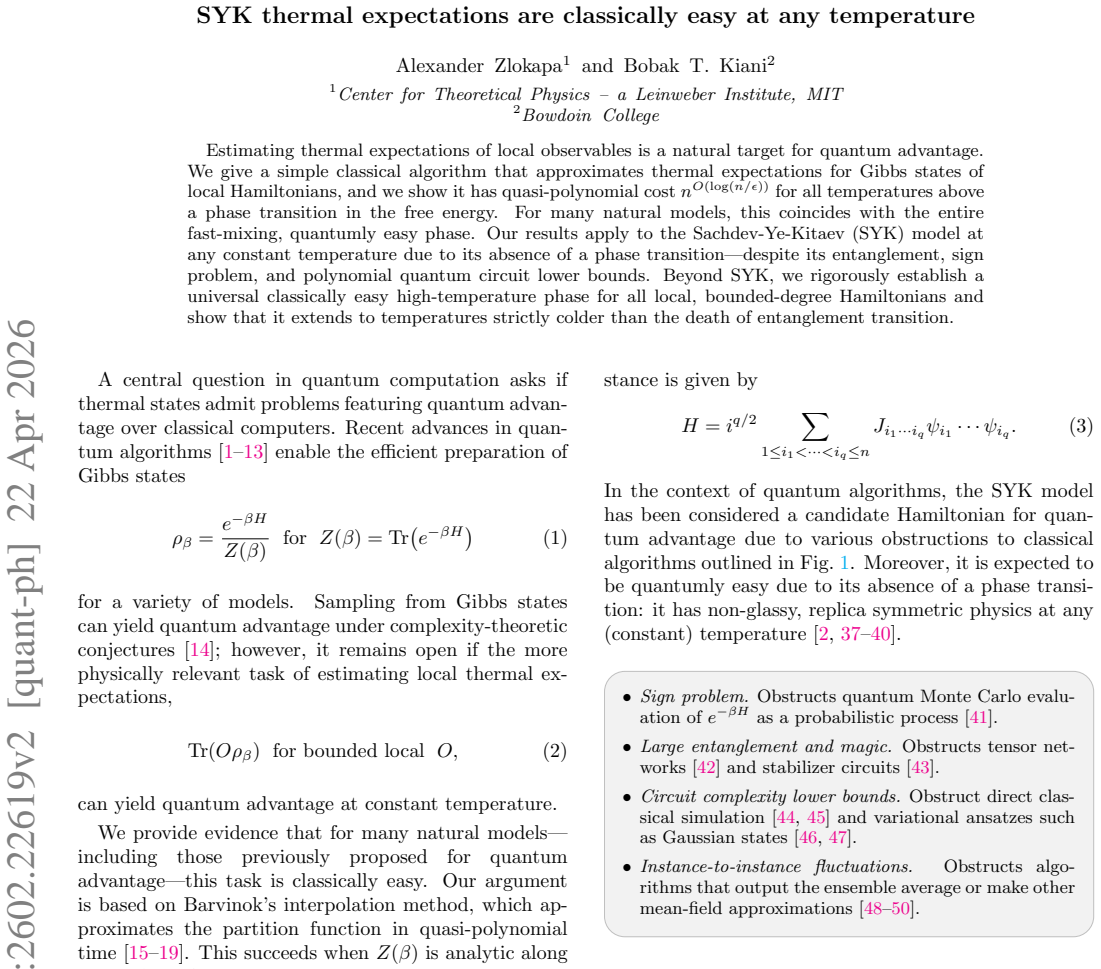
Estimating thermal expectations of local observables is a natural target for quantum advantage. We give a simple classical algorithm that approximates thermal expectations for Gibbs states of local Hamiltonians, and we show it has quasi-polynomial cost $n^{O(\log (n/\epsilon))}$ for all temperatures above a phase transition in the free energy. For many natural models, this coincides with the entire fast-mixing, quantumly easy phase. Our results apply to the Sachdev-Ye-Kitaev (SYK) model at any constant temperature due to its absence of a phase transition -- despite its entanglement, sign problem, and polynomial quantum circuit lower bounds. Beyond SYK, we rigorously establish a universal classically easy high-temperature phase for all local, bounded-degree Hamiltonians and show that it extends to temperatures strictly colder than the death of entanglement transition.
Editorial analysis
A structured set of objections, weighed in public.
Referee Report
Summary. The paper presents a classical algorithm for approximating thermal expectations of local observables in the Gibbs state of a local Hamiltonian, proving a quasi-polynomial runtime bound of n^{O(log(n/ε))} whenever the temperature lies above a phase transition in the free energy. It then asserts that the same bound holds for the SYK model at any constant temperature because SYK exhibits no such phase transition, even though SYK is all-to-all, entangled, and sign-problematic.
Significance. If the central claims are correct, the work identifies a broad, rigorously characterized regime in which thermal expectations of local observables remain classically tractable, including the entire constant-temperature range for SYK. This supplies a concrete classical baseline against which quantum advantage claims for SYK must be measured and shows that the high-temperature classically easy phase for bounded-degree local Hamiltonians extends strictly below the death-of-entanglement transition.
major comments (2)
- [Abstract and SYK application section] Abstract and the paragraph applying the result to SYK: the quasi-polynomial bound is derived for local, bounded-degree Hamiltonians using locality-dependent tools (cluster expansions or local Markov chains). SYK is all-to-all with unbounded degree; the manuscript provides no separate argument showing that the same n^{O(log(n/ε))} cost continues to hold when locality is dropped, even in the absence of a free-energy phase transition. This gap is load-bearing for the title and the SYK claim.
- [§3] §3 (universal high-temperature phase): the proof that the classically easy regime extends below the entanglement transition relies on a specific definition of the free-energy phase transition and on degree-dependent concentration bounds. It is not shown that these bounds remain valid for the dense, q-body interactions of SYK even when the free energy is smooth.
minor comments (1)
- [§2] The notation distinguishing the free-energy phase transition temperature from the entanglement transition temperature is introduced only in passing; a short clarifying sentence or diagram in §2 would improve readability.
Simulated Author's Rebuttal
We thank the referee for the careful and constructive report. The comments correctly identify that the current proof of the quasi-polynomial runtime relies on bounded-degree locality, while the SYK claim requires an explicit extension. We address both points below and will revise the manuscript to close the gap.
read point-by-point responses
-
Referee: The quasi-polynomial bound is derived for local, bounded-degree Hamiltonians using locality-dependent tools (cluster expansions or local Markov chains). SYK is all-to-all with unbounded degree; the manuscript provides no separate argument showing that the same n^{O(log(n/ε))} cost continues to hold when locality is dropped, even in the absence of a free-energy phase transition.
Authors: We agree that the main argument in §3 uses locality to obtain the required concentration bounds. For SYK we will add a dedicated paragraph (and short appendix) that invokes the model's known absence of a free-energy phase transition at any fixed temperature together with its large-N solvability. This allows the same quasi-polynomial cost to be recovered by a direct high-temperature expansion that does not rely on spatial locality, thereby justifying the title and the SYK application. The revised text will make the distinction between the general local case and the SYK case explicit. revision: yes
-
Referee: The proof that the classically easy regime extends below the entanglement transition relies on a specific definition of the free-energy phase transition and on degree-dependent concentration bounds. It is not shown that these bounds remain valid for the dense, q-body interactions of SYK even when the free energy is smooth.
Authors: The referee is right that the concentration estimates in §3 are degree-dependent. In the revision we will clarify that, once the free energy is known to be analytic (which holds for SYK at all constant temperatures), the quasi-polynomial runtime follows from a model-specific but locality-independent argument based on the replica-symmetric saddle-point structure of the SYK partition function. We will insert a short remark after the statement of the main theorem and a one-page appendix sketching the SYK-specific bound, so that the claim no longer rests on the degree-dependent estimates alone. revision: yes
Circularity Check
No significant circularity detected
full rationale
The paper defines a classical algorithm for local bounded-degree Hamiltonians whose quasi-polynomial cost is tied to the absence of a free-energy phase transition. It then invokes the independently established fact that the SYK model has no such phase transition at constant temperature to extend the claim. No equation reduces to a fitted parameter renamed as a prediction, no self-citation supplies a load-bearing uniqueness theorem, and no ansatz is smuggled in. The derivation chain for the local-Hamiltonian result is presented as self-contained; the SYK application is an external-property invocation rather than a re-derivation of the algorithm's cost bound from SYK data. This satisfies the default expectation of an honest non-finding.
Axiom & Free-Parameter Ledger
axioms (2)
- domain assumption Local Hamiltonians are defined on bounded-degree interaction graphs
- domain assumption The SYK model has no phase transition in the free energy at constant temperature
Lean theorems connected to this paper
-
IndisputableMonolith/Cost/FunctionalEquation.leanwashburn_uniqueness_aczel unclear?
unclearRelation between the paper passage and the cited Recognition theorem.
We give a simple classical algorithm that approximates thermal expectations for Gibbs states of local Hamiltonians... via Barvinok’s interpolation method... zero-free region... absence of a phase transition
-
IndisputableMonolith/Foundation/AbsoluteFloorClosure.leanreality_from_one_distinction unclear?
unclearRelation between the paper passage and the cited Recognition theorem.
For constant β, this yields a quasi-polynomial time... zero-free strip of constant height
What do these tags mean?
- matches
- The paper's claim is directly supported by a theorem in the formal canon.
- supports
- The theorem supports part of the paper's argument, but the paper may add assumptions or extra steps.
- extends
- The paper goes beyond the formal theorem; the theorem is a base layer rather than the whole result.
- uses
- The paper appears to rely on the theorem as machinery.
- contradicts
- The paper's claim conflicts with a theorem or certificate in the canon.
- unclear
- Pith found a possible connection, but the passage is too broad, indirect, or ambiguous to say the theorem truly supports the claim.
Forward citations
Cited by 4 Pith papers
-
The free energy limit of the SYK model at high temperature
Rigorous high-temperature free energy limit for the SYK model established via random graph components and cavity method, matching physics heuristics.
-
A rigorous quasipolynomial-time classical algorithm for SYK thermal expectations
A rigorous quasipolynomial-time classical algorithm computes SYK local thermal expectations at high constant temperature using a new Wick-pair cluster expansion.
-
Rapid mixing for high-temperature Gibbs states with arbitrary external fields
High-temperature Gibbs states with arbitrary external fields admit O(log n) quantum mixing via a detailed-balance Lindbladian and exhibit classical sampling hardness for β < 1.
-
Quantum Gibbs sampling through the detectability lemma
Detectability lemma enables Gibbs sampling without Lindbladian simulation, yielding O(M) cost reduction for M-term local Lindbladians and quadratic speedup in spectral gap for frustration-free and commuting cases.
Reference graph
Works this paper leans on
-
[1]
Disk to wedge We now provide a holomorphic mapping from the disk to a wedge which avoids zeros near the imaginary axis. Lemma A.8(Wedge-avoiding disk mapping).Fix0< ρ <1and a wedge half-angleδ θ ∈(0, π/2). Setp:= 1− 2δθ π ∈ (0,1)and define Q(s) := 1 +s 1−s , G(z) :=Q z R 2 p .(A30) 14 The wedge-avoiding interpolator takes the form ϕ(z) :=ρz r G(z)2 −1 z2 ...
-
[2]
Trotterization and factorization Fix an ordering of the elements inA={1, . . . , A}and letm∈N. Set the first-order Trotterization as Um(β) := Y a∈A e−(β/m)ha !m .(B3) By the Trotter product formula,e −βH = limm→∞ Um(β) [116]. 17 LetU:= [A]×[m] be the set ofeventsin both space and time. For each tuple (j, s)∈ U, we define Bj,s :=e −(β/m)hj −I.(B4) Note tha...
-
[3]
Event graph and polymers We embed a graph structure on the set of eventsU= [A]×[m] by connecting (j, s) and (j ′, s′) whenever their supports overlap. More formally, define the event graphG m = (U, E m) by putting an edge between (j, s) and (j ′, s′) if and only if supp(h j)∩supp(h j′)̸=∅(time indices do not affect adjacency). In particular, (j, s) is adj...
-
[4]
Koteck´ y–Preiss bound We will apply the KP convergence criteria which is formalized below. Theorem B.4(Koteck´ y-Preiss condition [58]).LetCdenote the set of polymers in the hardcore model of(B19). If there exists a functiona:C →[0,∞)such that for allγ∈ C, X γ′∼γ |ζ(γ ′)|ea(γ′) ≤a(γ),(B21) then the cluster expansion forlog Ξ m converges absolutely andΞ m...
-
[5]
For any polymerγ, X γ′∼γ |ζm(γ′)|ea(γ′) ≤ X u∈γ X v∈{u}∪N(u) X γ′∋v |ζm(γ′)|eθ|γ ′| ≤∆ m|γ|sup v∈U X γ′∋v |ζm(γ′)|eθ|γ ′|. (B23) For eachv∈ U, using|ζ m(γ′)| ≤T |γ′| and the connected set boundN s(v)≤ 1 s s∆m s−1 in Lemma B.3 gives X γ′∋v |ζm(γ′)|eθ|γ ′| ≤ X s≥1 Ns(v)(T eθ)s ≤ X s≥1 1 s s∆m s−1 (T eθ)s =T ∆m(T eθ),(B24) where the power seriesT ∆(x) is def...
-
[6]
These comparisons are shown in Table I
Comparison of explicit constants We compare several explicit sufficient conditions for the zero-freeness of the partition functionZ H(β) = Tr e−βH in the complexβ-plane, under the normalization∥h a∥ ≤1 and the assumption that each site participates in at most Dinteraction terms and each term acts on at mostksites. These comparisons are shown in Table I. E...
-
[7]
Zero-free versus separability thresholds Here, we compare the zero-free regime for bounded-degree Hamiltonians with the separability threshold established in [8]. To avoid ambiguity, we remind the reader of these two thresholds: •The zero-free thresholdβ zero−free indicates thatZ H(z)̸= 0 for everyk-local, degree-DHamiltonian in the class whenever|z|< β z...
-
[8]
Estimating the partition function AsC 1, . . . , Cm are independent check matrices that pairwise commute and form a code, the eigenspaces ofHare isomorphic to those of the transverse field modelPm i=1 Zi. In fact, eigenspacesD s ofHcan be placed in correspondence with bitstringss∈ {−1,+1} m with eigenvalueP i si and spanned by states Ds ={|ϕ⟩:C i |ϕ⟩=s i ...
-
[9]
Measuring local observables of thermal state The results above guarantee a zero-free region for the partition functionZ H(β). To measure observables of a Gibbs stateρ β with respect to a local operatorA, we need to apply Lemma A.1 which requires proving a zero-free region for a perturbed HamiltonianH+δAforδwhich can be inverse polynomially small inn. For ...
-
[10]
Entangled phase Since Barvinok’s interpolation can estimate the partition function at any inverse temperatureβ, an important question is at what thresholdβ c does the Gibbs state of a stabilizer code Hamiltonian become entangled (i.e., not separable). A separable state is a mixed stateρonnqubits which can be written as a convex combinationρ=PNsep i piσi o...
-
[11]
Since the Gibbs stateρ β has energymtanh(β), the Gibbs state is entangled at allβ >tanh −1(1/ √
-
[12]
Corollary C.6(Any code withd≥2).Given an[[n, k, d]]stabilizer code with check matricesC 1,
+o(1)≈0.8813. Corollary C.6(Any code withd≥2).Given an[[n, k, d]]stabilizer code with check matricesC 1, . . . , Cm, let ⟨C1, . . . , Cm⟩be the stabilizer group of the code generated by matrix products from the check matrices. Assume generators have maximum weightw max so the HamiltonianH= Pm i=1 Ci isw max-local. If the weight of any nontrivial Pauli mat...
-
[13]
Theorem D.4(Jensen’s formula).LetΩ⊂Cbe an open set that contains the disk D(0, R)for someR >0
Complex zeros from Jensen’s formula Our starting point for showing zero-freeness is Jensen’s formula, which has previously been used to show zero- freeness for permanents and the Sherrington-Kirkpatrick model [64, 78]. Theorem D.4(Jensen’s formula).LetΩ⊂Cbe an open set that contains the disk D(0, R)for someR >0. Let Z: Ω→Cbe an analytic function such that...
-
[14]
Complex zeros of SYK a. Solving the saddle point equations We computeE|Z(β)| 2 here via the path integral using the standard notation J 2 = qJ 2 2q−1 .(D17) In the Euclidean path integral computation ofE[Z n] [34, 36], one begins with the path integral Z= Z Dψi exp − Z β 0 dτ 1 2 X j ψj∂τ ψj +i q/2 X 1≤i1<···<iq≤N Ji1···iq ψi1 · · ·ψ iq (D18...
-
[15]
Harmonic function and Jensen’s formula We now show that for our choice ofc ∗, Re c2 ∗ 2 −2c ∗ tan c∗ 2 (D85) is harmonic on a regionRin order to apply Jensen’s theorem. Sincec ∗ → −c ∗ contributes identically to the action, we fix the sign and rewrite our condition onc L asF(c L, βJ) = 0 for F(c, b) =c−bcos c 2 .(D86) The holomorphic implicit function the...
-
[16]
Local observables Above, we showed the zero-free region of the SYK partition functionZ(β) = Tr e−βH . Here, we show that perturbingZ(β, λ) = Tr e−β(H+λO) for any local observableOand anyλ=o(1) preserves the zero-free region. This implies that ⟨O⟩β =− 1 β ∂λ logZ(β, λ) λ=0 (D101) can be estimated by evaluating the estimate of logZ(β, λ) at smallλand applyi...
-
[17]
Numerical experiments We fix a plotting rectangle R= [a, b] +i[c, d]⊂C(D107) 39 and, after verifying thatZ(β)̸= 0 forβ∈∂R, count the number of zeros inRby numerically integrating NR = 1 2πi I ∂R ∂β logZ(β)dβ,(D108) via a Riemann sum along the edges of∂R. We check that our integral error is sufficiently small to produce an integer answer forN R: for exampl...
-
[18]
Bounds on operators in OTOC Let adA(·) = [A,·] and let ad r A denote ther-fold iteration of the ad operation. Note that B(s) =e isad H(B) = X r≥0 (is)r r! adr H(B).(E12) We bound the size and norm of ad r H(B) using the bounded degree and locality assumptions onH. The following bound on∥ad r H(B)∥is standard and can be found in other works, e.g. see [134]...
-
[19]
For radiusR∈N, denoteB R as the set containing all sites at graph distance at mostRaroundb
Comparison to Lieb Robinson truncation LetBbe supported at sitebandMat sitemwith distancer:= dist(b, m). For radiusR∈N, denoteB R as the set containing all sites at graph distance at mostRaroundb. Then, letH BR be the restriction ofHtoB R dropping all terms that are inB c R. Define corresponding OTOC terms forH BR: BBR(t) :=e iHBR tBe−iHBR t, X 2L,BR(t) :...
discussion (0)
Sign in with ORCID, Apple, or X to comment. Anyone can read and Pith papers without signing in.